Author: admin

  • McGuire faces primary test as Democrats eye more competitive 5th District race

    McGuire faces primary test as Democrats eye more competitive 5th District race

    U.S. Rep. John McGuire may have breathed a sigh of relief after courts last month invalidated Virginia’s voter-approved redistricting amendment, which would have made the state’s 5th congressional District more favorable to Democrats.

    But the Goochland Republican still enters his first reelection campaign facing turbulence, including accusations that he has done little for constituents and a Democratic field trying to flip a district where affordability concerns and dissatisfaction with Washington could reshape the race heading into the 2026 midterms.

    The 5th District covers a vast stretch of Central and Southside Virginia, running from Charlottesville and Albemarle County through Lynchburg and Danville and south toward the North Carolina border. It also extends east into parts of Goochland, Hanover and Powhatan counties near Richmond.

    Roughly 760,000 people live in the district, including about 575,000 registered voters.

    Republicans still hold a clear advantage there. President Donald Trump carried the district by 11 points in 2024 after Glenn Youngkin, the GOP’s 2021 gubernatorial nominee, won it by an even wider margin that year. But Democrats believe changing suburban voting patterns and economic frustration could give them an opening this cycle.

    Under the redistricting amendment invalidated last month by the Supreme Court of Virginia — a ruling later left in place by the U.S. Supreme Court — Democrats had expected the district to become friendlier to their party. Instead, the race will move forward under the current court-drawn congressional map from 2021.

    The Aug. 4 primary election will determine nominees in one of Virginia’s most closely watched congressional races this year.


    Incumbent draws a GOP challenge


    McGuire, a former U.S. Navy SEAL and state senator first elected to Congress in 2024, defeated then-U.S. Rep. Bob Good, R-Campbell, in one of the country’s nastiest nomination contests.

    The race quickly became a loyalty test tied to President Donald Trump — then running for a second term — after Good backed Florida Gov. Ron DeSantis during the 2024 presidential primary. Trump later endorsed McGuire, helping push him past the conservative incumbent by a narrow margin that triggered a recount.

    Now McGuire faces a Republican challenger in Louisa County real estate broker Melanie Lucero, who has focused much of her campaign on constituent services and what she describes as McGuire’s lack of accomplishments in Congress.

    “We need to send representatives who are going to help the 5th district and who are going to fight for us,” Lucero told Charlottesville’s WVIR earlier this month.

    Lucero has also argued that many voters across the sprawling district — the state’s largest — feel disconnected from McGuire and unable to get responses from his office.

    McGuire has closely aligned himself with Trump and Republican leadership in Congress, emphasizing border security, tax cuts and reducing federal spending. On his campaign website, McGuire says he is focused on “putting America first” while fighting inflation and government overreach.

    By May 27, McGuire had raised just over $1.4 million for his reelection bid and reported roughly $497,000 cash on hand. Lucero had raised a little more than $64,000 and reported about $34,000 cash on hand.

    David Richards, a political science professor at the University of Lynchburg, said the existence of a Republican primary challenge is notable for a Republican congressman from the 5th District.

    “Normally, an incumbent would not draw a serious challenger, but Lucero seems pretty serious,” he said. “She has really driven home McGuire’s lack of accomplishments in Washington and his general lack of interest in his own constituents.”

    Richards said McGuire has increased campaign appearances around the district but may still struggle to point to major legislative achievements, which “may hurt him in the primary or the general election.”

    Still, Richards said he does not expect McGuire to be defeated in the nomination contest.

    “I don’t see him losing the primary, especially since Bob Good is no longer running,” he said.
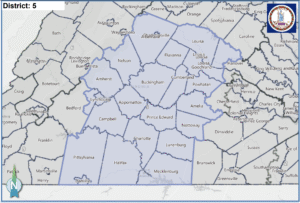
    Virginia’s 5th congressional District. (Photo courtesy of the Supreme Court of Virginia)


    Democrats consolidate around Perriello


    On the Democratic side, former U.S. Rep. Tom Perriello has emerged as the clear frontrunner in a field that once looked likely to become much larger under the proposed redistricting map.

    Perriello represented the 5th District from 2009 until 2011 after defeating longtime Republican U.S. Rep. Virgil Goode on the coattails of Barack Obama’s 2008 presidential wave. He launched his latest campaign late last year with a message heavily focused on affordability and economic pressure facing Virginia families.

    “It is not right that Virginians are working harder and harder just to afford the rising cost of food, electricity, and health care,” Perriello said at the time.

    After leaving Congress, Perriello served in the Obama and Biden administrations and later became president and CEO of the Open Society Foundations. He also mounted an unsuccessful run for governor in 2017.

    Several Democrats who had considered campaigns in a potentially redrawn district abandoned those plans after courts invalidated the redistricting amendment last month.

    Perriello now faces two remaining primary opponents: Suzanne Krzyzanowski and Rob Tracinski.

    Krzyzanowski, a physician and cancer researcher, has centered her campaign on healthcare, reproductive rights and scientific research funding. On her campaign website, she describes herself as a “doctor, scientist and advocate” focused on lowering costs and defending democratic institutions.

    Tracinski, a writer, political commentator and former Republican-turned-Democrat, has emphasized congressional independence and constitutional checks on executive power.

    Richards described Tracinski as an unconventional candidate whose message could still resonate with some voters.

    “Tracinski is an interesting alternative; he seems odd because he was part of the Tea Party, which tended to break with Republicans,” Richards said. “However, his message has been around reinforcing the powers and duties of Congress, and that squares with the Tea Party’s focus on constitutional rights.”

    However, Richards said Perriello’s name recognition and fundraising advantage make him the clear favorite for the nomination.

    “On the Democratic side, it seems like Perriello has the nomination locked up,” Richards said.

    The latest campaign finance reports reinforce that advantage.

    By May 27, Perriello had raised more than $1.4 million and reported roughly $1.1 million cash on hand, according to the latest campaign finance filings. Tracinski had raised about $44,000 with nearly $40,000 cash on hand, while Krzyzanowski had raised close to $16,000 and reported about $14,000 remaining.


    Affordability shapes the race


    Like many competitive congressional contests around the country, the race in Virginia’s 5th District is increasingly centered on affordability and cost-of-living concerns.

    Richards said both parties are trying to tap into voter frustration over prices and economic uncertainty, even though they blame very different causes.

    “The big issue in the 5th, as elsewhere, is affordability,” he said. “This seems to mean different things to each of the front-runners.”

    According to Richards, McGuire has largely embraced Republican arguments that tax cuts and deregulation will reduce economic pressure, while Democrats have tied rising prices and uncertainty to Republican control in Washington and the war against Iran.

    “McGuire wants to focus on tax cuts by the current administration, while Perriello wants to blame that same administration for the rise in prices,” Richards said. “Both are talking past each other in a way, both noting the affordability crisis but blaming different sources.”

    The district’s political makeup could ultimately determine how much room Democrats have to grow.

    Much of the district remains heavily conservative and rural, but Democrats have steadily improved in suburban and university-centered communities such as Charlottesville and Albemarle County. Lynchburg has also become somewhat more competitive in recent statewide elections.

    Richards said Perriello’s earlier victory in the district could help him, though he cautioned that both the lines and the political environment have changed significantly since 2008.

    “He did win the 5th in 2008, but that was a 5th with very different boundaries, plus he had the coattails of President Barack Obama’s big win,” Richards said. “This time will be different.”

    Richards said that Perriello would need overwhelming Democratic turnout, strong support from independents and at least some crossover Republican voters unhappy with Washington to seriously compete in November.

    “All of that is a tall order, but Perriello probably has a better shot at it than almost anyone else in the commonwealth,” he said.

    Even so, Richards said the race could remain competitive regardless of who emerges from the August primaries.

    “The question becomes, will enough voters in the middle vote for Perriello if things are still bad in the fall?” Richards said. “I am dubious that enough will swing to the Democrats, but it will be a close thing, even if McGuire wins in November.”
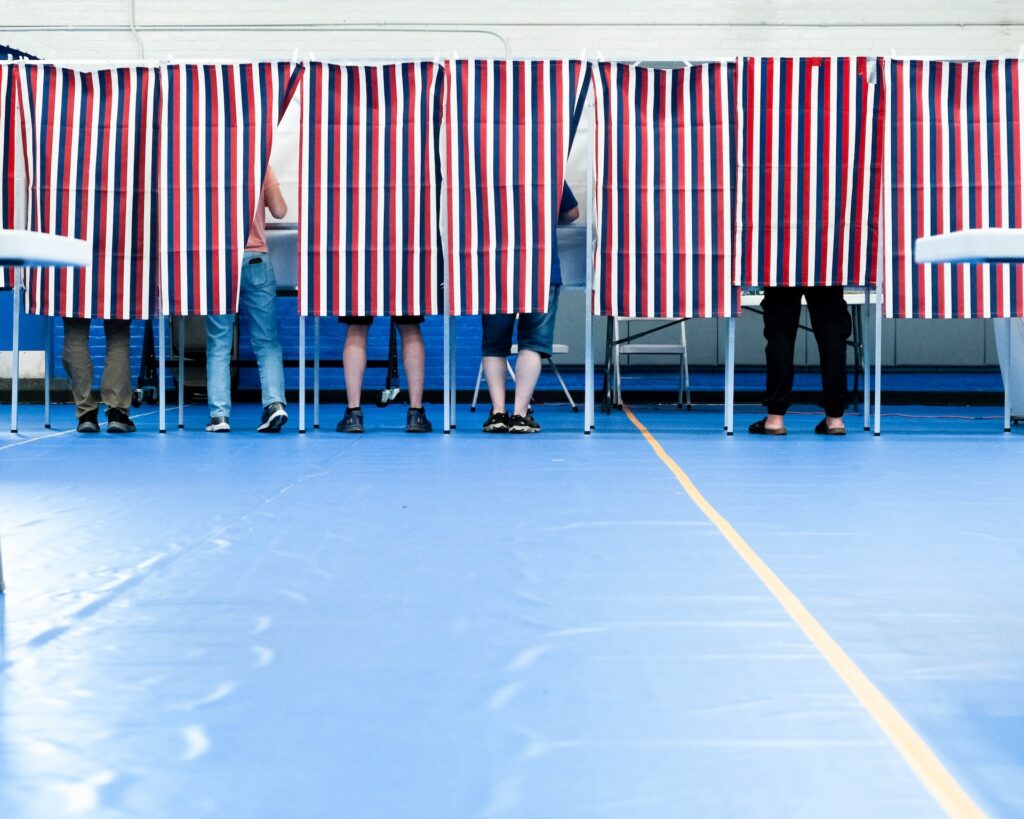
  • Virginia localities raise $119M for school construction through targeted sales tax

    Virginia localities raise $119M for school construction through targeted sales tax

    Over the past five years, several Virginia localities have generated just $119 million total from a targeted sales tax to fund school construction and maintenance, fueling calls to expand the tax statewide.

    When lawmakers first established the tax in 2021, a state survey showed over half of Virginia’s schools were more than 50 years old, with replacement costs in the billions.

    House Education Committee Chair Sam Rasoul, D-Roanoke, said the totals further emphasize the need for the commonwealth to do more to address aging buildings.

    Rasoul, along with Sen. Jeremy McPike, D-Prince William, proposed legislation to allow all counties and cities in the state to impose an additional local sales and use tax, at a max rate of 1%, strictly for public school capital projects. Both measures were ultimately added to their respective chamber’s budgets and is part of the combined budget legislative negotiators released Friday.

    Rasoul said that while $119 million is a small fraction of what the commonwealth needs, “it’s a good start to be able to help localities have another tool in their toolbox.” He continued, “The commonwealth needs to do more to help with school construction, but one thing we can be doing is at least help some localities help themselves.”

    Voters in each locality would decide through a referendum whether to adopt the additional local sales tax to fund school construction and maintenance.

    Virginia’s localities are only allowed to exercise powers granted by the legislature, including changing sales taxes. As a result, only nine localities — including the city of Danville and the counties of Charlotte, Gloucester, Halifax, Henry, Mecklenburg, Northampton, Patrick, and Pittsylvania — can currently levy a 1% sales tax for school projects.

    Danville has collected the most, with $30 million in three years, according to data from the Department of Taxation obtained through a FOIA request. In fiscal year 2025, tax revenue for school construction and maintenance varied unevenly across the nine localities, with significant per-student variation.
    Danville, which has levied the special tax for three years, generated the highest tax revenue per student enrolled in the district, at approximately $2,171.

    That’s more than four times the per-student amount in Pittsylvania ($478). Most other localities collected between roughly $950 and $1,260 per enrolled student, while per-resident (total population) contributions ranged from $63 to $276.

    McPike said that the state’s revenue figures highlight the urgent need for school construction funding and the proposal’s key feature—local option through voter referendums.

    “The core of the issue is that we are billions behind, and we still have kids in classrooms with leaky roofs and air conditioning that often breaks,” McPike said, adding, “and we know that overall localities need ways to pay for school construction, and the beauty of it is, this is one thing they have the option to do.”

    “I know (the proposal) in discussions of including it in the budget, which is great, because ultimately this also has to go to voters if the locality decides to move forward with it, and the voters get to decide—it’s the purest form of democracy.”

    These figures indicate the amount of school tax revenue each area can generate based on its local tax base. The per-student numbers reflect the total tax revenue divided by the number of students enrolled in each district, rather than the amount spent or paid by any individual student or resident.

    In a recently adopted resolution, the Charlottesville City School Board said it supported efforts to expand the 1% sales tax for school construction.

    The board said in its resolution that utilizing a local option sales tax allows Charlottesville to diversify revenue streams and reduce the burden on local property owners by sharing school infrastructure costs with visitors and commuters who utilize the city’s commercial corridors.

    Members added that if the city gains this legislative authority, the school board encourages “collaborative efforts with the city council to advance a local referendum, allowing the citizens of Charlottesville the opportunity to invest directly in the future of our children, our schools, and our community’s infrastructure.”

    Del. Cia Price, D-Newport News, has lobbied for such a measure in her home district, but the effort wasn’t successful. Price emphasized the importance of funding safe, modern school facilities in Virginia, amid federal funding cuts.

    Price said she would love for Newport News students to have schools like those she has toured elsewhere, where the environment is “welcoming and encouraging for creativity and not oppressive and dark and hard to breathe.” She added, “I think all Virginia students deserve that.”

    The school tax proposal’s supporters are eager for the state budget to be finalized. To place the referendum on the November ballot, lawmakers must adopt the language by June 29 so it can be properly advertised. State law requires referendums to be ordered at least 81 days before the election.

    Senate Majority Leader Scott Surovell, D-Fairfax, is cautiously supportive of the idea that a local sales tax has become a useful tool for certain localities that dislike raising real estate taxes, and acknowledges it has generated a “decent amount of revenue” for school construction.

    Surovell stressed, however, that Virginia faces a multi‑billion‑dollar backlog in school construction and maintenance. He argued that a Northern Virginia casino, which he proposed, could have been one of the “easiest” ways to close part of that gap, but Gov. Abigail Spanberger vetoed it.

    The proposal would have removed the Fairfax County Board of Supervisors’ authority to advance a casino referendum, Spanberger explained in her veto statement.

    The Senate and House are set to return to Richmond Monday to deliberate the budget, which will take effect July 1.

  • When teens drive less, they don’t register to vote. Here’s how civic groups are adapting.

    When teens drive less, they don’t register to vote. Here’s how civic groups are adapting.

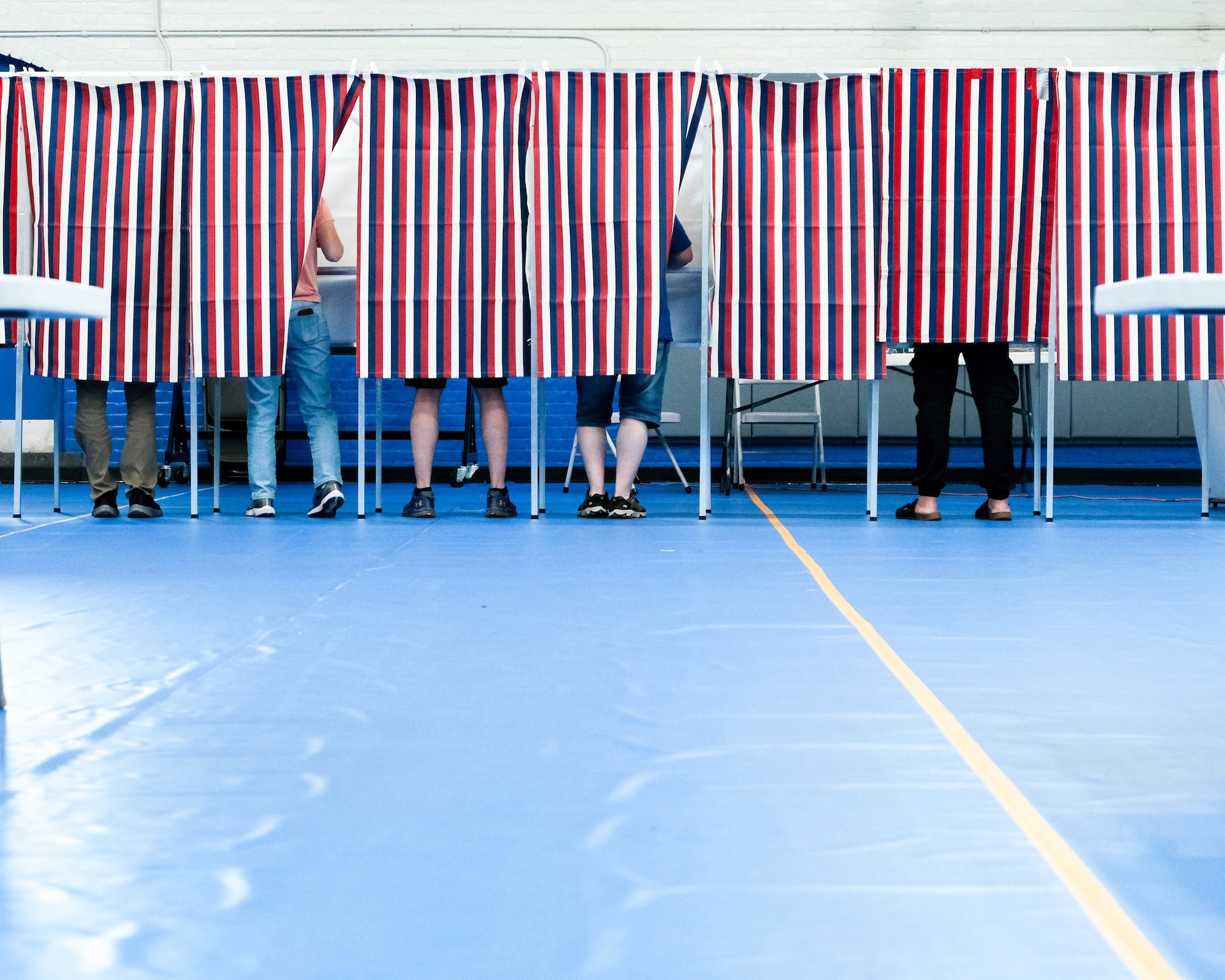
    American teens are driving less than in previous decades, prompting civic advocates to warn that fewer young people may register to vote.

    Yet at least one state — New Hampshire — offers insight into how civic groups can work around a lack of registration opportunities to ensure young people can register, as well as the challenges that remain.

    Since Congress passed the National Voter Registration Act in 1993, nearly all states must allow residents to register to vote at motor vehicle offices. But fewer teens are obtaining driver’s licenses today, translating into fewer trips to the local Department of Motor Vehicles and more missed chances to register.

    More than 7.5 million people ages 16 to 18 don’t have a driver’s license, according to data compiled by The Civics Center, a nonpartisan group focused on boosting youth voter registration. Three million of those youth will be old enough to vote this year and all will be eligible by 2028, the organization said in a June research report on how declines in teen driving, spurred in part by the rising cost of obtaining a license, could affect voting.

    Young people represent a large pool of potential voters for candidates ahead of the midterm elections this November and the presidential election in 2028. Still, voting advocates worry barriers to registration will keep many of them from the polls.

    “Our goal is to help people debunk these myths that it’s somehow young people’s fault that these systems aren’t working well for them,” said Laura Brill, founder and CEO of The Civics Center.

    Low registration rates

    In recent years about 60% of 18-year-olds have held driver’s licenses, according to the Federal Highway Administration. By contrast, in 1994, the year after the National Voter Registration Act was passed, about 74% had licenses.

    Even without declining visits to the DMV, registration rates among the youngest voters are low. During midterm election years, the percentage of 18-year-olds registered to vote typically remains under 30%, according to The Civics Center, compared to about 75% of Americans 45 and older.

    Some civic groups are pushing for more in-person voter registration drives, including in high schools, which may help offset the effects of fewer trips to the DMV. Without significant action, they fear registration rates will dip even lower.

    The League of Women Voters announced a partnership with The Civics Center in April to promote high school voter registration. The groups are offering state-specific training and toolkits to help members of the League, which has hundreds of chapters across the country, help students, teachers and school administrators hold registration drives.

    They also want states to provide teens more time to register before they can vote. About half of teens currently live in states that allow voter pre-registration at 16 or earlier, according to The Civics Center.

    These states include California, Colorado, Delaware, Florida, Illinois, Louisiana, Maine, Maryland, Massachusetts, Michigan, Minnesota, New York, North Carolina, Oregon, Rhode Island, Utah, Virginia and Washington.

    “Young people have a very short window of opportunity,” said Jeanette Senecal, chief of civic learning and impact at the League of Women Voters. “So when we increase that window of opportunity to allow for preregistration at 16 and 17, there’s a much longer kind of runway in order for us to get them registered to vote for that first election.”

    The focus on voter registration drives reflects, in part, an acknowledgement that online voter registration isn’t a panacea for fewer in-person DMV visits. Thirty-six states either offer no online voter registration option or allow voter registration only with a driver’s license or state-issued identification, according to information compiled by The Civics Center.

    “Paper forms, typically you only need a Social Security number and not a driver’s license. That’s one of the reasons that in-person efforts can be so effective,” Brill said.

    SAVE America Act

    Voter registration drives are under threat, however. President Donald Trump’s signature election legislation, the SAVE America Act, would effectively prohibit drives held by third-party organizations like the League of Women Voters because it would require individuals to present documents proving their citizenship, such as a passport or birth certificate, to government officials in person to register to vote.

    The bill has stalled in the U.S. Senate amid opposition from Democrats and a handful of Republican senators. Trump is still urging lawmakers to pass the measure and posted on social media recently that he opposes unrelated foreign surveillance legislation unless it also includes the SAVE America Act.

    As of late 2024, 24 states and the District of Columbia placed no restrictions on third-party voter registration drives, according to the Movement Advancement Project, a Colorado-based think tank. An additional 24 states impose some limits, while Wyoming and New Hampshire prohibit them.

    What worked in New Hampshire

    Because of its voter laws in the early 1990s, New Hampshire is one of six states exempt from the National Voter Registration Act, or NVRA, along with Idaho, Minnesota, North Dakota, Wisconsin, and Wyoming. The exemption means New Hampshire isn’t required to offer voter registration at motor vehicle offices.

    In New Hampshire, everyone — teens and older adults alike — registers in person with election officials and can also register at the polls on Election Day.

    Open Democracy, a New Hampshire voting rights group, has spent several years working to improve the registration rate among 18-year-olds.

    The organization hired an employee focused on high school voter registration and held 41 high school voter registration drives in 2024, said Olivia Zink, the group’s executive director. To hold the drives, it had to assure election officials were present to accept paperwork.

    In December 2023, an election off year, just 9% of New Hampshire 18-year-olds were registered. After the November 2024 election, nearly 64% of 18-year-olds were registered, according to data compiled by The Civics Center. Zink acknowledged that the presidential election was a major motivator, but she emphasized the importance of registering students every year.

    State laws can play a major role. Registrations plummeted last year, Zink said, after state lawmakers removed the ability of residents to sign an affidavit as proof of citizenship. She attributed the drop to students not regularly carrying their birth certificates or other documents proving citizenship with them.

    “Even with education and posters that are hung up at school and announcements and letters home to parents — we still saw so many fewer students register to vote in 2025 due to that law,” Zink said.

    In May, a federal judge blocked the New Hampshire law after a coalition of voting rights groups, including Open Democracy, challenged the measure.

    As part of her decision, Judge Samantha Elliott, a Biden appointee, found that Open Democracy registered fewer students in 2025 compared to 2023, even though the organization at that time didn’t have a full-time staff member dedicated to high school registration.

    Zink said that even in the first few weeks since the judge’s decision, she had heard of high school students once again registering by signing affidavits.

    Despite persistent barriers, Senecal cast the work of registering young people as critical. Each time someone votes, they’re more likely to vote again, she said.

    “So the earlier we can engage those people, we really help create these lifetime habits of voting,” Senecal said.

  • Virginia House, Senate leaders reach budget deal, chambers to meet Monday

    Virginia House, Senate leaders reach budget deal, chambers to meet Monday

    After months of debate and an increasingly fraught battle over how to tax and regulate data centers, Virginia budget negotiators announced Friday evening that they’d reached a deal featuring a new energy consumption tax for the industry that’s expected to generate $1.2 billion over the biennium.

    The new plan also includes 4% raises for teachers each year, and roughly $285 million for health insurance from the state marketplace and food assistance funding for low-income families. It will also give localities authority to impose a 1% sales tax for school construction and renovation, if they choose. Nearly $1 billion has been allocated in the revised budget as contingency reserve to cover anticipated gaps from reduced federal funding.

    The Virginia House of Delegates will convene Monday afternoon in Richmond and the state Senate will meet the same day, as both chambers vote to finalize the budget, which will take effect July 1.

    “This budget agreement reflects our shared commitment to making Virginia more affordable for families,” Sen. Louise Lucas, D-Portsmouth, and Appropriations Chair Del. Luke Torian, D-Prince William, said in a joint statement.

    “At a time when too many households are feeling squeezed by rising costs and economic uncertainty, this conference report makes historic investments to lower costs, strengthen our schools, protect access to healthcare, expand economic opportunity, and maintain the Commonwealth’s strong fiscal foundation,” they added.

    The House had been scheduled to meet last Thursday but Speaker Don Scott, D-Portsmouth, canceled the session, citing budget negotiators’ failure to reach an agreement. By Thursday, leaders in both bodies had signaled negotiations were progressing and legislators were closing in on a deal, the Richmond Time-Dispatch reported.

    Senate budget proposal keeps data center sales tax exemption, adds new tax for industry

    The issue that paralyzed the process for weeks was whether data centers should continue to be exempt from paying sales and use tax. Lucas proposed eliminating the exemption and was the most fierce defender of that stance until last week, when the Senate released an updated budget that removed the provision to revoke the exemption,

    Lucas instead pitched a tiered tax for data centers based on their generator use and traveled statewide in recent days, drumming up public support for her chamber’s plan to levy more costs onto data centers, which they said would net the state $1.8 billion.

    “We know technology is not bad,” Lucas said Tuesday on a tour stop in Chesterfield. “You know, we all can benefit from technology, but we, as a government, have not done a good job in managing the regulations and the impact on our communities and that’s what we’ve got to rein in.”

    The House released a reworked budget proposal last Friday that stripped environmental stipulations the body had previously recommended but preserved the tax exemption for the digital facilities that now number in the dozens statewide.

    The House and Senate both released new budgets. Here’s how they align and diverge.

    The Senate is set to gavel in at 10 a.m. Monday and the House will convene at 2 p.m.

    Editor’s note: This story has been updated to include details from lawmakers’ budget deal, released Friday evening. Stay tuned for The Mercury’s in-depth budget coverage this week.

  • When teens drive less, they don’t register to vote. Here’s how civic groups are adapting.

    When teens drive less, they don’t register to vote. Here’s how civic groups are adapting.

    American teens are driving less than in previous decades, prompting civic advocates to warn that fewer young people may register to vote.

    Yet at least one state — New Hampshire — offers insight into how civic groups can work around a lack of registration opportunities to ensure young people can register, as well as the challenges that remain.

    Since Congress passed the National Voter Registration Act in 1993, nearly all states must allow residents to register to vote at motor vehicle offices. But fewer teens are obtaining driver’s licenses today, translating into fewer trips to the local Department of Motor Vehicles and more missed chances to register.

    More than 7.5 million people ages 16 to 18 don’t have a driver’s license, according to data compiled by The Civics Center, a nonpartisan group focused on boosting youth voter registration. Three million of those youth will be old enough to vote this year and all will be eligible by 2028, the organization said in a June research report on how declines in teen driving, spurred in part by the rising cost of obtaining a license, could affect voting.

    Young people represent a large pool of potential voters for candidates ahead of the midterm elections this November and the presidential election in 2028. Still, voting advocates worry barriers to registration will keep many of them from the polls.

    “Our goal is to help people debunk these myths that it’s somehow young people’s fault that these systems aren’t working well for them,” said Laura Brill, founder and CEO of The Civics Center.

    Low registration rates

    In recent years about 60% of 18-year-olds have held driver’s licenses, according to the Federal Highway Administration. By contrast, in 1994, the year after the National Voter Registration Act was passed, about 74% had licenses.

    Even without declining visits to the DMV, registration rates among the youngest voters are low. During midterm election years, the percentage of 18-year-olds registered to vote typically remains under 30%, according to The Civics Center, compared to about 75% of Americans 45 and older.

    Some civic groups are pushing for more in-person voter registration drives, including in high schools, which may help offset the effects of fewer trips to the DMV. Without significant action, they fear registration rates will dip even lower.

    The League of Women Voters announced a partnership with The Civics Center in April to promote high school voter registration. The groups are offering state-specific training and toolkits to help members of the League, which has hundreds of chapters across the country, help students, teachers and school administrators hold registration drives.

    They also want states to provide teens more time to register before they can vote. About half of teens currently live in states that allow voter pre-registration at 16 or earlier, according to The Civics Center.

    These states include California, Colorado, Delaware, Florida, Illinois, Louisiana, Maine, Maryland, Massachusetts, Michigan, Minnesota, New York, North Carolina, Oregon, Rhode Island, Utah, Virginia and Washington.

    “Young people have a very short window of opportunity,” said Jeanette Senecal, chief of civic learning and impact at the League of Women Voters. “So when we increase that window of opportunity to allow for preregistration at 16 and 17, there’s a much longer kind of runway in order for us to get them registered to vote for that first election.”

    The focus on voter registration drives reflects, in part, an acknowledgement that online voter registration isn’t a panacea for fewer in-person DMV visits. Thirty-six states either offer no online voter registration option or allow voter registration only with a driver’s license or state-issued identification, according to information compiled by The Civics Center.

    “Paper forms, typically you only need a Social Security number and not a driver’s license. That’s one of the reasons that in-person efforts can be so effective,” Brill said.

    SAVE America Act

    Voter registration drives are under threat, however. President Donald Trump’s signature election legislation, the SAVE America Act, would effectively prohibit drives held by third-party organizations like the League of Women Voters because it would require individuals to present documents proving their citizenship, such as a passport or birth certificate, to government officials in person to register to vote.

    The bill has stalled in the U.S. Senate amid opposition from Democrats and a handful of Republican senators. Trump is still urging lawmakers to pass the measure and posted on social media recently that he opposes unrelated foreign surveillance legislation unless it also includes the SAVE America Act.

    As of late 2024, 24 states and the District of Columbia placed no restrictions on third-party voter registration drives, according to the Movement Advancement Project, a Colorado-based think tank. An additional 24 states impose some limits, while Wyoming and New Hampshire prohibit them.

    What worked in New Hampshire

    Because of its voter laws in the early 1990s, New Hampshire is one of six states exempt from the National Voter Registration Act, or NVRA, along with Idaho, Minnesota, North Dakota, Wisconsin, and Wyoming. The exemption means New Hampshire isn’t required to offer voter registration at motor vehicle offices.

    In New Hampshire, everyone — teens and older adults alike — registers in person with election officials and can also register at the polls on Election Day.

    Open Democracy, a New Hampshire voting rights group, has spent several years working to improve the registration rate among 18-year-olds.

    The organization hired an employee focused on high school voter registration and held 41 high school voter registration drives in 2024, said Olivia Zink, the group’s executive director. To hold the drives, it had to assure election officials were present to accept paperwork.

    In December 2023, an election off year, just 9% of New Hampshire 18-year-olds were registered. After the November 2024 election, nearly 64% of 18-year-olds were registered, according to data compiled by The Civics Center. Zink acknowledged that the presidential election was a major motivator, but she emphasized the importance of registering students every year.

    State laws can play a major role. Registrations plummeted last year, Zink said, after state lawmakers removed the ability of residents to sign an affidavit as proof of citizenship. She attributed the drop to students not regularly carrying their birth certificates or other documents proving citizenship with them.

    “Even with education and posters that are hung up at school and announcements and letters home to parents — we still saw so many fewer students register to vote in 2025 due to that law,” Zink said.

    In May, a federal judge blocked the New Hampshire law after a coalition of voting rights groups, including Open Democracy, challenged the measure.

    As part of her decision, Judge Samantha Elliott, a Biden appointee, found that Open Democracy registered fewer students in 2025 compared to 2023, even though the organization at that time didn’t have a full-time staff member dedicated to high school registration.

    Zink said that even in the first few weeks since the judge’s decision, she had heard of high school students once again registering by signing affidavits.

    Despite persistent barriers, Senecal cast the work of registering young people as critical. Each time someone votes, they’re more likely to vote again, she said.

    “So the earlier we can engage those people, we really help create these lifetime habits of voting,” Senecal said.

  • Juneteenth reminds us of Black Americans’ long struggle for education following end of slavery

    Juneteenth reminds us of Black Americans’ long struggle for education following end of slavery

    This piece originally appeared in The Conversation.

    The abolitionist and writer Frederick Douglass is known for many things, but perhaps among the most significant is his views on education’s relationship to slavery. Douglass himself was born into slavery in Maryland in 1818.

    Douglass described in his 1845 autobiography how one of his enslavers, Mrs. Auld, began teaching him to read when he was a child. Mrs. Auld’s husband ordered her to stop giving Douglass lessons.

    “Just at this point of my progress, Mr. Auld found out what was going on, and at once forbade Mrs. Auld to instruct me further, telling her, among other things, that it was unlawful, as well as unsafe, to teach a slave to read,” Douglass writes. “To use his own words, further, he said, ‘If you give a nigger an inch, he will take an ell. A nigger should know nothing but to obey his master.’”

    Congress enacted the 13th Amendment on Jan. 31, 1865, abolishing slavery. It was not until June 19, 1865, that word of the amendment reached enslaved people in Galveston, Texas, marking the origin of the Juneteenth holiday.

    The Biden administration declared Juneteenth a federal holiday in 2021. Today, Juneteenth commemorates the end of slavery in the U.S. But the story for formerly enslaved people continued to unfold in complex ways well after Juneteenth, including when it came to their educational journeys.

    Juneteenth made clear that freedom was not just confined to someone’s physical enslavement, but mental enslavement as well, bound in the laws that barred enslaved people from receiving an education in Southern states.

    A drawing of a National Freedmen’s Bureau school in Richmond, Va., in 1866. (Photo by Universal History Archive/Universal Images Group via Getty Images)

    Making learning illegal

    In 1739, the Stono slave rebellion took place in South Carolina. Fearing that educated slaves would go on to plot future rebellions, South Carolina passed an anti-literacy law in 1740, banning slaves from being taught how to read.

    Most Southern states soon followed with anti-literacy laws of their own between 1740 and 1834, in the hopes of preventing any further slave rebellions. These laws applied to both enslaved and free Black people.

    Despite these laws, thousands of enslaved people still learned to read and write in the antebellum South. Literacy was a means of freedom.

    Meanwhile, the first African Free School for Black children was established in New York City in 1787. The one-room schoolhouse began with 40 students, the majority of whom had parents who were formerly enslaved. Six additional, similar schools were created with public funding by 1824.

    Juneteenth and the path to freedom

    Juneteenth is a complicated story of formerly enslaved people’s faith and resilience, as well as white supremacists’ hate and resistance to formerly enslaved people experiencing liberation.

    It also offers an important reminder that true freedom must also include the right to an education.

    Formerly enslaved individuals had various responses to their newfound freedom in 1865, ranging from gratitude and joy to despair and loss.

    Many formerly enslaved people decided to leave plantations and Southern states to reunite with family members and communities separated by slavery.

    Others opted to remain where they had been enslaved, seeking to experience freedom in familiar surroundings. In fact, the vast majority of freed people remained in the South.

    Regardless of their choices, the approximately 4 million formerly enslaved people challenged the U.S. to acknowledge their liberation and welcome them as equals.

    Relentlessly, they endeavored to establish themselves as free citizens within the nation. One of these newly freed people’s primary goals was to receive an education.

    Learning to read, write and more

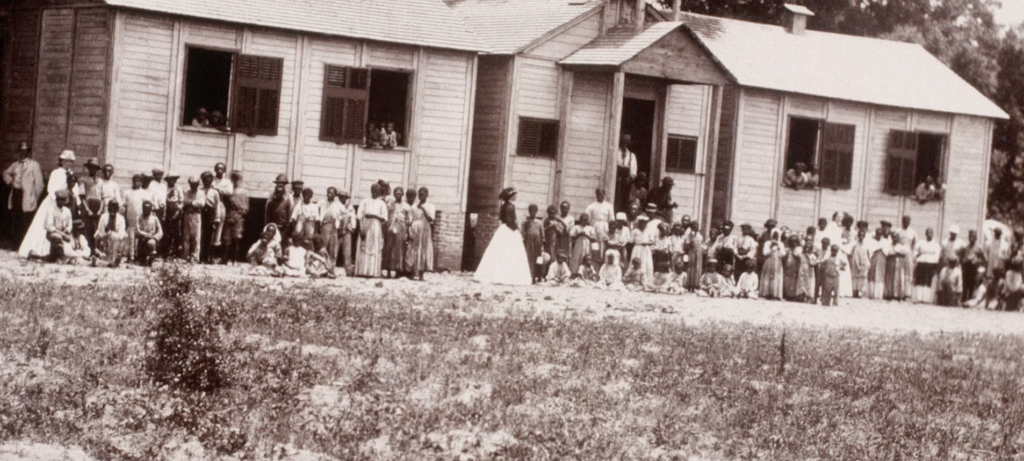
    After the Civil War, newly freed people gathered in churches, homes, cellars, sheds, meetinghouses and even under shade trees in the fields where they worked the crops to learn how to read and write. They also learned basic job skills, such as the ability to read and understand labor contracts.

    Many of the teachers had no formal training, and some of them were local Black people who were self-taught.

    Other educators included white teachers from the South and the North, sent by churches and aid societies.

    White aid societies and religious organizations from the North, including the American Missionary Association and the National Freedman’s Relief Association, sometimes funded these free schools for formerly enslaved Black people.

    However, most of the money to fund these schools came from the newly freed Americans, who privately paid for their schools.

    While about 90% of the Black population in Southern states were illiterate in 1865, this percentage dropped to 70% by 1880.

    A journey into higher education

    Newly freed Black people also began to have more options for higher education.

    The first historically Black college and university, Cheyney University, was established in Pennsylvania in 1837, well before the Civil War. A total of four HBCUs were established by the end of the Civil War in 1865.

    At this point, true liberation began, as a growing number of HBCUs offered academic freedom to Black Americans, who otherwise would have been prohibited from attending most colleges and universities.

    In the 15 years following the Civil War, a total of 59 HBCUs had opened their doors to Black students.

    In 1867, by act of Congress, Howard University was established in Washington, D.C. It provided not only basic college courses but also programs in law, medicine, education and pharmaceuticals.

    A history class at the Tuskegee Institute, a coeducational elementary and secondary school for Black Americans founded in 1881 in Georgia. (Photo by Corbis/Getty Images)

    A promise that requires education

    A whole new set of challenges and opportunities greeted the formerly enslaved Black Americans who sought freedom in the North. Most arrived in cities such as Chicago and New York, where they found some humanitarian support but also racial discrimination and poverty.

    Their lives were constantly filled with both legal and racial hostility.

    Education ranked high among the free people as a priority, as they looked to gain new skills and advance in life. They learned not only the basics in reading and math, but also job skills, citizenship and advanced learning in professional careers, such as law, medicine, pharmacy and teaching.

    Ultimately, Juneteenth offered a promise of freedom – but education was necessary to make it happen.

  • Four Va. counties will pump almost 20 million gallons of water a day to Amazon. Cause for concern?

    Four Va. counties will pump almost 20 million gallons of water a day to Amazon. Cause for concern?

    How you look at something – the frame you use and your perspective – often influences what you see.

    This holds true with the issue of data centers and water use. Amazon recently reported that it withdrew a total of 2.5 billion gallons of water for data center cooling operations in 2025. That seems like a lot of water.

    But Amazon also points out that Americans used 3.3 trillion gallons of water that same year to grow their gardens and lawns.

    The company apparently wants to assure you that the water it uses for its data center operations, in comparison to other uses of water across our very large country, is not such a big deal.

    Of course, Amazon doesn’t operate its data centers across the entire nation. It does so in only a few states, and nowhere at higher concentration than in Virginia.

    We wanted to learn for ourselves how much water local communities have promised to Amazon for data center cooling in our part of the state, the region between Northern Virginia and Richmond, including Louisa, Spotsylvania, Caroline and Stafford Counties.

    By scouring available public records and submitting Freedom of Information Act requests, we learned that local governments in the commonwealth have allocated at least 19.6 million gallons a day to Amazon.

    This, we think, is an underestimate. It doesn’t include at least one large water-cooled data center campus in another nearby county that might end up being leased and operated by Amazon, but is currently being constructed by another company. And it doesn’t include other potential Amazon data center campuses that have not yet been approved or are being held up in court.

    Even so, 19.6 million gallons a day seems like a good deal of water. It’s enough to fill 980 backyard swimming pools every day. If the average American uses 82 gallons of water a day, it’s enough to sustain 239,000 people.

    But Amazon tells us not to worry. The company has ambitious goals to become “water positive.” To Amazon, this means “replenishing more water to communities than we use in our direct operations.”

    But being “water positive” depends on your scale of analysis.

    For instance, Louisa County plans to provide seven million gallons a day to two separate Amazon data center campuses. Amazon is paying to construct the new water infrastructure that will make this possible.

    On one hand, this is “new” water to Louisa County that wouldn’t otherwise be available for industrial use without Amazon’s funding. But from the perspective of the larger North Anna reservoir and river system, it still constitutes a withdrawal.

    While Amazon is using raw water for its operations in Louisa County, in other localities the company is investing in extensive “purple pipe” systems that will capture water that would otherwise be sent downstream in order to circulate it to its data center campuses. The company is proud that it “works with utilities to collect treated wastewater, clean it to appropriate standards, and reuse it to save drinking water.”

    Amazon doesn’t mention, however, that it will lose more than half of this water through evaporation as it cools its data center facilities, sending most of it up into the atmosphere. So something that appears to be water positive from the perspective of a community hosting an Amazon data center campus might also be a net water loss to a river system and to downstream users.

    Even so, Amazon claims, it doesn’t use water to cool its operations throughout the whole year, only during the hottest days in Virginia.

    A company spokesperson, for instance, marked up a water service agreement between Stafford County and Amazon we received from a FOIA request, in which the county promised to deliver more than five million gallons a day. The spokesperson wrote to us that, “actual annual use is much lower. Based on 10 years of data, the campus only needs cooling water about 4% of the year during the hottest months.”

    The idea that Amazon is spending tens of millions of dollars to build a water system that it will only use for fifteen days out of the year strains credulity. Even if this is true, those are millions of gallons of water being diverted away from our rivers and streams during the peak of summer, when flows are the lowest and water is most needed.

    It’s especially concerning when most of the state is in a severe drought, as we are now experiencing and may endure again in future years.

    Beyond being Virginia’s leading data center company, Amazon has attained near- monopoly status as an online retailer and delivery service. It spends $19 million a year on lobbying alone, according to the Center for Responsive Politics. It funneled almost $10 million to political campaigns in 2024 in order to influence elections, the same source reports.

    Amazon, needless to say, also has a powerful public relations operation. It uses its economic and political power to avoid paying taxes that other companies and most individuals have to pay.

    And in Virginia, the company and others in the data center industry are exempt from paying sales and use tax, which lawmakers say costs us nearly $2 billion annually. That exemption is the sticking point in ongoing budget negotiations; if legislators don’t finalize the spending plan by June 30, with or without the tax exemption, the state will experience its first government shutdown.

    Amazon encourages us not to worry about all the water local governments are allocating to the company in central Virginia. It assures us that it is a good steward of this resource, and that it cares about sustainability.

    But Amazon, just like any company with vested interests and a profit motive, doesn’t always share the complete picture. It frames the view it wants the public to see.

    Given the massive size of this company and the ways it has abused its power in the past, Virginians would be wise to keep a watchful eye on how Amazon is using water. And as communities consider approving yet more data centers and additional water service agreements, Virginians may want to consider when enough is enough.

  • As Trump’s immigration dragnet grows, so do complaints of detention center conditions

    As Trump’s immigration dragnet grows, so do complaints of detention center conditions

    WASHINGTON — When the overhead lights turn off at the Farmville Detention Center in Virginia, it not only means that night has arrived for Aliaksei Scharbachenia, but that panic attacks will soon follow.

    The attacks, which started after his detention began last August, he said, have only grown worse, stemming from the fear that he will be returned to his country of Belarus and face persecution due to his opposition to the authoritarian government.

    “With the panic attacks, I was able to take care of myself before,” he said in Russian. “But now it’s kind of getting worse, so I really need some medication, which will help me.”

    States Newsroom interviewed Scharbachenia by video with the help of an interpreter.

    As the Trump administration increases the scale of its immigrant detention program, now up to 68,000 immigrants in custody, reports have surfaced of inhumane conditions and inadequate medical care at U.S. Immigration and Customs Enforcement detention facilities like the one housing Scharbachenia. Congress recently boosted funding for immigration enforcement by $70 billion over three years, through the end of President Donald Trump’s term.

    ICE acknowledged receiving, but did not respond to, a detailed list of questions from States Newsroom regarding Scharbachenia’s treatment at Farmville.

    Ailments ignored

    Farmville 2010

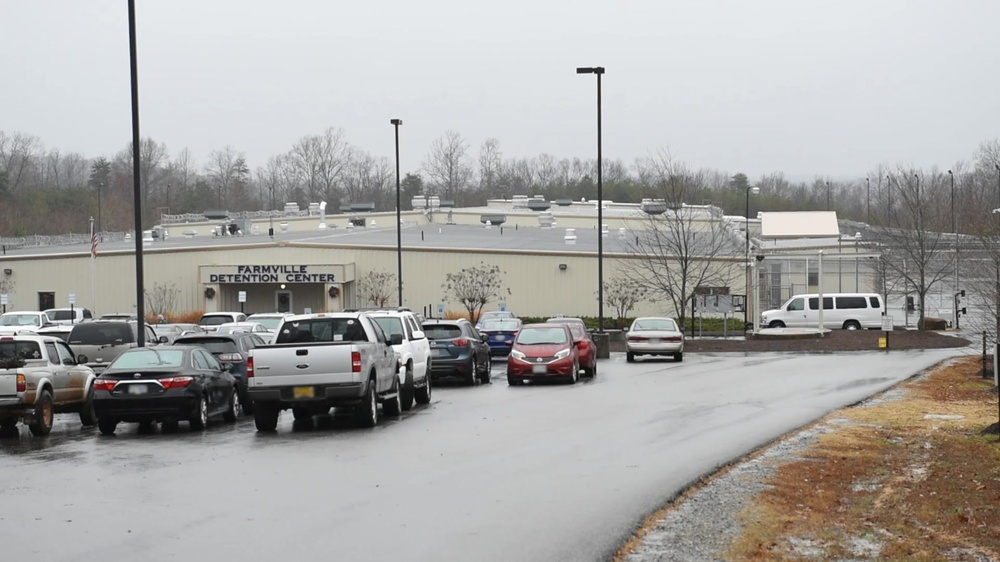
    The front entrance to the ICE Farmville Detention Center in 2010. (Photo by Paul Caffrey/ICE)

    The nightly panic attacks, and the lack of medication to treat them, are not the only health issues that 37-year-old Scharbachenia said he has brought to medical staff at the Virginia facility.

    He’s lost feeling in his right pinky and ring fingers, which he attributes to an-egg sized mass that developed on the back of his biceps during his 11-month detention. The few items that he purchased at the center – earplugs and a small blanket – were confiscated after he spent two weeks in solitary confinement after sharing know-your-rights information to newly arrived immigrants, he said.

    “I totally understand that’s another way of punishment to beat me, you know, so I will be quiet,” Scharbachenia said of his two weeks in solitary confinement.

    Scharbachenia told States Newsroom that on May 20, ICE agents tried to deport him to Belarus, despite his active legal petition challenging his detention. He said he was eventually placed on a deportation flight back to the United States from Turkey, his hands and feet bound for the nine-hour journey, and returned to the Farmville detention.

    States Newsroom could not independently verify the May 20 deportation attempt, and ICE did not respond to questions about it.

    Poor conditions at multiple facilities

    Scharbachenia’s complaints fit a pattern of reports from independent government inspectors that have found unsafe conditions and inadequate medical care provided to immigrants detained in facilities in Texas and Louisiana.

    A recent report from the Department of Homeland Security’s internal watchdog found a detention center in Louisiana failed to ensure sanitary conditions, properly store perishable food, report use-of-force incidents and maintain medical records of detainees.

    Congress this month passed the three-year, $70 billion immigration enforcement package that contains no restraints on ICE activities. The tens of billions in funding is on top of roughly $170 billion provided to DHS last year for detention and deportations.

    Democratic lawmakers conducting oversight visits at some facilities have raised concerns about poor conditions and lack of medical care provided.

    U.S. Rep. Adriano Espaillat, a New York Democrat who chairs the Congressional Hispanic Caucus, said during a recent press conference that the additional $70 billion in funding will only continue a “detention and deportation industry that profits from human suffering.”

    New Jersey facility

    State officials are demanding that health inspectors be given full access to the jail they say they have been unlawfully barred from entering. (Photo by Anne-Marie Caruso/New Jersey Monitor)

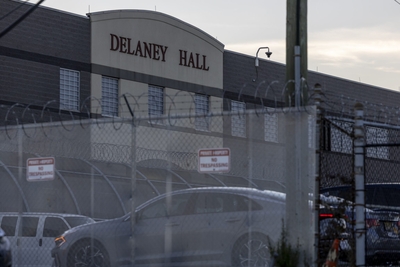
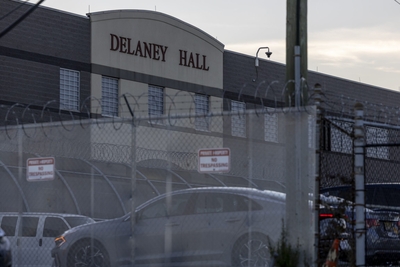
    Delaney Hall in New Jersey. (Photo by Anne-Marie Caruso/New Jersey Monitor)

    Civil rights groups have filed two major lawsuits charging poor and inadequate conditions at detention centers in Texas and New Jersey run by ICE and private contractors.

    In New Jersey, Sen. Andy Kim called for the Delaney Hall facility to be shut down after detained immigrants went on a hunger strike to protest their conditions. While Kim and dozens of advocates demonstrated at the facility, he was hit with pepper smoke deployed by immigration officers.

    “At Delaney Hall, we learned of unsanitary living conditions, lack of adequate medical care and unhealthy food,” House Minority Leader Hakeem Jeffries, D-N.Y., said after conducting oversight at the facility. “The situation is unacceptable. Delaney Hall must be shut down immediately.”

    In response to the criticism of poor conditions at Delaney Hall, Homeland Security Secretary Markwayne Mullin argued before lawmakers that the detention centers have higher standards than jails and prisons. He described the complaints about food as detainees wanting “ethnic food.”

    With House Democrats in the minority, the authority to make unannounced oversight visits at any federal facility that houses immigrants is one of the few tools they have. The power is codified in a 2019 appropriations law, but the Trump administration has not adhered to that policy.

    Democrats have sued to regain access in a case now before the U.S. Court of Appeals for the District of Columbia Circuit.

    Outbreaks at Farmville

    Prior to Trump’s current deportation push, lawmakers had raised concerns about issues at the detention center where Scharbachenia is held. In 2019, a mumps outbreak started at the facility, and in 2020, 93% of the detained population contracted the coronavirus.

    Roughly now three-quarters of the immigrants detained at Farmville, nearly 500, have no criminal record, according to the most recent government data. On the campaign trail, the president vowed to focus enforcement on immigrants with criminal records, but those in detention are there on a civil charge of violating U.S. immigration law.

    Virginia Democrats have continued to conduct oversight of the facility.

    U.S. Sen. Mark Warner went last August to visit Kilmar Abrego Garcia, who was transferred to Farmville after the Trump administration brought him back to the U.S. after erroneously deporting him to a brutal mega-prison in El Salvador.

    Warner also raised concerns about the facility during the coronavirus outbreak in 2020.

    During his August visit, Warner’s office said he “secured a commitment from the facility’s private operator to work with legislators to address concerns regarding food quality and access to health care.”

    Virginia Sen. Tim Kaine also visited the facility in March and his office said he “continues to track conditions there closely.”

    Scharbachenia, who is still detained at Farmville, has a pending habeas corpus petition, which is challenging his detention.

    He has a final order of removal from an immigration judge, but said if he is removed back to Belarus, the country’s special police force will be waiting for him, “along with electric shock torture and death.”

  • US Education Department offers two-year trim on student loan interest rates

    US Education Department offers two-year trim on student loan interest rates

    WASHINGTON — The U.S. Department of Education will temporarily reduce interest rates for federal student loan borrowers enrolled in auto pay starting July 1, the agency announced Thursday.

    Borrowers who enroll in auto pay — the optional feature that allows a borrower to have their monthly loan payment automatically deducted from their checking or savings account — will see a reduction in their interest rate by one full percentage point from July 1, 2026, through June 30, 2028.

    The change means a 6% interest rate would drop to 5%, for instance.

    Federal student loan borrowers currently enrolled in auto pay already receive an interest rate reduction of 0.25 percentage points from their servicer. Those borrowers do not need to take any additional action and will automatically receive an extra interest rate reduction of 0.75 percentage points, the department said.

    “This temporary incentive is designed to help borrowers pay down their balances more quickly, take full advantage of new repayment benefits, remain on track toward loan discharge opportunities and to strengthen the overall health of the federal student loan portfolio,” Under Secretary of Education Nicholas Kent said during a Thursday call with reporters.

    Kent said the benefit is estimated to cost the agency $6 billion.

    Changes coming

    The announcement came ahead of major changes for the federal student loan system — with many provisions slated to also begin July 1 — stemming from congressional Republicans’ mega tax and spending cut bill that President Donald Trump signed last year.

    The overhaul includes new loan limits for graduate and professional students, a restructured repayment system that gives new borrowers only two plans to choose from and the elimination of a key loan program for graduate and professional students that allowed for unlimited borrowing.

    Meanwhile, millions of borrowers under the now defunct Saving on a Valuable Education, or SAVE, plan will receive notices from their federal loan servicers starting July 1 that instruct them to enter into a legal repayment plan within 90 days.

    Auto pay enrollment halved

    The federal student loan portfolio stands at a “staggering $1.7 trillion,” with about 37% of borrowers currently in repayment, according to Kent.

    The under secretary noted that at the end of 2019, nearly 83% of borrowers were enrolled in auto pay but that the figure stood at just 40% by the end of 2025.

    There are also 9.16 million borrowers in default as of April, per the latest available department data.

    Borrowers have until Sept. 30, 2026, to opt in to auto pay to be eligible for the two-year benefit.

    The benefit is open to borrowers whose federal student loans originated after July 1, 2012, the department said.

    Kent encouraged borrowers to “take advantage of this opportunity and enroll in auto debit as soon as possible.”

    Borrowers can enroll by logging in to their loan servicer account and selecting “auto pay” from a navigation bar, he said.

    The department clarified that borrowers will need to stay in auto pay to continue receiving the reduced interest rate.

  • As Trump’s immigration dragnet grows, so do complaints of detention center conditions

    As Trump’s immigration dragnet grows, so do complaints of detention center conditions

    WASHINGTON — When the overhead lights turn off at the Farmville Detention Center in Virginia, it not only means that night has arrived for Aliaksei Scharbachenia, but that panic attacks will soon follow.

    The attacks, which started after his detention began last August, he said, have only grown worse, stemming from the fear that he will be returned to his country of Belarus and face persecution due to his opposition to the authoritarian government.

    “With the panic attacks, I was able to take care of myself before,” he said in Russian. “But now it’s kind of getting worse, so I really need some medication, which will help me.”

    States Newsroom interviewed Scharbachenia by video with the help of an interpreter.

    As the Trump administration increases the scale of its immigrant detention program, now up to 68,000 immigrants in custody, reports have surfaced of inhumane conditions and inadequate medical care at U.S. Immigration and Customs Enforcement detention facilities like the one housing Scharbachenia. Congress recently boosted funding for immigration enforcement by $70 billion over three years, through the end of President Donald Trump’s term.

    ICE acknowledged receiving, but did not respond to, a detailed list of questions from States Newsroom regarding Scharbachenia’s treatment at Farmville.

    Ailments ignored

    Farmville 2010

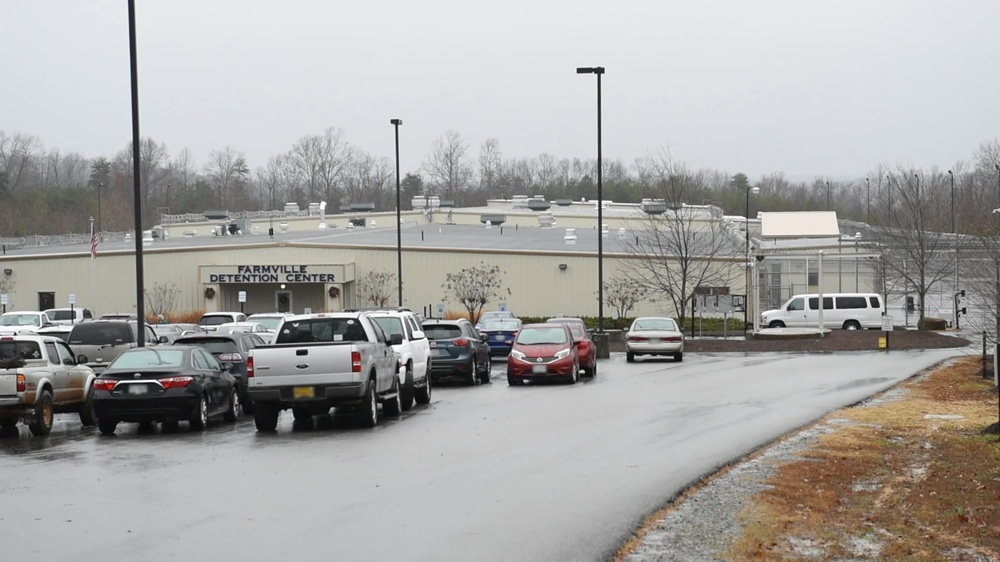
    The front entrance to the ICE Farmville Detention Center in 2010. (Photo by Paul Caffrey/ICE)

    The nightly panic attacks, and the lack of medication to treat them, are not the only health issues that 37-year-old Scharbachenia said he has brought to medical staff at the Virginia facility.

    He’s lost feeling in his right pinky and ring fingers, which he attributes to an-egg sized mass that developed on the back of his biceps during his 11-month detention. The few items that he purchased at the center – earplugs and a small blanket – were confiscated after he spent two weeks in solitary confinement after sharing know-your-rights information to newly arrived immigrants, he said.

    “I totally understand that’s another way of punishment to beat me, you know, so I will be quiet,” Scharbachenia said of his two weeks in solitary confinement.

    Scharbachenia told States Newsroom that on May 20, ICE agents tried to deport him to Belarus, despite his active legal petition challenging his detention. He said he was eventually placed on a deportation flight back to the United States from Turkey, his hands and feet bound for the nine-hour journey, and returned to the Farmville detention.

    States Newsroom could not independently verify the May 20 deportation attempt, and ICE did not respond to questions about it.

    Poor conditions at multiple facilities

    Scharbachenia’s complaints fit a pattern of reports from independent government inspectors that have found unsafe conditions and inadequate medical care provided to immigrants detained in facilities in Texas and Louisiana.

    A recent report from the Department of Homeland Security’s internal watchdog found a detention center in Louisiana failed to ensure sanitary conditions, properly store perishable food, report use-of-force incidents and maintain medical records of detainees.

    Congress this month passed the three-year, $70 billion immigration enforcement package that contains no restraints on ICE activities. The tens of billions in funding is on top of roughly $170 billion provided to DHS last year for detention and deportations.

    Democratic lawmakers conducting oversight visits at some facilities have raised concerns about poor conditions and lack of medical care provided.

    U.S. Rep. Adriano Espaillat, a New York Democrat who chairs the Congressional Hispanic Caucus, said during a recent press conference that the additional $70 billion in funding will only continue a “detention and deportation industry that profits from human suffering.”

    New Jersey facility

    State officials are demanding that health inspectors be given full access to the jail they say they have been unlawfully barred from entering. (Photo by Anne-Marie Caruso/New Jersey Monitor)

    Delaney Hall in New Jersey. (Photo by Anne-Marie Caruso/New Jersey Monitor)

    Civil rights groups have filed two major lawsuits charging poor and inadequate conditions at detention centers in Texas and New Jersey run by ICE and private contractors.

    In New Jersey, Sen. Andy Kim called for the Delaney Hall facility to be shut down after detained immigrants went on a hunger strike to protest their conditions. While Kim and dozens of advocates demonstrated at the facility, he was hit with pepper smoke deployed by immigration officers.

    “At Delaney Hall, we learned of unsanitary living conditions, lack of adequate medical care and unhealthy food,” House Minority Leader Hakeem Jeffries, D-N.Y., said after conducting oversight at the facility. “The situation is unacceptable. Delaney Hall must be shut down immediately.”

    In response to the criticism of poor conditions at Delaney Hall, Homeland Security Secretary Markwayne Mullin argued before lawmakers that the detention centers have higher standards than jails and prisons. He described the complaints about food as detainees wanting “ethnic food.”

    With House Democrats in the minority, the authority to make unannounced oversight visits at any federal facility that houses immigrants is one of the few tools they have. The power is codified in a 2019 appropriations law, but the Trump administration has not adhered to that policy.

    Democrats have sued to regain access in a case now before the U.S. Court of Appeals for the District of Columbia Circuit.

    Outbreaks at Farmville

    Prior to Trump’s current deportation push, lawmakers had raised concerns about issues at the detention center where Scharbachenia is held. In 2019, a mumps outbreak started at the facility, and in 2020, 93% of the detained population contracted the coronavirus.

    Roughly now three-quarters of the immigrants detained at Farmville, nearly 500, have no criminal record, according to the most recent government data. On the campaign trail, the president vowed to focus enforcement on immigrants with criminal records, but those in detention are there on a civil charge of violating U.S. immigration law.

    Virginia Democrats have continued to conduct oversight of the facility.

    U.S. Sen. Mark Warner went last August to visit Kilmar Abrego Garcia, who was transferred to Farmville after the Trump administration brought him back to the U.S. after erroneously deporting him to a brutal mega-prison in El Salvador.

    Warner also raised concerns about the facility during the coronavirus outbreak in 2020.

    During his August visit, Warner’s office said he “secured a commitment from the facility’s private operator to work with legislators to address concerns regarding food quality and access to health care.”

    Virginia Sen. Tim Kaine also visited the facility in March and his office said he “continues to track conditions there closely.”

    Scharbachenia, who is still detained at Farmville, has a pending habeas corpus petition, which is challenging his detention.

    He has a final order of removal from an immigration judge, but said if he is removed back to Belarus, the country’s special police force will be waiting for him, “along with electric shock torture and death.”