Author: admin

  • Trump’s policies won’t bring back coal, but they are driving up Virginians’ energy costs

    Trump’s policies won’t bring back coal, but they are driving up Virginians’ energy costs

    If virtue signaling has a Trump-era corollary, we might call it vice signaling. That’s what President Donald Trump’s most recent package of subsidies for the coal industry looks like: it infuriates the environmentalists he despises and thereby delivers a little dopamine hit to the president’s base, while accomplishing nothing meaningful for the industry or the nation’s energy supply.

    On the other hand, the administration’s policy moves on energy are definitely hurting the clean technologies that Virginia needs to reach its zero-carbon electricity goals and lower rates for residents.

    Browbeating Republicans in Congress to terminate wind and solar tax credits caused many renewable energy projects to get canceled across the U.S., wiping out $16 billion of clean energy investments; other projects have been blocked or lost grant funding.

    Unable to stop offshore wind by any other means, the administration has even resorted to paying developers to abandon leases, with payments totaling more than $2.5 billion.

    This mischief is hurting American consumers, and nowhere is that clearer than in Virginia. Our need for massively more power to feed the data center industry makes us especially vulnerable to the effects of Trump’s monkeying around with the energy markets. With less low-cost wind and solar available to buy, our utilities have to burn more high-cost coal. Our rates go up, and so does pollution.

    The irony is that even Virginia Republicans don’t champion coal anymore, having thrown it over for cheaper and cleaner-burning fracked gas. Four years ago, then-Gov. Glenn Youngkin’s energy plan touted what he called an all-of-the-above strategy that was mainly focused on fossil gas. About the only time the plan mentioned coal was to note that it had fallen to only 4% of Virginia’s electricity generation.

    Republicans here still rise to the defense of one coal plant, Dominion Energy’s Virginia City Hybrid Energy Center (VCHEC) in Wise County. But that’s in spite of the cost, not because of it.

    Last time we looked, VCHEC was losing millions of dollars annually – money that comes out of customer pockets. Legislators defend it only because the jobs it provides and the local taxes it pays keep Wise County afloat.

    This importance to Southwest Virginia earned VCHEC special treatment in the 2020 Virginia Clean Economy Act (VCEA), which aimed to slash both carbon and costs quickly by forcing the closure of Dominion’s other coal and oil-fired generation. Legally, VCHEC is allowed to stick around until 2045, though few people expected it would survive market realities that long.

    In spite of its poor economics, however, coal use has surged in Virginia and nationwide as demand from data centers makes utilities scramble to produce every possible electron. If you don’t have enough cheap renewable energy, you have to use whatever you’ve got, never mind the cost.

    Five years ago, Dominion expected to run VCHEC only 15.5% of the time in 2024, less than 11% of the time in 2025, and only a little more than 6% by 2030. Instead, the plant is generating more this year than it has at any time this decade.

    The only other large-scale coal plant still operational in Virginia, the Clover coal plant co-owned by Dominion and Old Dominion Electric Cooperative, puts out well under half the electricity it did ten years ago, generating mainly during summer heatwaves and winter cold spells. But it too runs more often now than it did in the first few years of this decade.

    Dominion also operates the Mount Storm coal plant in West Virginia. It serves Virginia customers, but its location outside Virginia means the VCEA didn’t require its closure.

    Appalachian Power operates coal plants in West Virginia, too, producing power for its residents in that state as well as Southwest Virginia.

    The lousy economics of coal mean all these plants generate significantly less power than they used to – but, again, more than they did just three or four years ago, thanks to the demand pressure of data centers. (Well, that and a Trump-style insistence by West Virginia regulators that utilities run their coal plants most of the time, no matter how much it hurts consumers).

    A similar dynamic is playing out across the country. Coal use jumped in 2025 nationwide as data centers demanded more energy, adding to air pollution and killing more people.

    The Trump administration is determined to make matters even worse.

    Since resuming office last year, Trump has ordered the Department of Defense to buy power from coal plants for its military installations. His Department of Energy has ordered units to keep operating at five coal plants that were about to close because they lose money. His Environmental Protection Agency is loosening pollution standards for coal plants to save them money.

    In February the Energy Department announced it would spend $175 million on six projects to extend the life of coal plants in West Virginia, Ohio, North Carolina and Kentucky. The federally-owned Tennessee Valley Authority announced it would keep coal units open at two power plants that were previously slated for closure.

    Then, in June, the Energy Department announced another $500 million in coal spending, including $425 million for a bunch more plant upgrades and a $75 million subsidy for a coal export terminal.

    Most recently, the department issued plans to throw $350 million at four more coal projects, including restarting a closed plant in Maryland and subsidizing construction of two new plants, one at Mt. Storm.

    Some of this spending will keep old plants limping along; some of it smells of grift. One of the proposed new coal plants getting an $18 million contribution from federal taxpayers is the project of a MAGA activist with no energy industry experience.

    Indeed, the idea of propping up last century’s technology to build an inefficient industrial plant that won’t ever make money has a distinctly retro vibe, reminiscent of the Soviet Union in its heyday. The problem with Trump‘s vision is that since these money-losing plants couldn’t be completed before his term expires, no self-respecting capitalist will build them.

    Trump’s vice signaling is having its intended effect in one respect, though: environmentalists hate it. So, for that matter, do economists and grid experts.

    One grid expert I spoke with, Mike Jacobs, a senior manager at the Union of Concerned Scientists, noted that “if the goal was to mine more coal and send more of it up a smokestack, it would make more sense to subsidize coal purchases directly.” Building a coal plant, he said, is “a vanity project.”

    What Trump isn’t accomplishing for coal, however, Big Tech is.

    Data centers’ demand for power, coupled with Trump’s stifling of the renewable energy sector, keeps coal plants belching along and drives up electricity costs for everyone. That these companies have a long history of virtue signaling with sustainability promises they haven’t met is just its own kind of irony.


  • Get ready for the semiquincentennial: Americans celebrate a 250th anniversary

    Get ready for the semiquincentennial: Americans celebrate a 250th anniversary

    WASHINGTON — Parties, protests, displays of historic documents, odes to the Founding Fathers — and a massive political rally by the president — will mark a deeply polarized nation’s 250th anniversary on this Fourth of July.

    Pomp and circumstance will abound for the semiquincentennial as the similarly named America250 and Freedom 250 offer different slates of programming on Independence Day and beyond.

    A countdown and ball drop will ring in the holiday in the eight time zones across the United States and its territories. The milestone birthday bash will close with an “unprecedented pyrotechnic spectacle” in the skies above the National Mall, livestreamed.

    Tourists walk along the barricades surrounding the Freedom 250 construction site on 7th Street NW on Monday, June 22, 2026. A banner in the distance promoting Freedom 250 hangs on the Federal Aviation Administration headquarters. (Photo by Ashley Murray/States Newsroom)

    Tourists walk along the barricades surrounding the Freedom 250 construction site on 7th Street NW on June 22, 2026. A banner in the distance promoting Freedom 250 hangs on the Federal Aviation Administration headquarters. (Photo by Ashley Murray/States Newsroom)

    In Philadelphia, a time capsule, to be opened in 2276, will be buried beneath Independence National Historic Park. The capsule contains contributions from each state and territory; sports memorabilia, including an Olympic gold medal; a 1GB digital archive from the Library of Congress; and a pocket Constitution signed by each Supreme Court justice, among hundreds of other items.

    Visitors to the nation’s capital can watch and anyone across the country, and the world, can tune in to a live dramatic reading of the Declaration of Independence at 10 a.m. Eastern at the National Archives.

    The public will also be invited to seldom-accessible spaces. The Federal Circuit Center for Innovation & Law will open its doors July 3. Guests, who must register ahead, will get the rare opportunity to don a judge’s robe and take part in a mock trial inside the U.S. Court of Appeals for the Federal Circuit’s courtrooms.

    Federal judges will be on hand to answer questions, and Chief Judge Kimberly A. Moore hopes the experience will “show how courts, public service, discovery and history continue to shape the American story,” she told States Newsroom in a statement.

    Former first lady Dolley Madison's parlor at her former residence on H Street NW in Washington, D.C., as seen on Monday, June 22, 2026. (Photo by Ashley Murray/States Newsroom)

    Former first lady Dolley Madison’s parlor at her former residence on H Street NW in Washington, D.C., on June 22, 2026. (Photo by Ashley Murray/States Newsroom)

    The court complex, which is connected to the residence of first lady Dolley Madison, the wife of President James Madison, will also showcase various highlights of American history. Visitors can see Dolley’s parlor, but also learn that NASA was headquartered there from 1958 to 1961. Space suits and a 3.9-billion-year-old moon rock will be on display.

    America250 vs. Freedom 250

    Two separate celebrations of America’s big year are similarly named but feature vastly differing programs that stretch beyond Independence Day.

    America250, a 24-member bipartisan commission created by Congress a decade ago, has spearheaded nationwide initiatives for school students, corporate employees and young entrepreneurs.

    The commission has organized plenty of July Fourth happenings, including the ball drops, time capsule burial and simultaneous block parties in Charleston, South Carolina; Fort Campbell, Kentucky; and Milwaukee.

    America250 will also host a benefit concert at the Los Angeles Memorial Coliseum, which will feature Chris Stapleton and the Smashing Pumpkins. Tickets are $17.76, and all proceeds go to nonprofit organizations to kick-off “Giving 4th,” a nationwide initiative to promote mid-year donations.

    It is all separate from President Donald Trump’s plans for 2026. Days after beginning his second term, Trump issued an executive order creating Task Force 250, resulting in White House-led programming known as Freedom 250.

    Fencing along the Freedom 250 construction site on the National Mall near Madison Drive and 7th Street NW on Monday, June 22, 2026. (Photo by Ashley Murray/States Newsroom)

    Fencing along the Freedom 250 construction site on the National Mall near Madison Drive and 7th Street NW on June 22, 2026. (Photo by Ashley Murray/States Newsroom)

    America250 Chair Rosie Rios said the parallel initiatives are a collaboration to balance events in the nation’s capital and beyond.

    “You see a lot of activities that the administration is planning in D.C. It was our agreement that we would focus on ‘sea to shining sea,’ and still obviously have opportunities for all Americans to participate across the board,” said Rios, who served as U.S. treasurer under the Obama administration.

    State fair, car races, Trump rally

    The White House initiative will take over the National Mall.

    The president will kick off the Great American State Fair with a speech on Wednesday night. The fair, featuring 150 exhibits from all states and territories, a Ferris wheel and a model of Trump’s controversial proposed “triumphal arch,” will last until July 10.

    The Washington Monument can be seen from a Freedom 250 ferris wheel at 7th Street and Madison Drive NW on Monday, June 22, 2026. (Photo by Ashley Murray/States Newsroom)

    The Washington Monument can be seen from a Freedom 250 ferris wheel at 7th Street and Madison Drive NW on June 22, 2026. (Photo by Ashley Murray/States Newsroom)

    Winners of the Freedom 250 “American Heroes” student art contest will also be honored at the fair.

    As part of the Freedom 250 lineup, Trump will visit North Dakota on July 1 ahead of the Theodore Roosevelt Presidential Library opening set for July 3.

    A Freedom 250 firework display at Mount Rushmore in South Dakota is also scheduled for the eve of Independence Day.

    Trump promised the “most spectacular TRUMP RALLY of them all” on July Fourth, featuring military bands and orchestras, military flyovers and keynote remarks from the president himself.

    The night will culminate with the “LARGEST FIREWORKS SHOW IN HISTORY,” he wrote on his Truth Social platform on June 15.

    A National Guard member stands along the National Mall on Independence Avenue and 12th Street SW on Monday, June 22, 2026, (Photo by Ashley Murray/States Newsroom)

    A National Guard member stands along the National Mall on Independence Avenue and 12th Street SW on June 22, 2026. (Photo by Ashley Murray/States Newsroom)

    Attendees can also expect to see an increased National Guard presence as part of the administration’s “summer surge.”

    Trump’s Freedom 250 festivities will extend into August with a national high school athletic competition for 14-to-17 year olds, dubbed “The Patriot Games.” The games are scheduled in Washington, D.C., for Aug. 9-11 and will stream on the ESPN app.

    A one-hour primetime finale special will air on ABC the evening of Aug. 13. One female and one male athlete each will win a $250,000 scholarship.

    A banner promoting the Freedom 250 Grand Prix scheduled for August hangs on the Department of Transportation's Orville Wright Federal Building at 800 Independence Ave. SW on Monday, June 22, 2026. (Photo by Ashley Murray/States Newsroom)

    A banner promoting the Freedom 250 Grand Prix scheduled for August hangs on the Department of Transportation’s Orville Wright Federal Building at 800 Independence Ave. SW on June 22, 2026. (Photo by Ashley Murray/States Newsroom)

    On Aug. 22-23, motorsports will come to the capital for the Freedom 250 Grand Prix where an NTT INDYCAR SERIES race will follow a 1.7 mile circuit “through the National Mall and surrounding city streets,” according to the event’s website. The event will be broadcast live on FOX.

    ‘After the fireworks’

    Rios said America250 also has an “after-the-fireworks strategy.”

    Winners of essay, art and poetry contests at schools across the U.S. can choose an all-expenses-paid “America’s Field Trip” to one of several locations.

    They include a private guided tour of the Kennedy Space Center in Cape Canaveral, Florida; Mount Rushmore National Memorial in South Dakota; or Yellowstone National Park in Montana and Wyoming, among other choices.

    A national contest and expo for young entrepreneurs in San Francisco — and another in Washington, D.C., this coming November — awarded $25,000 in seed grants under the “America Innovates” and startup initiative.

    A 3.9 billion-year-old Moon rock on display at the Federal Circuit Center for Innovation & Law, which is connected to NASA's former headquarters on Madison Place NW on Monday, June 22, 2026. (Photo by Ashley Murray/States Newsroom)

    A 3.9 billion-year-old Moon rock on display at the Federal Circuit Center for Innovation & Law, which is connected to NASA’s former headquarters on Madison Place NW on June 22, 2026. (Photo by Ashley Murray/States Newsroom)

    The commission is also aiming to make 2026 the “largest year of volunteer hours ever recorded by our country,” Rios said. A counter on the commission’s website displays the number of “America Gives” hours tracked, and Rios will announce a grand total on New Year’s Eve in Times Square.

    “We’ve had great stakeholders who’ve already made their pledges, so Coca-Cola, for example, made a pledge for 250,000 volunteer hours. Not to be outdone, Rob Manfred from Major League Baseball says, ‘Well, we’re going to do 250,000 volunteer hours,’” Rios said, referring to the baseball commissioner.

    ‘Declaration of Interdependence’

    Not all are feeling celebratory.

    A coalition of organizers led by those who spearheaded the 2017 Women’s March will host a nationwide mobilization event June 27 demanding change for America’s next 250 years.

    “We know the oxygen is going to be consumed by the official Trump-led commemoration on the Fourth. Kicking this off, in a proactive way, if we can talk about what we want this country to look like and what it actually does look like ahead of that, it’s important that we go first,” said Angelo Greco, a D.C.-based strategist handling messaging for the event.

    Progressive groups including the 50501 movement, All of U.S. 250, Next 250 and Get Free are expecting up to 5,000 people at a flagship march near the White House and thousands more at teach-ins, faith events, art installations, marches and cultural events at 80 locations throughout the U.S.

    Organizers are collecting signatures on a “Declaration of Interdependence” outlining four principles for a nation where: “All people are treated with dignity and respect; Everybody feels safe in every community; Access to clean, green spaces is abundant; and Every person who works earns a living wages and benefits that allow families a work-life balance.”

    “We’re taking away the spotlight from those in power that want to whitewash our history, and instead setting the terms of the debate about what the story of America has been, who we are, and who we should become,” said Anthony Vidal Torres, communications director at Get Free.

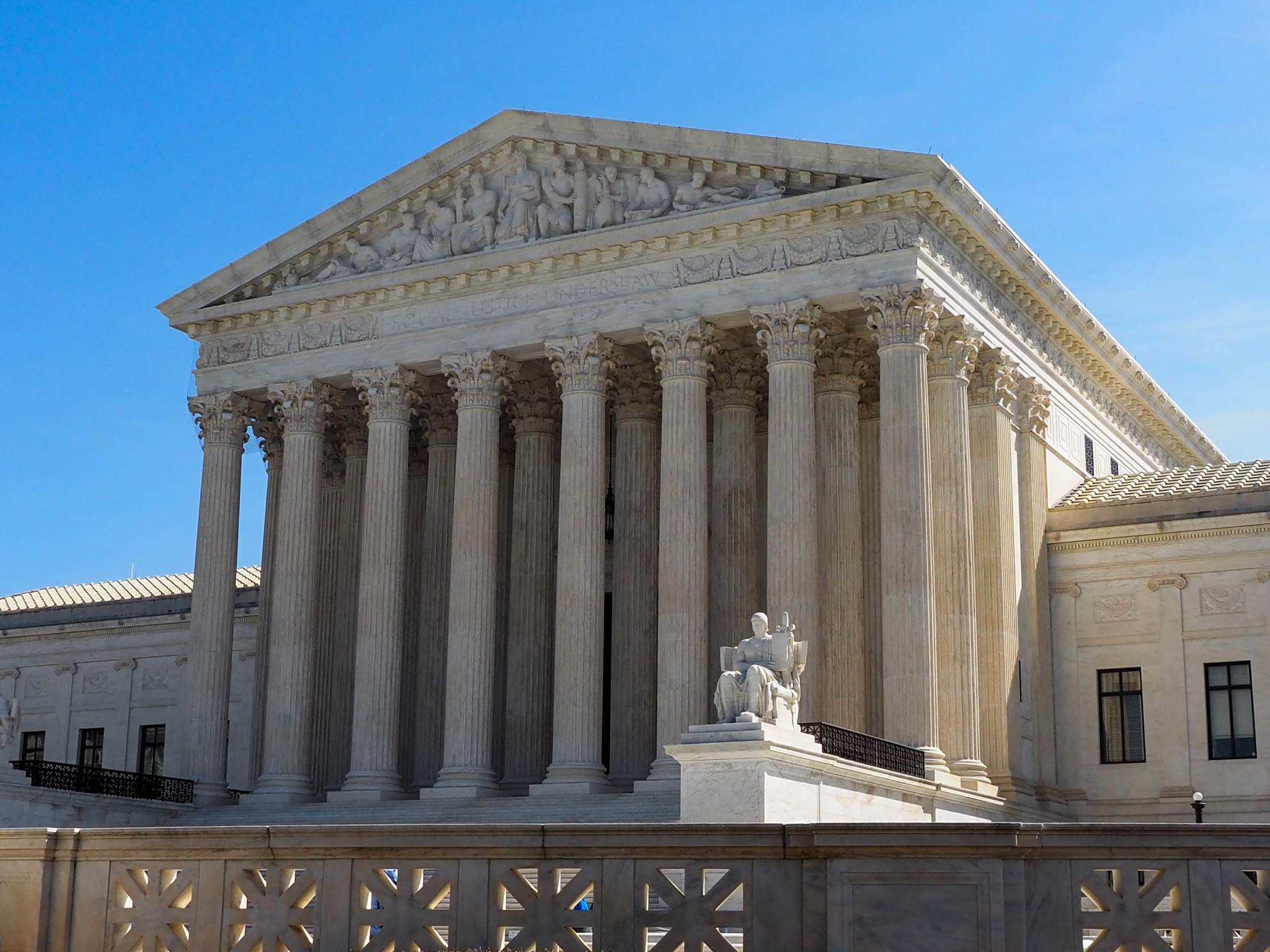
    Activists said they are ready to incorporate any relevant news events into their messaging, not least of which could include a forthcoming Supreme Court decision on birthright citizenship.

    The future of a polarized nation

    Thought leaders, lawmakers and former administration officials from both parties are marking the nation’s semiquincentennial by sounding the alarm about the effects of polarization.

    Citing recent statistics, including that only 4 in 10 Gen Zers are more likely to describe the Founding Fathers as “villains” rather than “heroes,” an advisory board convened by the center-left Progressive Policy Institute launched the American Identity Project meant to guide policymakers and educators on the future of civics education.

    Rep. Ritchie Torres, D-N.Y., an adviser on the project, said he worries the liberal patriotism modeled by figures like Martin Luther King Jr. and former President Barack Obama is “vanishingly rare.”

    “The central emotion of our time is not patriotic hope about America, but rage against America across the political spectrum,” Torres said at the think tank’s June 11 event to unveil the board’s Identity Project “manifesto.”

    Linda Chavez, a former Reagan administration official and chair of the conservative Center for Equal Opportunity, said she sees the problem on “both the left and right.”

    “I see kids on the left who find our whole system of government, including democracy, as not important, and you know they seek to transform the country, they want to throw everything out,” Chavez said at the June event.

    “And on the right I see young people who are falling under the sway of people like Tucker Carlson and Nick Fuentes and Candace Owens, who want to divide Americans, and basically they’re going to get to decide what an American is and who gets to count as an American.”

    Other current and former lawmakers who advised include Rep. Don Beyer, D-Va., and former Sens. Bill Bradley, D-N.J., and Doug Jones, D-Ala., who is Alabama’s current Democratic gubernatorial candidate.

  • Miscarriage management remains muddled 4 years after Dobbs

    Miscarriage management remains muddled 4 years after Dobbs

    Mylissa McNeill never expected to be a mother. But when she learned she was pregnant in the spring of 2022, at age 41, she and her partner were happy and excited at the prospect of parenting a little girl they planned to name Maeve.

    On June 24, 2022, about one month after McNeill discovered she was pregnant, the U.S. Supreme Court overturned Roe v. Wade in its Dobbs ruling, eliminating the constitutional right to an abortion and empowering states to outlaw it. Missouri was the first state to enact a ban; at that time, McNeill was living in Joplin, Missouri.

    In August 2022, McNeill miscarried. It was the beginning of a health crisis that plagues her to this day and that she blames, at least in part, on hospitals’ reluctance to provide miscarriage management care that might run afoul of state abortion bans.

    Missouri’s law prohibited nearly all abortions, but it allowed abortion providers who were charged or sued under the law to escape punishment by arguing that they acted in a “medical emergency” to prevent the death of the pregnant woman or to avert “a serious risk of substantial and irreversible physical impairment of a major bodily function.”

    Missouri’s ban is no longer in effect — it was overturned by voters in 2024 — but such language is typical: All 13 states that currently have abortion bans allow the procedure to protect the life of the pregnant woman. Some, but not all, of the bans also have exceptions to protect the health of the woman.

    But patients and providers have argued in lawsuits challenging the bans that such exceptions are too ill defined to give doctors and hospitals enough confidence to provide timely care. McNeill believes that her persistent health problems are the result of delayed care.

    In early August 2022, less than two months after Missouri’s ban took effect, McNeill’s water broke at about 18 weeks. She says her OB-GYN told her the pregnancy was no longer viable, and she sought an abortion and miscarriage management procedure known as dilation and curettage, or D&C, in hospitals in both Missouri and Kansas (where abortion was legal). However, doctors declined to provide miscarriage care while they were able to detect fetal cardiac activity.

    After three days of bleeding and aching, McNeill finally received treatment at a hospital in Illinois. When she had a subsequent tubal ligation to prevent future pregnancies, McNeill said medical staff told her she had scar tissue resulting from an infection she developed after her water broke.

    “While they were in there, they saw what happened,” McNeill said. “The infection went outside of my uterus. It went to my liver, and my liver is permanently attached in multiple places. It’s attached to my uterus; it’s attached to my stomach lining.”

    McNeill says the lingering effects of that infection include severe bouts of vomiting and significant financial hardship as she has struggled to pay for care without steady health care coverage.

    “I literally break all the blood vessels in my skin. … This kind of pain is — there’s no word for it,” said McNeill, who shared with Stateline pictures of her face covered in red splotches, her nose magenta. “The delay is what really upset me, because women have died with less time than I had, and that delay and the infection that I did get from this by waiting three days, it destroyed my life.”

    Last year, states including Texas, Kentucky and Tennessee enacted laws designed to provide additional clarity on medical exceptions to their bans, but confusion persists in those states and others. Stories of denied miscarriage care continue to emerge, including in a brand-new lawsuit in Texas, and several deaths have been attributed in part to abortion restrictions, including in Georgia and Texas. Research has linked abortion restrictions to higher rates of maternal death and injury.

    “The four years since the Dobbs (v. Jackson Women’s Health Organization) decision have unfortunately proven what OB-GYNs already knew: abortion care is inextricable from reproductive health care,” Molly Meegan, chief legal officer and general counsel for the American College of Obstetricians and Gynecologists, wrote in a statement.

    “Bans and restrictions on abortion care have resulted in patients across the country being denied care, even in instances of pregnancy loss and miscarriage.”

    A new study published last month by the Journal of the American Medical Association found that since the Dobbs decision, in states where abortion bans took effect, miscarriage management has shifted away from medical intervention toward more of a “wait-and-see” approach.

    But anti-abortion groups blame doctors and abortion-rights advocates for creating confusion around the medical exceptions in abortion bans, insisting it is clear what is a medically indicated abortion and what is purely elective.

    “As architects of the majority of the nation’s pro-life laws, Americans United for Life has been very clear that none prevent women from receiving life-saving miscarriage care. Efforts to suggest otherwise are made in bad faith” said Gavin Oxley, a spokesperson for the group.

    “Doctors who delay or altogether deny medical treatment must be held accountable for the harm they inflict upon women. If doctors are not clear on this four years after Dobbs, they clearly have not been listening.”

    Dr. Susan Bane, an OB-GYN in Greenville, North Carolina, who is on the board of directors for the American Association of Pro-Life Obstetricians and Gynecologists, told Stateline that doctors — especially the American College of Obstetricians and Gynecologists — have unfairly blamed abortion bans for the denial of medical care to pregnant or miscarrying women.

    “There’s nothing, I mean zero, about any of these laws that say you have to have her dying or septic,” Bane said. “I’ve done this hundreds of times in the last 30 years, where the baby was alive, and I sat at the bedside and had an excruciating conversation with a woman to say, ‘I am so sorry, but if we don’t move towards delivery, I’m worried both of you will die.’”

    She said her organization supports state laws, like one signed in South Dakota earlier this year, that redefine “abortion” as the intentional ending of the life of the “unborn child.” Supporters say such laws will allow doctors to manage miscarriages, ectopic pregnancies and other pregnancy-related emergencies.

    “It’s sad that more clarification isn’t happening, but the blame really started right in my profession.” Bane said.

    But Meegan said attempts to legislate health exceptions fall short of protecting all patients.

    “There is no law or exception that can account for the immense variety of medical situations that can present in pregnancy,” she wrote. “And there is no additional legislation that can undo the harm created by abortion bans short of repealing the bans themselves.”

    McNeill said that following her miscarriage, she lost her job and the health insurance that came with it. She sued and then reached a settlement with the Missouri hospital that she believes denied her prompt care. But she continues to search for relief from her health problems, and says she has racked up substantial medical debt.

    She and her husband moved to Arkansas and then Kansas in search of the financial stability that has eluded them since her miscarriage almost four years ago.

    “My debt is in the millions with all of this illness without coverage for long periods,” McNeill said. “Now that my credit is destroyed, I’ll never be able to buy a house again while in this health.”

    Stateline reporter Sofia Resnick can be reached at [email protected].

    This story was originally produced by Stateline, which is part of States Newsroom, a nonprofit news network which includes Virginia Mercury, and is supported by grants and a coalition of donors as a 501c(3) public charity.

  • US Senate joins House in rebuke of Trump over his war in Iran

    US Senate joins House in rebuke of Trump over his war in Iran

    WASHINGTON — The Republican-led U.S. Senate served up a rare public check on President Donald Trump’s agenda Tuesday when it voted to approve a House-passed War Powers Resolution to end hostilities in Iran.

    Senate approval marked the first time both chambers have agreed in a rebuke of Trump over his war in Iran.

    The concurrent resolution, which passed 50-48, does not require the president’s signature and its enforceability has been a perennial topic of debate.

    The Senate’s approval occurred against the backdrop of the administration’s peace deal negotiations with Iran, which have been criticized from both sides of the aisle.

    Four Republicans joined Democrats in voting for the measure: Lisa Murkowski of Alaska; Rand Paul of Kentucky; Louisiana’s Bill Cassidy, who recently lost his primary race after Trump endorsed an opponent; and Susan Collins, who’s fighting a tough reelection campaign in Maine.

    Democrat John Fetterman of Pennsylvania voted no. Paul and Fetterman have broken ranks with their parties on several previous Iran War Powers Resolution votes.

    Republican Sens. Mitch McConnell of Kentucky, who was recently hospitalized, and Dave McCormick of Pennsylvania did not vote. McCormick was with Trump on a trip to Pennsylvania.

    Debate over impact

    Trump administration officials, including Secretary of State Marco Rubio, argue that War Powers Resolutions are not constitutional.

    The U.S. Supreme Court in 1983 ruled against the validity of congressional measures that do not require a president’s signature.

    Senate Minority Leader Chuck Schumer, D-N.Y., said Congress “stood up to Donald Trump and voted to end his costly, unnecessary, and devastating war with Iran.”

    “Let me be clear: for the first time, this resolution has passed both chambers of Congress and does not require the President’s signature. The message from the only branch of government with the power to declare war is unmistakable: the Trump administration must withdraw U.S. forces from hostilities in Iran. The pressure on Republicans mounts,” Schumer said in a statement following the vote.

    Rep. Gregory Meeks, D-N.Y., who sponsored the original resolution that passed the House on June 3, said the measure is binding and the president “must cease all hostilities against Iran.”

    “Regardless of what President Trump says, this measure is binding under the War Powers Resolution, and I will explore all legal avenues to ensure the Executive complies with the will of Congress. Congress never authorized this failed war, and the president certainly has no authority to continue it indefinitely without our consent as the Constitution demands,” Meeks, the top Democrat on the House Committee on Foreign Affairs, said in a statement.

    The White House declined to comment on the vote.

    Negotiations continue

    Administration officials, who maintain hostilities ended in early April, are on a 60-day clock to hammer out a final agreement with Iran.

    As part of a temporary memorandum of understanding in effect during talks, the administration lifted its naval blockade of Iranian ports and economic sanctions on Iranian oil, allowing the Islamic Republic to now sell on the global market.

    The interim deal also charges Iran with demining the Strait of Hormuz and allowing tankers and cargo ships to travel unimpeded while Iran and Oman create a scheme for passage through the narrow shipping route where one-fifth of the world’s petroleum traveled prior to the war.

    Trump issued social media threats to Iran over the weekend as Iran’s new Persian Gulf Strait Authority continued to impose certain requirements for ships to pass.

    Thirteen American service members died in the war launched by the U.S. and Israel on Feb. 28, and over 400 have been injured, according to the Pentagon. Thousands of civilians across Iran and the Gulf region were killed during the fighting.

  • Bipartisan affordable housing bill heads to Trump’s desk

    Bipartisan affordable housing bill heads to Trump’s desk

    The U.S. House cleared a bipartisan housing policy overhaul Tuesday, aiming to lower the cost of homeownership as members of both parties attempt to focus on affordability issues ahead of November’s midterm elections.

    The House passed the bill, 358-32, sending it to President Donald Trump’s desk a day after the Senate’s 85-5 vote. The White House has said the administration supports the measure and Trump’s aides would advise he sign it.

    The bill would reduce some regulatory hurdles, including environmental reviews, to home construction and expand the possible uses of federal housing funds. It includes a high-profile provision to ban private equity firms from buying single-family homes.

    The bill would allow money from the Department of Housing and Urban Development’s Community Development Block Grant program to be used for construction of new affordable housing. It would also tie the amount some cities and states receive from the $3.3 billion grant program to their rates of affordable housing construction.

    Increasing worries over cost of living

    The action from Congress this week reflects a bipartisan focus on affordability, as both parties have sought to address voters’ increasing concerns with the cost of living that has been consistently rising since the start of the decade.

    Margaret Spellings, the president and CEO of the Bipartisan Policy Center, said at a housing policy conference hosted by the Washington, D.C., think tank that the rising cost of housing was due to a lack of supply.

    “During the past two decades, the U.S. has simply not built enough housing to meet demand,” she said. “This supply-demand imbalance has led to soaring prices and rents in communities across the nation, with millions of households struggling to make their payments and unable to achieve the American dream of home ownership.”

    She added that the issue had animated policymakers at the national, state and local levels.

    “Housing is now a top-tier issue here in Washington and in state capitols and city halls all across our country,” she said.

    Broad consensus

    The measure includes provisions from earlier proposals in both chambers, reflecting a consensus not only between the two major parties but between the two chambers of Congress that often cannot agree on how to approach even broadly supported legislation.

    Sen. Tim Scott, a South Carolina Republican who chairs the Senate Banking, Housing and Urban Affairs Committee, lauded the measure’s broad appeal in a pre-recorded message to the BPC conference.

    The bill was nonpartisan, reflecting “advocacy on behalf of common sense,” he said.

    “But it does take a bipartisan coalition who puts America first,” he said. “Your work encouraging all of us to put the country first, to put first-time homebuyers first, has resulted in legislation passed through the Senate yet again, and this time is on a path straight to the president’s desk.”

    The committee’s ranking Democrat, Elizabeth Warren of Massachusetts, called it a “BIG WIN to build more housing” in a post to social media Tuesday.

    “I’ve worked on this bill for over a year,” she wrote. “It’s still possible to find bipartisan, common ground on legislation that actually helps the American people.”

    Conservatives revolt

    Despite the bill’s broad appeal, a bloc of House conservatives frustrated with the Senate’s inability to pass a Trump-supported bill to require photo ID at polling places and other measures they say are important to secure elections, mounted a last-minute objection to the housing bill.

    Florida Republican Rep. Anna Paulina Luna was the most vocal member of the opposition Tuesday, pledging to vote against other bills and House rules resolutions until the Senate passed the elections security measure, titled the SAVE America Act, whose proponents have noted would restrict noncitizen voting, which is already illegal and extremely rare.

    “I will be voting no and oppose other bills AND rules until we fight for SAVE America Act,” Luna wrote on social media Tuesday afternoon, well after the bill had been scheduled for a floor vote. “That means if House GOP leadership chooses today to move the SENATE HOUSING BILL under suspension (getting rid of our house rules) I will vote to shut the floor down. I AM NOT THE ONLY ONE.”

  • US Senate joins House in rebuke of Trump over his war in Iran

    US Senate joins House in rebuke of Trump over his war in Iran

    WASHINGTON — The Republican-led U.S. Senate served up a rare public check on President Donald Trump’s agenda Tuesday when it voted to approve a House-passed War Powers Resolution to end hostilities in Iran.

    Senate approval marked the first time both chambers have agreed in a rebuke of Trump over his war in Iran.

    The concurrent resolution, which passed 50-48, does not require the president’s signature and its enforceability has been a perennial topic of debate.

    The Senate’s approval occurred against the backdrop of the administration’s peace deal negotiations with Iran, which have been criticized from both sides of the aisle.

    Four Republicans joined Democrats in voting for the measure: Lisa Murkowski of Alaska; Rand Paul of Kentucky; Louisiana’s Bill Cassidy, who recently lost his primary race after Trump endorsed an opponent; and Susan Collins, who’s fighting a tough reelection campaign in Maine.

    Democrat John Fetterman of Pennsylvania voted no. Paul and Fetterman have broken ranks with their parties on several previous Iran War Powers Resolution votes.

    Republican Sens. Mitch McConnell of Kentucky, who was recently hospitalized, and Dave McCormick of Pennsylvania did not vote. McCormick was with Trump on a trip to Pennsylvania.

    Debate over impact

    Trump administration officials, including Secretary of State Marco Rubio, argue that War Powers Resolutions are not constitutional.

    The U.S. Supreme Court in 1983 ruled against the validity of congressional measures that do not require a president’s signature.

    Senate Minority Leader Chuck Schumer, D-N.Y., said Congress “stood up to Donald Trump and voted to end his costly, unnecessary, and devastating war with Iran.”

    “Let me be clear: for the first time, this resolution has passed both chambers of Congress and does not require the President’s signature. The message from the only branch of government with the power to declare war is unmistakable: the Trump administration must withdraw U.S. forces from hostilities in Iran. The pressure on Republicans mounts,” Schumer said in a statement following the vote.

    Rep. Gregory Meeks, D-N.Y., who sponsored the original resolution that passed the House on June 3, said the measure is binding and the president “must cease all hostilities against Iran.”

    “Regardless of what President Trump says, this measure is binding under the War Powers Resolution, and I will explore all legal avenues to ensure the Executive complies with the will of Congress. Congress never authorized this failed war, and the president certainly has no authority to continue it indefinitely without our consent as the Constitution demands,” Meeks, the top Democrat on the House Committee on Foreign Affairs, said in a statement.

    The White House declined to comment on the vote.

    Negotiations continue

    Administration officials, who maintain hostilities ended in early April, are on a 60-day clock to hammer out a final agreement with Iran.

    As part of a temporary memorandum of understanding in effect during talks, the administration lifted its naval blockade of Iranian ports and economic sanctions on Iranian oil, allowing the Islamic Republic to now sell on the global market.

    The interim deal also charges Iran with demining the Strait of Hormuz and allowing tankers and cargo ships to travel unimpeded while Iran and Oman create a scheme for passage through the narrow shipping route where one-fifth of the world’s petroleum traveled prior to the war.

    Trump issued social media threats to Iran over the weekend as Iran’s new Persian Gulf Strait Authority continued to impose certain requirements for ships to pass.

    Thirteen American service members died in the war launched by the U.S. and Israel on Feb. 28, and over 400 have been injured, according to the Pentagon. Thousands of civilians across Iran and the Gulf region were killed during the fighting.

  • Trump administration in court win allowed to conduct nationwide fast-track deportations

    Trump administration in court win allowed to conduct nationwide fast-track deportations

    WASHINGTON — An appeals court Tuesday cleared the way for the Trump administration to use fast-track deportations within the interior of the country and not just at the Southern border, a key pillar in the president’s mass deportation campaign.

    The 2-1 decision from the U.S. Court of Appeals for the District of Columbia means the Department of Homeland Security can continue with an expanded use of expedited removal after lower courts blocked the policy over concerns that immigrants were not receiving due process.

    Last year, the Trump administration expanded the use of expedited removal to apply to immigrants in the interior of the United States who cannot prove they have remained in the country for more than two years, greatly expanding the numbers of migrants affected. Previously the policy applied only to migrants at the Southern border, rather than those in the interior of the country.

    Tuesday’s ruling, by Judge Justin R. Walker, argued that Congress allowed the executive branch to decide when to apply an expedited removal policy to immigrants. President Donald Trump appointed Walker, along with Judge Neomi Rao, who also ruled in favor of the government.

    They found in addition that the Trump administration’s policy did not violate the due rights of immigrants. The judges vacated lower court decisions that blocked the Trump policy.

    No immigration judge

    The expanded policy allows the removal of some immigrants – sometimes within hours – without an appearance before an immigration judge, which is key to the Trump administration’s mass deportation campaign.

    Judge Robert L. Wilkins disagreed and said he would have kept the lower court’s decision in place that blocked the policy. Former President Barack Obama nominated Wilkins.

    In a statement, James Percival, the Department of Homeland Security’s general counsel, praised the appeals court ruling.

    “For years, DHS has arbitrarily limited expedited removal to 14 days even though it applies to illegal aliens who entered the country illegally within the last two years,” Percival said. “Today, the DC Circuit vindicated our decision to apply the law as written.”

    Due process questions

    In December, the Department of Justice argued that due process is not guaranteed for immigrants in a fast-track deportation.

    The immigrants’ rights group that sued the Trump administration, Make the Road New York, contended that the expanded policy did not give adequate notice to immigrants and that immigration officials did not provide proper information to an immigrant who may or may not fall under the policy.

    Walker wrote that a notice of removal was satisfactory and that an immigration official notifying a migrant if they fall under the policy would be akin to providing them with legal counsel.

    “Make the Road’s contrary reasoning would require immigration officers to provide what amounts to legal advice,” Walker wrote. “If due process requires the government to inform individuals of the two-year continuous-presence rule, it presumably also requires informing them of every other basis for contesting expedited removal.”

    Wilkins, in his dissent, argued that immigration officials should inquire about how long an immigrant has been in the country before making a decision if expedited removal should be applied.

    “A procedure that can result in persons being deported pursuant to the expedited removal statute without even being asked how long they have been in the country might satisfy due process for persons encountered at the border, but it is woefully inadequate for persons encountered in the interior of the country,” Wilkins wrote.

    Make the Road New York did not immediately respond to States Newsroom’s request for comment.

  • Legal protections for nearly 350,000 Haitians at risk as US Supreme Court nears ruling

    Legal protections for nearly 350,000 Haitians at risk as US Supreme Court nears ruling

    By Kaitlin Bender-Thomas/Medill News Service

    WASHINGTON — Even with a valid driver’s license, Maryse Balthazar knows she lacks protection from what she dreads most: deportation back to Haiti.

    Balthazar, a nursing assistant, often hesitates to leave her home in South Florida, worried that something as simple as a broken taillight could upend the life she’s spent 16 years building in the United States.

    “If you get stopped for a traffic violation, what’s going to happen to you?” Balthazar said. “It’s a fear that lives with me every day.”

    Maryse Balthazar, a certified nursing assistant and one of 350,000 Haitians living in the United States with Temporary Protected Status. (Photo courtesy Maryse Balthazar)

    Maryse Balthazar, a Haitian certified nursing assistant living in the United States with Temporary Protected Status. (Photo courtesy Maryse Balthazar)

    Balthazar is one of nearly 350,000 Haitians living in the U.S. with Temporary Protected Status, or TPS. The program allows people from countries facing armed conflict, natural disasters or other extraordinary crises to live and work in the U.S. temporarily.

    Her fear comes as the Supreme Court weighs whether the Trump administration can end TPS for Haitians, as well as Syrians. Although protections remain in place while the case is pending, a Haitian TPS holder in Florida was recently detained during a routine traffic stop and deported, before being allowed to return to the U.S.

    What is TPS?

    Balthazar came to the U.S. under TPS in 2010, when Haiti was first designated for the program following a devastating earthquake that killed more than 200,000 people and destroyed more than 100,000 homes, including her own.

    Congress and President George H. W. Bush created TPS in 1990 to protect immigrants from being deported to unsafe countries. The designation grants temporary legal status and work authorization for up to 18 months and can be renewed if conditions do not improve. It does not provide a pathway to citizenship.

    Since 2010, the Department of Homeland Security has repeatedly extended Haiti’s TPS designation due to ongoing instability, including natural disasters, widespread gang violence and the 2021 assassination of President Jovenel Moïse.

    The government had set Haitian TPS to end on Feb. 3, but on Feb. 2, U.S. District Judge Ana Reyes blocked the termination, finding it was unlawful and likely motivated in part by “racial animus.”

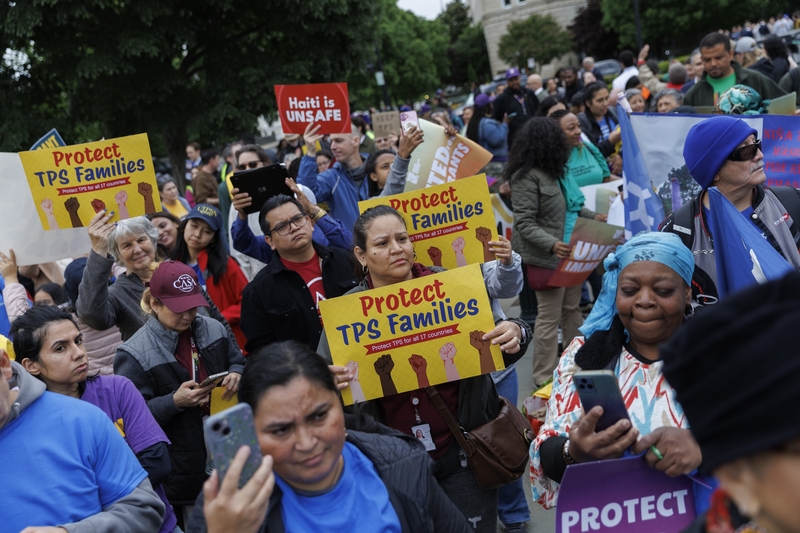
    Demonstrators chant and hold signs outside U.S. Supreme Court on April 29, 2026 in Washington, DC. The court heard arguments challenging DHS's termination of Temporary Protected Status for asylum seekers. (Photo by Tom Brenner/Getty Images)

    Demonstrators chant and hold signs outside U.S. Supreme Court on April 29, 2026 in Washington, DC. The court heard arguments challenging DHS’s termination of Temporary Protected Status for asylum seekers. (Photo by Tom Brenner/Getty Images)

    The Trump administration has argued that TPS has become a “de facto asylum program” and that conditions in Haiti have improved enough to end the designation. It appealed the ruling to the Supreme Court in March, and the justices heard oral arguments on an emergency basis.

    The court is expected to issue a ruling by the end of the term in late June or early July. The decision will determine whether the administration acted lawfully in its attempt to revoke TPS, including whether it consulted with the State Department when reviewing the country’s conditions.

    An uncertain future

    Immigration attorneys and advocates say the uncertainty surrounding TPS and immigration enforcement has heightened fears within the Haitian community.

    “Everyone is scared across the board,” said Tremaine Hemans, founder and managing attorney of an immigration law firm in Fort Lauderdale, Florida. “But specifically our Haitian clients.”

    Balthazar said she no longer feels entirely safe here, either.

    She said she used to fly to Massachusetts for months at a time to care for a patient. Now, she would refuse any nursing assistant job that required air travel, even if it paid $50 an hour, because she fears encountering Immigration and Customs Enforcement agents at the airport.

    “They handicap you, make you uncomfortable to live here, to be here,” Balthazar said.

    Violence and humanitarian instability continue to worsen throughout Haiti, said Brian Concannon, a human rights attorney and executive director of the Institute for Justice and Democracy in Haiti, a nonprofit focused on advancing human rights and justice in Haiti.

    By U.N. estimates, armed gangs control approximately 90% of the capital, Port-au-Prince, and hunger and displacement have risen sharply in recent years.

    “There’s literally no metric by which you can say that conditions in Haiti are improving or are in any way safe,” Concannon said.

    In Ohio, troubling phone calls

    For Rose-Thamar Joseph, a Haitian TPS holder and community advocate in Springfield, Ohio, that reality hits close to home.

    Joseph came to the U.S. under TPS in 2021 after former President Joe Biden redesignated the program for Haiti. She said she speaks with her family back home almost every day, including her 12-year-old son. Calls rarely end without her hearing gunfire in the background.

    She recalled her family sending photos of bullets that landed in their yard.

    One night, Joseph said she stayed on the phone with them until the morning, unable to sleep because she was worried about their safety.

    “It was a real, real challenging and stressful situation for me,” Joseph said.

    Sometimes the violence becomes so severe that her son cannot go to school. What worries her even more, she said, is when the country’s poor network service prevents her from reaching her family at all.

    Although Joseph has asylum status to fall back on if TPS ends, which would allow her to continue living and working in the U.S, she said many Haitian TPS holders don’t have that option.

    “It is so heartbreaking for me to see or to know that a lot of people will be out of work, will be laid off… because of TPS,” Joseph said.

    Consequences in the US for families, employers

    Concannon at the Institute for Justice and Democracy in Haiti said the Supreme Court’s decision could have immediate consequences for TPS holders and their families.

    Of the 350,000 Haitian TPS holders in the U.S., about 200,000 of them are already in the U.S. workforce, according to FWD.us, an immigration and criminal justice advocacy organization.

    Many send money home to support relatives in Haiti because ongoing violence and economic instability have left many families struggling to get by.

    “It’s literally thousands of families that are being kept afloat by remittances from TPS holders,” Concannon said.

    But the impact would also be felt by employers across the country.

    Many Haitian immigrants work in critical industries throughout the United States. FWD.us estimates that about 15,000 work in agriculture, 13,000 serve as nursing assistants, and another 8,000 work as caregivers.

    Todd Andrews, chief operating officer for Asbury Communities, a continuing care retirement community with campuses in Maryland, Pennsylvania, and Delaware, said immigrant workers play a critical role in caring for elderly adults.

    Asbury employs about 2,000 workers and serves more than 4,000 residents across its senior living communities. At the organization’s Gaithersburg, Maryland, campus alone, Andrews said employees represent more than 90 nationalities.

    “These jobs are very important, they’re very difficult, and they’re very, very integral in the care management of the residents,” Andrews said.

    He added that providers already face staffing shortages and warned that losing TPS workers could create disruptions similar to those experienced during the COVID-19 pandemic.

    “Employees that are employed today won’t be there tomorrow,” Andrews said. “So we’ll have to figure out a way to provide that care.”

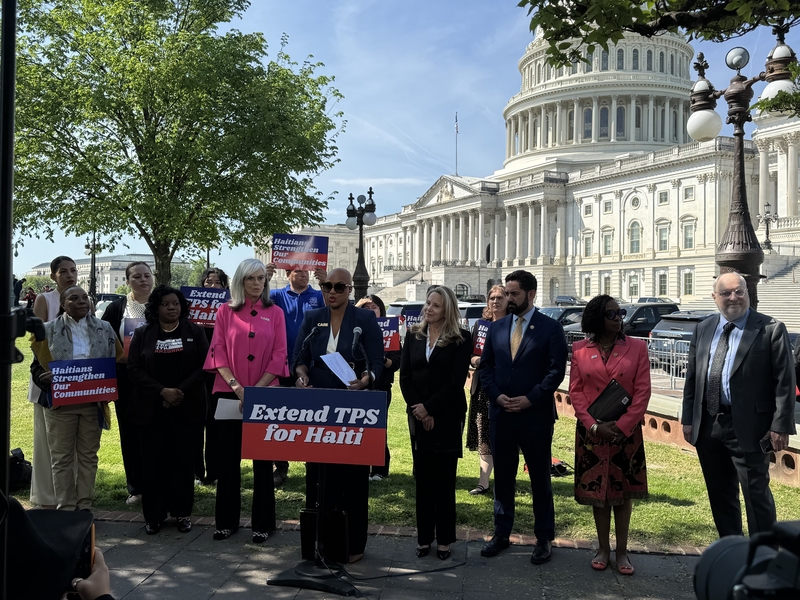
    Massachusetts Democratic U.S. Rep. Ayanna Pressley speaks at a press conference April 15, 2026, outside the U.S. Capitol in Washington, D.C., advocating for the extension of Temporary Protected Status for Haiti. The lawmakers alongside her include, from left, House Minority Whip Katherine Clark of Massachusetts, as well as New York's Democratic Rep. Laura Gillen, GOP Rep. Mike Lawler and Congressional Black Caucus Chair Yvette Clarke. (Photo by Shauneen Miranda/States Newsroom)

    Massachusetts Democratic U.S. Rep. Ayanna Pressley speaks at a press conference April 15, 2026, outside the U.S. Capitol in Washington, D.C., advocating for the extension of Temporary Protected Status for Haiti. The lawmakers alongside her include, from left, House Minority Whip Katherine Clark of Massachusetts, as well as New York’s Democratic Rep. Laura Gillen, GOP Rep. Mike Lawler and Congressional Black Caucus Chair Yvette Clarke. (Photo by Shauneen Miranda/States Newsroom)

    Lawmakers remain divided over the program’s future.

    Sen. Rick Scott, R-Fla., declined to explicitly say during an interview at the Capitol whether he believes TPS for Haitians should continue. Instead, he noted that Florida is home to “a lot of wonderful Haitians” and said the broader immigration system needs reform.

    “TPS was never a permanent program,” Scott said. “What I’d rather do is focus on, okay, so how do we fix the program where people can come here that are fully vetted that want to add to our economy.”

    Sen. Raphael Warnock, D-Ga., said immigrant communities make significant contributions to the U.S. economy and criticized the Trump administration’s efforts to end TPS for Haiti.

    “How can you deny Haitians who are here Temporary Protected Status, while at the same time put Haiti under the travel ban?” Warnock said. “It doesn’t make any sense.”

    Painful conversations

    While lawmakers remain divided over the future of TPS, Balthazar said the uncertainty has forced painful conversations with her daughter, a U.S. citizen and college student, about what might happen if she is deported.

    “That will affect her a lot,” Balthazar said. “She will be more at ease, more relaxed, if mama is around because she knows that she can rely on me…but if I’m not around, she will have to take care of herself.”

    For now, Balthazar said she is focused on living in the present. She spends her time caring for elderly patients, running her small online hair care business, and being with her family.

    Like many Haitians living under TPS, she said she still hopes for the day her country is stable enough to return.

    “As Haitians, we all dream, we all are dreaming to go back because we love our country. We just don’t have a system like here.”

    Medill News Service articles are reported and written by graduate student journalists in the Washington program of the Medill School at Northwestern University.

  • Program providing free children’s beds adds Wood to counties served

    Program providing free children’s beds adds Wood to counties served

    By Staff Reports
    For The Parkersburg News and Sentinel

    Parkersburg – Wood County is the latest county in West Virginia reached by a statewide group that distributes complete beds for qualifying households.

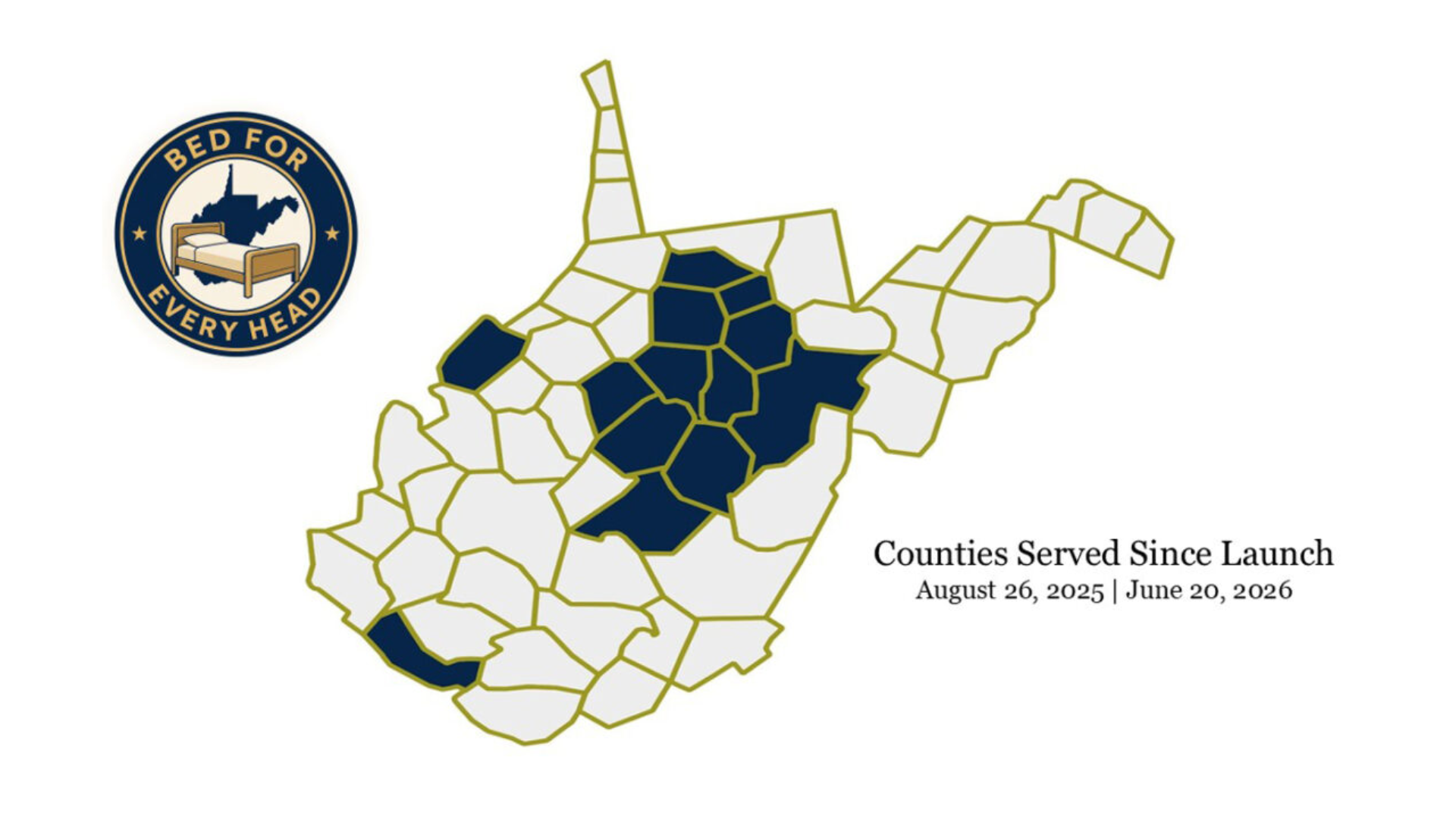
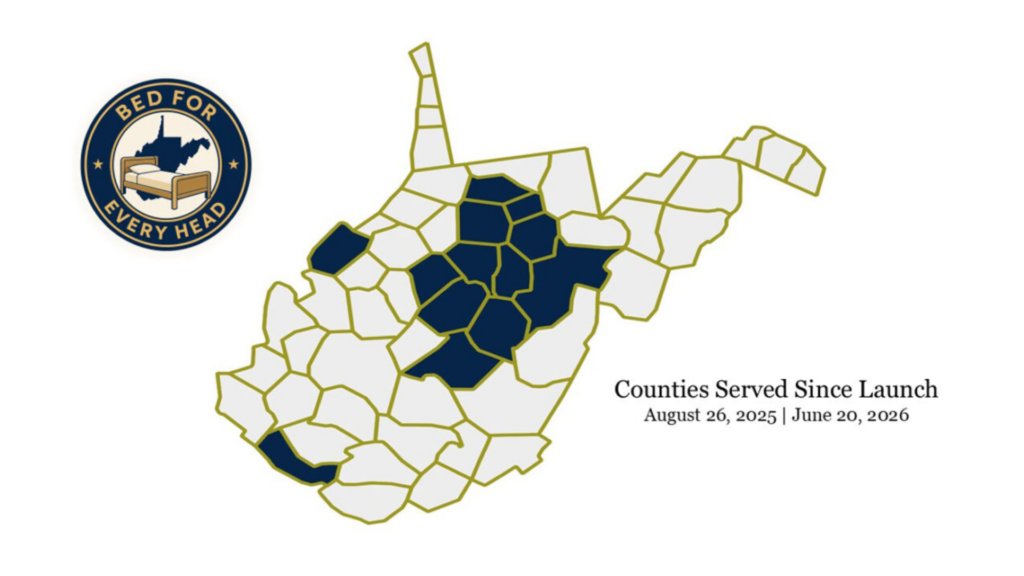
    The Bed for Every Head program through Riverstone Community Services, part of the West Virginia State Hospital Initiative Inc., last week delivered a complete crib placement for a household in Wood County, the 12th county to be served by the organization since the program began Aug. 26, 2025.

    “It won’t be the last,” said Titus Swann, founder and chairman of the State Hospital Initiative.

    Bed for Every Head primarily provides complete cribs, bassinets and twin beds to qualifying households. Larger bed sizes may be considered when necessary due to age, height, weight or room-space, particularly when more than one child shares a room. Each placement is reviewed according to program policy and fulfilled as a complete placement when approved.

    Swan anticipates more beds will be needed in Wood County as word of their availability spreads and people become informed through agencies.

    “Then the floodgates open,” he said.

    The need is great here and in every county in the state, he said. Nearly 70 beds have been distributed, Swann said.

    The placement in Wood County was from a referral from Mission West Virginia.

    Bed for Every Head receives referrals through several pathways, including Mission West Virginia, West Virginia Department of Human Services caseworkers, schools, family support workers, housing-related contacts and households that apply directly. The program is child-first and built around rapid response, with the goal of moving from approval to placement in a matter of days whenever possible, according to a release from the State Hospital Initiative.

    Riverstone Community Services is encouraging Wood County residents, caseworkers, school staff, churches, civic organizations, and community advocates to help identify households where a child may be without a proper bed, crib, bassinet or safe sleep placement, the release said.

    “If there is a child in Wood County without a safe or proper place to sleep, we want the people around that child to know they can reach out,” Swann said in the release. “Sometimes the first step is simply making sure the right person knows help may be available.”

    Families and referral sources may learn more or contact the organization at [email protected] or visit www.wvshi.org.

    Donations to the program can be made by calling 304-460-5727 or at the program’s website, WVSHI.org.

    The West Virginia State Hospital Initiative Inc. is a 501(c)3 nonprofit organization focused on preserving the history of West Virginia’s state hospitals, advancing public education and carrying out related charitable work.

    Read more from The Parkersburg News and Sentinel, here.

    The post Program providing free children’s beds adds Wood to counties served appeared first on West Virginia Press Association.

  • Bluefield working to get splash pad improvements ready for July 4th celebration

    Bluefield working to get splash pad improvements ready for July 4th celebration

    By Charles Owens
    For Bluefield Daily Telegraph

    Bluefield — Planning for the big America 250 celebration at Bluefield’s Lotito Park is ongoing, and city officials are still hoping to reopen the city’s splash pad with its new amenities in conjunction with that event.

    Work has been ongoing on the splash pad improvements, which will include new awnings, new shade structures, an expanded turf and a new concrete addition as well as a concession area. The goal is to still have the splash pad reopened in time for the Fourth of July celebration, City Manager Cecil Marson said.

    “We’re pushing very hard and there will be more coming out in the press to ribbon cut the additions to the splash pad, the concession stand and the walkway project to do that on the second (of July),” Marson said.

    As long as the weather cooperates, Marson said everything should be ready with the splash pad in time for the America 250 celebration at city park, which will be held on Saturday, July 4, from 1 to 9 p.m.

    So right now depending on how the weather holds — if we get a ton of rain, it’s going to complicate things — but right now we’re holding fast that we’ll be able to get it done by the second (of July) and have a great opening.— City Manager Cecil Marson on the planned reopening of Bluefield’s splash pad with its new amenities in time for the Fourth of July.

    “The concession (stand) crew is in here next week,” Marson said. “The concrete has has been poured and laid. They were doing that yesterday. The turf crew is supposed to be out there as we speak. The weather has not been overly cooperative today. But so far we’ve finished up some of the gravel work and the grading for the walkway that goes through the park. So right now depending on how the weather holds — if we get a ton of rain, it’s going to complicate things — but right now we’re holding fast that we’ll be able to get it done by the second (of July) and have a great opening.”

    Marson said other pre-events also are planned, including the Field of Honor event that will open on Wednesday, July 1, on the lower field area of Bluefield University that will feature more than 300 American flags, followed by a fireworks show at the conclusion of the Ridge Runner baseball game at Bowen Field on July 2.

    “We got a really big kickoff on the first of July with the Bluefield, Va. Lions Club on the Field of Honor, which will be a great event,” Marson said. “On the second there will be a huge baseball game with a big fireworks show at Bowen field, which we are really happy about.”

    Rick Showwalter, director of parks and recreation, told members of the Bluefield Board of Directors at their June 9 meeting that the July 4th deadline will be tight, but is still the goal.

    “It really isn’t one big project there, it’s three,” Showwater said. “We have the bathroom that we started working on a year ago. It’s being delivered. And that has to go down and the concrete has to be done before then and the turfing and all of that has to happen before July 4th. I’m just warning you that is going to be tight. We are working through it trying to line everybody up.”

    Showwalter said the shade structures will be the fourth addition to the splash pad, adding that those are currently being prepared by public works crews.

    “So keep your fingers crossed,” Showwalter said. “We will open up the splash pad as soon as we can but it’s very tight.”

    The city board approved bids last month for the splash pad improvements and the walking trail project. The expanded walking trail will encompass much of city park’s interior.

    A $31,414 bid was awarded to Top Dog Concrete for the splash pad concrete project, and a $63,301.80 bid was awarded to Playground Professionals LLC for the splash pad turf project.

    The board also approved a bid of $96,800 with Exterior Services SWV Inc. for the walking trail project at city park.

    The American 250 celebration at Lotito Park, which is being jointly organized by the city of Bluefield and the town of Bluefield, Va., will include vendors, live music, a petting zoo, a parade, bounce houses, craft vendors, a dunk booth, food trucks and more.

    Read more from Bluefield Daily Telegraph, here.

    The post Bluefield working to get splash pad improvements ready for July 4th celebration appeared first on West Virginia Press Association.