Category: VA State News

  • Rising costs of fuel, other goods squeeze already strained abortion funds

    Rising costs of fuel, other goods squeeze already strained abortion funds

    The increasing costs of fuel for cars and airplanes are adding extra strain to abortion funds that help people pay to travel for care in other states, leaders of several funds said this week.

    Abortion funds can help when someone must travel from their home state to a state where care is available. That often includes people living in one of the 13 states with a near-total abortion ban, but it also encompasses those who need to travel because of gestational limits in other states. Funds, which often come exclusively from donations, help pay for the cost of the abortion procedure as well as transportation costs, lodging, meals and other expenses.

    In the four years since the U.S. Supreme Court’s decision in the Dobbs v. Jackson Women’s Health case, abortion fund leaders say the need for assistance has exploded. Poonam Dreyfus-Pai, interim executive director of the National Network of Abortion Funds, said Monday that the funds supported more than 158,000 people in 2025, up from 82,000 in 2022. And the cost per person has doubled from less than $200 to nearly $400 on average nationwide.

    Nearly 1 in 4 people seeking abortions out of state chose Illinois. Here’s why

    Dreyfus-Pai said about one-third of the abortion funds in their network reported that they had to pause their hotline services in 2025 because of funding shortages, staff burnout, legal barriers, security concerns and other issues.

    “We’re seeing that this year is even harder for funds, with many more funds needing to temporarily close their doors to stretch their funding, and some even closing permanently,” Dreyfus-Pai said.

    In Virginia, Blue Ridge Abortion Fund Executive Director April Greene said more than one-quarter of their callers traveled from out of state in the current fiscal year. Greene said the fund has distributed more than $6.1 million in funding since it was founded in 1989, but more than $4 million of that came after the Dobbs decision.

    Melisa Hidalgo-Cuellar, director of Colorado’s Cobalt Abortion Fund, said her organization saw a 1,000% increase in spending for abortion seekers from 2021 to 2025, supporting patients from 32 states and six countries. The fund spent $2.4 million to support abortion seekers in 2025, compared with $206,000 spent in 2021, before Dobbs. Many of the fund’s out-of-state clients are from Texas, which has a near-total ban and other civil enforcement laws related to abortion.

    The spending rose another 26% in the first three months of 2026, at least in part because of rising fuel costs associated with the ongoing conflict in Iran and the closure of the Strait of Hormuz, and recent price increases for food and other services. The total spent in the first quarter of 2025 was about $465,000, while the total in the first quarter of 2026 was nearly $590,000.

    “We saw a 44% increase in how much we spent on flights in March of 2025 to March of 2026,” Hidalgo-Cuellar said. “So it’s a significant increase.”

    The airfare costs can be especially high because when funds receive a help request, the caller usually needs to travel within a few days. Ginnely Carrasco, director of programs and interim executive director of the Florida Access Network, said the quick travel window can increase a ticket’s price by $500 to $700.

    According to a report published Tuesday, the Cobalt Abortion Fund also spent $23,000 in the first quarter of this year to support access to abortion medication by telehealth. Continued access via telehealth to mifepristone, one of two drugs approved by the U.S. Food and Drug Administration to terminate a pregnancy before 10 weeks, is threatened by an ongoing lawsuit filed by the state of Louisiana in 2025.

    The U.S. Supreme Court preserved the rule allowing telehealth prescriptions for now, but the case is ongoing.

    Stateline reporter Kelcie Moseley-Morris can be reached at [email protected].

    This story was originally produced by Stateline, which is part of States Newsroom, a nonprofit news network which includes Virginia Mercury, and is supported by grants and a coalition of donors as a 501c(3) public charity.

  • US Senate blocks Trump’s SAVE America Act, thwarting restrictions on voting

    US Senate blocks Trump’s SAVE America Act, thwarting restrictions on voting

    The U.S. Senate rejected the SAVE America Act on Thursday, dealing a blow to President Donald Trump’s efforts to impose voting restrictions ahead of the November midterm elections.

    Senators voted 48-50 against advancing an amendment that would have incorporated Trump’s top legislative priority into an immigration-focused spending bill. The vote offered the clearest sign yet that despite pressure from the president, a handful of Republican senators continue to resist advancing the bill, which critics say would unleash immense chaos ahead of elections this fall.

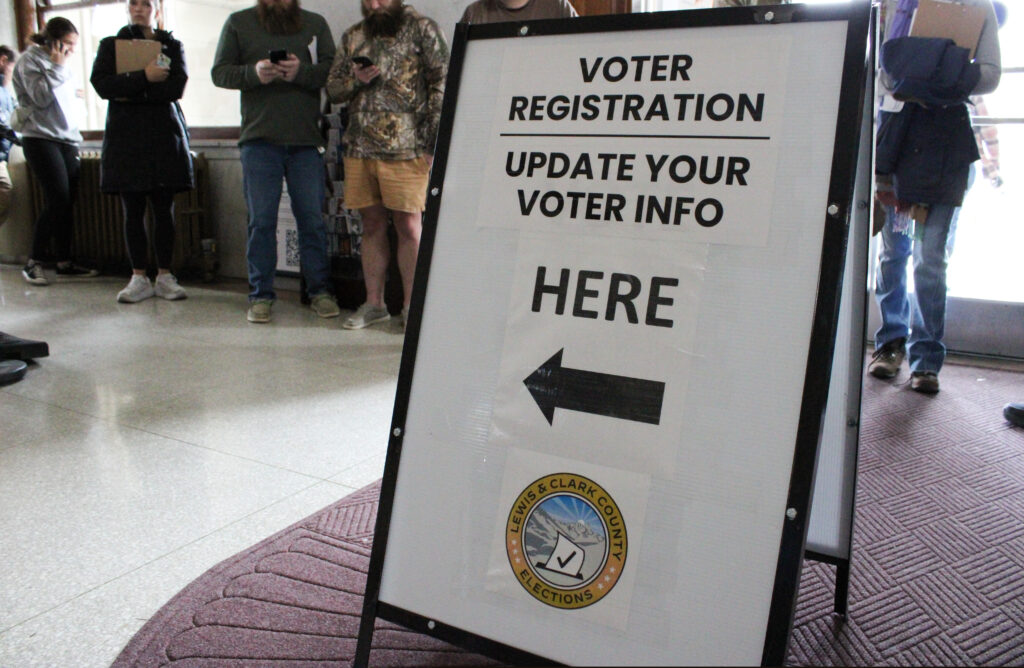
    The SAVE America Act would require voters to offer documents, such as a birth certificate or passport, proving their citizenship when registering to vote. It would also mandate voters show photo ID when casting a ballot and restrict where voters can register, effectively eliminating voter registration drives.

    Democrats and voting rights groups have assailed the bill, saying it would disenfranchise voters and upend the midterms because the new rules would take effect immediately. Trump and the bill’s GOP supporters say it’s needed to combat noncitizen voting, an extremely rare phenomenon.

    Since taking office last year, Trump has made a series of attempts to shape how elections are run. An executive order that would limit voting by mail remains in effect for now as opponents challenge it in federal court, and the Department of Justice continues to seek to force states to hand over sensitive voter data, so far unsuccessfully.

    The Senate amendment, offered by Republican Sen. Lindsey Graham of South Carolina, also included restrictions on sports participation by transgender athletes. On social media after the vote, Graham called the SAVE America Act “one of the most consequential” pieces of legislation developed by Trump and his team.

    “All Democrats voted no, and they will eventually pay a price,” Graham wrote.

    Republicans also vote no

    But the proposal fell short among a small group of Republicans, too. Sens. Susan Collins of Maine, Mitch McConnell of Kentucky, Lisa Murkowski of Alaska and Thom Tillis of North Carolina joined Democrats in voting no.

    Collins is seeking reelection in what is one of the most competitive Senate races in the country. McConnell and Tillis have both opted against seeking reelection, while Murkowski has said the bill would set up barriers for voters in her large, rural state.

    Sixty votes would have been needed to advance the amendment — the same threshold to overcome a filibuster.

    The vote came after the Senate spent weeks debating the SAVE America Act earlier this year before moving on to other business without a vote. Trump has urged Republicans to abandon the filibuster to pass the bill, without success.

    “We will squash this blatant attempt at voter suppression,” Sen. Mark Warner, a Virginia Democrat, wrote on social media after the vote.

    The Senate also rejected, 50-49, a separate amendment offered by Sen. Mike Lee, a Utah Republican, that included a different version of the SAVE America Act. According to Lee, the amendment was the version of the bill passed by the House, which didn’t include provisions on transgender athletes.

    Collins voted in favor of the amendment after earlier opposing Graham’s amendment.

    California

    Both amendments failed hours after Trump asserted, without evidence, that Democrats were stealing “the vote” in California. The state held primary elections earlier this week, but vote counting is often slow in the state, meaning vote totals reported on election night don’t always reflect the final outcome of a race.

    Trump linked California’s elections to his push for the SAVE America Act, writing on social media that “I hope Republicans are watching” so they could pass the legislation.

    “They found a lot of mail-in ballots last night, shockingly,” Trump said at an unrelated Oval Office event on Thursday. “So we don’t want that.”

    With the Senate unwilling to advance the SAVE America Act, some GOP lawmakers have begun offering alternative election-related bills.

    Republican Reps. Julie Fedorchak of North Dakota and Laurel Lee of Florida on Thursday introduced the SAVE America Through REAL ID Act, which would create a grant program to help states provide REAL ID-compliant driver’s license and identification cards to residents for free to low-income Americans.

    On Tuesday, Sen. Marsha Blackburn, a Tennessee Republican, and Graham introduced the Election Security Partnership Act, designed to encourage states to submit their voter rolls to a computer program operated by the Department of Homeland Security that can identify possible noncitizens.

    States can already upload voter data to the program, called Systematic Alien Verification for Entitlements or SAVE, but the legislation would provide $20 million in grants for states to offset any costs related to using SAVE.

  • What Virginians’ and Americans’ D-Day sacrifices teach us about our country now

    What Virginians’ and Americans’ D-Day sacrifices teach us about our country now

    NORMANDY AMERICAN CEMETERY, COLLEVILLE-SUR-MER, FRANCE- Richard Powhatan Hall’s grave sits nine rows into the vast final resting place of 9,400 U.S. soldiers who lost their lives in the 1944 D-Day invasion. Hall, a man from Virginia’s Albemarle County, was killed in action June 6, 1944 at Omaha Beach, a few hundred yards from where he is buried.

    He died at 26 fighting fascism.

    Hall was among 184 Virginians who gave their lives to spearhead an extended assault that eventually led to Paris, then Berlin, and brought down Adolph Hitler and the Nazis, a regime powered by hate and intolerance.

    The Virginia dead included the Bedford 20, a group of young men from the same small town in the southwest region of the state. They became the best-known Old Dominion D-Day casualties for their community’s collective sacrifice.

    Bedford lost more residents per capita than any other community in the United States on D-Day, as far as is known, according to John Long, education director of the National D-Day Memorial. To the best of historians’ knowledge, the state of Virginia lost more residents per capita in the D-Day mission than any other state in the union, Long said.

    Ruined remains of German gun emplacements still stud the high bluffs above the Atlantic coast. The gun emplacements, considered nearly impenetrable during World War II, have evolved into monuments of the shared pain and desperately hard work it took to overcome fascism.

    U.S. Army rangers who scaled the near vertical rock face of Pont du Hoc used ropes and knives shoved into small cracks to propel themselves upward into enemy fire. Their courage symbolized the difficulty and determination of the entire campaign.

    As Long noted, “They obviously knew they were going into battle. I’ve never talked to a veteran of World War II who would not admit that they were scared.”

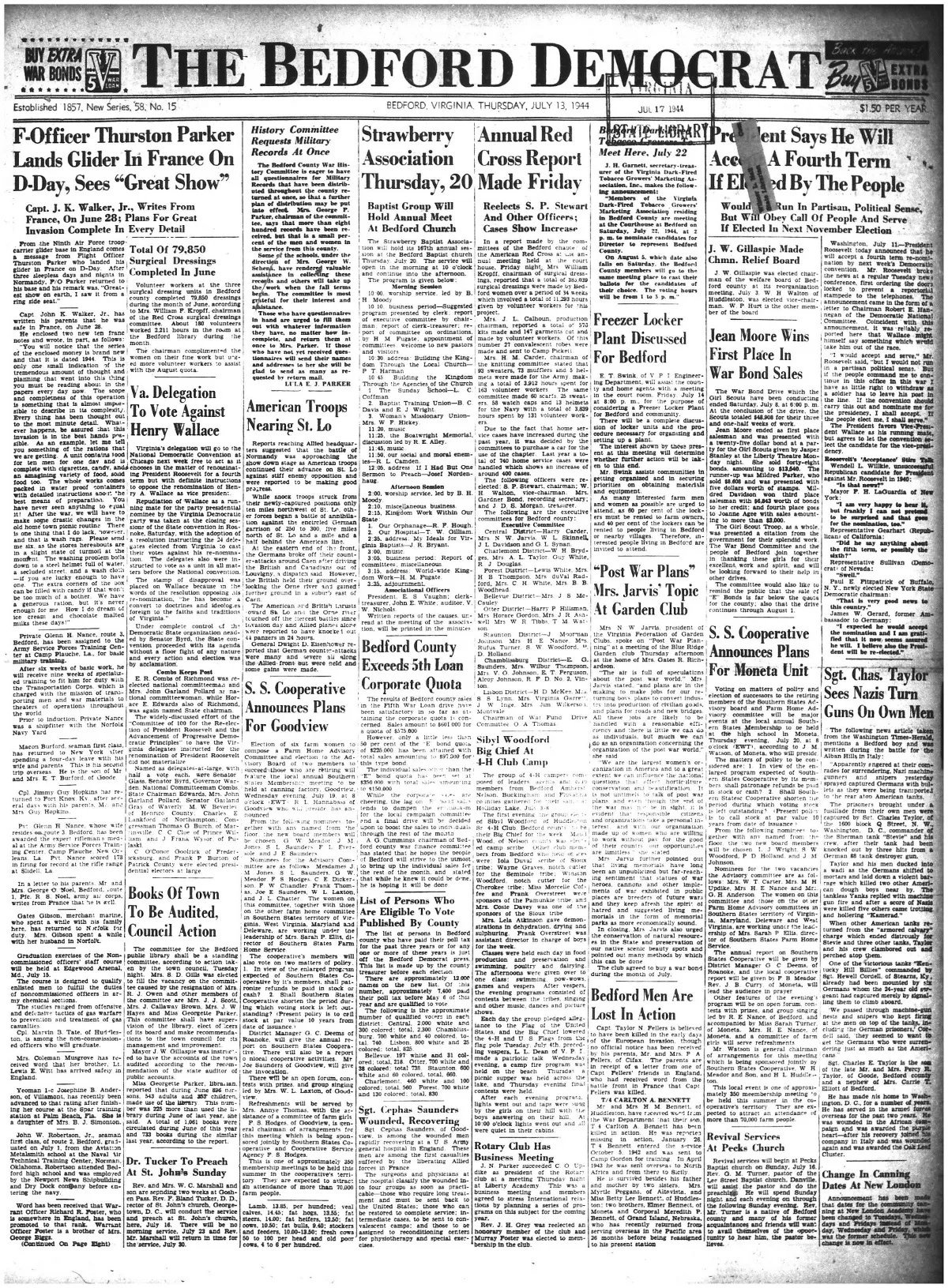
    The July 13, 1944 edition of The Bedford Democrat newspaper details the names of men from the county w ho perished in World War II up to that point. (Photo courtesy Library of Virginia)

    Many of those killed on D-Day were entering combat for the first time, Long said. But they also knew that they were in a crucial battle between good and evil.

    The U.S. worked with its allies, England and Canada, in those days. The leader of the invasion, U.S. Gen. Dwight Eisenhower, ultimately made the decisions. But he led with power that considered other viewpoints. That birthed a spirit of cooperation and adaptation that overcame everything that went wrong on D-Day, a spirit that had to extend to the troops for anything to succeed.

    In his Order of the Day, Eisenhower referred to what was about to happen as a “Great Crusade.”

    This crusade required more than brilliant tacticians or seasoned soldiers. It relied on guys like Hall, who before the war worked for a Charlottesville Ford dealership, according to his obituary.

    Hall, the Bedford 20,most of the rest of the lost Virginians and more than 9,000 other Americans who died in the D-Day invasion were not military professionals. They were mostly average Joes who understood and accepted the obligation of their country’s commitment to freedom from dictators.

    Standing among seemingly endless rows of U.S. grave markers in Normandy inevitably invites a comparison of America’s spirit on D-Day and today.

    On D-Day, the U.S. aligned itself with allies. It did not alienate or publicly lecture them, as our government leaders currently do. The country felt a shared responsibility to the world in a war that was not being fought on American soil. That commitment sprang from ideology instead of property. Freedom from authoritarian rule was the goal, but not just in an abstract sense.

    To fight on D-Day meant facing daunting physical risks to take down the enemy or die trying.

    “By and large, allied leaders made it clear this was a battle of good versus evil that had to be won,” Long said. “They had a sense of what they had to do and why.”

    But there was also a personal sense of the mission reliant on individual survival instincts to succeed. The only path to victory was up the bluffs.

    “Their thinking,” said Long, “was that taking those bluffs was how they got to go home.”

    Thousands didn’t. Still, they trusted in leaders whose integrity made it worth the try.

    In a country whose leaders routinely lie or use their positions to expand personal authority and wealth, such trust cannot exist.

    This is the country we now live in. It is a place where the president punishes institutions that practice traditional values of tolerance, opportunity and compassion.

    It is a place where the president calls the late Sen. John McCain, a hero who suffered years of torture for his service in the Vietnam War, a “loser.”

    We now live in a place where white nationalists and misogynists masquerading as war experts strip promotions from black and female military officers, and the president, a draft dodger who never served, pursues military policies so devoid of tactical rationale and legality that America’s finest officers must resign because they cannot in good conscience follow what they believe to be illegal orders.

    Our highest political leader today believes that undocumented immigrants deserve no constitutional rights and can be separated from their children and thrown into detention facilities for months without court hearings.

    We now live in a country where the same leader encourages government agents to attack protesters. The Trump administration initially refused to cooperate with state investigators seeking facts in the killings of two legal Minnesota residents by Immigration and Customs Enforcement agents. A judge had to order the administration to release evidence.

    ICE officer fatally shoots driver through car window in Minneapolis

    Finally, and perhaps most tragically, instead of fighting fascism, today we live in a country where the leader spreads lies about election fraud when he loses, then encourages an attack on the U.S. Capitol to stop the peaceful transfer of power.

    The attack injured police and led to several deaths. It cost taxpayers tens of millions of dollars. It led to 1,500 criminal convictions. But the leader, shielded from personal criminal prosecution by conservative Supreme Court justices, pardoned the criminals who did his bidding.

    What Americans did in 1944 on the beaches at Normandy showed greatness and selflessness. What Donald Trump has done in his time as president is destroy Americans’ sense of unity and responsibility, which gave us the strength to defeat Hitler.

    On this D-Day anniversary, that begs an ugly question for every American:

    How did the United States go from fighting fascism in 1944 to embracing it in 2026?

  • After Ashland dam removal, freshwater mussel species reintroduced to South Anna River

    After Ashland dam removal, freshwater mussel species reintroduced to South Anna River

    For about 200 years the Ashland Mill Dam, about a half-hour north of Richmond, blocked many fish from moving through the South Anna River. Without fish like herring to attach their larvae to, a freshwater mussel species known as the alewife floater disappeared from the waterway, making them “functionally extinct” in the area, according to Joe Wood with the Chesapeake Bay Foundation.

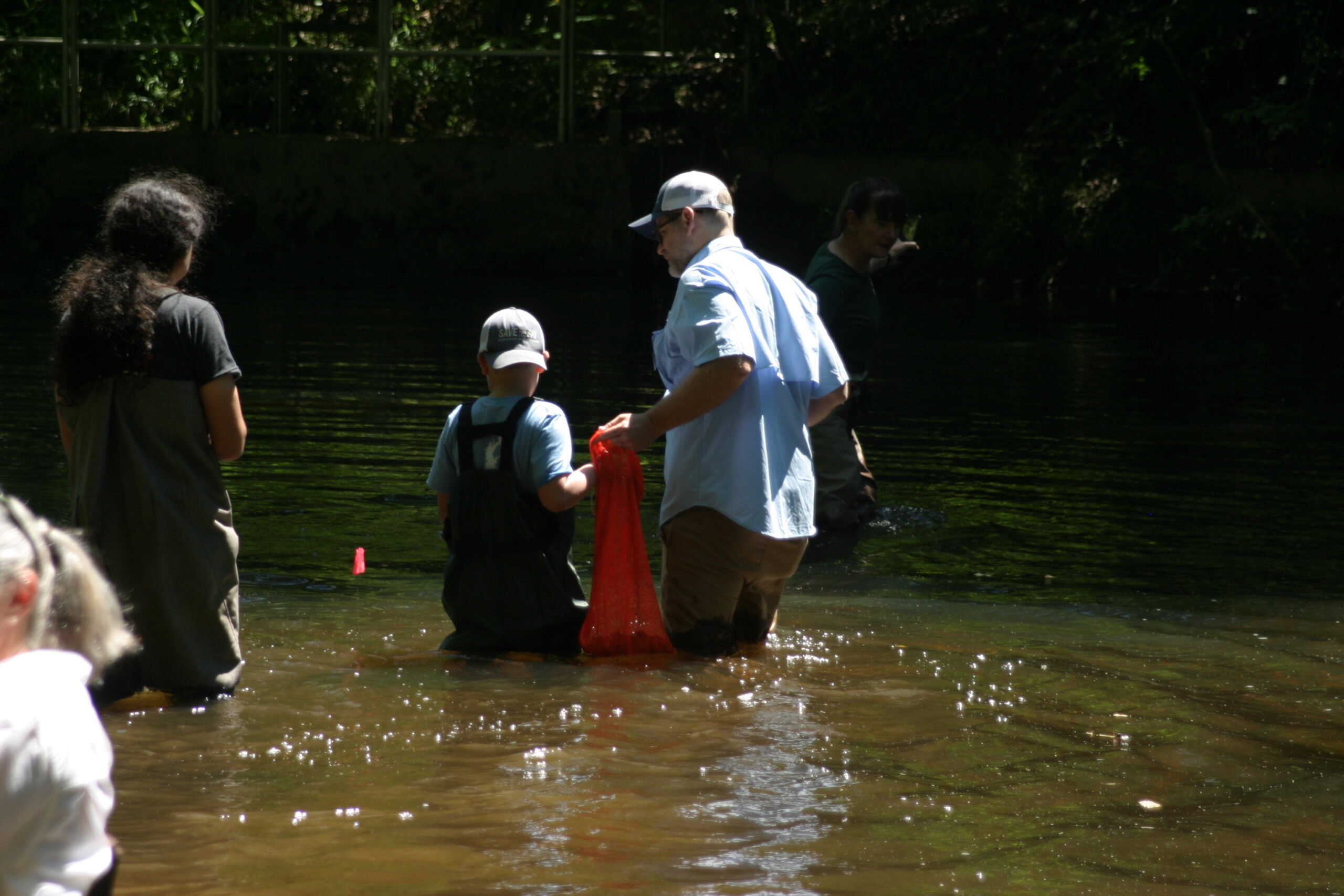
    The dam was removed two years ago and on Thursday, biologists and volunteers planted over 750 of the shelled critters back in the river to help them migrate upstream.

    Volunteers plant freshwater mussels in the South Anna River in June 2026. (Photo by Shannon Heckt/Virginia Mercury)

    “With the dam gone, we know that there’s unfettered access to these habitats. Any of the fish that are moving up and down this river that are potential mussel hosts are going to help these mussels,” said Alan Weaver, the fish passage coordinator for the Virginia Department of Wildlife Resources.

    For decades, scientists worked to find ways to either build a fishway —a pathway through the dam to allow some fish to move through — or find a way to remove the dam outright. In 2024, a private company purchased the dam to get mitigation credits required by federal law through the Clean Water Act to offset another project in the same watershed that could damage wetlands or other habitats.

    The company, Davey Mitigation, demolished the dam that had been a fixture of the western Hanover landscape for nearly two centuries.

    Since the removal, several targeted species have been able to migrate up the river for the first time in years. The restoration of mussel habitats also coincides with new goals laid out in the recently-renewed Chesapeake Bay Watershed Agreement, which outlines goals for animal habitat growth and pollution reduction.

    “Understanding that life cycle is really important to understanding freshwater mussels, because they’re one of our most endangered classes of organisms in the country,” Wood said.

    Alewife floaters are one of five mussel species found in the area. They can filter up to 15 gallons of water a day, which helps clear pollutants and sediment from streams.

    Freshwater mussel in the South Anna River. June 2026. (Photo by Shannon Heckt/Virginia Mercury)

    The alewife floaters rely on herring to carry their young upstream to grow and spread. Once the dam was removed, scientists began noting species of fish farther up the river than previously recorded.

    “Last year, we got the American shad, the hickory shed, the alewife, the blueback herring,” Weaver said. “Not only the fish are using the river, but they’re also going pretty far inland, and they’re actually using the habitat that we predicted that they would use.”

    The effort to restore the freshwater mussel populations was made possible through a partnership between the Chesapeake Bay Foundation, the Departments of Wildlife Resources, and Conservation and Recreation, and the Pamunkey and Mattaponi Indian Tribes.

    The Bay Foundation received a federal grant of $199,700 through the Chesapeake WILD program to restore wildlife habitat through this alliance, with a matching fund of $44,100 from various sources.

    Even with the dam removal, the return of the alewife floaters has been slow. Wood said it could have taken another hundred years for the mussels to move back upstream to their full potential. The planting efforts will speed up their migration and establish habitats to help them grow.

    South Anna River. June 2026 (Photo by Shannon Heckt/Virginia Mercury)
  • FOIA Friday: Richmond city and schools face scrutiny

    FOIA Friday: Richmond city and schools face scrutiny

    One of the less noticed features of the Virginia Way is the long-running tendency of the commonwealth’s leaders to conduct their decision-making behind closed doors. While the Virginia Freedom of Information Act presumes all government business is by default public and requires officials to justify why exceptions should be made, too many Virginia leaders in practice take the opposite stance, acting as if records are by default private and the public must prove they should be handled otherwise.

    In this feature, we aim to highlight the frequency with which officials around Virginia are resisting public access to records on issues large and small — and note instances when the release of information under FOIA gave the public insight into how government bodies are operating.

    The Mercury’s efforts to track FOIA and other transparency cases in Virginia are indebted to the work of the Virginia Coalition for Open Government, a nonprofit alliance dedicated to expanding access to government records, meetings and other state and local proceedings.

    Richmond fails to uphold transparency plan

    Richmond is facing new transparency questions after the city failed for seven years to follow its own law requiring routine publication of financial transactions, The Richmonder reported in May.

    The outlet found the city followed the law for about four years before it stopped posting new data in 2019. In 2024, it also removed older data because it contained confidential information that had been missed during earlier reviews.

    Mayor Danny Avula’s administration republished most of the information in April after The Richmonder filed a records request for the transactions. The administration took office in January 2025. The Richmonder said the data detailed a range of financial transactions, from a $55 million debt service payment to a $600 paint job for a bathroom in the mayor’s office.

    The administration said concerns over confidential information have prevented the city from ”complying with a law meant to help assure Richmond taxpayers that public funds are spent wisely,” The Richmonder wrote. City officials have said reviewing the records takes significant time as a result.

    The news outlet also reported that Councilmember Kenya Gibson planned to introduce an oversight resolution asking the council to investigate the city’s failure to publish the payment register.

    Courthouse News Service challenges court practices

    A federal judge’s ruling allows a closely watched over access to Virginia to move forward, after court officials argued the case should be thrown out before evidence could be examined.

    The suit, filed by Courthouse News Service, challenges restrictions tied to the Virginia’s Officer of the Court Remote Access system, known as OCRA, which gives attorneys and government workers access to non-confidential court filings that journalists and the public cannot directly access.

    In a May 5 ruling, U.S. District Judge James Jones said the plaintiffs had sufficiently alleged that Virginia’s policies may improperly delay or restrict public access to newly filed civil complaints. Jones wrote that disputes over how the OCRA system functions are issues for the later stages of the case, not grounds for dismissal at the outset.

    Shortly after the ruling, Karl Hade, executive secretary of the Supreme Court of Virginia, appealed the decision on behalf of court officials to the U.S. Court of Appeals for the Fourth Circuit.

    Public allowed to hear complaints against board

    Complaints involving Suffolk County School Board members are now open to the public, the Suffolk News Herald reports.

    The news outlet said in May that the board revised its regulations to allow such matters to be addressed in public rather than in closed session.

    The change also addresses disputes over board norms, member discipline and transparency.

    Some of the issues included court rulings finding FOIA violations, litigation over public access to meetings, and the censure of former board member Sherri Story when the board’s operations and practices became subject of public debate.

    Richmond schools defend redactions in facilities department probe

    Richmond City Public Schools is standing by a personnel exemption after redacting an internal investigation report on its facilities department, which is responsible for maintaining school buildings.

    According to WTVR, which requested the records, the school system’s report revealed little about allegations of mismanagement under former director Bobby Hathaway, who left during the probe.

    Virginia Coalition for Open Government Director Megan Rhyne told the network that “the personnel exemption was never designed and never intended to cover up wrongdoing by public employees, particularly when that wrongdoing has to do with the misappropriation of public funds or taxpayer dollars.”

    She said the exemption should apply to human resources matters or performance reviews, not alleged wrongdoing. She believes RPS applied the exemption too broadly.

    In 2024, a circuit court judge ruled that the district improperly withheld the report on the Huguenot High School graduation shooting investigation, forcing its release. In that case, RPS relied on a different FOIA exemption.

    WTVR requested records tied to the facilities investigation, which revealed operational failures.

    The news outlet reported the investigation uncovered misuse of purchase card accounts, including instances in which non-facilities personnel used the department’s account for purchases at Lowe’s.

    Investigators also found that parts of the work order system were ”completely ignored,” and materials were not properly recorded and stored. The report said a lack of protocols “created an environment susceptible to loss and misuse of assets.”

    Investigators recommended operational reforms and a forensic review of all purchases made by the facilities department to determine the “full scope of financial impact.”

    Much of the remainder of the report was heavily redacted.

    Asked about the redactions, RPS spokesperson Alyssa Schwenk told WTVR that “the division must balance public interest and legal obligations to current and former employees. Our consistent practice is to protect information directly concerning personnel.”

  • Virginia measles cases surge past 70, concentrated in Central Virginia

    Virginia measles cases surge past 70, concentrated in Central Virginia

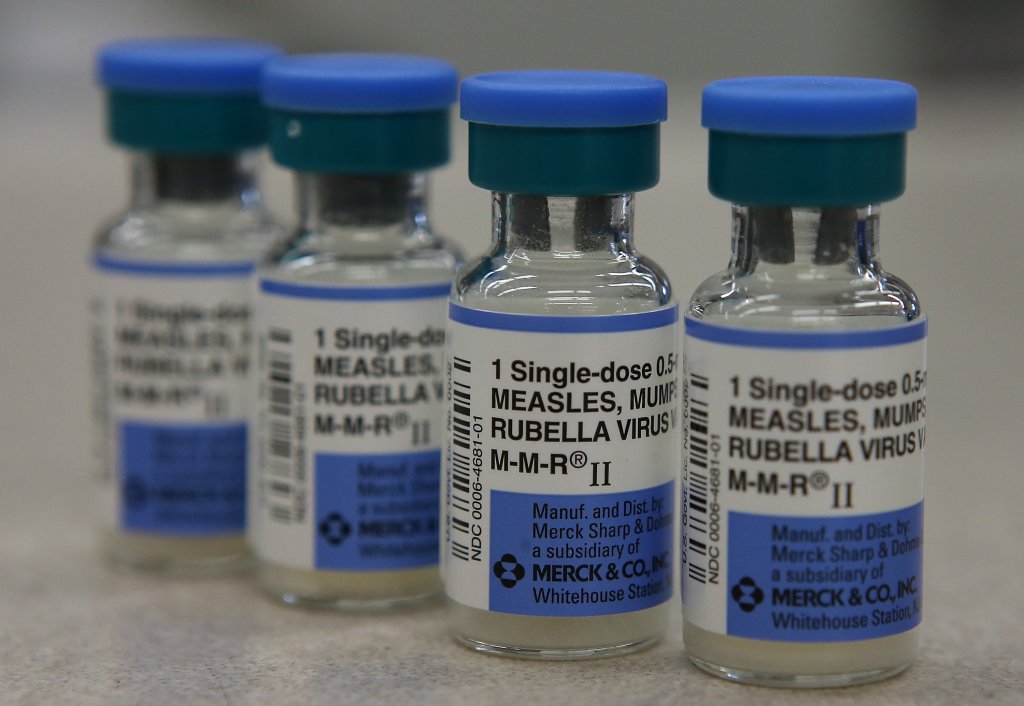
    Virginia’s measles count has jumped by more than 30 cases in recent weeks, with most of the infections centered in Central Virginia around Buckingham County. Data from the Virginia Department of Health shows that there have been 77 cases this year, most involving unvaccinated people.

    The bulk of the cases are babies and children younger than 12, aligning with how some parents were more likely to follow anti-vaccine trends that emerged in the earlier 2000s and have resurfaced more recently.

    During a visit to Virginia Wednesday, U.S. Health and Human Services Secretary Robert F. Kennedy Jr. recommended measles vaccines as a key preventative measure — a relatively recent endorsement following years of national prominence in anti-vaccine movements.

    About two decades ago, measles was considered eliminated in the U.S., but anti-vaccine rhetoric became more mainstream and misinformation about vaccines spread, leading to confusion and hesitancy among some people.

    Kennedy’s comments to Virginia reporters this week follow an acknowledgement he made during Congressional testimony in late April. It marks a relatively new stance after he did not recommend vaccination during a measles outbreak in Texas last year and instead advised Americans to “do your own research.

    Despite the U.S. being among the countries that previously eradicated measles, Kennedy noted this week that new cases are “happening all over the world.”

    “At (the Center for Disease Control and Prevention), we encourage people to get their measles vaccination,” he added. “That’s the best way to prevent yourself from getting measles.”

    Piedmont Health District Director Maria Almond said in an email that local health officials continue recommending vaccinations. Her health district is responding to the region of the state where most measles cases are occurring.

    Virginia Department of Health Commissioner Cameron Webb reiterated that people who remain unsure should speak with their doctors.

    “If you’re still not sure about the MMR vaccine, you should talk to your trusted health care provider immediately,” Webb said. “They can answer all your questions and address any concerns you may have.”

    About a month ago, Virginia’s measles cases were still in the two-dozen range as infections also climbed in other states. The increase prompted the CDC to issue summer travel guidance to encourage vaccinations and other preventive measures.

    Almond said the outbreak in the Piedmont region “has “not yet overburdened the local healthcare systems.”

    Hospitals and clinics are more likely to face strain during epidemics and pandemics.

    In Virginia and across the country, health systems and health departments have also dealt with staff turnover and burnout. Virginia’s health department has spent years addressing internal challenges following the COVID-19 pandemic.

    “According to the CDC, one in five people infected by measles requires hospitalization for complications, including pneumonia and dehydration,” Almond said.

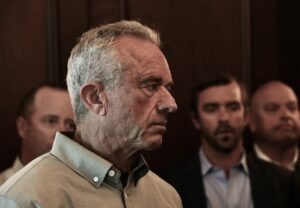
    U.S. Secretary of Health and Human Services Robert F. Kennedy Jr. during a press conference in Doswell Wednesday. (Photo by Charlotte Rene Woods/Virginia Mercury)
  • Congress nears major bipartisan housing bill with support from Virginia lawmakers

    Congress nears major bipartisan housing bill with support from Virginia lawmakers

    Last summer, U.S. Sen. Mark Warner, D-Va., criticized Congress for often “kicking the can” on federal housing policy. One year later, federal lawmakers are close to sending a large bipartisan housing bill to President Donald Trump’s desk.

    Dubbed the 21st Century ROAD To Housing Act, the effort is led by Sens. Tom Scott, R-S.C., and Elizabeth Warren, D-Mass. along with U.S. Reps. French Hill, R-Ark., and Maxine Waters, D-Calif.

    A key provision of the bill aligns with one of Trump’s goals to restrict large investment firms from buying up too many single-family homes. The practice has stifled first-time homebuyers, and state lawmakers from both parties in Virginia have previously introduced similar restrictions.

    Trump’s administration has expressed it “strongly supports” the federal bill — a clue that he would likely sign it.

    Other provisions in the bill encourage housing development in underused or vacant commercial properties like strip malls.

    “They can be converted to housing because they’ve already got power, parking and utilities around,” said Warner, who spearheaded that portion of the bill.

    The concept, along with incentives to build manufactured homes, drew inspiration from legislation also introduced in Virginia.

    A “housing near jobs” bill by Sen. Schuyler VanValkenburg, D-Henrico, and Del. Dan Helmer, D-Fairfax, did not become law, but its similarity to Warner’s proposal could give supporters hope to try again, VanValkenburg said. The bill would encourage multifamily and mixed-use development by right in certain commercial corridors so more people can live closer to where they work and reduce suburban sprawl.

    VanValkenburg’s manufactured homes bill, which was recently signed into law by Gov. Abigail Spanberger, can help bring those types of homes onto the market in areas that need or want them. Likewise, Congress’ pending bill would treat the factory-built style of home the same as a site-built home when it comes to zoning and financing.

    Slate of new Virginia laws address health care and housing affordability

    “Housing is tricky because a lot of it is local, but of course state and federal governments play a role too,” VanValkenburg said.

    To guide local governments, which typically control land use decisions like housing, the federal bill would also direct the U.S. Department of Housing and Urban Development to publish model zoning guidelines for states and localities to explore in their communities.

    “We also have to be honest that zoning is a local prerogative — too often, it’s a local prerogative to say ‘no,’” Housing Opportunities Made Equal Director Thomas Okuda Fitzpatrick said. “That’s why we need strong state actions and policy solutions in parallel with the 21st Century Road to Housing Act.”

    All of Virginia’s congressional representatives from both parties voted to advance the bill. But with differences between the House and Senate versions still unresolved, lawmakers cautioned that final passage — and Trump’s signature — are not guaranteed yet.

    ‘Devil’s in the details’

    U.S. Sen. Mark Warner, D-Va., speaks on the patio of Legend Brewing Co. in Richmond on April 9, 2026. (Photo by Charlotte Rene Woods/Virginia Mercury)

    One major sticking point involves a provision the House stripped from its version of the bill that would have required developers of build-to-rent housing to sell properties within seven years of construction completion.

    Build-to-rent developments allow tenants to rent single-family homes instead of apartments and can serve people who are not ready to buy or cannot yet afford home ownership but need more space. Supporters of the original provision argued it could help create a path to homeownership for renters, while developers warned the time limit could discourage investment in that type of housing altogether.

    The National Association of Home Builders praised the House changes and said it hopes the Senate accepts them.

    In a statement, Chairman Bill Owens said that keeping the original provision would have “reduced supply.”

    The House version of the bill also includes provisions to streamline examinations for smaller banks, which Owens called “meaningful relief to community banks.”

    “We urge the Senate to move quickly to send a once-in-a-generation housing bill to President Trump to expand housing supply and address America’s housing affordability challenges,” Owens wrote.

    Warner said he is cautiously optimistic the Senate can get the legislation across the finish line.

    “Never underestimate the ability of Congress to screw up a sure thing,” Warner said in a recent phone call.

    He added that the compromise feels “fairly reasonable, so I think we’ll get it done, but there are some strong personalities involved.”

    Fitzpatrick said corporate ownership has long concerned his organization, particularly when investors target low-income neighborhoods to “change the ownership landscape there.” But he described build-to-rent housing as “more nuanced” because “they provide a housing option.”

    “As with so many things, the devil’s in the details,” he said.

    Still, Fitzpatrick said his organization is pleased to see federal lawmakers exploring solutions to the country’s housing shortage. He also praised provisions aimed at boosting federal funding streams local governments and housing groups rely on, even as some of those programs face proposed cuts from Trump.

    Community Development Block Grants, for example, have long provided funding for local governments to build affordable housing, revitalize neighborhoods and support economic development projects in low-and-moderate-income communities.

    Warner’s fellow Democratic Virginia senator, Tim Kaine, said Congress has repeatedly blocked Trump’s attempts to eliminate the grants because lawmakers hear how “enormously popular” they are with local governments across the country. Kaine, a former Richmond mayor, said he saw their impact firsthand.

    Overall, Kaine said he does not view the differences between the House and Senate bills as insurmountable and is prepared to help colleagues “get this done.”

    With congressional midterm elections later this year expected to intensify partisan fights, lawmakers may soon return to attacking one another over policy differences.

    But VanValkenburg said the housing bill shows bipartisan cooperation is still possible.

    “In a day and age where we all have, rightfully, a lot of cynicism about Congress and its ability to act, this seems like a bipartisan action on an issue that needs action,” VanValkenburg said.

  • Virginia schools push for local tax option as aging buildings strain rural divisions

    Virginia schools push for local tax option as aging buildings strain rural divisions

    Every time storms threaten the Tidewater region, Superintendent David Daniel worries the next round of severe weather could cripple Mathews County Public Schools’ aging environmental system, forcing classroom closures and creating safety risks for students.

    In one case, the storm did just that. Moisture overwhelmed the elementary school’s heating, ventilation and cooling system, causing water to collect on the floors and forcing staff to close the school for three days because of safety concerns. Daniel said the infrastructure is decades behind where it needs to be.

    Now, Mathews and other localities hope to change that if lawmakers and the governor approve changes to state law that would allow all localities to generate tax revenue for school construction projects, which have historically been costly for jurisdictions.

    If approved, voters in each locality decide through a referendum whether to adopt an additional local sales tax to fund school construction and maintenance.

    “I think having appropriate facilities and funding for public education is critical,” Daniel said. “Localities can’t do it alone, especially as small rural localities aren’t able to equitably prepare their students to compete in a statewide or a global economy without the help of Richmond.”

    The legislative process

    As a Dillon’s Rule state, Virginia only allows local governments to exercise powers granted by the legislature. Localities can adjust property tax rates but need General Assembly approval to change sales taxes.

    Currently, only nine localities — including the city of Danville and the counties of Charlotte, Gloucester, Halifax, Henry, Mecklenburg, Northampton, Patrick and Pittsylvania — can levy a 1% sales tax for school projects. Efforts to expand the authority to other areas, such as Newport News and Prince Edward County, have failed.

    Former Gov. Glenn Youngkin vetoed similar bills in previous years, citing concerns about adding to Virginians’ tax burden. He also noted that lawmakers and his administration had already appropriated millions of dollars for school construction.

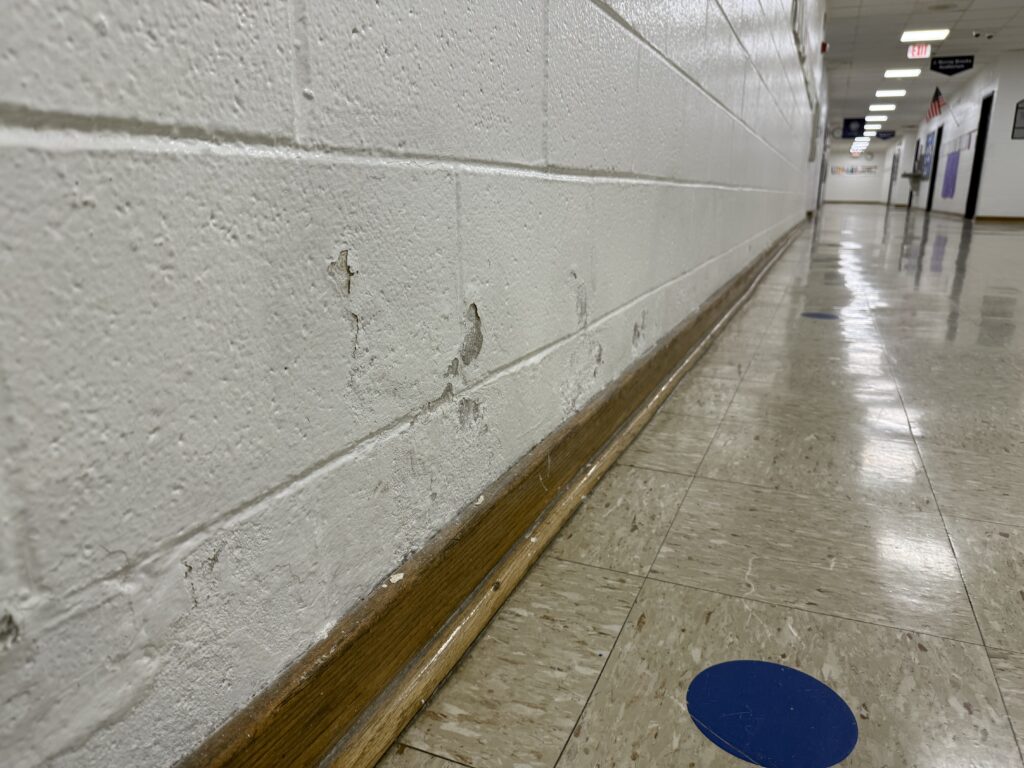
    A view of the conditions from inside one of the schools in Mathews County. (Courtesy of Mathews County Public Schools)

    A 2021 Virginia Department of Education survey found that more than half of the state’s schools are over 50 years old, with replacement costs into the billions.

    Keith Perrigan, president of the Coalition for Small and Rural Schools, hosted federal, state, and local leaders for a “Crumbling Schools Tour” five years ago that highlighted schools in need of updates or replacement.

    “Obviously, there’s a lot of work to be done, and based on our information with the Coalition of Small and Rural Schools, a large percentage of those schools that need improvements are in rural areas,” Perrigan said in a recent interview.

    “To have the opportunity to generate the revenue that it would take to improve those facilities and have taxpayers make that decision themselves is certainly, we think, a win-win for not only the commonwealth, but especially for rural schools in the commonwealth.”

    Summer school, maintenance time

    As schools prepare for summer break, some divisions are balancing maintenance projects with getting facilities ready for summer instruction.

    Henrico County Public Schools is preparing 16 sites for summer school while continuing to address persistent air conditioning and heating issues.

    “With summer academy season upon us, ensuring the comfort, well-being and ability of students and staff to fully engage in teaching and learning remains a top priority,” Mike Dunavant, a spokesperson for Henrico Schools, said in a statement, adding that “those sites will be prioritized for repair if any arise.”

    In Mathews County, Daniel said the school system will not offer summer school this year — a program that provides academic support and credit recovery — because of costs associated with buses, bus drivers, cafeteria workers and teachers, which total about $650,000.

    Instead, the division will use the summer for critical infrastructure and safety upgrades, including electrical work, HVAC improvements, lighting, boilers, and light poles.

    The middle school will also merge with the elementary and high school due to low enrollment and high repair costs.

    The tax benefits

    Last summer, Gloucester completed a $65 million renovation on its high school, likely aided by revenue from the 1% school construction tax.

    The project included roof upgrades, all-new HVAC systems and ductwork, and modernization of electrical, plumbing and stormwater systems.

    The school also added a new 1,250 kW generator to support critical operations during power outages.

    Safety and security improvements included new doors and windows, an upgraded fire sprinkler system and alarm network, and a redesigned secure main entrance vestibule.

    “The one percent has allowed us to repair an aging high school,” Gloucester County Supervisor Ashley Chriscoe said in a statement. “The excess revenue from the one percent has allowed us to add some additional projects with the excess revenue, to tackle some other qualifying projects. It has been an amazing asset.”

    Compared with neighboring Mathews County, Gloucester has substantially larger revenue-generating capacity because of its broader business sector and more diversified commercial tax base.

    Mathews, on the other hand, relies heavily on revenue from high-value waterfront property and loses residents — and shopping dollars — to neighboring localities, where they pay the one-cent sales tax on purchases made outside the county.

    “Whether that’s through the annual operations support that we get through the local composite index, the state can’t leave all of that burden on the locality because localities don’t have the same economic leverage to provide the same experiences for their kids,” Daniel said.

    “We talk about equity an awful lot, but it shouldn’t matter what your zip code is to determine whether or not you have access to all of the opportunities that kids in other zip codes would have.”

    Time crunch

    To place the referendum on the November ballot, lawmakers will have to adopt the language by June 29 so it can be properly advertised. State law requires referendums to be ordered at least 81 days before the election.

    The House is scheduled to meet again on June 18, followed by the Senate on June 22. The state also faces a July 1 deadline before government operations could shut down.

  • Virginia farmers talk meat production, fertilizer costs with USDA officials

    Virginia farmers talk meat production, fertilizer costs with USDA officials

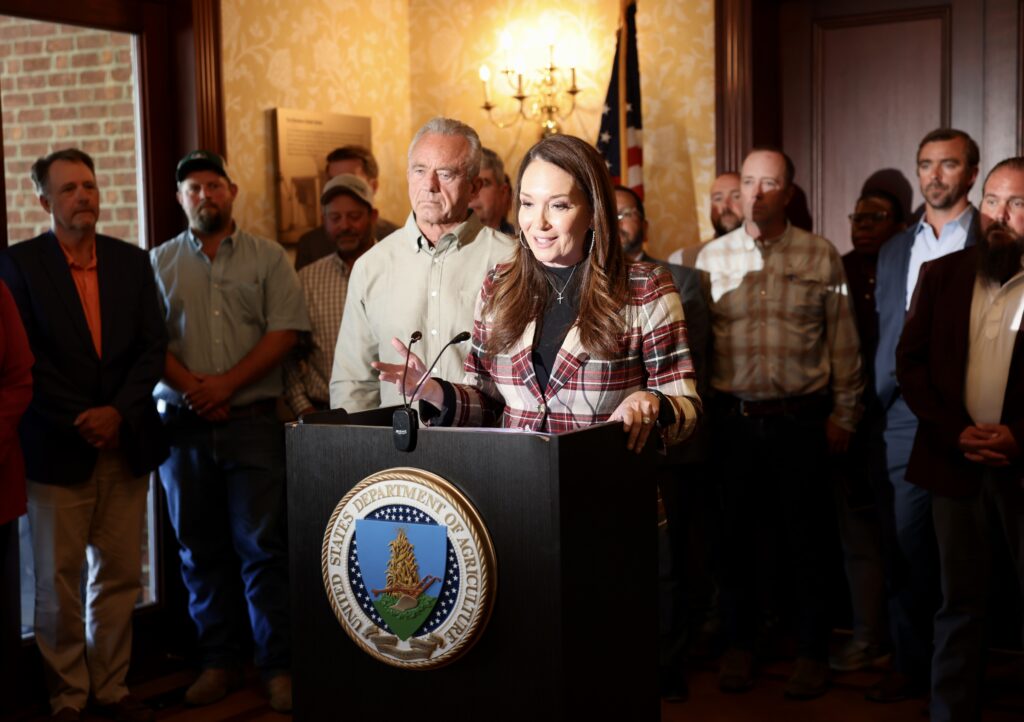
    United States Department of Agriculture Secretary Brooke Rollins and Health and Human Services Secretary Robert F. Kennedy traveled to Doswell Wednesday to meet with Virginia farmers and meat producers and discuss the challenges they face – and what the federal government can do to help.

    Limited access to local meat processors is a persistent challenge for cattle and poultry producers in Virginia and elsewhere, they said. Production facilities that are USDA approved are often overburdened with the amount of work they have.

    Rollins announced on Wednesday an action plan to reduce regulatory burdens on processors and that the fourth phase of the Meat and Poultry Processing Expansion Program has just opened.

    “Several of the comments we heard here were: why are we shipping these beautiful beef cattle from Virginia all the way to the middle of the country to get processed?” Rollins told reporters. “Obviously, this won’t change overnight. We have a country to feed, and the world loves our beef from this country, but this is the way, as we deconsolidate a lot of the processing industry.”

    The grant program, allotted $60 million in this phase, allows small meat processors to apply for grants that can aid them in buying machinery, upgrades, renovations and other needs.

    The grants range from $50,000 to $2 million for expansion projects and $10,000 to $250,000 for equipment-only applications.

    After meeting with the secretaries, the newly elected president of the Virginia Cattlemen’s Association Dave Norford said increasing the number of small processors is critical to help local producers get their products to the market.

    “There’s not a lot (of small processors). There’s some, but they stay pretty busy. So, if we had access to more of that, then I think the idea is there will be more opportunity for people to directly market their beef,” Norford said.

    Virginia farmers are also grappling with the rising cost of fertilizer. As the Strait of Hormuz remains a choke point for the global supply chain amid the Iran war, some fertilizer costs have skyrocketed about 40%. Fuel, a necessary component of fertilizer production, has also experienced a major price jump.

    This has led producers to cut back on the amount of fertilizer they buy and spread on their land, which ultimately will impact their yield for this year and next, while corn bushels are already at a low price.

    Rollins said she has met with some American-based fertilizer companies and asked them not to raise their prices during this fraught time, and outlined other measures the agency is taking to try and shore up availability of fertilizer. She said it is a long-term issue the Trump administration will continue working on.

    “For the short term, we waived the Jones Act, we opened up lines from Venezuela,” Rollins said. “I had American fertilizer companies, there (were) still a few left, come into my office at USDA and basically I said, for the good of the American farmer, will you consider freezing your prices.”

    Virginia is also in its fourth year of drier-than-normal conditions, Norford said. This year the drought persists, with an unusually warm spring and a dry winter compounding challenges to groundwater availability.

    Norford has about 1000 head of cattle at his Albemarle County farm. He said the USDA offers some programs to help farmers and herd owners with potential feed shortages due to the drought.

    “From a cattle standpoint, there’s a program that’s just come online, at least in my area, to help you with some costs,” Norford said. “They would pay you so much per head for your cattle to help you buy feed, buy hay, buy corn from a different area.”

    The USDA has several other programs aimed to help provide relief to producers dealing with drought, the leaders said.

    Rollins added that the agency is working to process Gov. Abigail Spanberger’s request for a secretarial disaster declaration, which will unleash financial aid to farmers who experienced harsh freeze and frost events earlier this year following a warm spell that set up crops to be in a vulnerable state when the cold returned.

    In addition to Rollins and Kennedy, U.S. National Advisor for Nutrition of Agriculture Dr. Ben Carson attended the roundtable event.

  • Virginia officials urge hurricane preparedness as 2026 storm season begins

    Virginia officials urge hurricane preparedness as 2026 storm season begins

    With the 2026 Atlantic hurricane season underway, Virginia officials are urging residents to prepare now for severe weather that can bring flooding, damaging winds, tornadoes and prolonged power outages across the commonwealth.

    State leaders gathered Wednesday at the Virginia Emergency Operations Center in Richmond for hurricane preparedness briefings and tabletop simulations meant to test coordination among emergency management agencies, first responders and state officials ahead of the busiest stretch of storm season.

    The Atlantic hurricane season began June 1 and runs through Nov. 30, with Virginia typically facing its greatest risk from late summer into early fall.

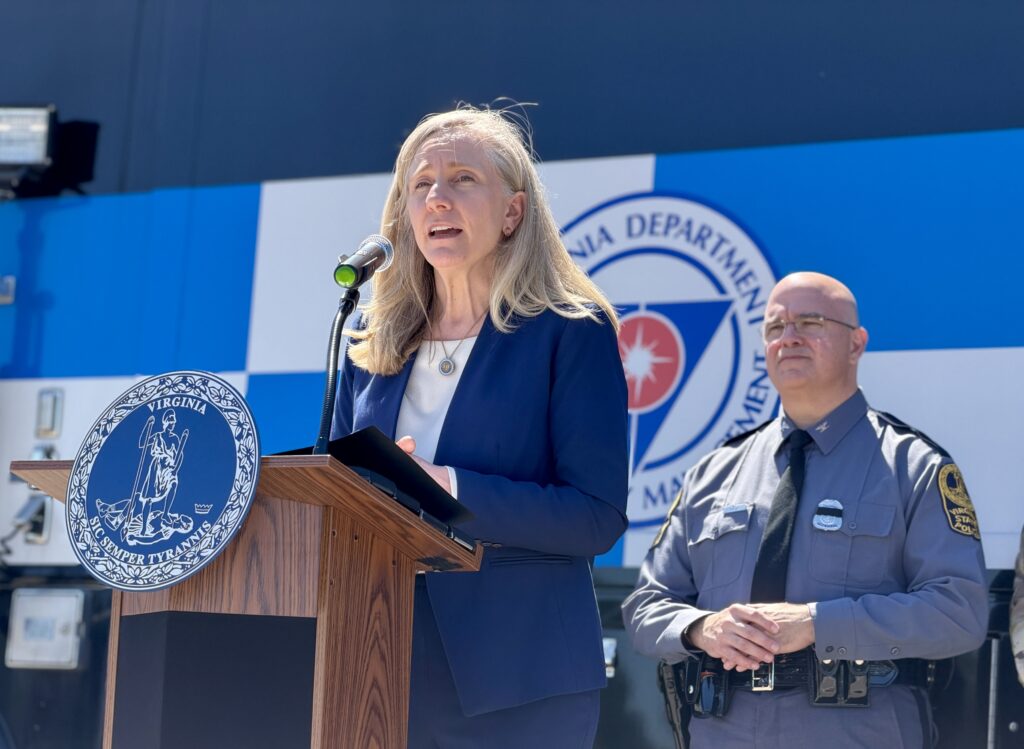
    “We spent the morning here in the emergency operations center, going through briefings and preparedness simulations,” Gov. Abigail Spanberger told reporters after the briefing. “While it is beautiful outside today, we know that now is the time for us to begin preparing.”

    Spanberger pointed to the lingering damage left by Hurricane Helene, which tore through parts of Southwest Virginia after moving inland through the Southeast in September 2024.

    “We know that storms that started in the Atlantic or the Gulf can come north and cause severe damage in Virginia,” she said. “We saw this with the devastation caused by Hurricane Helene, and communities are still working to recover and rebuild.”

    The storm caused catastrophic flooding, road washouts and widespread damage, particularly in Damascus along the Virginia Creeper Trail corridor in the southwestern part of the state, prompting a federal major disaster declaration.

    In Damascus, business is down but hopes are high one year after Hurricane Helene

    Virginia later estimated roughly $4 billion in damage statewide. Nearly two years later, some communities are still rebuilding infrastructure and tourism economies.

    Emergency management officials said preparing before storms remains one of the most effective ways to reduce injuries, property damage and service disruptions during severe weather.

    “Preparedness starts long before a storm appears on the forecast map,” said Lauren Opett, acting state coordinator of emergency management. “The best time to gather supplies, review evacuation plans, and discuss emergency procedures with your household is now.”

    Opett said residents should focus on practical steps that can be handled before severe weather threatens the state.

    “Small steps taken today can make a tremendous difference when severe weather impacts Virginia,” she said. “Our team at VDEM stands ready to support communities across the Commonwealth throughout hurricane season.”

    Emergency officials further warned that tropical systems do not need to make landfall in Virginia to create dangerous conditions. Hurricanes and tropical storms can trigger inland flooding, tornadoes, storm surge, heavy rain and power outages far from the coast.

    Spanberger also encouraged Virginians to begin by developing emergency plans for their households. That includes identifying evacuation routes, choosing meeting locations if family members become separated and signing up for wireless emergency alerts.

    “The first thing that we can all do to get prepared is to just make a plan,” she said. “If you need to evacuate this hurricane season, you can get your family to safety faster if you have already thought about what to do. Where would you go? How will you get there? And figure out how to reconnect with family if you’re not together at the time that a storm hits.”

    Residents in coastal and flood-prone areas are also being encouraged to review evacuation zones before storms threaten the state.

    Spanberger directed Virginians to KnowYourZoneVA.org for evacuation information while emphasizing the importance of building emergency kits with supplies to last at least 72 hours.

    Emergency management materials released Wednesday advises Virginians to stock flashlights, batteries, medications and other essentials. The governor urged home owners to secure loose outdoor objects, clean gutters, trim damaged tree limbs and inspect backup power equipment ahead of severe weather.

    State officials also emphasized generator safety, reminding residents to check carbon monoxide detector batteries before storms arrive and operate generators outdoors and away from homes.

    Flood insurance was another major focus of Wednesday’s briefing. Spanberger warned that many standard property insurance policies do not cover flood damage and noted that flood insurance policies can take up to 30 days before becoming active.

    “It’s better not to wait until a storm is imminently coming our way,” Spanberger said.

    Just one inch of water inside a home or office can cause thousands of dollars in damage, including repairs to drywall, flooring and furniture.

    Businesses are also encouraged to review emergency response plans, communicate with vendors about possible supply chain disruptions and protect important records and computer systems before storms develop.

    But Virginia, Spanberger said, remains prepared for hurricane season.

    “We are working together to collaborate across state agencies,” she said. “First responders, community organizations and individual Virginians are essential to our effective disaster response.”

    The Virginia Department of Emergency Management is encouraging residents to monitor trusted weather forecasts and visit VAEmergency.gov for preparedness guidance and emergency information throughout hurricane season.