Category: VA State News

  • Virginians suffer as callous, major cuts to food stamps become entrenched

    Virginians suffer as callous, major cuts to food stamps become entrenched

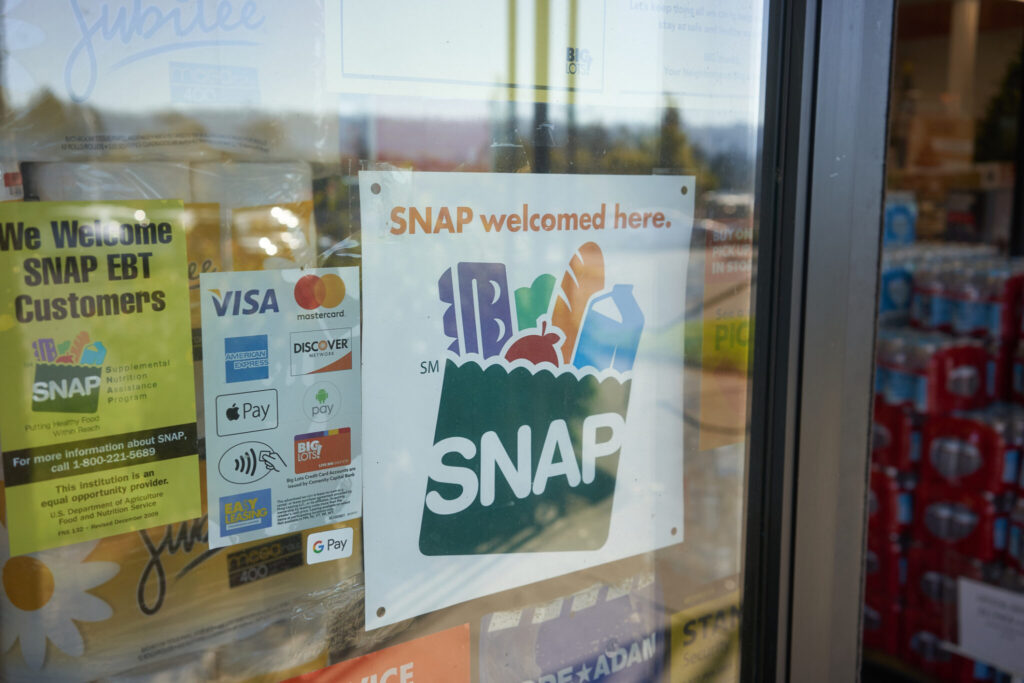
    President Donald Trump’s Darwinian food stamp modifications – abetted last year by supine Republican congresspeople whose constituents are now suffering – is working out just as critics had predicted. Low-income and disabled residents in Virginia and elsewhere are forced to choose between food, shelter, and healthcare.

    ‘Trying to do the best we can’: Va. lawmakers, beneficiaries brace for SNAP changes

    Roughly 867,000 Virginians received Supplemental Nutrition Assistance Program benefits in March 2025. The figure a year later is down to almost 754,000, a spokesman with the Virginia Department of Social Services said Friday. That’s a nearly 14% drop.

    Some $187 billion will be cut from the federal food stamps program over a decade because of the changes. It’s as if Inspector Javert is running the program.

    Don’t just take my word for the calamity these heartless cuts have caused – all to mostly benefit wealthy Americans. Listen to the people on the front lines in the commonwealth who assist the poor, unemployed and others who are overwhelmed by decreasing federal aid, a stagnant economy and higher gas prices because of the poorly planned war against Iran:

    Patrice Smallwood, chair of the board of Virginia Organizing, said Trump’s H.R. 1 bill was supposed to take money from scammers and those committing fraud to redirect money to the truly needy. “That’s not what I’m seeing,” she continued. “That was deception.

    “The biggest thing really is the propaganda … about how Virginians and people all across the country were going to be helped,” Smallwood said.

    Though some decline in enrollment occurred before H.R. 1 passed (I refuse to call it by Trump’s risible slogan), the demand on area food pantries has rocketed in recent years, said Eddie Oliver, executive director of the Federation of Virginia Food Banks. The group is a collaboration among seven regional food banks and hundreds of agency partners around the state.

    “We’ve seen a pretty steady rise in food pantry usage since 2023,” Oliver said. Some food banks are seeing all-time record demand now, he added, which was supercharged by the government shutdown late last year.

    Social worker Erika Nunez, of the Feed More food bank in Richmond, visits the St. Thomas Episcopal Church Food and Wellness Pantry in Richmond twice a month to assist people applying for SNAP benefits. Here she is working with volunteer Quentin Atkins. (Photo courtesy of the St. Thomas Food and Wellness Pantry)

    The federation notes that eight of the 10 localities with the highest rates of food insecurity are rural and concentrated in Southwest Virginia. Those areas typically select Republicans in Congress – and GOP congresspersons almost unanimously supported cuts to SNAP and Medicaid last year.

    All five Virginia Republicans in the U.S. House of Representatives – Ben Cline, Morgan Griffith, Jennifer Kiggans, John McGuire and Rob Wittman – voted to slash the social safety net. All of them are up for re-election this fall.

    Many Virginians who remain eligible for food stamps are exasperated because of stricter application and work requirements, noted Hannah Wyatt, a staff attorney who specializes in food security and public benefits with the Virginia Poverty Law Center.

    “Some are kind of just giving up,” Wyatt said.

    Able-bodied adults without dependents, for example, already faced a three-month time limit on SNAP participation if they weren’t working at least 80 hours per month. But the legislation increased the age that adults must adhere to those work requirements and time limits, from 54 years old before to 64 now.

    So older adults will be forced back into the workforce to remain eligible, even if it’s a chore because of age and general creakiness to get up, get out and get to a job.

    This is just one of the regulations in the legislation that tilt away from compassion for average Americans. The law also made eligibility stricter for non-citizens and reduced exemptions for certain requirements.

    Other states face the same problems. For example, NBC News recently reported on the upheaval in Arizona, where applicants must fight to prove their eligibility. Some were even quizzed about monetary birthday gifts sent by Zelle, and whether they were one time or recurring.

    The article told of recipients who had to turn over even more documents to prove they’re eligible – forcing people off the rolls who should get food aid. Folks needed to visit food pantries more often. The number of Arizonans getting food stamps in March was about half the total from the same time last year; 200,000 children have lost benefits, state data showed.

    The claims by toadies for the Trump administration that the new regs are ending “fraud, waste and abuse” have been illusory – especially since those receiving aid are jumping through more hurdles to receive what they deserve.

    Plus, the Center on Budget and Policy Priorities, a nonpartisan research and policy institute, previously reported that “cases of intentional fraud by participants or SNAP authorized retailers are relatively rare.”

    VDSS has published a webpage with a dedicated list of resources for SNAP participants that covers employment and volunteer opportunities, medical resources and more information.

    “The primary impact of this law on the Commonwealth is that now more families are going hungry when nobody should have to go hungry,” the spokesman said.

    Contrast the amount of documentation that SNAP recipients must provide to the lack of oversight involving repairs to the Lincoln Memorial Reflecting Pool in D.C. Trump put a proverbial thumb on the scale to help a contractor that he knew. (Trump later claimed he didn’t know the firm. But we’ve seen this story before.)

    Atlantic Industrial Coatings, a Virginia firm, received a no-bid contract, bypassing a requirement to seek competing offers – reportedly because a delay would cause “serious injury” to the government. The president wants the repairs done before the nation’s 250th birthday on July 4.

    The New York Times has reported that Trump promised the repairs would cost nearly $2 million; the total is now more than $13 million. The company also has an inflated profit margin of 20%, a government analysis found.

    Trump said he chose the company because it had worked on swimming pools at his golf club in Sterling, Virginia. He doesn’t even try to disguise his obvious conflict of interest.

    It’s too bad that millions of Americans, desperate for food, don’t have such a chummy relationship with the president. They’re just trying to survive.

    The callousness is a disgrace. Trump’s cuts are heartless and have endangered lives and livelihoods.

    The government’s contempt for the poor is a blight on our nation.
  • May rains help ease Virginia drought, but dry conditions persist

    May rains help ease Virginia drought, but dry conditions persist

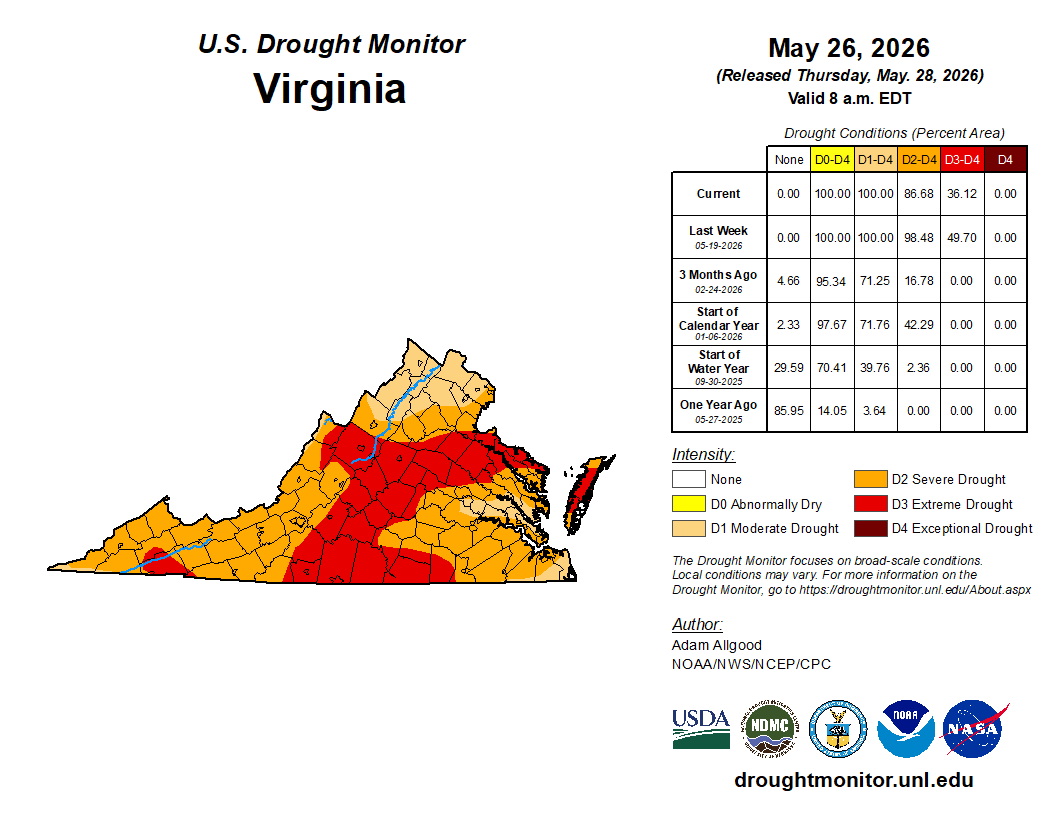
    Many parts of Virginia ended May with soaking rains after reports showed 80% of the state was experiencing “severe drought” conditions. While the rain that moved through much of the state helped ease some of the dryness, the drought remains.

    “We realized about 2-5 inches of rain throughout the commonwealth,” said Weedon Cloe, who manages the Department of Environmental Quality’s Office of Water Supply. “And that went a long way to making some short term improvements in stream flow, and precipitation.”

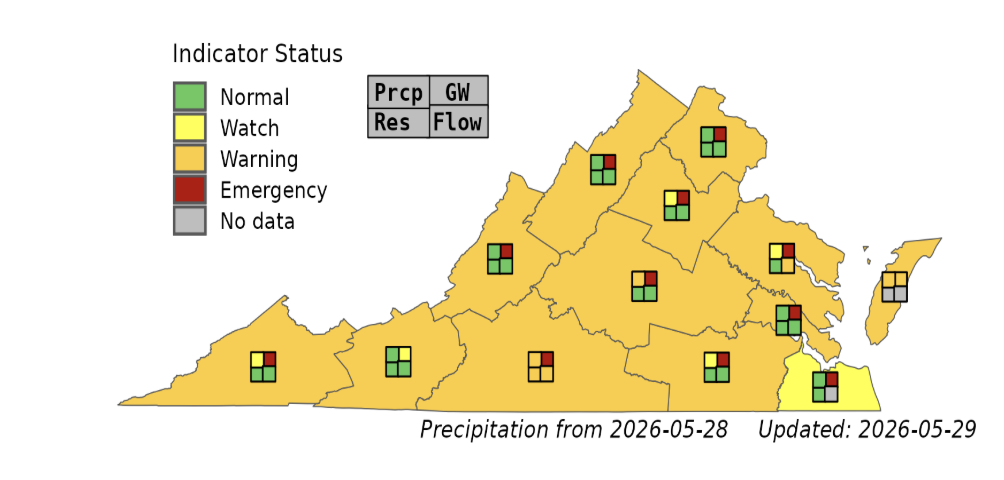
    The state is mostly classified under a “drought warning” by DEQ, but many regions spanning from Southside Virginia into the central part of the state remain in critical groundwater conditions.

    This time of year, much of the rain gets caught up in the tree canopy and is absorbed by vegetation before it can reach the water table and replenish groundwater supplies. Cloe said officials did see areas where the water table had bottomed out and received some water recharge from recent rains.

    U.S. Drought monitor shows conditions across Virginia at the end of May 2026. (U.S. Drought Monitor)

    The state experienced an overall dry winter, which left water tables lower than usual, and the dry spring hasn’t helped. DEQ reports that of the 24 groundwater monitoring wells, groundwater levels in 20 are still below the 10th percentile for this time of the year. The state is also about 7.5 inches short on precipitation for the water year that began in October, DEQ states.

    “We are limping along,” Cloe said, describing conditions leading into the final weeks of spring before summer heat intensifies.

    “I would still say it’s probably one of the driest springs, if not one of in recent history,” Cloe said. “There’s still (a) large swath of D3 (extreme) in the U.S. drought monitor punching up from the southside, up through the middle of the state.”

    Drought Indicators and key to Drought Map for the end of May 2026. (Virginia Department of Environmental Quality)

    Despite the persistent dry conditions, drinking water reservoirs remain in good condition, Cloe said. If rainfall tapers off, as forecast in the short term, and temperatures rise significantly, agencies have procedures in place to restrict water use if necessary.

    It will take more sustained rainfall to fully replenish the water table and make up for the long-term dry conditions the state has experienced.

    For a drought warning, DEQ recommends minimizing nonessential water use and beginning voluntary water conservation efforts. The agency also encourages local governments to publicly share water conservation information, continue leak detection and repair programs, and impose mandatory water use restrictions when local water supply conditions warrant.

  • What’s in the water? What we know and don’t know about data center water discharge in Virginia

    What’s in the water? What we know and don’t know about data center water discharge in Virginia

    Data centers require a massive amount of water to cool their systems, which heat up as they process digital information through numerous computers and network servers. Systems that aren’t “closed loop” have to cycle out water that doesn’t evaporate.

    Most data centers in Virginia are permitted to discharge water into municipal wastewater systems, the same place household water goes to be treated and recycled for consumption. But there’s limited data tracking of potential chemicals in data centers’ discharge water.

    At least one data center is permitted to discharge directly into a natural water source in the state: Northeast Creek in Louisa County. Another is applying for a similar permit to discharge into nearby Sedges Creek which feeds into Lake Anna.

    That water is pretreated before being released into the creek and has limits to certain metals and temperature set by the Department of Environmental Quality. But the knowledge gaps about the chemical makeup of data centers’ water discharge poses major questions over whether “forever chemicals” could be contaminating water from the facilities, posing risks to human and environmental health.

    Cooling the waters

    Amazon’s Lake Anna Tech Park project will include an evaporative water cooling system, which is what they use in the Northeast Creek location. The H2O will come from well water until industrial systems are hooked up. At that point, the water will be run through a “membrane” that cools the air and fans will blow it onto the data halls containing the computers.

    Amazon – which operates dozens of data centers in the state – explained that at the two Louisa sites they are only using the evaporation method a small portion of the year; the rest of the time they pull in air from outside for cooling. Water sent through an evaporative cooling system is considered non-contact, meaning it does not directly touch the computer equipment.

    “In Louisa County, we rely on outside natural air-cooling for about 96% of the year and only use water-based cooling during the hottest periods, which is about 4% of annual operations,” Amazon said in a statement.

    After a few cycles the water has to be released. The system dechlorinates the water and manages pH balance before sending it into the creek.

    “As part of this process, cooling water needs to be periodically discharged; this cooling water is called ‘non-contact cooling water.’ It never touches IT equipment, and it’s treated before release in alignment with state environmental standards,” an Amazon representative said.

    Larger, newer data centers are more frequently designed with “closed loop” systems, meaning they don’t take in as much water on a daily basis. Initially, hundreds of gallons of water are pumped into this type of system, much of which evaporates, and then it’s topped off as needed.

    But they take more energy to operate.

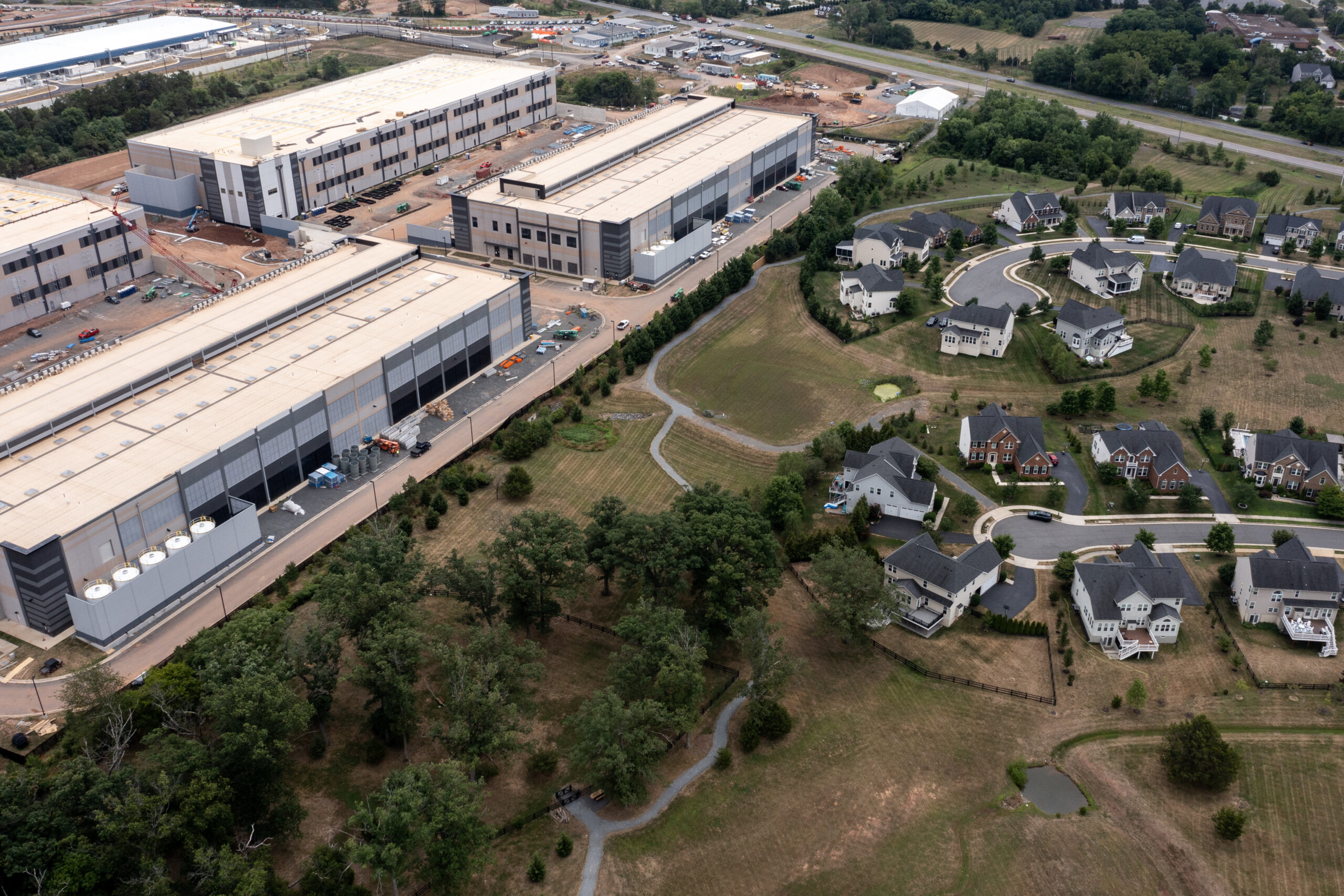
    In an aerial view, an Amazon Web Services data center is shown situated near single-family homes on July 17, 2024 in Stone Ridge, Virginia. (Photo by Nathan Howard/Getty Images)

    Closed loop systems will often use what is described as mechanical cooling or liquid cooling, where the water is recycled through the system, cooled, and placed directly on chips to bring the temperature down. The heat from those systems still has to be expelled through an HVAC system.

    The water is pretreated before being released into the creek and has limits for certain metals and temperature set by DEQ. But with recent reports showing the ubiquitous nature of per- and polyfluoroalkyl substances (PFAS) in everything from water to soil to household products, community members are increasingly worried about whether the data center’s discharge water contains them, too.

    Residents have also cited concerns over PFAS being present in the equipment inside of data centers that is used to cool the heated systems and routinely replaced every few years.

    These chemicals can have serious health impacts when people are exposed to even small amounts, such as decreased fertility, higher risk of some cancers, and weakening of the immune system.

    Virginia currently does not have requirements for the testing of the discharge water of data centers for PFAS, nor does the federal Environmental Protection Agency.

    Because the water being discharged from data centers either into wastewater systems or into the creek are not explicitly required to be tested for PFAS, it is unclear whether they are present or not.

    “We know that they may be using, not only PFAS, but other toxic chemicals. We know that they released massive amounts of water, at least to treatment works, and some of them to surface waters,” said Jonathan Kalmuss-Katz with EarthJustice, a nonprofit that litigates environmental issues. ”And beyond that, it’s just a void. There’s really a dangerous lack of information.”

    The Environmental and Energy Study Institute reports that PFAS can be present in the cooling systems that are liquid based – which is not what the Louisa Amazon data centers use. Data on how much of those chemicals are released from centers and cause pollution is minimal.

    Documents DEQ provided in response to community concerns about potential chemicals in the treated water for the Sedges Creek permit application provide some answers.

    “25% sodium hydroxide, 93% sulfuric acid, 40% sodium bisulfite, polyaluminum chloride, polymer, sulfide‐functional polymer, and 32% calcium chloride,” the agency wrote. “These chemicals are removed during the treatment process; however, Total Residual Chlorine (TRC), chlorides and pH are monitored to ensure they have been removed and that the treatment process is operating properly.”

    What Virginia allows

    Data centers that discharge their pretreated water into wastewater infrastructure have to comply with local treatment requirements and regulations. The amount of water they may unload varies by project and is determined by local leaders.

    Industry representatives emphasize that they follow local and state regulations, which do not include the PFAS testing in the water discharge.

    “Those that do produce wastewater handle it in a variety of ways in compliance with the law. Some may send their wastewater back to a municipal treatment plant, while others may treat it on site,” Nicole Riley with the Data Center Coalition said in an interview. “Some data centers are actually discharging cleaner water than they take in. In all cases, the industry takes seriously its responsibility to comply with applicable laws and regulations.”

    The permit for the Amazon data center in the Northeast Tech Campus in Louisa is allowed to discharge up to 460,000 gallons of water a day into Northeast Creek that feeds into Lake Anna.

    Under the pollutant discharge elimination system permit for that data center, operators must test monthly, and in some cases daily, for residual chlorine used in the treatment phase, as well as aluminum, cadmium, copper, zinc, hardness and pH. The water temperature must be maintained below 90 degrees Fahrenheit.

    In general, data collected over most data centers’ five-year permits must be evaluated by state regulators before the permit may be re-issued. Depending on the results, data center operators may have to make adjustments.

    “In the case of a data center, the source water, type of cooling system, and any additives used with the cooling system are key and need to be evaluated to determine the reasonable potential for a pollutant to be in the discharge,” a DEQ representative said.

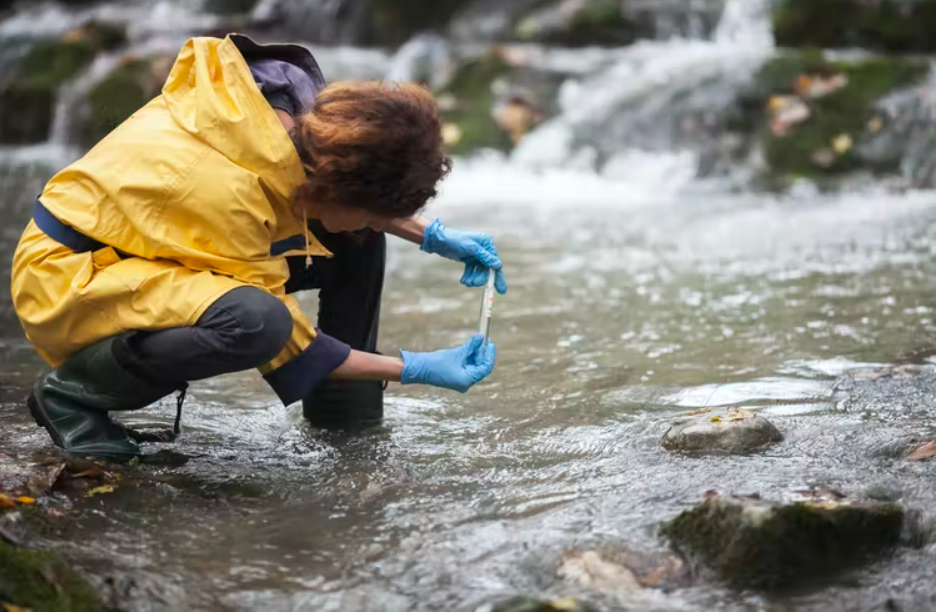
    PFAS, which pose harm to human and environmental health, also find their way into drinking water and human bodies. (Photo by CasarsaGuru via Getty Images)

    The draft permit for the additional Amazon data center in the Lake Anna Tech campus that would discharge into Sedges Creek allows up to 280,000 gallons a day. It will abide by the same standards for metals, pH, and temperature regulation.

    Amazon anticipates not needing to use the cooling system all year round. DEQ states they plan to use it “mainly in April through October of each year,” which would presumably lead to less water use than the permitted gallons. The company claims it will be even less, with only 4% of the year needing the water cooling system rather than using air from outside the facility.

    The draft permit also allows for it to be altered to potentially include PFAS testing in the future, if that is something regulators desire.

    “The permit may be reopened to incorporate changes to any applicable standard or requirement, including those related to per- and polyfluoroalkyl substances” DEQ said. It’s a step that advocates want to see the state take.

    “They can test their wastewater before they discharge it to the publicly owned treatment works (POTW) and they should be doing that. POTWs need to know what the sources of PFAS that they’re dealing with are,” Kalmuss-Katz said.

    New PFAS regulations in the works

    The General Assembly this year advanced legislation towards testing for PFAS in wastewater and trying to locate the largest polluters of forever chemicals.

    Senate Bill 138 requires public wastewater treatment facilities, industrial companies that use PFAS, airports and firefighting facilities to test their discharge for PFAS. Data centers do not currently fall under this legislation’s self reporting requirements.

    Additionally, other bills were signed into law that require biosolids — sewage sludge from wastewater treatment facilities that is converted into fertilizer for farms — to be tested for the presence of PFAS. This pairs with past legislation to track down the largest sources of PFAS that are ending up in wastewater treatment facilities.

    The Trump Administration has been adamant about expanding AI infrastructure, which includes data centers, by signing executive orders to beef up the expansion of the industry and the necessary transmission lines and power generation needed to support it.

    Subsequently, the EPA announced the fast-track review of new chemicals that are intended to be used by the data center industry for their equipment and the manufacturing of their components.

    What comes next

    For the draft permit for the Amazon data center discharge into Sedges Creek, the next public hearing will be at Louisa County Middle School on June 9, 2026 at 7 to 9 p.m. From there, DEQ will make final decisions on if they will approve the permit for the facility.

    It remains to be seen whether state or local officials will begin requiring data center discharge water be tested for PFAS and what that process might entail.