
Category: National News

  • Ceasefire reached with Iran, ending hostilities and opening Strait of Hormuz

    Ceasefire reached with Iran, ending hostilities and opening Strait of Hormuz

    WASHINGTON — President Donald Trump said Monday he had signed a ceasefire with Iran, moving the two countries one step closer to ending the war that began in February.

    Trump, speaking from the G7 conference in Europe, said the memorandum of understanding ensures Iran cannot possess a nuclear weapon and clears the way for ships to move through the Strait of Hormuz without paying a toll.

    Trump added he would like the U.S. and Iran to develop a more collegial diplomatic relation in the months and years ahead as additional details of the agreement are worked out.

    “Hopefully it’s going to be a good relationship and we’re going to get along,” he said. “And if we don’t, we go back to where we started but I don’t think that’s going to be necessary.”

    Trump said he expects the memorandum of understanding to pave the way for economic sanctions relief subject to several conditions. That document should be released publicly sometime after Friday, when Vice President JD Vance is scheduled to attend a ceremonial signing.

    One potential obstacle to a longer-term deal could be the ongoing Israeli war in Lebanon, which Pakistani Prime Minister Shehbaz Sharif wrote in a social media post is part of the agreement between the U.S. and Iran.

    “Both sides have declared the immediate and permanent termination of military operations on all fronts, including in Lebanon,” Sharif wrote.

    He added that a ceremonial signing event had been scheduled for Friday in Switzerland.

    “With the agreement now in place, mediators will facilitate a series of meetings this week,” Sharif wrote. “These pre-implementation discussions will lay the foundation for the technical talks and the official signing ceremony.”

    Trump said from the G7 conference that he would look into ways to end Israel’s war in Lebanon, but didn’t say that is part of the United States’ agreement with Iran.

    “We do want to see if we can straighten out the Lebanon thing because it just seems to just never end,” Trump said. “And that’s a mini version of what we were doing, but it should not be tough. So, Hezbollah we have to have a little talk with them.”

    Israel not part of agreement

    Israeli Prime Minister Benjamin Netanyahu said a couple hours after Trump spoke that he didn’t plan to withdraw troops from Gaza, Lebanon or Syria.

    “I’d like to clarify, we will stay there in the security zone as long as it takes in order to protect our country,” he said, according to a translator.

    Netanyahu added during his brief remarks that he believed the joint military campaign against Iran prevented that country from developing a nuclear weapon.

    “The most important thing is that we saved the state of Israel from clear and present nuclear danger because Iran was running toward it,” he said.

    But Netanyahu indicated his country’s military would not pull back in the days or months ahead, saying “the struggle has not finished yet.”

    “Today after we achieved all of that, there are those who want to belittle it and cancel these achievements and I’m telling you we are about to achieve many more great things and to eliminate threats,” Netanyahu said.

    The remarks were somewhat different from those posted earlier in the day by the Israeli minister of national security who appeared to oppose the agreement between the U.S. and Iran.

    “Trump’s agreement does not bind us,” Itamar Ben-Gvir wrote in a social media post. “Israel is not subject to the United States, and we are an independent and sovereign nation!”

    Israel and the United States began the war in Iran together, but the Israeli military has also struck targets and taken territory inside Lebanon during the past few months.

    Framework for peace

    Trump’s comments came just after two senior U.S. officials, who did not wish to be identified by name, told reporters on a call organized by the White House that Vance and Iran’s parliamentary Speaker Mohammad-Bagher Ghalibaf also signed the MOU.

    That document, one official said, creates a framework for how both countries will operate during the next few months as talks over some of the more complicated aspects continue.

    “The basic way it works is the more that the Iranians are willing to work with us on their nuclear program, on verifying that they’re not building a nuclear weapon, on not funding radicalism and terrorism in the region, the more that they’re going to be welcomed into the world economy through a combination of sanctions relief and other economic measures,” the official said.

    That official said it would take some time for oil tankers and other ships to operate in the Strait of Hormuz the way they did before the war due to the mines Iran placed in those waters during the past few months.

    “Some crews are ready to go now, and in fact, have been going over the last couple of weeks,” the official said. “Some crews want to see a little bit more stability for the next couple of days, maybe the next couple of weeks. But you will see a significant increase in traffic in the Strait of Hormuz.”

    The official noted the relationships built between negotiators from both countries could lead to a new phase of diplomatic relations that hasn’t occurred since before the Iranian revolution in the late 1970s.

    “One of the really cool things and interesting things about this entire process is that we actually have a direct relationship with a number of people at the highest levels of the Iranian government,” the official said. “That really hasn’t happened in 47 years of our relationship with Iran. And I think it’s one of the reasons why we’ve made significant progress and understood, you know, where they’re willing to give and where we still have some wood to chop.”

    The official said the heightened U.S. military presence will remain in the region as negotiations take place over how exactly inspectors can ensure Iran doesn’t try to rebuild its nuclear program.

    “The agreement contemplates the reduction of military forces in the region upon the agreement of a final deal, which again is the agreement that we assume we can make, so long as the Iranians make some concessions and give up some of their activities and some of their nuclear program,” the official said.

    Sanctions and Iran nuclear program

    The United States, so far, has not unfrozen any seized Iranian assets or lifted any sanctions, though that will likely change in the months ahead.

    “The way that I think about this is, Iran’s nuclear weapons program has been systematically destroyed. In order to rebuild it, they need a lot of money, and this deal really has two pathways,” the official said.

    “Option one for Iran is they don’t get any money, and so they don’t have the resources to rebuild their defense industrial base or the nuclear weapons program,” the official added. “Option two is they are invited into the world economy with all the prosperity that comes along with it, but only if they provide us the enforcement and verification mechanism to ensure they’re not going to rebuild that nuclear weapon.”

    The second official on the call gave a faster timeline for releasing text of the memorandum of understanding than the president, saying it would be shared publicly within 24 to 48 hours.

    “You’ll see in the MOU, we discussed the possibility of releasing frozen funds, sanctions relief, you know, a big $300 billion fund to rebuild their country,” the second official said. “And all of these things are going to be tied to performance.”

    That second official added this is “just the first MOU” and that negotiators from the U.S. and Iran are going to begin “technical discussions later this week.”

    The second official said that Israel withdrawing its troops from Lebanon “was not a condition” of the current deal between the U.S. and Iran.

    “The deal is a ceasefire. And it will not be a one-way ceasefire, meaning that if Iran is not able to control Hezbollah, and if they attack Israeli positions or Israeli towns, Israel will have the right to defend themselves and respond,” the second official said.

    There is hope within the Trump administration, the official said, that talks between Israel, Lebanon and Secretary of State Marco Rubio would also lead to a ceasefire in that war.

    “The first point in the MOU talks about how Iran and its allies and America and its allies seek to have a ceasefire and end hostilities, end the war and hopefully have a final peace that hopefully will include a lot of these proxy groups,” the second official said. “And hopefully this will help us get the Israel-Lebanon normalization and peace done properly.”
  • A US spying law expires amid distrust of Trump moves on national security

    A US spying law expires amid distrust of Trump moves on national security

    WASHINGTON — For the first time in nearly two decades, Congress missed a deadline for reauthorization of a key surveillance authority, raising questions about whether the U.S. government can continue to monitor certain communications.

    Lawmakers have regularly approved short- and long-term extensions for Section 702 of the Foreign Intelligence Surveillance Act since 2008, clearing the way for intelligence agencies to collect and analyze electronic communications from people living in other countries.

    The government says it uses the program to secure information that can protect the United States or its citizens from attacks by foreign powers, terrorism, weapons of mass destruction, the trafficking of illegal drugs and other threats.

    Intelligence agencies aren’t supposed to target U.S. citizens but lawmakers across the political spectrum and civil liberties organizations have repeatedly raised grievances with how officials handle the information they get when an American is part of a targeted conversation.

    Even though lawmakers let Section 702 lapse on June 12, the annual certification from the court that oversees the program should allow intelligence agencies to keep collecting data, experts say.

    Kia Hamadanchy, senior policy counsel at the American Civil Liberties Union, said during an interview with States Newsroom that Congress included a safety net in a previous authorization that planned for this exact scenario.

    “We feel pretty confident that there will be no immediate consequences,” he said. “The way the statute is crafted, it basically says if there is an existing certification, you can continue Section 702 surveillance until that certification expires.”

    That won’t happen until March 2027.

    Senate Judiciary Committee Chairman Chuck Grassley, R-Iowa, agreed with the assessment there are safeguards in place, but he contended members of Congress should not have taken the risk of letting that section of the Foreign Intelligence Surveillance Act expire.

    “There’s a dangerous assumption that the program will function seamlessly if this statute expires on Friday,” he said. “While I hope the certifications issued a few months ago will still apply in the event of the statute lapsing. This is not a certainty. There will be high-stakes litigation and a very real possibility that intelligence collection will cease at least temporarily. And in this work of intelligence gathering, minutes do matter.”

    Pulte announcement

    Republicans and Democrats have worked for the past few months to broker consensus on another years-long reauthorization with overhauls. Those negotiations included significant debate about what the government should do when Americans are part of the conversations swept up by intelligence agencies.

    But President Donald Trump’s announcement that Bill Pulte would temporarily run the Office of the Director of National Intelligence following Tulsi Gabbard’s exit raised concerns on Capitol Hill and stopped negotiations.

    Democrats said someone trustworthy must lead the ODNI even for a brief amount of time, while Republicans argued the two issues shouldn’t be linked and that letting Section 702 lapse represents a national security risk.

    Senate Select Committee on Intelligence Chairman Tom Cotton, R-Ark., said not extending the program for a few weeks while lawmakers work out their differences on a longer-term bill could have severe, even fatal, consequences.

    “Well over half of every item in the president’s daily brief is derived from Section 702,” he said. “It has stopped terrorist attacks, it stopped the flow of deadly drugs into our country, it’s protected our troops overseas, it’s allowed us to rescue troops overseas.”

    Senate Minority Leader Chuck Schumer, D-N.Y., contended that having Pulte temporarily run the ODNI even though he has “zero relevant experience” would place “Americans in danger.”

    “We need real leadership in the intelligence community, not a national security novice sent to undermine the work of intelligence professionals,” he said.

    Schumer added that Pulte couldn’t be expected “to speak truth to power, to conduct objective analysis, to resist efforts to politicize the intelligence community in a job where facts are so important, and the president knowing the real facts are so important.”

    Trump’s choice of Jay Clayton as his official nominee for the role June 11 as both chambers of Congress ended their work week didn’t ease concerns or clear the way for a short-term extension of Section 702.

    “Pulte has to go. He cannot be in the DNI role,” Schumer said. “Our national security is too important.”

    More problems

    Pulte’s short-term assignment, however, isn’t the only roadblock to a long-term reauthorization.

    Oregon Democratic Sen. Ron Wyden said substantial changes must be made and that “there just have been too many abuses of Americans’ rights across multiple administrations” under the authorities provided by Section 702.

    “Every day that 702 is in effect without reforms is a day that Americans’ rights are under threat,” he said. “I believe Americans deserve new guardrails. If Congress is going to extend these authorities, and that is what we’re talking about, those guardrails are essential. And at a minimum, Americans deserve transparency about how these surveillance powers have been abused.”

    The House Freedom Caucus, a group of far-right Republicans led by Maryland Rep. Andy Harris, has also pressed for overhauls.

    “Congress can, and should, continue seeking reforms to Section 702 without endangering national security,” it posted on social media. “Necessary reforms – including warrant requirements for searching Americans’ private communications, consistent with the Fourth Amendment – can also be passed by Congress without endangering national security.”

    The Freedom Caucus added that it’s “nonsense” for anyone to “claim that once Section 702 expires, lawsuits by communications and tech companies could suspend intelligence collection.”

    Court certification

    One of the reasons some members of Congress have raised dire concerns about a lapse of Section 702 even with the certification in place is to lobby for a years-long reauthorization, Hamadanchy of the ACLU said.

    “They’re trying to use that fear-mongering to force people to vote for something that they may not like otherwise,” he said.

    The sense of urgency created by waiting until the last minute to hold floor votes on a reauthorization bill and raising the possibility of terrorist attacks, Hamadanchy said, can also be used to prevent amendment votes.

    That, for example, could block floor debate on whether to require a warrant for Americans’ data that does get collected as part of other Section 702 surveillance.

    “There’s been repeated requests under both administrations of both parties in terms of that number of Americans. They’ve never told us,” Hamadanchy said. “But what we do know is they routinely search through that database for the communications of Americans without a warrant.”

  • Details on removal of nuclear materials from Iran to be worked out as deal to end war nears

    Details on removal of nuclear materials from Iran to be worked out as deal to end war nears

    WASHINGTON — The Trump administration still needs to determine how it will remove nuclear materials from Iran after officials from both countries sign documents to end the war, a senior official said Friday.

    “This is very combustible stuff, very volatile stuff. We’re not just going to, like, go down there with a backhoe and a guy with a backpack and start taking it out,” the official, who did not want to be identified by name, said on a call with reporters organized by the White House. “The technical details need to be figured out, but I think there’s a commitment to do that.”

    Iranian Foreign Minister Seyed Abbas Araghchi wrote in a social media post a few hours before the call that a memorandum of understanding with the United States “has never been closer.”

    “Pending its finalization, the media should refrain from entering speculation about its content,” he added. “In line with our responsible and transparent approach, all details will be shared with the public in due course.”

    The officials’ comments came one day after President Donald Trump said negotiators had “just made a great settlement of the war with Iran” that would be “subject to finalization of documents” over the next few days.

    Possible meeting in Europe

    The U.S. official said the administration is 80% to 85% sure leaders from the two countries would gather sometime this month to sign a memorandum of understanding to end the war, possibly in Europe.

    Those documents will create a framework to reopen the Strait of Hormuz, destroy enriched nuclear materials and establish inspections to ensure Iran doesn’t possess a nuclear weapon, the official said.

    The MOU will also start a 60-day technical negotiation where leaders from both countries work out more specifics of what the United States wants to see Iran accomplish in order to lift economic sanctions, the official said.

    The step-by-step process with verification requirements is designed to build trust and “accomplish something meaningful for both Iran and the United States of America,” the official said.

    “I don’t think the Iranians trust us and I don’t think the United States trusts the Iranians,” the official said.

    Whether or not Iran could have a civilian nuclear program for energy production will remain to be seen, though the official didn’t entirely rule it out.

    “We’re not bothered at all by the idea of civilian power plants in Iran,” the official said. “What we’re bothered by is the type of infrastructure that would allow them to jump from civilian power generation to nuclear weapons development and that’s what they’ve had for a very long time.”

    Ashley Murray contributed to this report.

  • After local missing teen case, Indiana congressman aims to expand Amber Alert guidelines

    After local missing teen case, Indiana congressman aims to expand Amber Alert guidelines

    WASHINGTON — U.S. House Rep. Rudy Yakym is pursuing changes to the nation’s Amber Alert notification system after a 17-year-old girl from his home state of Indiana went missing and was later found dead.

    The Republican has introduced legislation named for the victim in the case, Hailey Buzbee of Fishers, Indiana. It would allow police to issue Amber Alerts, which widely publicize missing children cases, for all children under 18 thought to be “high-risk missing persons.”

    Currently, alerts only go off for individuals confirmed by law enforcement as abducted and recognized to be in immediate danger, according to a press release announcing Yakym’s bill.

    An Amber Alert for Buzbee was never issued because her disappearance was classified as a runaway rather than an abduction, the press release added.

    “I spoke with Hailey’s parents this week,” Yakym said in a statement to States Newsroom. “They are some of the bravest, strongest people I’ve ever met, turning the most unimaginable pain a parent can feel into action so no other family has to go through what they’ve been through.”

    Hailey’s case

    Buzbee went missing from her home in early January and was pronounced dead nearly a month later after her remains were found in an Ohio forest.

    Hailey Buzbee. (Photo courtesy of Buzbee family)

    Hailey Buzbee. (Photo courtesy of Buzbee family)

    Authorities say she was taken away and later killed by Tyler Thomas, a 39-year-old man from Columbus, whom they say she’d met playing video games online.

    “Her family knew she was in danger. Her community knew she was in danger,” Yakym said. “But because there was no confirmed abduction, no AMBER Alert went out — and because she didn’t have a qualifying disability, a Silver Alert didn’t apply.”

    Thomas has since been charged with “sexually exploiting a minor and traveling interstate with the intent to engage in illicit sexual conduct,” according to a press release from the U.S. Attorney’s office for the Southern District of Ohio.

    He would face up to 30 years in prison if convicted on those charges, the release said.

    State laws

    The case has attracted much publicity and led state lawmakers in Indiana and Ohio to introduce bills aimed at making online forums a safer place for minors.

    Indiana Gov. Mike Braun, a Republican, signed a law April 1 that places parental consent requirements, age-verification guidelines and algorithm limits on certain social media platforms for children under 16.

    He then approved a law that strengthens penalties for child exploiters.

    In Ohio, two state senators are moving to present a bill that would require parental approval and increase safeguards for children on online gaming platforms. The measure would also create an enhanced version of the Amber Alert notification and work to educate young people about grooming.

    Hailey’s parents, Beau and Ronya Buzbee, have been heavily involved in both states’ legislative efforts. They are now working with Yakym to get the HAILEY Act passed.

    “Real change for families like ours — who just want to keep our children safe — is now one step closer,” the Buzbee family said in Yakym’s press release. “We strongly encourage the U.S. House of Representatives to pass this commonsense legislation that could protect the next child before it’s too late.”

    “The system that’s supposed to protect kids didn’t have a box to put her in,” Yakym said. “That cost her life.”

  • Judge allows UFC cage matches to go ahead on White House lawn

    Judge allows UFC cage matches to go ahead on White House lawn

    The Ultimate Fighting Championship cage matches set to take place on the White House South Lawn on Sunday will go on as scheduled, a federal judge in Washington, D.C., ruled Friday.

    U.S. District Judge Amit Mehta denied an emergency petition from two Virginia plaintiffs to stop the fight until the court litigates allegations that the Trump administration illegally allowed the Las Vegas-based sports promotion company to build its towering structure, called “The Claw,” on the White House grounds, and use the Ellipse and Lincoln Memorial for related events.

    UFC began constructing the 92-foot-tall, 154-foot-wide steel staging area on May 26, and corporate organizers were placing the final touches on the temporary 4,300-seat structure this week.

    According to government court filings, organizers expect up to 120,000 guests to watch the fights on large screens on the Ellipse in addition to the guests under “The Claw.”

    In all, organizers have spent $60 million on preparation for the event, which is part of the Donald Trump administration-organized “Freedom 250” celebration — separate and apart from the bipartisan “America250” governed by a congressional commission — to mark the country’s 250th anniversary.

    In a 15-page order, Mehta wrote that the plaintiffs’ “unreasonable delay in filing suit, though not dispositive, undercuts their claims of irreparable harm.”

    “The public has known that the White House would be hosting a UFC fight event since President Trump first announced it in July 2025. Equipment and materials for the event began arriving at the White House around May 20, 2026, … and construction of the Claw began six days later. Plaintiffs, however, waited until June 7, 2026 — more than two weeks after visible preparations commenced at the White House — to seek emergency relief,” according to the order.

    Additionally, Mehta wrote that the plaintiffs’ claims of harm — aesthetic and First Amendment — are not irreparable because they are “decidedly temporary.”

    White House spokesperson Davis Ingle praised the ruling.

    “The court rightly rejected an untimely and frivolous effort to halt the historic UFC event hosted to honor the 250th anniversary of our Nation. The White House is thankful for this correct decision and looks forward to hosting this once-in-a-lifetime celebration on the South Lawn,” Ingle said in a written statement to States Newsroom.

    Brendan Ballou, founder of the Public Integrity Project, an anti-corruption legal advocacy organization that represented the plaintiffs, said the decision wasn’t the one they wanted.

    “This isn’t a case about a sporting event, it’s about corruption, as a handful of people and companies stand to profit from our public monuments. While we’re disappointed in this decision, we of course respect it, and we’ll keep bringing cases to raise the cost of corruption in America,” Ballou said in a written statement to States Newsroom.

  • Judge blocks Trump’s ‘anti-weaponization’ fund until government agrees it’s been dissolved

    Judge blocks Trump’s ‘anti-weaponization’ fund until government agrees it’s been dissolved

    ALEXANDRIA, Va. — A federal judge in the Eastern District of Virginia issued a preliminary injunction Friday halting the Trump administration’s nearly $1.8 billion “anti-weaponization” fund for one week, giving the government time to sign a “clear, unambiguous” agreement that the fund is dead.

    U.S. District Judge Leonie Brinkema said from the bench the agreement must be signed by acting Attorney General Todd Blanche and Treasury Secretary Scott Bessent.

    “The balance of harms tips in the favor of the plaintiff,” said Brinkema, a Clinton administration appointee.

    Brinkema had already temporarily blocked the fund on May 29 on an emergency basis.

    The prospect that the fund would pay Trump’s supporters, including those who assaulted police officers during the Jan. 6, 2021, U.S. Capitol riot, sparked multiple lawsuits, including the filing in Virginia.

    Challengers included a former Department of Justice Jan. 6 prosecutor who was fired last year and a protester at an immigration raid last year who was charged with a felony, and has since been acquitted by a jury. The plaintiffs are represented by the legal advocacy groups Democracy Forward and Common Cause.

    The Department of Justice announced the creation of the fund, in the amount of $1.776 billion, on May 18 in exchange for President Donald Trump voluntarily dropping his $10 billion lawsuit against the IRS for the leak of his tax returns nearly seven years ago.

    Issue not moot, judge says

    During a hearing that lasted less than an hour, Brinkema swiftly called Andrew Block, senior counsel to the U.S. associate attorney general, to speak first.

    “You’re a brave man, Mr. Block. You’re all by yourself. Frankly, you’re in the hot seat,” Brinkema said, noting that Block was the only representative for the government in the courtroom.

    Brinkema kicked off questioning by asking Block if he’d had a chance to find an answer to why Blanche has not formally rescinded the “anti-weaponization” fund in writing.

    The question had been posed to Block by U.S. District Judge Richard Leon in U.S. District Court for the District of Columbia less than 48 hours ago during a hearing for a separate lawsuit against the fund. Block, who also appeared alone before Leon, told the judge he did not know the reason Blanche had not issued a written order.

    “Do you have an answer to that question now?” Brinkema asked.

    “Your honor, I don’t. I don’t have the ability to speak to the AG,” he responded.

    As he did in federal court June 10, Block argued that Blanche testified publicly before Congress that the administration was not moving forward with the fund, and that Blanche had signed legal briefs on the matter.

    Acknowledging those arguments, Leon denied an emergency request to block the fund, saying the case appeared “moot.”

    Brinkema, however, said she does not agree with Leon’s assessment.

    Doubting whether any of Blanche’s verbal or written statements to stop the fund had been made under penalty of perjury, Brinkema said, “that means the issue, in my view, is not moot.”

    Brinkema also cited Trump’s public comments praising the fund, even after Blanche’s declaration it would not move forward.

    “When the president of the United States says he’s going to be disappointed if something doesn’t happen, that’s a pretty good indication that it (could) happen,” Brinkema said.

    “There are a lot of people out there who think this fund is up and running,” she added.

    Block responded: “People may think a lot of things.” He said “what I can tell you” is that no commissioners have been appointed to the fund to establish a claim system.

    No lawful business restrained

    Block, as he did before Judge Leon, dismissed the plaintiffs’ allegations as “what-ifs,” based on a “loose factual record that is premature.”

    Referring to the departments of Justice and Treasury, Brinkema asked, “What injury do they face if the court issues a preliminary injunction at this point?”

    Block argued any temporary order to block the fund would mean the government was being “restrained” in conducting business.

    “You think this is lawful business? This is a serious issue,” Brinkema said, adding the “only reason this fund exists” is because it’s a settlement in the president’s IRS case, which is “under severe scrutiny.”

    U.S. District Judge Kathleen Williams, in the Southern District of Florida, has asked for the government’s response by day’s end to a May 27 request from 35 former federal judges to reopen the case. The judges allege the government deceived the court by not sharing all details of the settlement.

    Blanche on Capitol Hill

    The Department of Justice declined to comment Friday.

    The department maintains the fund does not exist, based on Blanche’s June 2 statements before a House Appropriations subcommittee that the department was “not moving forward with the fund, period.”

    Skye Perryman, president and CEO of Democracy Forward, wrote in a statement the “ruling is a significant victory for the Constitution, the rule of law, and people in America.”

    “The court recognized the serious legal concerns raised by the Trump-Vance administration’s attempt to create a secretive, taxpayer-funded compensation program,” she continued. “Despite the administration’s shifting explanations about the future of the slush fund, the court’s order ensures that taxpayer dollars cannot be distributed through this unlawful scheme while the courts fully consider the serious constitutional issues at stake.”

  • Corporate logos abound on White House grounds in prep for fights by Trump-allied UFC

    Corporate logos abound on White House grounds in prep for fights by Trump-allied UFC

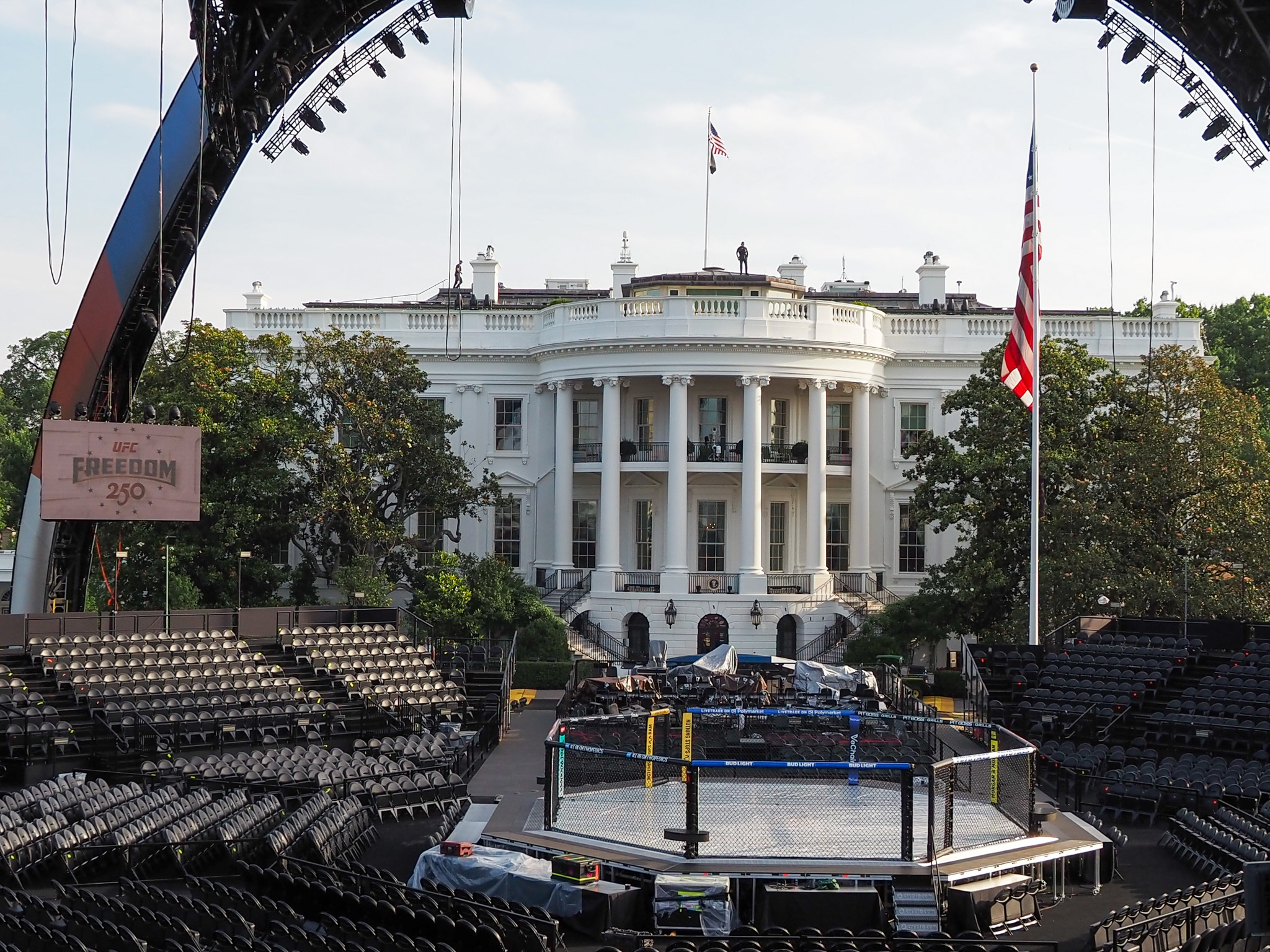
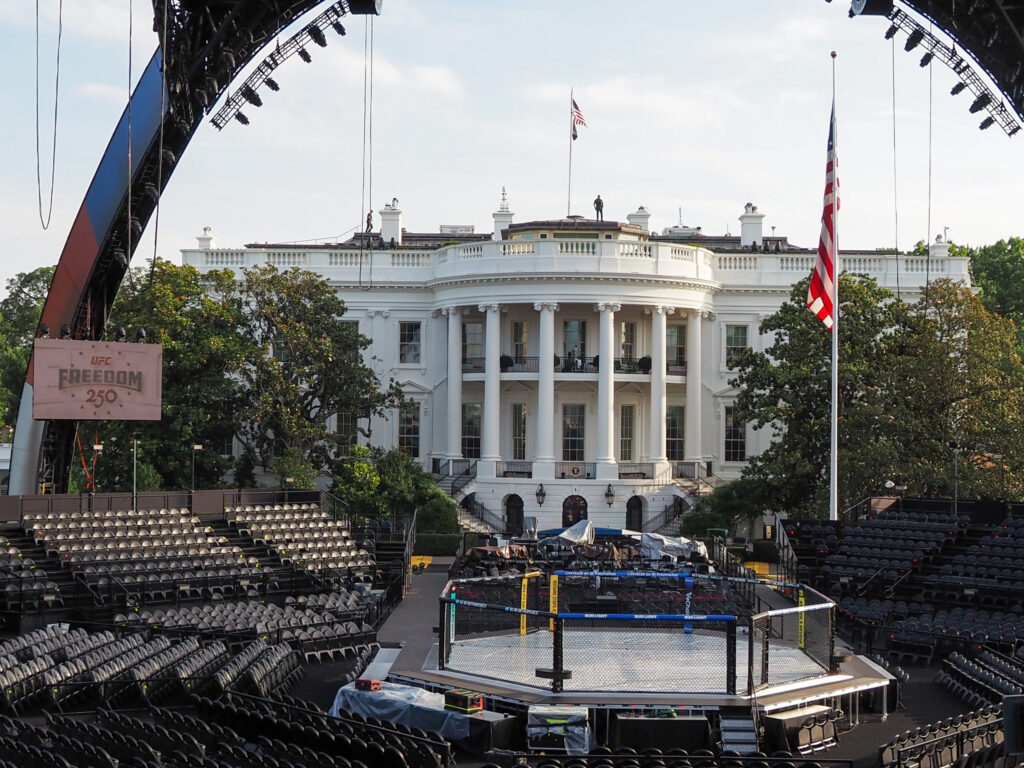
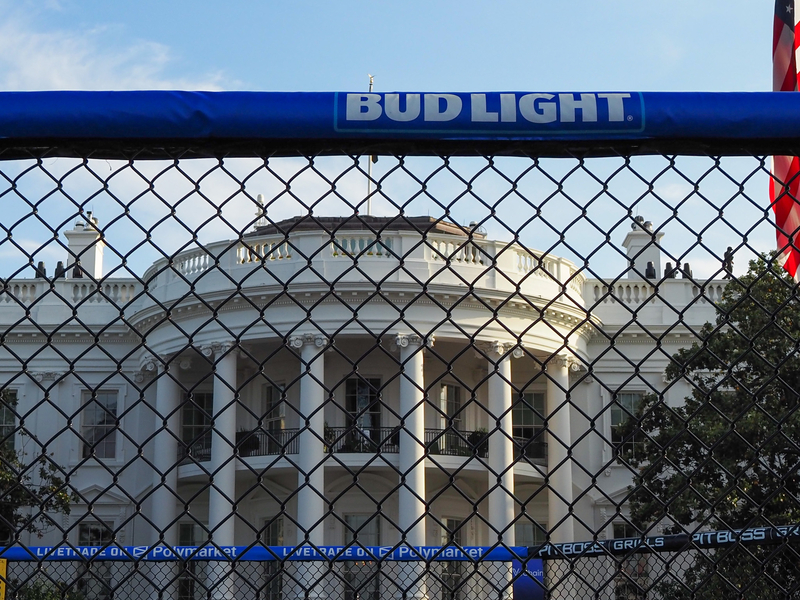
    WASHINGTON — Advertisements for Polymarket and Bud Light lined an eight-sided cage on the White House grounds Thursday ahead of a series of mixed martial arts fights scheduled for Sunday, President Donald Trump’s 80th birthday, and billed as a celebration of America’s 250th birthday.

    The Las Vegas-based Ultimate Fighting Championship company, whose chief executive is an ally of the president’s, will stage the seven-fight card that has drawn curiosity, outrage, a legal challenge and lots of money.

    The organization, led by Dana White, who delivered primetime speeches for Trump at the last three Republican National Conventions, is expecting over 65,000 fans at the two-day festival on the Ellipse beginning Saturday.

    The event reportedly cost $60 million, according to a government court filing. VIP sponsorship packages, including a chance to sit cage-side under “the claw” on the lawn of what’s often referred to as “The People’s House,” could cost up to the widely reported price tag of $1.5 million.

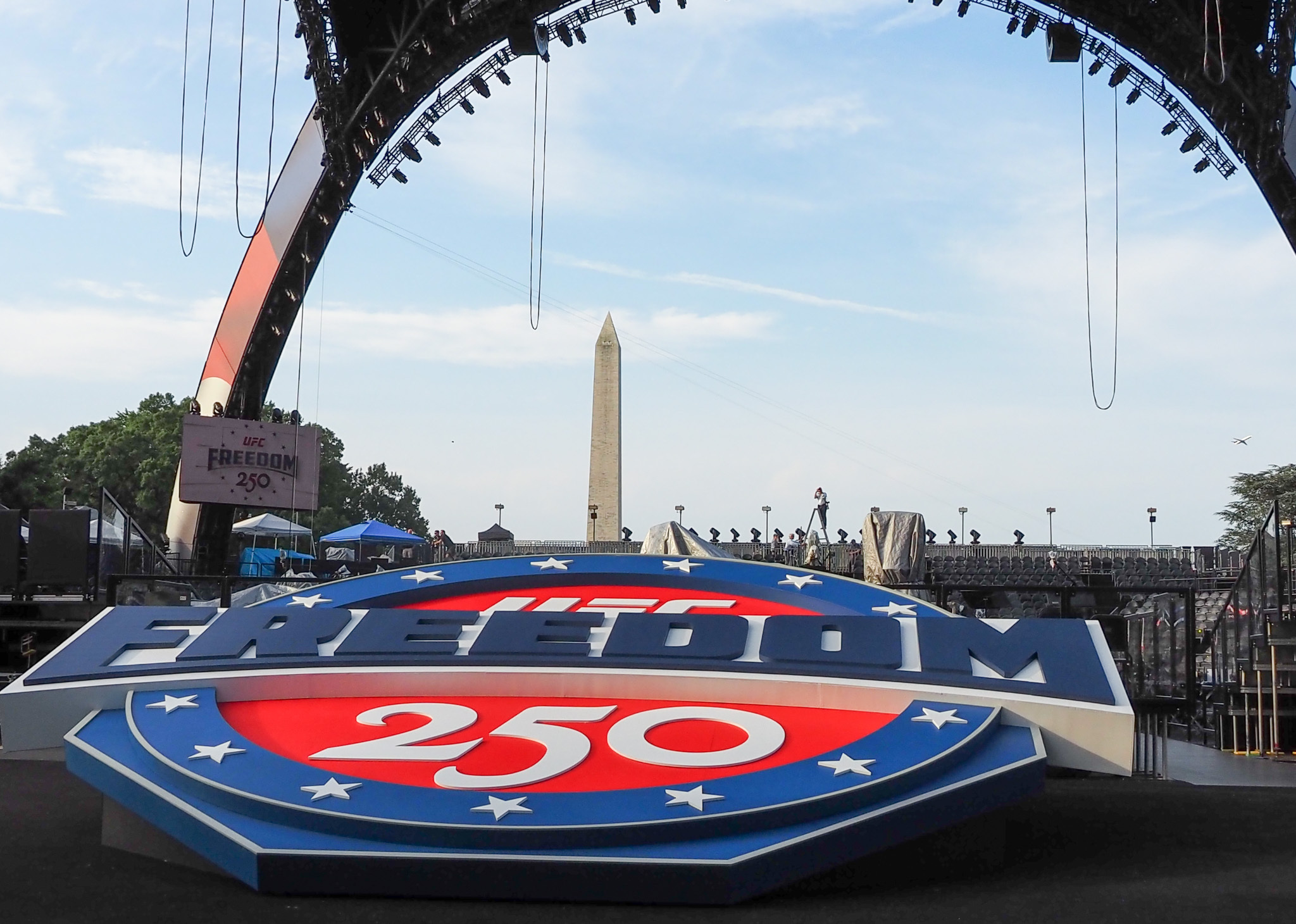
    Corporate organizers were laying finishing touches this week on a 92-foot red, white and blue structure that towers over the White House and reaches a radius around the fighting “octagon” — still under protective covering — to fit roughly 4,300 exclusive seats.

    Space for tens of thousands more spectators who can watch the fights on large screens is designated on the Ellipse, which will be open only to ticketholders and UFC-approved media. Up to 120,000 fans who scored free tickets in a lottery are expected, according to the administration. Additionally, the administration has invited 1,000 members of the armed services.

    The event, which is billing itself as “UFC Freedom 250,” is not affiliated with the national nonpartisan organization America 250, a commission created by Congress to mark the nation’s semiquincentennial.

    A June 10 promotional UFC article described the event as a “celebration of how far mixed martial arts has come and how deeply the UFC has embedded itself into mainstream sports and culture.”

    The main card will feature lightweight title champion Ilia Topuria up against interim champion Justin Gaethje and a heavyweight title fight between Alex Pereira and Ciryl Gane.

    The advertising blitz on grounds owned by the federal government has inspired accusations of corruption. Brendan Ballou, founder of the Public Integrity Project, which is suing to stop the event, said the main purpose is “to enrich the President and his friends.”

    Various advertisements, including those for Bud Light beer and Polymarket live betting, surrounded the Ultimate Fighting Championship ring, or

    Various advertisements, including those for Bud Light beer and Polymarket live betting, surrounded the Ultimate Fighting Championship ring, or “octagon,” on the White House South Lawn on Thursday, June 11, 2026. (Photo by Ashley Murray/States Newsroom)

    Corporate tie-ins

    The event has provided corporate advertising opportunities, including for companies with close ties to Trump, and “came together by special invite from the President of the United States,” according to UFC’s press materials.

    Dodge and Crypto.com are primary sponsors. Dodge is heavily promoting its line of Ram trucks at the event and Crypto.com will offer a $1 million in Cronos, the company’s digital currency, bonus pool to the evening’s top fighters.

    The fight will stream on Paramount Plus, the platform owned by Paramount Skydance, the mega-media company whose high-profile 2025 merger the Trump administration approved. UFC recently reached a $7.7 billion deal with the streamer giving it exclusive streaming rights for seven years.

    The White House collaborated with sports apparel company Fanatics to create an exclusive “USA 250” patch and logo that will be featured on fighters’ uniforms and on merchandise for sale, according to the UFC.

    An Ultimate Fighting Championship cage, or “octagon,” on the White House South Lawn on Thursday, June 11, 2026. (Video by Ashley Murray/States Newsroom)

    The “Octagon girls,” scantily clad young women who are fight mainstays and promoted by the company, “will wear a variety of custom outfits that will align with the overall theme of UFC FREEDOM 250 and further celebrate America’s history,” according to press materials.

    Trump has made no secret of his support for the MMA fight promotion company owned by his friend. He began promising a UFC fight on the White House lawn while on the campaign trail in 2024.

    The president purchased between $15,000 and $50,000 of stock in TKO Group Holdings, UFC’s parent company, in March, according to public reporting and court filings.

    In April, as Vice President JD Vance was in Pakistan wrapping up failed peace negotiations to end the U.S.-Iran war, Trump and Secretary of State Marco Rubio appeared together at a UFC cage match in Miami.

    A press conference is scheduled for the event Friday at the Lincoln Memorial and the Georgia-based Zac Brown Band is set to perform Saturday night, according to a court filing from the government.

    The Ultimate Fighting Championship branded its upcoming mix martial arts fight on the White House South Lawn, on Thursday, June 11, 2026, as a celebration of America's 250th birthday. (Photo by Ashley Murray/States Newsroom)

    The Ultimate Fighting Championship branded its upcoming mixed martial arts fight on the White House South Lawn, on Thursday, June 11, 2026, as a celebration of America’s 250th birthday. (Photo by Ashley Murray/States Newsroom)

    Block attempt

    Critics have panned the event as a “corrupt scheme,” and some are hoping for a last-minute court order to stop the event altogether.

    The nationwide anti-Trump organization No Kings has partnered with the Committee for the First Amendment to host and livestream a concert from New York City that will feature Patti Smith, Rufus Wainwright and Bette Midler.

    The groups are encouraging people to organize watch parties for the concert, which will occur at the same time as the “UFC cage fight spectacle,” No Kings organizers said in a statement.

    The Public Integrity Project, an anti-corruption advocacy organization, is backing two Virginians who say the National Park Service and the Department of the Interior are illegally lending out the public land for a massive event without permission from Congress and necessary environmental reviews.

    “If this fight is allowed to proceed, it will be only the beginning, and our national monuments will become little more than branding opportunities for the rich and well-connected. We plan to stop that,” Ballou said in a statement June 6 upon filing the lawsuit in U.S. District Court for the District of Columbia.

    The plaintiffs, a Vietnam War veteran and a civic activist, requested an emergency order from the court to halt the fight while the case plays out.

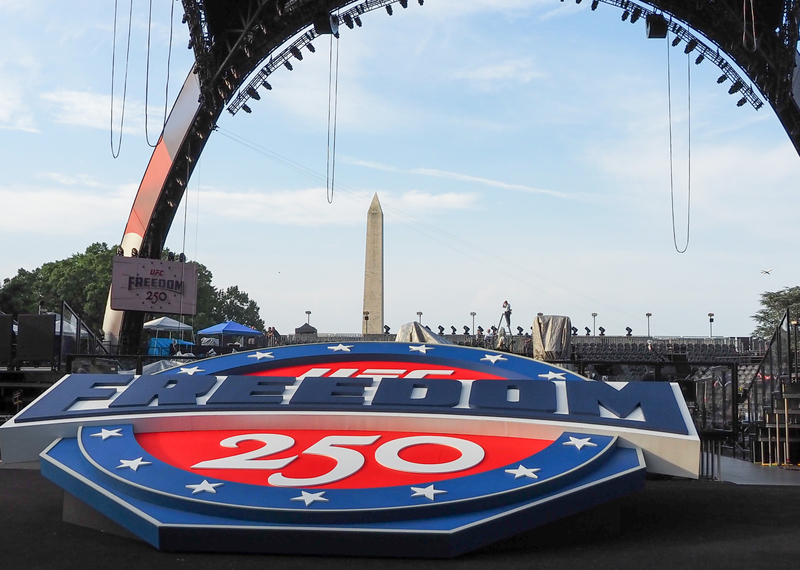
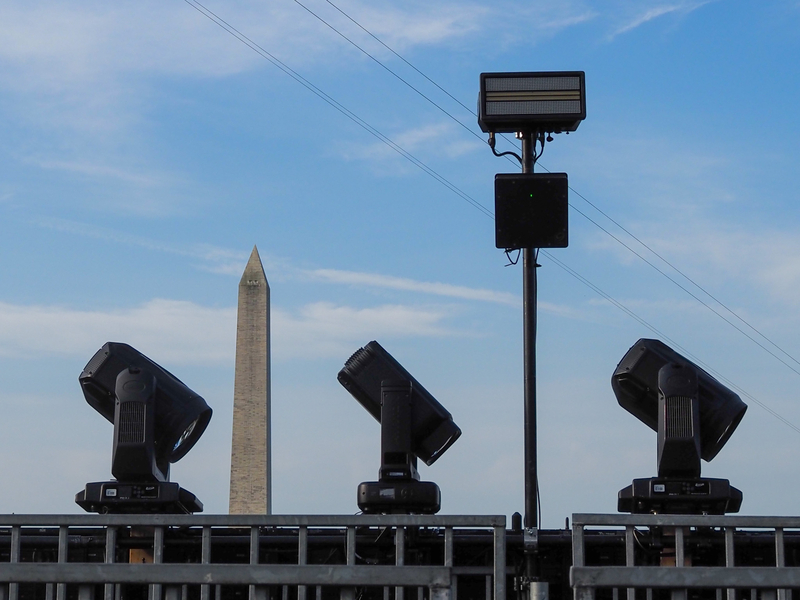
    Lights from the Ultimate Fighting Championship structure on the White House South Lawn frame the Washington Monument on Thursday, June 11, 2026. (Photo by Ashley Murray/States Newsroom)

    Lights from the Ultimate Fighting Championship structure on the White House South Lawn frame the Washington Monument on Thursday, June 11, 2026. (Photo by Ashley Murray/States Newsroom)

    Legal decision coming

    U.S. District Judge Amit Mehta, an Obama appointee, issued an order Thursday stating he would not schedule an emergency hearing but rather decide based on written briefs.

    In its response, the Trump administration dismissed the lawsuit as meritless, and noted that it did not name UFC as a defendant. Department of Justice lawyers wrote the plaintiffs are “two individuals: one who plans to walk past the event (intentionally ‘coming to the nuisance’) and another who might happen to drive past it.”

    “Two Plaintiffs with idiosyncratic preferences cannot use equity to upend an event of this cost and magnitude at the last minute and spoil the evenings of tens of thousands of other Americans who wish to celebrate their pride in their country in a manner that Plaintiffs disdain,” the DOJ argued.

    “No one is holding Plaintiffs in a jiu jitsu lock, forcing them to watch UFC Freedom 250 against their will,” the brief continued. “The public interest does not favor allowing them to exercise a heckler’s veto, particularly at this late date.”

    The White House, which has referred all questions about the event to the UFC, did not immediately respond to a request for comment about Mehta’s decision to not hold a hearing.

    The UFC did not respond to questions, including a request for comment on the pending lawsuit, the cost of the event and sponsorship packages, how many tickets have been sold and if the organization has a weather contingency plan for possible storms.

  • Trump says ‘great settlement’ of Iran war in the works, signing ceremony soon

    Trump says ‘great settlement’ of Iran war in the works, signing ceremony soon

    WASHINGTON — President Donald Trump announced Thursday that administration officials were close to brokering an end to the hostilities with Iran and predicted there could be a signing ceremony in Europe as soon as this weekend.

    “We just made a great settlement of the war with Iran and we’re going to be subject to finalization of documents, which should get done over the next few days, probably have a signing, maybe in Europe, and it’s a great thing,” Trump, who has earlier said deals were in the offing that did not come to fruition, said from the Oval Office.

    Trump said Iran’s Supreme Leader had approved the agreement, which he referred to as “a very strong memorandum of understanding that is a little conceptual.” There was no immediate confirmation of the agreement on social media accounts on which Iranian leaders often post.

    The deal, Trump said, would ensure Iran will not be able to develop or purchase a nuclear weapon and will end the blockade of the Strait of Hormuz, a main oil shipping route, once signed.

    Trump said he didn’t plan to attend the signing ceremony himself, but would likely send Vice President JD Vance.

    He projected the end of the conflict, which began in late February, would lower gas prices that rose sharply after the United States and Israel began a joint bombing campaign.

    Israel not part of deal

    Israeli Prime Minister Benjamin Netanyahu’s office posted on social media that the country doesn’t consider itself subject to the agreement brokered between the United States and Iran.

    “President Trump spoke this evening with Prime Minister Netanyahu regarding the emerging memorandum of understanding (MOU) with Iran to enter into negotiations,” the post said.

    “Even though Israel is not a party to the memorandum of understanding, the Prime Minister expressed his appreciation for President Trump’s commitment that the final agreement at the conclusion of negotiations will include the removal of enriched material, the dismantling of enrichment infrastructure, limits on missile production, and the cessation of Iran’s support for its terrorist proxies in the region.”

    The war led to considerable debate on Capitol Hill, where Democrats forced floor votes on several War Powers resolutions, questioning whether Trump had the authority to engage in a protracted bombing campaign without a formal declaration of war or an authorization for use of military force from Congress.

    The Trump administration sent a letter to lawmakers on May 1 declaring the war “terminated,” but bombing resumed this week after an Iranian drone shot down a U.S. helicopter.

    Strikes vowed, then called off

    Trump posted on social media a couple hours before his Oval Office appearance that he had “cancelled the scheduled strikes and bombings against Iran this evening.”

    “Discussions and final points have been, in both concept and great detail, approved by all parties involved, including the United States, Israel, Saudi Arabia, UAE, Qatar, Turkey, Pakistan, Bahrain, Kuwait, Jordan, Egypt, and others,” Trump wrote. “The Naval Blockade will remain in full force and effect until this Transaction is finalized — Time and place of the signing to be announced shortly.”

    The announcement was a reversal from one Trump posted earlier in the morning, where he wrote the U.S. military planned another round of intense bombing and would seek to control an island in the Persian Gulf.

    “At some point in the not too distant future, we will be taking Kharg Island, and other oil infrastructure points, and assume total control of their Oil and Gas Markets, much like we have with Venezuela, which is working out brilliantly for both Venezuela and the United States of America,” he wrote.

    Trump on Thursday declined to give a firm deadline for when U.S. and Iranian officials would sign a formal end to the hostilities, only saying he believes it will happen “pretty quickly.”

    Trump said he “might look at” providing financial aid to American farmers who experienced rising costs, including for fertilizer, as a result of the war, though he didn’t commit to it.

    “The farmers have a problem with fertilizer, but that’s all coming down now,” he said. “And your fuel is going to be, I think it’s going to be lower than it was four or five months ago.”

  • Tariff refunds for small businesses past due, US Senate Dems tell Trump administration

    Tariff refunds for small businesses past due, US Senate Dems tell Trump administration

    WASHINGTON — The Trump administration has failed to refund more than $145 billion in tariffs that the U.S. Supreme Court has ruled unlawful, a pair of U.S. Senate Democrats said in a Wednesday letter to the administration’s chief of customs.

    Sens. Ron Wyden of Oregon and Edward Markey of Massachusetts demanded that the U.S. Customs and Border Protection Commissioner Rodney Scott pay out refunds to small businesses for the tariffs that the court later determined President Donald Trump was not actually empowered to set.

    In their letter, the senators condemned what they called the administration’s continuous efforts to complicate and dodge the refund process and sought full compensation for all importers who together paid roughly $166 billion in tariff taxes under the International Emergency Economic Powers Act.

    Small businesses “deserve better, and the CBP needs to answer for this debacle,” they wrote.

    President Donald Trump aggressively placed tariffs on countries across the globe early in his second term, making the import taxes a centerpiece of his economic agenda.

    But the U.S. Supreme Court found Trump’s stack of global tariffs, which he began implementing in early 2025, to be illegal in a February ruling, saying that his use of the emergency tariff act exceeded his powers as president.

    Soon after,the U.S. Court for International Trade instructed CBP to issue refunds to the businesses that had borne the costs.

    But according to court documents filed May 26, the Trump administration has refunded only about $20.6 billion of the tax money, while another roughly $85 billion remains in the processing stage, leaving more than $60 billion that is not even in the process of being returned.

    “That means tens of billions of dollars unlawfully collected from American businesses remain in government hands months after the courts ordered their return,” Markey and Wyden wrote.

    Markey is the ranking Democrat on the Senate Small Business and Entrepreneurship Committee, and Wyden holds the same position on the Finance Committee, which sets tax policy.

    An ongoing price to pay

    Many small business owners struggled under the weight of Trump’s tariffs while they were in effect, forced to raise prices, lay off employees and give up hopes of expansion to offset the costs.

    Now, they are still dealing with financial pressures as they wait for repayment from an administration that has, in Markey and Wyden’s words, “slow-rolled implementation of the refund process from the outset.”

    Following the Supreme Court’s decision, the administration took weeks to announce a refund procedure, the senators wrote.

    CBP eventually settled on a new claims tool called the Consolidated Administration and Processing of Entries, or CAPE, for the roughly 330,000 importers who paid tariffs to submit refund requests. The system went live in April.

    The lawmakers also pointed to Trump administration claims that some businesses may need to pursue individualized claims through litigation in order to receive tariff refunds, a process that could take up to years to settle.

    “This entire episode raises serious questions about whether the Administration is intentionally slowing the refund process in order to retain access to unlawfully collected funds for as long as possible,” they wrote in their letter.

    The senators included a list of refund-related questions for CBP in their letter and requested that the agency send written responses by June 24.

    A spokesperson for CBP acknowledged a request for comment Thursday, but said they could not guarantee a response in time for publication.

  • Strong candidates in Alaska, Ohio seen as moving US Senate races toward Dems

    Strong candidates in Alaska, Ohio seen as moving US Senate races toward Dems

    Democrats’ prospects in a trio of key U.S. Senate races are improving, an influential elections forecaster said Thursday, though Republicans are still favored to retain control of the chamber after the midterm elections.

    Sabato’s Crystal Ball, which predicts election outcomes, moved three races — in North Carolina, Alaska and Ohio — in Democrats’ favor. After the changes, the University of Virginia-based forecaster considers four contests pure toss-ups: Alaska, Ohio, Maine and Michigan.

    Democrats would have to sweep those races, and win competitive races in which they’re favored in Georgia, New Hampshire and Minnesota, to gain control of the Senate, which Republicans now hold with a 53-47 majority.

    That’s a tall task for Democrats, but it represents the best chance the party has seen this midterm cycle.

    In North Carolina, the race to succeed retiring Republican Thom Tillis is trending toward Democrats due to “big picture political factors” such as President Donald Trump’s poor approval ratings, the tip sheet said. Former Gov. Roy Cooper, a Democrat, easily won the state’s March primary and will face former Republican National Committee Chair Michael Whatley in November.

    The party that controls the White House is typically at a disadvantage in midterm races, and Trump’s underwater favorability in North Carolina only makes that race harder for Republicans, the Crystal Ball writers said.

    The three ratings changes make “Democrats’ path to the majority clearer, but we still favor Republicans in the overall race for the Senate,” authors Kyle Kondik and J. Miles Coleman wrote.

    Proven candidates

    Two Democratic candidates who have won statewide elections in Republican-leading Ohio and Alaska buoy Democrats’ chances there.

    In the Buckeye state, former U.S. Sen. Sherrod Brown is seeking to return for a fourth term in a favorable Democratic year after Republican Bernie Moreno ousted him in a GOP-dominated cycle two years ago. Brown will face Republican Sen. Jon Husted, who has never won election to the seat but was appointed to replace now-Vice President JD Vance after the 2024 election, in the fall.

    And former U.S. Rep. Mary Peltola, who in 2022 won a special election to become the first Democrat to represent Alaska in the House in a half-century, is challenging incumbent Dan Sullivan.

    Questions in Maine, Michigan

    The forecaster did not change its toss-up rating for Maine, which is the only Republican-held Senate seat contested this year in a state Trump lost in 2024 and was considered among Democrats’ best pickup opportunities at the start of the cycle.

    Political newcomer and Marine Corps veteran Graham Platner won the June 9 Democratic primary after his strongest opponent, Gov. Janet Mills, suspended her campaign. But some experts question his strength in a general election after more personal scandals were reported between Mills’ departure and primary Election Day.

    The Crystal Ball article Thursday compared Platner to weak Republican candidates who likely cost the GOP seats in favorable election years 2010 and 2022.

    The Maine race “features an embattled Democratic nominee, veteran Graham Platner, an anti-establishment candidate who may wind up being Democrats’ answer to weak, outsider GOP nominees from the Tea Party era (and, more recently, the 2022 midterm) that cost Republicans winnable races,” they wrote.

    The authors also said Democratic candidate quality will be a key factor in Michigan’s open seat.

    The race will likely keep the toss-up label at least until the Aug. 4 primary, they said.

    Former Wayne County health director Abdul El-Sayed has led some recent surveys in the three-way Democratic race, but polls the worst against GOP nominee former Rep. Mike Rogers. U.S. Rep. Haley Stevens appears to be Democrats’ strongest general election candidate, the forecasters said.