Author: admin

  • Trump wants $87.6 billion to pay for his war in Iran, aid to farmers and more

    Trump wants $87.6 billion to pay for his war in Iran, aid to farmers and more

    WASHINGTON — The Trump administration sent Congress a request Wednesday for $87.6 billion in emergency funding to cover the cost of the war in Iran and other expenses.

    White House budget director Russ Vought wrote in a letter that in addition to addressing “urgent needs” for the Defense Department, the funding would help the U.S. government assist with the Ebola outbreak and provide aid to American farmers.

    Funding for the Energy Department, he wrote, would “support nuclear and other energy security requirements, primarily for the National Nuclear Security Administration.”

    The supplemental spending request asks Congress to provide money for “restoration and construction projects in and around Washington, D.C.,” as well as the project that would modernize Penn Station in New York City.

    The proposal asks lawmakers to add a few policy changes, including the year-round sale of E-15 gasoline, to any supplemental spending bill they may approve in the weeks and months ahead. Sen. Charles Grassley, R-Iowa, praised the move on social media. “Pres Trump’s admin is exactly right 2say yr-round nationwide E15 is ‘urgent’ & ‘needed’ Congress MUST pass yr-round nationwide E15 by end of fiscal yr Im very glad 2 see it incl in Defense Dept’s supplemental request,” said Grassley.

    The proposals didn’t appear to have broad consensus among Democrats, who would likely be needed for any emergency funding to become law.

    Senate Appropriations Committee ranking member Patty Murray, D-Wash., wrote in a statement the administration’s request “is not merely meant to pay for the president’s disastrous war, but an attempt to secure tens of billions of additional dollars for unrelated Pentagon priorities that should rightly be considered through the annual appropriations process.”

    “I will closely review this request in its entirety and ensure we take care of our servicemembers, but I will not rubberstamp tens of billions more for this disastrous war of choice,” Murray added.

    Senate Appropriations Chairwoman Susan Collins, R-Maine, wrote in a statement she will “evaluate the Administration’s supplemental budget request.”

    “I plan to convene an Appropriations Committee hearing so that Senators can hear directly from the relevant Administration officials,” she said.

    The supplemental spending requests ask lawmakers to provide:

    • $67.15 billion for the Defense Department
    • $11.1 billion for the Agriculture Department to provide aid to farmers
    • $3.36 billion for the State Department for diplomatic, security and global health programs
    • $2.03 billion for the U.S. Coast Guard
    • $1 billion for the Transportation Department to “to assist in the final design and construction of a modernized Penn Station in New York City”
    • $1 billion for the Labor Department to “increase the benefit levels for participants of certain pension plans that were sponsored by Delphi Corporation and terminated as a result of General Motors’ bankruptcy in 2009″
    • $767.5 million for the Energy Department
    • $600 million for the General Services Administration’s federal buildings fund
    • $500 million for the National Park Service to upgrade a seawall and improve the World War II Memorial
    • $40.26 million for the FBI for its role in the Iran war and “other classified needs”
    • $36.18 million for the Treasury Department’s office of terrorism and financial intelligence
    • $13.1 million for the Homeland Security Department’s operations and support account that was part of a “classified request.”
  • Lunch with ‘mad as a murder hornet’ Trump and US Senate GOP fails to heal divisions

    Lunch with ‘mad as a murder hornet’ Trump and US Senate GOP fails to heal divisions

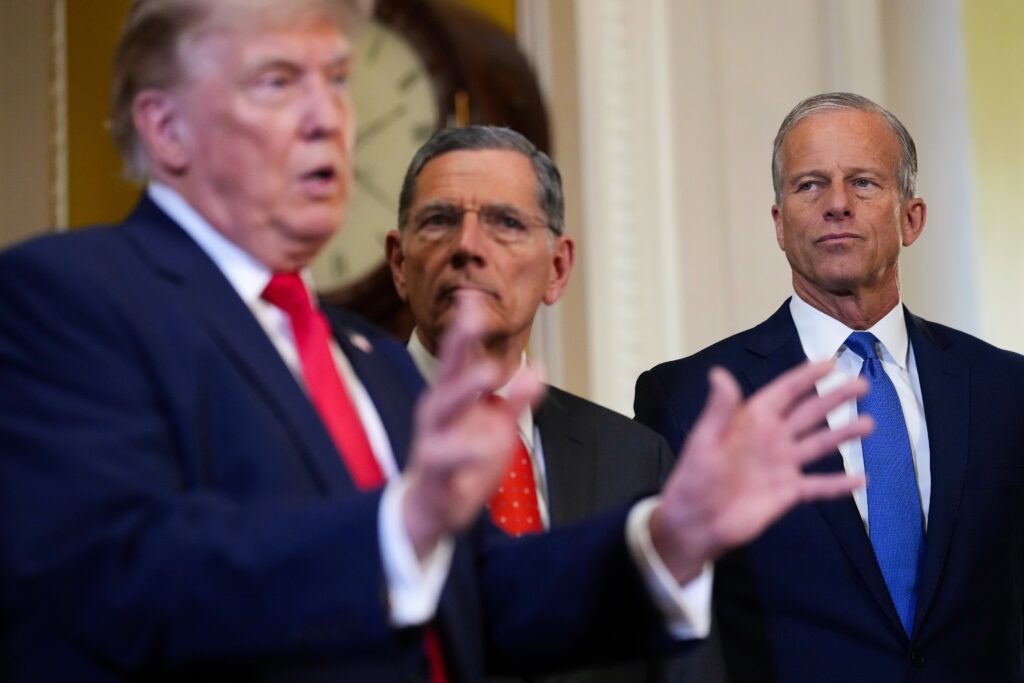
    WASHINGTON — U.S. Senate Republicans walked into a lunch with the president on Wednesday looking for ways to unify, but they left the closed-door meeting on Capitol Hill as fractured as ever about policy goals.

    President Donald Trump said after the huddle that he was “very proud of the party” but didn’t offer any concrete steps forward amid deep divisions on a nationwide voter identification law or other issues that don’t yet have enough GOP support to reach his desk.

    “For the most part we have a really well-unified party,” Trump said. “And I said it very strongly, we have the hottest country anywhere in the world.”

    Republican senators said during hallway interviews after the meeting ended that it wasn’t entirely productive and didn’t create much, if any, goodwill.

    Louisiana Sen. Bill Cassidy somewhat jokingly said the meeting went “swimmingly” before detailing a confrontation he had with Trump over the lack of information on the Iran war. Senators have repeatedly asked for a classified briefing from administration officials, but haven’t yet received one.

    Cassidy, who lost his May primary after Trump endorsed an opponent, said the exchange began when Trump asked why four Republican senators voted with Democrats to approve a War Powers Resolution earlier this week. Along with Cassidy, they were Lisa Murkowski of Alaska, Rand Paul of Kentucky and Susan Collins of Maine.

    “I said, ‘Well, we’ve not been briefed on how it’s going, that the stated objectives don’t appear to be achieved, and it appears as if … it’s not going as well as we’re being told,’” Cassidy recalled. “At which point I think the president said something negative about me. I perceived it as attempting to bully me from asking a question that I think the American people need to know.

    “And I’m not going to be bullied when I feel like I’m asking a question the American people need to know. And so at that point it began to escalate. And at some point it de-escalated.”

    Trump declined to directly answer a question before the meeting began about whether he believes the voter identification law he advocates, which doesn’t have the votes necessary to advance in the Senate, is more important than a broadly bipartisan housing bill. The housing package would have given Republicans a legislative victory on the campaign trail roughly four months before the midterm elections.

    The president was scheduled to sign that housing measure just before he met with Senate Republicans, but he canceled to press for the election bill, called the SAVE America Act.

    The bill would overhaul how Americans register to vote and cast ballots in federal elections, such as requiring proof of citizenship to register to vote and requiring a government-issued photo identification at polling locations.

    “Every election is important. We’re doing very well,” Trump said.

    “They want a lot of communists to come in,” he said, referring to Democrats. “I’m saying it a little bit differently but the people that they’re pushing are communists. And this country is not going to have communists.”

    Trump ‘mad as a murder hornet’ about Iran vote

    Florida Sen. Rick Scott said he hoped the meeting would help Republicans build consensus, though he acknowledged it led to tension.

    “You’ve been around the president, he was pretty forceful about what he cares about,” Scott said, later adding his goal in organizing the meeting was “to try to bring people together.”

    Scott said Senate Republicans didn’t talk with Trump about using the complex budget reconciliation process to establish grants for states that implement certain voter identification requirements. House Speaker Mike Johnson put the idea forward earlier in the day as one way to promote elements of the SAVE America Act.

    Louisiana Sen. John Kennedy said he appreciated the president’s “candor” during the meeting before saying Trump was “mad as a murder hornet about the war powers vote.”

    “And I don’t blame him,” Kennedy said. “Put yourself in his shoes, he’s right in the middle of delicate negotiations and the Senate votes to get out of Iran. And it upset him.”

    Kennedy said the president also pressed for the SAVE America Act, though he somewhat dismissed Johnson’s proposal to provide grants to states instead of enacting the entire bill.

    “I don’t think that’s going to satisfy the president,” Kennedy said.

    ‘Like a hospital board meeting,’ with yelling

    West Virginia Sen. Jim Justice said both Trump and Cassidy “expressed their feelings and didn’t hold back, but at the same time, it ended up respectful.”

    “It was, I wouldn’t say super combative, but very passionate — very passionate,” he said.

    Justice noted that “very, very few questions” were asked at the lunch.

    Kansas Sen. Roger Marshall described Trump and Cassidy’s exchange as “very much like a hospital board meeting when a bunch of doctors are yelling at each other. But at the end of the day, we’ll figure out a way to get along.”

    Trump, he said, was “very disappointed” by the four GOP senators voting this week to try to limit any additional military action against Iran.

    “They’re trying to negotiate that and they feel like that vote from Republicans chopped their legs out from under them,” Marshall said. “And they’re making such incredible progress on this deal. So it’s hard for them to negotiate it when there’s two messages coming out of Washington.”

    Pressed on the confrontation between Cassidy and Trump, Sen. Tommy Tuberville said the two “just had some differences of opinion about Iran.”

    The Alabama Republican said “it was very cordial — it wasn’t over the top.”

    Not many questions

    North Carolina Sen. Thom Tillis acknowledged there was some contention in the meeting over the voter identification bill.

    “I know there’s frustration over the SAVE America Act passage, but we simply don’t have the votes because we’re not gonna nuke the filibuster, so it’s more a matter of how do we move forward,” he said. “Not all of the meeting was contentious, but there’s a general consensus that we on Capitol Hill have to start getting in lockstep.”

    When it comes to the bipartisan housing bill, Tillis said it being signed into law is “up to the president, we’ve done our work.”

    South Dakota’s Mike Rounds declined to give details about the meeting but said that Republicans “had a good talking to,” and that senators did not ask the president many questions.

    Rounds said while Trump pushed for the SAVE America Act, there was little acknowledgment that the Senate lacks the votes to pass the bill.

    Texas Sen. John Cornyn said there “wasn’t really a lot of opportunity” to ask questions during the meeting. He said Trump spoke for one hour and 15 minutes.

    Missouri Sen. Josh Hawley said the president repeated some of the comments he posted on social media earlier in the day when he said he would refuse to sign the housing affordability package until Congress approves the election bill.

    “He’s here to talk about whatever it is he wants to talk about,” Hawley said. “And without speaking for him, I think it’s safe to say that what he posted this morning is what he talked about.”

  • Families, lawmakers, advocates pay tribute to victims of social media harms at US Capitol memorial

    Content notice: This story includes discussion of suicide. If you are struggling or in crisis, help is available. You can call or text 988 in the U.S. and Canada, or contact the National Suicide Prevention Lifeline. There is also an online chat at 988lifeline.org.

    WASHINGTON — Placards featuring 272 names, each with a photo and the age of a child or young adult who lost their life due to what their families call social media-related causes, lined the lawn of the U.S. Capitol’s Upper Senate Park Tuesday evening.

    Scattered among the signs stood dozens of bereaved families, friends, lawmakers and advocates from across the country and both sides of the political aisle, joining together to honor those who had died — and call for legislation aiming to make social media safer for children.

    Founded in 2023 by two mothers whose sons died the same morning, Social Media Victims Remembrance Day commemorates young victims of online threats such as cyberbullying, blackmail, drug dealing, viral challenges and addictive algorithms.

    Tuesday’s public memorial — the largest ever held in commemoration of kids impacted by social media, organizers said — featured speeches from Democratic and Republican U.S. senators working to pass legislation that would, among other things, seek to hold tech companies more accountable for a series of harms caused by their platforms.

    Just as they took the stage, the rain that had been showering Washington all day trickled to an end and sunlight broke through clouds, shining down on the crowd and the placards that swayed gently in the breeze around them, which Sen. Amy Klobuchar used as a metaphor for the issue.

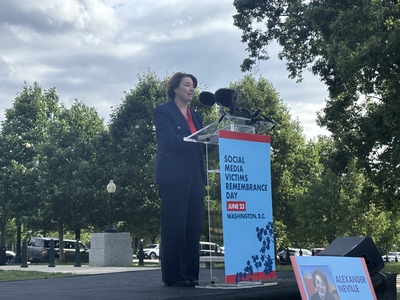
    “I think part of what we need is more sunshine on what’s happening here, and more transparency, and people understanding how truly bad this is,” the Minnesota Democrat told the families seated before her.

    Sens. Richard Blumenthal, a Connecticut Democrat, and Josh Hawley, a Republican from Missouri, also spoke at Tuesday’s memorial.

    Social Media Victims Remembrance Day

    Klobuchar

    U.S. Sen. Amy Klobuchar, a Minnesota Democrat, speaks at a Social Media Victims Remembrance Day event outside the U.S. Capitol on June 23, 2026. (Photo by Amelia Twyman/States Newsroom)

    Mothers Kristin Bride and Amy Neville created Social Media Victims Remembrance Day to honor their late sons Carson Bride and Alexander Neville, who died in social media-related incidents on June 23, 2020.

    Carson Bride, of Oregon, was 16 when he died by suicide after being cyberbullied through anonymous integrated apps on Snapchat. Fourteen-year-old Alexander Neville, of Arizona, lost his life the same morning from a fake prescription pill laced with fentanyl, which he had purchased through a drug dealer, also on Snapchat.

    For Neville, founding Social Media Victims Remembrance Day was a way for her to put her “feelings out there at scale.”

    The day now also gives her the chance to connect with other parents who have gone through similar tragedies.

    “It’s a weird feeling being out in the world among people who don’t know what you’ve experienced,” she said in a joint interview with Bride on Tuesday. “Being together like this with folks who know, folks who have similar experiences, we feel normal. It is special to be together like this.”

    Bride saw Social Media Victims Remembrance Day as an opportunity to “make a difference,” she said.

    “I really feel like the way we can come at social media companies is education and awareness, which this event does,” she added. “Carson always wanted to make the world a better place. And I feel like we could be grieving alone on this day, or we could be together with so many other families.”

    Big Tech or families?

    Bride and Neville held the first Social Media Victims Remembrance Day event in 2023 in front of the Orange County Crime Victims Monument, a memorial outside the district attorney’s office.

    Then, after taking a year off, they decided to bring the observance to the nation’s capital last year because they wanted to increase lawmakers’ awareness of the dangers surrounding youth social media use.

    “We want them to make the decision: Is it Big Tech, or is it American families?” Bride said. “Because unfortunately, this memorial continues to grow.”

    Over the past year, efforts to protect children online and hold Big Tech companies accountable for social media harms have continued to grow, with U.S. lawmakers in both the House and Senate pushing regulatory legislation and parents taking a legal stand.

    Tuesday’s event three months after a California jury found Meta and Youtube liable in a breakthrough social media addiction trial, one of the first in a long line of suits blaming tech companies for personal injury and recklessness. A New Mexico jury had just days before found that Meta violated its state law in a separate child sexual exploitation case.

    Social media platforms have rejected the framing that their products are responsible for harms to young users.

    In a statement responding to the California verdict, Meta said the issue was much more complicated than the jury recognized.

    “Teen mental health is profoundly complex and cannot be linked to a single app,” a company spokesman wrote on X.

    Hawley Rememberance Day

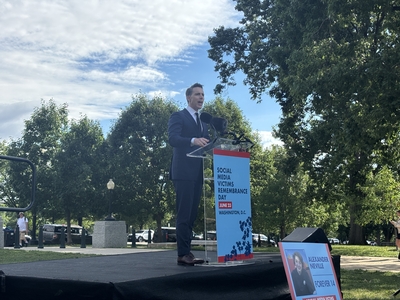
    U.S. Sen. Josh Hawley, a Missouri Republican, speaks at a Social Media Victims Remembrance Day event outside the U.S. Capitol on June 23, 2026. (Photo by Amelia Twyman/States Newsroom)

    Congressional action

    On Monday, Republican and Democratic leaders on the House Committee on Energy and Commerce announced that they had reached a bipartisan agreement on a bill aimed at making social media environments safer for children and holding parent companies accountable.

    “If you make a defective toaster and it blows up in someone’s home, they are liable,” Blumenthal said Tuesday. “When Big Tech makes products that addict and kill young people, they should be liable under a duty of care that is clear and effective.”

    Blumenthal was one of the senators who introduced the measure in February 2022. The bill eventually passed in the Senate, 91-3, but did not receive a vote in the House as social media platforms opposed it.

    House Energy and Commerce Committee Chair Brett Guthrie of Kentucky, a Republican, and ranking Democrat Frank Pallone of New Jersey reached a deal this year to include the bill as part of a broader legislative package titled the Kids Internet and Digital Safety, or KIDS, Act.

    “Through empowering parents, establishing safety as a default, strengthening privacy for children and teens, increasing transparency around data brokers, and holding Big Tech accountable, the KIDS Act delivers the 21st century protections parents have demanded and our kids deserve,” Guthrie and Pallone said in a news release.

    Politico reported last week that Meta has dropped its opposition to the safety measures because the package also includes provisions on artificial intelligence that the company supports.

    Hawley on Tuesday accused the companies of putting profits above children’s wellness.

    “We’re here today to say that there is no amount of profit that justifies the exploitation of our children,” Hawley said. “But that’s exactly what these companies are doing, and they know just what they’re doing.”

  • Judges block Trump push for Michigan voter info, setting up possible Supreme Court fight

    Judges block Trump push for Michigan voter info, setting up possible Supreme Court fight

    A federal appeals court on Wednesday ruled the Department of Justice isn’t entitled to access the sensitive personal data of Michigan voters, a setback in President Donald Trump’s push to assert power over state-run elections.

    The decision moves the country closer to a potential fight at the U.S. Supreme Court over state voter rolls ahead of the November midterm elections, with Michigan at the center.

    The Trump administration has sued 30 states for copies of their voter information. Federal officials want to run the data through a Department of Homeland Security computer program to identify possible noncitizen voters.

    In a 2-1 decision, a three-judge panel of the 6th Circuit Court of Appeals found that Michigan Democratic Secretary of State Jocelyn Benson isn’t required to turn over sensitive voter data, including dates of birth, driver’s license and Social Security numbers of voters. The 6th Circuit is the first appellate court to weigh in on the voter roll lawsuits after a series of district court rulings against the DOJ.

    The Justice Department had demanded Michigan’s voter roll under the 1960 Civil Rights Act, which grants the U.S. attorney general broad access to documents and records that “come into the possession” of election officials. Congress passed the law to empower investigations into voting discrimination against Black citizens.

    Lower court affirmed

    Wednesday’s opinion affirmed a February decision by U.S District Court Judge Hala Jarbou, a Trump appointee in the Western District of Michigan, who ruled that the Justice Department isn’t entitled to voters’ data. Michigan’s voter registration database is a record created by state officials, not a document that comes into their possession, she reasoned.

    The appellate judges agreed, writing that making the state’s full voter roll subject to the Civil Rights Act would place Michigan officials on a “collision course” with the National Voter Registration Act and the Help America Vote Act, two federal laws that require states to maintain and update voter registration lists.

    The Civil Rights Act “tells election officials to retain and preserve certain records and papers that come into their possession, and the NVRA and HAVA tell election officials to remove ineligible voters from statewide voter registration lists,” Judge Andre B. Mathis, a President Joe Biden appointee, wrote in the majority opinion.

    “We should not adopt a reading that would place election officials in violation of one federal law for trying to comply with others,” Mathis added.

    One member of the appellate panel, Judge John B. Nalbandian, a Trump appointee, wrote in a dissent that Michigan’s voter roll is a record that the Justice Department can demand under the Civil Rights Act. He argued that requiring Michigan to turn over the data wouldn’t conflict with the NVRA and HAVA.

    DOJ sees ‘carveout’

    During oral arguments in May, the Justice Department suggested that upholding the district court decision would weaken its ability to investigate racial discrimination in voting. DOJ attorney David Goldman told the panel that the district court judge had created a “carveout” in the Civil Rights Act not rooted in the law.

    But Michigan Assistant Attorney General Heather Meingast, representing Benson, told the judges that the Justice Department’s demand is unprecedented and unsupported by federal law.

    “It doesn’t seem to meet the test of what the (Civil Rights Act) was talking about in the ‘60s,” Meingast said. “And the purpose was voters turning in their documents, their applications, their poll taxes.”

    The Justice Department has been pursuing state voter rolls for more than a year. While some Republican-led states voluntarily provided the data, most states have resisted, leading to a wave of lawsuits. So far, no court has ruled in the DOJ’s favor.

    Lawyers for the Justice Department have said the voter information would be shared with Homeland Security’s Systematic Alien Verification for Entitlements, or SAVE, system — a computer program that originally checked the eligibility of individual immigrants for government benefits that the Trump administration overhauled into a tool to verify citizenship.

    On Monday, a federal judge in Washington, D.C., ruled that the changes to SAVE had been made illegally and that the Trump administration had violated the privacy of millions of Americans. The judge also noted that problems had been found with SAVE, including falsely flagging citizens.

    The Justice Department didn’t immediately respond to a request for comment. DOJ lawyers can ask the full 6th Circuit or Supreme Court to hear the case.

    “The law cannot be any clearer– states run elections, the federal government is not entitled to Michigan voters’ personal data, and the president cannot change election law with the stroke of a pen,” Benson said in a statement.

  • States that won’t obey Trump order will have their mail ballots halted, postmaster says

    States that won’t obey Trump order will have their mail ballots halted, postmaster says

    The U.S. Postal Service won’t deliver mail ballots in states that refuse to turn over lists of voters under a proposed rule, the agency’s chief executive said Wednesday, angering Democrats who warn the decision will disenfranchise voters.

    Postmaster General David Steiner defended the rule at a Senate hearing and dismissed accusations that the Postal Service was acting politically after President Donald Trump signed an executive order in March restricting voting by mail.

    “If a state refuses to turn their absentee voter list over to the federal government, will the Postal Service still mail their ballots under this proposed rule?” Sen. Gary Peters, a Michigan Democrat, asked Steiner.

    “Under our proposed regulation, no,” Steiner replied.

    Steiner’s testimony, before the Senate Homeland Security & Governmental Affairs Committee, marked the clearest acknowledgment yet by a federal official that the rule threatens to upend voting by mail across the country.

    If the rule takes effect and Democratic-led states refuse to comply, the requirements would effectively limit mail voting to Republican-led states during November midterm elections to decide control of Congress.

    The Postal Service put forward the rule after Trump ordered Steiner to require states to submit lists of anticipated mail voters to the agency as a condition of having ballots delivered.

    Trump cancels signing ceremony

    The executive order is one of several steps the Trump administration has taken this year to influence how elections are administered, along with the Department of Justice suing states to obtain sensitive voter data.

    Underscoring the depth of Trump’s interest, as Steiner was speaking Wednesday morning the president abruptly called off a U.S. Capitol ceremony to sign a bipartisan housing bill because of the Senate’s refusal to pass the SAVE America Act. The legislation would require voters to show documents, such as a birth certificate or passport, proving their citizenship.

    “Now we have this new rule you’ve put out saying that states have to turn over their voting rolls and you, the U.S. Postal Service, will decide who’s approved to send their ballot through the mail,” Sen. Elissa Slotkin, a Michigan Democrat, said. “It’s just another backdoor way of trying to influence this election.“

    Slotkin said Trump’s decision to cancel the housing bill signing demonstrated the “level of obsession this president has” over elections.

    Turning over names

    Every state would have to provide the names of residents expected to vote by mail. Additionally, eight states and Washington, D.C., conduct elections by mailing all voters a ballot, meaning election officials would have to provide information on every voter. Those states include California, Colorado, Hawaii, Nevada, Oregon, Utah, Vermont and Washington.

    Trump and his aides argue the restrictions are needed to combat noncitizen voting, which occurs very rarely. Democrats and voting rights groups have sued over the order, arguing it’s an unconstitutional assertion of presidential authority over state-run elections. No judge has yet halted it.

    Steiner sought to place himself outside the controversy and said, in response to a question, that the Postal Service would adhere to a court order blocking the rule if one were issued. Asked about the legal authority underlying the rule, he said he would “have to defer that to the courts to understand the authority.”

    Steiner, who became the postmaster general in July 2025, cast the rule as primarily focused on best practices for election mail, a description that understates the scope of the proposal, which postal experts call unprecedented.

    “I’m not a political person and the Postal Service is not a political organization,” Steiner said.

    Dems urge Steiner to withdraw rule

    Democrats expressed sharp disagreement with Steiner and accused him of folding to Trump’s efforts to exercise more control over elections. Steiner answers to the USPS Board of Governors, not the president, and his critics say he is endangering the agency’s independence by complying with the executive order.

    Every Senate Democrat, as well as two independents who caucus with the party, on Tuesday signed a letter to Steiner urging him to withdraw the rule. The letter warns that aside from the rule’s legal and constitutional problems, it’s not feasible for state and local election officials to meet its requirements.

    “The proposed regulation demands that the Postal Service set up an entirely new system and database to process and transmit millions of absentee ballots that is secure and accessible to every American election official, just months prior to a general election,” the letter says.

    At Wednesday’s hearing, GOP senators mostly steered clear of the mail ballot rule, instead focusing on the official topic, the Postal Service’s finances. But Sen. Bernie Moreno, an Ohio Republican, accused Democrats of hypocrisy over their past support of the “For the People Act.”

    The sweeping bill, offered when Democrats last controlled Congress, would have required states to offer same-day voter registration and expand mail voting. Opponents said it amounted to nationalized elections.

    “Three years later all of them are testifying, ‘It’s outrageous, President Trump is trying to nationalize elections.’ No, he’s not, he’s trying to get rid of voter fraud,” Moreno said, adding that Democrats had now “dug up from their bottom desk drawer” the Constitution.

    “Should we get back to post office stuff now?” Moreno said.

    “Absolutely,” Steiner replied.

  • Trump spikes housing bill at last minute, refusing to sign until SAVE America Act passes

    Trump spikes housing bill at last minute, refusing to sign until SAVE America Act passes

    President Donald Trump derailed a housing overhaul that he was set to sign into law Wednesday, canceling a signing ceremony for the broadly popular bipartisan bill until Congress passes an election security measure.

    Trump had been scheduled to sign the bill, which passed the Senate Monday and House Tuesday with wide margins, during a Capitol ceremony.

    But in a pair of social media posts prior to the event, he derided the overhaul aimed at lowering housing costs as “minor” before refusing to sign it entirely.

    “Today’s Housing News Conference and Signing is hereby cancelled until such time as we pass the desperately needed SAVE AMERICA ACT, which I consider to be a National Emergency,” Trump wrote on his social media platform, Truth Social.

    The controversial SAVE America Act, a top priority for Trump, addresses the extremely rare phenomenon of noncitizen voting. Republican senators have told Trump there are not enough votes in the chamber for it to pass.

    The housing bill’s Senate sponsors, Banking Committee Chairman Tim Scott and ranking Democrat Elizabeth Warren of Massachusetts, sought to lower the costs of housing construction by removing regulatory barriers, expanding the uses of federal housing grants and banning institutional investors from buying single-family homes.

    Scott, a South Carolina Republican, lauded the bill Tuesday as not only bipartisan, but nonpartisan, addressing universal needs.

    Republican leaders framed the measure as addressing affordability, which is expected to be a key issue in November’s midterm elections amid stubborn inflation.

    The measure, which combined elements of proposals in each chamber, appeared on a fast track to becoming law after the Senate approved it 85-5 Monday and the House voted 358-32 Tuesday. The White House had said Trump supported the bill.

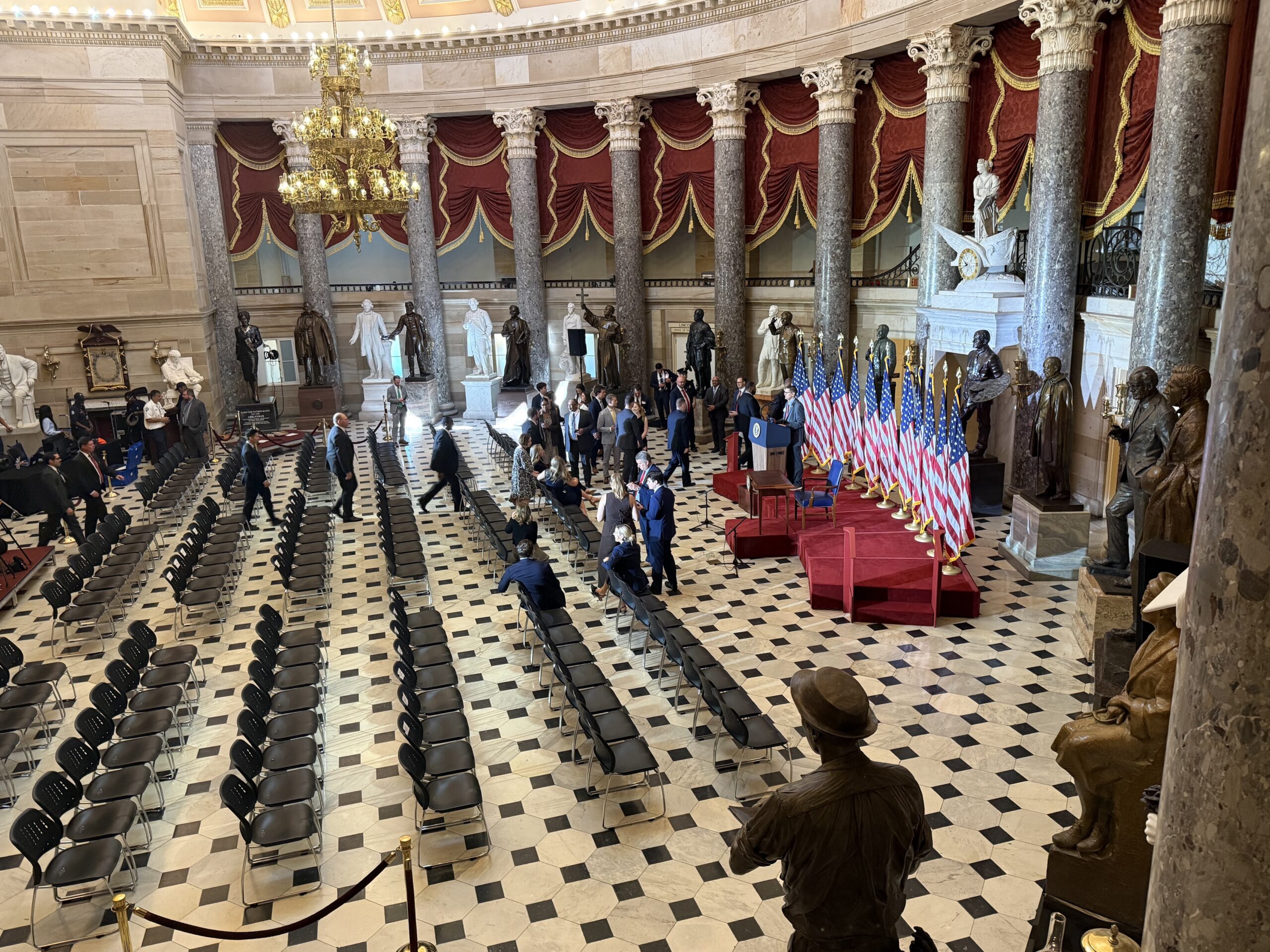
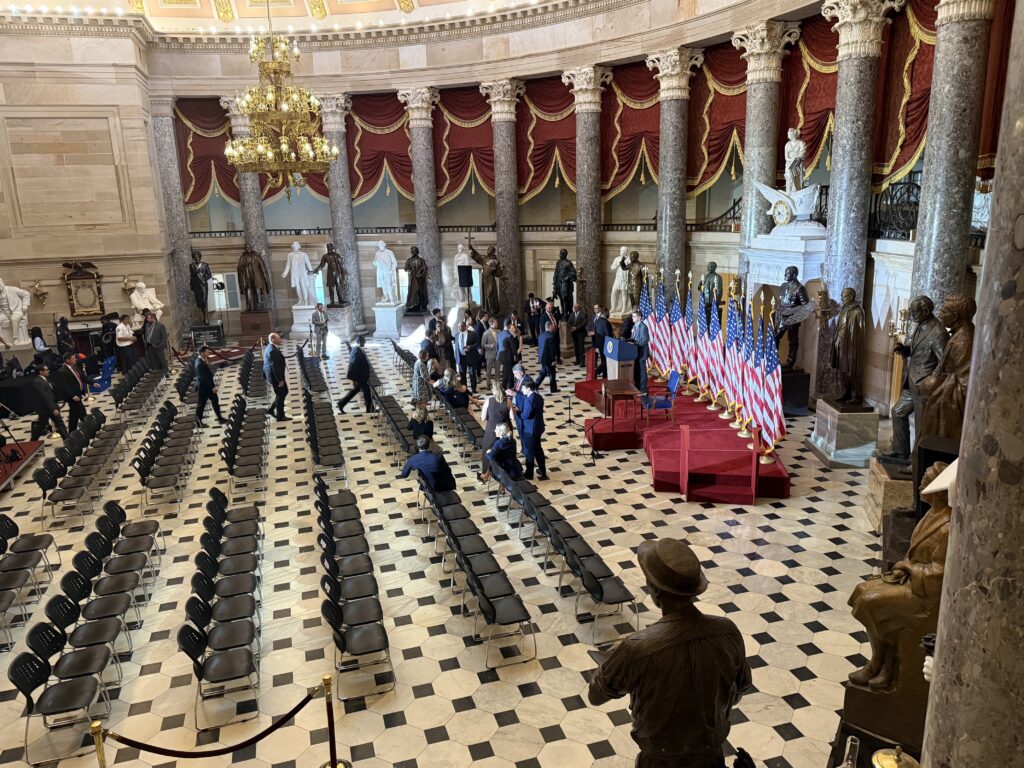
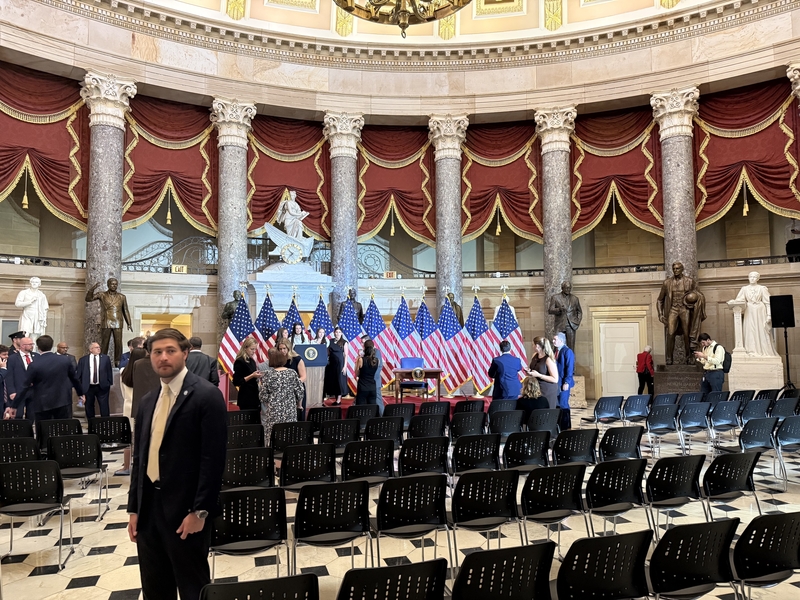
    Statuary Hall in the U.S. Capitol on June 24, 2026, after President Donald Trump called off a scheduled bill-signing ceremony. (Photo by Jennifer Shutt/States Newsrooom)

    Statuary Hall in the U.S. Capitol on June 24, 2026, after President Donald Trump called off a scheduled bill-signing ceremony. (Photo by Jennifer Shutt/States Newsroom)

    The House opponents were virtually all from a group of conservatives, led by Florida’s Anna Paulina Luna, who said she would oppose all legislation from the Senate, and even some House rules resolutions, until the Senate passed Trump’s elections security measure.

    Speaker Mike Johnson, R-La., said during a Wednesday morning press conference that he spoke with the president earlier in the day and that he is going to delay signing the housing bill until Congress approves a grant program for elections through the complex budget reconciliation process. That’s the same procedure the GOP used to enact its “big, beautiful” law and $70 billion for immigration enforcement.

    “You have to put it on a reconciliation bill,” he said. “We believe that if you create a grant program that ties it to reconciling the budget and you allow blue states, if they come to their senses and they want to avail themselves of election integrity proposals and ideas and policies, they can draw down from a federal fund and use those funds. We’re willing to invest heavily in that.”

    Johnson said he told Trump that Republicans in Congress can enact that policy if they “stand together.”

    “As you know he has a window of time before he has to sign a bill and he’s going to use a bit more of that window of time,” Johnson said. “And we’re going to go through this together.”

    Johnson said he expects Trump to sign the housing bill within the 10-day window.

  • W.Va. lawmakers urge Capito, Justice to support ending greyhound racing; Ohio County lawmakers oppose greyhound racing prohibitions

    W.Va. lawmakers urge Capito, Justice to support ending greyhound racing; Ohio County lawmakers oppose greyhound racing prohibitions

    By Steven Allen Adams
    For The Parkersburg News and Sentinel

    Charleston – Several Republican members of the West Virginia Legislature are encouraging the state’s two U.S. senators to back a ban on greyhound racing included in the latest version of the federal farm bill, while two lawmakers from Ohio County expressed support for the industry.

    In a letter sent Monday to U.S. Sens. Shelley Moore Capito and Jim Justice, both R-W.Va., eight members of the West Virginia Legislature urged the senators to endorse the Greyhound Protection Act within the Farm, Food and National Security Act of 2026. The letter was first reported by West Virginia Public Broadcasting.

    The Greyhound Protection Act would amend the Animal Welfare Act to ban greyhound racing in the country and make gambling on greyhound racing illegal. The bill would outlaw remote gambling on greyhound races and prohibit the transport and sale of greyhounds across state lines for the purpose of racing. Anyone violating these provisions would be fined and possibly imprisoned for up to seven years.

    Eight state lawmakers signed the letter: Senate Majority Leader Patrick Martin, R-Lewis; Sen. Chris Rose, R-Monongalia; Sen. Mike Azinger, R-Wood; Sen. Vince Deeds, R-Greenbrier; Sen. Anne Charnock, R-Kanawha; House Deputy Speaker Matthew Rohrbach, R-Cabell; Del. Jonathan Pinson, R-Mason; and Del. Jarred Cannon, R-Putnam.

    “As members of the West Virginia Legislature, we write to ask for your support of the Greyhound Protection Act and to urge its inclusion in the upcoming Farm Bill reauthorization,” the lawmakers wrote. “Federal action on this issue would help West Virginia follow the path that all other states have already taken, and most importantly, it will free up significant state tax revenues for unmet needs in our state.”

    Since 2020, West Virginia has the only remaining greyhound tracks in the nation at Mardi Gras Casino and Resort near Charleston and Wheeling Island Hotel Casino Racetrack. Both are owned by Delaware North. Voters in Ohio and Kanawha counties approved table games at Mardi Gras and Wheeling Island in 2007, but only as long as the casinos had racing. Wheeling Island will celebrate 50 years of greyhound racing in August.

    The two casinos employ more than 900 workers combined according to Delaware North, not including the number of businesses and support services that support the greyhound industry in West Virginia and other states.

    The farm bill, which is renewed roughly every five years, is awaiting action in the U.S. Senate. The bill passed the U.S. House of Representatives 224-200 with Rep. Carol Miller, R-W.Va., and Rep. Riley Moore, R-W.Va., voting for it. Moore offered an unsuccessful amendment to the farm bill – supported by Miller – that would have exempted West Virginia’s two greyhound tracks.

    According to the National Greyhound Association, the handle – the total amount of money – wagered on greyhound racing at West Virginia’s two tracks in 2025 was $353.4 million, a $5 million increase over 2024. Of that $353 million, more than $211 million was wagered at Wheeling Island and more than $142 million was wagered at Mardi Gras.

    West Virginia’s two greyhound tracks benefit from table game revenues. The West Virginia Lottery receives a privilege tax of 35% of adjusted gross receipts from each licensed racetrack which is deposited weekly into the Lottery’s racetrack table game fund. From the gross amounts deposited into the table games fund, the Lottery on a monthly basis retains 3% of the adjusted gross receipts for administrative expenses.

    The Lottery then transfers 2.25% of adjusted gross receipts from all thoroughbred and greyhound racetracks participating in licensed table games to the special funds established by each thoroughbred and greyhound racetrack table games licensee for the payment of regular racetrack purses to be divided equally among each licensee.

    A transfer of 1.8% of the adjusted gross receipts is made from all licensed racetracks to the thoroughbred development fund and the greyhound breeding development fund. Thoroughbred horse racing takes place at Mountaineer Casino Racetrack and Resort in New Cumberland and Hollywood Casino at Charleston Town Races.

    According to the West Virginia Lottery’s annual comprehensive financial report covering the 2024 and 2025 fiscal years, $2.08 million was distributed by the Lottery to racetrack purse funds in FY25, down from $2.107 million in FY24; while $1.664 was distributed to thoroughbred and greyhound development funds in FY25, down from $1.686 million in FY24. Past distributions to the West Virginia Greyhound Breeding Development Fund have ranged from $15 million per year to $17 million per year.

    This revenue from table game wagers is sometimes described as a subsidy. In the letter, the state lawmakers refer to studies from Ball State University and Spectrum Gaming Group that question the financial benefits of greyhound racing for West Virginia.

    “Every dollar that is diverted to greyhound purses is a dollar that does not flow to the state’s general revenue fund, lowering our citizens’ tax burden, paving state roads, or ensuring that local schools stay open,” the lawmakers wrote. “This arrangement is fundamentally inconsistent with the conservative principles we all share.”

    “The West Virginia greyhound program is, in plain terms, a government mandate paired with corporate welfare, and it has produced exactly the result one would predict: an industry that has collapsed everywhere it was allowed to compete on its own merits, kept on life support here only by force of law and support of subsidy,” the letter continued.

    State Sen. Laura Wakim Chapman, R-Ohio, disagreed with her fellow GOP lawmakers. In a statement Tuesday, Chapman compared federal involvement in ending greyhound racing to federal regulations on coal and coal-fired power generation.

    “This is just another example of federal overreach into West Virginia industries,” she said. “We saw it with the war on coal. This is a state issue under the separation of powers and must be addressed on the state level.”

    House Minority Whip Shawn Fluharty, Chapman’s Democratic opponent in the 1st Senatorial District, agreed, saying that support by state lawmakers for the Greyhound Protection Act was not an example of conservativism but an example of Republicans using the levers of big government to take away local control.

    “The irony is hard to miss,” said Fluharty, D-Ohio. “Many of the same politicians who routinely preach about states’ rights and keeping Washington out of West Virginia are now asking Congress to override our state’s authority and eliminate an industry that supports jobs and pensions for our police and fire in communities in the Northern Panhandle. They can’t even do it on facts.”

    State lawmakers attempted to push through a bill during the 2020 legislative session that would have eliminated the greyhound breeding development fund in hopes of hastening the industry’s demise in West Virginia. It would have eliminated the transfer of wagers on table games and video lottery machines to the fund and instead sent that money to the Excess Lottery Revenue Fund for distribution by the Legislature. But the legislation failed in the Senate in 2020 by an 11-23 vote.

    The bill would have also used the remaining money in the Greyhound Breeding Development Fund to retrain workers in the greyhound industries in the state, promote adoption of greyhounds used at the two racetracks, and provide a one-time $500 tax credit for West Virginians who adopted greyhounds.

    Fluharty said it was wrong to call table game revenues used for the Greyhound Breeding Development Fund “subsidies” when those funds are generated by casino patrons, not through taxes.

    “Zero taxpayer money is part of greyhound racing funding, yet they continue to call it a subsidy,” he said. “Bottom line, this is a West Virginia decision, not a Washington, D.C., decision and I find it embarrassing my colleagues want to delegate their duties. Maybe they should find a new line of work or move to D.C.”

    Chapman criticized members of Congress for sneaking the Greyhound Protection Act into the farm bill and inserting themselves into a local issue.

    “People are tired of these federal omnibus bills that are hundreds of pages long and do more than the title of the bill suggests,” she said. “Perhaps Congress should focus more on balancing budgets and lowering inflation than on an issue that only affects West Virginia.”

    Read more from The Parkersburg News and Sentinel, here.

    The post W.Va. lawmakers urge Capito, Justice to support ending greyhound racing; Ohio County lawmakers oppose greyhound racing prohibitions appeared first on West Virginia Press Association.
  • Bluefield loosens fireworks restrictions for America 250 celebration

    Bluefield loosens fireworks restrictions for America 250 celebration

    By Charles Owens
    For Bluefield Daily Telegraph

    Bluefield — With the big America 250 celebration at Lotito Park now less than two weeks away, city officials are taking steps to temporally loosen restrictions on fireworks.

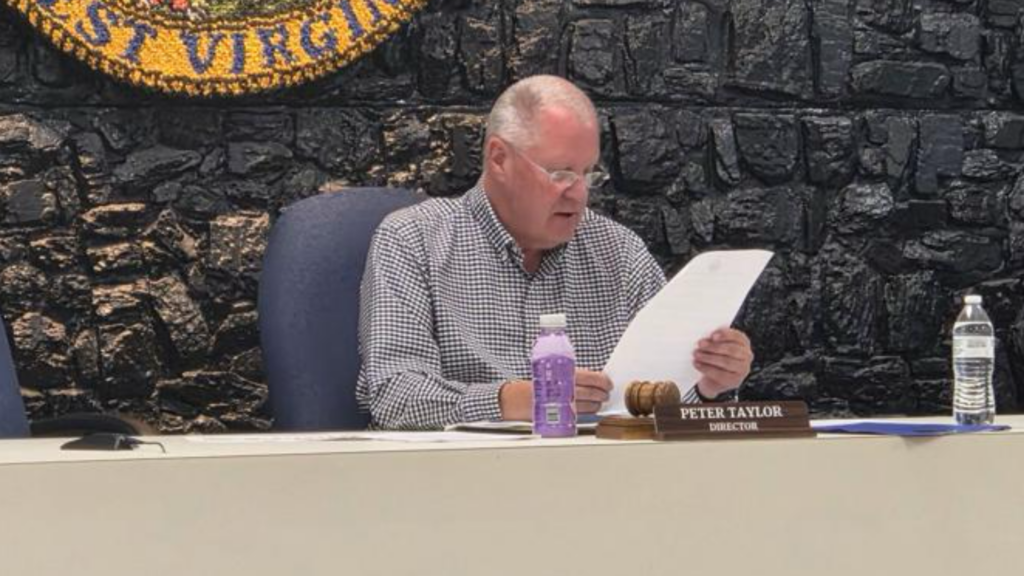
    The Bluefield Board of Directors voted 3-0 Tuesday to adopt a resolution honoring the 250th anniversary of the United States of America. The same resolution read by Vice Mayor Peter Taylor also said the city desired to provide additional opportunities for citizens to enjoy America’s 250th birthday while maintaining a spirit of community pride and patriotism.

    As a result, the resolution read by Taylor said the city board finds it appropriate to temporarily suspend enforcement of a section of city code regulating fireworks in recognition of the America 250 celebration.

    According to the proclamation, the board finds it appropriate during the nation’s semi quincentennial celebration to suspend Chapter 24, Section 24-33A of city code every Saturday and Sunday during the month of July, beginning at 9 p.m. on Saturday and continuing until 12:30 a.m. on Sunday.

    It’s the 250th and a lot of folks, for whatever reason, can’t get all their family together on the Fourth of July, so we wanted to give them the month to try to do something nice and also celebrate this great country,” — Bluefield City Manager Cecil Marson.

    City manager Cecil Marson clarified after the meeting to the Daily Telegraph that the section of code mentioned in the resolution deals with fireworks.

    “By ordinance of the city only the Fourth of July and New Year’s Eve can you shoot fireworks,” Marson said. “We’ve had a lot of requests come up in the last couple of months in the spirit of 250th (asking) if they could open that up for the month of July. So that was what the proclamation is about.”

    Marson said the proclamation basically establishes a limited window where fireworks can be discharged in July.

    “It’s the 250th and a lot of folks, for whatever reason, can’t get all their family together on the Fourth of July, so we wanted to give them the month to try to do something nice and also celebrate this great country,” Marson said.

    The proclamation celebrating the nation’s 250th, and temporarily loosening city code as it relates to fireworks, passed 3-0 with Mayor Ron Martin and board member Matt Knowles absent.

    Bluefield, in cooperation with the neighboring town of Bluefield, Va., is planning a America 250 celebration at Lotito Park on Saturday, July 4. The event will feature vendors, live music, a petting zoo, a parade, bounce houses, craft vendors, a dunk booth, food trucks and more.

    “There’s tons of vendors, bounce houses and a parade for all the kids,” Marson said. “It’s just going to be a great day down at the park, and a really great time to celebrate our 250th. I can’t think of a better way to spend your 250th with everybody together. So it will be a great day, and it all kind of ends up with a nice baseball game at night.”

    The city’s splash pad also is still tentatively scheduled to reopen for the America 250 celebration with several new additions.

    Work has been ongoing on those additions, which will include new awnings, new shade structures, an expanded turf and a new concrete addition as well as a concession area.

    Marson said the new concession area for the splash pad is expected to arrive at city park next week.

    Other pre-Fourth of July events also are planned, including the Field of Honor event that will open on Wednesday, July 1, on the lower field area of Bluefield University that will feature more than 300 American flags, along with a fireworks show at the conclusion of the Ridge Runner baseball game at Bowen Field on July 2.

    Read more from Bluefield Daily Telegraph, here.

    The post Bluefield loosens fireworks restrictions for America 250 celebration appeared first on West Virginia Press Association.
  • Federal government scouts for interest in mineral mining off Virginia shores

    Federal government scouts for interest in mineral mining off Virginia shores

    The Bureau of Ocean Energy Management has pitched the possibility of leasing areas of the outer continental shelf off Virginia’s shores for mineral mining. Over the next month, the agency will seek comments from seabed mining industries interested in leasing portions of the coast.

    The move is part of President Donald Trump’s effort to increase domestic production of minerals, which are needed for the production of electronics and defense materials.

    “Virginia’s offshore mineral resources present a pathway to lessen foreign dependence and reinforce America’s strategic position by establishing secure domestic supply chains,” BOEM Acting Director Matt Diacona said in a statement.

    The area that is under consideration for the lease sale is a massive swath next to the Eastern Shore that the Southern Environmental Law Center noted is larger than the state of Delaware.

    The entire zone under consideration would not be leased, but if the mining industry shows interest in extracting minerals off the coast, BOEM would then identify areas that could be available for a lease. From there, environmental tests and potential impacts would be analyzed before a lease is granted.

    The SELC and Environment Virginia quickly condemned the idea of allowing private companies to conduct industrial dredging to remove large amounts of sediment from the ocean floor with heavy machinery. Both groups cited the major environmental risks it could pose.

    From dolphins breaching the waves to seabirds soaring above our heads, a visit to Virginia’s coast is a reminder of the vibrant ecosystems we are lucky enough to have right over the horizon. Ripping up vast swaths of the seafloor puts this ocean heritage at risk,” said Elly Wilson, the state director of Environment Virginia.

    Virginia has not conducted offshore mineral mining before. The SELC is gearing up to fight the potential lease and likened it to proposals for offshore drilling.

    Following 2015 and 2018 proposals by BOEM to offer offshore leases for oil and gas production, the Virginia General Assembly passed a law in 2020 banning the permitting and leasing of seabeds within 50 miles of the commonwealth’s shores for oil and gas production. But that law still allows for mineral mining.

    “This beloved public resource belongs to the people, not private, extractive industry. Opening Virginia’s federal waters to seabed mining would put countless essential resources at risk, and that’s not a risk we can or should take,” said Megan Huynh with SELC’s wetlands and coasts program.

    Environment Virginia suggested that mining companies would be interested in heavy mineral sands in the deep water locations and phosphorites in the shallower waters.

    The United States Geological Survey states that “titanium, zirconium, and rare earth elements, needed to manufacture, for example, modern electronics for consumer and defense applications” are commonly found in those heavy mineral sands.

    The nation relies on imports of these minerals from foreign countries across the globe, which the Trump administration wants to end..

    A public comment period on the potential interest in this mining effort will be open on the Federal Register website until July 23.

  • Spanberger unveils reformed practices for Va. prisons and council on corrections

    Spanberger unveils reformed practices for Va. prisons and council on corrections

    A new council convened by Gov. Abigail Spanberger aims to help solve longstanding issues in Virginia’s prisons that residents and correctional officers have expressed concerns about for years.

    The Governor’s Community Partnership Council On Corrections, which Spanberger announced Tuesday, will bring together representatives from advocacy groups, faith-based organizations, healthcare and public safety groups and former prisoners to share their experiences and work towards solutions.

    Two years ago a handful of prisoners at Red Onion State Prison, the most embattled correctional institution in the state, burned themselves in protest of living conditions and in attempts to transfer elsewhere.

    Allegations of racism and retaliation by correctional officers were not ruled out by a state watchdog investigation at the prison and a class action lawsuit on behalf of prisoners who say they were abused will head to trial later this year.

    Federal judge allows Va. inmates rights’ lawsuits to move forward

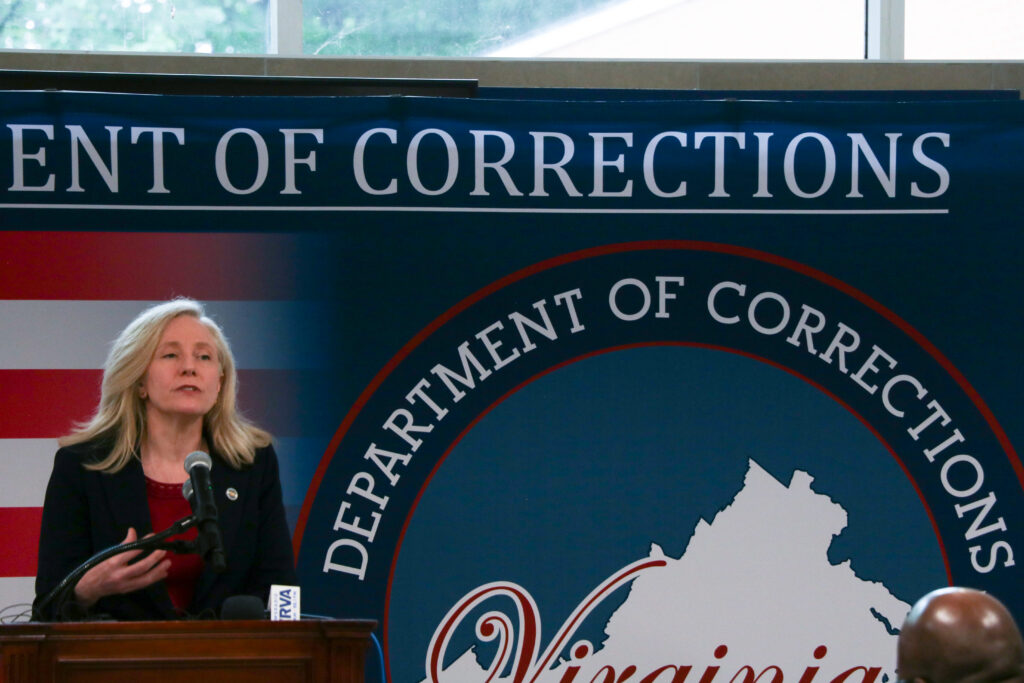
    “The people living in Virginia’s prisons are not forgotten on our watch,” Spanberger said at a press conference announcing the new council held at the Virginia Department of Corrections headquarters in Richmond.

    Virginia Public Safety and Homeland Security Secretary Stanley Meador emphasized that the council will empower participants to propose solutions to problems and help the administration “see things we can’t see.”

    Shawn Weneta, a policy strategist who has helped shape some criminal justice law changes in recent years, commended the creation of the council. He noted that some VADOC changes first began under the previous director but is pleased with the progress that the new administration is building.

    Speaking as a formerly incarcerated person, he emphasized that the council’s mission can best succeed by including “those most directly impacted by the system.”

    Ahead of assembling the official council, Spanberger’s administration has already conducted engagement within prisons and implemented her Executive Order 12, which entailed enhanced training for correctional officers and building partnerships with communities.

    From January to May of this year, Spanberger said use of force across all VADOC facilities has declined by 39%, serious inmate-on-staff assaults dropped 56%, lockdowns decreased by 27%, confirmed overdoses dropped 47%, while suspected overdoses dipped 12%.

    Virginia prisons have stopped using five-point restraints, which can be harmful for people in mental health crises, she said.

    The practice of isolating inmates in restorative housing, a persistent problem, has dropped by 20%.

    Restorative housing is Virginia state code’s euphemism for solitary confinement. It removes inmates from general populations and houses them in solitary cells.

    Restorative housing is used when there’s a threat of gang violence and as a disciplinary measure for inmates who violate prison rules.

    When asked how the reduction in restorative housing was made possible, Spanberger shared that staff training refreshers since she took office have focused on deescalation, which doesn’t exacerbate situations where an inmate may be in crisis or agitated.

    Spanberger also said her administration is considering how to fine tune the state’s Step Down program.

    Step Down is supposed to offer people placed in restorative housing a pathway out by helping address root causes of why they were placed in solitary housing and giving them measures to transition out of it.

    Several current and former inmates have relayed to The Mercury in recent years that restorative housing has been heavily utilized and people sometimes spend weeks or years, rather than days, in it.

    A third-party report to state lawmakers in late 2024 confirmed that at least one facility had placed the majority of its residents under solitary housing.

    Spanberger said her administration wants to be “making sure that every movement is documented on why someone is in restorative housing and their pathways out of it.”

    Under her direction, VADOC has also started to solve visitor access issues.

    After hearing tales of disparate visitation access, Spanberger identified COVID-era restrictions — like less seating and fewer visitor time slots — as a contributing factor.

    In recent months, VADOC has worked to restore past seating capacities in prisons’ visitor centers and expand visitor time slots, the governor said. She also signed a law that creates more guidance and takes into account the needs of long-distance travelers who come to see their loved ones behind bars.

    This “benefits, not just the family, but the person who is incarcerated,” she said.

    With Joseph Walters now serving as director of VADOC, Spanberger’s administration established a new code of ethics for VADOC employees and mandated refreshed training.

    Staffing issues have also plagued Virginia’s prisons. Walters and Meador shared that they’re very proud that their agencies’ work so far has been achieved even with a 21% staffing vacancy.

    This means, they said, that current staffers are working longer hours and pledging deeper commitment to their tasks. But rebuilding employee teams will be critical to halt turnover and alleviate burnout.

    Walters, Meador and Spanberger also hosted in-person engagement sessions with 13 advocacy groups that the governor said had gone unheard by the state’s top leaders for years.

    She called it “stunning” how long some groups had tried to relay concerns to previous administrations and that she hopes her efforts to strengthen communication can “build a foundation for after I am no longer in office.”

    Editor’s note: This story has been updated to correct the spelling of Walters.