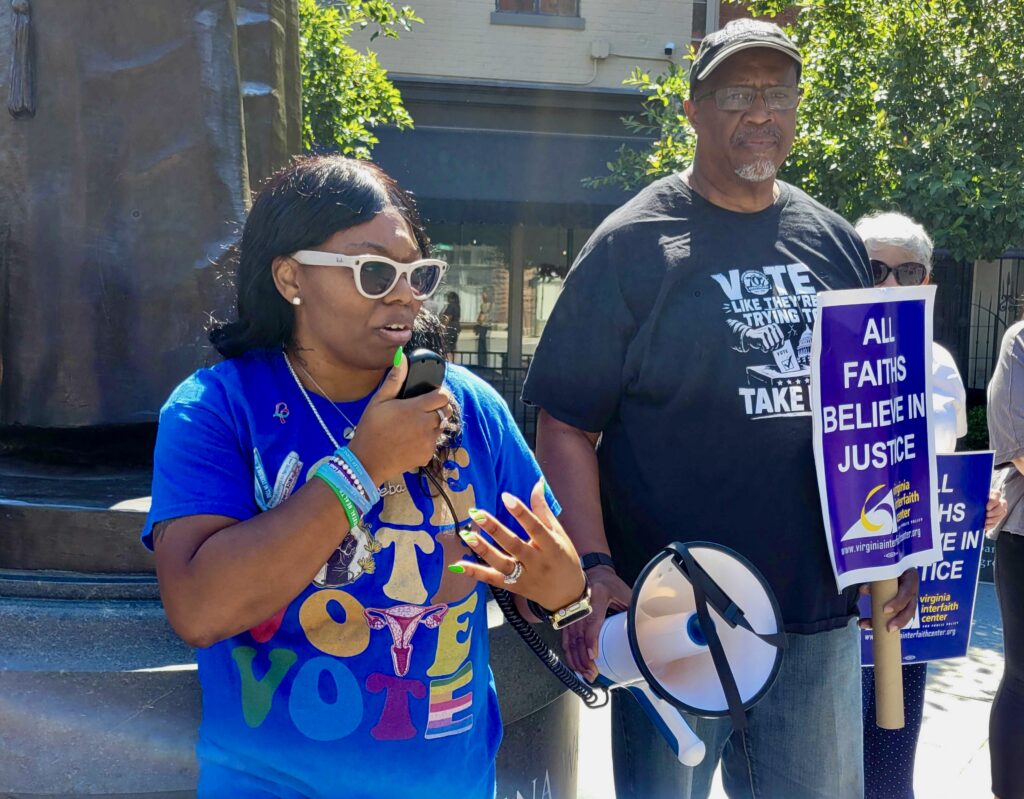
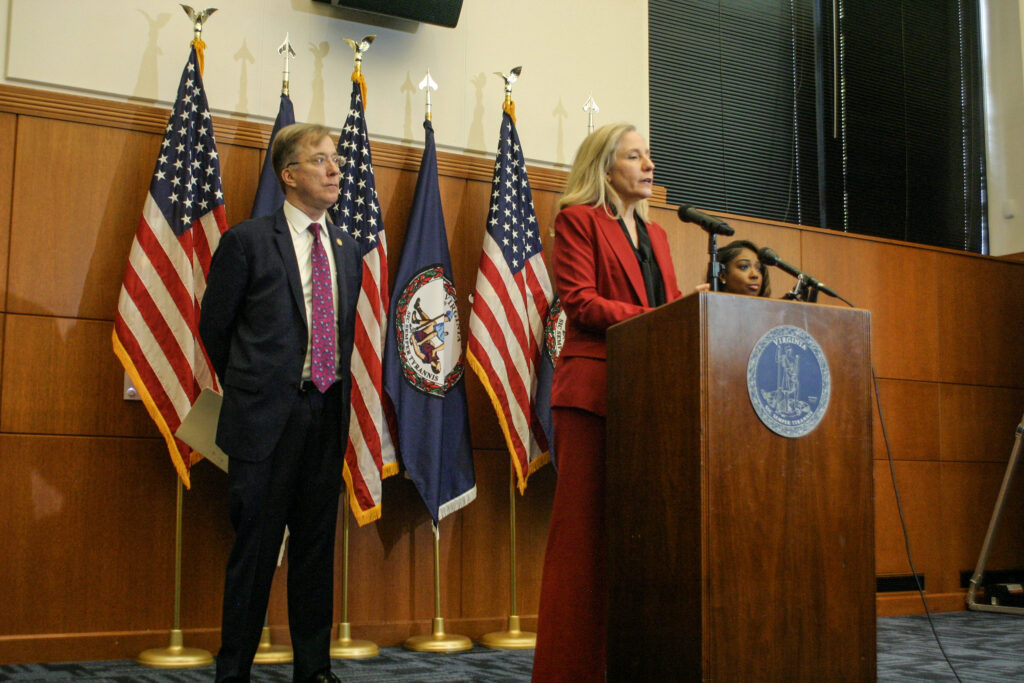
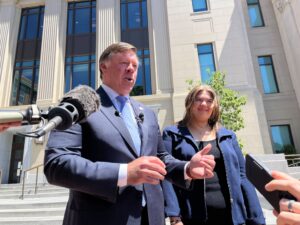
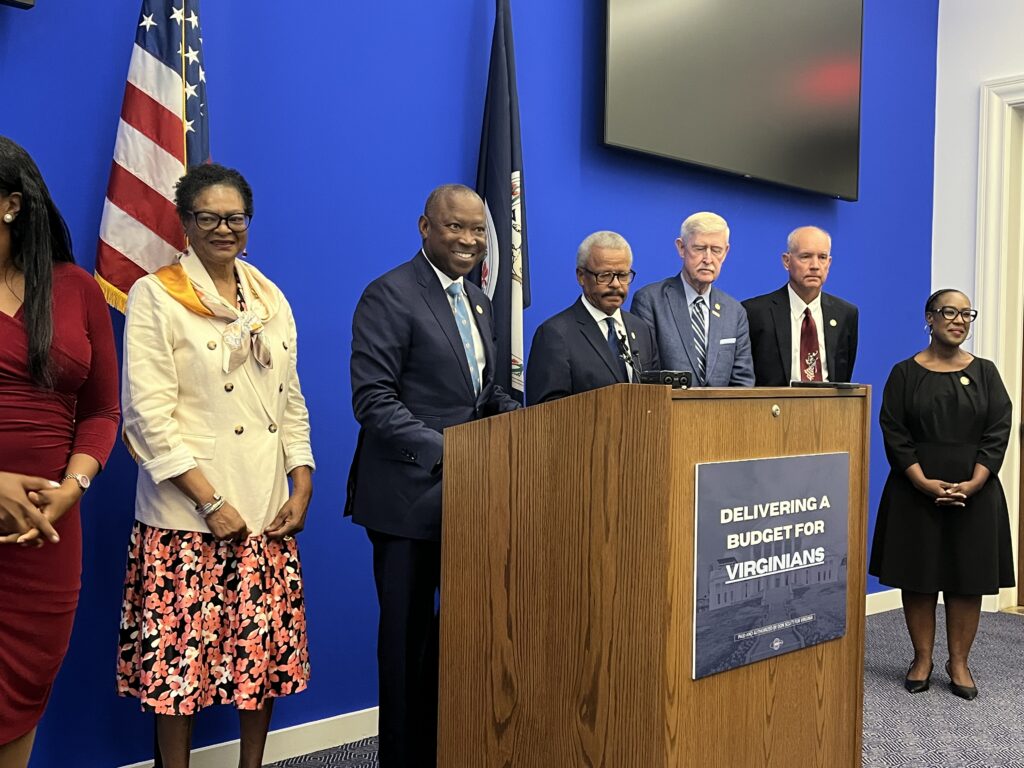
Nolef Turns director Sheba Williams speaks at a press conference in Richmond on June 17, 2026. (Photo by Charlotte Rene Woods/Virignia Mercury)
While a pending constitutional amendment to automatically restore voting rights to people with felony convictions who have served their sentences awaits Virginians’ approval or rejection in a statewide referendum later this year, thousands of people who should never have lost their right to vote in the first place remain in limbo during this summer’s congressional primary elections.
After a court ruled earlier this year that certain felony convictions should not have resulted in loss of voting rights, Virginia’s Department of Elections had until June 1 to comply with the order to rectify the situation.
Instead, on June 1, the department sent an advisory to election officials indicating that they should not deny peoples’ applications but to not fully process them either.
“Please note that records available through the felon search may have been affected by the updates to the Agency Felony Prohibited table. ELECT will provide additional guidance on reviewing felony history soon,” the June 2 advisory obtained by The Mercury read.
The crux, Nolef Turns director Sheba Williams said, is that some people with felony convictions who should be eligible to vote this summer are nervous to register because it is a crime to lie on applications.
“When they get to their application, there is a question about whether or not you have been convicted of a felony,” Williams explained.
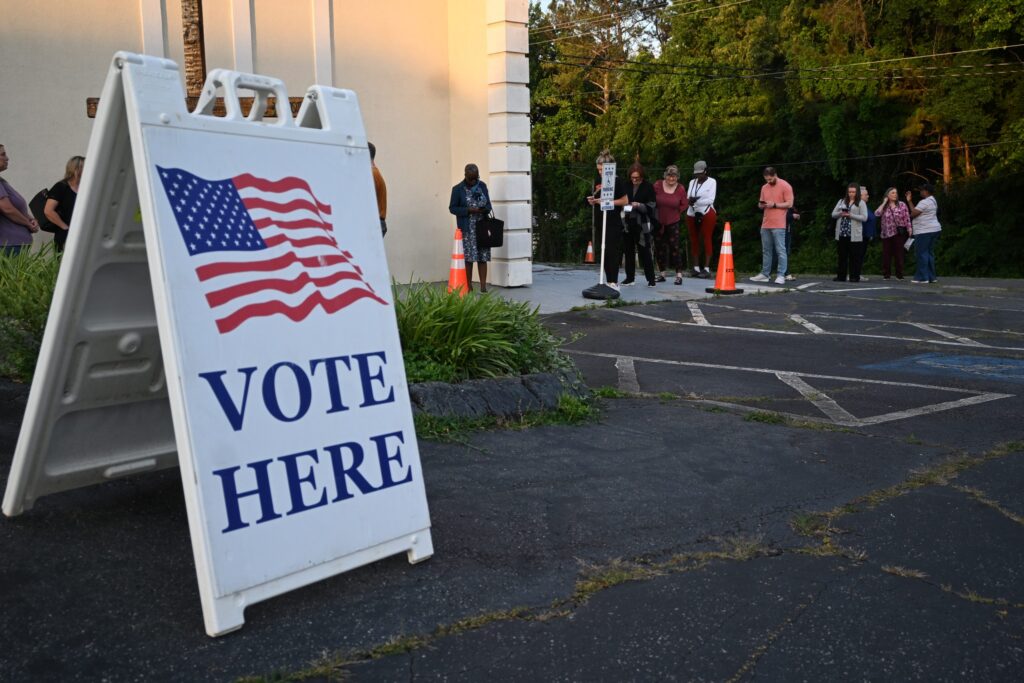
For people whose felonies don’t count towards prohibition of voting, they are unsure if they should check the box or not. So, with early voting for the congressional midterms beginning June 18, relevant applicants are stuck waiting as the process plays out.
Williams organized a press conference in Richmond on Wednesday along with the Virginia Interfaith Center For Public Policy and Bridging the Gap Virginia. Each group has advocated for criminal justice reform and voting rights laws and some have helped returning citizens navigate post-incarceration life.
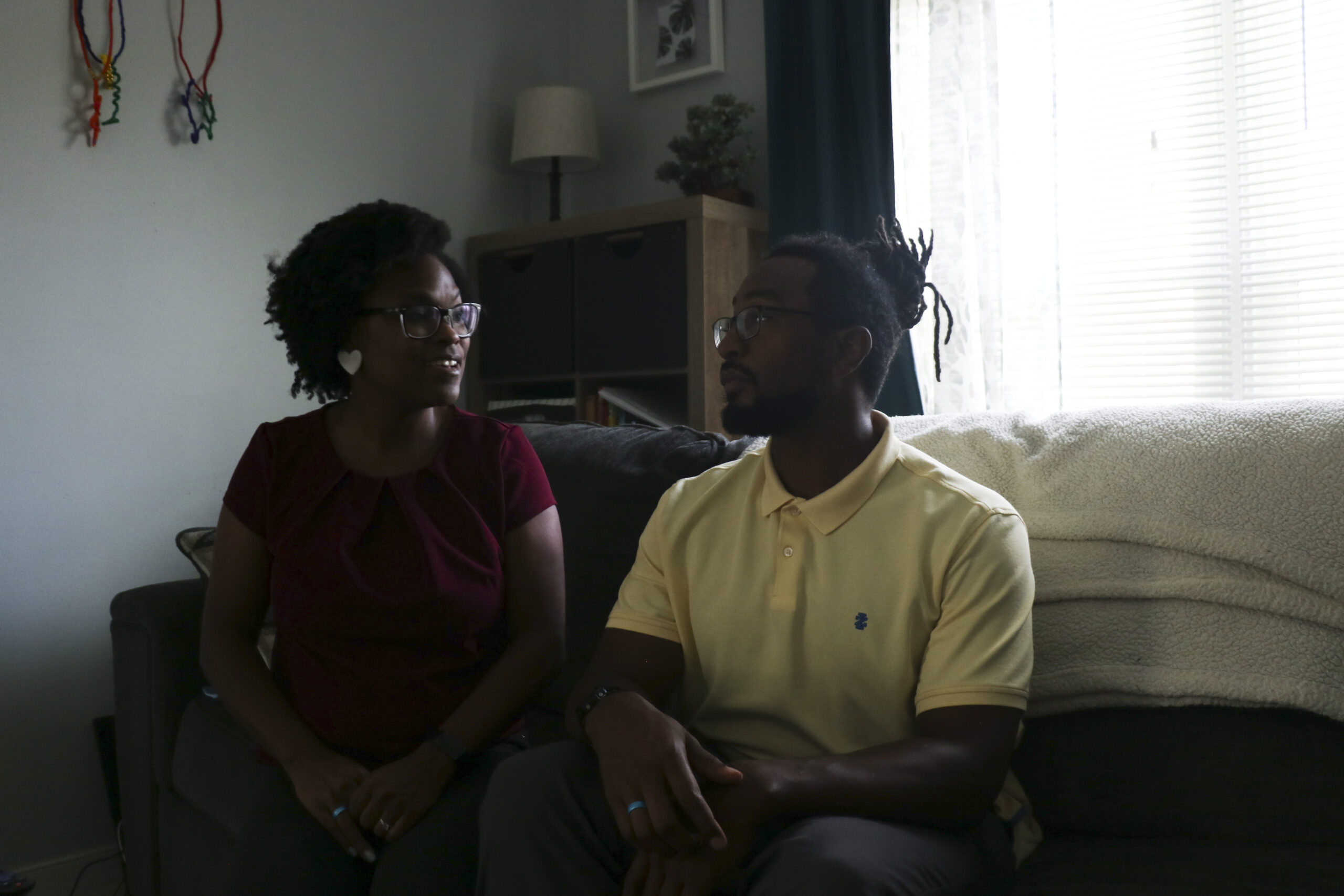
Quadaire Patterson and his wife Santia Nance attended the event. The couple has ramped up their criminal justice advocacy, starting when Patterson was still incarcerated. Though he’s helped shape laws before and after his 2024 release, he has still been unable to vote.
Santia Nance (left) sits with husband Quadaire Patterson (right) in their living room in Henrico County in September 2024. (Photo by Charlotte Rene Woods/Virginia Mercury)
“As I think back to my crime when I was 19 years old, I had no awareness of the political systems that are in play,” Patterson said. But now at 38, having spent about half of his life behind bars, Patterson said he understands how important it is to engage in democracy. The importance of the right to vote hits closer to home now that he and his wife have a 14-month-old daughter, Trinity.
“If we ever want to repair this broken system, if we ever want to repair our broken communities, we have to fully allow returning citizens to participate in the civic processes,” Patterson said.
The case at the core of the matter stemmed from a series of 1870 laws called the Readmission Acts, which allowed former Confederate states to re-enter U.S. Congress after the Civil War. The laws had barred states from constitutionally disenfranchising people other than those convicted of crimes considered common law at the time.
“We create crimes every year but we never revisit and say ‘what did we get wrong?’ and I think that is a barrier too,” Williams said.
Following the suit, Attorney General Jay Jones’ office has been drafting lists of crimes that could be applicable to the ruling.
Congressional primaries will take place Aug. 4 and the deadline to register to vote in those elections is July 24.
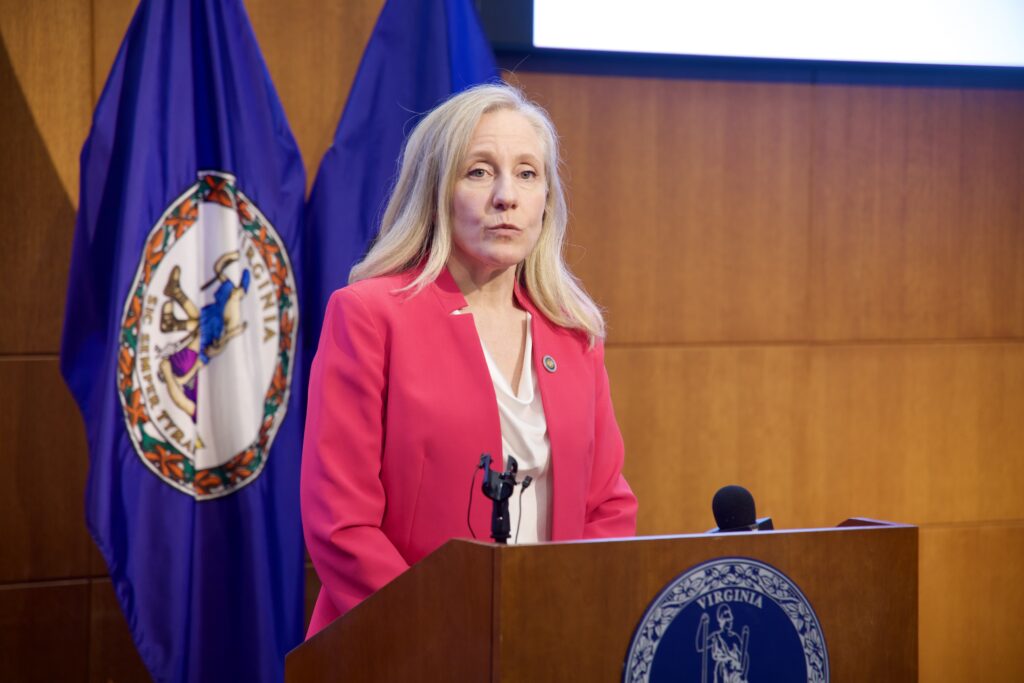
Gov. Abigail Spanberger, seen here in Richmond on April 22, has joined a national coalition of governors committed to preserving access to reproductive health medications. (Photo by Charlotte Rene Woods/Virginia Mercury)
From support for legislation and ballot referendums to helping states stockpile abortion and miscarriage management drug mifepristone, a growing cohort of governors are banding together as the Reproductive Freedom Alliance. Virginia Gov. Abigail Spanberger announced Wednesday that she has joined the coalition.
Members include California Gov. Gavin Newsom, New York Gov. Kathy Hochul, Gov. Wes Moore from Maryland and New Jersey Gov. Mikie Sherrill — who was elected the same night as Spanberger last fall — among 23 others so far.
As part of the alliance, Spanberger said she will “continue doing everything in my power to preserve the rights of Virginians seeking reproductive care and making sure families across our Commonwealth can continue making their own personal healthcare decisions.”
Mifepristone has been subject to legal challenges, with opponents pushing for a national ban on mailing the medication. Several of the states are working to preserve access to the medication and have also enacted shield laws to protect patients’ privacy and expand coverage for over-the-counter contraception.
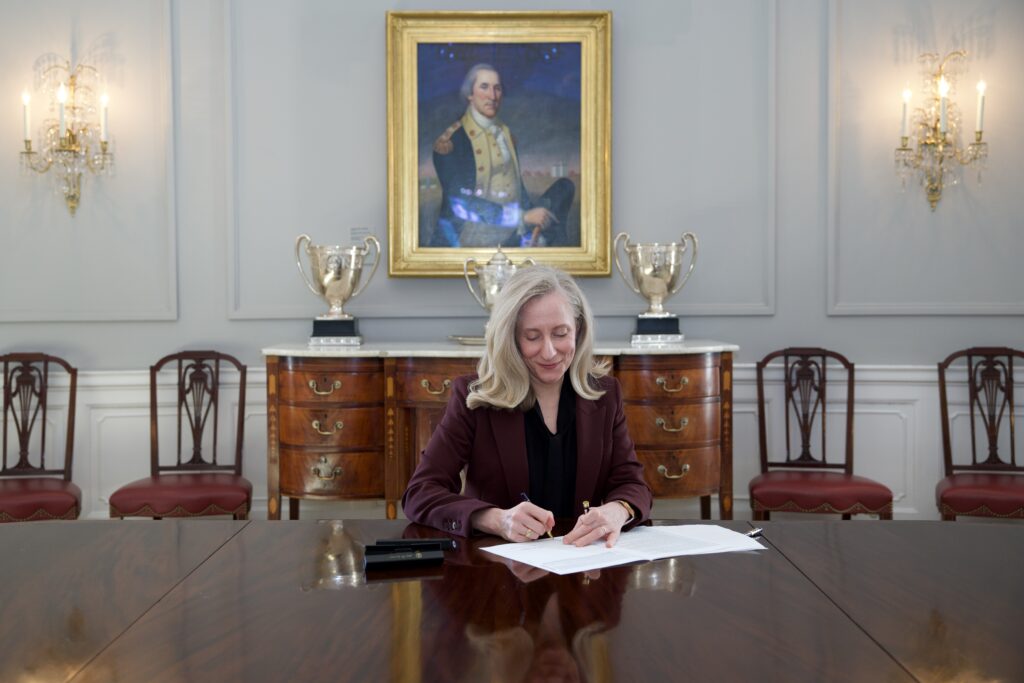
On the heels of announcing she’d joined the governors’ group, Spanberger signed two new reproductive health bills into law in Lorton Wednesday. Years-long efforts dubbed the Right-To-Contraception Act and Contraception Equity Act will fortify people’s ability to access family planning measures.
Del. Cia Price, D-Newport News, who carried the legislation, has emphasized that contraception is also used to treat conditions like polycystic ovarian syndrome and endometriosis. Price uses contraception to treat her own PCOS symptoms, she said.
After signing the law Wednesday, Spanberger called contraception “vital for being able to contend with an ongoing health issue.”
The coalition announcement and new laws preempt the fourth anniversary of the overturn of federal abortion protections by the U.S. Supreme Court and a ballot referendum in Virginia later this year to enshrine reproductive rights into the state’s constitution.
With abortion drawing the most scrutiny, several states have enacted deep restrictions or bans on the procedure. Virginia, where abortion is legal to varying degrees in all three trimesters of pregnancy, is the least restrictive Southern state.
As such, clinics and abortion funds have noted upticks in out-of-state patients in recent years.
Blue Ridge Abortion Fund director April Greene said that 26% of people seeking assistance from her organization live outside Virginia, a 13% uptick since 2023. More people are relying on abortion funds for financial assistance, as rising fuel prices affect travel.
“What this tells us is that abortion bans, anywhere, impact access everywhere,” Greene said.
Spanberger, reproductive rights advocates, state lawmakers and congressional candidates will continue advocating for the constitutional amendment leading up to this fall’s election.
Despite some Republican-leaning states having already pursued similar measures, the amendment has fallen along partisan lines in Virginia. Every elected Republican in the state legislature has voted against the amendment, which had to clear the legislature two years in a row before it could appear on statewide ballots.
“Once it becomes enshrined in our constitution it becomes harder to fight,” said Family Foundation president Victoria Cobb at the Virginia March For Life this past spring.
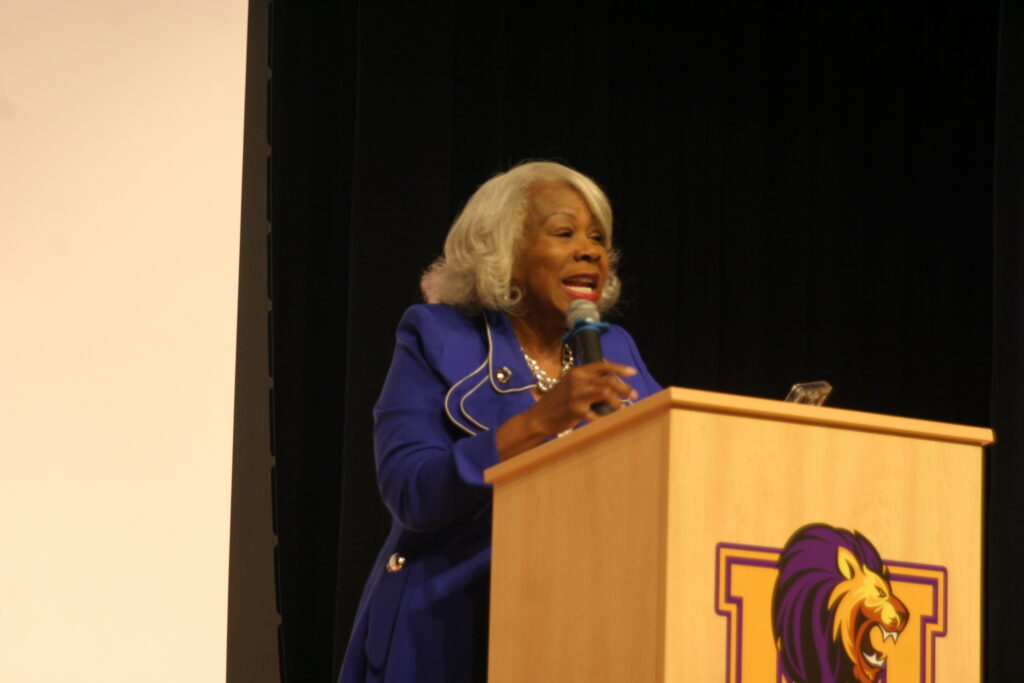
Sen. L. Louise Lucas, D-Portsmouth, speaks during a Chesterfield stop on her statewide listening tour about data centers. (Photo by Shannon Heckt/Virginia Mercury)
On Tuesday, the Virginia Senate released its latest budget proposal that preserves a sales and use tax exemption for the data center industry, the major hangup that has gummed up negotiations between both legislative chambers.
The revamped proposal also adds a tiered tax for the industry that targets diesel generators and would generate $1.8 billion for the state, Senate leaders said.
Sen. Louise Lucas, D-Portsmouth, has advocated to axe the exemption for months but amid stalled negotiations that risk a government shutdown if a budget isn’t finalized by June 30, the new proposal from her chamber signals willingness to compromise, with a sustained goal of regaining money the state misses out on due to the exemption.
“We know technology is not bad. You know, we all can benefit from technology, but we, as a government, have not done a good job in managing the regulations and the impact on our communities and that’s what we’ve got to rein in,” Lucas said Tuesday night at a middle school in Chesterfield at a stop on her data center listening tour.
The new Senate spending plan would levy a tiered impact tax on the types of backup generators that data centers use. The diesel generators have been a point of contention for residents who live near data centers due to heightened concerns over the air pollution released from the generators.
The older, Tier 1 and 2 model backup generators release the most pollution. A new state law requires all new data centers that apply for an air permit to use Tier 4 models, which, along with tier 3 models, are cleaner.
The Senate’s proposed data center tax would be distributed this way:
– $45.00 per permitted kilowatt electrical (kWe) on any Tier 1 and Tier 2 generator;
– $37.00 per permitted kWe on any Tier 2 backup generator retrofitted to be a Tier 4-
equivalent backup generator, Tier 3 generators, and any generator powered by natural gas
– $35.00 per permitted kWe on any Tier 4 generator or any other generator.
Each quarter, data centers would remit the fees to the Department of Taxation and deposited to the general fund.
The key term is “permitted.” Data centers rarely run their backup generators unless there is an emergency power outage or for short periods for monthly testing. But they are permitted for vastly larger amounts than their actual use – which would mean more tax revenue under this plan.
According to Senate finance committee officials, the new generator tax would bring in an estimated $1.8 billion over the biennium. This would be about half of what the state could make in tax revenue if the sales and use tax exemption for the industry was revoked.
The Senate plan, similar to the House, would create a workgroup to generate policy recommendations on how to phase out the sales tax exemption for the industry and present a report to the General Assembly in the fall.
When asked how this group’s report would differ from past reports, such as the 2024 JLARC study on data centers, Lucas said it won’t reveal more than what the state already knows about the impact of data centers across the commonwealth.
“I don’t expect that there’s going to be anything new coming out of it. I actually think it’s a waste of time. But since they want to do it, we will accommodate them,” Lucas said Tuesday.
Lucas said that the House and Senate conferees planned to meet late into the night on Tuesday to work out a deal.
House Speaker Don Scott, D-Portsmouth, cancelled the chamber’s special session on the budget that had been scheduled for Thursday in Richmond, since a deal with the Senate has not been finalized.
Lucas said that the goal for budget conferees of both bodies is to have a deal in place before the Senate is slated to return to the Capitol on Monday.
From left: Del. Paul Krizek, D-Fairfax, Gov. Abigail Spanberger and Sen. Lashrecse Aird, D-Henrico present a revamped plan for the state's retail cannabis marketplace, which includes compromise provisions incorporating many of lawmakers' priorities in the original bill and the governor's tweaks. Cannabis sales are set to begin July 1, 2027, they said. (Photo by Shannon Heckt/Virginia Mercury)
Tuesday morning, Gov. Abigail Spanberger and the legislative architects of a long-awaited retail weed framework presented a revamped plan for the recreational marketplace that they said is set to launch next summer, pending finalization of the state budget.
The announcement marked a major shift, after Spanberger vetoed the cannabis marketplace plan approved by lawmakers in this year’s General Assembly session, five years after the state made adult simple possession legal.
“I am excited to stand alongside Sen. Lashrecse Aird and Del. Paul Krizek to announce that we have agreed to a proposal that will create a safe, legal, and well-regulated cannabis market here in the commonwealth of Virginia, with recreational sales beginning on July 1, 2027,” Spanberger said at the press conference in Richmond.
“Virginians have been waiting a long time for policymakers and a governor who wanted to do this and get it right. And today we are taking an important step forward,” Spanberger added.
Aird, a Democrat from Henrico, said the state tax on cannabis sales will be 6% at launch and will increase to 8% in 2029. Localities also have the option to add an additional tax of 1 to 3.5%.
“If our goal is to move consumers away from the illicit market, then the legal market has to be able to compete, and keeping the tax rate low at the start is not just an economic decision, it is a public safety strategy,” Aird said.
The plan will also limit the total number of retail locations to 350 statewide, which Aird said wouldn’t all debut at once and will be geographically balanced.
In a compromise between the original legislation and Spanberger’s tweaks that lawmakers rejected before her veto, the new framework includes a $250 public consumption civil penalty that will not take effect until 2027.
“We had serious concerns about creating extreme new penalties that would not have meaningfully reduced the illicit market,” Aird said, “but we believe this final framework strikes the right balance for enforcement mechanisms, but also in accountability, but also not harming those who just choose to participate in the market.”
Krizek, a Fairfax Democrat, announced several measures designed to make the marketplace more equitable and accessible to small businesses, including one that will direct 75% of license fee deposits in the first year of operation into the Cannabis Equity Business Loan Fund.
“This is important because access to capital is one of the biggest barriers for small businesses entering a highly regulated marketplace,” Kirzek said.
The Virginia Cannabis Control Authority will be allowed to issue up to 100 microbusiness licenses by May 1, 2027, Krizek added, which will “help prevent the market from being dominated solely by the largest and best capitalized ventures.”
Microbusinesses will also be authorized to operate up to two locations under their license structure, which had been a key concern for small and rural entrepreneurs.
Regulatory structures of the original plan like seed-to-sale tracking, a product testing framework, licensing administration, and reporting requirements related to ownership, equity, participation, and disciplinary actions are present in the updated framework, with Krizek framing them as tools to “create transparency and accountability as the market develops.”
In contrast to the recent tensions between leading Democrats and Spanberger after she vetoed 31 bills that represented priority issues for the party, the governor, Aird and Krizek repeatedly emphasized the collaboration and compromise undergirding the new plan.
“We have always had this same end goal, an end goal that has been years in the making, so I am proud to stand alongside these dedicated legislators and to be working alongside them to deliver a marketplace built to last,” Spanberger said.
The retail cannabis plan — released as the Senate money committee met nearby to unveil its reworked state spending proposal — hinges on finalization of the state budget, which has been stalled for weeks as lawmakers debate whether data centers’ sales tax exemption should continue.
“I believe that the Senate is very much interested in also getting us a budget, and that we have shared goals on how to get there,” Aird said.
The House revealed its new budget proposal on Friday; the chambers must work together to finalize the budget by June 30 to prevent a state government shutdown.
In Virginia's 2nd Congressional District, four Democrats are vying for the chance to unseat Republican incumbent Jennifer Kiggans. The Virginia Democratic primary is Aug. 4. (Photo by Ross Williams/Georgia Recorder)
This summer, four Democratic candidates will face off in a primary for the chance to oust incumbent Republican representative Jen Kiggans in Virginia’s 2nd Congressional District.
The Virginia Beach-anchored district is politically purple and often oscillates between partisan control, though in past years it had a decidedly Republican lean.
Its nearly 600,000 residents backed Gov. Abigail Spanberger last year by 53% and analysts consider it flippable — making it a key contest that could help determine partisan control of Congress.
All four Democratic primary candidates — which include the district’s former representative Elaine Luria, acute care doctor Nila Devanath, former USAID worker Patrick Mosolf and regional government official Bill Fleming — seek to hold Kiggans “accountable” and help congress provide a check and balance to the “corruption” of President Donald Trump.
Who’s who
Kiggans, a Navy veteran and nurse practitioner, has represented the district for two terms after ousting Luria, who also represented it for two terms. With no primary challenger, she did not do an interview for this story, but she did respond to questions by email.
With Navy veteran Luria formerly representing the district, she already has backing from the Democratic Congressional Campaign Committeealong with Democratic leadership in Virginia including Gov. Abigail Spanberger and Sen. Louise Lucas, D-Portsmouth.
During her time in Congress Luria backed the creation of the Affordable Care Act’s Enhanced Premium Tax Credits — which have since expired but helped reach more people struggling to afford healthcare. She also backed the 2022 Inflation Reduction Act, a range of energy efficiency and healthcare affordability measures.
Devanath,the daughter of Bangladesh immigrants, is an acute care doctor but previously worked as a lawyer at a legal clinic defending domestic violence survivors.
If elected, she plans to bring her legal and medical insights to Congress. She has already made trips to D.C. to meet with members of finance committees, she said, to prepare for how she can help address economic issues if she earns a seat on Capitol Hill.
Virginia Beach Soil and Water Conservation District director Bill Fleming hopes to join the U.S. House Committee on Agriculture if elected so that he can help advance environmental laws. He shares many progressive policy priorities with some of his primary opponents but considers himself an “independent democrat.”
From serving as director of a homeless shelter to time spent working for USAID, Mosolf said his time spent solving problems has helped him prepare to take that work to the nation’s legislative body. He was motivated to run and find new routes to solve problems after losing his job to Trump’s closure of USAID.
Addressing the cost of living
The rising cost of living, from groceries to housing to healthcare, is a motivating factor for Kiggans and all four Democratic candidates.
Luria said Kiggans expressed interest in bipartisan collaboration after ousting Luria from the seat in 2022, a stance she said was in contrast with Kiggans’ votes in favor of Trump policies.
Ahead of the passage of the One Big Beautiful Bill Act last summer, Kiggans joined an open letter in opposition to aspects of the bill she ultimately voted for.
Kiggans was previously outspoken about the need to renew expiring ACA tax credits, Luria said, even writing a letter in support of extending the credits, but ultimately changed her tune.
“Writing a letter that is in opposition to something you’re voting for — it just doesn’t work that way,” Luria said.
In an email, Kiggans said her initial support of renewing the credits was conditional on “meaningful reforms” to strengthen protections against “waste fraud and abuse.”
All Democratic challengers said addressing affordability issues will be a priority for them, if elected.
“I think it’s going to take a lot of small things. It’s not just pushing a magic button,” Mosolf said.
All the Democratic contenders said they would work to extend the ACA subsidies and undo the healthcare provisions of the reconciliation bill.
They are supportive of a massive bipartisan housing bill that is nearing Trump’s desk and could see his signature; if it doesn’t, though, they said they will try again.
On healthcare, Devanath and Fleming are backing a growing Democratic embrace of universal healthcare. The idea is to replace private insurance companies with government-run insurance available to everyone.
Because uninsured and underinsured people are more likely to put off primary care, Devanath said she’s increasingly treating people in critical condition or for whom more drastic measures could have been prevented.
“You have to have people who are willing to be bold,” Devanath said. “Instead of following incremental change, let’s go for the gold. Put it out there, stick to it, and see where we land.”
Devanath and Fleming also support the Working Americans’ Tax Cut Act, which would create a tiered surtax on income over a million dollars.
“It’s one thing to sit and grumble about something while you’re watching television, but it’s better to try to get a seat at the table, so that you can maybe affect change,” Fleming said.
Stock trading crackdown, campaign finance reform
Luria said Congress should hold itself accountable by banning stock trading of elected officials, pointing to what she called a “long list” of ways Trump has capitalized on his presidency to financially benefit his family or allies.
As a congresswoman, Gov. Abigail Spanberger championed an effort to prevent lawmakers from capitalizing on sensitive information and disproportionately benefitting from their positions of power.
Luria was not always on board with the proposal, calling it “bullsh-t,” but her stance has evolved into support.
“Congress can set the example and actually walk the walk,” she said.
All of the Democratic contenders want to address how candidates receive donations for their campaigns by reigning in large political action committees’ donations along with “dark money” contributions, large entities’ donations that are not publicly disclosed.
Luria’s Democratic challengers have taken issue with her updated stance on campaign finance. In 2018, she’d signed a pledge to not take corporate money before accepting $34,000 from corporate PACs in 2020.
Luria’s donors have included the Democratic Majority for Israel PAC and some of her donors have also contributed to American Israel Public Affairs Committee. After a United Nations committee concluded that Israel is committing genocide in Gaza, Luria’s challengers said it would be unethical for them to take money from groups that support Israel. (Israeli officials have denounced the report as “distorted and false,” according to NPR.)
While AIPAC has historically supported both parties so long as candidates are “pro-Israel,” the group’s supporthas emerged as a rift among some Democratic candidates in recent election cycles.
Kiggans, who has also been boosted by AIPAC, has supported U.S. involvement in Israel’s affairs. In 2024 she voted for military aid to Israel in a package of bills she said were “not perfect,” but needed at the time.
The conflict, initiated by America, has contributed to spiking gas prices because Iran is a critical global player in oil trades.
“When the Iran conflict is over, gas prices will come down and we’ll work to get them even lower with American energy dominance,” Kiggans said.
While Democrats have lambasted Kiggans for voting for the Big Beautiful Bill, she emphasized that the measure also “cut taxes on social security, tips and overtime” to “put more money in the pockets of Virginians.”
The two-term congresswoman has bucked Trump’s administration over a new rule that will exclude post-baccalaureate nursing degrees from a “professional degrees” list, joining a bipartisan letter in opposition.
Kiggans was also critical of the Trump administration’s efforts to stop construction of Dominion Energy’s offshore wind project, which is located in her district.
Still, her Democratic opponents said she has too often aligned with GOP majorities and the president, including her endorsement of federal workforce trimming despite the 2nd district having among the largest concentration of federal workers in the state.
“The bottom line is she has put Trump over the people of Hampton Roads,” Luria said. “People will hold her accountable at the ballot box in November.”
The Democratic hopefuls will face off for the chance to defeat Kiggans in the Democratic state primary election on Aug. 4.
Editor’s note: This story has been corrected to reflect that Luria has not received donations from AIPAC, as previously stated, but some of her donors have contributed to the organization.
The House of Delegates, pictured here on the final day of the 2026 legislative session, proposed a revamped budget stripped of environmental standards data centers would have had to meet to keep their sales and use tax exemption. (Photo by Markus Schmidt/Virginia Mercury)
Oh yay, another commission.
Leaders in the House of Delegates are continuing to tweak their version of a state budget, but they aren’t backing down from their fight with the Senate over data centers. What they are backing down from is their former insistence that data centers use clean energy. Instead, they propose to punt this and every other data center issue over to a commission.
Is that supposed to resolve the budget impasse? Because if that’s the idea, it sure seems like an odd way to go about it.
Recall that Senate Finance Chair Louise Lucas, D-Portsmouth, wants to terminate the sales tax exemption that data centers have exploited to the tune of $1.6 billion lost from state coffers. (The total subsidy rises to $1.9 if you include the exemption from local taxes, but what’s a few hundred million bucks among friends?)
The tax isn’t something specific to data centers. It’s the same one all the rest of us pay. The argument that there are better ways to spend the money than to give it away to the world’s richest corporations has reaffirmed Lucas as a bonafide social media star at age 82, and she is enjoying it very much.
In response to the new House budget proposal, Lucas tweeted out a tweak of her own: She now proposes to subject data centers to a nearly-equivalent fee that would generate $1.7 billion in revenue. Lucas and allies have launched a “listening tour” to build support for her approach.
But the House budget does not eliminate the exemption, leaving the two sides at an impasse.
The House is set to reconvene on June 18, and the Senate on June 22. The chambers will attempt to resolve their differences and adopt a budget before July 1 to avoid a government shutdown.
House leaders argue that data center operators relied on this tax exemption when they chose to locate in Virginia. They signed memorandums of understanding agreeing to a few minor conditions, and in return they were promised they wouldn’t have to pay sales tax on computer chips and other equipment until 2035. (In the case of Amazon and any other corporation that sinks $50 billion into data centers in Virginia, the date has been extended out to 2045.)
But the House budget proposal originally incorporated provisions drawn from legislation introduced by Del. Rip Sullivan, D-Fairfax, requiring data centers that take advantage of the tax exemption to buy increasing percentages of renewable energy, refrain from using onsite fossil fuels as their primary energy source, and begin phasing out the backup diesel generators that threaten air quality. The bill passed the House but died in the Senate around the same time Lucas decided there shouldn’t be a tax exemption at all.
The disagreement left Virginia without a budget for the new year. Now suddenly the House has issued a new proposal that has the support of Gov. Abigail Spanberger. Instead of resolving the impasse, though, it actually goes backwards on regulating data centers.
It still leaves the tax exemption intact, but now “includes explicit direction for the establishment of a Commission to thoroughly evaluate the direct and indirect costs and benefits of the data center industry.” The commission is to issue a report and recommendations for legislative and budgetary changes, which the General Assembly will then consider next year.
Are you feeling a little prickle of déjà vu? That’s because we have seen this before, and not very long ago. In December 2023, the General Assembly headed off action for all of 2024 by directing the Joint Legislative Audit and Review Commission (JLARC) to assess the impact of the industry on energy demand, state revenue, natural resources – essentially, the same things this year’s commission is supposed to look at all over again.
You remember the JLARC report. It sounded a dire warning against the consequences of “unconstrained” data center demand. The report made a stir in December of 2024 when it was issued. Statements were released, proposals were floated.
And thus warned, the General Assembly went into the 2025 session and did . . . nothing.
Doing nothing pretty much described 2026 legislative action on data centers, as well. Among the few reforms House and Senate Democrats seemed to agree on were that data centers needed to buy renewable energy and storage to limit the increase in Virginia’s carbon emissions and to decrease the pollution from diesel generators. The House did this by way of Sullivan’s bill; the Senate supported a different approach. Each chamber killed the other’s bill.
That left the House budget as the only vehicle for progress this year on one of the central problems of the data center buildout. By backtracking now, House leaders and the governor show they are willing to capitulate entirely to the data center industry and its labor allies.
To be sure, a budget amendment this year that puts conditions on tax exemptions in future years would need to be followed with new legislation to lock in the requirements. And for that purpose, House and Senate members should definitely work together this summer to align their proposals, ensuring both chambers agree on the terms of the legislation before it is introduced.
A commission with that task could be useful. After all, the Commission on Electric Utility Regulation, now rebranded as the Energy Commission of Virginia, succeeded in bringing together House and Senate members around a striking number of good energy bills this year.
But a commission that is thrown together suddenly and instructed to retrace the steps of a report issued barely 18 months ago seems suspiciously like a substitute for action.
This is all too familiar. When it comes to data centers, inaction seems to be the point.
By Shannon Heckt, Charlotte Rene Woods, Nathaniel Cline, Samantha Willis Virginia Mercury
The state Capitol building in Richmond. Lawmakers must reconcile the budget by June 30 to avoid a state government shutdown. (Photo by Charlotte Rene Woods/Virginia Mercury)
With a June 30 deadline looming before a state government shutdown, Virginia legislators have released new budget proposals, the latest actions in a long-simmering debate over the state spending plan that has deadlocked over whether data centers should keep being exempt from the state’s sales and use tax.
Virginia House of Delegates leaders presented their updated budget proposal Friday, revamping their $74 billion funding plan based on a new revenue forecast ordered by Gov. Abigail Spanberger last month. The House budget no longer includes environmental standards that data centers would have to meet to keep the exemption, which saves the industry nearly $2 billion annually.
Hours after the new House budget was unveiled, Sen. Louise Lucas, D-Portsmouth, divulged an updated Senate budget proposal, with scant details, on social media.
While Lucas didn’t outline the particulars of the plan, she said it included a 4% raise for teachers, $345 million for health and human services initiatives including food assistance for low-income Virginians and a $100 “fair share” rebate for individuals.
Here’s how each chamber plans to address key issues in the next two-year state budget.
Chambers still at odds over data centers
The data center sales and use tax exemption remains the biggest bottle neck on state budget negotiations.. The state currently forgoes an average of $1.6 billion annually by allowing the industry to not pay the 5.3% state tax on their computer equipment and server racks.
Lawmakers in the House of Delegates, including Speaker Don Scott, consider the exemption a strong driver for union electrical and construction jobs, whose workers build the facilities that make major investments on the local level. The House’s previous budget would keep the exemption in place and require data centers to use cleaner back up generators, improve their energy efficiency, and take other environmental steps to keep the tax break.
The House’s updated budget preserves the exemption through 2035 and eliminates the environmental standards. Instead, the House proposed creating a commission made up of legislators and stakeholders to examine data centers’ energy use and how the industry impacts the state and local tax revenues.
A similar report was released by the Joint Legislative Audit and Review Commission in 2024. But Spanberger, who supports the House’s plan, said the new commission would dig deeper and produce more in-depth reports that would help drive policy decisions in the next regular session of the General Assembly.
Concerning the proposed commission’s focus, Spanberger said Friday, “We want a little bit more help in understanding if we’re making good choices for our communities. (Such as) rules of the road, best practices, whether it’s setbacks or noise reductions, limits on diesel generators, requirements for battery backup.”
The Senate has not released the full context of their new updated budget proposal but it includes a “tiered state impact fee,” Lucas said in her social media statement. The fee would be placed on the facilities according to their generator type and their energy capacity. Lucas said the system would generate an estimated $1.7 billion in tax revenue for the state but didn’t detail how. Her office did not have further details of the proposal available for clarification on Monday.
Lucas also said the new Senate budget includes funding for a work group to study the tax exemption and other potential protections for ratepayers and local communities, similar to the house’s proposed commission.
Cannabis market still hazy
After Spanberger vetoed bipartisan legislation to create a retail market for recreational cannabis, House lawmakers said Friday that the proposal has been added to their updated budget.
Few details were available Friday about the weed market plan, spearheaded by Del. Paul Krizek, D-Fairfax, but he confirmed “we have a deal, and it’s just a matter of finishing the legal edits” of the retail market framework. Krizek said more details would be released in a joint press conference with Spanberger on Tuesday.
House lawmakers also added “$865,000 each year from the general fund and four positions to support workload increases” in the The Virginia Department of Agriculture and Consumer Services’ Office of Weights and Measures to their updated spending plan, “related to the establishment of an adult-use recreational cannabis market.”
The overview of the new Senate budget shared by Lucas didn’t include the cannabis framework. However, the chamber passed SB 542, the companion measure to the House bill which would create the marketplace. And the Senate ’s two-year budget pitched before the end of this year’s legislative session includes over $12 million for the operation of the Virginia Cannabis Control Authority over two years.
Sometimes errors in overpaying or underpaying households arise from paperwork mistakes by government staff or outdated information from beneficiaries. A federal law passed last summer mandates states drop their error rates.
That same law also entails verification changes to Medicaid, which is estimated to put thousands of Virginians at risk of losing coverage and add financial strains to hospitals.
These shifts are why the state budget proposals from both chambers include money to help streamline compliance for social service workers around the state and mitigate insurance drop offs.
The new proposal from the House maintains a $2.4 billion increase to fully fund Medicaid and Children’s Health Insurance Program forecasts. It would also add $39 million to partially restore proposed cuts to Medicaid and CHIP.
House lawmakers earmarked $3 million to support social service staff compliance with the new SNAP and Medicaid federal standards.
Where a previous version of the House budget entailed a $5 million increase in funding for the state’s free clinics, the new draft increased it to $13 million. An already “strained safety net,” free clinics are bracing for an influx in uninsured patients as people lose Medicaid or ACA and are a key partner for hospitals to reduce caseloads in emergency rooms.
A holdover from the chamber’s previous proposal, lawmakers would direct $79.1 million towards a state-level version of the expired Affordable Care Act subsidies that Congress let expire last year.
“We’ve never had this much of an onus on the state before,” Henrico Democratic Del. Rodney Willett, who chairs the House’s Health and Human Services Committee, said in a previous interview. “It will take a lot of work with the people, processes and systems to go with that.”
Over 33,000 Virginians and counting have dropped their ACA insurance so far this year amid rising premiums. Of Virginia’s roughly 400,000 ACA clients, about 100,000 have been estimated to have lost the subsidies.
Likewise, the Senate has its ideas for addressing the federal fallout too.
Its newest version still includes $200 million for a state-level ACA subsidy along with a special enrollment period for people who dropped off and want to sign back up for insurance.
Health and human services work in the state would receive $345 million and would address a range of programs, from Medicaid to SNAP to developmental disability waiver rates.
It’s unclear how that will be divided up as the Senate had not fully released its next proposed version of the budget by the time of this publication. Initially, the chamber had settled on $135 million for SNAP, with lawmakers assuming the state cannot drop below a 10% error rate.
More recently, the chamber suggested $190 million to offset future rate increases in state employee health insurance premiums.
Housing support boosted
As a flurry of housing bills passed the legislature and were signed into law by the governor, both budget proposals entail funding to help get them off the ground — but they differ in how that should happen.
The House’s new draft would invest an additional $20 million into the Virginia Housing Trust Fund. The program offers loans for low-income housing projects and provides grants to organizations that serve unhoused people. The additional boost brings the House’s earmark for the fund up to $195 million over the next two years.
The House also wants to add $14 million over the next two years to support organizations that work with unhoused populations or help people at risk of homelessness.
As state lawmakers have refined Virginia’s Eviction Reduction Program, the House proposes $11.5 million in new resources for it, bringing total support to $18.5 million over the biennium.
On housing, the preview of the Senate’s forthcoming new budget draft entails $110 million for housing-related initiatives “including eviction reduction, weatherization programs, and Housing Trust Fund deposits.”
K-12, school construction funding reflects uncertainty
Local governments and school leaders are waiting on the budget to be finalized to decide how they will be able to cover teacher pay raises, and how much those raises will be. The legislature’s dueling spending plans also address another key concern: covering construction and modernization costs for the upcoming school year.
The House’s revised budget proposes a 3% raise for state and state-supported employees, including teachers, over the next two years, while the new Senate budget includes a 4% increase aimed at moving Virginia toward the national average teacher salary.
“With inflation being over 4%, a 3% raise does not really end up being a raise, it’s a pay cut in practice, and the average teacher would lose money in buying power,” Carol Bauer, president of the Virginia Education Association, said.
In the area of school construction, the House’s revised proposal includes an additional $299 million for school construction grants, bringing the biennial total to $519 million.
In contrast, Lucas’ overview of the updated Senate budget did not mention school construction grants. In February, the body approved a plan to allocate $172 million from the Literary Fund to the School Construction Fund for construction and renovation grants.
However, the Senate’s plans for the grants and the School Construction Fund remain uncertain, because its funding relied on expected casino tax revenues under the chamber’s previous budget.
Additionally, the House is now proposing to move the $172 million originally from the Literary Fund to cover teacher retirement costs, adding to the unpredictability.
Both chambers still proposed expanding a 1% sales tax to pay for construction costs; however, the House version goes further, permitting jurisdictions in Planning District 8, or Northern Virginia, to use these funds for transportation projects to address public transit needs in that region.
Among other notable budget moves, the House announced that the previously proposed $400 million one-time flexible funding was removed and replaced by a $98.4 million one-time supplement for at-risk student programs.
The amended House budget returned $10.1 million in unused laboratory school funds to the state’s main funding pool.
Both budget proposals are similar in that they fund the state’s special education line item: the House proposes $148.4 million, compared to the $150 million Lucas mentioned in her letter about the Senate’s revamped plan.
The delayed completion of the budget “puts hardship on school districts trying to get contracts out, puts a hardship on folks knowing what their actual compensation is going to be for the next year, and so we honestly would like things to get settled,” Bauer said.
House meets this week, Senate the next
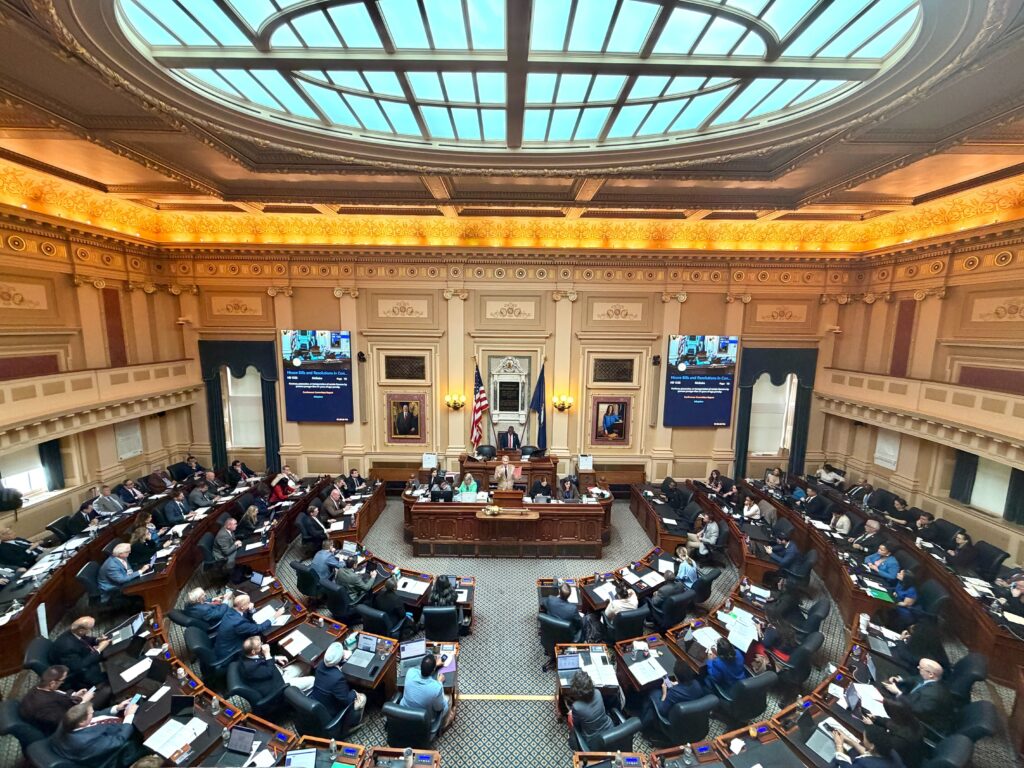
The House reconvenes Thursday and the Senate is scheduled to meet in Richmond June 22. The chambers must reconcile their spending plans and approve a new budget before the June 30 deadline, or a state government shutdown — the first in the state’s history — will ensue.
Gov. Abigail Spanberger signs legislation in Richmond in April. Spanberger’s first six months in office have been marked by clashes over vetoes, affordability policies and ongoing budget negotiations tied to data center tax incentives. (Photo courtesy of the Virginia Governor’s Office)
Back in January, Gov. Abigail Spanberger arrived in office promising pragmatism, affordability and a less combative style of politics.
Fast forward a few months, and Virginia’s first woman governor finds herself navigating one of the rockiest starts to a Democratic administration in years, with budget negotiations intensifying weeks before a shutdown deadline, frustration simmering inside her own party over a wave of vetoes and lawmakers openly questioning her governing style.
“I think it’s outrageous that we are where we are, and I hear from many legislators that they are displeased with the process,” Spanberger said during an interview with The Mercury at her office in Richmond Thursday, referring to the state’s still unfinished biennial spending plan.
“And I know that they are making that known to their individual bodies. And we will get there, because we have to.”
The impasse has overshadowed much of Spanberger’s opening months in office. Democratic leaders remain divided over whether to scale back Virginia’s lucrative data center tax incentives and how aggressively to regulate the fast-growing industry.
Lawmakers face a June 30 deadline to approve a spending plan before the new fiscal year begins July 1. Without a deal, Virginia could enter an unprecedented government shutdown.
The fight has also exposed tensions between Spanberger and some top Democrats in the legislature who expected a smoother relationship with a governor from their own party after four years of divided government under Republican Gov. Glenn Youngkin.
Political analyst Bob Holsworth said the administration’s first few months have been shakier than many Democrats anticipated.
“By and large, I think it’s been a wobbly term for sure,” Holsworth said. “We’ve never seen the kind of vetoes that we had before, and the Democrats are in a position that’s almost embarrassing in terms of the budget.”
Still, Spanberger rejects the idea that her administration so far has been defined mainly by conflict.
“I’ve signed more than 100 bills that Governor Youngkin had vetoed,” she said.
Richmond versus the rest of Virginia
Spanberger said one of the biggest surprises on the job has been the disconnect she sees between debates dominating Capitol Square and the concerns she hears while traveling the commonwealth.
“How different things are here in Richmond, or even Capitol Square, versus everywhere else in Virginia,” she said, recalling recent visits to Abingdon, Washington County, Blacksburg and Surry County during Virginia Agriculture Week.
“The things people are talking about at times are very, very different from the things that people are talking about in Richmond,” she said.
Spanberger said that disconnect has influenced how she approaches many of the biggest issues coming out of the General Assembly.
While progressive lawmakers pushed for sweeping changes on labor, environmental and criminal justice issues, Spanberger said she often evaluates legislation differently now as governor, focusing more heavily on implementation, agency capacity and long-term economic effects.
“It’s important to me that not only are we getting it right, but when there’s clear places and areas for improvement in terms of how we can set up state agencies or entities for that implementation, we need to make those changes,” she said.
Spanberger pointed to paid family and medical leave as an example of a policy she supports but also requires careful implementation.
“Virginia is the 14th state in the country to adopt a policy like this. It’s a policy that I think people are going to feel in a positive way, but it is a major shift, and we have to get it right,” she said.
But Holsworth said many lawmakers expected clearer guidance from the governor earlier in the legislative process, especially relating to the state budget.
“She could have been involved earlier there,” he said. “Typically governors really try to do a more determined job of setting the parameters of the budget early on.”
Holsworth also argued the tensions reflect ideological shifts within the Democratic Party of Virginia.
“Virginia’s always had these pro-business governors, Democratic or Republicans,” he said. “But the legislative branch of the Democratic Party has moved a little further to the left.”
The data center divide
Sen. Louise Lucas on the Senate floor at the Virginia State Capitol in Richmond during this year’s legislative session. Lucas has emerged as one of the leading voices pushing to scale back Virginia’s data center tax incentives amid ongoing state budget negotiations. (Photo by Shannon Heckt/Virginia Mercury)
Much of the budget dispute comes down to disagreements over Virginia’s sales and use tax exemption for data center equipment, an incentive credited with helping the commonwealth become the world’s largest data center hub.
Sen. Louise Lucas, D-Portsmouth, the chair of the powerful Senate Finance and Appropriations Committee, wants to eliminate the incentive, arguing the state is subsidizing highly profitable corporations while residents face rising utility costs and environmental concerns.
Last week, Lucas announced that she would take the data center debate directly to the voters, launching a statewide listening tour focused on the industry’s impact on communities statewide.
Stops are planned across Virginia, including Hampton Roads on Sunday, Richmond and Northern Virginia as lawmakers continue weighing whether the state should scale back billions of dollars in tax incentives for the rapidly expanding sector.
Spanberger, however, has taken a more cautious approach.
“What is less part of the discussion is the end goal,” she said, warning that abruptly dismantling the tax break could trigger lawsuits, damage Virginia’s business reputation and destabilize local governments heavily dependent on data center revenue.
“Look at Mecklenburg, where they’ve built multiple public schools fully with data center funding,” Spanberger said. “When you have localities with nearly half their local revenues coming in from data centers, there’s some localities that are saying, wait, why are you going to pull up the ladder behind you?”
At the same time, she said the industry should face stricter standards on energy consumption, water usage and environmental impacts.
“If energy generation and energy consumption is a problem — and I’ve been very clear that data centers need to pay their fair share as relates to energy consumption — well, how do we get there?” she said.
Spanberger argued Virginia still holds leverage because companies want to locate in the commonwealth.
“We have a pretty significant stance to be able to say we have these very high standards, and we want you all to meet them,” she said.
On Friday, the House released a new budget proposal that would preserve the existing sales and use tax exemption for data centers while creating a commission to study the industry’s long-term impact on Virginia’s power grid, water resources and economy.
The revised plan also eliminated earlier Senate-backed environmental requirements opposed by industry groups and some business advocates. Spanberger, who has repeatedly argued the state should “honor its commitments” to companies that invested in Virginia under the current incentive structure, praised the House approach Friday.
“This proposal creates a clear roadmap for evaluating the impact of the data center industry in Virginia and for reassessing the state’s incentives into the future, with a focus on fairness to ratepayers and the needs of local communities,” Spanberger said in a statement.
Meanwhile, Senate Minority Leader Ryan McDougle, R-Hanover, blamed Democrats broadly — and Spanberger specifically — for the ongoing impasse.
“She’s the governor and it’s her party,” McDougle said in an interview Friday. “She should take the blame.”
McDougle also criticized what he described as a lack of policy engagement from the administration during the session.
“My conversations with the governor during the legislative process were always polite and courteous, but nothing substantive about policy. I would expect such conversations would have a significant policy component, and I did not see that from my perspective. And we did not see representatives of the administration at many of the committee hearings and debates,” McDougle said.
Holsworth said the budget stalemate has exposed deeper tensions over Virginia’s economic identity.
“You have one group of Democrats, with Spanberger leading it, saying that if we do this, our ranking, as the best state for business, is really going to take a hit,” he said.
“On the other hand, you have Senator Louise Lucas and other people in the Senate, some Republicans included, saying, ‘Why in the world are we paying a couple of billion dollars a year to the richest people in the world as a tax exemption? We should get rid of it, or at least tone it down in some fashion.’”
Senate Minority leader Ryan McDougle, R-Hanover, speaks with reporters outside the Virginia State Capitol in Richmond last month as lawmakers continued negotiations over the state budget and data center tax incentives. (Photo by Shannon Heckt/Virginia Mercury)
Affordability and political pressure
Spanberger campaigned heavily on affordability last year, but acknowledged many Virginians still don’t feel economic relief.
“The measure of success keeps changing because all of the pressures that require us to work on issues of affordability and lowering costs keep getting worse,” she said.
She highlighted insulin cost reforms, healthcare changes involving insurance pre-authorization and housing measures she said will help residents more directly.
However, Spanberger acknowledged those gains collided with inflation and rising fuel prices.
“The progress we’re making is muted by the fact that there’s still pressures and bad policies that are negatively impacting people,” she said.
Republicans have repeatedly argued that Democratic policies are contributing to higher household costs.
McDougle said the governor’s policies contradict her campaign messaging on affordability and bipartisanship.
“She talked a lot about being for people and bipartisanness and affordability on the campaign trail. And then her initial policies, right out of the gate, were to raise everybody’s power bill through RGGI,” he said, referring to Democrats’ move to rejoin the Regional Greenhouse Gas Initiative.
The Spanberger administration pointed out that 75% of the governor’s “Affordable Virginia Agenda” passed with bipartisan support.
But Holsworth said Republicans moved quickly after Spanberger took office to define her politically before she could fully establish her governing identity.
“They went after her early, and I think they caught that team a little unaware,” Holsworth said. He added that many of Spanberger’s affordability initiatives may ultimately prove popular but are not tangible to many voters.
“The average person in the street knows that their electric bills and insurance bills are going up,” he said.
What comes after the budget
Even with the budget fight and criticism from some Democrats, Spanberger said she remains focused on longer-term priorities, particularly housing, childcare and administrative reforms.
“There’s more to do to continue to really push on the supply side challenge,” she said, referring to housing and childcare.
The governor is also closely watching Dominion Energy’s proposed merger with NextEra Energy, which would create one of the nation’s largest utility companies.
Spanberger said she sees possible benefits if the merger expands renewable energy production and lowers costs for ratepayers, but she also expressed concerns about long-term impacts on Virginia jobs and consumers.
“There also has to be some clear financial benefit for the fact that these two gigantic companies are endeavoring to merge to become even more enormous,” she said.
Spanberger also acknowledged that, as Virginia’s first woman governor, some reactions to her leadership may be shaped by expectations that previous governors did not face.
“I think that things are scrutinized differently, assumptions are made differently,” she said. “I might not be exactly in the model that people are used to.”
Still, she suggested that some of the criticism surrounding her first few months in office reflects discomfort with a governing style that does not fit traditional expectations of Virginia governors.
“The way that people will level critiques against me just objectively, they wouldn’t do it (to others),” Spanberger said. “They haven’t.”
Water tower for the town of Tangier, VA. June, 8 2026. (Photo by Shannon Heckt/Virginia Mercury)
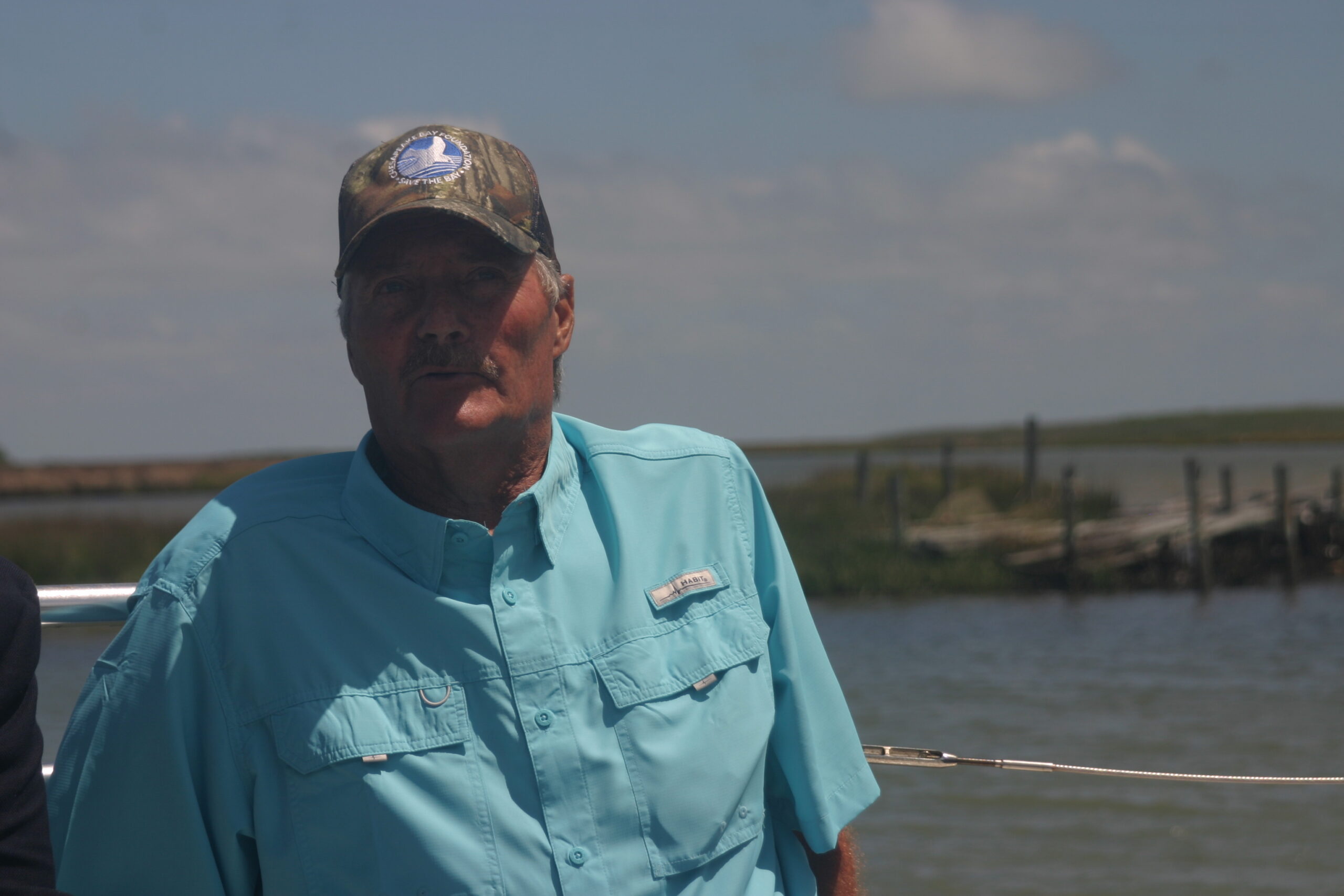
TANGIER ISLAND, CHESAPEAKE BAY — On a windy June morning, the Chesapeake Bay Foundation’s boat rocked violently on the waves of its namesake watershed, brackish drops splashing into the vessel as it sped towards Tangier Island, a 1.2 square mile land mass that was first settled in colonial times but whose future is now uncertain.
On the hour ride from the Crisfield, Maryland marina, Tangier Island Mayor James “Ooker” Eskridge detailed how much the land of his home has been battered away by storms and rising sea levels. Tangier has reportedly lost two-thirds of its land mass since 1850.
It’s not clear exactly how many residents live there; the 2020 U.S. Census Bureau indicated 430 people, while other sources place it closer to 252. What’s undeniable, Eskridge said, is that more people leave each year.
The island needs greater financial investment from the federal government if it is to survive, he added.
“But I know there’s billions of dollars being spent on creating islands like Poplar Island,” a similarly eroded island off the coast of Maryland, Eskridge said. ”They built that island back up for nothing. Nobody lives there. … Now here we are, we have a working waterman’s community, and we’re having a struggle just to protect it.”
Tangier Mayor James “Ooker” Eskridge shows map of the island’s land-loss. June 8, 2026. (Photo by Shannon Heckt/Virginia Mercury)
For generations, the island has been home to people who made their living crabbing and fishing. The residents have a unique cadence, with “ a tendency to prolong a vowel,” Tangier Island native and linguist David L. Shores told The National Geographic. The island can only be reached by boat or plane.
“We’ve been here for hundreds of years and we’d like to stay. Tangier is very savable now. I know it’s a lot of money to the community, but to the (federal) government it’s not,” Eskridge said.
Tangier Island comes into view on the horizon of the Chesapeake Bay. June 8, 2026. (Photo by Shannon Heckt/Virginia Mercury)
Homes here stand just a few feet above sea level on some parts of the island. Port Isobel, which rests on the smaller island east of Tangier, serves as a research and education hub, with breakwaters allowing the beach to hold its shape and forested land.
Wave erosion on the coast of Tangier Island off the Virginia coast, June 8, 2026. (Photo by Shannon Heckt/Virginia Mercury)
Tangier is not just a singular aspect of Virginia’s coastal culture and history. The marshes surrounding the island also serve as essential habitat for crabs, fish and oysters who need seagrasses to survive.
“We’re working to try to make sure that this really unique archipelago out in the middle of the Bay that anchors the bay-grasses, that anchors the oyster reefs, that is comprised of marshes that are incredibly important habitat to the Chesapeake Bay … is preserved,” Tom Ackerman, the Chesapeake Bay Foundation’s vice president for environmental education, said. “Because if we lose the land, everything else is gonna just get blown out.”
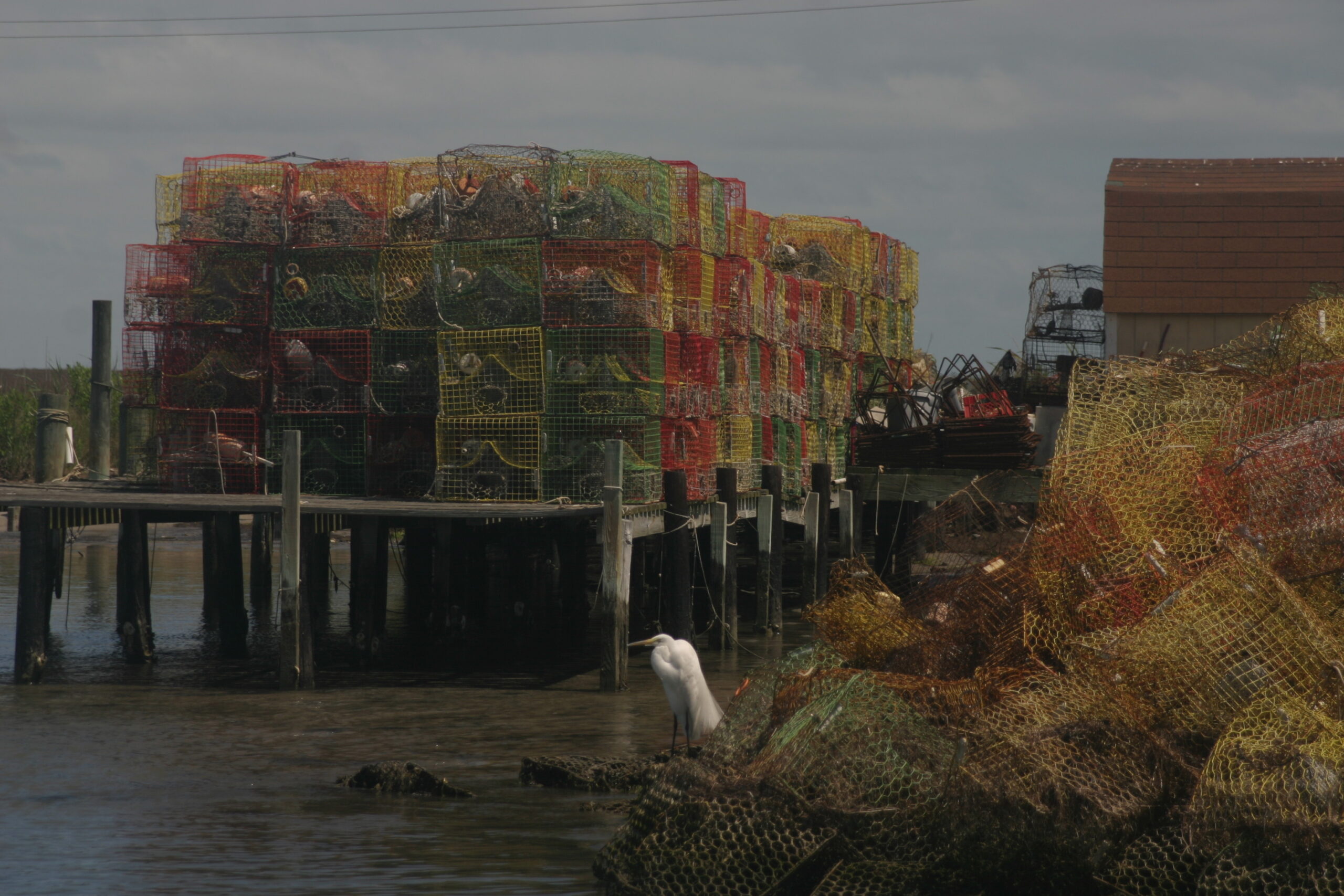
Crab pots lined up on pier on Tangier Island off the Virginia coast. June 8, 2026. (Photo by Shannon Heckt/Virginia Mercury)
The island’s economy is sustained by blue crab and oyster fishing.
Tangier’s fishermen are estimated to harvest about 13% of the entire Chesapeake’s blue crabs. Oysters harvesting made a major comeback when authorities halted winter crab dredging, allowing the oyster populations to rebound. It’s a welcome change from prior decades, locals and conservationists say.
In the 1970s and 1980s, oysters in the Bay struggled to survive. Chris Moore with CBF explained that three main factors contributed to the former decrease: over-harvesting, pollution and disease.
Recent efforts to restore the species in the Bay have been incredibly successful and enable a profitable winter business for the Tangier watermen.
“Today, the only way for the waterman to make a living (in the winter) is oysters. And it’s vital that we maintain a healthy population, which we do have now. Oysters are doing exceptionally well now,” Eskridge said.
Oyster beds in the Chesapeake Bay off the coast of Tangier Island, June 8, 2026. (Photo by Shannon Heckt/Virginia Mercury)
The oysters also serve as natural coastal protection.
Oyster reefs can help slow down incoming stormwater and serve as natural breakwaters. State and federal agencies are putting them to use through a massive oyster habitat restoration effort, the Tangier-Pocomoke Sound Oyster Recovery Project.
At full capacity, the project will reserve over 4,000 acres of the Bay for oyster habitat, some of which will be available for harvesting by local fishermen. Work on the first 275 acres of the project will begin in 2028.
“I think it’ll actually be a really good example of how we can continue to … think about how we do restoration differently and how it can support more uses as we continue to get better at it,” Moore said.
Several groups have banded together to create a shoreline protection plan to guide federal and state funding to projects that buffer the beaches and staunch erosion.
The consulting and design group Bay Land has been meeting with locals to identify key areas where berms should be built, dredged materials could build up marshes and natural infrastructure can be planted. The roadmap is anticipated to be completed later this year.
The town had previously been awarded $356,500 from the National Fish and Wildlife Foundation (NFWF) through the National Coastal Resilience Fund, to begin the community engagement to identify priorities for the roadmap.
This year, the group didn’t receive additional funding of $1.2 million from NFWF to start moving some of the plans in the roadmap into the design phase, which they called “a disappointment.”
Without that money, Bay Land representatives said, projects will be delayed another year before design finalization, time that many on the island say they don’t have. Bay Land will apply again in February when the funding applications reopen.
As the boat curved around the island, a lighthouse appeared far in the distance. Terry Parks, a life-long resident of the island, said his grandfather told stories of being able to walk on land almost all the way to the lighthouse when he was young.
Parks piloted the boat along that same land, which is now only a few feet below the water’s surface.
Lighthouse off the coast of Tangier Island, VA. June 8, 2026. (Photo by Shannon Heckt/Virginia Mercury)
The boat pulled up along the northwestern portion of the island, where a breach in the shoreline in a place called Tom’s Gut allows water to freely flow inland, aiding erosion.
The Army Corps of Engineers tried to fix the breach by using some of the materials dredged annually from the island’s central canal. It wasn’t enough to fill the gap and washed away.
“I think it’s critical to see if you can fix that breach. Just stop that velocity to help that erosion on the marshes on the backside,” said Jeff Swallow with the Army Corps of Engineers.
Tangier Island coastline. June 8, 2026. (Photo by Shannon Heckt/Virginia Mercury)
The boat docked downtown and passengers disembarked to walk along the island’s narrow streets, most just wide enough for one golf cart – the main mode of transportation on Tangier Island.
Narrow street in the town of Tangier, VA. June, 8 2026. (Photo by Shannon Heckt/Virginia Mercury)
The visitors, from various state and federal agencies, piled into Lorraine’s, a popular seafood restaurant. Before heading in, Tangier Councilmember Anna Pruitt-Parks admitted the island’s financial struggles have been paramount for residents in recent years.
The focus on generating money and keeping the island’s government and public services afloat may have partially obscured the reality of erosion, Pruitt-Parks said, but the environmental threats can no longer be downplayed.
“As a kid, you don’t notice (changes) as much, but the older I’ve got, I’ll say every week I see a change, especially like in the ditches in the middle of the island,” she noted. “All of that’s been widening and big chunks of marsh are just breaking off and it’s really hard to watch. Very hard to watch.”
Cemetery in Tangier, VA. June, 8 2026. (Photo by Shannon Heckt/Virginia Mercury)
Inside the eatery, agency representatives shared the latest on state funding for the resiliency plan and new laws that could help Tangier.
Del. Robert Bloxom, R-Accomack, successfully passed House Bill 52 to the Virginia General Assembly this year. The measure requires materials that are dredged up from canals and other projects to be reused for resiliency projects, like building up marshes, starting in 2027.
There are some exceptions that would limit the use of some materials. Maryland already has a similar policy in place, which has helped the state pursue coastal projects such as the one on Poplar Island.
Eskridge advocated for urgent action, not endless legislative debate.
“I know many studies have been done…but we’re losing the land at such a rapid rate. We don’t really have the time to play around,” Eskridge said. “And I believe there’s probably been enough money spent on studies that you could actually have protected all this by now.”
Tangier Mayor James “Ooker” Eskridge, June 8, 2026. (Photo by Shannon Heckt/Virginia Mercury)
After feasting on cuisine that originated from the waters surrounding them, the groups conclude their meeting by pinpointing other funding sources and potential partner organizations to help them preserve the island.
Even as the clock ticked, Eskridge said he was encouraged to see state, local, and federal agencies try to find solutions to protect Tangier.
While the visitors boarded the boat to leave, skiffs shook in the waves while seabirds picked at empty crab pots. Locals’ casual conversations carry over the harbor lined with “for sale” signs.
People have suggested Eskridge follow the droves who have departed the island for good, looking for more opportunity in a place that isn’t being swallowed up by the sea. He always tells them the same thing: “There is no place like home.”
View of the Chesapeake Bay from downtown pier in Tangier Island, June, 8 2026. (Photo by Shannon Heckt/Virginia Mercury)
Speaker of the House Don Scott, D-Portsmouth, presents the chamber's latest budget proposal on June 12, 2026 in downtown Richmond. (Photo by Shannon Heckt/Virginia Mercury)
Speaker of the House of Delegates Don Scott, flanked by Appropriations Chair Del. Luke Torian, D-Prince William, and other bipartisan house members, unveiled the chamber’s latest budget proposal in Richmond on Friday, which they framed as a “compromise package” that they urged the state Senate to accept.
The updated spending plan no longer includes environmental standards data centers would need to meet in order to be exempted from the state’s sales and use tax, an issue that has stalled budget negotiations for weeks and sparked speculation about a government shutdown if the parties can’t finalize the budget by June 30.
“This budget comes through for Virginians in a real and meaningful way without introducing a single new tax,” Torian said in a statement. “It anticipates future federal funding cuts by establishing a reserve – so when Washington turns its back again on Virginians we are prepared to step in.”
The dueling House and Senate budget proposals differ over whether data centers should continue to be exempt from the state’s 5.3% sales and use tax. State data shows the industry saves about $1.6 billion annually through the exemption, money Senate lawmakers say the state should recoup by ending the tax break.
Data centers have to routinely upgrade and replace pricey computer equipment, which is the bulk of where they save with the exemption.
The new House proposal removes the previous measures that would have mandated developers limit data centers from co-locating with power facilities that emit carbon emissions.
The previous proposal also outlined energy efficiency requirements for the digital warehouses, including using newer backup generator models that emit less carbon.
The new House budget instead proposes creating a commission of stakeholders and lawmakers to study the impacts and benefits of the data center industry in Virginia.
The commission would be required to report to the General Assembly by Nov. 1 on ways to ensure energy demands don’t put extra costs onto residential utility customers. The commission would also scrutinize local tax revenue impacts and “other ways to generate revenue from the industry”.
“(It will be a) full investigation into energy costs, financial impacts, air quality, water conservation, renewable energy, and community impacts,” Scott said, “So the 2027 General Assembly can pass real national reform. Or if the governor would like, we could come back right after that report … for a special session.”
Scott has staunchly supported preserving data centers’ exemption, he said, because of the local tax revenue the centers generate and the union jobs that come with the construction of the facilities.
Gov. Abigail Spanberger has also publicly supported keeping the exemption, saying the state should “honor its commitments” to businesses that have located in the commonwealth. She praised the updated House budget on Friday.
“This proposal creates a clear roadmap for evaluating the impact of the data center industry in Virginia and for reassessing the state’s incentives into the future, with a focus on fairness to ratepayers and the needs of local communities,” Spanberger said in a statement.
Senate members’ response to the updated House budget was unclear Friday afternoon, with no comment from Finance Chairwoman Sen. Louise Lucas, D-Portsmouth.
Lucas has been adamant about ending the tax exemption for data centers since the Senate spending plan was introduced earlier this year.
“I want (the money) to go towards hard working families. We’ve got people who are struggling to put food on the table, to put a roof over their heads, pay for their car payment, their kids school. I want that money to go back to them,” Lucas said then.
The House is slated to return to Richmond to debate this proposal on June 18, while the Senate, who has not yet released an updated budget proposal, will return on June 22. If a budget is not passed by the end of the month, state services and employee pay will be interrupted.