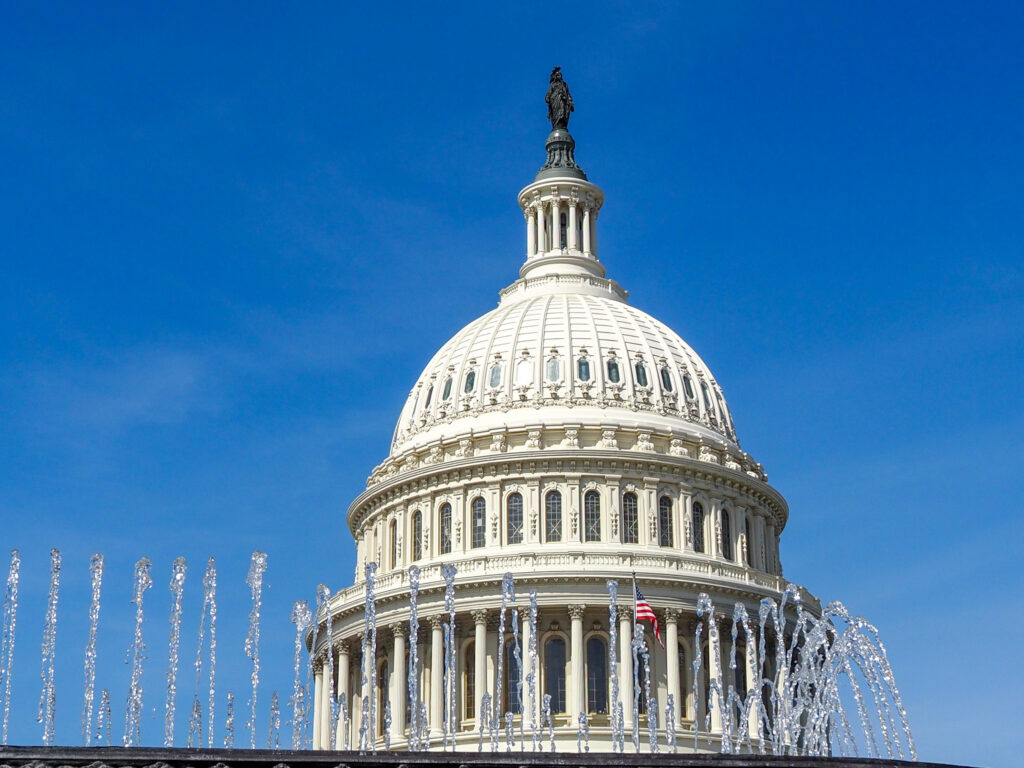
The U.S. Capitol on April 9, 2026. (Photo by Ashley Murray/States Newsroom)
WASHINGTON — The Republican-led U.S. Senate served up a rare public check on President Donald Trump’s agenda Tuesday when it voted to approve a House-passed War Powers Resolution to end hostilities in Iran.
Senate approval marked the first time both chambers have agreed in a rebuke of Trump over his war in Iran.
The concurrent resolution, which passed 50-48, does not require the president’s signature and its enforceability has been a perennial topic of debate.
The Senate’s approval occurred against the backdrop of the administration’s peace deal negotiations with Iran, which have been criticized from both sides of the aisle.
Four Republicans joined Democrats in voting for the measure: Lisa Murkowski of Alaska; Rand Paul of Kentucky; Louisiana’s Bill Cassidy, who recently lost his primary race after Trump endorsed an opponent; and Susan Collins, who’s fighting a tough reelection campaign in Maine.
Democrat John Fetterman of Pennsylvania voted no. Paul and Fetterman have broken ranks with their parties on several previous Iran War Powers Resolution votes.
Republican Sens. Mitch McConnell of Kentucky, who was recently hospitalized, and Dave McCormick of Pennsylvania did not vote. McCormick was with Trump on a trip to Pennsylvania.
Debate over impact
Trump administration officials, including Secretary of State Marco Rubio, argue that War Powers Resolutions are not constitutional.
The U.S. Supreme Court in 1983 ruled against the validity of congressional measures that do not require a president’s signature.
Senate Minority Leader Chuck Schumer, D-N.Y., said Congress “stood up to Donald Trump and voted to end his costly, unnecessary, and devastating war with Iran.”
“Let me be clear: for the first time, this resolution has passed both chambers of Congress and does not require the President’s signature. The message from the only branch of government with the power to declare war is unmistakable: the Trump administration must withdraw U.S. forces from hostilities in Iran. The pressure on Republicans mounts,” Schumer said in a statement following the vote.
Rep. Gregory Meeks, D-N.Y., who sponsored the original resolution that passed the House on June 3, said the measure is binding and the president “must cease all hostilities against Iran.”
“Regardless of what President Trump says, this measure is binding under the War Powers Resolution, and I will explore all legal avenues to ensure the Executive complies with the will of Congress. Congress never authorized this failed war, and the president certainly has no authority to continue it indefinitely without our consent as the Constitution demands,” Meeks, the top Democrat on the House Committee on Foreign Affairs, said in a statement.
The White House declined to comment on the vote.
Negotiations continue
Administration officials, who maintain hostilities ended in early April, are on a 60-day clock to hammer out a final agreement with Iran.
As part of a temporary memorandum of understanding in effect during talks, the administration lifted its naval blockade of Iranian ports and economic sanctions on Iranian oil, allowing the Islamic Republic to now sell on the global market.
The interim deal also charges Iran with demining the Strait of Hormuz and allowing tankers and cargo ships to travel unimpeded while Iran and Oman create a scheme for passage through the narrow shipping route where one-fifth of the world’s petroleum traveled prior to the war.
Trump issued social media threats to Iran over the weekend as Iran’s new Persian Gulf Strait Authority continued to impose certain requirements for ships to pass.
Thirteen American service members died in the war launched by the U.S. and Israel on Feb. 28, and over 400 have been injured, according to the Pentagon. Thousands of civilians across Iran and the Gulf region were killed during the fighting.
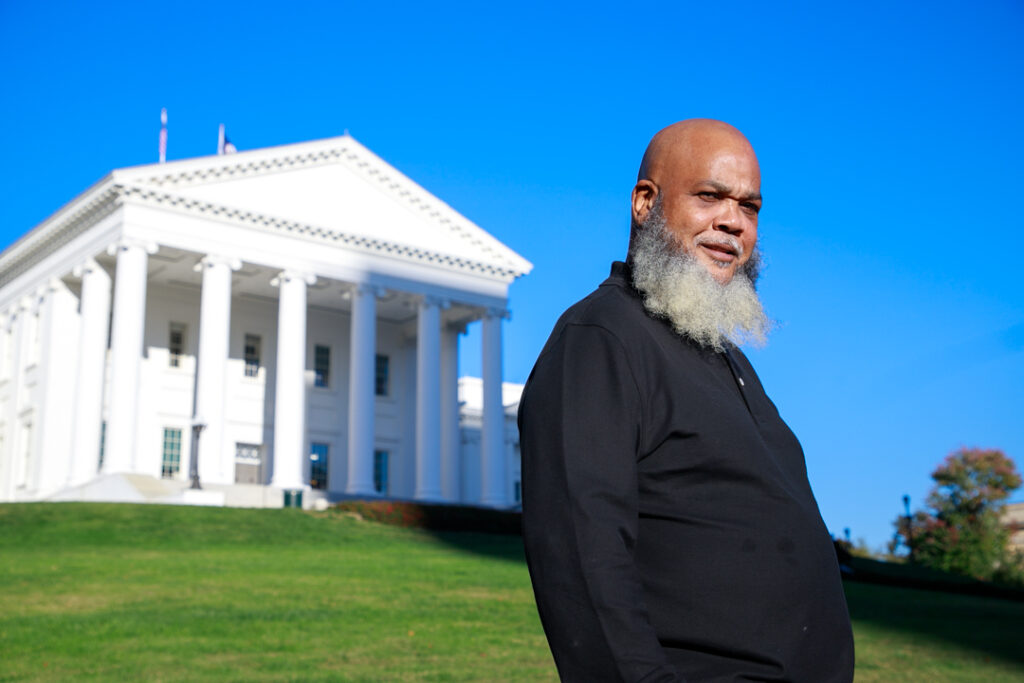
Virginia resident Tati King, a former felon who helped lead a major lawsuit to win back his and others’ voting rights, stands outside of Virginia’s Capitol. (Photo courtesy of Phuong Tran/ACLU of Virginia)
As thousands of Virginians with certain past felony convictions remain in a voting registration limbo, a civil rights group filed a motion on June 18 seeking an expedited remedy.
The group accused election officials of violating a voting rights lawsuit previously won earlier this year.
The voting access issue stems from a series of 1870 laws called the Readmission Acts, which banned states from constitutionally disenfranchising people other than those convicted of crimes considered common law at the time.
In Virginia, people with felony convictions lose their right to vote unless they successfully petition a governor for it to be restored or are pardoned — both subjective processes which haven’t always had clear guidelines.
Virginia’s chapter of the American Civil Liberties Union argued in King v. O’Bannon that Virginians with a variety of felony convictions should have never lost their right to vote in the first place. A judge ruled in their favor earlier this year and ordered the state to comply by May.
Attorney General Jay Jones then successfully sought an extension to June 1 so that the state could compile guidance for registrars and ascertain which modern-day felonies might bar someone from registering to vote.
For instance, illegally using tear gas was included on a list of such crimes from Jones’ office, “even though tear gas was not invented in 1870,” ACLU attorney Eden Heilman said in an interview.
While the legal organization “has serious questions” about how the lists were determined and whether eligible people will be able to vote this year, the group has tried for months to glean a better understanding from Jones’ office.
Since June, registrars have been instructed to not fully process new voter registrations of people with felony convictions, according to documents obtained by The Mercury that are now exhibited in the new motion.
In May, ACLU Virginia wrote a letter to Jones and Solicitor General Tillman Breckenridge asking why revisions to registration forms were not feasible for registrars, and for more details on challenges preventing the state from fully complying with the court order.
The organization also asked for more clarity on conviction types that may require individualized review by Jones’ office.
Breckenridge responded two days later to confirm receipt of the letter and end the conversation.
“While we appreciate the information you’ve provided to us to this point, we do not believe further engagement on the topics in your letter would be constructive at this time,” he wrote.
Heilman said that previous meetings with Jones’ office had not been successful.
“It became clear that we were not making progress and had different understandings of what the court order was requiring,” she said.
Jones’ office has not responded to requests for comment on the situation.
With early voting for congressional primary elections underway, plaintiffs hope that the situation can be resolved before the Aug. 4 election so that eligible voters can participate.
This fall, Virginia voters will also approve or reject a constitutional amendment that would allow all ex-felons the right to vote, so long as they have served their sentences.
Outdated forms and web portals another hurdle
The apparent lack of full compliance with King v. O’Bannon sparked a period of uncertainty for ex-felons in the state, Nolef Turns director Sheba Williams said. The nonprofit shares resources with formerly incarcerated people and advocates for ways to reduce recidivism.
Voter registration applications question whether or not someone has committed a felony, which Williams said has confused formerly incarcerated people who want to cast a ballot. Many don’t know if they’re eligible or if they should answer the question or not, since it’s a crime to lie on applications.
Northern Virginia resident Tati King, who’s been a lead plaintiff on the King v. O’Bannon case, claims that his registration was placed in limbo and as of the time of the motion filing on June 18, he was not yet able to vote.
Fellow plaintiff Toni Heath Johnson, a Southwest Virginia resident, encountered the same “on hold” status.
While in-person applicants were told their registrations won’t be processed right away, virtual applicants like Southwest Virginia resident Jared Rose relayed via lawyers that he could not proceed in the online process after clicking the felony conviction box.
Rose is quoted in the filing saying he was “nervous” about additional prosecution if he didn’t indicate his past felony status despite being able to vote.
“We’re in a pivotal moment where we have been seeing trust in our courts be eroded,” Williams said. “Virignia has an opportunity to restore faith by upholding the ruling of Judge (John) Gibney.”
Gibney ruled that Virginia can’t take away someone’s voting rights, except for specific common law felonies from 1870. Those are arson, burglary, escape and rescue from a prison or jail, manslaughter, mayhem, murder, rape, robbery, sodomy and suicide.
As part of their motion to enforce, ACLU suggests forms be amended to ask “only whether the applicant had been convicted of an offense corresponding to one of the 11 common law felonies set forth in the final order.”
For now, the state has 14 days from the June 18 filing of the motion to respond.
A view of the Alexandria Transit Company’s electric buses in Northern Virginia (Courtesy Alexandria Transit Company)
Virginia lawmakers want to examine consolidating Northern Virginia’s transit agencies to assess potential cost savings and service improvements.
The proposal, which is included in the two-year budget lawmakers passed Monday, directs the Department of Rail and Public Transportation to include in its report not only the cost savings and long-term financial impacts of merging multiple systems, but also how potential changes would affect riders through fare structures, service reliability and accessibility.
The transportation study emerged as legislators work to avoid a shutdown and finalize a two-year spending plan ahead of the July 1 deadline, which includes state funds for the Washington Metropolitan Area Transit Authority, or Metro.
The outcome of the study could reshape transit for four agencies — DASH Alexandria Transit, Fairfax Connector, ART Arlington Transit, and CUE Fairfax City — by identifying potential efficiencies and improvements through consolidation.
On Monday, Senate Majority Leader Scott Surovell, D-Fairfax, stressed that merging transit systems could eliminate redundant operations and boost efficiency, similarly to a widespread, unified system that existed in previous decades.
He argued that the current fragmentation hinders the delivery of better services and responsible spending.
“In this budget, we are asking taxpayers to step up and provide more funding to WMATA, and I think as we do that, it’s important that we demand that WMATA and other transit agencies in Northern Virginia try to do business more efficiently,” said Surovell.
He said that in Northern Virginia, every locality has its own bus system, which he calls “incredibly inefficient,” with multiple garages, purchasing systems, fare systems and contracts with different operators.
“Before 1980, all these services were operated under WMATA as one sole entity,” he said, “and I think we need to look at a way that we can make these systems more efficient, so we don’t have to keep revisiting how to fund them every seven years.”
The agency must also gather rider and community input, assess the potential effects of any consolidation on public access and daily transportation options and examine similar changes in other regions and states to inform the public about possible impacts.
The proposed study aligns with broader efforts by area leaders to support the region’s transit network.
At the culmination of their work, regional leaders encouraged Virginia, Maryland, and Washington, D.C. to contribute to a $460 million new capital funding package starting in fiscal year 2028, which aims to stabilize service, support investments and provide budget certainty for all three jurisdictions.
Virginia also created a committee that urged the General Assembly to consider “net new” revenue sources, avoid reductions in current transportation funding or the use of existing transportation funding and minimize impacts on low-income Virginians.
In response, lawmakers proposed allocating $153 million in the budget for additional operating assistance for Metro. It also requires Metro to produce a 20-year capital plan and annual performance reports.
Metro and other public transit services in Northern Virginia could also generate funding through a plan that would allow localities to use a 1% sales tax to pay for transportation projects that address the region’s public transit needs.
If the study language remains in the budget after the governor’s review, a report is due to the Chairs of the Senate and House Transportation Committees by Dec. 15.
Lawmakers are scheduled to return to finalize the budget on Monday, after Gov. Abigail Spanberger examines it.
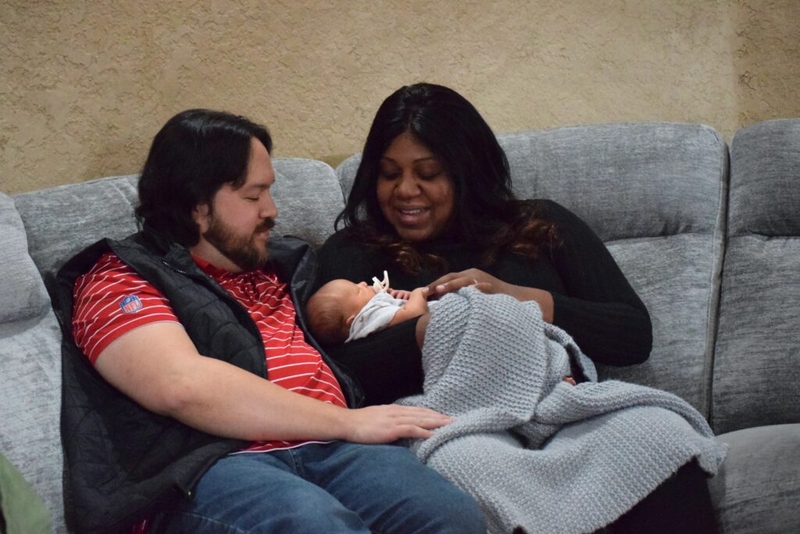
A couple sits with their newborn inside their Bentonville, Arkansas, home. The Trump administration is shifting the federal Title X program, which has traditionally provided access to contraception, toward an emphasis on childbearing. (Photo by Antoinette Grajeda/Arkansas Advocate)
A federal poverty-fighting program focused on reducing unintended pregnancies is about to undergo a major overhaul.
Reproductive health clinics use Title X federal grant money to provide birth control, cancer screenings and testing and treatment for sexually transmitted infections to people with little or no health insurance. Title X money cannot be used for abortions.
The Guttmacher Institute estimates that Title X, which was signed into law by Republican President Richard Nixon in 1970, has prevented almost 20 million unintended pregnancies and 9 million abortions. It has also helped reduce child poverty, according to the group, which supports abortion rights.
But President Donald Trump has taken aim at the program, which has long been a target for abortion opponents. Since regaining the White House, Trump has temporarily blocked and then restored grants to certain reproductive health clinics, and proposed a U.S. Department of Health and Human Services budget with no funding for the program.
The department’s recently issued funding guidelines for Title X grants represent a significant mission shift.
Instead of expanding access to contraception, the focus of Title X will be “to strengthen family formation and assist clients in achieving healthy pregnancies,” according to the new guidance. That will align the program with the administration’s efforts to increase the U.S. birth rate.
The new rules say Title X will prioritize educating Americans about natural methods to avoid pregnancy and overcome infertility, and will promote “body literacy education” and “informed, preventive, and restorative approaches to reproductive health.” Some conservative groups tout an obscure alternative treatment for infertility called “restorative reproductive medicine,” which is based on the idea that the underlying causes of infertility can be treated through lifestyle changes and improving a person’s overall health.
The guidance directs Title X clinics to promote “fertility-awareness-based methods,” such as period-tracking apps, which the American College of Obstetricians and Gynecologists says can be helpful for getting pregnant but less effective at preventing pregnancy. It also calls on clinics to offer counseling on male fertility issues and to address environmental causes of infertility, including pornography use. And it includes a prohibition on DEI efforts and warns grantees that federal money cannot be used to “facilitate or incentivize illegal immigration.”
Anti-abortion groups support the changes, but many health policy researchers say they will disproportionately harm low-income and minority women, who are more reliant on Title X services and are more likely to have unintended pregnancies. Researchers also say the new guidelines are unlikely to achieve the administration’s “pronatalist” goal of reversing declining birth rates.
Corinne Rocca, an epidemiology professor at the University of California, San Francisco, said the way to do that would be to spend more on childcare subsidies and other social programs to help new parents.
“Policies that help people and families feel supported to meet their childbearing preferences … would actually help people who are open to the prospect of childbearing to do so,” Rocca said.
Rocca co-authored a study published in JAMA Network Open last fall suggesting Black and Hispanic women are less likely than other racial groups to be able to choose if, when and how to start a family.
Clinics must reapply for funding under these new guidelines by Jan. 9, 2027. HHS did not respond to a request for comment.
During his first term, Trump banned Title X clinics from referring patients to other providers for an abortion or even mentioning it as an option. He also prohibited grantees from offering family planning services and abortions in the same building. As a result, many grantees quit the program, including about a dozen state health departments and all participating Planned Parenthood chapters.
The program served about 844,000 fewer patients in 2019 than it did in 2018, when it served 3.9 million patients, according to HHS. About 225,000 fewer patients received oral contraceptives; about 50,000 fewer received hormonal implants; and about 86,000 fewer received IUDs.
The reframing of Title X that is reflected in the new guidelines was a recommendation laid out in the controversial blueprint known as Project 2025, created by the conservative think tank Heritage Foundation as a guide for the second Trump administration.
In line with Project 2025’s recommendations, HHS says Title X grantees will no longer be required to counsel or refer for abortions, and tells applicants that relationship counseling should encourage marriage as a precursor to having children.
“In a time when we are facing a rapidly declining birth rate that falls far short of the replacement fertility rate, we should be doing all we can to encourage and support family formation and fertility,” Dr. Christina Francis, CEO of the American Association of Pro-Life Obstetricians and Gynecologists, told MedPage Today in April.
“Women deserve accurate information about their fertility and their health — and this includes highlighting the many benefits of pregnancy and motherhood.”
Some abortion opponents have criticized Title X for promoting certain forms of contraception, such as IUDs, that they view as abortifacients. A spokesperson for the National Right to Life Committee said the organization does not take a stance on contraception that prevents fertilization, “however, National Right to Life does oppose any device or drug that would destroy a life already created at fertilization.”
“If there is any doubt, we recommend that a woman speak with her doctor to determine if an agent would cause an abortion,” the spokesperson said in an email.
But Leonard Lopoo, a professor at the Maxwell School of Citizenship and Public Affairs at Syracuse University who has studied fertility and family policies for the past three decades, said the federal government could help families achieve their family planning goals by expanding pregnancy prevention and infertility treatments at all income levels.
“When you’re trying to take away the funding for someone who doesn’t want to have a child, that’s not the same as providing funding to support someone who does,” Lopoo said.
As a Black woman and researcher focused on Black maternal health at Ibis Reproductive Health, Terri-Ann Thompson is better informed than most on the ways having children can be disproportionately more dangerous and less affordable for women who look like her.
But she says what she wasn’t expecting to uncover — during research for a study she co-authored in the journal Frontiers in Public Health this spring — is how much the fear of negative medical and criminal justice outcomes makes many Black women in Georgia and North Carolina scared of pregnancy.
“I was very surprised to see that folks were actually thinking about the context within which a Black child is born and raised well before they even contemplated starting a family,” Thompson said. “We had a lot of, just, stories of folks saying, ‘Why would I want to bring a child into this context; how does one prepare Black women to bring a child into this context?’”
Thompson said her team’s findings show how much Black women depend on low-cost access to long-acting reversible contraceptives such as IUDs.
“We have people who drove very, very far just to get a sliding scale to either get an IUD placed, an IUD removed, or to even get on birth control pills,” Thompson said.
“If the administration moves forward with these restrictions, what we are doing is we are removing access to contraceptives for a population that is at higher risk.”
Stateline reporter Sofia Resnick can be reached at [email protected].
This story was originally produced by Stateline, which is part of States Newsroom, a nonprofit news network which includes Virginia Mercury, and is supported by grants and a coalition of donors as a 501c(3) public charity.
By Nathaniel Cline, Shannon Heckt, Charlotte Rene Woods, Samantha Willis Virginia Mercury
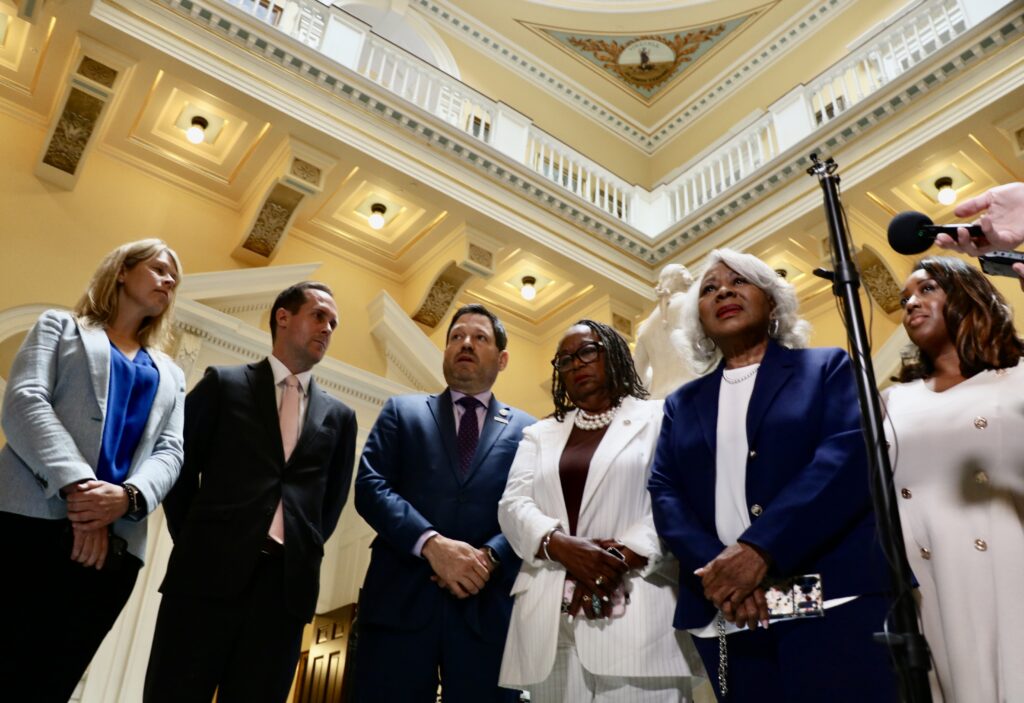
Members of Virginia’s Senate Finance and Appropriations Committee speak with the press in the Capitol Rotunda on June 22, 2026. The legislature advanced a $205 billion, two-year spending plan the same day. (Photo by Charlotte Rene Woods/Virignia Mercury)
On Monday, Virginia legislators approved a two-year, $205 billion budget proposal to fund healthcare and public education, provide 4% teacher raises and a 3.5% pay bump to state employees, establish a retail weed marketplace and hedge against decreased federal dollars.
The spending plan also includes a provision to tax data centers for their energy consumption, which is slated to generate a maximum of $600 million each year but doesn’t include the environmental standards the House of Delegates wanted to impose on the industry or the end of the sales tax exemption that the Senate sought.
Senate Finance Committee chair Louise Lucas, D-Portsmouth, said after her chamber’s morning session that she “didn’t love” the data center compromise and framed it as a necessity — but not the final solution.
“I would have preferred another method, but we had to get a budget. We were not going to let the government be shut down, and so this was a good start,” Lucas said.
“This is a compromise proposal — one my administration helped craft — and it builds a strong foundation for further discussions about the future of this industry in Virginia on issues like environmental and community impact,” Gov. Abigail Spanberger said of the data center provision in a statement.
The Senate passed the budget proposal 23-16 vote, while the House advanced it 71-22.
With both chambers finally on the same page after months of gridlock over data centers, the plan will now be reviewed by Spanberger. She can sign it as-is, recommend changes or veto line items. The whole process must be finalized by July 1, when the new budget will take effect.
Here are the key priorities addressed by the spending plan.
Data centers
The amended budget proposal creates an energy consumption tax for data centers which totals $.011 per kilowatt hour used per month.
The state will collect up to $600 million a year from this new tax, according to budget language. Any funds collected over that cap would be put into a fund and given back to data centers at the end of each fiscal year.
This is only a fraction of what the state could have made if they had ended the sales and use tax exemption, but, after months of arguing, lawmakers ultimately didn’t agree to that measure. Spanberger supported keeping the exemption in place through the end of the agreement’s term in 2035.
Additionally, language was put into the budget to direct the Department of Environmental Quality to study the groundwater impacts of non-closed loop data centers, which use millions of gallons of water each year.
DEQ will locate “cooling water scarcity areas” where the use of potable water for computer cooling systems could be detrimental to surrounding areas’ water quality and availability.
The department will have until July 2027 to create regulations for the scarcity areas. After they are developed, future data centers in that area will be required to “use air cooling, closed loop cooling systems, or more efficient cooling systems that become available.”
After July 1, 2027, data centers in the Eastern Groundwater Management Area will have to “use air cooling systems, 100% recycled water and/or stormwater for cooling, or use a closed loop system.” A study will be released in October 2026 on how to retrofit existing data centers in those areas to align with the new regulations.
Some Republican lawmakers characterized the measure as inconsistent.
“The budget does not create one strong statewide water usage standard for data centers. Some parts of Virginia get stronger protections and other parts get weaker protection or no protection at all,” said Sen. Glen Sturtevant, R-Chesterfield. “That should concern every locality that is concerned about becoming the next target for a massive data center.”
Budget language also directs DEQ to put in place noise abatement regulations for data centers before the end of 2029. The department will determine the lowest possible noise level for data centers and make it the standard starting in 2030.
After that date, facilities who violate the noise standard will face a fine of $32,500 per day.
“The noise issues are some of the things we hear the most from people that live next to data centers,” said Sen. Scott Surovell, D-Fairfax, whose district contains dozens of data centers. “Water is a rising concern, especially for any data centers that are gonna be put east of I-95, where we already have a real problem with our declining aquifer.”
Lucas told reporters that this is not the end of the conversation about doing away with the sales and use tax exemption, and that a study group will look closer at the issue and provide a report on their findings in November.
Health and human services
Overall, the pending budget will earmark $158.3 million in the state’s general fund for fiscal year 2027 and $245.1 million in 2028 for healthcare and social services.
The money was set aside both for healthcare and social services the state typically handles along with support to comply with new federal mandates and partially plug holes created by federal funding shortfalls.
As thousands of Virginians have fallen off Affordable Care Act health insurance this year, Virginia’s new budget entails $150 million to support a state-level version of the expired federal assistance for people between 138% and 250% of the federal poverty level.
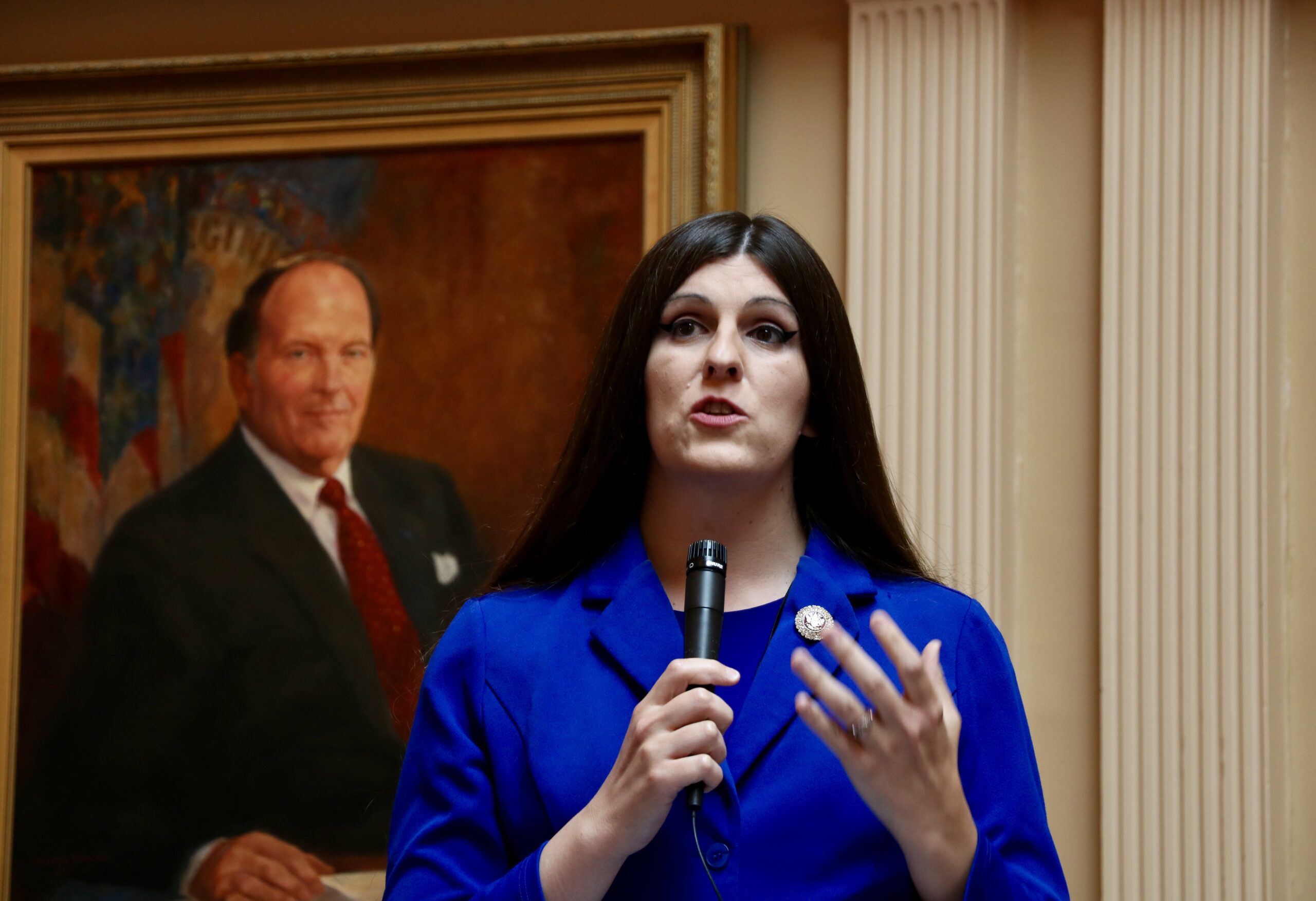
Sen. Danica Roem, D-Manassas, a former journalist and restaurant worker, described the difficulty of living uninsured for two years in a floor speech on Monday.
“I don’t want anyone to live like that,” she said.
She added that the budget “puts major money” into making sure that the state is “taking care” of people.
Sen. Danica Roem, D-Prince William, speaks on the Senate floor during the special budget session on June 22, 2026. (Photo by Charlotte Rene Woods/Virginia Mercury)
The plan calls for $3.5 million to determine ways the state can ensure eligible people remain on Medicaid amid forthcoming eligibility requirement shifts and additional verification work.
Virginia’s roughly 850,000 Supplemental Nutrition Assistance Program beneficiaries went without their food stamps last fall during the federal shutdown. And due to a reconciliation bill Congress passed last summer, states like Virginia are attempting to reduce their error rates.
State lawmakers have designated $135 million to handle SNAP, should the error rate not fall to the required 6% by the end of the calendar year.
Sometimes SNAP households are overpaid or underpaid because of paperwork mistakes by government staff or outdated information from beneficiaries. Work in social service departments is already underway to reduce error rates.
Free clinics will receive $20 million in state funding over the next two years while federally qualified health centers will get $10 million in that time.
While federally qualified health centers offer sliding scale fees for low-income patients, free clinics are also a resource for uninsured patients. Both entities have been bracing for additional clients as Virginians lose their ACA or Medicaid insurance.
A little over $1 million is allocated to help local health departments statewide handle rent increases. The regional centers help fill healthcare access gaps and are often tailored to the local communities they serve.
As federal dollars for HIV/AIDS care are slashed, the state budget also contains over $26 million for that specific type of healthcare over the next two years. Staying on top of medication is critical in preventing the spread of the disease.
Education
Under the newly approved budget proposal, K-12 education funding would increase by $1.4 billion, including a 4% increase for teachers in each of the next two years.
Lawmakers propose $590 million for rebenchmarking, declining enrollment, and high-need groups, including $28.9 million for at-risk and $148.4 million for special education students.
Also included: $500,000 for grants to help schools purchase Automated External Defibrillators (AEDs) and implement cardiac emergency response plans.
In higher education, the budget proposes restoring funding for affordable access and tuition moderation, as well as expanding nursing programs at several public universities. The Internships Virginia (InVA) initiative to provide paid internships for postsecondary students would also be funded.
To support educational infrastructure, lawmakers also agreed to expand the authority to allow all localities to use a 1% sales tax to pay for construction costs, contingent on a referendum that must pass in each jurisdiction. The language also permits jurisdictions in Northern Virginia to use the funds for transportation projects to address public transit needs.
Tax deductions
Taxpayers will be able to keep a bit more of their cash, as the new budget increases the standard income tax deduction from $8,750 for single filers and $17,500 for joint filers to $9,200 and $18,400 in 2027 and $9,300 and $18,600 in 2028.
RGGI/environment
A budget amendment was added into the conference report that would divert 45% of the funds earned from the Regional Greenhouse Gas Initiative back to ratepayers.
The funds come from carbon credit sales, which utilities must purchase if they want to burn carbon-based fuels sources that release emissions. Those costs are then passed down to utility customers.
When former Gov. Glenn Youngkin removed the state from the agreement in 2021, it cost about $4 a month on the average residential customer’s bill. Recently, Dominion Energy filed for the “RGGI Rider” to be added back to monthly bills as mandated by a law to rejoin the agreement, signed by Spanberger in recent weeks.
Dominion is required to begin purchasing from the carbon credit auction in July but the charge to customers won’t begin until March should the State Corporation Commission approve the application by the utility. This will lead to an increased charge of $10-$13 monthly.
The state previously earned about $800 million from the RGGI funds that had to go towards community flood preparedness projects and low-income energy efficiency projects. The new budget language includes the rebate for customers, which would put money back in wallets but detract from the funds for flood and efficiency projects.
The rebate will not apply to co-op utility customers.
Housing
While a handful of housing bills passed the 2026 session and have since been signed into law, the new spending plan includes measures to ensure bills with fiscal impacts get off the ground.
The state budget proposal directs $60 million overall for housing initiatives, $40 million of which will go to the state’s Housing Trust Fund and $20 million that will go towards a mixed-income housing pilot program.
Additionally, lawmakers set aside $11.5 million for the Virginia Eviction Reduction Program and $10 million for the Clean Energy Innovation Bank.
Cannabis
Spanberger and lawmakers announced June 16 a reworked proposal for a retail cannabis marketplace that included key compromises between legislators’ and the governor’s visions. The marketplace is set to launch July 1, 2027 and will be limited to 350 stores statewide.
State sales tax on retail weed will be 6% at launch and will increase to 8% in 2029. Localities also have the option to add an additional tax of 1 to 3.5%.
Because lawmakers added a Part 5 amendment, the market will be permanently established in the state.
The new framework includes a $250 public consumption civil penalty that will not take effect until 2027.
“We had serious concerns about creating extreme new penalties that would not have meaningfully reduced the illicit market,” Sen. Lashrecse Aird, D-Henrico, said at a press conference announcing the framework last week.
“But we believe this final framework strikes the right balance for enforcement mechanisms, but also in accountability, but also not harming those who just choose to participate in the market.”
Child care
The budget sets aside $137.6 million for the state-subsidized child care program slots, which will be devoted to families making 85% or less of the state median income.
This follows legislation carried by Del. Briana Sewell, D-Prince Wiliam, requiring the state education department to update how it calculates the cost of childcare for Virginia families. A majority of Virginia parents and employers say child care costs are prohibitive.
Spanberger signed the bill into law last month.
A new cost-sharing program for child care will be funded through the budget, with lawmakers allocating $25 million for the initiative to spread the price of child care between families, employers and the state.
Transportation
Lawmakers included $153 million in the budget for additional operating assistance for the Washington Metropolitan Area Transit Authority, or Metro, with the caveat that Metro must produce a 20-year capital plan and annual performance reports.
The action comes as inflation has driven up the costs of operating transit services.
Lawmakers also proposed directing the secretary of transportation to evaluate options, including public-private partnerships, to accelerate large-scale improvements to the I-81 corridor.
The legislature allocated $7 million for the Route 460 Phase IIA Finish Grade Project and directed stakeholder engagement to prioritize improvements along the U.S. Route 220 corridor.
The budget also directs the state to identify federal funds to support rural electric-vehicle charging infrastructure and provides $500,000 to continue developing Advanced Air Aviation Test Sites to enable advanced air mobility.
What’s next
The proposal will now head to Spanberger, who said it contained “a lot to be proud of” in a Monday afternoon statement.
“Today, the General Assembly has moved forward with a budget proposal — and that means we are keeping our government open and delivering for the 8.8 million people who call our Commonwealth home,” she added.
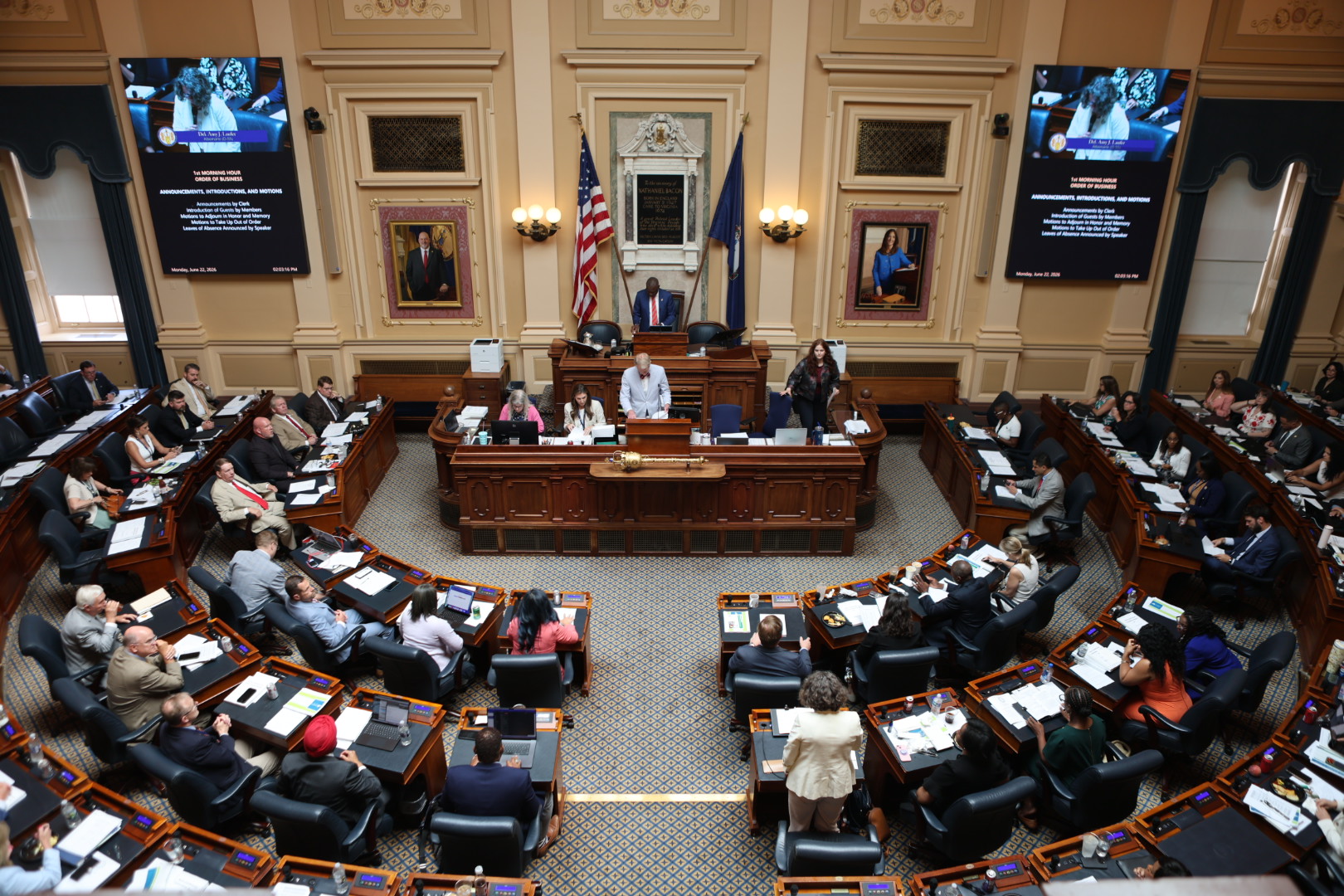
A view from inside the Virginia House of Delegates chamber on June 22, 2026. (Photo by Nathaniel Cline/Virginia Mercury)
Interior of a modern data center. (Photo by Imaginima/Getty Images)
About one-third of the state of Virginia is under extreme drought conditions, according to the U.S. Drought Monitor, and Gov. Abigail Spanberger is urging citizens to conserve water. So when local water authorities implement restrictions on water use, are there specific carve outs and rules for data centers, which use hundreds of thousands of gallons of water to cool their computer systems?
No. Across multiple localities, they’re treated the same as all other commercial, industrial and residential customers, state and local officials revealed.
The Department of Environmental Quality is responsible for permitting the groundwater withdrawal for public water authorities. Once that permit is granted it is up to each authority to manage their water use and limit customers as needed, based on the weather conditions.
“Any of the permittees that are withdrawing are very cognizant of what they’re pulling out,” Weedon Cloe, manager of the Office of Water Supply at DEQ, said. “They have the limits and those limits are baked in during specific times of the year to ensure that the resource is not depleted.”
There are provisions in the drought assessment and response plan that allow DEQ’s director to alter those permits in extreme circumstances. Cloe said that the department is reviewing those procedures, since the state is experiencing the worst drought they’ve seen in decades.
Virginia hasn’t been this dry since 2002, when the extreme conditions triggered new standards.
“The entire water supply program came (from) that drought. It was severe. It was like a huge swath through the center of the state running north south,” Cloe said.
There are three main stages of drought that are declared by DEQ, which help localities decide on what water restrictions to implement.
Under a drought watch, the state agency recommends localities minimize nonessential water use and to get a contingency plan in place.
In the drought warning category, officials recommend local leaders to start voluntary water restrictions and aggressively identify any leaks or repairs needed.
Once a drought emergency is declared, mandatory restrictions are put in place and if water customers don’t curb inessential water like irrigation, washing paved surfaces, or filling up pools, they could be fined.
Some places, like Henrico County, have not needed to venture into the mandatory category for their customers in two decades.
Bentley Chan, the director of Henrico’s department of public utilities, said that of the eleven data centers in the county, only one makes it into the list of their top ten water users. Apartment complexes and hospitals are the biggest water consumers there, and they don’t have specific usage rules in times of drought.
“It’s not just on the residential customers (to restrict water use) and you’ll find that a lot of the industrial users have extraneous uses, such as irrigation, additional cleaning, and things of that nature,” Chan said. “And we do ask everybody to be a part of the mandatory restrictions … to preserve the flow in the James River.”
Similar policies are used in Loudoun and Fairfax counties that house over 200 data centers combined. In Fairfax, the county follows guidance from the Metropolitan Washington Council of Governments that requires all customers to implement reductions under the mandatory orders.
In Norfolk, there are no data centers online at this time that use water from their utilities, according to a utility representative. The representative went on to state that since they get their water from multiple sources, it is rare to have to implement restrictions.
“If there comes such a time (of data centers), the department would analyze the capacity versus the needs and factor in all conditions to ensure they’re able to adequately provide for all customers,” the representative said in a statement.
Western Virginia Water Authority provides water to 69,000 customers in the Roanoke area, where there are also no data centers online yet. A representative told the Mercury that they are considering updating their policies once a data center is built – with one from Google expected to begin taking in water in 2028 that will be authorized to use up to 8 million gallons of water per day.
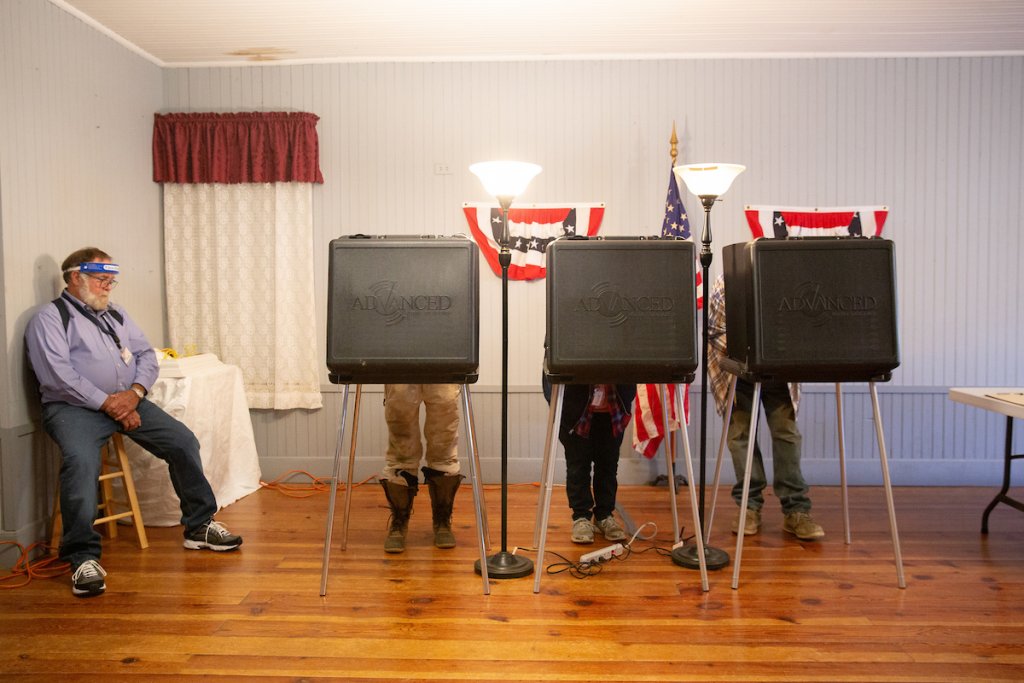
Voters cast ballots in Scottsville, Virginia in Nov. 2020. (Photo by Parker Michels-Boyce for The Virginia Mercury)
U.S. Rep. John McGuire may have breathed a sigh of relief after courts last month invalidated Virginia’s voter-approved redistricting amendment, which would have made the state’s 5th congressional District more favorable to Democrats.
But the Goochland Republican still enters his first reelection campaign facing turbulence, including accusations that he has done little for constituents and a Democratic field trying to flip a district where affordability concerns and dissatisfaction with Washington could reshape the race heading into the 2026 midterms.
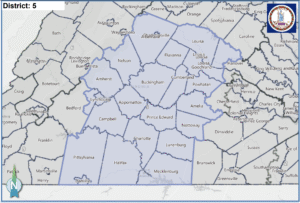
The 5th District covers a vast stretch of Central and Southside Virginia, running from Charlottesville and Albemarle County through Lynchburg and Danville and south toward the North Carolina border. It also extends east into parts of Goochland, Hanover and Powhatan counties near Richmond.
Roughly 760,000 people live in the district, including about 575,000 registered voters.
Republicans still hold a clear advantage there. President Donald Trump carried the district by 11 points in 2024 after Glenn Youngkin, the GOP’s 2021 gubernatorial nominee, won it by an even wider margin that year. But Democrats believe changing suburban voting patterns and economic frustration could give them an opening this cycle.
Under the redistricting amendment invalidated last month by the Supreme Court of Virginia — a ruling later left in place by the U.S. Supreme Court — Democrats had expected the district to become friendlier to their party. Instead, the race will move forward under the current court-drawn congressional map from 2021.
The Aug. 4 primary election will determine nominees in one of Virginia’s most closely watched congressional races this year.
The race quickly became a loyalty test tied to President Donald Trump — then running for a second term — after Good backed Florida Gov. Ron DeSantis during the 2024 presidential primary. Trump later endorsed McGuire, helping push him past the conservative incumbent by a narrow margin that triggered a recount.
Now McGuire faces a Republican challenger in Louisa County real estate broker Melanie Lucero, who has focused much of her campaign on constituent services and what she describes as McGuire’s lack of accomplishments in Congress.
“We need to send representatives who are going to help the 5th district and who are going to fight for us,” Lucero told Charlottesville’s WVIR earlier this month.
Lucero has also argued that many voters across the sprawling district — the state’s largest — feel disconnected from McGuire and unable to get responses from his office.
McGuire has closely aligned himself with Trump and Republican leadership in Congress, emphasizing border security, tax cuts and reducing federal spending. On his campaign website, McGuire says he is focused on “putting America first” while fighting inflation and government overreach.
By May 27, McGuire had raised just over $1.4 million for his reelection bid and reported roughly $497,000 cash on hand. Lucero had raised a little more than $64,000 and reported about $34,000 cash on hand.
David Richards, a political science professor at the University of Lynchburg, said the existence of a Republican primary challenge is notable for a Republican congressman from the 5th District.
“Normally, an incumbent would not draw a serious challenger, but Lucero seems pretty serious,” he said. “She has really driven home McGuire’s lack of accomplishments in Washington and his general lack of interest in his own constituents.”
Richards said McGuire has increased campaign appearances around the district but may still struggle to point to major legislative achievements, which “may hurt him in the primary or the general election.”
Still, Richards said he does not expect McGuire to be defeated in the nomination contest.
“I don’t see him losing the primary, especially since Bob Good is no longer running,” he said.
Virginia’s 5th congressional District. (Photo courtesy of the Supreme Court of Virginia)
Democrats consolidate around Perriello
On the Democratic side, former U.S. Rep. Tom Perriello has emerged as the clear frontrunner in a field that once looked likely to become much larger under the proposed redistricting map.
Perriello represented the 5th District from 2009 until 2011 after defeating longtime Republican U.S. Rep. Virgil Goode on the coattails of Barack Obama’s 2008 presidential wave. He launched his latest campaign late last year with a message heavily focused on affordability and economic pressure facing Virginia families.
“It is not right that Virginians are working harder and harder just to afford the rising cost of food, electricity, and health care,” Perriello said at the time.
After leaving Congress, Perriello served in the Obama and Biden administrations and later became president and CEO of the Open Society Foundations. He also mounted an unsuccessful run for governor in 2017.
Several Democrats who had considered campaigns in a potentially redrawn district abandoned those plans after courts invalidated the redistricting amendment last month.
Krzyzanowski, a physician and cancer researcher, has centered her campaign on healthcare, reproductive rights and scientific research funding. On her campaign website, she describes herself as a “doctor, scientist and advocate” focused on lowering costs and defending democratic institutions.
Tracinski, a writer, political commentator and former Republican-turned-Democrat, has emphasized congressional independence and constitutional checks on executive power.
Richards described Tracinski as an unconventional candidate whose message could still resonate with some voters.
“Tracinski is an interesting alternative; he seems odd because he was part of the Tea Party, which tended to break with Republicans,” Richards said. “However, his message has been around reinforcing the powers and duties of Congress, and that squares with the Tea Party’s focus on constitutional rights.”
However, Richards said Perriello’s name recognition and fundraising advantage make him the clear favorite for the nomination.
“On the Democratic side, it seems like Perriello has the nomination locked up,” Richards said.
The latest campaign finance reports reinforce that advantage.
By May 27, Perriello had raised more than $1.4 million and reported roughly $1.1 million cash on hand, according to the latest campaign finance filings. Tracinski had raised about $44,000 with nearly $40,000 cash on hand, while Krzyzanowski had raised close to $16,000 and reported about $14,000 remaining.
Affordability shapes the race
Like many competitive congressional contests around the country, the race in Virginia’s 5th District is increasingly centered on affordability and cost-of-living concerns.
Richards said both parties are trying to tap into voter frustration over prices and economic uncertainty, even though they blame very different causes.
“The big issue in the 5th, as elsewhere, is affordability,” he said. “This seems to mean different things to each of the front-runners.”
According to Richards, McGuire has largely embraced Republican arguments that tax cuts and deregulation will reduce economic pressure, while Democrats have tied rising prices and uncertainty to Republican control in Washington and the war against Iran.
“McGuire wants to focus on tax cuts by the current administration, while Perriello wants to blame that same administration for the rise in prices,” Richards said. “Both are talking past each other in a way, both noting the affordability crisis but blaming different sources.”
The district’s political makeup could ultimately determine how much room Democrats have to grow.
Much of the district remains heavily conservative and rural, but Democrats have steadily improved in suburban and university-centered communities such as Charlottesville and Albemarle County. Lynchburg has also become somewhat more competitive in recent statewide elections.
Richards said Perriello’s earlier victory in the district could help him, though he cautioned that both the lines and the political environment have changed significantly since 2008.
“He did win the 5th in 2008, but that was a 5th with very different boundaries, plus he had the coattails of President Barack Obama’s big win,” Richards said. “This time will be different.”
Richards said that Perriello would need overwhelming Democratic turnout, strong support from independents and at least some crossover Republican voters unhappy with Washington to seriously compete in November.
“All of that is a tall order, but Perriello probably has a better shot at it than almost anyone else in the commonwealth,” he said.
Even so, Richards said the race could remain competitive regardless of who emerges from the August primaries.
“The question becomes, will enough voters in the middle vote for Perriello if things are still bad in the fall?” Richards said. “I am dubious that enough will swing to the Democrats, but it will be a close thing, even if McGuire wins in November.”
A 2021 tour of the construction of the new Highland Springs High School in Henrico, estimated to cost about $80 million. (Photo courtesy of Henrico County Public Schools)
Over the past five years, several Virginia localities have generated just $119 million total from a targeted sales tax to fund school construction and maintenance, fueling calls to expand the tax statewide.
When lawmakers first established the tax in 2021, a state survey showed over half of Virginia’s schools were more than 50 years old, with replacement costs in the billions.
House Education Committee Chair Sam Rasoul, D-Roanoke, said the totals further emphasize the need for the commonwealth to do more to address aging buildings.
Rasoul, along with Sen. Jeremy McPike, D-Prince William, proposed legislation to allow all counties and cities in the state to impose an additional local sales and use tax, at a max rate of 1%, strictly for public school capital projects. Both measures were ultimately added to their respective chamber’s budgets and is part of the combined budget legislative negotiators released Friday.
Rasoul said that while $119 million is a small fraction of what the commonwealth needs, “it’s a good start to be able to help localities have another tool in their toolbox.” He continued, “The commonwealth needs to do more to help with school construction, but one thing we can be doing is at least help some localities help themselves.”
Voters in each locality would decide through a referendum whether to adopt the additional local sales tax to fund school construction and maintenance.
Virginia’s localities are only allowed to exercise powers granted by the legislature, including changing sales taxes. As a result, only nine localities — including the city of Danville and the counties of Charlotte, Gloucester, Halifax, Henry, Mecklenburg, Northampton, Patrick, and Pittsylvania — can currently levy a 1% sales tax for school projects.
Danville has collected the most, with $30 million in three years, according to data from the Department of Taxation obtained through a FOIA request. In fiscal year 2025, tax revenue for school construction and maintenance varied unevenly across the nine localities, with significant per-student variation. Danville, which has levied the special tax for three years, generated the highest tax revenue per student enrolled in the district, at approximately $2,171.
That’s more than four times the per-student amount in Pittsylvania ($478). Most other localities collected between roughly $950 and $1,260 per enrolled student, while per-resident (total population) contributions ranged from $63 to $276.
McPike said that the state’s revenue figures highlight the urgent need for school construction funding and the proposal’s key feature—local option through voter referendums.
“The core of the issue is that we are billions behind, and we still have kids in classrooms with leaky roofs and air conditioning that often breaks,” McPike said, adding, “and we know that overall localities need ways to pay for school construction, and the beauty of it is, this is one thing they have the option to do.”
“I know (the proposal) in discussions of including it in the budget, which is great, because ultimately this also has to go to voters if the locality decides to move forward with it, and the voters get to decide—it’s the purest form of democracy.”
These figures indicate the amount of school tax revenue each area can generate based on its local tax base. The per-student numbers reflect the total tax revenue divided by the number of students enrolled in each district, rather than the amount spent or paid by any individual student or resident.
In a recently adopted resolution, the Charlottesville City School Board said it supported efforts to expand the 1% sales tax for school construction.
The board said in its resolution that utilizing a local option sales tax allows Charlottesville to diversify revenue streams and reduce the burden on local property owners by sharing school infrastructure costs with visitors and commuters who utilize the city’s commercial corridors.
Members added that if the city gains this legislative authority, the school board encourages “collaborative efforts with the city council to advance a local referendum, allowing the citizens of Charlottesville the opportunity to invest directly in the future of our children, our schools, and our community’s infrastructure.”
Del. Cia Price, D-Newport News, has lobbied for such a measure in her home district, but the effort wasn’t successful. Price emphasized the importance of funding safe, modern school facilities in Virginia, amid federal funding cuts.
Price said she would love for Newport News students to have schools like those she has toured elsewhere, where the environment is “welcoming and encouraging for creativity and not oppressive and dark and hard to breathe.” She added, “I think all Virginia students deserve that.”
The school tax proposal’s supporters are eager for the state budget to be finalized. To place the referendum on the November ballot, lawmakers must adopt the language by June 29 so it can be properly advertised. State law requires referendums to be ordered at least 81 days before the election.
Senate Majority Leader Scott Surovell, D-Fairfax, is cautiously supportive of the idea that a local sales tax has become a useful tool for certain localities that dislike raising real estate taxes, and acknowledges it has generated a “decent amount of revenue” for school construction.
Surovell stressed, however, that Virginia faces a multi‑billion‑dollar backlog in school construction and maintenance. He argued that a Northern Virginia casino, which he proposed, could have been one of the “easiest” ways to close part of that gap, but Gov. Abigail Spanberger vetoed it.
The proposal would have removed the Fairfax County Board of Supervisors’ authority to advance a casino referendum, Spanberger explained in her veto statement.
The Senate and House are set to return to Richmond Monday to deliberate the budget, which will take effect July 1.
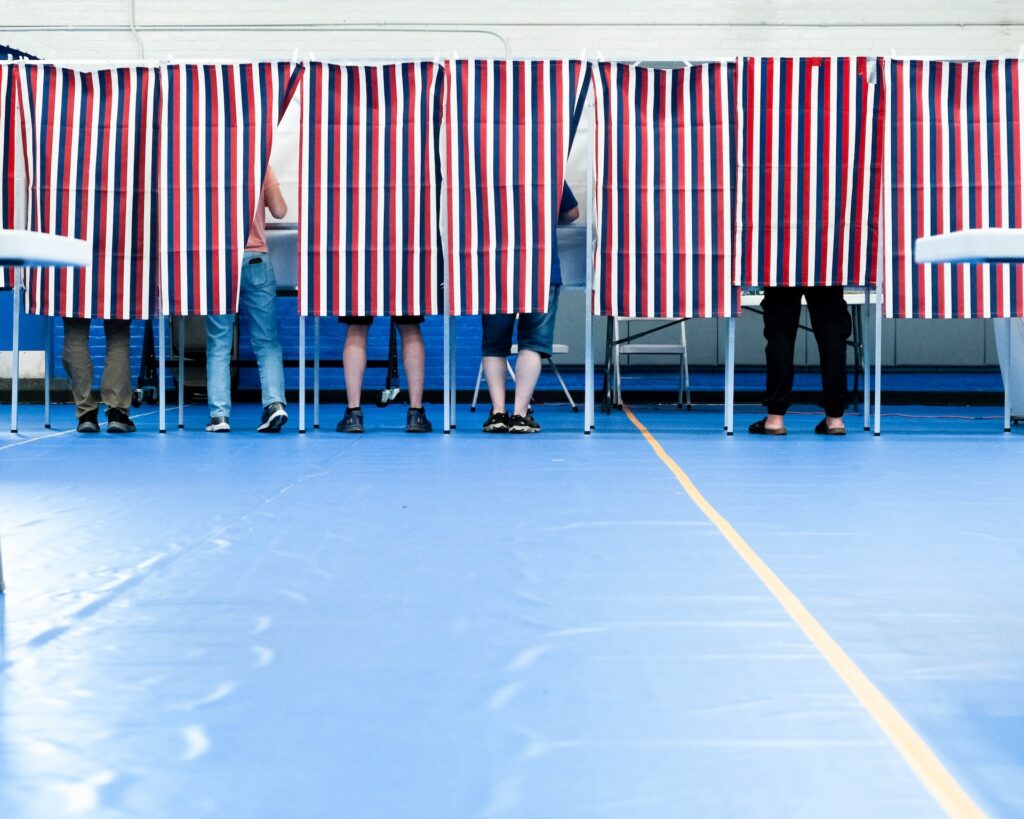
Open Democracy, a New Hampshire voting rights group, has spent several years working to improve the registration rate among 18-year-olds. Shown are New Hampshire voters. (Photo by Will Steinfeld/New Hampshire Bulletin)
American teens are driving less than in previous decades, prompting civic advocates to warn that fewer young people may register to vote.
Yet at least one state — New Hampshire — offers insight into how civic groups can work around a lack of registration opportunities to ensure young people can register, as well as the challenges that remain.
Since Congress passed the National Voter Registration Act in 1993, nearly all states must allow residents to register to vote at motor vehicle offices. But fewer teens are obtaining driver’s licenses today, translating into fewer trips to the local Department of Motor Vehicles and more missed chances to register.
More than 7.5 million people ages 16 to 18 don’t have a driver’s license, according to data compiled by The Civics Center, a nonpartisan group focused on boosting youth voter registration. Three million of those youth will be old enough to vote this year and all will be eligible by 2028, the organization said in a June research report on how declines in teen driving, spurred in part by the rising cost of obtaining a license, could affect voting.
Young people represent a large pool of potential voters for candidates ahead of the midterm elections this November and the presidential election in 2028. Still, voting advocates worry barriers to registration will keep many of them from the polls.
“Our goal is to help people debunk these myths that it’s somehow young people’s fault that these systems aren’t working well for them,” said Laura Brill, founder and CEO of The Civics Center.
Low registration rates
In recent years about 60% of 18-year-olds have held driver’s licenses, according to the Federal Highway Administration. By contrast, in 1994, the year after the National Voter Registration Act was passed, about 74% had licenses.
Even without declining visits to the DMV, registration rates among the youngest voters are low. During midterm election years, the percentage of 18-year-olds registered to vote typically remains under 30%, according to The Civics Center, compared to about 75% of Americans 45 and older.
Some civic groups are pushing for more in-person voter registration drives, including in high schools, which may help offset the effects of fewer trips to the DMV. Without significant action, they fear registration rates will dip even lower.
The League of Women Voters announced a partnership with The Civics Center in April to promote high school voter registration. The groups are offering state-specific training and toolkits to help members of the League, which has hundreds of chapters across the country, help students, teachers and school administrators hold registration drives.
They also want states to provide teens more time to register before they can vote. About half of teens currently live in states that allow voter pre-registration at 16 or earlier, according to The Civics Center.
These states include California, Colorado, Delaware, Florida, Illinois, Louisiana, Maine, Maryland, Massachusetts, Michigan, Minnesota, New York, North Carolina, Oregon, Rhode Island, Utah, Virginia and Washington.
“Young people have a very short window of opportunity,” said Jeanette Senecal, chief of civic learning and impact at the League of Women Voters. “So when we increase that window of opportunity to allow for preregistration at 16 and 17, there’s a much longer kind of runway in order for us to get them registered to vote for that first election.”
The focus on voter registration drives reflects, in part, an acknowledgement that online voter registration isn’t a panacea for fewer in-person DMV visits. Thirty-six states either offer no online voter registration option or allow voter registration only with a driver’s license or state-issued identification, according to information compiled by The Civics Center.
“Paper forms, typically you only need a Social Security number and not a driver’s license. That’s one of the reasons that in-person efforts can be so effective,” Brill said.
SAVE America Act
Voter registration drives are under threat, however. President Donald Trump’s signature election legislation, the SAVE America Act, would effectively prohibit drives held by third-party organizations like the League of Women Voters because it would require individuals to present documents proving their citizenship, such as a passport or birth certificate, to government officials in person to register to vote.
The bill has stalled in the U.S. Senate amid opposition from Democrats and a handful of Republican senators. Trump is still urging lawmakers to pass the measure and posted on social media recently that he opposes unrelated foreign surveillance legislation unless it also includes the SAVE America Act.
As of late 2024, 24 states and the District of Columbia placed no restrictions on third-party voter registration drives, according to the Movement Advancement Project, a Colorado-based think tank. An additional 24 states impose some limits, while Wyoming and New Hampshire prohibit them.
What worked in New Hampshire
Because of its voter laws in the early 1990s, New Hampshire is one of six states exempt from the National Voter Registration Act, or NVRA, along with Idaho, Minnesota, North Dakota, Wisconsin, and Wyoming. The exemption means New Hampshire isn’t required to offer voter registration at motor vehicle offices.
In New Hampshire, everyone — teens and older adults alike — registers in person with election officials and can also register at the polls on Election Day.
Open Democracy, a New Hampshire voting rights group, has spent several years working to improve the registration rate among 18-year-olds.
The organization hired an employee focused on high school voter registration and held 41 high school voter registration drives in 2024, said Olivia Zink, the group’s executive director. To hold the drives, it had to assure election officials were present to accept paperwork.
In December 2023, an election off year, just 9% of New Hampshire 18-year-olds were registered. After the November 2024 election, nearly 64% of 18-year-olds were registered, according to data compiled by The Civics Center. Zink acknowledged that the presidential election was a major motivator, but she emphasized the importance of registering students every year.
State laws can play a major role. Registrations plummeted last year, Zink said, after state lawmakers removed the ability of residents to sign an affidavit as proof of citizenship. She attributed the drop to students not regularly carrying their birth certificates or other documents proving citizenship with them.
“Even with education and posters that are hung up at school and announcements and letters home to parents — we still saw so many fewer students register to vote in 2025 due to that law,” Zink said.
In May, a federal judge blocked the New Hampshire law after a coalition of voting rights groups, including Open Democracy, challenged the measure.
As part of her decision, Judge Samantha Elliott, a Biden appointee, found that Open Democracy registered fewer students in 2025 compared to 2023, even though the organization at that time didn’t have a full-time staff member dedicated to high school registration.
Zink said that even in the first few weeks since the judge’s decision, she had heard of high school students once again registering by signing affidavits.
Despite persistent barriers, Senecal cast the work of registering young people as critical. Each time someone votes, they’re more likely to vote again, she said.
“So the earlier we can engage those people, we really help create these lifetime habits of voting,” Senecal said.
Lawmakers, who will meet at the state Capitol on Monday, June 22, have closed in on a budget deal. (Photo by Charlotte Rene Woods/Virginia Mercury)
After months of debate and an increasingly fraught battle over how to tax and regulate data centers, Virginia budget negotiators announced Friday evening that they’d reached a deal featuring a new energy consumption tax for the industry that’s expected to generate $1.2 billion over the biennium.
The new plan also includes 4% raises for teachers each year, and roughly $285 million for health insurance from the state marketplace and food assistance funding for low-income families. It will also give localities authority to impose a 1% sales tax for school construction and renovation, if they choose. Nearly $1 billion has been allocated in the revised budget as contingency reserve to cover anticipated gaps from reduced federal funding.
The Virginia House of Delegates will convene Monday afternoon in Richmond and the state Senate will meet the same day, as both chambers vote to finalize the budget, which will take effect July 1.
“This budget agreement reflects our shared commitment to making Virginia more affordable for families,” Sen. Louise Lucas, D-Portsmouth, and Appropriations Chair Del. Luke Torian, D-Prince William, said in a joint statement.
“At a time when too many households are feeling squeezed by rising costs and economic uncertainty, this conference report makes historic investments to lower costs, strengthen our schools, protect access to healthcare, expand economic opportunity, and maintain the Commonwealth’s strong fiscal foundation,” they added.
The House had been scheduled to meet last Thursday but Speaker Don Scott, D-Portsmouth, canceled the session, citing budget negotiators’ failure to reach an agreement. By Thursday, leaders in both bodies had signaled negotiations were progressing and legislators were closing in on a deal, the Richmond Time-Dispatch reported.
The issue that paralyzed the process for weeks was whether data centers should continue to be exempt from paying sales and use tax. Lucas proposed eliminating the exemption and was the most fierce defender of that stance until last week, when the Senate released an updated budget that removed the provision to revoke the exemption,
Lucas instead pitched a tiered tax for data centers based on their generator use and traveled statewide in recent days, drumming up public support for her chamber’s plan to levy more costs onto data centers, which they said would net the state $1.8 billion.
“We know technology is not bad,” Lucas said Tuesday on a tour stop in Chesterfield. “You know, we all can benefit from technology, but we, as a government, have not done a good job in managing the regulations and the impact on our communities and that’s what we’ve got to rein in.”
The House released a reworked budget proposal last Friday that stripped environmental stipulations the body had previously recommended but preserved the tax exemption for the digital facilities that now number in the dozens statewide.
The Senate is set to gavel in at 10 a.m. Monday and the House will convene at 2 p.m.
Editor’s note: This story has been updated to include details from lawmakers’ budget deal, released Friday evening. Stay tuned for The Mercury’s in-depth budget coverage this week.