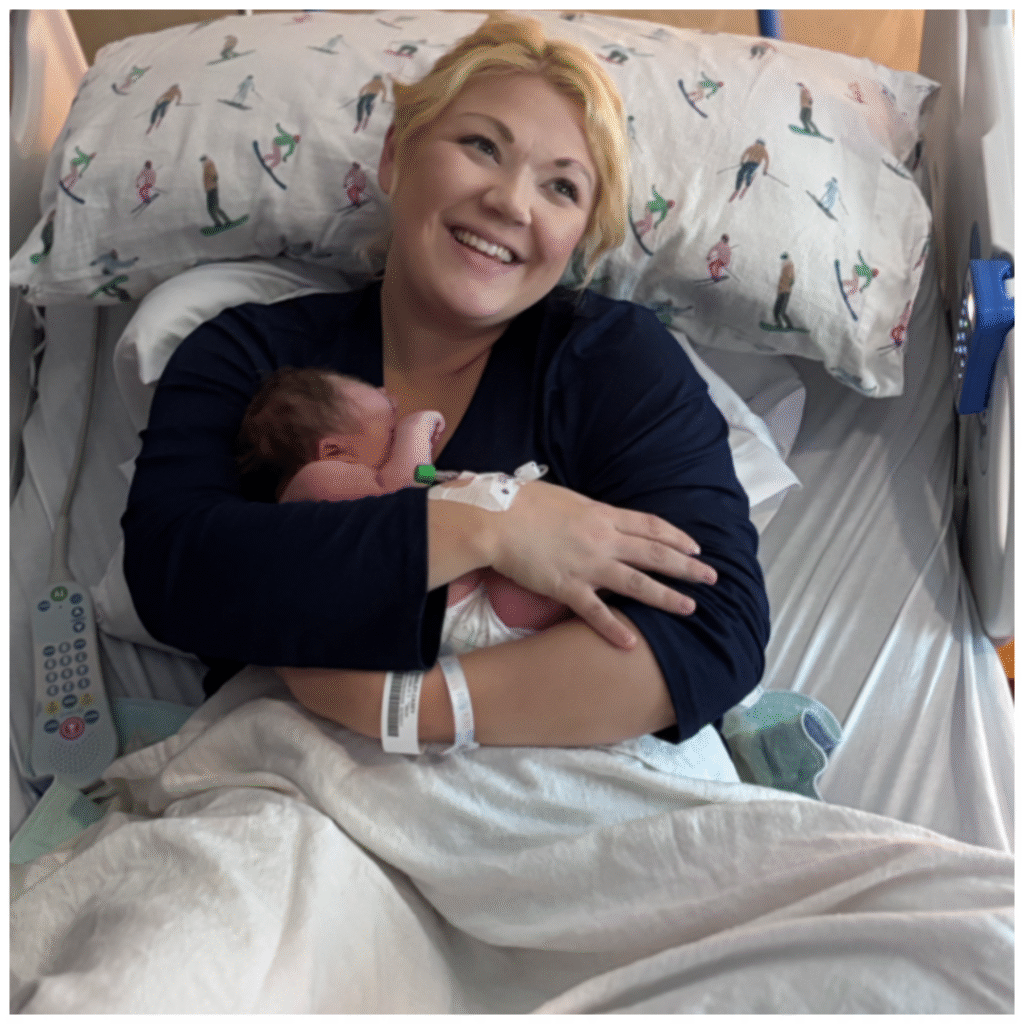
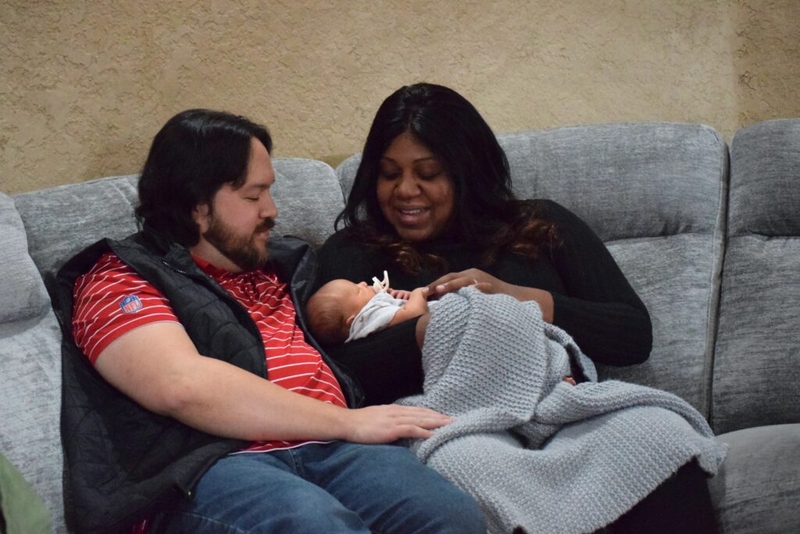
Casey Oakley, who needed an abortion after an unsuccessful IVF embryo transfer. She and her husband have two biological children and she has been a surrogate mom for two families. The couple has also foster parented four girls. (Photo courtesy Casey Oakey)
Editor’s note: This story mentions pregnancy loss.
Miscarriages were common for Albemarle County resident Casey Oakley during her in vitro fertilization process. Some embryo transfers weren’t successful and her body would expel the remnants, a process she had always handled safely at home, until an irregular delay.
Her bloodwork had indicated her pregnancy hormones were not elevating properly, signaling an imminent miscarriage. But two weeks later nothing had happened.
“(Doctors) didn’t know where the embryo had implanted in my body, so I was scheduled for an abortion, and I was told before my surgery that if they couldn’t find products of conception in my uterus, that they were going to be taking my tubes,” she said.
The fallback option was meant to spare her the deadly infections that can arise when miscarriages fail to complete.
“It wasn’t a question that they asked, it was more of a ‘this is what we have to do to make sure that you live,’” Oakley said.
Doctors eventually discovered that her body had maintained a gestational sac but no fetal DNA.
“My body had fought so hard for a pregnancy that would have no baby and then I was going into sepsis,” she said. “The abortion saved my life.”
Her experience is foundational to her support for a pending constitutional amendment heading to Virginia voters statewide in November.
If approved, it will permanently embed reproductive rights into Virginia’s constitution.
The amendment would protect people’s access to contraception, IVF and abortion, four years after the Supreme Court overturned federal protections for abortion and more states have restricted access to the procedure and birth control.
Virginia remains the least restrictive Southern state for reproductive healthcare in the era after Dobbs v. Jackson Women’s Health Organization, the abortion protection case that justice struck down in 2022.
State lawmakers weigh in
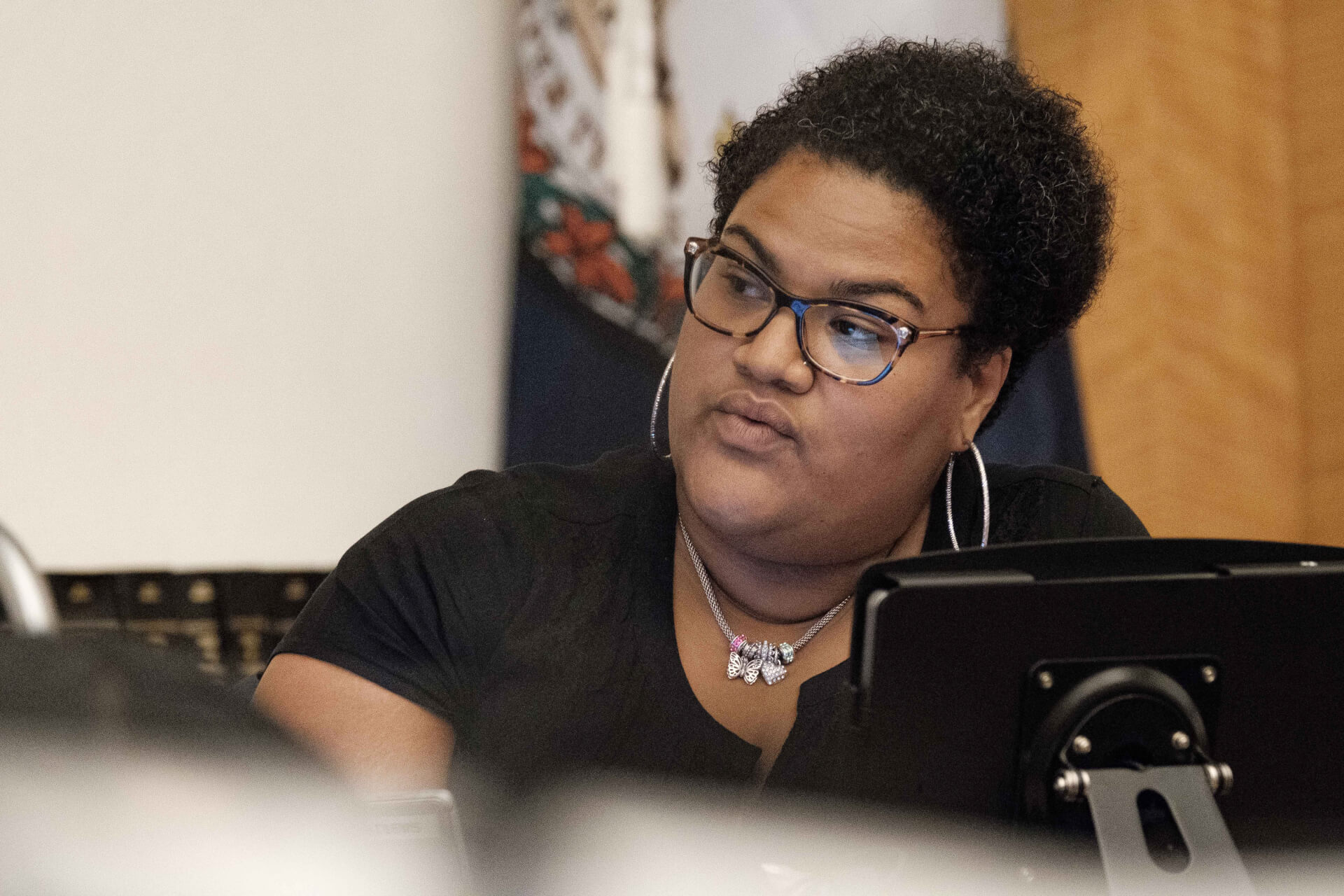
Del. Cia Price, D-Newport News. (Ned Oliver/Virginia Mercury)
Del. Cia Price, D-Newport News, was diagnosed with polyendocrine metabolic ovarian syndrome at 16 years old. She recalled debilitating cramps that made it hard for her to focus in school and days she could not get out of bed.
Formerly known as polycystic ovarian syndrome, PMOS is a full body disorder that affects people’s metabolism and reproductive organs. It can also cause infertility. Contraception has long been a standard treatment for the disorder to improve quality of life.
Though Price doesn’t need contraception for family planning as she is in a same-sex relationship and does not want biological children, the treatment lessens her PMOS symptoms.
She said her and others’ access to the medication could be at risk.
After Dobbs, Justice Clarence Thomas suggested the court revisit cases that have protected contraception, as well.
Gov. Abigail Spanberger signed Price’s Right To Contraception Act into law this summer, after the bill was vetoed multiple times by former Gov. Glenn Youngkin.
It will protect contraception access in the interim, though the pending reproductive rights amendment would shore matters up longterm.
Price said she understands some of her constituents’ and legislative colleagues’ reasons for not supporting contraception or abortion — from religious objections to debates over life-at-conception. But she underscored the healthcare utility of each.
“It’s just really disheartening for your quality of life to be at the intersection of an argument,” she said.
“This is a difficult topic for a lot of people,” Sen. Emily Jordan, R-Suffolk, said during a floor speech earlier this year amid debate over the amendment.
Jordan was among the Virginia Republicans who unsuccessfully sought to alter the amendment to reinforce existing state code outlining restrictions for minors and outlining care for infants when they are born.
The amendment advanced due to Democrats’ majority in the Virginia statehouse. Now, it’s in voters’ hands.
Price believes her contraception bill and the amendment “takes the conversation out of the political sphere and puts it in the medical sphere and the personal decision sphere.”
The medical cost
Dr. Kimi Chernoby, an emergency medicine doctor and lawyer, noted that emergency abortion care can happen at all stages of pregnancy if things go awry with the fetus or parent.
She added that many first trimester abortions stem from miscarriages or ectopic pregnancies, and that restrictive state laws increase margins for death.
“These laws are written by lawyers who have no medical training,” she said. “They actually prohibit a lot of care around miscarriages and ectopics, unless they fall within certain exceptions, and so that’s the care that is getting tangled up.”
As chief operating officer for a nonprofit called FemInEM, Chernoby organizes training around the country for emergency physicians to handle reproductive health emergencies.
The national patchwork of bans and restrictions with scant exceptions has complicated her and other physicians’ work, she said.
Legal challenges to mifepristone further muddle matters, as the abortion pill is also critical for managing miscarriages to prevent sepsis. FemInEM has submitted amicus briefs as a key court case that could affect abortions and miscarriage care nationwide unfolds.
Ahead of the fall referendum and pending court rulings, Oakley reflected on how an abortion allowed her to become a mother, surrogate and foster parent many times over.
“I was able to further the lives of my children and four other little girls,” she said. “There will be many other children to come into our lives afterwards.”
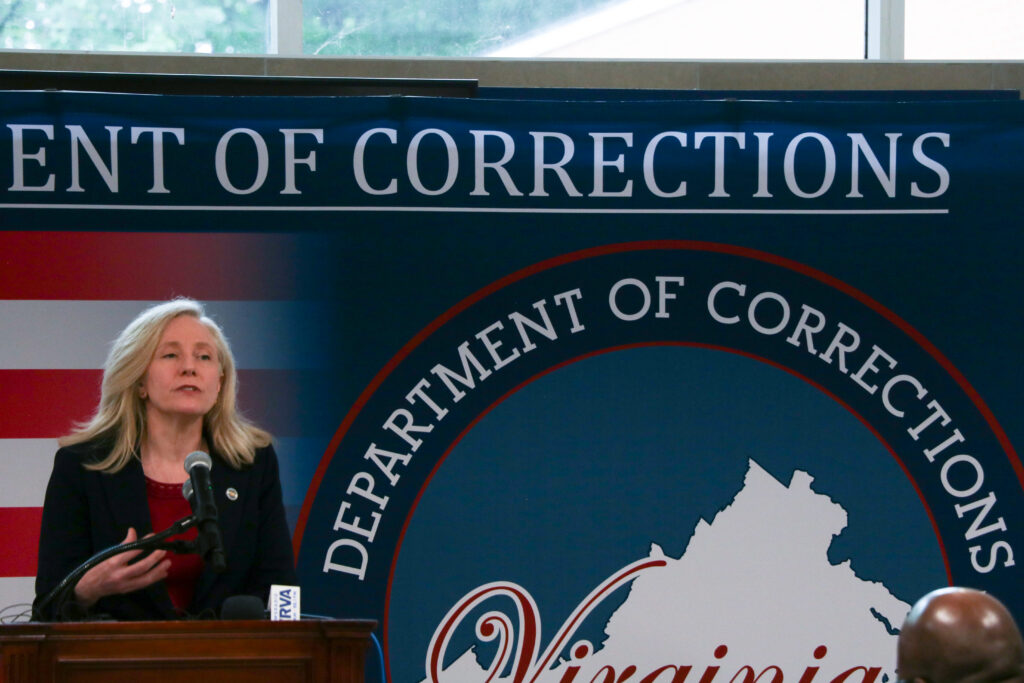
Gov. Abigail Spanberger announced she has created the Governor’s Community Partnership Council On Corrections on June 23 at the Virginia Department of Corrections headquarters in Richmond. (Photo by Charlotte Rene Woods/Virginia Mercury)
A new council convened by Gov. Abigail Spanberger aims to help solve longstanding issues in Virginia’s prisons that residents and correctional officers have expressed concerns about for years.
The Governor’s Community Partnership Council On Corrections, which Spanberger announced Tuesday, will bring together representatives from advocacy groups, faith-based organizations, healthcare and public safety groups and former prisoners to share their experiences and work towards solutions.
Two years ago a handful of prisoners at Red Onion State Prison, the most embattled correctional institution in the state, burned themselves in protest of living conditions and in attempts to transfer elsewhere.
Allegations of racism and retaliation by correctional officers were not ruled out by a state watchdog investigation at the prison and a class action lawsuit on behalf of prisoners who say they were abused will head to trial later this year.
“The people living in Virginia’s prisons are not forgotten on our watch,” Spanberger said at a press conference announcing the new council held at theVirginia Department of Corrections headquarters in Richmond.
Virginia Public Safety and Homeland Security Secretary Stanley Meador emphasized that the council will empower participants to propose solutions to problems and help the administration “see things we can’t see.”
Shawn Weneta, a policy strategist who has helped shape some criminal justice law changes in recent years, commended the creation of the council. He noted that some VADOC changes first began under the previous director but is pleased with the progress that the new administration is building.
Speaking as a formerly incarcerated person, he emphasized that the council’s mission can best succeed by including “those most directly impacted by the system.”
Ahead of assembling the official council, Spanberger’s administration has already conducted engagement within prisons and implemented her Executive Order 12, which entailed enhanced training for correctional officers and building partnerships with communities.
From January to May of this year, Spanberger said use of force across all VADOC facilities has declined by 39%, serious inmate-on-staff assaults dropped 56%, lockdowns decreased by 27%, confirmed overdoses dropped 47%, while suspected overdoses dipped 12%.
Virginia prisons have stopped using five-point restraints, which can be harmful for people in mental health crises, she said.
The practice of isolating inmates in restorative housing, a persistent problem, has dropped by 20%.
Restorative housing is Virginia state code’s euphemism for solitary confinement. It removes inmates from general populations and houses them in solitary cells.
Restorative housing is used when there’s a threat of gang violence and as a disciplinary measure for inmates who violate prison rules.
When asked how the reduction in restorative housing was made possible, Spanberger shared that staff training refreshers since she took office have focused on deescalation, which doesn’t exacerbate situations where an inmate may be in crisis or agitated.
Spanberger also said her administration is considering how to fine tune the state’s Step Down program.
Step Down is supposed to offer people placed in restorative housing a pathway out by helping address root causes of why they were placed in solitary housing and giving them measures to transition out of it.
Several current and former inmates have relayed to The Mercury in recent years that restorative housing has been heavily utilized and people sometimes spend weeks or years, rather than days, in it.
A third-party report to state lawmakers in late 2024 confirmed that at least one facility had placed the majority of its residents under solitary housing.
Spanberger said her administration wants to be “making sure that every movement is documented on why someone is in restorative housing and their pathways out of it.”
Under her direction, VADOC has also started to solve visitor access issues.
After hearing tales of disparate visitation access, Spanberger identified COVID-era restrictions — like less seating and fewer visitor time slots — as a contributing factor.
In recent months, VADOC has worked to restore past seating capacities in prisons’ visitor centers and expand visitor time slots, the governor said. She alsosigned a law that creates more guidance and takes into account the needs of long-distance travelers who come to see their loved ones behind bars.
This “benefits, not just the family, but the person who is incarcerated,” she said.
With Joseph Walters now serving as director of VADOC, Spanberger’s administration established a new code of ethics for VADOC employees and mandated refreshed training.
Staffing issues have also plagued Virginia’s prisons. Walters and Meador shared that they’re very proud that their agencies’ work so far has been achieved even with a 21% staffing vacancy.
This means, they said, that current staffers are working longer hours and pledging deeper commitment to their tasks. But rebuilding employee teams will be critical to halt turnover and alleviate burnout.
Walters, Meador and Spanberger also hosted in-person engagement sessions with 13 advocacy groups that the governor said had gone unheard by the state’s top leaders for years.
She called it “stunning” how long some groups had tried to relay concerns to previous administrations and that she hopes her efforts to strengthen communication can “build a foundation for after I am no longer in office.”
Editor’s note: This story has been updated to correct the spelling of Walters.
Mylissa McNeill, sitting outside her home in Jacksonville, Ark., earlier this year, says she was denied prompt miscarriage care in August 2022. It was the beginning of a cascade of health problems that she blames, at least in part, on hospitals’ reluctance to provide miscarriage management care that might run afoul of state abortion bans. (Photo by Katie Adkins/Arkansas Advocate)
Mylissa McNeill never expected to be a mother. But when she learned she was pregnant in the spring of 2022, at age 41, she and her partner were happy and excited at the prospect of parenting a little girl they planned to name Maeve.
On June 24, 2022, about one month after McNeill discovered she was pregnant, the U.S. Supreme Court overturned Roe v. Wade in its Dobbs ruling, eliminating the constitutional right to an abortion and empowering states to outlaw it. Missouri was the first state to enact a ban; at that time, McNeill was living in Joplin, Missouri.
In August 2022, McNeill miscarried. It was the beginning of a health crisis that plagues her to this day and that she blames, at least in part, on hospitals’ reluctance to provide miscarriage management care that might run afoul of state abortion bans.
Missouri’s law prohibited nearly all abortions, but it allowed abortion providers who were charged or sued under the law to escape punishment by arguing that they acted in a “medical emergency” to prevent the death of the pregnant woman or to avert “a serious risk of substantial and irreversible physical impairment of a major bodily function.”
Missouri’s ban is no longer in effect — it was overturned by voters in 2024 — but such language is typical: All 13 states that currently have abortion bans allow the procedure to protect the life of the pregnant woman. Some, but not all, of the bans also have exceptions to protect the health of the woman.
But patients and providers have argued in lawsuits challenging the bans that such exceptions are too ill defined to give doctors and hospitals enough confidence to provide timely care. McNeill believes that her persistent health problems are the result of delayed care.
In early August 2022, less than two months after Missouri’s ban took effect, McNeill’s water broke at about 18 weeks. She says her OB-GYN told her the pregnancy was no longer viable, and she sought an abortion and miscarriage management procedure known as dilation and curettage, or D&C, in hospitals in both Missouri and Kansas (where abortion was legal). However, doctors declined to provide miscarriage care while they were able to detect fetal cardiac activity.
After three days of bleeding and aching, McNeill finally received treatment at a hospital in Illinois. When she had a subsequent tubal ligation to prevent future pregnancies, McNeill said medical staff told her she had scar tissue resulting from an infection she developed after her water broke.
“While they were in there, they saw what happened,” McNeill said. “The infection went outside of my uterus. It went to my liver, and my liver is permanently attached in multiple places. It’s attached to my uterus; it’s attached to my stomach lining.”
McNeill says the lingering effects of that infection include severe bouts of vomiting and significant financial hardship as she has struggled to pay for care without steady health care coverage.
“I literally break all the blood vessels in my skin. … This kind of pain is — there’s no word for it,” said McNeill, who shared with Stateline pictures of her face covered in red splotches, her nose magenta. “The delay is what really upset me, because women have died with less time than I had, and that delay and the infection that I did get from this by waiting three days, it destroyed my life.”
Last year, states including Texas, Kentucky and Tennessee enacted laws designed to provide additional clarity on medical exceptions to their bans, but confusion persists in those states and others. Stories of denied miscarriage care continue to emerge, including in a brand-new lawsuit in Texas, and several deaths have been attributed in part to abortion restrictions, including in Georgia and Texas. Research has linked abortion restrictions to higher rates of maternal death and injury.
“The four years since the Dobbs (v. Jackson Women’s Health Organization) decision have unfortunately proven what OB-GYNs already knew: abortion care is inextricable from reproductive health care,” Molly Meegan, chief legal officer and general counsel for the American College of Obstetricians and Gynecologists, wrote in a statement.
“Bans and restrictions on abortion care have resulted in patients across the country being denied care, even in instances of pregnancy loss and miscarriage.”
A new study published last month by the Journal of the American Medical Association found that since the Dobbs decision, in states where abortion bans took effect, miscarriage management has shifted away from medical intervention toward more of a “wait-and-see” approach.
But anti-abortion groups blame doctors and abortion-rights advocates for creating confusion around the medical exceptions in abortion bans, insisting it is clear what is a medically indicated abortion and what is purely elective.
“As architects of the majority of the nation’s pro-life laws, Americans United for Life has been very clear that none prevent women from receiving life-saving miscarriage care. Efforts to suggest otherwise are made in bad faith” said Gavin Oxley, a spokesperson for the group.
“Doctors who delay or altogether deny medical treatment must be held accountable for the harm they inflict upon women. If doctors are not clear on this four years after Dobbs, they clearly have not been listening.”
Dr. Susan Bane, an OB-GYN in Greenville, North Carolina, who is on the board of directors for the American Association of Pro-Life Obstetricians and Gynecologists, told Stateline that doctors — especially the American College of Obstetricians and Gynecologists — have unfairly blamed abortion bans for the denial of medical care to pregnant or miscarrying women.
“There’s nothing, I mean zero, about any of these laws that say you have to have her dying or septic,” Bane said. “I’ve done this hundreds of times in the last 30 years, where the baby was alive, and I sat at the bedside and had an excruciating conversation with a woman to say, ‘I am so sorry, but if we don’t move towards delivery, I’m worried both of you will die.’”
She said her organization supports state laws, like one signed in South Dakota earlier this year, that redefine “abortion” as the intentional ending of the life of the “unborn child.” Supporters say such laws will allow doctors to manage miscarriages, ectopic pregnancies and other pregnancy-related emergencies.
“It’s sad that more clarification isn’t happening, but the blame really started right in my profession.” Bane said.
But Meegan said attempts to legislate health exceptions fall short of protecting all patients.
“There is no law or exception that can account for the immense variety of medical situations that can present in pregnancy,” she wrote. “And there is no additional legislation that can undo the harm created by abortion bans short of repealing the bans themselves.”
McNeill said that following her miscarriage, she lost her job and the health insurance that came with it. She sued and then reached a settlement with the Missouri hospital that she believes denied her prompt care. But she continues to search for relief from her health problems, and says she has racked up substantial medical debt.
She and her husband moved to Arkansas and then Kansas in search of the financial stability that has eluded them since her miscarriage almost four years ago.
“My debt is in the millions with all of this illness without coverage for long periods,” McNeill said. “Now that my credit is destroyed, I’ll never be able to buy a house again while in this health.”
Stateline reporter Sofia Resnick can be reached at [email protected].
This story was originally produced by Stateline, which is part of States Newsroom, a nonprofit news network which includes Virginia Mercury, and is supported by grants and a coalition of donors as a 501c(3) public charity.
A couple sits with their newborn inside their Bentonville, Arkansas, home. The Trump administration is shifting the federal Title X program, which has traditionally provided access to contraception, toward an emphasis on childbearing. (Photo by Antoinette Grajeda/Arkansas Advocate)
A federal poverty-fighting program focused on reducing unintended pregnancies is about to undergo a major overhaul.
Reproductive health clinics use Title X federal grant money to provide birth control, cancer screenings and testing and treatment for sexually transmitted infections to people with little or no health insurance. Title X money cannot be used for abortions.
The Guttmacher Institute estimates that Title X, which was signed into law by Republican President Richard Nixon in 1970, has prevented almost 20 million unintended pregnancies and 9 million abortions. It has also helped reduce child poverty, according to the group, which supports abortion rights.
But President Donald Trump has taken aim at the program, which has long been a target for abortion opponents. Since regaining the White House, Trump has temporarily blocked and then restored grants to certain reproductive health clinics, and proposed a U.S. Department of Health and Human Services budget with no funding for the program.
The department’s recently issued funding guidelines for Title X grants represent a significant mission shift.
Instead of expanding access to contraception, the focus of Title X will be “to strengthen family formation and assist clients in achieving healthy pregnancies,” according to the new guidance. That will align the program with the administration’s efforts to increase the U.S. birth rate.
The new rules say Title X will prioritize educating Americans about natural methods to avoid pregnancy and overcome infertility, and will promote “body literacy education” and “informed, preventive, and restorative approaches to reproductive health.” Some conservative groups tout an obscure alternative treatment for infertility called “restorative reproductive medicine,” which is based on the idea that the underlying causes of infertility can be treated through lifestyle changes and improving a person’s overall health.
The guidance directs Title X clinics to promote “fertility-awareness-based methods,” such as period-tracking apps, which the American College of Obstetricians and Gynecologists says can be helpful for getting pregnant but less effective at preventing pregnancy. It also calls on clinics to offer counseling on male fertility issues and to address environmental causes of infertility, including pornography use. And it includes a prohibition on DEI efforts and warns grantees that federal money cannot be used to “facilitate or incentivize illegal immigration.”
Anti-abortion groups support the changes, but many health policy researchers say they will disproportionately harm low-income and minority women, who are more reliant on Title X services and are more likely to have unintended pregnancies. Researchers also say the new guidelines are unlikely to achieve the administration’s “pronatalist” goal of reversing declining birth rates.
Corinne Rocca, an epidemiology professor at the University of California, San Francisco, said the way to do that would be to spend more on childcare subsidies and other social programs to help new parents.
“Policies that help people and families feel supported to meet their childbearing preferences … would actually help people who are open to the prospect of childbearing to do so,” Rocca said.
Rocca co-authored a study published in JAMA Network Open last fall suggesting Black and Hispanic women are less likely than other racial groups to be able to choose if, when and how to start a family.
Clinics must reapply for funding under these new guidelines by Jan. 9, 2027. HHS did not respond to a request for comment.
During his first term, Trump banned Title X clinics from referring patients to other providers for an abortion or even mentioning it as an option. He also prohibited grantees from offering family planning services and abortions in the same building. As a result, many grantees quit the program, including about a dozen state health departments and all participating Planned Parenthood chapters.
The program served about 844,000 fewer patients in 2019 than it did in 2018, when it served 3.9 million patients, according to HHS. About 225,000 fewer patients received oral contraceptives; about 50,000 fewer received hormonal implants; and about 86,000 fewer received IUDs.
The reframing of Title X that is reflected in the new guidelines was a recommendation laid out in the controversial blueprint known as Project 2025, created by the conservative think tank Heritage Foundation as a guide for the second Trump administration.
In line with Project 2025’s recommendations, HHS says Title X grantees will no longer be required to counsel or refer for abortions, and tells applicants that relationship counseling should encourage marriage as a precursor to having children.
“In a time when we are facing a rapidly declining birth rate that falls far short of the replacement fertility rate, we should be doing all we can to encourage and support family formation and fertility,” Dr. Christina Francis, CEO of the American Association of Pro-Life Obstetricians and Gynecologists, told MedPage Today in April.
“Women deserve accurate information about their fertility and their health — and this includes highlighting the many benefits of pregnancy and motherhood.”
Some abortion opponents have criticized Title X for promoting certain forms of contraception, such as IUDs, that they view as abortifacients. A spokesperson for the National Right to Life Committee said the organization does not take a stance on contraception that prevents fertilization, “however, National Right to Life does oppose any device or drug that would destroy a life already created at fertilization.”
“If there is any doubt, we recommend that a woman speak with her doctor to determine if an agent would cause an abortion,” the spokesperson said in an email.
But Leonard Lopoo, a professor at the Maxwell School of Citizenship and Public Affairs at Syracuse University who has studied fertility and family policies for the past three decades, said the federal government could help families achieve their family planning goals by expanding pregnancy prevention and infertility treatments at all income levels.
“When you’re trying to take away the funding for someone who doesn’t want to have a child, that’s not the same as providing funding to support someone who does,” Lopoo said.
As a Black woman and researcher focused on Black maternal health at Ibis Reproductive Health, Terri-Ann Thompson is better informed than most on the ways having children can be disproportionately more dangerous and less affordable for women who look like her.
But she says what she wasn’t expecting to uncover — during research for a study she co-authored in the journal Frontiers in Public Health this spring — is how much the fear of negative medical and criminal justice outcomes makes many Black women in Georgia and North Carolina scared of pregnancy.
“I was very surprised to see that folks were actually thinking about the context within which a Black child is born and raised well before they even contemplated starting a family,” Thompson said. “We had a lot of, just, stories of folks saying, ‘Why would I want to bring a child into this context; how does one prepare Black women to bring a child into this context?’”
Thompson said her team’s findings show how much Black women depend on low-cost access to long-acting reversible contraceptives such as IUDs.
“We have people who drove very, very far just to get a sliding scale to either get an IUD placed, an IUD removed, or to even get on birth control pills,” Thompson said.
“If the administration moves forward with these restrictions, what we are doing is we are removing access to contraceptives for a population that is at higher risk.”
Stateline reporter Sofia Resnick can be reached at [email protected].
This story was originally produced by Stateline, which is part of States Newsroom, a nonprofit news network which includes Virginia Mercury, and is supported by grants and a coalition of donors as a 501c(3) public charity.
By Nathaniel Cline, Shannon Heckt, Charlotte Rene Woods, Samantha Willis Virginia Mercury
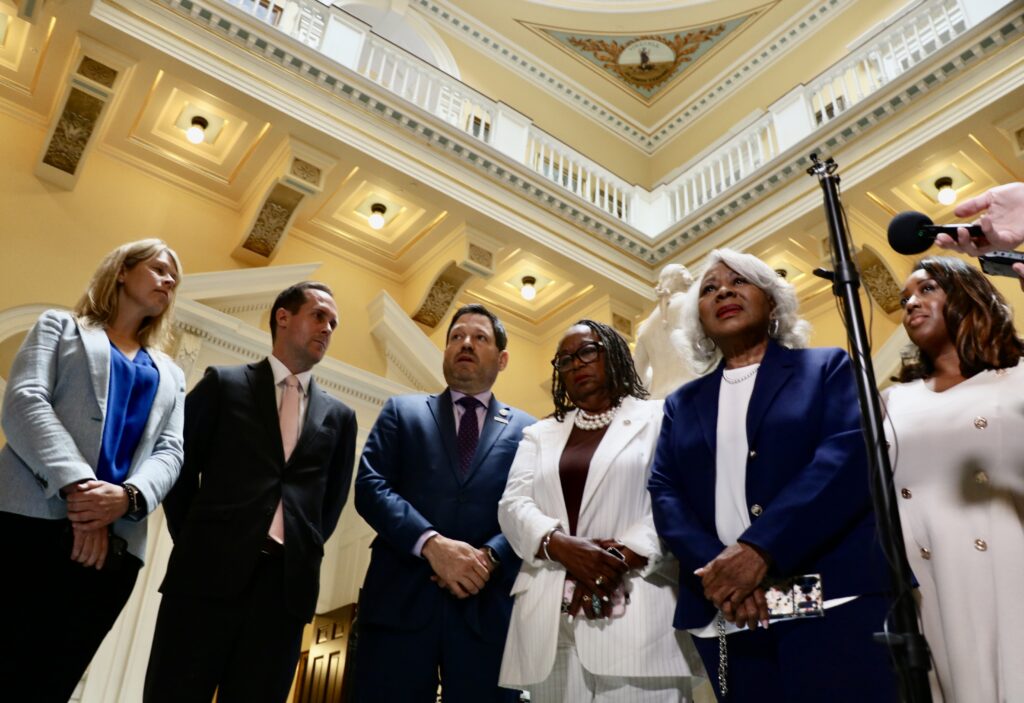
Members of Virginia’s Senate Finance and Appropriations Committee speak with the press in the Capitol Rotunda on June 22, 2026. The legislature advanced a $205 billion, two-year spending plan the same day. (Photo by Charlotte Rene Woods/Virignia Mercury)
On Monday, Virginia legislators approved a two-year, $205 billion budget proposal to fund healthcare and public education, provide 4% teacher raises and a 3.5% pay bump to state employees, establish a retail weed marketplace and hedge against decreased federal dollars.
The spending plan also includes a provision to tax data centers for their energy consumption, which is slated to generate a maximum of $600 million each year but doesn’t include the environmental standards the House of Delegates wanted to impose on the industry or the end of the sales tax exemption that the Senate sought.
Senate Finance Committee chair Louise Lucas, D-Portsmouth, said after her chamber’s morning session that she “didn’t love” the data center compromise and framed it as a necessity — but not the final solution.
“I would have preferred another method, but we had to get a budget. We were not going to let the government be shut down, and so this was a good start,” Lucas said.
“This is a compromise proposal — one my administration helped craft — and it builds a strong foundation for further discussions about the future of this industry in Virginia on issues like environmental and community impact,” Gov. Abigail Spanberger said of the data center provision in a statement.
The Senate passed the budget proposal 23-16 vote, while the House advanced it 71-22.
With both chambers finally on the same page after months of gridlock over data centers, the plan will now be reviewed by Spanberger. She can sign it as-is, recommend changes or veto line items. The whole process must be finalized by July 1, when the new budget will take effect.
Here are the key priorities addressed by the spending plan.
Data centers
The amended budget proposal creates an energy consumption tax for data centers which totals $.011 per kilowatt hour used per month.
The state will collect up to $600 million a year from this new tax, according to budget language. Any funds collected over that cap would be put into a fund and given back to data centers at the end of each fiscal year.
This is only a fraction of what the state could have made if they had ended the sales and use tax exemption, but, after months of arguing, lawmakers ultimately didn’t agree to that measure. Spanberger supported keeping the exemption in place through the end of the agreement’s term in 2035.
Additionally, language was put into the budget to direct the Department of Environmental Quality to study the groundwater impacts of non-closed loop data centers, which use millions of gallons of water each year.
DEQ will locate “cooling water scarcity areas” where the use of potable water for computer cooling systems could be detrimental to surrounding areas’ water quality and availability.
The department will have until July 2027 to create regulations for the scarcity areas. After they are developed, future data centers in that area will be required to “use air cooling, closed loop cooling systems, or more efficient cooling systems that become available.”
After July 1, 2027, data centers in the Eastern Groundwater Management Area will have to “use air cooling systems, 100% recycled water and/or stormwater for cooling, or use a closed loop system.” A study will be released in October 2026 on how to retrofit existing data centers in those areas to align with the new regulations.
Some Republican lawmakers characterized the measure as inconsistent.
“The budget does not create one strong statewide water usage standard for data centers. Some parts of Virginia get stronger protections and other parts get weaker protection or no protection at all,” said Sen. Glen Sturtevant, R-Chesterfield. “That should concern every locality that is concerned about becoming the next target for a massive data center.”
Budget language also directs DEQ to put in place noise abatement regulations for data centers before the end of 2029. The department will determine the lowest possible noise level for data centers and make it the standard starting in 2030.
After that date, facilities who violate the noise standard will face a fine of $32,500 per day.
“The noise issues are some of the things we hear the most from people that live next to data centers,” said Sen. Scott Surovell, D-Fairfax, whose district contains dozens of data centers. “Water is a rising concern, especially for any data centers that are gonna be put east of I-95, where we already have a real problem with our declining aquifer.”
Lucas told reporters that this is not the end of the conversation about doing away with the sales and use tax exemption, and that a study group will look closer at the issue and provide a report on their findings in November.
Health and human services
Overall, the pending budget will earmark $158.3 million in the state’s general fund for fiscal year 2027 and $245.1 million in 2028 for healthcare and social services.
The money was set aside both for healthcare and social services the state typically handles along with support to comply with new federal mandates and partially plug holes created by federal funding shortfalls.
As thousands of Virginians have fallen off Affordable Care Act health insurance this year, Virginia’s new budget entails $150 million to support a state-level version of the expired federal assistance for people between 138% and 250% of the federal poverty level.
Sen. Danica Roem, D-Manassas, a former journalist and restaurant worker, described the difficulty of living uninsured for two years in a floor speech on Monday.
“I don’t want anyone to live like that,” she said.
She added that the budget “puts major money” into making sure that the state is “taking care” of people.
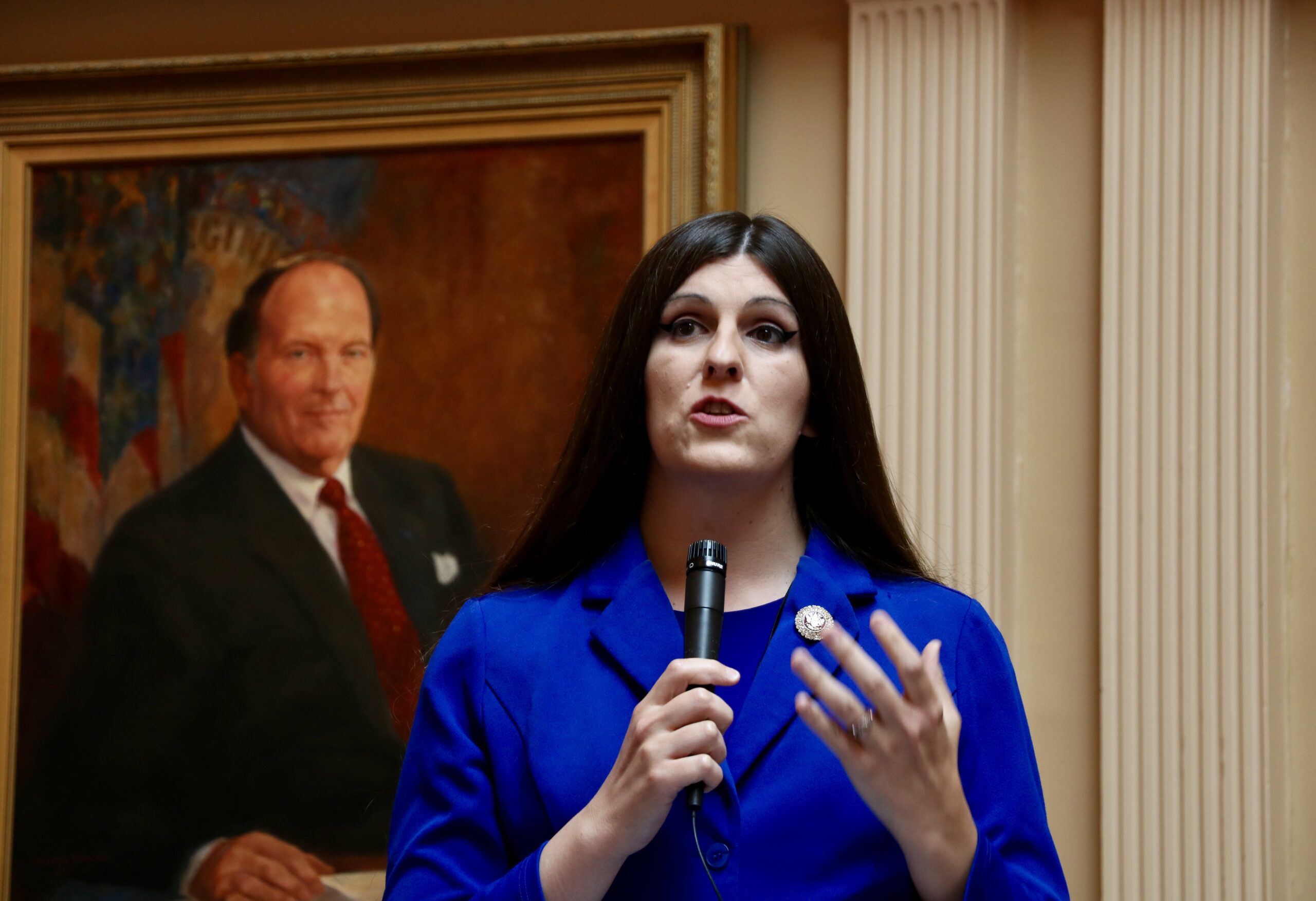
Sen. Danica Roem, D-Prince William, speaks on the Senate floor during the special budget session on June 22, 2026. (Photo by Charlotte Rene Woods/Virginia Mercury)
The plan calls for $3.5 million to determine ways the state can ensure eligible people remain on Medicaid amid forthcoming eligibility requirement shifts and additional verification work.
Virginia’s roughly 850,000 Supplemental Nutrition Assistance Program beneficiaries went without their food stamps last fall during the federal shutdown. And due to a reconciliation bill Congress passed last summer, states like Virginia are attempting to reduce their error rates.
State lawmakers have designated $135 million to handle SNAP, should the error rate not fall to the required 6% by the end of the calendar year.
Sometimes SNAP households are overpaid or underpaid because of paperwork mistakes by government staff or outdated information from beneficiaries. Work in social service departments is already underway to reduce error rates.
Free clinics will receive $20 million in state funding over the next two years while federally qualified health centers will get $10 million in that time.
While federally qualified health centers offer sliding scale fees for low-income patients, free clinics are also a resource for uninsured patients. Both entities have been bracing for additional clients as Virginians lose their ACA or Medicaid insurance.
A little over $1 million is allocated to help local health departments statewide handle rent increases. The regional centers help fill healthcare access gaps and are often tailored to the local communities they serve.
As federal dollars for HIV/AIDS care are slashed, the state budget also contains over $26 million for that specific type of healthcare over the next two years. Staying on top of medication is critical in preventing the spread of the disease.
Education
Under the newly approved budget proposal, K-12 education funding would increase by $1.4 billion, including a 4% increase for teachers in each of the next two years.
Lawmakers propose $590 million for rebenchmarking, declining enrollment, and high-need groups, including $28.9 million for at-risk and $148.4 million for special education students.
Also included: $500,000 for grants to help schools purchase Automated External Defibrillators (AEDs) and implement cardiac emergency response plans.
In higher education, the budget proposes restoring funding for affordable access and tuition moderation, as well as expanding nursing programs at several public universities. The Internships Virginia (InVA) initiative to provide paid internships for postsecondary students would also be funded.
To support educational infrastructure, lawmakers also agreed to expand the authority to allow all localities to use a 1% sales tax to pay for construction costs, contingent on a referendum that must pass in each jurisdiction. The language also permits jurisdictions in Northern Virginia to use the funds for transportation projects to address public transit needs.
Tax deductions
Taxpayers will be able to keep a bit more of their cash, as the new budget increases the standard income tax deduction from $8,750 for single filers and $17,500 for joint filers to $9,200 and $18,400 in 2027 and $9,300 and $18,600 in 2028.
RGGI/environment
A budget amendment was added into the conference report that would divert 45% of the funds earned from the Regional Greenhouse Gas Initiative back to ratepayers.
The funds come from carbon credit sales, which utilities must purchase if they want to burn carbon-based fuels sources that release emissions. Those costs are then passed down to utility customers.
When former Gov. Glenn Youngkin removed the state from the agreement in 2021, it cost about $4 a month on the average residential customer’s bill. Recently, Dominion Energy filed for the “RGGI Rider” to be added back to monthly bills as mandated by a law to rejoin the agreement, signed by Spanberger in recent weeks.
Dominion is required to begin purchasing from the carbon credit auction in July but the charge to customers won’t begin until March should the State Corporation Commission approve the application by the utility. This will lead to an increased charge of $10-$13 monthly.
The state previously earned about $800 million from the RGGI funds that had to go towards community flood preparedness projects and low-income energy efficiency projects. The new budget language includes the rebate for customers, which would put money back in wallets but detract from the funds for flood and efficiency projects.
The rebate will not apply to co-op utility customers.
Housing
While a handful of housing bills passed the 2026 session and have since been signed into law, the new spending plan includes measures to ensure bills with fiscal impacts get off the ground.
The state budget proposal directs $60 million overall for housing initiatives, $40 million of which will go to the state’s Housing Trust Fund and $20 million that will go towards a mixed-income housing pilot program.
Additionally, lawmakers set aside $11.5 million for the Virginia Eviction Reduction Program and $10 million for the Clean Energy Innovation Bank.
Cannabis
Spanberger and lawmakers announced June 16 a reworked proposal for a retail cannabis marketplace that included key compromises between legislators’ and the governor’s visions. The marketplace is set to launch July 1, 2027 and will be limited to 350 stores statewide.
State sales tax on retail weed will be 6% at launch and will increase to 8% in 2029. Localities also have the option to add an additional tax of 1 to 3.5%.
Because lawmakers added a Part 5 amendment, the market will be permanently established in the state.
The new framework includes a $250 public consumption civil penalty that will not take effect until 2027.
“We had serious concerns about creating extreme new penalties that would not have meaningfully reduced the illicit market,” Sen. Lashrecse Aird, D-Henrico, said at a press conference announcing the framework last week.
“But we believe this final framework strikes the right balance for enforcement mechanisms, but also in accountability, but also not harming those who just choose to participate in the market.”
Child care
The budget sets aside $137.6 million for the state-subsidized child care program slots, which will be devoted to families making 85% or less of the state median income.
This follows legislation carried by Del. Briana Sewell, D-Prince Wiliam, requiring the state education department to update how it calculates the cost of childcare for Virginia families. A majority of Virginia parents and employers say child care costs are prohibitive.
Spanberger signed the bill into law last month.
A new cost-sharing program for child care will be funded through the budget, with lawmakers allocating $25 million for the initiative to spread the price of child care between families, employers and the state.
Transportation
Lawmakers included $153 million in the budget for additional operating assistance for the Washington Metropolitan Area Transit Authority, or Metro, with the caveat that Metro must produce a 20-year capital plan and annual performance reports.
The action comes as inflation has driven up the costs of operating transit services.
Lawmakers also proposed directing the secretary of transportation to evaluate options, including public-private partnerships, to accelerate large-scale improvements to the I-81 corridor.
The legislature allocated $7 million for the Route 460 Phase IIA Finish Grade Project and directed stakeholder engagement to prioritize improvements along the U.S. Route 220 corridor.
The budget also directs the state to identify federal funds to support rural electric-vehicle charging infrastructure and provides $500,000 to continue developing Advanced Air Aviation Test Sites to enable advanced air mobility.
What’s next
The proposal will now head to Spanberger, who said it contained “a lot to be proud of” in a Monday afternoon statement.
“Today, the General Assembly has moved forward with a budget proposal — and that means we are keeping our government open and delivering for the 8.8 million people who call our Commonwealth home,” she added.
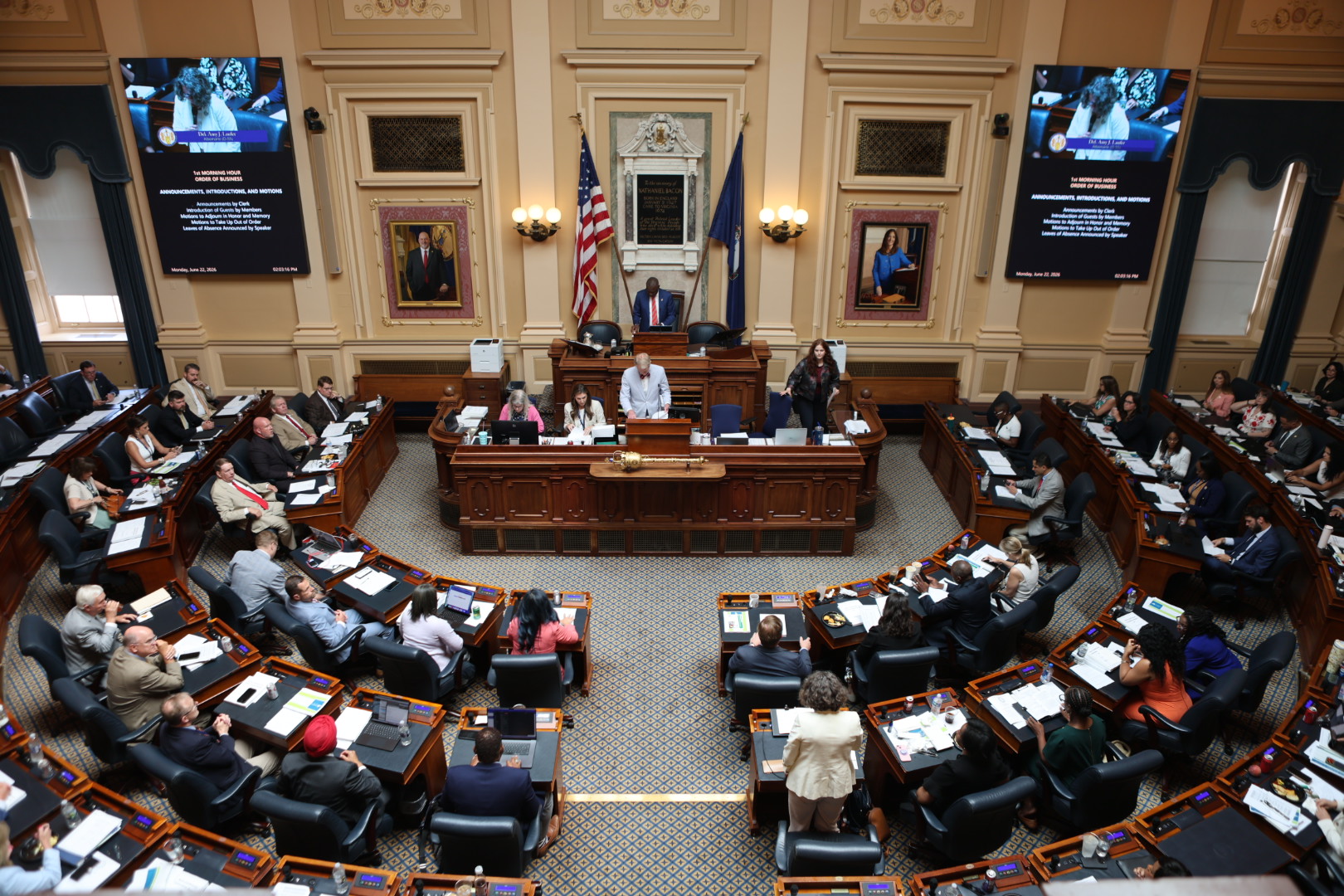
A view from inside the Virginia House of Delegates chamber on June 22, 2026. (Photo by Nathaniel Cline/Virginia Mercury)
Gov. Abigail Spanberger, seen here in Richmond on April 22, has joined a national coalition of governors committed to preserving access to reproductive health medications. (Photo by Charlotte Rene Woods/Virginia Mercury)
From support for legislation and ballot referendums to helping states stockpile abortion and miscarriage management drug mifepristone, a growing cohort of governors are banding together as the Reproductive Freedom Alliance. Virginia Gov. Abigail Spanberger announced Wednesday that she has joined the coalition.
Members include California Gov. Gavin Newsom, New York Gov. Kathy Hochul, Gov. Wes Moore from Maryland and New Jersey Gov. Mikie Sherrill — who was elected the same night as Spanberger last fall — among 23 others so far.
As part of the alliance, Spanberger said she will “continue doing everything in my power to preserve the rights of Virginians seeking reproductive care and making sure families across our Commonwealth can continue making their own personal healthcare decisions.”
Mifepristone has been subject to legal challenges, with opponents pushing for a national ban on mailing the medication. Several of the states are working to preserve access to the medication and have also enacted shield laws to protect patients’ privacy and expand coverage for over-the-counter contraception.
On the heels of announcing she’d joined the governors’ group, Spanberger signed two new reproductive health bills into law in Lorton Wednesday. Years-long efforts dubbed the Right-To-Contraception Act and Contraception Equity Act will fortify people’s ability to access family planning measures.
Del. Cia Price, D-Newport News, who carried the legislation, has emphasized that contraception is also used to treat conditions like polycystic ovarian syndrome and endometriosis. Price uses contraception to treat her own PCOS symptoms, she said.
After signing the law Wednesday, Spanberger called contraception “vital for being able to contend with an ongoing health issue.”
The coalition announcement and new laws preempt the fourth anniversary of the overturn of federal abortion protections by the U.S. Supreme Court and a ballot referendum in Virginia later this year to enshrine reproductive rights into the state’s constitution.
With abortion drawing the most scrutiny, several states have enacted deep restrictions or bans on the procedure. Virginia, where abortion is legal to varying degrees in all three trimesters of pregnancy, is the least restrictive Southern state.
As such, clinics and abortion funds have noted upticks in out-of-state patients in recent years.
Blue Ridge Abortion Fund director April Greene said that 26% of people seeking assistance from her organization live outside Virginia, a 13% uptick since 2023. More people are relying on abortion funds for financial assistance, as rising fuel prices affect travel.
“What this tells us is that abortion bans, anywhere, impact access everywhere,” Greene said.
Spanberger, reproductive rights advocates, state lawmakers and congressional candidates will continue advocating for the constitutional amendment leading up to this fall’s election.
Despite some Republican-leaning states having already pursued similar measures, the amendment has fallen along partisan lines in Virginia. Every elected Republican in the state legislature has voted against the amendment, which had to clear the legislature two years in a row before it could appear on statewide ballots.
“Once it becomes enshrined in our constitution it becomes harder to fight,” said Family Foundation president Victoria Cobb at the Virginia March For Life this past spring.
In Virginia's 2nd Congressional District, four Democrats are vying for the chance to unseat Republican incumbent Jennifer Kiggans. The Virginia Democratic primary is Aug. 4. (Photo by Ross Williams/Georgia Recorder)
This summer, four Democratic candidates will face off in a primary for the chance to oust incumbent Republican representative Jen Kiggans in Virginia’s 2nd Congressional District.
The Virginia Beach-anchored district is politically purple and often oscillates between partisan control, though in past years it had a decidedly Republican lean.
Its nearly 600,000 residents backed Gov. Abigail Spanberger last year by 53% and analysts consider it flippable — making it a key contest that could help determine partisan control of Congress.
All four Democratic primary candidates — which include the district’s former representative Elaine Luria, acute care doctor Nila Devanath, former USAID worker Patrick Mosolf and regional government official Bill Fleming — seek to hold Kiggans “accountable” and help congress provide a check and balance to the “corruption” of President Donald Trump.
Who’s who
Kiggans, a Navy veteran and nurse practitioner, has represented the district for two terms after ousting Luria, who also represented it for two terms. With no primary challenger, she did not do an interview for this story, but she did respond to questions by email.
With Navy veteran Luria formerly representing the district, she already has backing from the Democratic Congressional Campaign Committeealong with Democratic leadership in Virginia including Gov. Abigail Spanberger and Sen. Louise Lucas, D-Portsmouth.
During her time in Congress Luria backed the creation of the Affordable Care Act’s Enhanced Premium Tax Credits — which have since expired but helped reach more people struggling to afford healthcare. She also backed the 2022 Inflation Reduction Act, a range of energy efficiency and healthcare affordability measures.
Devanath,the daughter of Bangladesh immigrants, is an acute care doctor but previously worked as a lawyer at a legal clinic defending domestic violence survivors.
If elected, she plans to bring her legal and medical insights to Congress. She has already made trips to D.C. to meet with members of finance committees, she said, to prepare for how she can help address economic issues if she earns a seat on Capitol Hill.
Virginia Beach Soil and Water Conservation District director Bill Fleming hopes to join the U.S. House Committee on Agriculture if elected so that he can help advance environmental laws. He shares many progressive policy priorities with some of his primary opponents but considers himself an “independent democrat.”
From serving as director of a homeless shelter to time spent working for USAID, Mosolf said his time spent solving problems has helped him prepare to take that work to the nation’s legislative body. He was motivated to run and find new routes to solve problems after losing his job to Trump’s closure of USAID.
Addressing the cost of living
The rising cost of living, from groceries to housing to healthcare, is a motivating factor for Kiggans and all four Democratic candidates.
Luria said Kiggans expressed interest in bipartisan collaboration after ousting Luria from the seat in 2022, a stance she said was in contrast with Kiggans’ votes in favor of Trump policies.
Ahead of the passage of the One Big Beautiful Bill Act last summer, Kiggans joined an open letter in opposition to aspects of the bill she ultimately voted for.
Kiggans was previously outspoken about the need to renew expiring ACA tax credits, Luria said, even writing a letter in support of extending the credits, but ultimately changed her tune.
“Writing a letter that is in opposition to something you’re voting for — it just doesn’t work that way,” Luria said.
In an email, Kiggans said her initial support of renewing the credits was conditional on “meaningful reforms” to strengthen protections against “waste fraud and abuse.”
All Democratic challengers said addressing affordability issues will be a priority for them, if elected.
“I think it’s going to take a lot of small things. It’s not just pushing a magic button,” Mosolf said.
All the Democratic contenders said they would work to extend the ACA subsidies and undo the healthcare provisions of the reconciliation bill.
They are supportive of a massive bipartisan housing bill that is nearing Trump’s desk and could see his signature; if it doesn’t, though, they said they will try again.
On healthcare, Devanath and Fleming are backing a growing Democratic embrace of universal healthcare. The idea is to replace private insurance companies with government-run insurance available to everyone.
Because uninsured and underinsured people are more likely to put off primary care, Devanath said she’s increasingly treating people in critical condition or for whom more drastic measures could have been prevented.
“You have to have people who are willing to be bold,” Devanath said. “Instead of following incremental change, let’s go for the gold. Put it out there, stick to it, and see where we land.”
Devanath and Fleming also support the Working Americans’ Tax Cut Act, which would create a tiered surtax on income over a million dollars.
“It’s one thing to sit and grumble about something while you’re watching television, but it’s better to try to get a seat at the table, so that you can maybe affect change,” Fleming said.
Stock trading crackdown, campaign finance reform
Luria said Congress should hold itself accountable by banning stock trading of elected officials, pointing to what she called a “long list” of ways Trump has capitalized on his presidency to financially benefit his family or allies.
As a congresswoman, Gov. Abigail Spanberger championed an effort to prevent lawmakers from capitalizing on sensitive information and disproportionately benefitting from their positions of power.
Luria was not always on board with the proposal, calling it “bullsh-t,” but her stance has evolved into support.
“Congress can set the example and actually walk the walk,” she said.
All of the Democratic contenders want to address how candidates receive donations for their campaigns by reigning in large political action committees’ donations along with “dark money” contributions, large entities’ donations that are not publicly disclosed.
Luria’s Democratic challengers have taken issue with her updated stance on campaign finance. In 2018, she’d signed a pledge to not take corporate money before accepting $34,000 from corporate PACs in 2020.
Luria’s donors have included the Democratic Majority for Israel PAC and some of her donors have also contributed to American Israel Public Affairs Committee. After a United Nations committee concluded that Israel is committing genocide in Gaza, Luria’s challengers said it would be unethical for them to take money from groups that support Israel. (Israeli officials have denounced the report as “distorted and false,” according to NPR.)
While AIPAC has historically supported both parties so long as candidates are “pro-Israel,” the group’s supporthas emerged as a rift among some Democratic candidates in recent election cycles.
Kiggans, who has also been boosted by AIPAC, has supported U.S. involvement in Israel’s affairs. In 2024 she voted for military aid to Israel in a package of bills she said were “not perfect,” but needed at the time.
The conflict, initiated by America, has contributed to spiking gas prices because Iran is a critical global player in oil trades.
“When the Iran conflict is over, gas prices will come down and we’ll work to get them even lower with American energy dominance,” Kiggans said.
While Democrats have lambasted Kiggans for voting for the Big Beautiful Bill, she emphasized that the measure also “cut taxes on social security, tips and overtime” to “put more money in the pockets of Virginians.”
The two-term congresswoman has bucked Trump’s administration over a new rule that will exclude post-baccalaureate nursing degrees from a “professional degrees” list, joining a bipartisan letter in opposition.
Kiggans was also critical of the Trump administration’s efforts to stop construction of Dominion Energy’s offshore wind project, which is located in her district.
Still, her Democratic opponents said she has too often aligned with GOP majorities and the president, including her endorsement of federal workforce trimming despite the 2nd district having among the largest concentration of federal workers in the state.
“The bottom line is she has put Trump over the people of Hampton Roads,” Luria said. “People will hold her accountable at the ballot box in November.”
The Democratic hopefuls will face off for the chance to defeat Kiggans in the Democratic state primary election on Aug. 4.
Editor’s note: This story has been corrected to reflect that Luria has not received donations from AIPAC, as previously stated, but some of her donors have contributed to the organization.
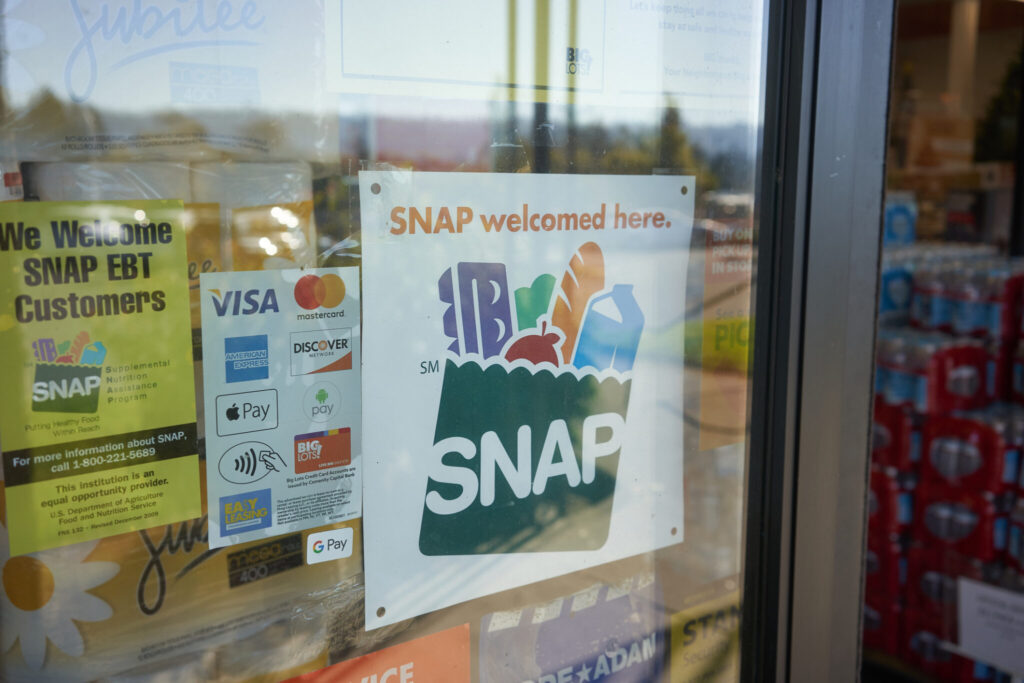
A SNAP sign in a storefront. (Photo by Getty Images)
Virginia Attorney General Jay Jones announced Thursday that a federal judge issued a preliminary injunction on June 5 amid a multi-state lawsuit challenging “vague, extraneous and unreasoned conditions” to how the U.S Department of Agriculture issues funding to states.
“As Virginians face a growing cost crisis, President Trump is politicizing funding for critical USDA programs that help feed vulnerable children, hardworking families, senior citizens and rural communities,” Jones said in a statement, noting that nearly one million Virginians are facing hunger and rely on programs like SNAP and WIC, which are funded by the USDA.
As part of its 2026 conditions, states receiving USDA grants must certify that they don’t operate “any programs that advance or promote Diversity, Equity and Inclusion,” do not “promote gender ideology” and that they do not permit funding disbursement to undocumented immigrants.
Countering this, Virginia, 20 other states and the District of Columbia sued in March, stating they believe the impositions for compliance are unclear and unconstitutional.
The injunction means that these conditions will not apply as the lawsuit continues to advance.
Federal lawyers said in court filings that the new requirements would “help promote the sound stewardship of taxpayer dollars, strengthen USDA’s control and oversight of obligated funds, and ensure that grant recipients comply with federal laws, regulations and policies.”
About 850,000 Virginians (and millions of people nationwide) use SNAP to help them purchase their groceries.
USDA is also the federal umbrella agency for other social services like the Special Supplemental Nutrition Program for Women, Infants and Children, the Emergency Food Assistance Program, and the Volunteer Fire Capacity Program.
With one in eight Virginians facing hunger, Jones’ office called the USDA conditions “unconstitutional,” and Jones pledged to “keep fighting for these crucial resources and the people who depend on them.”
“I Voted” stickers are displayed at a Richmond polling place during the 2022 midterm elections. (Photo by Graham Moomaw/Virginia Mercury)
After a grueling redistricting battle that spanned months and cost millions, the congressional district lines Virginia adopted in 2021 remain in place as Democratic contenders line up to challenge longtime Republican incumbent Robb Wittman in this fall’s race to represent the state’s 1st Congressional District.
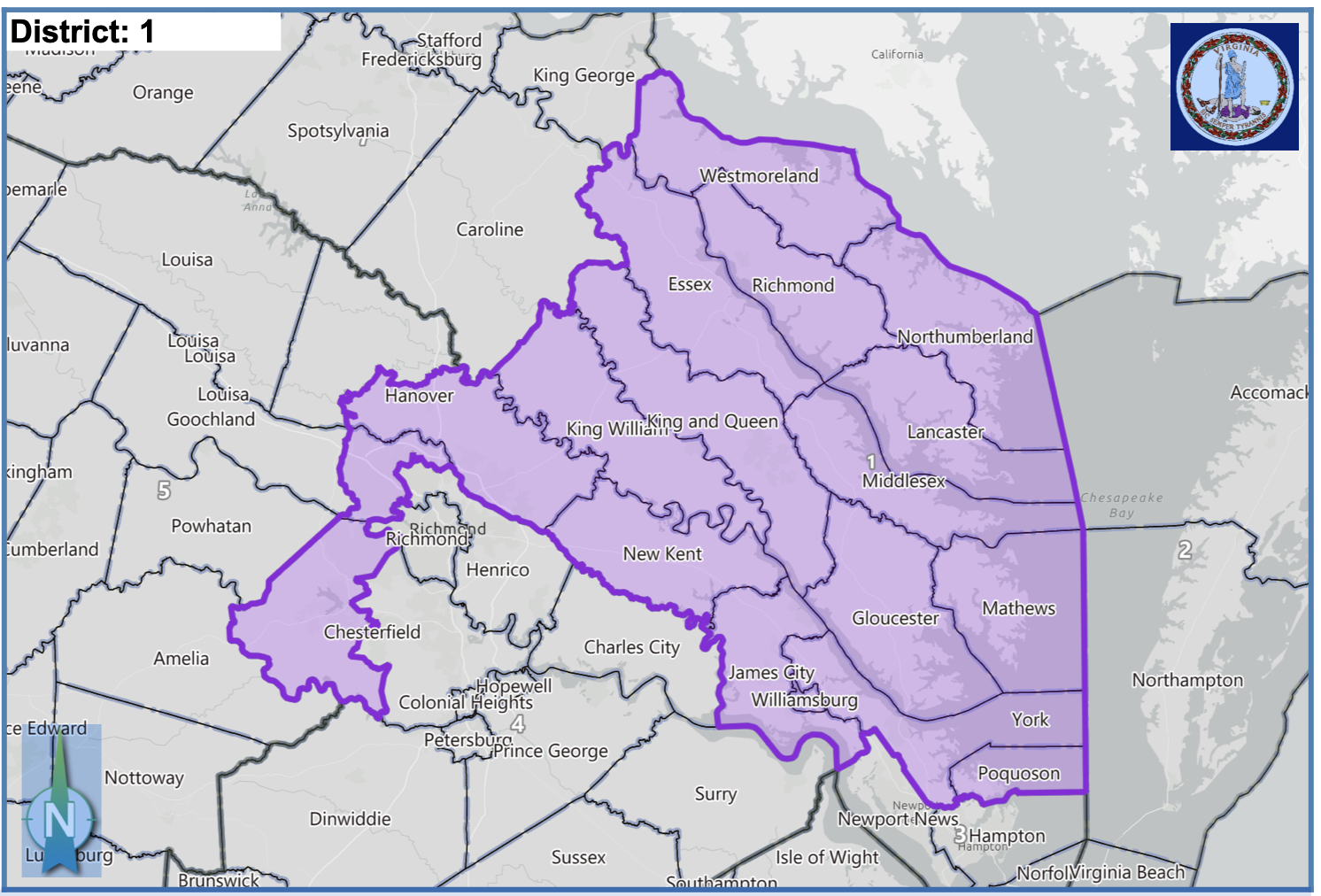
The 1st District stretches from Colonial Beach down the eastern coast of the state to Williamsburg, and hooks over the north side of Henrico County into part of Chesterfield.
Over 615,000 registered voters live in the 1st District, with the largest portions of the population in Henrico, Chesterfield, Hanover, and James City counties. The majority of voters there are white, but U.S. Census Bureau data shows diverse demographics: nearly 13% of voters are Black, almost 7% identify as multiracial and 6% are Asian. About 6% of voters are Hispanic or Latino.
Voters in the area have historically favored Republicans, with 51.6% choosing Donald Trump in the 2024 presidential election and 57.8% voting for Glenn Youngkin in 2021, helping send the GOP newcomer to the governor’s mansion.
That tide shifted in 2025, when Abigail Spanberger was elected governor with a margin of 51% in the district. Spanberger’s victory supercharged scrutiny from up-ballot Democrats, who saw it as a sign the district could be flipped in the 2026 midterm elections.
Virginia Congressional District 1 (Photo courtesy Supreme Court of Virginia)
Wittman to defend seat of nearly two decades
U.S. Rep. Rob Wittman, R-Westmoreland, has represented the 1st District in Congress since 2007. Before taking office, he served in the Virginia Department of Health’s Division of Shellfish Sanitation for 26 years, which has shaped his policies and tenure on the House Natural Resources Committee.
Wittman was one of just a handful of House Republicans nationwide to join Democrats in voting to extend the Enhanced Premium Tax Credits through the Affordable Care Act for three years. The measure ultimately failed.
Wittman has consistently supported H.R. 1, the One Big Beautiful Bill, which excluded the credits when passed last summer, critics have highlighted. The congressman also faced blowback from constituents last year who said he avoided in-person town halls amid sweeping federal budget cuts and layoffs.
Promising to guard against “reckless government spending” on his website, Wittman also supports enhanced border security – including the construction of a wall bordering Mexico to staunch illegal immigration.
Wittman did not respond to requests for comment on his campaign and has not completed The Virginia Mercury’s candidate questionnaire, sent to all contenders on June 1.
Seven Democrats vie to take on Wittman
Shannon Taylor, the frontrunner in the race to flip the 1st District to blue, is an experienced prosecutor and has spent the last 13 years as the Henrico Commonwealth’s Attorney. She was the first woman to hold the position and the first Democrat to be elected to the seat in 40 years.
Her courtroom experience undergirds one of her key campaign priorities: managing political corruption. She also advocates for congressional stock trading to be made illegal.
Taylor is also committed to protecting healthcare access in the wake of the sweeping changes from H.B. 1, she said.
“More than 44,000 Virginians have lost their ACA coverage, and rural hospitals like Rappahannock General are at risk of closure,” Taylor said. “I’ll fight to lower health care costs by extending the ACA tax credits, expand Medicare’s ability to negotiate drug prices, and protect Medicaid.”
She previously ran for the office of the Attorney General but lost the primary to Jay Jones, who was elected to the seat last fall. Taylor’s campaign has raised $1,300,040, as of the latest campaign finance reporting.
Political newcomer and lawyer Salaam Bhatti’s priorities center on expanding Medicare access, increasing taxes for the highest earners and reforming political candidates’ campaign finance process.
The former Virginia Poverty Law Center attorney is a child of immigrants who relied on programs like WIC and free school meals while growing up. Bhatti focused his VPLC work on expanding SNAP access and at the Food Research and Action Center, worked against a farm bill addition that would have made major cuts to SNAP.
Wittman has had more than enough time to better address issues of poverty and healthcare access in the district, Bhatti said.
“Rob Wittman has been in office for nearly 20 years and in that time our neighbors have gotten poorer, healthcare has become more expensive, corporate donors have gotten more access, and Rob has become a multimillionaire through stock trades,” he said.
Bhatti has raised $184,834 as of March 31 reporting.
Tim Cywinski, another Democratic challenger, is not new to the political sphere. He spent years as a community advocate and has worked on the political side as an intern for the Obama campaign when he was 17.
Cywinski’s brother was born with a heart defect, and the cost of his care contributed to his family’s skyrocketing medical debt and eventual loss of their home. That experience, Cywinski said, gave him personal experience with the challenges of America’s healthcare system and fuels his interest in addressing it via federal legislation.
Wittman represents what Cywinski characterized as the political establishment, which doesn’t provide solutions for constituents’ healthcare needs, tax burdens and other priorities. His campaign is about finding ways to take big money out of politics, he said.
“My main platform is what I call the fair shot agenda because unless you’re already powerful or unless you’re really wealthy and well connected, no one feels like they have a fair shot in this country and our politics upholds that reality,” Cywinski said.
As of March 31, Cywinski has raised just over $8,113, the smallest campaign coffer of any candidate in the race. He lives in the greater Richmond area.
Jason Knapp has served his country for 21 years as a naval officer and said his military background shapes his policy goals.
A former defense fellow assigned to the Armed Services Committee and deputy director of legislative affairs for the U.S. European Command, Knapp has taken aim at the cost Virginians and Americans are paying for the Iran war, a conflict Wittman has supported.
“Food, fuel, energy, housing, and medical costs are skyrocketing and people are literally choosing between buying food, buying medicine, or paying bills — and the man who represents this district is at worst complicit in these hardships, and at best, apathetic to the real problems people are facing,” Knapp said.
Universal healthcare is another top priority for Knapp, who aims to counter the privatization of the Veterans Administration, which he said creates barriers for servicemembers to access essential care.
Ericka Kopp, a healthcare attorney and a caregiver to her husband who is a disabled veteran, said Wittman’s support of the congressional bill that stripped funding for Medicaid compelled her to run to replace him.
Kopp earned her law degree from the University of Richmond and clerked for a Virginia circuit court judge. She said she never considered running for office until her frustrations with Wittman bubbled to the surface because he did not attend several town hall meetings in her district in 2025.
“He’s not accessible to the people, let alone accountable to us. In April of last year, I started thinking that anyone could do a better job, even me. And then I thought, ‘Why not me?’” Kopp said.
Her campaign priorities include expanding Medicaid and healthcare access. She has raised $13,867 so far.
Business lawyer and small law firm owner, Mel Tull believes he can help bridge the partisan divide in Congress and said his experience successfully navigating competing interests can earn the trust of other lawmakers and the people they represent.
Like several other Democratic contenders, Tull said Wittman’s 18 years in Congress is too long a time to serve without better addressing issues like healthcare, affordability, and government functionality.
“My job has been to evaluate competing interests, understand risks and consequences, and help people make sound decisions. I’ve spent my career bringing people together to solve difficult problems, not score political points,” Tull said.
Tull served in the Army before branching into business law. His campaign has raised $179,991, to date.
Elizabeth Dempsey Beggs, the final Democratic contender in the contest, was one of the first women to serve as a tank commander in a combat role in the U.S. Army. The veteran now works in the package and manufacturing industry.
She said concerns about affordability and government transparency drove her to enter the race. Her campaign priorities also include protecting the right to vote and reproductive healthcare access.
“As a mother, foster parent, and business leader, I’ve seen firsthand how decisions made in Washington affect families every single day,” Beggs said. “Whether it’s the cost of childcare, access to healthcare, housing affordability, or the lack of accountability in government, people are working harder than ever and feeling like they have less and less to show for it.”
Public office should be a service and not a long-standing career, Beggs added, pointing out Wittman’s tenure in the seat. So far, she has raised $64,494.
Early voting for the primary election for the first congressional district begins on June 18. Election day is Aug. 4.
An MRI machine in Lee County Community Hospital in Southwest Virginia, a once-shuttered facility that Ballad Health reopened in 2021. (Photo by Charlotte Rene Woods/Virginia Mercury)
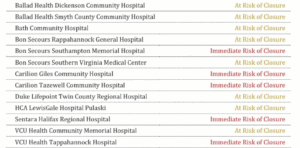
A new report by Virginia’s Joint Commission on Health Care found 13 of Virginia’s 36 rural hospitals are at distant or immediate risk of closure, as state lawmakers and their constituents work to close healthcare access gaps in the commonwealth’s farthest-flung regions.
The commission based its analysis on patients’ socioeconomic demographics and insurance types as well as hospitals’ financial information to determine risk levels for closure.
King William resident Celeste Garrett’s go-to facility, VCU Health Tappahannock Hospital, is on the list. It takes her about 20 minutes to get there and she worries about an emergency if it were to close. That would make VCU’s Richmond location her closest resource, an hour or more away “depending on the traffic.”
“Minutes matter. Seconds matter,” Franklin County resident Penny Blue said as she joined Garrett on a press call with the state’s health committee chairs Tuesday.
After a brain aneurysm in 2021, Blue was taken 15 minutes to her nearest hospital and then air-lifted to another one in Roanoke (which otherwise would have been an hour commute).
With rural hospitals already shoring up access in Southwest and South Side Virginia, the women expressed concern about themselves and their neighbors.
Some hospitals’ struggles can be traced back years and include demographics and economic regional shifts. But, the current strains are attributed to recent Medicare and Medicaid reimbursement rate cuts, a reconciliation bill Congress passed last summer that makes thousands of Virginians vulnerable to losing health insurance, and Congress’ failure to renew expired Affordable Care Act credits.
Screenshot from a June 2026 Virginia Joint Commission on Health Care presentation.
“(Rural hospitals) have always been living on the edge, but with H.R. 1 kicking in our hospitals across Virginia will lose about $2 billion dollars a year,” said Sen. Barbara Favola, D-Arlington, who chairs the Senate’s Education and Health Committee.
Uninsured people are more likely to delay care until dire situations, so hospital ERs are bracing for surges of patients. Free clinics, long considered public health safety nets, are also preparing for people to rely on them more.
“We have yet to feel the pain (of the bill) but it’s coming,” King William resident Garrett said on Tuesday’s call.
After absorbing unpaid or under-paid care from uninsured patients, health systems will eventually negotiate insurance rates with private insurers. This may lead to higher premiums for people with private insurance down the line, health systems have warned.
Sentara chief administrative operator Aubrey Layne said in a recent phone call that the hospital chain has become “more purposeful lately about getting the public to understand” the challenges.
That chain has facilities around the state, with its Sentara Halifax Regional Hospital on the new at-risk list.
Still, Virginia Hospital and Healthcare Association spokesman Julian Walker said hospitals will continue to adapt rather than close overnight or forever.
“We will see what other measures might have to be taken to continue to sustain hospitals longterm,” he said.
Those efforts are already playing out in some cases. Citing Congress’ bill as a contributing factor, Valley Health changed staffing contracts and trimmed services this spring. Last winter, Centra closed its labor and delivery unit at a hospital in Farmville. Last fall, Shenandoah Valley’s Augusta Health closed three clinics.
House Health and Human Services chair Del. Rodney Willett, D-Henrico, emphasized that the federal government placed heavy burdens on state and local governments, calling it a “situation no one wants to be in.”
The state’s pending budget has proposals to help the state comply with additional requirements for Medicaid and Supplemental Nutrition Assistance Program verifications and could support a state-level ACA subsidy to plug some holes.
Favola and Willett said the efforts cannot fully heal what federal actions have created but are a reflection of bipartisan assistance.
As both lawmakers have served on bipartisan health-focused committees and commissions, Willett said Congressional Republicans should be held accountable for pushing through the reconciliation bill but that going forward, both parties will have to work together to create lasting solutions.
“This report is a nonpartisan report done by the joint commission, we all sit on that — Republicans and Democrats,” Willett said. “The facts are the facts and what’s being done to us by Washington is unconscionable.”