Tag: exclusive

  • Another year, another Va. retail cannabis market veto leaves businesses, the public with few options

    Another year, another Va. retail cannabis market veto leaves businesses, the public with few options

    By Yiqing Wang and Toby Cox/WHRO

    Throughout her bid for governor, Gov. Abigail Spanberger said she would support a bill to set up a legal, adult-use cannabis market — which is why her veto on May 19 caught many rooting for such a market by surprise.

    “I thought it was a joke, honestly,” said Julian Redcross, a Hampton-based hemp grower. “When I saw it going around on fire on social media, I was like, ‘Oh, this is not real. This is AI.’”

    Spanberger said her decision was based on the need for stronger tools to enforce the law and regulate a legal cannabis market.

    Spanberger vetoes cannabis bill, stalling legal sales again

    “Virginians deserve a system that replaces the illicit cannabis market with one that prioritizes our children’s health and safety, public safety, product integrity, and accountability,” she wrote in her veto statement.

    The veto left Virginia cannabis businesses facing another year in limbo after many spent years preparing for a legal market following the 2021 legalization of personal possession. Now, some hemp growers are having to make tough calls about the future of their businesses.

    It also left the state’s safety questions unresolved: Regulators say they cannot finalize licensing, monitoring or inspection rules without a law in place, while health experts warn consumers are likely to keep buying products that are hard to test, label and trace.

    The bill Virginia lawmakers sent to the governor’s desk this year would have allowed adults 21 and older to buy marijuana starting in January 2027. The legislation proposed capping the number of licenses to a few hundred to limit the number of retail cannabis stores. It included policies for labeling and testing, said Jason Blanchette, president of the Virginia Cannabis Association and a hemp grower in Hampton Roads.

    Spanberger sent back changes that pushed the starting sale date to July 2027, capped the number of stores at 200, reduced the personal possession limit to two ounces and recommended new criminal penalties, VPM reported.

    The new penalties, especially, gave lawmakers and lobbyists pause.

    “The way that she wrote those back in, we are now recriminalizing a product that we have already made legal in the state of Virginia, so to a lot of those groups it appears that we are moving backwards when it comes to justice,” Blanchette said.

    A sliver of hope remains that a compromise could still be reached when lawmakers meet later this month to talk about the state budget, Blanchette said, but it’s a long-shot.

    “We’ll be lucky to be up and running by 2028,” he said.

    That will be too late for some businesses.

    ‘Up in smoke’


    Brad Wynne started growing hemp in Virginia Beach in 2023 for his company Veg Out Organics, which sells topical CBD products.

    He stopped growing hemp in 2024, biding his time for the state to get the ball rolling on a retail cannabis market. But he said he can’t afford to wait any longer.

    “I’m shutting down end of June,” Wynne said.

    He said his operation was as small as they come, but he spent years building it.

    “If you were to start from scratch with no land, no building, no nothing, each business, whether it’s retail, growing or dispensing, is about $500,000 to $1 million,” he said.

    Va. hemp growers worry about the future of their industry amid state and federal shifts

    The high startup cost makes sure the business can stay afloat while the plant is growing, which takes roughly six months.

    “This is a living plant, so this is not something you just buy from out of state, throw onto a shelf of a dispensary overnight, and you’re open the next morning,” Blanchette said.

    Wynne said he wished Spanberger sent her changes as line items lawmakers could have addressed individually, rather than as a substitute that had to be accepted or rejected as a whole.

    Blanchette said he disagreed with Spanberger’s assessment that the legislation was rushed.

    “I’ve been personally working on this for five years, so I know that we’ve put plenty of time and effort into this, and it has not been rushed,” he said.

    Julian Redcross said he was angry at Spanberger’s decision at first. But the anger soon gave way to acceptance and hope that a better bill will be proposed in the future.

    He and his twin brother Jonathan Redcross co-own Yoagie Enterprises and started growing hemp in 2019, while keeping their day jobs. They stopped growing operations this year when new hemp regulations strained their business. Julian said they plan to keep waiting.

    “We just have an empty space right now that’s costing money, but we didn’t jump over the edge just yet,” he said.

    Julian and Jonathan said they hope when the state eventually sets up a retail market, it gives small businesses like theirs a fighting chance. As for Spanberger, Julian said doesn’t take this year’s veto as her backtracking on her support of the legal market — yet.

    “She said she would pass it,” he said. “She didn’t say when.”

    A regulatory dilemma


    One of Spanberberger’s reasons for vetoing the bill was the need for stronger regulations.

    “That includes clear enforcement authority and sufficient resources for compliance, testing, and inspections, and robust tools to crack down on bad actors who continue to profit from the illicit market,” she wrote in her veto statement.

    But the illicit market will continue to reign supreme with no competition from a legal market, said Wynne, the Virginia Beach grower.

    Some businesses and public health experts say the commonwealth needs stronger safety rules before opening a retail cannabis market, but in practice, regulators are limited in how much they can prepare before lawmakers pass a final bill.

    Barbara Biddle, a hemp business owner from Northern Virginia and the founder of the Cannabis Small Business Association, said she supports legalization, but did not think the vetoed bill was the right vehicle to create the market.

    “It was a necessary action that needed to happen,” Biddle said. “But we don’t think that this was the right vehicle for it.”

    Biddle said Virginia needs clearer rules for testing, labeling and industry compliance, as well as more training for police and first responders before retail sales begin.

    Jamie Patten, chief administrative officer at the Virginia Cannabis Control Authority, has previously told WHRO that the authority is ready to implement additional regulation and resources if lawmakers approve a retail market.

    Those measures will include specific rules for licensing, monitoring and data collection in an adult-use retail market.

    But without finalized legislation, she said, the agency can’t settle the details of how that market would be monitored.

    In the interim, Patten said the authority has been focused on public education, including warnings about impaired driving, after a survey found nearly a third of Virginia drivers believe cannabis makes them safer behind the wheel.

    Michelle Peace, a forensic science professor at Virginia Commonwealth University who specializes in cannabis testing, said without a regulated retail market, consumers have fewer ways to know whether cannabis products are accurately labeled, properly tested or made under consistent safety standards.

    She’s repeatedly found products with THC levels that did not match their labels.

    “My laboratory has demonstrated over and over again that products are either more concentrated than what’s on the label or significantly less concentrated than what’s on the label,” Peace said.

    The risk will also be hard to track because consumers may not know where to report adverse reactions from unregulated products, Peace said.
  • States face tight timeline as feds unveil new Medicaid work requirement rules

    States face tight timeline as feds unveil new Medicaid work requirement rules

    The federal government released new guidance this week on how states should roll out the Medicaid work requirements that will affect healthcare coverage for millions of Americans.

    The new interim rule, issued by the federal Centers for Medicare & Medicaid Services, is intended to give states more details on how they’re supposed to verify the work status for about 20 million adults enrolled in Medicaid, the publicly funded health insurance program for people with low incomes.

    The new details come as states are staring down the January 1, 2027, deadline to put the new work requirements in place, and have requested more clarity from the feds on how they’re supposed to implement them.

    “States are being asked to carry out a complicated federal mandate without clear rules, without enough time, and with the risk that eligible people lose health care because of paperwork problems and system failures,” Oregon Democratic Gov. Tina Kotek said last week in a statement.

    Kotek led a six-state coalition of Democratic governors in asking the Trump administration last week to slow the rollout of the new work requirements, calling the timeline unworkable.

    Congress built the new work requirements into last year’s so-called One Big Beautiful Bill Act. Under the measure, states that have expanded Medicaid eligibility to more adults under the Affordable Care Act — 40 states plus the District of Columbia and another two that have partially expanded — will have to require those adults to prove they’re working, going to school or serving their communities for at least 80 hours a month to receive Medicaid.

    The rules released this week are intended to clarify key parts of the new law, including exemptions for people who are considered “medically frail,” how to reach out to Medicaid beneficiaries, and methods for verifying Medicaid eligibility.

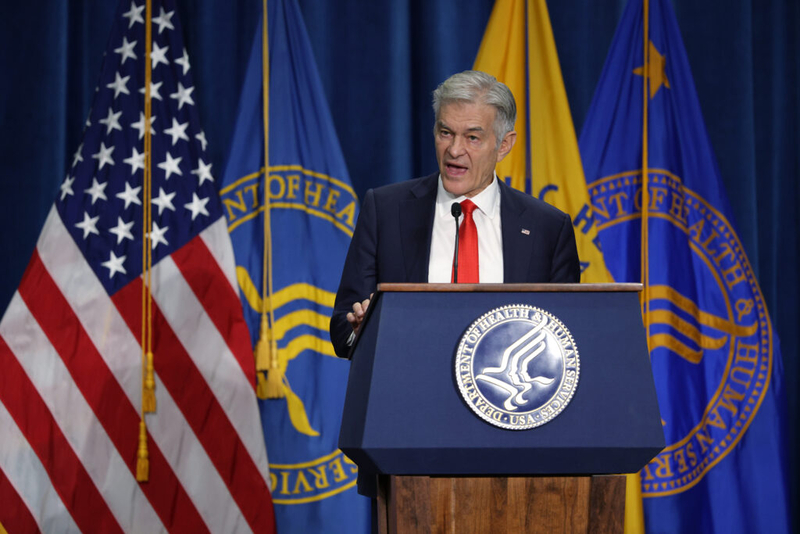
    “This rule helps Americans build skills and independence through work, education, job training, or community service, creating new opportunities for themselves and their families,” said Dr. Mehmet Oz, director for the Centers for Medicare & Medicaid Services, in a statement announcing the new guidance.

    But critics of work requirements point to evidence that it kicks people off Medicaid who are otherwise entitled to it without meaningfully increasing the share of adults who are working.

    For example, Arkansas tried instituting work requirements for Medicaid recipients during Trump’s first term in 2018. By the time a federal judge halted the policy less than a year later, 18,000 adults had already lost coverage and reported problems paying off medical debt, delaying healthcare and delaying medications due to cost. Studies later found that Arkansas’ work requirements didn’t increase employment. And data shows that most adults on Medicaid under age 65 are already working.

    Supporters say the new requirements are flexible. They say the feds have created a broad category of “medically frail” people who are exempt from the work requirements, and they’re permitting states to allow people to self-attest that they’re exempt one time before documentation is required.

    The new work requirements will apply to about 20 million people who are eligible for Medicaid through expansion, according to estimates from health research organization KFF. These expansion enrollees make up about 30% of all Medicaid enrollees.

    A recent analysis from the Urban Institute projects that 3-7 million people could lose coverage because of the new work requirements.

    Stateline reporter Anna Claire Vollers can be reached at [email protected].

    This story was originally produced by Stateline, which is part of States Newsroom, a nonprofit news network which includes Virginia Mercury, and is supported by grants and a coalition of donors as a 501c(3) public charity.

  • Congress weighs cuts to states’ already ‘insufficient’ election security dollars

    Congress weighs cuts to states’ already ‘insufficient’ election security dollars

    Ahead of the November midterm elections, President Donald Trump and his Republican allies have demanded Congress pass sweeping voting restrictions, including showing proof of citizenship to register — all in the name of election security.

    At the same time, the only federal agency dedicated solely to helping states and localities run smooth and secure elections operates on a meager budget. It provides grants for election security far smaller than in the past. And U.S. House Republicans have signaled they want sizable further cuts.

    The agency, the U.S. Election Assistance Commission, sits at the center of a fight playing out in Congress over how to best ensure secure elections. The debate has thrown into sharp relief a yawning gap between GOP rhetoric over election tampering and actual congressional support for election security efforts.

    “If my colleagues truly cared about protecting our elections from foreign interference, they’d put the resources behind it,” Rep. Sanford Bishop, a Georgia Democrat, said at a House Appropriations Committee meeting this spring. “Instead, we get empty rhetoric, zero urgency, while putting the right of citizens to vote at risk.”

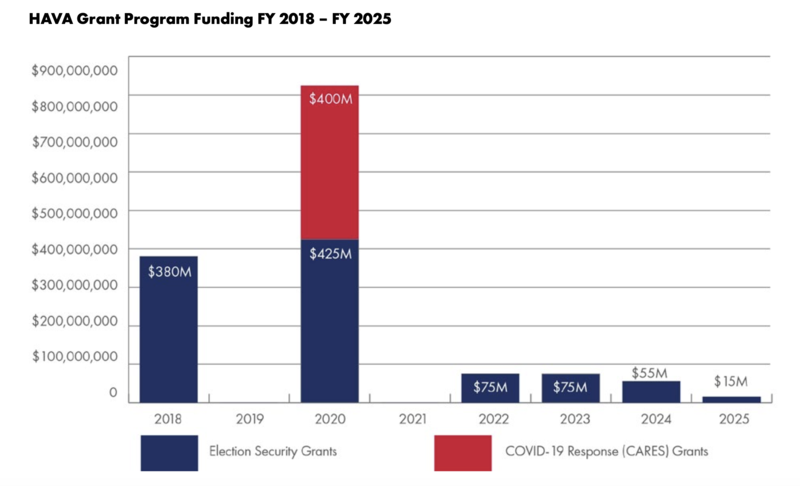
    Congressional support of the EAC’s election security grant program has fluctuated over time, but has generally trended downward.

    Graph

    Congress has approved election security grant funding at much lower levels than the program’s early years. (Credit: U.S. Election Assistance Commission 2025 Annual Report)

    Lawmakers approved $380 million in 2018 and $425 million in 2020, along with an additional $400 million in election-related pandemic aid that year.

    Since then, grant funding has slowed to a trickle. Congress appropriated $75 million in 2022 and again in 2023. That was followed by $55 million in 2024 and $15 million in 2025.

    This year’s amount, $45 million, is an increase from the previous year — consistent with enhanced needs in an election year — but substantially lower than other recent years and a far cry from the program’s early years.

    Trump and many GOP lawmakers support the SAVE America Act, which would impose new restrictions on voting. It would require voters to show a photo ID at the polls, as well as require them to bring documents proving their citizenship, such as a passport or birth certificate, with them when they register to vote.

    The requirements are needed, the bill’s supporters say, to combat noncitizen voting, an extremely rare occurrence.

    “The cheating is rampant in our elections,” Trump asserted without evidence in his 2026 State of the Union address. He has called the SAVE America Act “commonsense, country-saving legislation.”

    The House passed the bill in February but it has floundered in the Senate amid opposition from Democrats and a handful of Republicans. Trump continues to seek new avenues to advance the measure, including urging lawmakers to attach it to housing legislation.

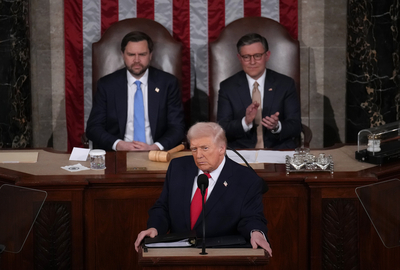
    President Donald Trump delivers his State of the Union address on Feb. 24, 2026, in Washington, DC. Trump delivered his address days after the Supreme Court struck down the administration's tariff strategy and amid a U.S. military buildup in the Persian Gulf threatening Iran. (Photo by Andrew Harnik/Getty Images)

    President Donald Trump delivers his State of the Union address on Feb. 24, 2026. During the address, Trump claimed, without evidence, “cheating is rampant” in U.S. elections. (Photo by Andrew Harnik/Getty Images)

    Cuts to election security agency

    The Trump-led push for voting restrictions has largely ignored concrete election security needs in favor of chasing the phantom specter of noncitizen voting, Democrats and experts on election administration say. The result, they say, has been the possibility of sharp cuts at the EAC.

    The House Appropriations Committee in April approved a bill that would cut the EAC’s salaries and expenses from $23.86 million to $17 million. It would mark the first time in four years the agency’s budget has dropped below $20 million.

    The bill would also sharply cut the EAC’s election security grant program from $45 million to $15 million, the same as the last non-election year.

    Since 2018, the agency has distributed the grants to election officials for technology upgrades, including cybersecurity, physical security improvements at election sites and efforts to combat voter misinformation. Lawmakers created the election security grants in response to foreign interference in the 2016 election.

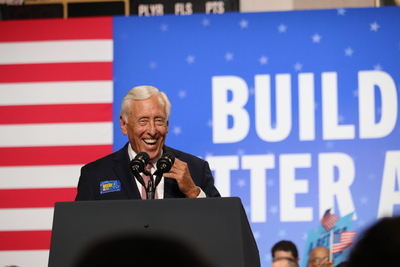
    Hoyer at a rally

    U.S. Rep. Steny Hoyer, a Maryland Democrat, at a Democratic rally in 2022. (Photo by Danielle E. Gaines/Maryland Matters)

    “Republicans claim falsely that our elections are plagued by fraud and that more needs to be done to secure the vote,” Rep. Steny Hoyer, a Maryland Democrat, said in a statement to States Newsroom.

    “Yet, they have consistently undermined the security of our elections, including by proposing to cut election-security grants by two-thirds and the Election Assistance Commission’s (EAC) overall budget by almost 30% in Fiscal Year 2027,” Hoyer said. “This will leave states without critical resources to secure their voting systems and adopt the latest in voting technology and best practices.”

    Hoyer, who helped spearhead the 2002 legislation creating the EAC and is the ranking Democrat on the Appropriations subcommittee that oversees the agency’s budget, said it has been a tremendous benefit to state and local election officials and to the integrity of the vote.

    “I will continue to oppose Republican efforts to cut its funding,” he said.

    Congressional GOP embraces Trump

    The bill represents only one, early step in the appropriations process. The House hasn’t voted on it and the Senate could eliminate or alter the cuts, with any differences eventually worked out in a conference committee.

    The House Appropriations Committee, which is not burdened with the Senate’s need for bipartisan approval of most legislation, in past years has also put forward cuts to election security grant funding that have been abandoned later.

    Still, the measure this year demonstrates how House Republicans have embraced Trump’s focus on noncitizen voting.

    While cutting the EAC and election security funding, the bill includes a provision prohibiting the use of funds to register noncitizens to vote. Noncitizens are already prohibited from voting in federal elections and only a very small number of municipalities allow noncitizens to vote in local contests.

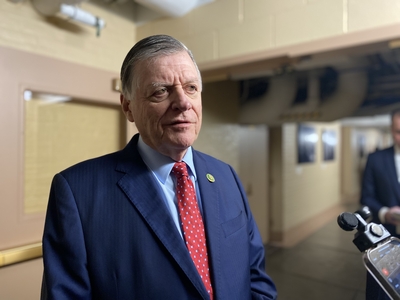
    Oklahoma Republican Rep. Tom Cole speaks with reporters following a closed-door meeting of the House Republican Conference inside the Capitol on Jan. 10, 2024. (Photo by Jennifer Shutt/States Newsroom)

    Oklahoma Republican Rep. Tom Cole speaks with reporters at the U.S. Capitol in January 2024. (Photo by Jennifer Shutt/States Newsroom)

    “The people demanded a new mandate, we’re carrying it forward. That includes reinforcing President Trump’s work to … ensure that only citizens vote in our elections,” Rep. Tom Cole, an Oklahoma Republican and the Appropriations Committee chairman, said at an April meeting.

    A spokesperson for Rep. Dave Joyce, an Ohio Republican who chairs the Appropriations subcommittee that developed the bill, didn’t respond to a request for comment.

    Funding ebb

    Congress created the EAC in the 2002 Help America Vote Act, passed in the wake of the 2000 presidential election and the Florida recount.

    A bipartisan commission leads the agency, which has about 70 employees, according to its 2025 annual report. It focuses on aiding state and local election officials with training and other resources, certifying voting equipment and overseeing grant programs.

    Gideon Cohn-Postar, director of federal affairs at the Institute for Responsive Government, said election officials generally want Congress to provide about $400 million a year, a figure that reflects lawmakers’ initial commitment to the grant program in 2018 and would allow states to make significant strides in bolstering their election infrastructure.

    Each year’s grants are split between states and territories based on a formula. In practice, most receive the minimum amount. The $45 million grant for 2026 translated into $819,000 for most states, with a mandatory 20% match.

    “It’s absolutely insufficient,” Cohn-Postar said.

    State spending

    A December 2024 report from the Bipartisan Policy Center measuring the impact of the grant program found that cybersecurity constituted the single largest category of grant spending, at over $200 million, followed by nearly $150 million on voting equipment.

    Some states save up their grant money over several years to help pay for larger purchases, like voter registration systems, with the money earning interest in the meantime. As of March 2025, states had collectively spent 69% of their grant dollars, according to the latest data available from the EAC.

    Two states — Nevada and Ohio — have spent 100% of their funds. Only Louisiana has spent none, ahead of a future elections system overhaul.

    In Connecticut, election officials have spent 95% of the $13.8 million it has received in election security grants over the years, according to the EAC data. The funds have helped towns conduct security audits, Connecticut Democratic Secretary of State Stephanie Thomas said in an interview.

    As an example, Thomas said when she took office in 2023 not all of the town’s systems were on a government online domain but most have now adopted one.

    “Someting like that, it never gets the headlines but hugely important from a security perspective,” Thomas said.

    Commission warns against cuts

    EAC commissioners have been warning Congress that unstable funding and budget cuts would harm their agency’s work. All three current commissioners and a recent former commissioner testified at a House Administration Committee hearing on election security in May, where they cautioned lawmakers against reduced and unpredictable resources.

    Commissioner Benjamin Hovland, a Democratic appointee of Trump, noted that while Congress has provided “significant” funding since the 2002 law, federal dollars have covered less than 5% of the total cost of running elections during that time.

    Election officials today face challenges that would have been unimaginable when the law was passed, he said, adding that commissioners heard enthusiasm for the EAC’s work in recent meetings with officials.

    “But the agency is nearing a point where funding cuts will impact what we can accomplish, and the support we can provide election officials, especially related to election security,” Hovland said.

    States frequently tell the EAC they want federal funding that is “predictable, consistent, and sufficient” to support long-term planning, said Christy McCormick, a Republican commissioner appointed by President Barack Obama.

    U.S. Election Assistance commissioner prepares for 2024 election with Iowa officials

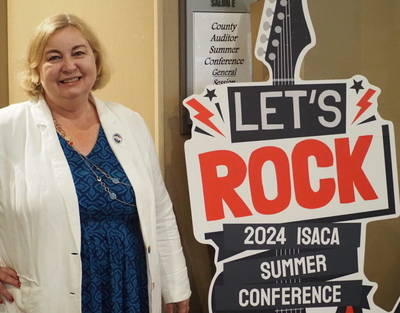
    U.S. Election Assistance Commissioner Christy McCormick spoke at the Iowa State Association of County Auditors summer conference in Des Moines in June 2024 about federal resources available to local election officials. (Photo by Robin Opsahl/Iowa Capital Dispatch)

    The EAC’s adoption of newer, more rigorous standards for election equipment illustrates the importance of funding for state and local election officials.

    In 2021, the EAC adopted the Voluntary Voting System Guidelines 2.0, or VVSG 2.0, replacing the earlier 1.0 guidelines. The technical standards are designed to enhance security, such as requiring air gapped systems, and greater accessibility for voters with disabilities.

    While states are not required to use VVSG-certified machines, many states have followed the EAC’s lead and mandated the use of machines that meet these standards. Upgrading is expensive, however.

    In the meantime, election technology continues to age. By 2028, the average age of modern voting equipment will rise to 9.3 years old, up from just 4.9 years old in 2020, according to a report from the Bipartisan Policy Center released in late May. The report identified “episodic and unpredictable” federal funding as one obstacle to states purchasing VVSG 2.0 equipment.

    “Federal support is absolutely key to making sure that election infrastructure is functioning well at the state and local levels,” Will Adler, a co-author of the report, said in an interview.

    ‘Don’t give me any more money’

    To be sure, some state election officials are skeptical of accepting grant funding. Kansas Republican Secretary of State Scott Schwab told a congressional hearing in April that elections are best run and funded locally.

    He said he previously accepted grant dollars but that state lawmakers then didn’t approve the required matching funds, leaving his office in a bind.

    “I would rather, because of the strings attached, just don’t give me any more money,” Schwab said. “If we need more money, we can handle it locally.”

    But since the House Appropriations Committee advanced cuts to the EAC and the election security grants in April, numerous election officials and voting rights groups have urged lawmakers to reconsider.

    On May 12, the Project for Election Infrastructure sent a letter signed by several dozen local election officials asking senators for $400 million in election security grants, with at least two-thirds directed to localities. The true cost of modernizing and fully securing American election systems will run billions of dollars, the letter warned.

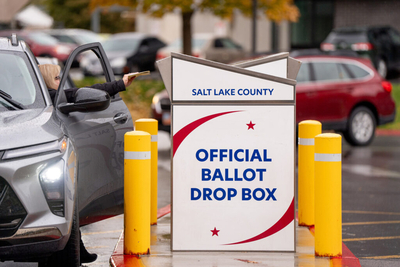
    A voter drops off a ballot in a drop box at the Salt Lake County Government Center in Salt Lake City on Election Day, Tuesday, Nov. 5, 2024. (Photo by Spenser Heaps for Utah News Dispatch)

    Bollards surround a ballot drop box at the Salt Lake County Government Center in Salt Lake City on Election Day, Tuesday, Nov. 5, 2024. (Photo by Spenser Heaps for Utah News Dispatch)

    The National Association of Counties on June 2 asked House and Senate appropriations leaders to not cut funding. The years between presidential elections are when “critical groundwork is laid,” the association’s CEO and executive director, Matt Chase, wrote in a letter.

    Chase ticked through typical security expenses that can quickly add up. Bollards to protect remote drop boxes can cost $500 to $4,000 per bollard. Key card access at election facilities can cost $1,500 to $5,000 per door. Video surveillance cameras can run hundreds to thousands of dollars.

    “Federal investment scaled only to presidential cycles leaves counties without the resources needed to be ready when turnout surges,” Chase wrote.

    Thomas, the Connecticut secretary of state, echoed the sentiment.

    “I feel that many people use the term election security almost like a slogan,” Thomas said. “But election security is actually year-round work.”

  • US Senate panel pans DHS plan to stop customs processing at blue-city airports

    US Senate panel pans DHS plan to stop customs processing at blue-city airports

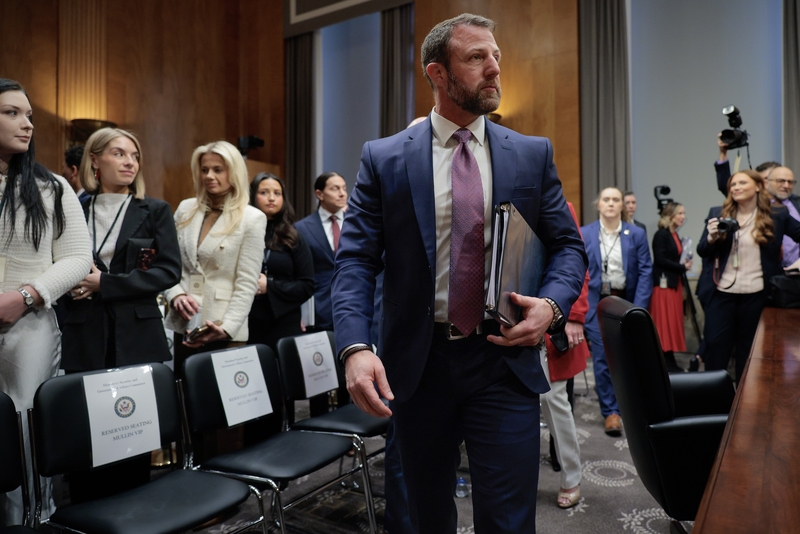
    WASHINGTON — Homeland Security Secretary Markwayne Mullin appeared before the U.S. Senate Appropriations Homeland Security panel Tuesday and defended his threats to cripple international air travel into some cities led by Democrats.

    Democratic senators on the panel also pressed Mullin about aggressive immigration tactics from federal officers; whether the department would follow court orders from federal judges; and his recent televised comments floating plans to pull customs employees from airports in cities that don’t cooperate with federal immigration enforcement.

    Republicans also probed Mullin about visa issues affecting rural hospitals and employers in the hospitality industry.

    It was the first time Mullin, who was advocating for President Donald Trump’s fiscal 2027 budget request, has appeared before Congress since the Senate confirmed his nomination to lead the Department of Homeland Security in March.

    The top Democrat on the panel, Chris Murphy of Connecticut, asked Mullin if DHS would implement court orders from federal judges.

    Mullin did not answer the question, but said he would “never break the Constitution.”

    Murphy pressed him several more times, but Mullin only argued that some judges make a “political opinion from the bench.”

    “If we didn’t think the courts were politicized then I’d be able to answer that,” he said.

    Airspace in ‘chaos’?

    Murphy criticized Mullin’s first few months in his role, citing repeated statements he would suspend arrivals of international flights to cities and states that are governed by Democrats.

    “Not only would that throw our airspace into chaos, it’s illegal,” Murphy said. “Do not ask us to fund an agency that makes up its own laws.”

    Mullin pushed back on Murphy’s characterizations, calling them “outlandish claims” that “are flat wrong.”

    “What’s unconstitutional that we’re doing?” Mullin said. “We’re doing the job that Congress gave us.”

    Mullin said in interviews on Fox News and Newsmax last week that he was considering a plan to remove customs officers from airports in cities that do not cooperate with federal immigration enforcement.

    “Listen, these sanctuary cities where the local radical left Democrats aren’t allowing us to do our job and enforce federal laws, then we shouldn’t be processing international flights into their cities, either,” he told Fox’s Sean Hannity May 26.

    The move would severely harm customs processing.

    The top Democrat on the full Appropriations Committee, Sen. Patty Murray of Washington, said it would be “insane.”

    “It is not only dangerous but would spell economic crisis for blue and red states,” Murray said.

    Kilmar Abrego Garcia

    Maryland Democratic Sen. Chris Van Hollen brought up the high-profile case of Kilmar Abrego Garcia, the Salvadoran immigrant who was wrongly deported to a brutal mega-prison in El Salvador last year. Abrego Garcia fought to be returned to the United States, where the Trump administration continues to try to deport him.

    Van Hollen asked Mullin if he was aware that Abrego Garcia has agreed to be removed to Costa Rica, and that Costa Rica will accept him.

    Mullin said he was not aware of that.

    In a federal court in Maryland, Abrego Garcia is challenging the Trump administration’s efforts to remove him to several African countries, rejecting his offer of moving to Costa Rica.

    Abrego Garcia’s wrongful deportation cast a national spotlight on the Trump administration’s aggressive deportation campaign. Several courts ruled his deportation illegal and the Supreme Court ruled Abrego Garcia should be returned to the U.S., but stopped short of requiring it.

    The Justice Department indicted Abrego Garcia on human-smuggling charges stemming from a 2022 traffic stop, but a federal judge in Tennessee last month found the move to be vindictive and dismissed the charges.

    Prior to the charges being dismissed, the Justice Department offered for Abrego Garcia to be removed to Costa Rica if he were to plead guilty to those initial charges. He refused. Since then, the Trump administration has tried to remove him to Eswatini, Liberia and Uganda.

    Van Hollen told Mullin that Abrego Garcia had agreed to be deported to Costa Rica.

    “Great. If he’s willing to do that, we’ll send him,” Mullin said.

    Visa restrictions

    Appropriations Committee Chair Susan Collins of Maine asked Mullin about two visa programs, H-1B for high-skill workers and H-2B for seasonal workers. She said the newly imposed visa fee for highly skilled workers the Trump administration placed – $100,000 – is impacting rural hospitals in her state.

    She asked Mullin if the Trump administration would consider making a carveout for healthcare workers on a H-1B visa.

    Mullin said DHS has looked into that issue, but said his ability to address it was limited.

    “To have a carveout would be difficult,” he said. “We still have to do our due diligence.”

    Collins asked Mullin if DHS would consider reinstating a visa policy that allowed repeat seasonal workers to not be included in the annual cap for H-2B visas.

    Mullin said his hands were tied and said Congress would have to give him a higher cap.

    New Hampshire Democratic Sen. Jeanne Shaheen asked Mullin for a followup on visa processing for international students on F-1 visas, citing her state’s New England College as an example.

    “Without approval by July 1 they will lose 2,000 graduate students,” she said.

    Mullin said he had looked into the issue and alerted U.S. Citizenship and Immigration Services, the agency that processes legal immigration paperwork. DHS is “working on it,” he added.

    “There’s some real urgency,” Shaheen said.

  • Trump administration dumps $1.77B ‘anti-weaponization’ fund

    Trump administration dumps $1.77B ‘anti-weaponization’ fund

    WASHINGTON — The Trump administration has scrapped plans to use nearly $1.8 billion in taxpayer dollars to pay people who believe they were wrongly prosecuted by the Justice Department — a proposal that halted work on legislation to fund immigration and deportation activities.

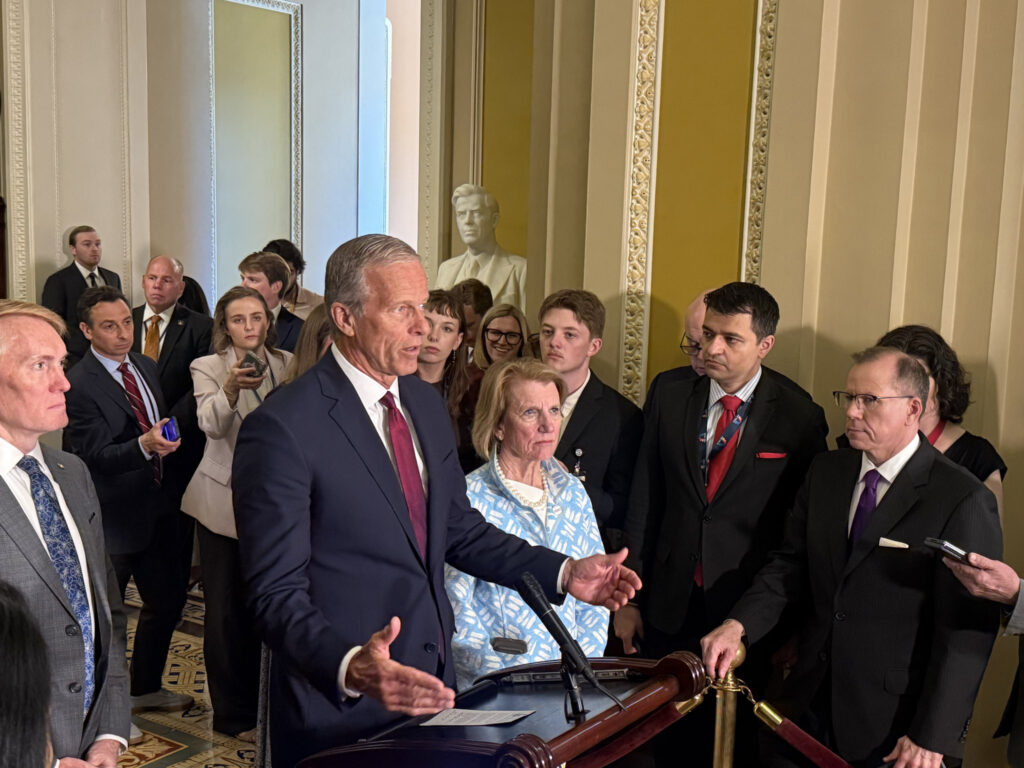
    Acting Attorney General Todd Blanche testified Tuesday before a House committee the DOJ will no longer move forward with those plans shortly after Senate Majority Leader John Thune, a South Dakota Republican, said the administration had reversed course.

    That decision could clear the way for the Senate to debate a roughly $70 billion package meant to fund immigration and deportation for the rest of President Donald Trump’s term.

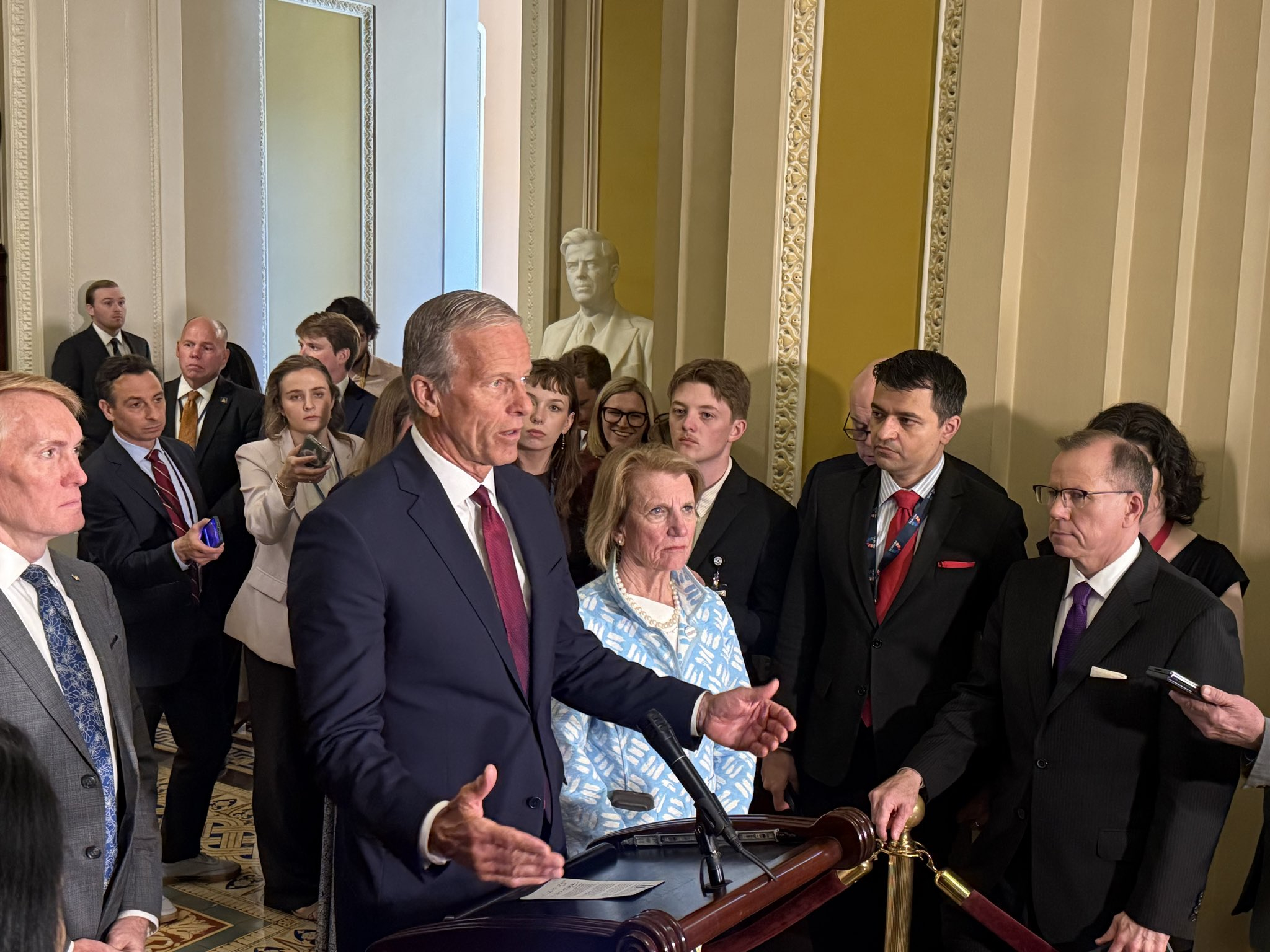
    “I think his statements are going to be very definitive, very clear and create the certainty that I hope all of our members, and House members need as well, in order for us to proceed on the reconciliation bill,” Thune said, referring to Blanche. “But I’m not guaranteeing that happens yet.”

    Blanche confirmed Thune’s statements when he testified before a House Appropriations subcommittee in the afternoon.

    “We’re not moving forward with the fund, period,” Blanche said when pressed by the subcommittee’s top Democrat, Rep. Grace Meng of New York.

    “You and Associate Attorney General Woodward signed earlier documents regarding the settlement and this fund, would both of you now sign and release documents reversing the DOJ position on the fund?” Meng asked.

    “We’re not moving forward with the fund. I’m not sure what that means to sign documents reversing. There’s nothing to reverse,” Blanche replied.

    The DOJ posted on social media this week that it plans to abide by a temporary court ruling that blocked distribution of the funds, but Republican lawmakers said that wasn’t enough to end the impasse it created.

    The Justice Department announced the creation of the fund last month as part of a legal settlement between Trump and the IRS over leaked copies of his returns during Trump’s first term. The settlement included provisions that precluded future IRS investigations into Trump and his family.

    Senate Republicans weigh in

    Thune said GOP senators had a “quite robust conversation” during a closed-door lunch about the DOJ fund and whether to move forward with their immigration and deportation package.

    North Dakota Sen. John Hoeven said after that meeting it’s up to GOP leaders to determine whether there are enough votes to move forward with the immigration package.

    “I think the next step is for our whip team to find out where everybody’s at based on the administration’s indication that they’re not going to move forward with the fund,” Hoeven said.

    Louisiana Sen. John Kennedy said there is a “chance” that Republicans could begin a marathon amendment voting session on the immigration bill as soon as Wednesday, if Blanche’s testimony alleviates concerns created by the DOJ fund.

    Montana Sen. Steve Daines, however, said he believes it’s “unlikely” that process begins this week.

    North Carolina Republican Sen. Thom Tillis said earlier in the day, before the lunch, that he wouldn’t accept taxpayer dollars going toward people who attacked the Capitol on Jan. 6.

    “To provide restitution to somebody who assaulted a police officer and pled guilty to it. I mean, man, I’ve seen some crazy stuff before, but that’s right up there with crazy,” he said.

    Utah Republican Sen. John Curtis said he needs to know “if it’s dead or nearly dead.”

    Oklahoma Republican Sen. James Lankford said he wants clarification from the White House about the settlement fund in light of the court’s ruling.

    He added that Republicans are waiting to see if “the court case set aside both the settlement fund and the audits.”

    “We need clarification for what it is and isn’t, because the White House already said ‘we agree, we don’t like it, but we agree with the courts,’” Lankford said. “What does that mean?”

    Amendment to ban fund

    Democrats have also criticized Trump and those in his administration over the fund, vowing to block it in law.

    Senate Minority Leader Chuck Schumer, D-N.Y., said during an afternoon press conference that promises from Trump and administration officials are “worthless.”

    “Trump sued his own government, had his own Justice Department settle the case and is now trying to use taxpayer dollars to pay off his MAGA allies, billionaire buddies and cop-beating insurrectionists,” Schumer said.

    “And let’s be clear, Trump has not killed this slush fund,” he added. “He has not revoked the special tax immunity he gave himself and his family. He has not ended the corruption. He hit a temporary roadblock. That’s it.”

    Schumer said the first amendment he would offer during debate on Republicans’ immigration and deportation bill would “ban Trump’s slush fund permanently and revoke his family’s free rein to commit tax fraud forever.”

    Ashley Murray contributed to this report.

  • Dems spotlight anti-weaponization fund as US Senate GOP struggles to pass immigration bill

    Dems spotlight anti-weaponization fund as US Senate GOP struggles to pass immigration bill

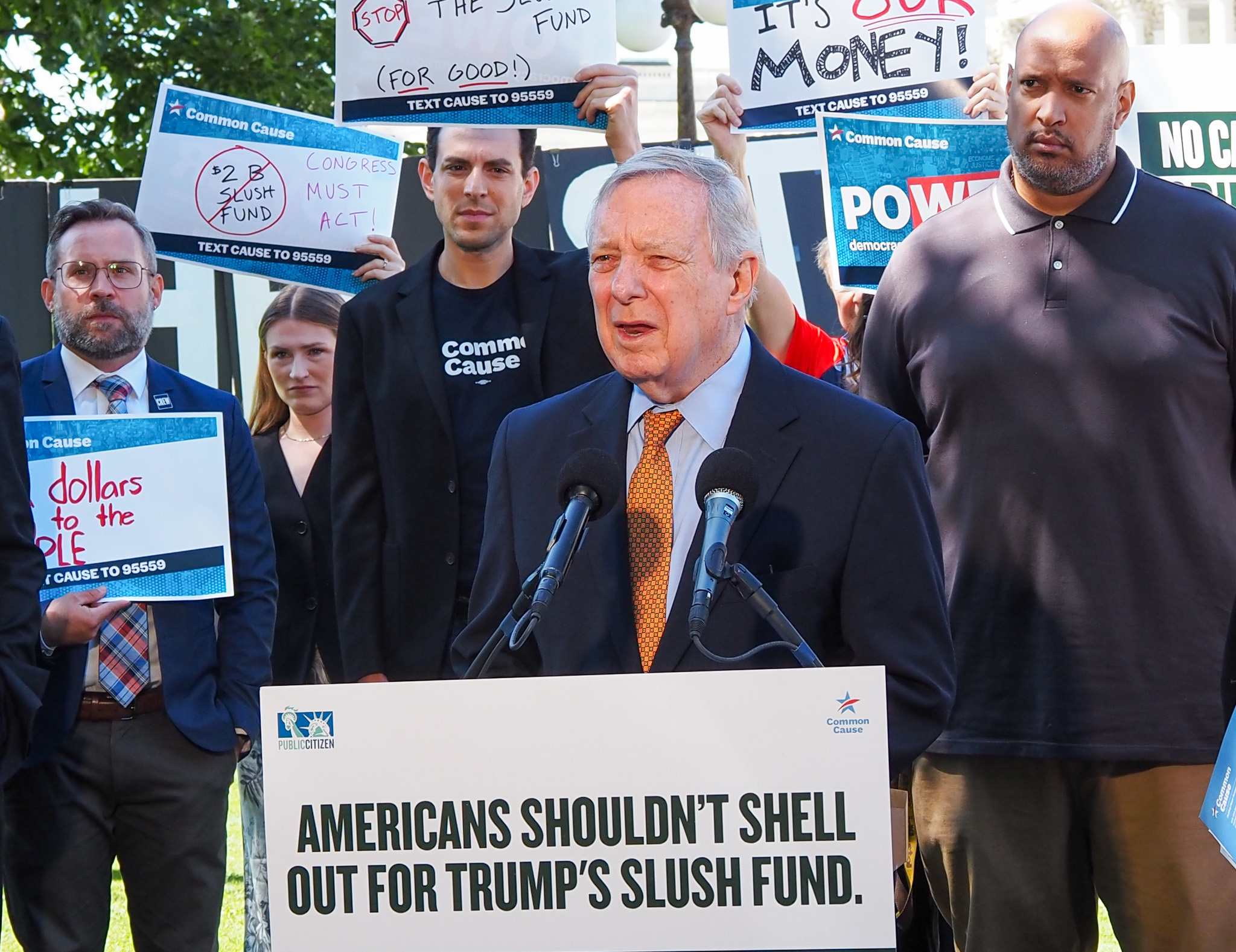
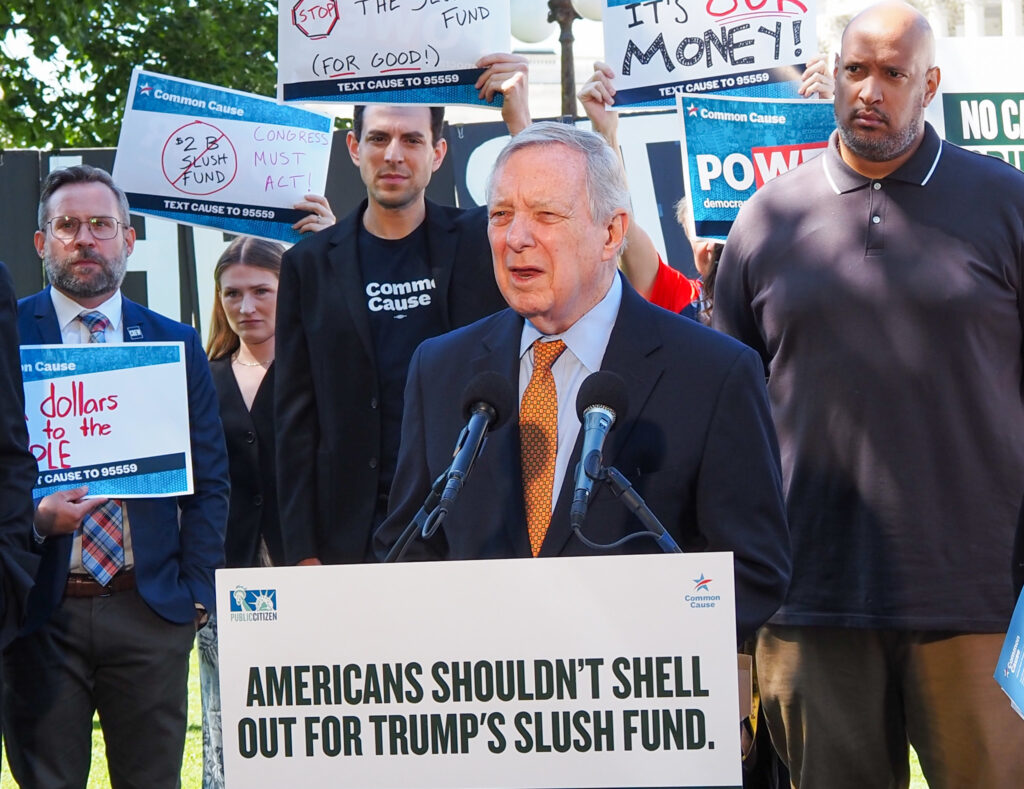
    WASHINGTON — U.S. Senate Democrats, police officers who defended the U.S. Capitol during the Jan. 6 insurrection and their legal advocates spoke out Tuesday against the Trump administration’s proposed $1.776 billion “anti-weaponization” fund.

    The press conference, organized by liberal litigation organizations Public Citizen and Common Cause, occurred as Senate Democrats applied pressure to their Republican counterparts struggling to pass an immigration budget reconciliation bill with only a handful of votes to spare.

    Democrats plan to introduce multiple amendments proposing guardrails on the fund if and when Senate Republicans bring to the floor the $72 billion immigration package that President Donald Trump said he wanted on his desk by June 1.

    “The notion that we are going to come up with a fund to provide some sort of a relief for the Capitol Hill cop beaters is outrageous to me, to think the Republican Party would even consider it,” Sen. Dick Durbin, the top Democrat on the Senate Judiciary Committee, said.

    “That’s why we’re making every effort to make sure that there is a record vote against this slush fund,” Durbin, of Illinois, said as former U.S. Capitol Police Officer Harry Dunn, who is running for the Democratic nomination for a U.S. House seat in Maryland, stood behind him.

    Dunn along with former Washington Metropolitan Police Officer Daniel Hodges, who also attended the press conference, are suing the Trump administration over the fund. Dunn and Hodges both deployed to the Capitol on Jan. 6, 2021, and Hodges described in the complaint how he thought he was going to die as rioters assaulted him.

    “Beat police, support Donald Trump, get paid,” Dunn said. “Cause an insurrection, get paid. I believe that this is Donald Trump putting his mob on a retainer.”

    Trump pardoned nearly all defendants charged with attacking the Capitol that day, and commuted the prison sentences of more than a dozen involved in planning the attack.

    Trump repeatedly characterized those involved in the riot as “patriots” during his 2024 presidential campaign, and accused the Biden administration of weaponizing the Department of Justice.

    Acting U.S. Attorney General Todd Blanche has said the fund is not targeted toward Jan. 6 attack defendants, and that anyone of any political affiliation can “be heard and seek redress.”

    IRS settlement

    The Department of Justice announced the $1.776 billion fund on May 18 as a condition of Trump dropping his $10 billion lawsuit against the IRS over the leak of his tax returns in 2019.

    A day later, the DOJ issued another order declaring Trump and his family would be forever immune from government inquiries, including tax audits, as part of Trump’s voluntary dismissal of the suit.

    Sen. Sheldon Whitehouse, a Rhode Island Democrat, said the DOJ is facing “real pressure now, and indeed the Trumpsters are starting to say they might have to abandon their cop beaters slush fund.”

    U.S. Sen. Sheldon Whitehouse, D-R.I., at a press conference opposing the Trump administration's $1.776 billion

    U.S. Sen. Sheldon Whitehouse, D-R.I., at a press conference opposing the Trump administration’s $1.776 billion “anti-weaponization” fund on Tuesday, June 2, 2026. (Photo by Ashley Murray/States Newsroom)

    Whitehouse, another senior Judiciary Committee member, also slammed the DOJ order to indefinitely absolve Trump family members from any future tax audits.

    “Even if they get rid of the crooked cop beaters slush fund, even if they get rid of the crooked Trump family tax amnesty, that still leaves one very interesting thing, and that is the question of whether the crooked Trumpsters committed a fraud on the court,” Whitehouse said.

    U.S. District Judge Kathleen Williams of the Southern District of Florida reopened Trump’s IRS case on May 29 following a filing from 35 former federal judges who argued the DOJ “deceived” the court by not sharing with the judge details of the “anti-weaponization” fund.

    The government has until June 12 to respond.

    Fund future unclear

    The Department of Justice said Monday in a social media post the administration would comply with a separate temporary court order to pause the fund, but would not answer States Newsroom Tuesday about reports that the department planned to scrap the fund altogether in the face of intense scrutiny, even from Republicans.

    Skye Perryman, president and CEO of Democracy Forward, said during the event that the organization is seeking further details from the DOJ.

    “We are in the position of trusting but verifying, and so have demanded that DOJ send us a response today asking them to confirm that they have taken a number of steps to comply with that order,” Perryman said. “We have also asked them to confirm what the status of the fund is, since they seem to be leaking that they are somehow abandoning the fund.”

    Democracy Forward is representing multiple plaintiffs in a lawsuit challenging the nearly $1.8 billion fund, including a former DOJ Jan. 6 prosecutor who was fired and a university professor who was charged with a felony then acquitted by a jury for involvement in protesting a 2025 immigration raid.

    U.S. District Judge Leonie Brinkema in the Eastern District of Virginia on May 29 ordered the Department of Justice, the Treasury Department and other high-ranking administration officials from taking any additional actions to create the fund or make payments from it.

  • Virginia revenue forecast jumps by $1.5 billion as budget talks continue

    Virginia revenue forecast jumps by $1.5 billion as budget talks continue

    Virginia’s revenue outlook has improved by $1.5 billion over the next three fiscal years, giving lawmakers more breathing room as negotiations over a stalled state budget are set to continue in Richmond later this month.

    Gov. Abigail Spanberger on Monday afternoon released the updated revenue forecast she ordered last month, telling top legislative budget writers that Virginia is projected to collect substantially more General Fund revenue through fiscal year 2028 than previously expected.

    The revised forecast projects revenues for fiscal year 2026 will exceed the official estimate by $585.5 million. Another $922.6 million in General Fund revenue is projected for fiscal years 2027 and 2028, including $582.4 million in 2027 and $340.2 million in 2028.

    The new projections arrive while lawmakers remain stuck in negotiations over Virginia’s next two-year budget, with disagreements over data center tax incentives and spending priorities continuing to hold up a final deal.

    In a letter to Sen. Louise Lucas, D-Portsmouth, and Del. Luke Torian, D-Prince William — the chairs of the legislature’s money committees — Spanberger said lawmakers need updated economic information as they work toward a budget deal.

    “As General Assembly leadership and budget conferees continue their important work, it is critical they have the most current and accurate information available,” Spanberger said in a statement.

    “While forecasted General Fund revenues have increased, I remain concerned by rising national economic instability, the ongoing conflict in Iran, and the continued impacts of federal workforce cuts. We must account for these evolving economic conditions as we plan for the long-term strength of our commonwealth.”

    The updated forecast arrives as lawmakers prepare to return to Richmond later this month for another attempt to break the budget impasse before the start of the new fiscal year.

    The House is scheduled to reconvene its special session June 18, followed by the Senate on June 22, as budget conferees continue working toward a compromise spending plan that can pass both chambers and reach Spanberger’s desk before the June 30 deadline.

    The revised forecast reflects strong tax collections even as parts of Virginia’s economy show signs of slowing.

    General Fund revenues have grown 7.3% on a fiscal year-to-date basis and are running 3.3% ahead of forecast. Virginia is currently $851 million ahead of expectations, though nearly 70% of that amount — about $578 million — comes from nonwithheld income tax payments and individual refunds, two of the state’s most volatile revenue categories.

    Virginia Secretary of Finance Mark Sickles said the revised forecast attempts to balance the state’s recent revenue growth against growing uncertainty in the national economy.

    “The updated forecast confirms that the commonwealth’s revenue performance remains solid but also factors in the deteriorating economic conditions and increased uncertainty in the national outlook,” Sickles said in a statement.

    “The additional $1.5 billion in updated projected revenues should provide the General Assembly with enough resources to craft a structurally balanced budget that mitigates any potential risks related to national market volatility.”

    The updated forecast follows warnings from state finance officials last month that Virginia’s economy is facing slower job growth, persistent inflation and weakening consumer confidence even as tax revenues continue to exceed expectations.

    During a May presentation of the Senate Finance & Appropriations Committee, Sickles said Virginia had lost 41,900 jobs since the beginning of fiscal year 2026 while General Fund revenues remained more than $850 million ahead of forecast.

    At the time, Sickles suggested the surplus could help lawmakers move past the budget stalemate.

    “It would not be unprecedented for us to use some of this money to get past this impasse, if we needed to,” Sickles told the committee.

    Spanberger ordered the updated forecast May 19 while budget negotiations remained unsolved. The revised projections extend through fiscal year 2031 and are intended to give lawmakers updated economic data before final spending decisions are made.

    The prolonged budget standoff has raised concerns about whether lawmakers will finish work on a revised spending plan before the new fiscal year begins July 1.

    Lawmakers adjourned a special session in April without an agreement. Disputes over data center tax incentives, transportation funding and competing priorities between the Democratic-controlled House and Senate have remained major obstacles.

    The stronger revenue forecast could give negotiators additional flexibility on spending priorities including education, transportation, healthcare and state employee compensation. But administration officials cautioned that economic risks remain.

    Federal workforce reductions continue weighing heavily on Northern Virginia and Hampton Roads, both of which have large concentrations of federal employees and contractors. State officials have also pointed to instability in financial markets and international tensions as possible threats to future economic growth.

    Even with revenues ahead of forecast, Virginia officials have repeatedly noted that much of the current surplus comes from revenue streams that can fluctuate significantly from year to year.

  • Virginia Tech rector refuses to resign after Spanberger’s dismissal

    Virginia Tech rector refuses to resign after Spanberger’s dismissal

    Virginia Tech governing board member John Rocovich has refused to resign after Gov. Abigail Spanberger removed him last week after 16 years.

    Rocovich stated in a four-page letter addressed to the Secretary of the Commonwealth that he will not resign before his term ends on June 30, 2027. There was no sign of him at the board’s committee meetings on Monday in Blacksburg.

    Spanberger’s decision is the latest effort by her administration to shake up governing boards at Virginia’s colleges and universities, amid concerns within the higher education community about the politicization of public university governing bodies. She recently appointed four new members to Tech’s governing board.

    Governor fires Virginia Tech Rector Rocovich, appoints Dominion Energy’s Edward Baine as replacement

    Spanberger removed Rocovich, citing “misconduct” in a letter sent last Wednesday, but the letter did not specify the details of Rocovich’s alleged violations, only stating that the findings provided “sufficient cause” for his removal. Rocovich pushed back on that claim.

    “I was appointed to serve a term, I have served that term faithfully, and I intend to fulfill my obligations to the students, faculty, and people of Virginia who depend upon the proper governance of this great university,” Rocovich wrote. “Governor Spanberger’s letter failed to state my specific cause, as the law requires. I am confident she will find no such grounds.”

    Board member William Holtzman, who was appointed by former Gov. Glenn Youngkin and will complete his term next year, said he was “disappointed” with the governor’s decision.

    “I think all of us were disappointed because I think it’s a unanimous feeling of our group that he has done a phenomenal job, and I didn’t understand at all why she removed him, and I don’t think there was any cause for it,” Holzman said.

    Lawmakers have also urged the governor to explicitly state her reasons for the termination.

    Senate Republican Caucus Chair Mark Obenshain, R-Harrisonburg, said Rocovich deserves “fairness,” and emphasized that transparency is “not optional” concerning the governor’s decision to boot Rocovich from the board.

    “What makes this decision especially disappointing is that Governor Spanberger campaigned on a promise to depoliticize higher education governance and to reduce executive involvement in the affairs of Virginia’s universities,” Obenshain said in a statement on Friday. “Removing the sitting rector of Virginia Tech without publicly stating a lawful basis appears inconsistent with those commitments.”

    Edward Baine, executive vice president of utility operations and president of Dominion Energy Virginia, who was appointed to replace Rocovich, attended the first committee meeting on Monday.

    He did not comment on his appointment on Monday morning, but asked Provost Julie Ross about the university’s efforts to address enrollment, which the board expressed interest in growing.

    Rocovich’s dismissal followed the board’s vote to grant an exception allowing him to serve a third one-year term as rector during the search for Virginia Tech’s next president, following Tim Sands’s departure in April, Cardinal News reported last month.

    The board minutes noted that Rocovich was elected rector because no other nominees were available and he was willing to serve.

    A native of Roanoke and a Virginia Tech graduate, Rocovich founded a law firm and specializes in taxation as well as trusts and estates law. He served on the board of visitors from 1997 to 2005, was appointed for a term from 2010 to 2014, and was rector from 2002 to 2004.

    According to the Virginia Public Access Project, Rocovich has donated to several Republican campaigns and candidates, including formerRepublican gubernatorial nominee and Spanberger rival Winsome Earle-Sears.

    In his letter, Rocovich criticized the termination and the governor, expressing his “disappointment” with her use of a “subordinate“ to deliver the message, which he said was the opposite of the respect he showed Spanberger by calling her directly to discuss the board.

    “Virginia Tech deserves better than to be made a political football,” Rocovich wrote. “I have given too much of my life to this institution to stand by silently while its independence is threatened—regardless of which party holds the governor’s office.”

    The governor and attorney general’s offices did not immediately respond for comment on whether they will enforce the termination.

    The board’s committee meetings continued on Monday. The board will have a full meeting on Tuesday. The body will vote on a new rector and vice rector to replace Rocovich and Sandy Davis, who died on March 17.

  • Valley Link unveils reworked routes for high-voltage transmission line

    Valley Link unveils reworked routes for high-voltage transmission line

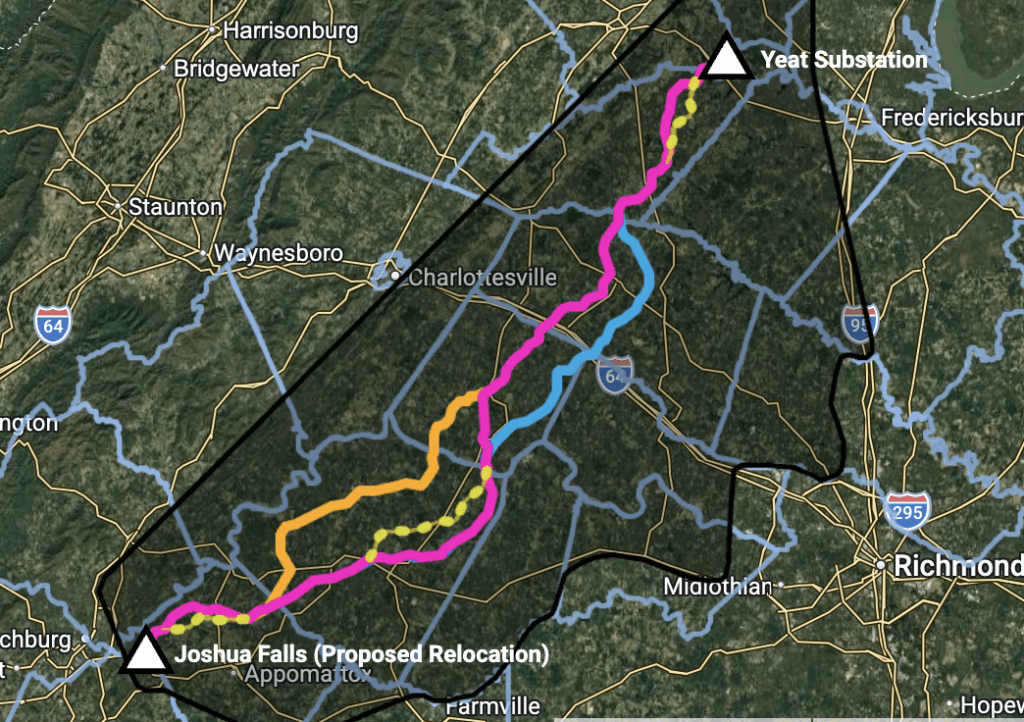
    Valley Link Transmission has released a new set of potential routes for the controversial project ahead of the first public meetings across the nine-county region that may be impacted by the 765 kilovolt, 115-mile transmission line.

    The power line will stretch from just outside of Lynchburg to Culpeper County. Dominion Energy, Transource, and FirstEnergy are developing the line to help move power from the Ohio River Valley to Northern Virginia, where major energy demands are spiking.

    The Valley Link project was identified by PJM, the regional grid operator for 13 states and Washington, D.C., as crucial to maintain grid reliability.

    Since the project was unveiled, residents across Campbell, Appomattox, Buckingham, Fluvanna, Louisa, Orange, Goochland, Spotsylvania, and Culpeper counties have sounded off about the potential impacts the project will have on the environment and historic preservation of certain sensitive locations, including Civil War battlefields.

    Valley Link refined the routes through the public feedback from the initial hearings about the project. The final route for the power line will be determined by the State Corporation Commission.

    The new routes will reportedly reduce the number of residences that come within 500 feet of the corridor to 75. There are no homes that come within 150 feet of the route. Developers also considered wetlands, environmental resources, recreational areas, conservation easements, and historical and architectural resources.

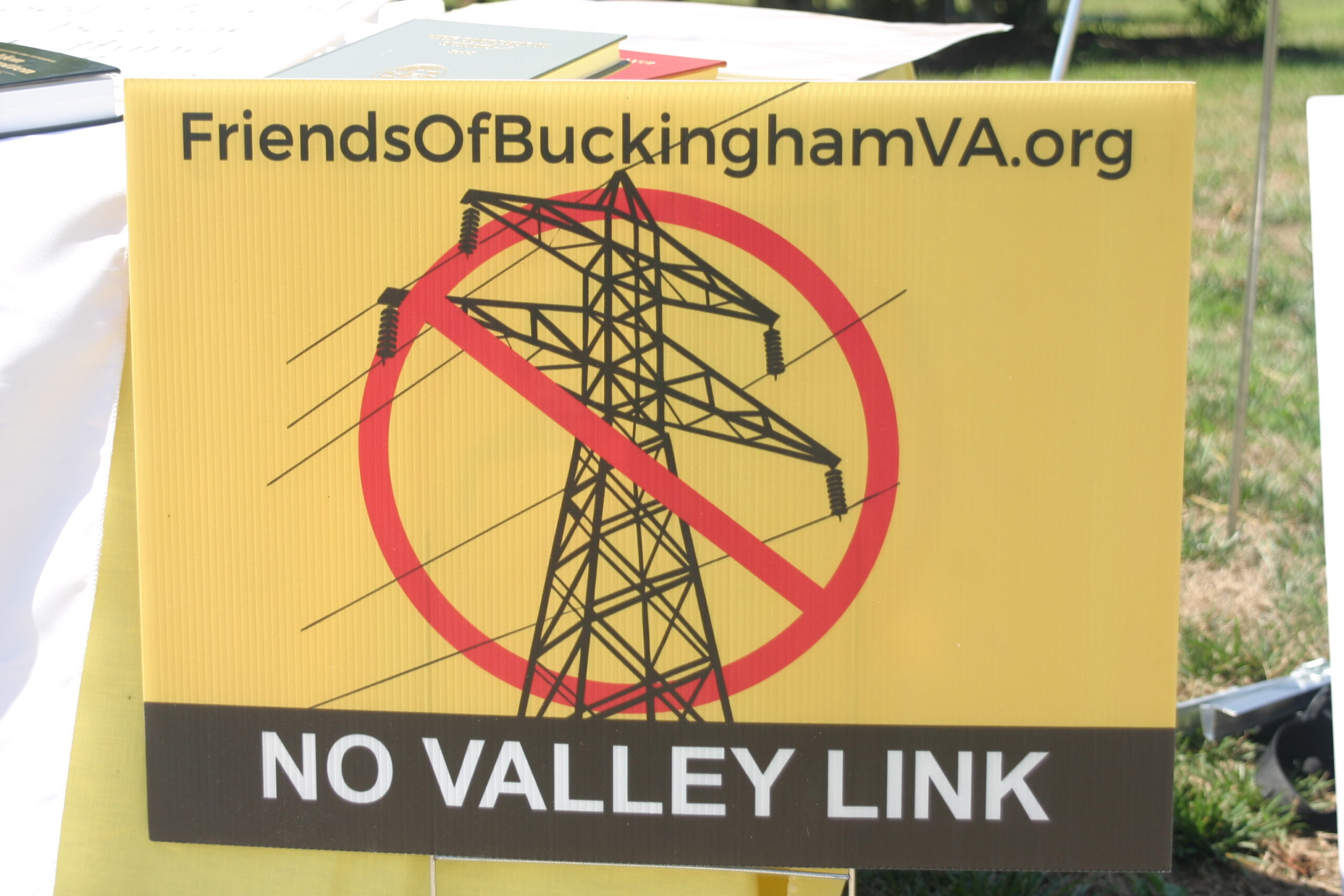
    A sign showing community opposition to the Valley Link transmission line project, May 2026. (Photo by Shannon Heckt/Virginia Mercury)

    Residents along the route have also voiced concerns about possible future energy infrastructure construction, since the transmission line is meant to act as highway with on and off ramps to hook up other energy projects.

    “Property owners along the refined routes are now receiving letters about the route updates and have been invited to a second round of open houses in June. We look forward to sharing the refined routes in person and continuing our dialogue with the communities we serve,” a Valley Link representative said in a statement Monday.

    Even with the newly proposed routes, environmental groups and residents said they are wary.

    “The potential impacts are enormous. Over 2,600 acres of land that is currently forested, farmed, providing critical wildlife habitat and contributing to the rural economy and character of the region would be cleared and converted to utility right-of-way,” the Piedmont Environmental Council said in a statement. “Tens of thousands of acres more along the line are likely to face pressure for new development.”

    The first community meeting will be June 10 in Orange County at the Orange County High School, and may be attended in person. Additional community meetings will be held in the coming months in various locations near the proposed routes; you may find the full list here.

  • Trump ‘slush fund’ echoes scorned 19th-century spoils system, academics say

    Trump ‘slush fund’ echoes scorned 19th-century spoils system, academics say

    President Donald Trump’s extraordinary $1.776 billion fund to pay off allies and others who say they have been wronged by past administrations has drawn widespread condemnation by opponents, including some Republicans, who characterize it as an act of brazen corruption.

    But the Trump administration’s push to reward its supporters also harkens back to an earlier era of American cronyism, experts say, while expanding the frontiers of political favoritism.

    From the early years of the United States until well into the 19th century, a spoils system dominated the federal government. Presidents handed out jobs to supporters, filling the bureaucracy with workers who had demonstrated loyalty to the administration in power.

    President Andrew Jackson (Courtesy Library of Congress)

    President Andrew Jackson (Courtesy Library of Congress)

    Trump’s political idol, President Andrew Jackson, replaced large numbers of federal officials after his 1829 inauguration, for instance. One appointee to a role at the Port of New York made out with more than $1 million, valued at tens of millions today.

    The comparison isn’t exact. The spoils system was associated with the distribution of government jobs to political allies, a practice called patronage. Trump’s new fund would instead deliver taxpayer dollars directly to favored individuals.

    Yet, academics who have studied the spoils system and the presidency see parallels between the past and present — with a desire to reward allies and build allegiance at the center of it all.

    “It seems to me that may be the common element here,” said Sidney Shapiro, a professor of law at Wake Forest University who wrote before the 2024 election that Trump wanted to reinstate the spoils system. “It appears President Trump is thinking about using the fund to reward people unfairly punished, but I think in his mind it’s unfairly punished because they were trying to support him.”

    Five-member board to be named by Trump

    The Department of Justice announced the “anti-weaponization fund,” which critics call a “slush fund,” on May 18 as it moved to settle a lawsuit Trump had filed in his personal capacity against the IRS over the leaking of his tax returns by a former agency contractor.

    The suit placed Trump in the extremely unusual position of effectively negotiating with himself because he has erased the DOJ’s post-Watergate tradition of independence from the White House.

    Even before the settlement, the Justice Department under Trump had taken actions that would have been unheard of in other recent administrations. For instance, federal prosecutors have brought a case against former FBI Director James Comey and tried to pursue criminal charges against New York Democratic Attorney General Letitia James.

    The DOJ has also obtained an indictment against the Southern Poverty Law Center, a frequent critic of GOP politicians.

    Trump’s settlement agreement provides for the creation of the fund overseen by a board of five members chosen by acting Attorney General Todd Blanche, who previously served as Trump’s personal attorney. Trump can fire the members for any reason.

    The fund’s board will have the power to make decisions about payments, as well as issue formal apologies. Claims submitted to the fund must be processed by Dec. 1, 2028, prior to the end of Trump’s term.

    Jan. 6 rioters line up

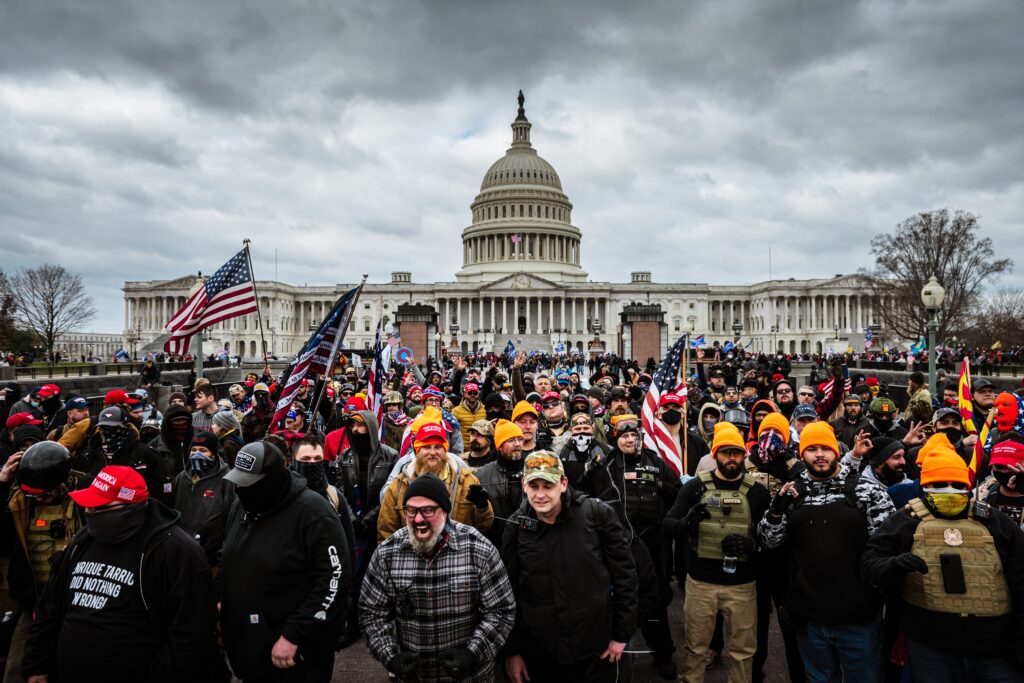
    A bevy of Trump supporters and hangers-on have said they plan to apply for compensation. They include individuals who stormed the U.S. Capitol on Jan. 6, 2021, disrupting Congress’ certification of President Joe Biden’s Electoral College victory. Trump previously pardoned rioters when he took office in January 2025.

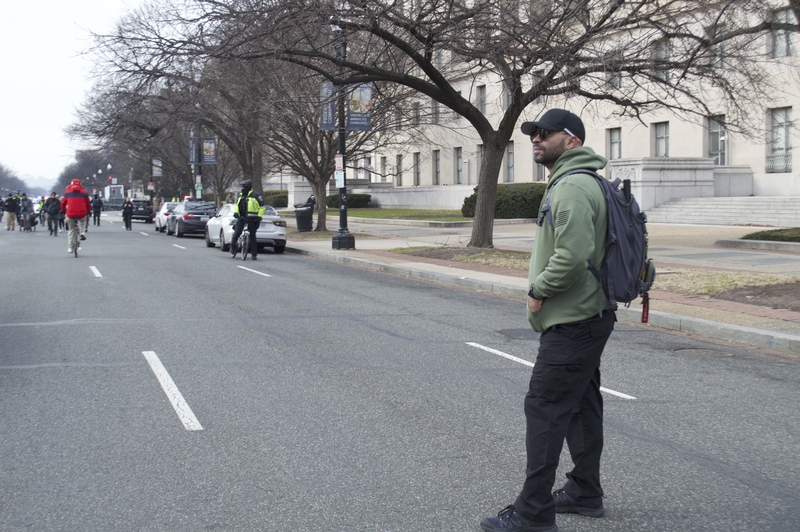
    Former Proud Boys leader Enrique Tarrio, who was convicted of seditious conspiracy and sentenced to 22 years in prison before Trump pardoned him, predicted on a recent podcast that a “lot of J6ers are going to spend their money on firearms.”

    Former national Proud Boys leader Enrique Tarrio looked on as far-right activists celebrating the Jan. 6 Capitol attack marched down Constitution Avenue on Tuesday, Jan. 6, 2026. Tarrio was sentenced to 22 years in prison on sedition charges related to the attack, but President Donald Trump commuted his sentence. (Photo by Ashley Murray/States Newsroom)

    Former national Proud Boys leader Enrique Tarrio looked on as far-right activists celebrating the Jan. 6 Capitol attack marched down Constitution Avenue on Tuesday, Jan. 6, 2026. Tarrio was sentenced to 22 years in prison on sedition charges related to the attack, but President Donald Trump commuted his sentence. (Photo by Ashley Murray/States Newsroom)

    Trump has cast the fund as an act of magnanimity on his part because the settlement agreement doesn’t include a monetary payout to him.

    However, Blanche also signed a document barring any additional scrutiny of the president’s past tax history, a move that shields him from audits. The New York Times and ProPublica reported in 2024 that Trump could have owed $100 million if he lost an audit battle over improper tax breaks.

    “I gave up a lot of money in allowing the just announced Anti-Weaponization Fund to go forward. I could have settled my case, including the illegal release of my Tax Returns and the equally illegal BREAK IN of Mar-a-Lago, for an absolute fortune,” Trump wrote on Truth Social, referring to the FBI search of his Florida residence in 2022.

    “Instead, I am helping others, who were so badly abused by an evil, corrupt, and weaponized Biden Administration, receive, at long last, JUSTICE!”

    Trump has adopted a “patrimonial” approach to governing, James Pfiffner, a professor emeritus at George Mason University who has studied the presidency, wrote in an email to States Newsroom.

    Benefits, like federal contracts, go to those who are loyal, Pfiffner wrote, and the government is treated as if it were a family business and the state’s resources were his personal property.

    The “anti-weaponization fund” represents an extension of that approach, Pfiffner wrote, but also goes further than past presidents. He wrote that he could think of no past precedents in the modern presidency for such a blatant use of taxpayer money to potentially reward loyalists.

    “At least in the spoils system, the people hired by the government were working and presumably doing their jobs,” Pfiffner wrote. “The beneficiaries of this fund have done nothing to earn their benefits, and presumably some will be rewarded for having committed crimes to overturn the 2020 election.”

    Congress began curbing the spoils system after the 1881 assassination of President James Garfield by a spurned job seeker.

    Over the next two decades, many federal positions were moved into a civil service system. While the federal government still includes some 4,000 political appointees today, the vast majority of the bureaucracy is staffed by civil servants.

    Critics and defenders in Congress

    But it’s unclear whether Congress will block Trump’s fund, despite an intense backlash.

    Anger among Republican senators has stalled action on budget legislation funding immigration enforcement, which Democrats would have used to force votes on amendments to block the fund. Democrats have introduced multiple bills aimed at halting it.

    “Congress cannot stand by while Trump turns the federal government into a political operation for his friends and cronies,” Sen. Michael Bennet, a Colorado Democrat, said in a statement.

    Obstacles exist to congressional action. Even if Republicans who control both chambers voted with Democrats, Trump could veto bills passed placing restrictions on the fund, which would require two-thirds majorities in the House and Senate to override.

    And some GOP lawmakers have defended the fund.

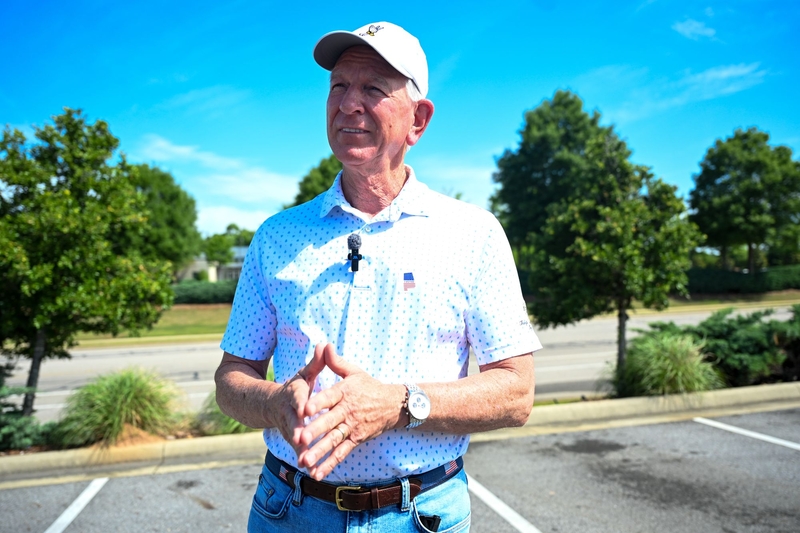
    U.S. Sen. Tommy Tuberville, R-Ala., speaks to reporters after voting in the GOP primary in Auburn, Alabama on May 19, 2026. (Photo by Anna Barrett/Alabama Reflector)

    U.S. Sen. Tommy Tuberville, R-Ala., speaks to reporters after voting in the GOP primary in Auburn, Alabama on May 19, 2026. Tuberville has defended President Donald Trump’s “anti-weaponization” fund. (Photo by Anna Barrett/Alabama Reflector)

    On May 21, Sen. Tommy Tuberville, an Alabama Republican, objected to a unanimous consent request by Sen. Alex Padilla, a California Democrat, to pass a bill that would prohibit payments to Jan. 6 rioters.

    “Thankfully, acting Attorney General Todd Blanche and the Trump Department of Justice established a standard and lawful process to hear from American citizens who suffered lawfare or weaponization under the Biden administration,” Tuberville said on the Senate floor.

    Lawsuits have been filed challenging the fund and how it’s structured. Two police officers who defended the Capitol on Jan. 6 have sued, warning that rioters could use the money to organize.

    Fund blocked temporarily

    On Friday, a federal judge in Virginia ordered the Trump administration to halt work on the fund for at least two weeks while she considers ordering a lengthier pause.

    The decision came in a lawsuit brought by a former federal prosecutor fired by the DOJ and a California professor who was charged but acquitted of assaulting a federal officer after protesting an immigration raid.

    Legal advocacy groups also argue Congress didn’t intend for federal money to be used for these kinds of payoffs.

    “Another commonality is we the taxpayers are funding both,” Shapiro, the Wake Forest professor, said of the spoils system and the Trump fund. “We certainly fund the jobs that people have and now we’re funding this fund.”