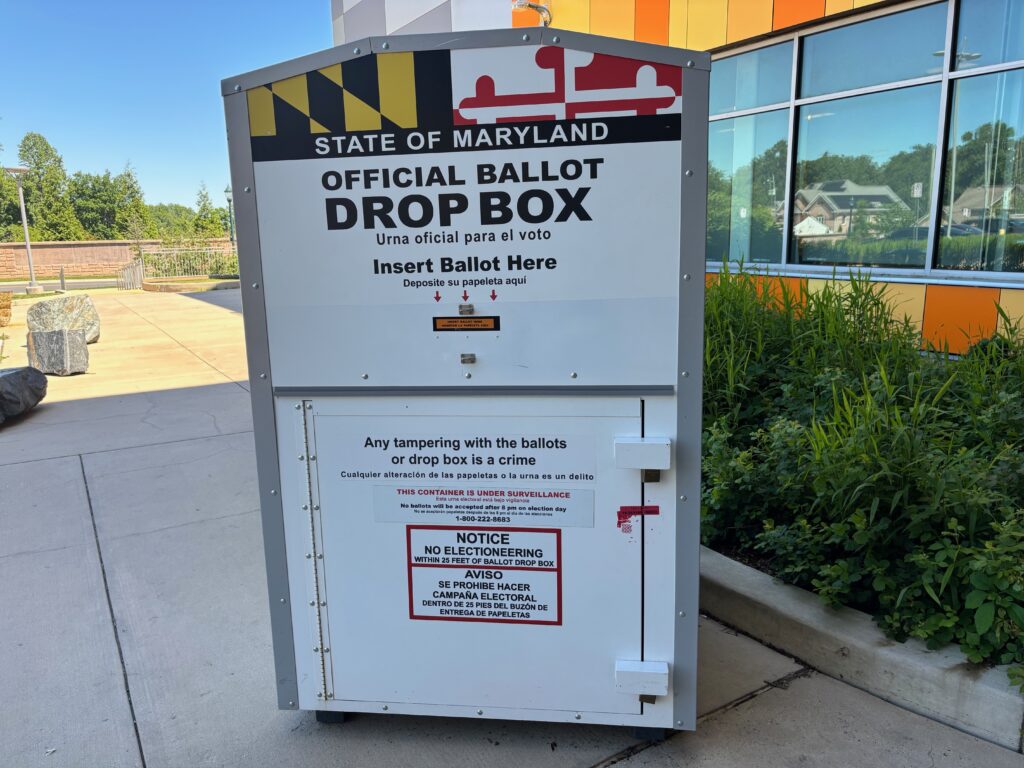
An official ballot drop box for Maryland voters, in Wheaton, Maryland, on June 7, 2026. (Photo by Jane Norman/States Newsroom)
The U.S. Department of Homeland Security will allow states to access federal citizenship data by June 30 and plans to monitor the flow of mail ballots for signs of voter fraud, according to a court document.
Amid a series of lawsuits, President Donald Trump’s administration is now moving to carry out a March 31 executive order restricting voting by mail ahead of the November midterm elections.
Democrats and voting rights advocates oppose the directive as unconstitutional election meddling by Trump and have sued to stop him. The president, who has long attacked mail ballots but votes by mail himself, says the additional rules will fight noncitizen voting, a rare phenomenon.
“No president has the authority to unilaterally rewrite election rules or dictate how states administer their elections,” Marcia Johnson, chief of activation and justice at the League of Women Voters, said in a statement last week. The League of Women Voters filed one of at least five lawsuits challenging the order.
Potential disruptions
The order could carry major consequences for the midterm elections. Any new restrictions on mail ballots would risk disrupting how tens of millions of voters cast their ballots. About 30% of voters cast mail ballots in 2024, according to data gathered by the U.S. Election Assistance Commission.
But despite several legal challenges, the order remains in effect.
A federal judge in Washington, D.C., in late May ruled against a request by Democratic groups to pause the order, finding that it was too soon to weigh in because federal officials hadn’t taken enough action yet. A second judge in Massachusetts held a hearing last week, but didn’t immediately issue a decision.
“The Trump Administration will continue fighting for the safety and security of American elections,” White House spokesperson Abigail Jackson said in a statement shortly after the D.C. judge’s decision.
One portion of the order demands the postmaster general enact new restrictions on mailed ballots and not transmit ballots from states that refuse to provide the names of absentee voters. The U.S. Postal Service, despite its status as an independent corporation, has put forward a proposal in line with the order to require states to submit lists of voters before mailing ballots.
Now, Homeland Security is responding to another part of the order that requires the creation of lists of voting-age citizens in every state, which the Trump administration calls “state citizenship lists.” State election officials would receive the lists, which they could compare to their voter rolls in a search for noncitizen voters.
Homeland Security’s plans for the citizenship lists came into focus on June 5, when the U.S. Department of Justice filed a notice in federal court that briefly outlines the administration’s plans. The notice describes a two-part effort by Homeland Security and its subsidiary agency, U.S. Citizenship and Immigration Services, to comply with the order.
First, Homeland Security will implement a “State Voter Roll Verification” that allows state election officials to submit their voter rolls to the Systematic Alien Verification for Entitlements, or SAVE, system.
SAVE is a powerful computer program that checks names against citizenship information held in a variety of government databases. It can flag registered voters as possible noncitizens, but faces criticism for incorrect identifications.
For the past year, states have already had the option to upload their voter rolls into SAVE. Some Republican-led states, such as Indiana, Texas and Wyoming, have used the system, while Democratic states have declined. It’s unclear how the State Voter Roll Verification would be different, if at all, from states’ current SAVE access.
Homeland Security and U.S. Citizenship and Immigration Services didn’t respond to questions from States Newsroom.
Second, the Justice Department notice says Homeland Security will set up a registry for state election officials to securely access “citizenship-related data” from USCIS, the Social Security Administration and the State Department.
According to the notice, the “underlying data would remain in each agency’s respective system.” No other details were provided.
The notice also outlines Homeland Security’s intention to use the lists of voters that states provide to the Postal Service for investigations. It says DHS wants to “integrate” data on those voters “to monitor mail-in and absentee ballot flows, identify anomalies that may suggest voter fraud or misuse, and generate authorized investigative leads.”
California elections
The notice comes as Trump renews his attacks on mail-in voting. Last week he alleged, without evidence, voter fraud in California, which held primary elections last week. California relies heavily on mail ballots and often counts votes at a slow pace — meaning final results sometimes don’t match election night vote totals.
“Do you know why they’re doing that? Because they’re cheating on the election,” Trump said in an interview on NBC’s “Meet the Press.”
While the executive order already faces a slew of lawsuits, the NAACP on June 3 filed a motion in federal court seeking to specifically block the Postal Service’s proposed regulations of mail ballots. The NAACP alleges the regulations violate a 2021 settlement agreement that requires timely delivery of election mail to all voters.
The Postal Service has until Thursday to respond.
The American Postal Workers Union in a statement on June 5 denounced the executive order, saying the Postal Service serves all Americans. It is “not a tool for politicians” to pick which Americans receive which benefits, the union said.
“The Executive Order is an unconstitutional attack on the millions of Americans who vote by mail,” the union said, “and another front in an ongoing assault on voting rights in the United States of America.”
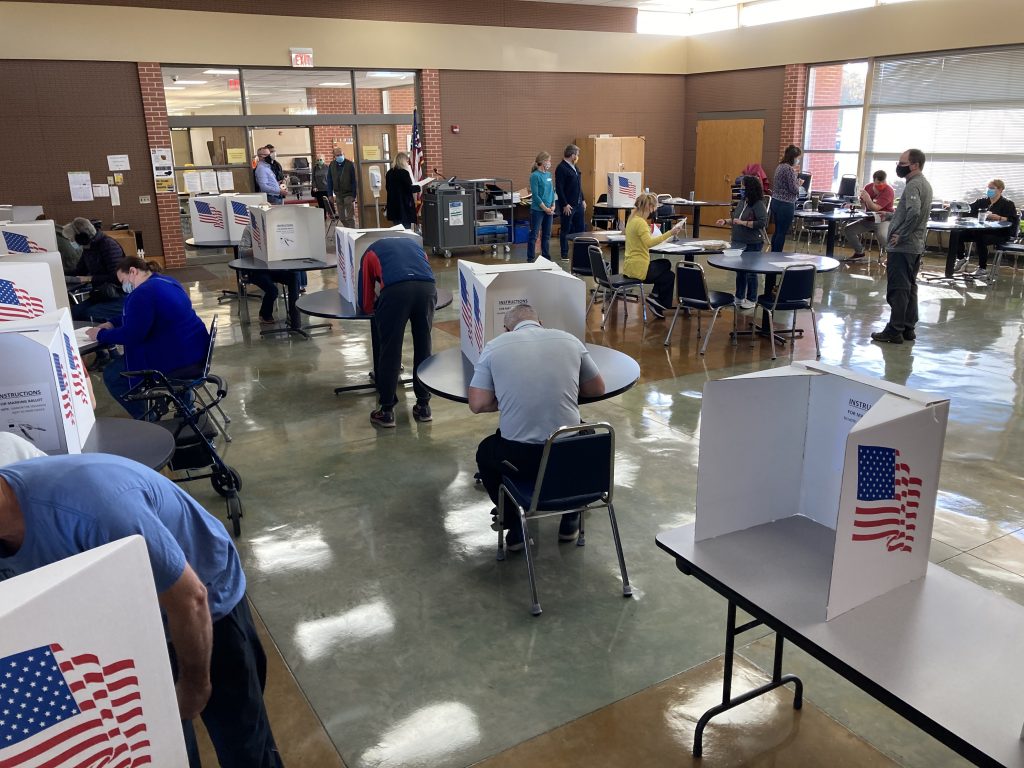
Voters cast ballots at the Northwest Community Center in Des Moines, Iowa, on Nov. 3, 2020. (Photo by Jim Obradovich for Iowa Capital Dispatch)
Ahead of the November midterm elections, President Donald Trump and his Republican allies have demanded Congress pass sweeping voting restrictions, including showing proof of citizenship to register — all in the name of election security.
At the same time, the only federal agency dedicated solely to helping states and localities run smooth and secure elections operates on a meager budget. It provides grants for election security far smaller than in the past. And U.S. House Republicans have signaled they want sizable further cuts.
The agency, the U.S. Election Assistance Commission, sits at the center of a fight playing out in Congress over how to best ensure secure elections. The debate has thrown into sharp relief a yawning gap between GOP rhetoric over election tampering and actual congressional support for election security efforts.
“If my colleagues truly cared about protecting our elections from foreign interference, they’d put the resources behind it,” Rep. Sanford Bishop, a Georgia Democrat, said at a House Appropriations Committee meeting this spring. “Instead, we get empty rhetoric, zero urgency, while putting the right of citizens to vote at risk.”
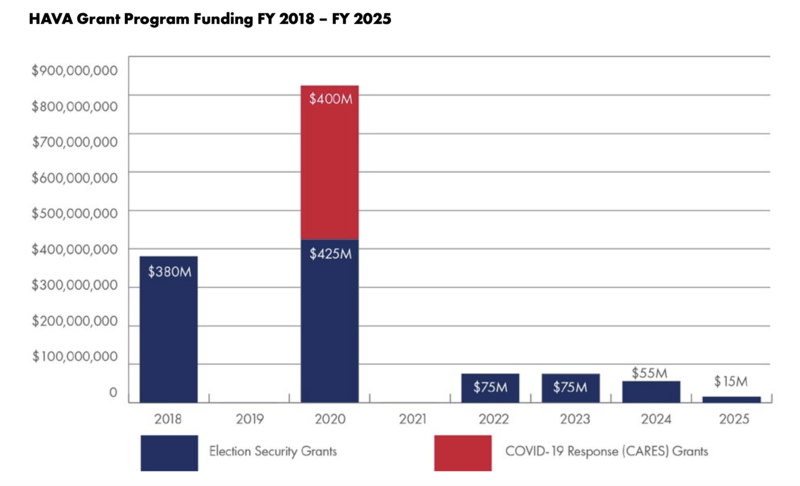
Congressional support of the EAC’s election security grant program has fluctuated over time, but has generally trended downward.
Congress has approved election security grant funding at much lower levels than the program’s early years. (Credit: U.S. Election Assistance Commission 2025 Annual Report)
Lawmakers approved $380 million in 2018 and $425 million in 2020, along with an additional $400 million in election-related pandemic aid that year.
Since then, grant funding has slowed to a trickle. Congress appropriated $75 million in 2022 and again in 2023. That was followed by $55 million in 2024 and $15 million in 2025.
This year’s amount, $45 million, is an increase from the previous year — consistent with enhanced needs in an election year — but substantially lower than other recent years and a far cry from the program’s early years.
Trump and many GOP lawmakers support the SAVE America Act, which would impose new restrictions on voting. It would require voters to show a photo ID at the polls, as well as require them to bring documents proving their citizenship, such as a passport or birth certificate, with them when they register to vote.
The requirements are needed, the bill’s supporters say, to combat noncitizen voting, an extremely rare occurrence.
“The cheating is rampant in our elections,” Trump asserted without evidence in his 2026 State of the Union address. He has called the SAVE America Act “commonsense, country-saving legislation.”
The House passed the bill in February but it has floundered in the Senate amid opposition from Democrats and a handful of Republicans. Trump continues to seek new avenues to advance the measure, including urging lawmakers to attach it to housing legislation.
President Donald Trump delivers his State of the Union address on Feb. 24, 2026. During the address, Trump claimed, without evidence, “cheating is rampant” in U.S. elections. (Photo by Andrew Harnik/Getty Images)
Cuts to election security agency
The Trump-led push for voting restrictions has largely ignored concrete election security needs in favor of chasing the phantom specter of noncitizen voting, Democrats and experts on election administration say. The result, they say, has been the possibility of sharp cuts at the EAC.
The House Appropriations Committee in April approved a bill that would cut the EAC’s salaries and expenses from $23.86 million to $17 million. It would mark the first time in four years the agency’s budget has dropped below $20 million.
The bill would also sharply cut the EAC’s election security grant program from $45 million to $15 million, the same as the last non-election year.
Since 2018, the agency has distributed the grants to election officials for technology upgrades, including cybersecurity, physical security improvements at election sites and efforts to combat voter misinformation. Lawmakers created the election security grants in response to foreign interference in the 2016 election.
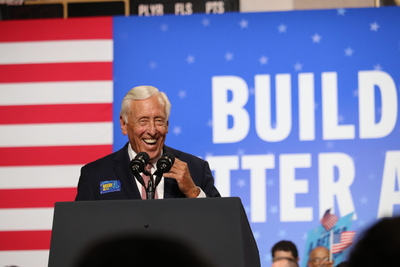
U.S. Rep. Steny Hoyer, a Maryland Democrat, at a Democratic rally in 2022. (Photo by Danielle E. Gaines/Maryland Matters)
“Republicans claim falsely that our elections are plagued by fraud and that more needs to be done to secure the vote,” Rep. Steny Hoyer, a Maryland Democrat, said in a statement to States Newsroom.
“Yet, they have consistently undermined the security of our elections, including by proposing to cut election-security grants by two-thirds and the Election Assistance Commission’s (EAC) overall budget by almost 30% in Fiscal Year 2027,” Hoyer said. “This will leave states without critical resources to secure their voting systems and adopt the latest in voting technology and best practices.”
Hoyer, who helped spearhead the 2002 legislation creating the EAC and is the ranking Democrat on the Appropriations subcommittee that oversees the agency’s budget, said it has been a tremendous benefit to state and local election officials and to the integrity of the vote.
“I will continue to oppose Republican efforts to cut its funding,” he said.
Congressional GOP embraces Trump
The bill represents only one, early step in the appropriations process. The House hasn’t voted on it and the Senate could eliminate or alter the cuts, with any differences eventually worked out in a conference committee.
The House Appropriations Committee, which is not burdened with the Senate’s need for bipartisan approval of most legislation, in past years has also put forward cuts to election security grant funding that have been abandoned later.
Still, the measure this year demonstrates how House Republicans have embraced Trump’s focus on noncitizen voting.
While cutting the EAC and election security funding, the bill includes a provision prohibiting the use of funds to register noncitizens to vote. Noncitizens are already prohibited from voting in federal elections and only a very small number of municipalities allow noncitizens to vote in local contests.
Oklahoma Republican Rep. Tom Cole speaks with reporters at the U.S. Capitol in January 2024. (Photo by Jennifer Shutt/States Newsroom)
“The people demanded a new mandate, we’re carrying it forward. That includes reinforcing President Trump’s work to … ensure that only citizens vote in our elections,” Rep. Tom Cole, an Oklahoma Republican and the Appropriations Committee chairman, said at an April meeting.
A spokesperson for Rep. Dave Joyce, an Ohio Republican who chairs the Appropriations subcommittee that developed the bill, didn’t respond to a request for comment.
Funding ebb
Congress created the EAC in the 2002 Help America Vote Act, passed in the wake of the 2000 presidential election and the Florida recount.
A bipartisan commission leads the agency, which has about 70 employees, according to its 2025 annual report. It focuses on aiding state and local election officials with training and other resources, certifying voting equipment and overseeing grant programs.
Gideon Cohn-Postar, director of federal affairs at the Institute for Responsive Government, said election officials generally want Congress to provide about $400 million a year, a figure that reflects lawmakers’ initial commitment to the grant program in 2018 and would allow states to make significant strides in bolstering their election infrastructure.
Each year’s grants are split between states and territories based on a formula. In practice, most receive the minimum amount. The $45 million grant for 2026 translated into $819,000 for most states, with a mandatory 20% match.
“It’s absolutely insufficient,” Cohn-Postar said.
State spending
A December 2024 report from the Bipartisan Policy Center measuring the impact of the grant program found that cybersecurity constituted the single largest category of grant spending, at over $200 million, followed by nearly $150 million on voting equipment.
Some states save up their grant money over several years to help pay for larger purchases, like voter registration systems, with the money earning interest in the meantime. As of March 2025, states had collectively spent 69% of their grant dollars, according to the latest data available from the EAC.
Two states — Nevada and Ohio — have spent 100% of their funds. Only Louisiana has spent none, ahead of a future elections system overhaul.
In Connecticut, election officials have spent 95% of the $13.8 million it has received in election security grants over the years, according to the EAC data. The funds have helped towns conduct security audits, Connecticut Democratic Secretary of State Stephanie Thomas said in an interview.
As an example, Thomas said when she took office in 2023 not all of the town’s systems were on a government online domain but most have now adopted one.
“Someting like that, it never gets the headlines but hugely important from a security perspective,” Thomas said.
Commission warns against cuts
EAC commissioners have been warning Congress that unstable funding and budget cuts would harm their agency’s work. All three current commissioners and a recent former commissioner testified at a House Administration Committee hearing on election security in May, where they cautioned lawmakers against reduced and unpredictable resources.
Commissioner Benjamin Hovland, a Democratic appointee of Trump, noted that while Congress has provided “significant” funding since the 2002 law, federal dollars have covered less than 5% of the total cost of running elections during that time.
Election officials today face challenges that would have been unimaginable when the law was passed, he said, adding that commissioners heard enthusiasm for the EAC’s work in recent meetings with officials.
“But the agency is nearing a point where funding cuts will impact what we can accomplish, and the support we can provide election officials, especially related to election security,” Hovland said.
States frequently tell the EAC they want federal funding that is “predictable, consistent, and sufficient” to support long-term planning, said Christy McCormick, a Republican commissioner appointed by President Barack Obama.
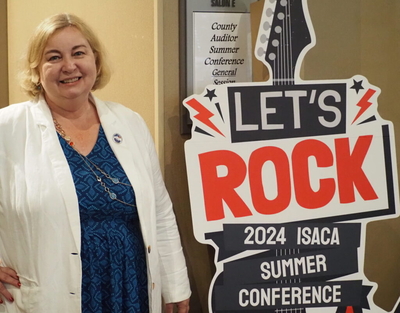
U.S. Election Assistance Commissioner Christy McCormick spoke at the Iowa State Association of County Auditors summer conference in Des Moines in June 2024 about federal resources available to local election officials. (Photo by Robin Opsahl/Iowa Capital Dispatch)
The EAC’s adoption of newer, more rigorous standards for election equipment illustrates the importance of funding for state and local election officials.
In 2021, the EAC adopted the Voluntary Voting System Guidelines 2.0, or VVSG 2.0, replacing the earlier 1.0 guidelines. The technical standards are designed to enhance security, such as requiring air gapped systems, and greater accessibility for voters with disabilities.
While states are not required to use VVSG-certified machines, many states have followed the EAC’s lead and mandated the use of machines that meet these standards. Upgrading is expensive, however.
In the meantime, election technology continues to age. By 2028, the average age of modern voting equipment will rise to 9.3 years old, up from just 4.9 years old in 2020, according to a report from the Bipartisan Policy Center released in late May. The report identified “episodic and unpredictable” federal funding as one obstacle to states purchasing VVSG 2.0 equipment.
“Federal support is absolutely key to making sure that election infrastructure is functioning well at the state and local levels,” Will Adler, a co-author of the report, said in an interview.
‘Don’t give me any more money’
To be sure, some state election officials are skeptical of accepting grant funding. Kansas Republican Secretary of State Scott Schwab told a congressional hearing in April that elections are best run and funded locally.
He said he previously accepted grant dollars but that state lawmakers then didn’t approve the required matching funds, leaving his office in a bind.
“I would rather, because of the strings attached, just don’t give me any more money,” Schwab said. “If we need more money, we can handle it locally.”
But since the House Appropriations Committee advanced cuts to the EAC and the election security grants in April, numerous election officials and voting rights groups have urged lawmakers to reconsider.
On May 12, the Project for Election Infrastructure sent a letter signed by several dozen local election officials asking senators for $400 million in election security grants, with at least two-thirds directed to localities. The true cost of modernizing and fully securing American election systems will run billions of dollars, the letter warned.
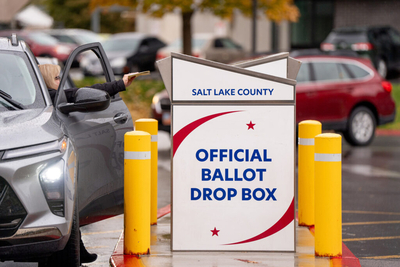
Bollards surround a ballot drop box at the Salt Lake County Government Center in Salt Lake City on Election Day, Tuesday, Nov. 5, 2024. (Photo by Spenser Heaps for Utah News Dispatch)
The National Association of Counties on June 2 asked House and Senate appropriations leaders to not cut funding. The years between presidential elections are when “critical groundwork is laid,” the association’s CEO and executive director, Matt Chase, wrote in a letter.
Chase ticked through typical security expenses that can quickly add up. Bollards to protect remote drop boxes can cost $500 to $4,000 per bollard. Key card access at election facilities can cost $1,500 to $5,000 per door. Video surveillance cameras can run hundreds to thousands of dollars.
“Federal investment scaled only to presidential cycles leaves counties without the resources needed to be ready when turnout surges,” Chase wrote.
Thomas, the Connecticut secretary of state, echoed the sentiment.
“I feel that many people use the term election security almost like a slogan,” Thomas said. “But election security is actually year-round work.”
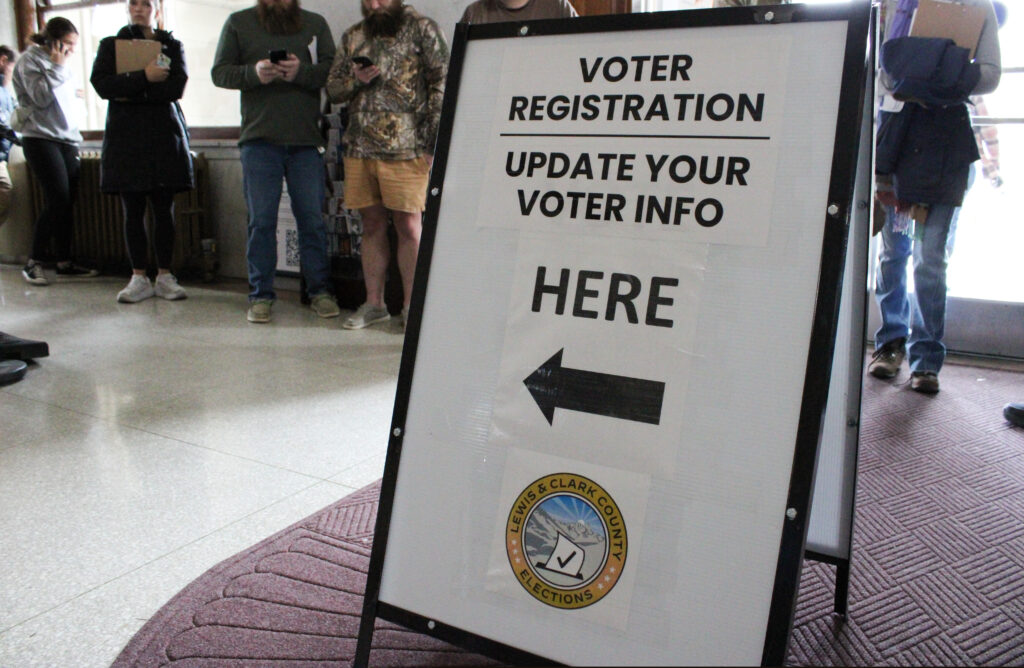
Montanans stand in line to register to vote at the Lewis and Clark County Elections Office on Nov. 5, 2024. (Photo by Blair Miller/Daily Montanan)
The U.S. Senate rejected the SAVE America Act on Thursday, dealing a blow to President Donald Trump’s efforts to impose voting restrictions ahead of the November midterm elections.
Senators voted 48-50 against advancing an amendment that would have incorporated Trump’s top legislative priority into an immigration-focused spending bill. The vote offered the clearest sign yet that despite pressure from the president, a handful of Republican senators continue to resist advancing the bill, which critics say would unleash immense chaos ahead of elections this fall.
The SAVE America Act would require voters to offer documents, such as a birth certificate or passport, proving their citizenship when registering to vote. It would also mandate voters show photo ID when casting a ballot and restrict where voters can register, effectively eliminating voter registration drives.
Democrats and voting rights groups have assailed the bill, saying it would disenfranchise voters and upend the midterms because the new rules would take effect immediately. Trump and the bill’s GOP supporters say it’s needed to combat noncitizen voting, an extremely rare phenomenon.
Since taking office last year, Trump has made a series of attempts to shape how elections are run. An executive order that would limit voting by mail remains in effect for now as opponents challenge it in federal court, and the Department of Justice continues to seek to force states to hand over sensitive voter data, so far unsuccessfully.
The Senate amendment, offered by Republican Sen. Lindsey Graham of South Carolina, also included restrictions on sports participation by transgender athletes. On social media after the vote, Graham called the SAVE America Act “one of the most consequential” pieces of legislation developed by Trump and his team.
“All Democrats voted no, and they will eventually pay a price,” Graham wrote.
Republicans also vote no
But the proposal fell short among a small group of Republicans, too. Sens. Susan Collins of Maine, Mitch McConnell of Kentucky, Lisa Murkowski of Alaska and Thom Tillis of North Carolina joined Democrats in voting no.
Collins is seeking reelection in what is one of the most competitive Senate races in the country. McConnell and Tillis have both opted against seeking reelection, while Murkowski has said the bill would set up barriers for voters in her large, rural state.
Sixty votes would have been needed to advance the amendment — the same threshold to overcome a filibuster.
The vote came after the Senate spent weeks debating the SAVE America Act earlier this year before moving on to other business without a vote. Trump has urged Republicans to abandon the filibuster to pass the bill, without success.
“We will squash this blatant attempt at voter suppression,” Sen. Mark Warner, a Virginia Democrat, wrote on social media after the vote.
The Senate also rejected, 50-49, a separate amendment offered by Sen. Mike Lee, a Utah Republican, that included a different version of the SAVE America Act. According to Lee, the amendment was the version of the bill passed by the House, which didn’t include provisions on transgender athletes.
Collins voted in favor of the amendment after earlier opposing Graham’s amendment.
California
Both amendments failed hours after Trump asserted, without evidence, that Democrats were stealing “the vote” in California. The state held primary elections earlier this week, but vote counting is often slow in the state, meaning vote totals reported on election night don’t always reflect the final outcome of a race.
Trump linked California’s elections to his push for the SAVE America Act, writing on social media that “I hope Republicans are watching” so they could pass the legislation.
“They found a lot of mail-in ballots last night, shockingly,” Trump said at an unrelated Oval Office event on Thursday. “So we don’t want that.”
With the Senate unwilling to advance the SAVE America Act, some GOP lawmakers have begun offering alternative election-related bills.
Republican Reps. Julie Fedorchak of North Dakota and Laurel Lee of Florida on Thursday introduced the SAVE America Through REAL ID Act, which would create a grant program to help states provide REAL ID-compliant driver’s license and identification cards to residents for free to low-income Americans.
On Tuesday, Sen. Marsha Blackburn, a Tennessee Republican, and Graham introduced the Election Security Partnership Act, designed to encourage states to submit their voter rolls to a computer program operated by the Department of Homeland Security that can identify possible noncitizens.
States can already upload voter data to the program, called Systematic Alien Verification for Entitlements or SAVE, but the legislation would provide $20 million in grants for states to offset any costs related to using SAVE.
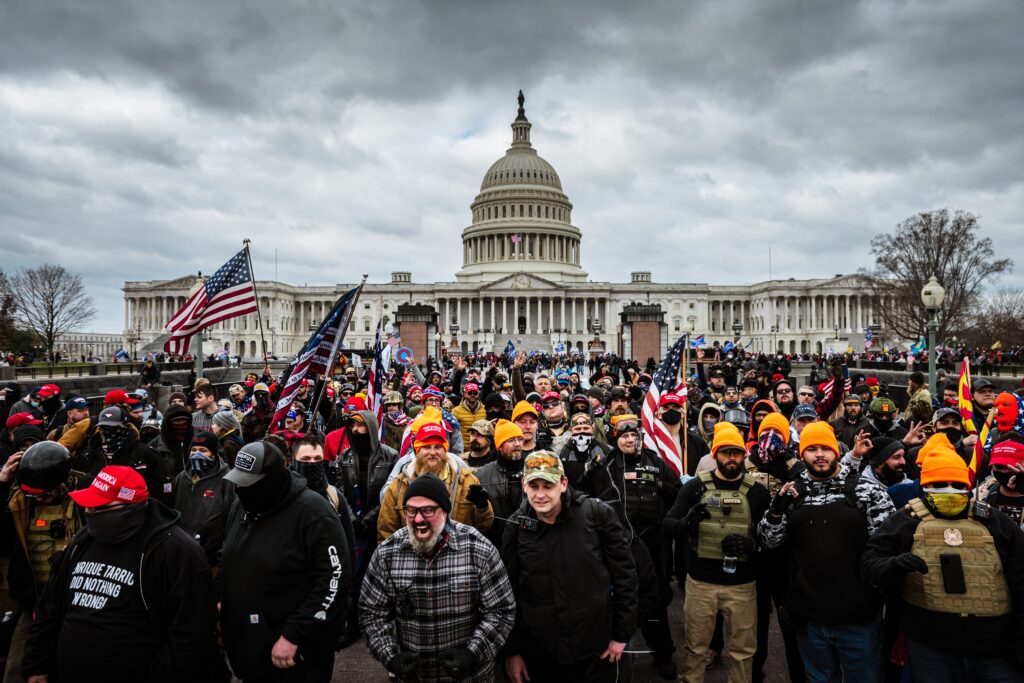
A mob of Trump supporters gathers in front of the U.S. Capitol Building on Jan. 6, 2021 in Washington, DC. An “anti-weaponization” fund was created by the Department of Justice in May 2026 that could make payments to those who took part in the Jan. 6 attack. (Photo by Jon Cherry/Getty Images)
President Donald Trump’s extraordinary $1.776 billion fund to pay off allies and others who say they have been wronged by past administrations has drawn widespread condemnation by opponents, including some Republicans, who characterize it as an act of brazen corruption.
But the Trump administration’s push to reward its supporters also harkens back to an earlier era of American cronyism, experts say, while expanding the frontiers of political favoritism.
From the early years of the United States until well into the 19th century, a spoils system dominated the federal government. Presidents handed out jobs to supporters, filling the bureaucracy with workers who had demonstrated loyalty to the administration in power.
President Andrew Jackson (Courtesy Library of Congress)
Trump’s political idol, President Andrew Jackson, replaced large numbers of federal officials after his 1829 inauguration, for instance. One appointee to a role at the Port of New York made out with more than $1 million, valued at tens of millions today.
The comparison isn’t exact. The spoils system was associated with the distribution of government jobs to political allies, a practice called patronage. Trump’s new fund would instead deliver taxpayer dollars directly to favored individuals.
Yet, academics who have studied the spoils system and the presidency see parallels between the past and present — with a desire to reward allies and build allegiance at the center of it all.
“It seems to me that may be the common element here,” said Sidney Shapiro, a professor of law at Wake Forest University who wrote before the 2024 election that Trump wanted to reinstate the spoils system. “It appears President Trump is thinking about using the fund to reward people unfairly punished, but I think in his mind it’s unfairly punished because they were trying to support him.”
Five-member board to be named by Trump
The Department of Justice announced the “anti-weaponization fund,” which critics call a “slush fund,” on May 18 as it moved to settle a lawsuit Trump had filed in his personal capacity against the IRS over the leaking of his tax returns by a former agency contractor.
The suit placed Trump in the extremely unusual position of effectively negotiating with himself because he has erased the DOJ’s post-Watergate tradition of independence from the White House.
Even before the settlement, the Justice Department under Trump had taken actions that would have been unheard of in other recent administrations. For instance, federal prosecutors have brought a case against former FBI Director James Comey and tried to pursue criminal charges against New York Democratic Attorney General Letitia James.
The DOJ has also obtained an indictment against the Southern Poverty Law Center, a frequent critic of GOP politicians.
Trump’s settlement agreement provides for the creation of the fund overseen by a board of five members chosen by acting Attorney General Todd Blanche, who previously served as Trump’s personal attorney. Trump can fire the members for any reason.
The fund’s board will have the power to make decisions about payments, as well as issue formal apologies. Claims submitted to the fund must be processed by Dec. 1, 2028, prior to the end of Trump’s term.
Jan. 6 rioters line up
A bevy of Trump supporters and hangers-on have said they plan to apply for compensation. They include individuals who stormed the U.S. Capitol on Jan. 6, 2021, disrupting Congress’ certification of President Joe Biden’s Electoral College victory. Trump previously pardoned rioters when he took office in January 2025.
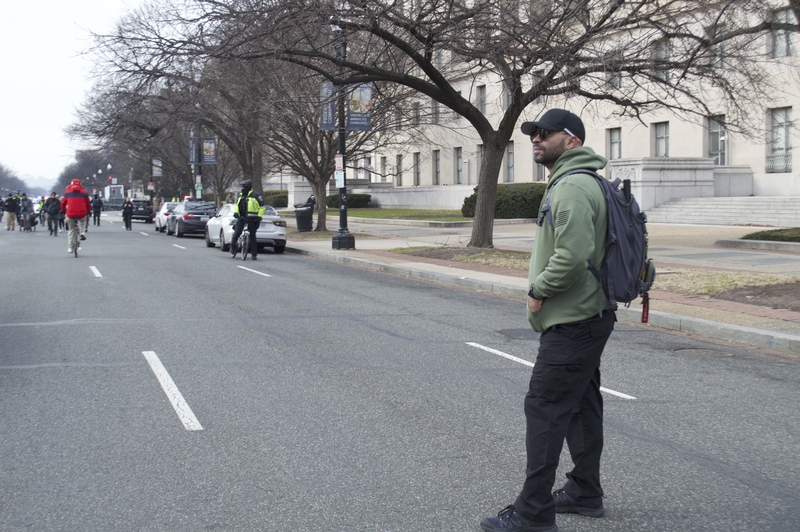
Former Proud Boys leader Enrique Tarrio, who was convicted of seditious conspiracy and sentenced to 22 years in prison before Trump pardoned him, predicted on a recent podcast that a “lot of J6ers are going to spend their money on firearms.”
Former national Proud Boys leader Enrique Tarrio looked on as far-right activists celebrating the Jan. 6 Capitol attack marched down Constitution Avenue on Tuesday, Jan. 6, 2026. Tarrio was sentenced to 22 years in prison on sedition charges related to the attack, but President Donald Trump commuted his sentence. (Photo by Ashley Murray/States Newsroom)
Trump has cast the fund as an act of magnanimity on his part because the settlement agreement doesn’t include a monetary payout to him.
However, Blanche also signed a document barring any additional scrutiny of the president’s past tax history, a move that shields him from audits. The New York Times and ProPublica reported in 2024 that Trump could have owed $100 million if he lost an audit battle over improper tax breaks.
“I gave up a lot of money in allowing the just announced Anti-Weaponization Fund to go forward. I could have settled my case, including the illegal release of my Tax Returns and the equally illegal BREAK IN of Mar-a-Lago, for an absolute fortune,” Trump wrote on Truth Social, referring to the FBI search of his Florida residence in 2022.
“Instead, I am helping others, who were so badly abused by an evil, corrupt, and weaponized Biden Administration, receive, at long last, JUSTICE!”
Trump has adopted a “patrimonial” approach to governing, James Pfiffner, a professor emeritus at George Mason University who has studied the presidency, wrote in an email to States Newsroom.
Benefits, like federal contracts, go to those who are loyal, Pfiffner wrote, and the government is treated as if it were a family business and the state’s resources were his personal property.
The “anti-weaponization fund” represents an extension of that approach, Pfiffner wrote, but also goes further than past presidents. He wrote that he could think of no past precedents in the modern presidency for such a blatant use of taxpayer money to potentially reward loyalists.
“At least in the spoils system, the people hired by the government were working and presumably doing their jobs,” Pfiffner wrote. “The beneficiaries of this fund have done nothing to earn their benefits, and presumably some will be rewarded for having committed crimes to overturn the 2020 election.”
Congress began curbing the spoils system after the 1881 assassination of President James Garfield by a spurned job seeker.
Over the next two decades, many federal positions were moved into a civil service system. While the federal government still includes some 4,000 political appointees today, the vast majority of the bureaucracy is staffed by civil servants.
Critics and defenders in Congress
But it’s unclear whether Congress will block Trump’s fund, despite an intense backlash.
Anger among Republican senators has stalled action on budget legislation funding immigration enforcement, which Democrats would have used to force votes on amendments to block the fund. Democrats have introduced multiple bills aimed at halting it.
“Congress cannot stand by while Trump turns the federal government into a political operation for his friends and cronies,” Sen. Michael Bennet, a Colorado Democrat, said in a statement.
Obstacles exist to congressional action. Even if Republicans who control both chambers voted with Democrats, Trump could veto bills passed placing restrictions on the fund, which would require two-thirds majorities in the House and Senate to override.
And some GOP lawmakers have defended the fund.
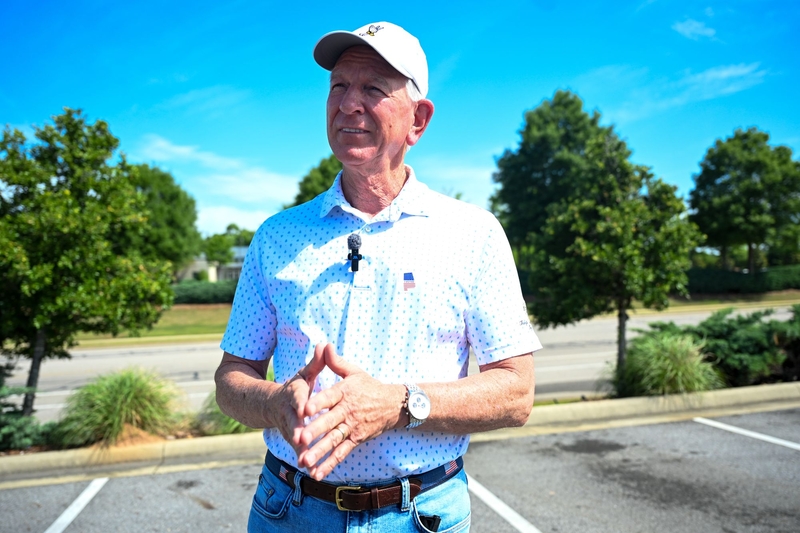
U.S. Sen. Tommy Tuberville, R-Ala., speaks to reporters after voting in the GOP primary in Auburn, Alabama on May 19, 2026. Tuberville has defended President Donald Trump’s “anti-weaponization” fund. (Photo by Anna Barrett/Alabama Reflector)
On May 21, Sen. Tommy Tuberville, an Alabama Republican, objected to a unanimous consent request by Sen. Alex Padilla, a California Democrat, to pass a bill that would prohibit payments to Jan. 6 rioters.
“Thankfully, acting Attorney General Todd Blanche and the Trump Department of Justice established a standard and lawful process to hear from American citizens who suffered lawfare or weaponization under the Biden administration,” Tuberville said on the Senate floor.
Lawsuits have been filed challenging the fund and how it’s structured. Two police officers who defended the Capitol on Jan. 6 have sued, warning that rioters could use the money to organize.
Fund blocked temporarily
On Friday, a federal judge in Virginia ordered the Trump administration to halt work on the fund for at least two weeks while she considers ordering a lengthier pause.
The decision came in a lawsuit brought by a former federal prosecutor fired by the DOJ and a California professor who was charged but acquitted of assaulting a federal officer after protesting an immigration raid.
Legal advocacy groups also argue Congress didn’t intend for federal money to be used for these kinds of payoffs.
“Another commonality is we the taxpayers are funding both,” Shapiro, the Wake Forest professor, said of the spoils system and the Trump fund. “We certainly fund the jobs that people have and now we’re funding this fund.”