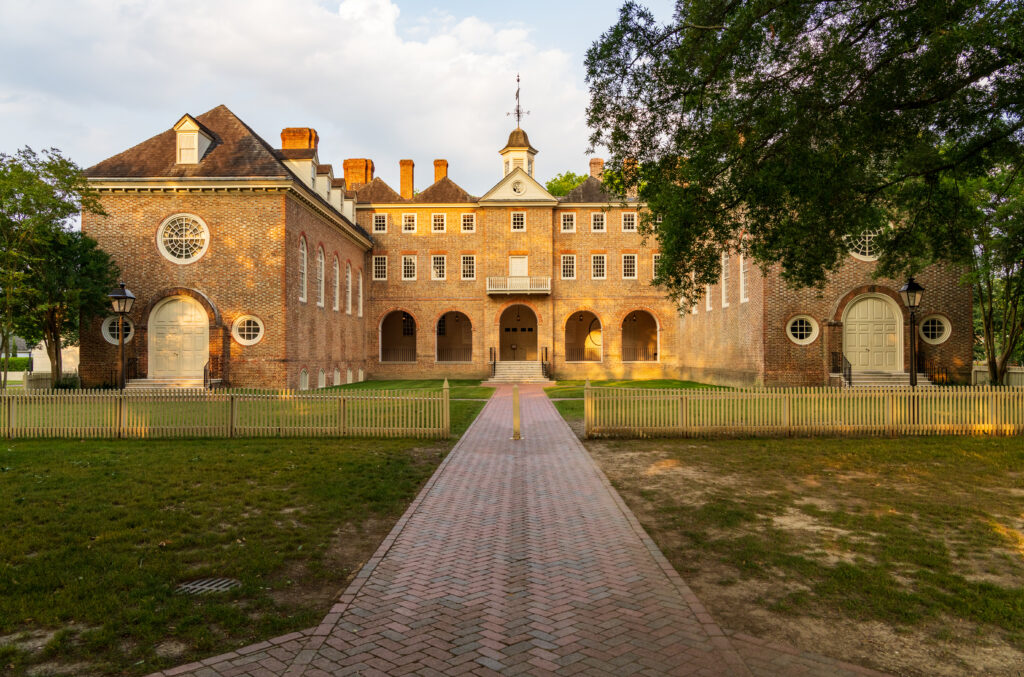
Back view of Wren building at William and Mary college in Williamsburg, Va. (Photo by Getty Images)
Governor Abigail Spanberger appointed 32 new members to governing boards at Virginia’s colleges and universities, continuing her effort to reshape higher education leadership across the commonwealth.
On Friday evening, Spanberger announced 52 appointments, including 20 reappointments. The move furthers her efforts to remake university leadership amid concerns about the politicization of public college boards.
“I am proud to appoint this talented group of individuals to serve on our higher education boards,” said Spanberger in a statement.
“I have full confidence that their leadership will strengthen our world class institutions while upholding the values that make our commonwealth’s colleges and universities the envy of the world. I look forward to their service as they advance opportunities for every student who walks onto our campuses.”
Among the new appointees are several well-known education figures, including James Dyke, former secretary of education; Cristin Grigos, senior vice president at the Association of Governing Boards of Universities and Colleges; and Ann Cherry, longtime Hampton school board member.
Other appointments, while not education experts, are widely recognized. They include former lawmaker Jeff Bourne; longtime NBA official Tony Brothers; Victor Branch, a regional bank executive; and Angela Reddix, founder and president of a healthcare company.
The appointments come shortly after Spanberger removed John Rocovich from Virginia Tech’s Board of Visitors after 16 years of service for what she described as “misconduct.” Spanberger’s letter did not specify the details of the alleged violations, stating only that the findings provided “sufficient cause” for his removal.
The General Assembly is responsible for confirming all appointments, which typically occurs during the legislature’s regular session at the start of each year.
Cannabis flower rests on a rolling tray, surrounded by a pack of rolling papers, a grinder and a lighter. Lawmakers in a handful of states this year have introduced legislation to impose stricter THC limits on certain cannabis products. Photo by Amanda Watford/Stateline)
When her son was a teenager, Connecticut mom Amy Wadsworth said, he was the type of kid parents rarely worry about.
He played sports, cared about his health and stayed away from drugs. In 2018, when he left West Hartford to start his freshman year at American University in Washington, D.C., she expected his biggest challenge would be adjusting to college life.
Instead, she said, he began using cannabis to cope with social anxiety and as a sleep aid.
Within months, Wadsworth’s son was calling home in the middle of the night, terrified and disoriented.
Over the next several years, his behavior became increasingly erratic, he had psychotic episodes and he was eventually diagnosed with severe cannabis use disorder. That’s when a person’s marijuana use becomes difficult to control and begins interfering with daily life.
Now 25, Wadsworth’s son has spent much of the past several years cycling through hospitals and treatment programs across the country.
“It’s definitely changed the trajectory of his life,” Wadsworth said. “It did nothing but harm him, literally harm every facet of his life — every facet, physical, mental, everything.”
States have spent the past several decades debating whether to legalize cannabis. Now, they are debating how intoxicating legal products should be.
A growing body of research suggests that frequent use of high-THC cannabis increases the risk of cannabis use disorder, psychosis and other mental health problems for users, particularly adolescents and young adults. In response, lawmakers in some states this year have moved to impose stricter potency caps, while others have scaled back or rejected such measures amid industry opposition and uncertainty over research findings.
While cannabis flower once commonly contained THC levels in the single digits, many products sold legally today contain 15% to 20% THC or more. Concentrates — such as waxes, oils and shatter — can exceed 80%.
About 15% of Americans ages 12 and older reported using marijuana in the past month in 2024, according to the Substance Abuse and Mental Health Services Administration. And about 3 in 10 people who use cannabis have cannabis use disorder, according to the federal Centers for Disease Control and Prevention.
Some public health researchers and addiction specialists argue that public perceptions of marijuana have not kept pace with the growing availability of high potency products. They say broader legalization efforts — including the federal government’s recent move to reclassify medical marijuana as a less restrictive drug under the Controlled Substances Act — may reinforce the belief that cannabis is harmless.
“Moving cannabis from Schedule I to Schedule III doesn’t help me save lives by decreasing the perception of that risk,” said Dr. Alta DeRoo, the chief medical officer of the Hazelden Betty Ford Foundation, one of the largest nonprofit treatment providers for addiction and mental health. DeRoo also is a board-certified addiction medicine physician and OB-GYN.
Some state efforts to impose potency limits have been stalled by resistance from the cannabis industry and questions about how far governments should go in regulating a legal product.
In Connecticut, lawmakers this year reinstated a 35% THC cap on flower just weeks after voting to eliminate it. Lawmakers from both sides of the aisle said they were concerned about the potential public health effects of increasingly potent marijuana products.
At the same time, the legislation moved forward with other cannabis market expansions. Lawmakers removed a 70% THC cap on concentrates, increased the amount of THC allowed in certain cannabis-infused beverages and expanded the market to include products such as topicals, tablets and capsules.
Proposals to cap THC potency have surfaced in statehouses across the country for years. This year, lawmakers in California, Georgia, Mississippi, Oklahoma, Oregon and South Dakota introduced similar measures, though most did not advance.
Georgia Republican Gov. Brian Kemp signed a law in May that removes the state’s previous 5% THC potency cap starting July 1. The new law will also add a 12,000 mg possession limit for registered medical cannabis patients and allow patients over 21 to vaporize medical marijuana.
‘A perennial debate’
Lawmakers across the country have proposed a range of measures aimed at limiting the potency of cannabis products.
In Washington state, Democratic state Rep. Lauren Davis has spent years trying to place guardrails on high-potency cannabis products. Since 2020, she has introduced at least five bills that would have capped THC levels in concentrates or imposed safeguards, including age restrictions, warning labels and a higher tax rate on products with elevated THC levels.
Most of those measures were thwarted by opposition from the cannabis industry, Davis told Stateline.
Industry groups and cannabis businesses argued that Washington’s existing regulations already protected consumers and kept cannabis away from minors. Opponents also warned that limiting high-THC products would drive consumers to the illicit market, hurting legal businesses and exposing users to unregulated, possibly contaminated products.
“(The industry) then went on to basically rain down all fire and brimstone and crush every bill that I’ve ever attempted in this area,” Davis said.
The only proposal to become law was a 2024 measure that requires retailers to warn customers about the association between high-potency THC products and psychotic disorders.
Washington state does not currently impose THC caps on flower or concentrates, but it does set limits on edibles and beverages.
Nearly all states have some form of medical-only or hybrid medical and recreational cannabis program, but just eight states, Connecticut, Mississippi, Montana, Nevada, New Mexico, Oregon, Rhode Island and Vermont, have potency caps on some products, including flower, according to the National Conference of State Legislatures. Potency limits on edibles are far more common.
“This is a perennial debate that comes up in Vermont and elsewhere around higher potency products,” said James Pepper, who chairs the Vermont Cannabis Control Board, the agency that regulates the state’s market.
“I feel like the concerns are certainly real,” he added.
In Oklahoma, a recent incident in which a 4-year-old boy was hospitalized and remained unconscious for more than a day after his parents said he ingested a 1,000 mg edible found at a playground has added to growing debate over high-potency cannabis products in the state.
“We know that some of our medical patients truly do need higher potency products, but do we really need a 2,000 milligram gummy available for anyone with a patient license to purchase in an Oklahoma dispensary?” said Adria Berry, the executive director of the Oklahoma Medical Marijuana Authority, which oversees the state’s medical market.
Oklahoma Republican Gov. Kevin Stitt also signed a measure into law last month that will take effect in November, adding stricter packaging and labeling requirements, including restrictions intended to prevent products from resembling candy or appealing to children.
While some industry experts acknowledge the potential harms, they say the focus should be on consumer education and clear information about potency and effects, rather than new restrictions.
An official with Trulieve, a cannabis company that operates dispensaries in eight states, told Stateline that its products are independently tested and that potency information is available for customers to review and ask questions about, including a product’s effects.
“We believe that that piece of information is critical for a consumer to make an educated decision on what type and what potency of product they are looking to consume,” said Lauren Niehaus, Trulieve’s executive director of government relations.
Some advocacy and trade groups, such as the National Cannabis Industry Association and the National Organization for the Reform of Marijuana Laws (NORML), argue that policymakers should steer consumers into tightly regulated legal markets rather than imposing blanket THC caps that could push some users back to illicit sellers. They say that accurate labeling, child-resistant packaging and public education campaigns are the best strategies to protect public health and prevent youth access.
“It’s undoubtedly safer and better for public health outcomes to regulate these products,” said Adam Rosenberg, who chairs the board of the National Cannabis Industry Association.
Paul Armentano, NORML’s deputy director, said potency caps oversimplify the risks of cannabis products and fail to account for how consumers actually use them. Consumers view ultra-potent products as a novelty, he said, and ultimately gravitate toward lower-potency options.
“When you look at state-tracked sales in legal states, cannabis flower or botanical cannabis still outsells every other product, and I would dare say it’s because that is the most moderate to low potency product available on the shelf, and that’s what most people want,” Armentano said.
Armentano also argued that some of the strongest calls for THC limits come from opponents of legalization, who see potency restrictions as a way to gradually roll back access to legal cannabis.
What the research says
A study published earlier this year in JAMA Health Forum found that adolescents who use cannabis, including products with higher potencies, had a significantly increased risk of developing psychotic and bipolar disorders, along with higher risks of depression and anxiety. The research followed about 463,000 adolescents in Northern California between ages 13 and 17 and tracked outcomes into early adulthood. The study did not, however examine whether the use of higher-potency products is more likely to cause psychotic and bipolar disorders.
But other research has linked frequent use of high-potency cannabis to a greater risk of psychosis and psychotic disorders, particularly among heavy users. Several studies have found a dose-response relationship, meaning the risk tends to rise as THC concentration and frequency of use increase. Experts caution, however, that many studies cannot definitively prove that cannabis causes psychosis and that individual risk varies widely.
Other research suggests the risk of developing psychosis may be higher for adolescents and young adults, whose brains are still developing, as well as people with existing mental health conditions or a family history of psychotic disorders.
“I’ve seen patients come through our facilities where they haven’t done any other drugs other than just high-potency marijuana, and their psychosis is remarkable,” said DeRoo, of the Hazelden Betty Ford Foundation. “They don’t have a grasp of reality. They come in seeing things, they come in believing things, alternate realities.”
John Puls, a psychotherapist and addiction specialist in Florida, has seen similar patterns in his practice at Full Life Comprehensive Care, particularly among adolescents and young adults using high-potency products.
He said families often don’t believe cannabis alone could be driving such dramatic changes. Beyond psychosis, he added, cannabis can chip away at more ordinary parts of life: Motivation drops, executive functioning suffers, patients miss appointments or forget obligations, and short‑term memory and relationships start to fray.
Some medical and industry experts say that cannabis can provide meaningful relief for some people, including those undergoing cancer treatment or who have chronic pain. But there is very little consensus on appropriate medical uses, dosing and long-term effects, particularly as products vary widely in potency.
“If there’s no standardized testing of products, or if there’s no enforcement of potency limits, then we might be putting people at more risk,” said Dr. Smita Das, an adult addiction psychiatrist and a clinical professor at Stanford University School of Medicine.
Stateline reporter Amanda Watford can be reached at [email protected].
This story was originally produced by Stateline, which is part of States Newsroom, a nonprofit news network which includes Virginia Mercury, and is supported by grants and a coalition of donors as a 501c(3) public charity.
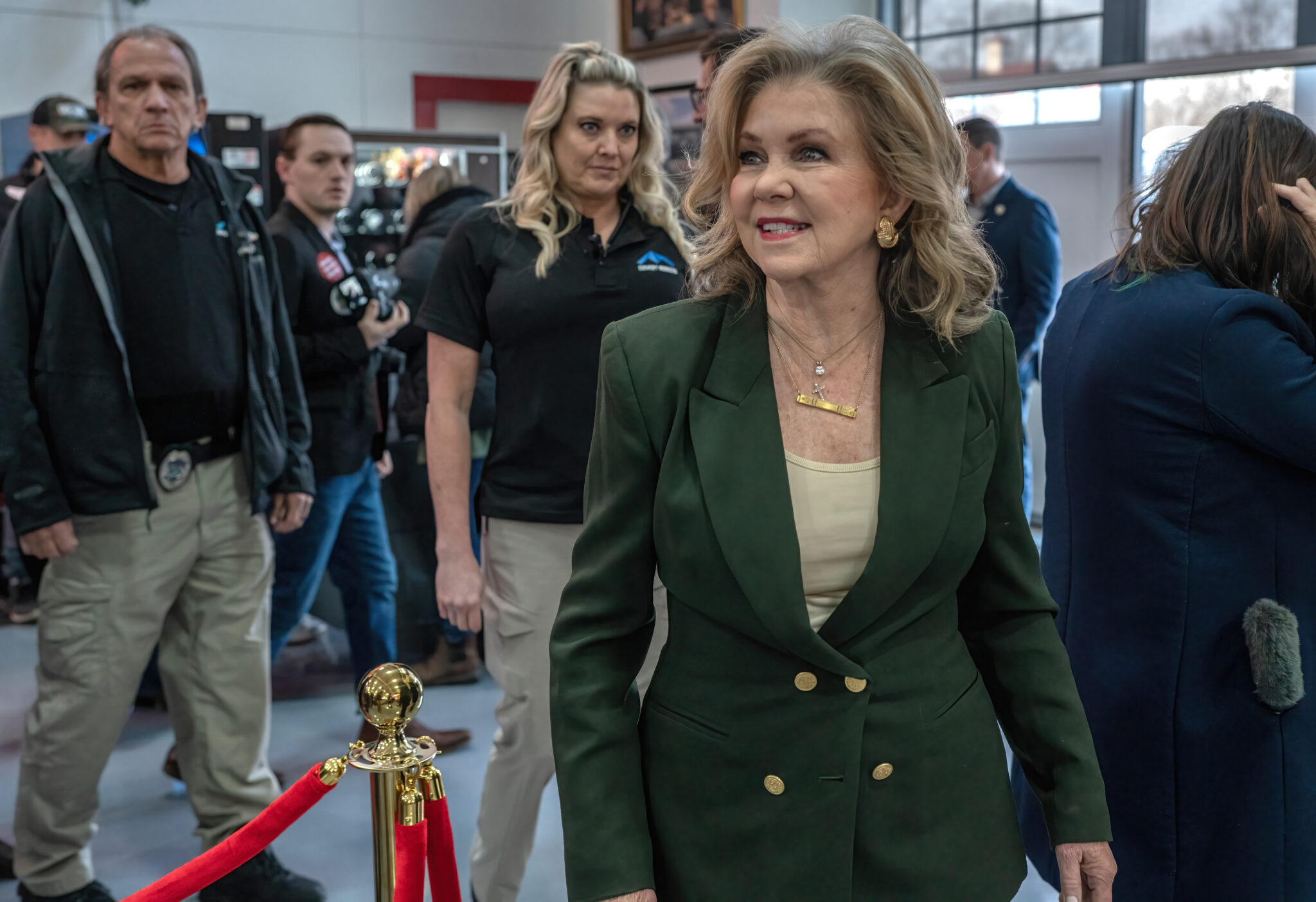
I do! It was taken on Dec. 1, 2025, at the Franklin, Tennessee home of billionaire Republican donor Willis Johnson during a GOTV event for U.S. Rep. Matt Van Epps in the CD7 special election.
By Elena Tittel/Medill News Service
WASHINGTON – A North Carolina jury convicted a man for carjacking a truck from a McDonald’s parking lot by holding something “cold and hard” on the driver’s neck. A federal appeals court overturned the conviction in 2016, citing insufficient evidence.
“The evidence was insufficient to support a rational finding beyond a reasonable doubt that (Kenneth) Bailey possessed the specific intent, conditional or otherwise, to kill or seriously harm his victim when he took control of the vehicle,” a panel of the U.S. Court of Appeals for the 4th Circuit wrote in its ruling.
Cases like that inspired some in Congress to propose a federal law that would make it easier for prosecutors to convict people of carjackings. That could result in harsher sentences, even the death penalty.
People younger than 25 make up most of the carjackers, causing advocates and Democratic legislators to argue that a lower threshold for proving carjackings could result in many young adults, especially Black men, spending decades in prison.
“These tough on crime, really extreme sentencing schema don’t really work, and they only end up incarcerating more youth and perpetuating racial disparities,” said Malik Pickett, a senior attorney at the Juvenile Law Center, a nonprofit public interest law firm and national advocacy organization.
The bill, dubbed the Federal Carjacking Enforcement Act, was introduced on May 1, 2025, by Sen. Marsha Blackburn, R-Tenn. The Senate Judiciary Committee on April 30 advanced the measure with an 18-4 vote. But the measure has not yet faced a floor vote. An identical House version introduced by Rep. Barry Moore, R-Ala., in November has not had any action yet.
In Washington, D.C., which has a higher-than-average carjacking rate, there have been 1,751 carjacking offenses between January 2023 and the end of May 2026, 1,273 of which involved a firearm, according to the Metropolitan Police Department.
Proving intent
The federal carjacking statute first came into effect in October 1992. On Sep. 13, 1994, the statute was amended to include “Whoever, with intent to cause death or serious bodily harm takes a motor vehicle” and added the possibility of the death penalty in cases when someone was killed.
However, some lawmakers said the need to prove intent made it difficult for prosecutors to convict carjackers.
“We need to make it easier for federal prosecutors to combat and prevent carjackings,” Blackburn said in a statement following an April hearing. “My Federal Carjacking Enforcement Act would make our streets safer for Tennesseans and all Americans by fixing a broken statute that has hindered federal prosecutors from holding carjacking offenders accountable.”
The bill would change the required standard of proof so that prosecutors would instead need to show a defendant acted “knowingly,” rather than needing to prove the defendant acted “with intent” to cause harm.
In some previous cases, prosecutors failed to prove intent, making prosecution difficult. For instance, in the North Carolina case, Kenneth Lee Bailey Jr. stole someone’s truck in a McDonald’s parking lot. In Bailey’s testimony, he claimed he approached the witness’s car and asked for a ride, promising payment. However, when the witness refused, Bailey forced his way into the car and placed something “cold and hard” on the driver’s neck. The prosecutor failed to prove that it was a weapon.
Intent requires prosecutors to prove that the defendant wanted to inflict harm, whereas knowingly only requires the prosecutor to prove the defendant was aware that their actions would result in harm, even if that was not their goal.
“Federal prosecutors shouldn’t have to read minds to put dangerous criminals behind bars,” Moore said in a press release.
Penalties for carjackings too harsh, some argue
People convicted of serious carjacking crimes can face between 15 to 25 years in prison, depending on if serious bodily injury results. If death results, the defendant could face life in prison or the death penalty, the statue states.
Sen. Cory Booker, D-N.J., said during the April hearing that easier convictions and stricter sentences for carjackings might do more harm than good.
“Federal prison does not put young people on a better path,” Booker said. “Carjackings are a serious crime … but I think here this bill is doing some things that have been proven to be misguided, that undermine a sense of fairness and decency.”
Youth criminal justice advocates argued against the change in the federal carjacking legislation to make it stricter.
Carjackings “are traditionally local offenses that should be left in the hands of communities,” said Liz Komar, senior policy counsel at The Sentencing Project, an advocacy group. “They don’t need more aggressive federal penalties.”
Young people convicted
Research from The Sentencing Project shows carjacking convictions disproportionately involve young adults. From 2020 to 2024, nearly half of carjacking convictions involved individuals 24 or younger.
Data from the Council on Criminal Justice also shows that Black men are disproportionately convicted of carjackings. Between 2018 and 2022 across 10 U.S. cities, the Black offending rate was higher than the white offending rate for carjacking, robbery and motor vehicle theft.
Komar said that young people committing these crimes might not realize what they are doing is a serious crime.
“I think we’ve seen on social media, particularly in some cities, for carjacking to be related to young people engaging in risk-seeking behavior who don’t understand that what they’re doing is a crime,” Komar said. “They’re certainly not entering into it with the intent to seriously harm someone and then spend decades in prison, and nonetheless, that’s what may result.”
Democrats and youth advocates argued against the new legislation, citing research that showed that for those convicted under the age of 25, their brains are still developing. Research cited by The Sentencing Project has shown that young people are most at-risk for committing crimes in their late teenage years to their mid-twenties, raising questions as to whether lengthy prison sentences are appropriate for young defendants
However, this hasn’t stopped federal prosecutors from prosecuting youths and imposing long sentences:
In January 2020, 19-year-old Elijah Roberts from St. Louis was sentenced to 11 years and two months in federal prison for his involvement in a February 2018 armed carjacking, which would have made Roberts 17 at the time.
In May 2025, 20-year-old Bryant Hoskins and 19-year-old Samuel Fancher, Jr. of Indianapolis were sentenced to 17 years in federal prison each after pleading guilty to two counts of armed carjacking that took place in May 2024.
In April 2026, 21-year-old Jaquell Blackwell – a member of the “5zzly” crew, a Bronx-based gang – was sentenced to 63 months in prison for committing three armed carjackings. Another member, 21-year-old Abodul Azika, was sentenced to 87 months in December 2025 for his participation in an armed carjacking with Blackwell and two other armed carjackings. The carjackings took place between June 2022 and June 2023, which would have made the men around 18 at the time.
In his motion, he argued that these offenses were committed prior to the age of 25, “placing him squarely within the class of youthful offenders now recognized by the Sentencing Commission and courts as possessing heightened capacity for rehabilitation.”
The U.S. Sentencing Commission, an independent federal agency, was created to respond to widespread disparity in federal sentencing.
Govan also argued that the effects of the COVID-19 pandemic made his sentence more severe than the U.S. District Court for the Southern District of Indiana originally intended and that he had “endured prolonged lockdowns, suspension of rehabilitative programming and heightened exposure to illness all while suffering from multiple mental health condition[s] which he was diagnosed [with] as a child,” according to court filings.
Still, the court ruled that such circumstances do not constitute extraordinary and compelling reasons for release.
Medill News Service articles are reported and written by graduate student journalists in the Washington program of the Medill School at Northwestern University.
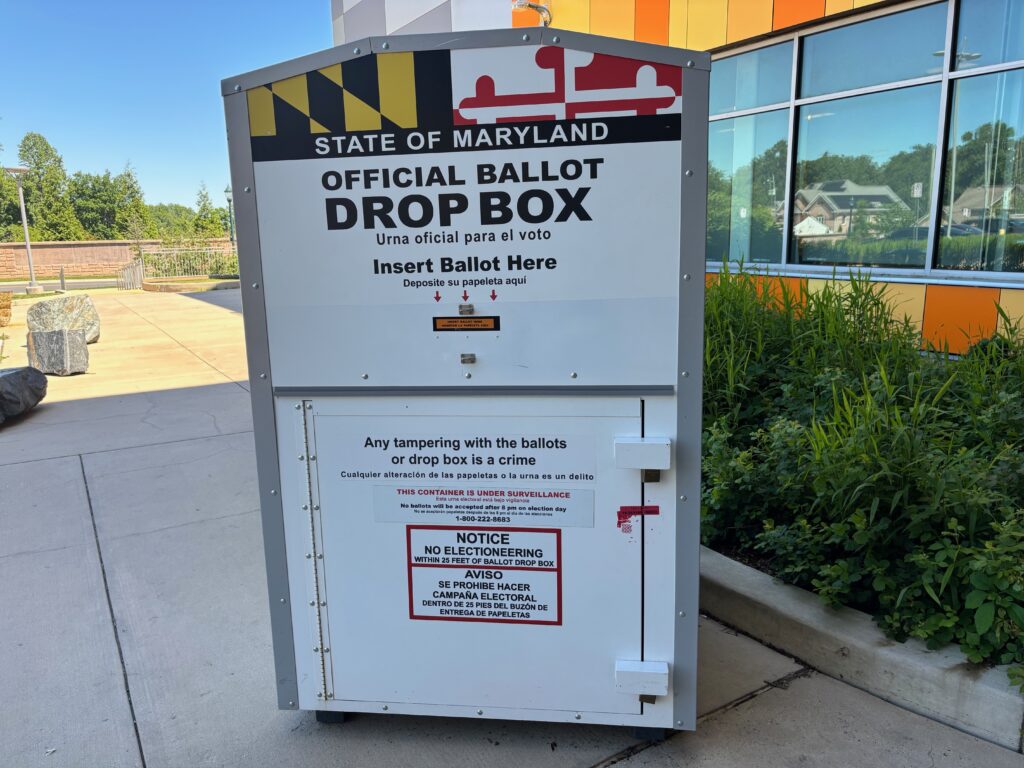
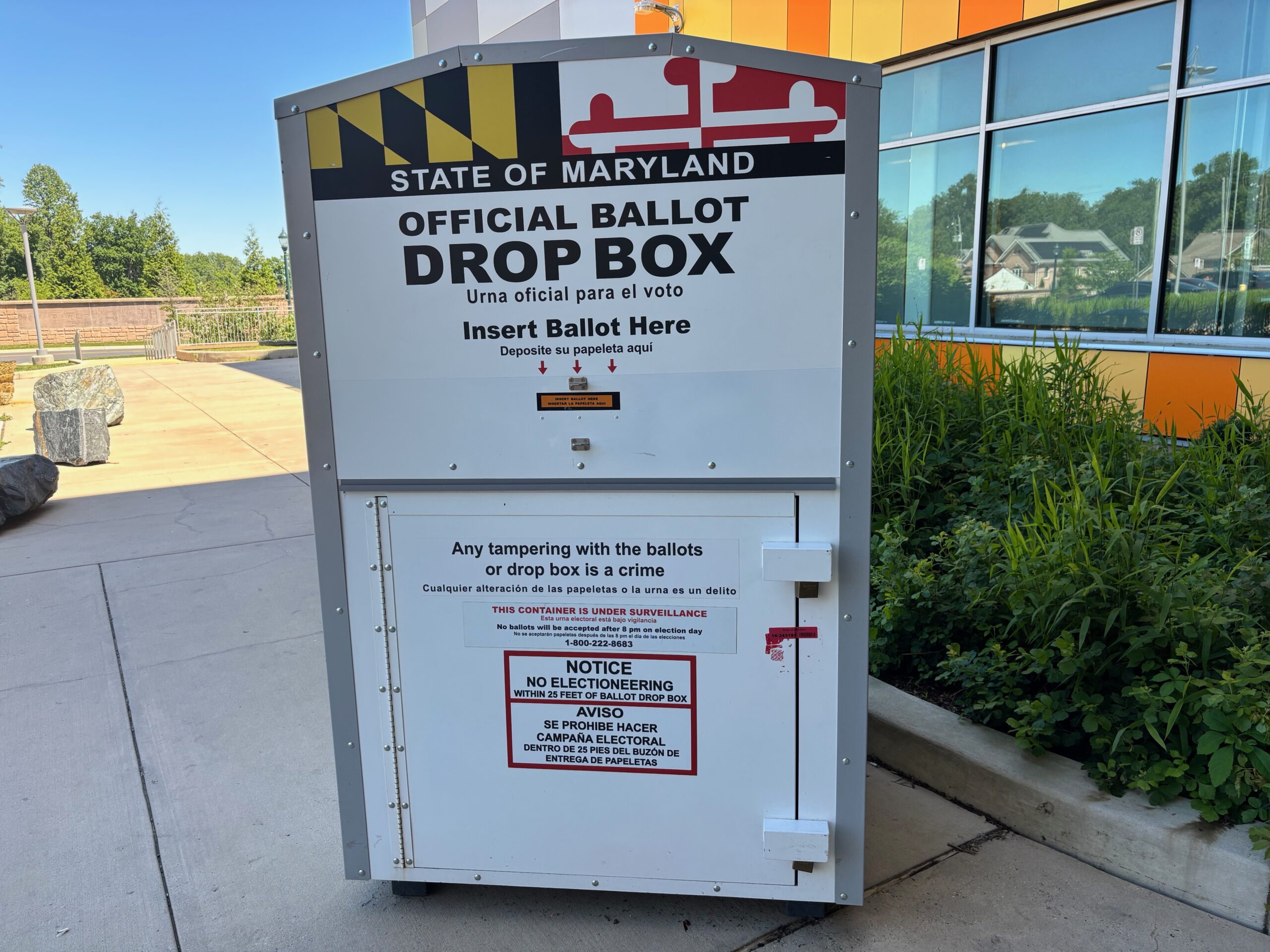
An official ballot drop box for Maryland voters, in Wheaton, Maryland, on June 7, 2026. (Photo by Jane Norman/States Newsroom)
The U.S. Department of Homeland Security will allow states to access federal citizenship data by June 30 and plans to monitor the flow of mail ballots for signs of voter fraud, according to a court document.
Amid a series of lawsuits, President Donald Trump’s administration is now moving to carry out a March 31 executive order restricting voting by mail ahead of the November midterm elections.
Democrats and voting rights advocates oppose the directive as unconstitutional election meddling by Trump and have sued to stop him. The president, who has long attacked mail ballots but votes by mail himself, says the additional rules will fight noncitizen voting, a rare phenomenon.
“No president has the authority to unilaterally rewrite election rules or dictate how states administer their elections,” Marcia Johnson, chief of activation and justice at the League of Women Voters, said in a statement last week. The League of Women Voters filed one of at least five lawsuits challenging the order.
Potential disruptions
The order could carry major consequences for the midterm elections. Any new restrictions on mail ballots would risk disrupting how tens of millions of voters cast their ballots. About 30% of voters cast mail ballots in 2024, according to data gathered by the U.S. Election Assistance Commission.
But despite several legal challenges, the order remains in effect.
A federal judge in Washington, D.C., in late May ruled against a request by Democratic groups to pause the order, finding that it was too soon to weigh in because federal officials hadn’t taken enough action yet. A second judge in Massachusetts held a hearing last week, but didn’t immediately issue a decision.
“The Trump Administration will continue fighting for the safety and security of American elections,” White House spokesperson Abigail Jackson said in a statement shortly after the D.C. judge’s decision.
One portion of the order demands the postmaster general enact new restrictions on mailed ballots and not transmit ballots from states that refuse to provide the names of absentee voters. The U.S. Postal Service, despite its status as an independent corporation, has put forward a proposal in line with the order to require states to submit lists of voters before mailing ballots.
Now, Homeland Security is responding to another part of the order that requires the creation of lists of voting-age citizens in every state, which the Trump administration calls “state citizenship lists.” State election officials would receive the lists, which they could compare to their voter rolls in a search for noncitizen voters.
Homeland Security’s plans for the citizenship lists came into focus on June 5, when the U.S. Department of Justice filed a notice in federal court that briefly outlines the administration’s plans. The notice describes a two-part effort by Homeland Security and its subsidiary agency, U.S. Citizenship and Immigration Services, to comply with the order.
First, Homeland Security will implement a “State Voter Roll Verification” that allows state election officials to submit their voter rolls to the Systematic Alien Verification for Entitlements, or SAVE, system.
SAVE is a powerful computer program that checks names against citizenship information held in a variety of government databases. It can flag registered voters as possible noncitizens, but faces criticism for incorrect identifications.
For the past year, states have already had the option to upload their voter rolls into SAVE. Some Republican-led states, such as Indiana, Texas and Wyoming, have used the system, while Democratic states have declined. It’s unclear how the State Voter Roll Verification would be different, if at all, from states’ current SAVE access.
Homeland Security and U.S. Citizenship and Immigration Services didn’t respond to questions from States Newsroom.
Second, the Justice Department notice says Homeland Security will set up a registry for state election officials to securely access “citizenship-related data” from USCIS, the Social Security Administration and the State Department.
According to the notice, the “underlying data would remain in each agency’s respective system.” No other details were provided.
The notice also outlines Homeland Security’s intention to use the lists of voters that states provide to the Postal Service for investigations. It says DHS wants to “integrate” data on those voters “to monitor mail-in and absentee ballot flows, identify anomalies that may suggest voter fraud or misuse, and generate authorized investigative leads.”
California elections
The notice comes as Trump renews his attacks on mail-in voting. Last week he alleged, without evidence, voter fraud in California, which held primary elections last week. California relies heavily on mail ballots and often counts votes at a slow pace — meaning final results sometimes don’t match election night vote totals.
“Do you know why they’re doing that? Because they’re cheating on the election,” Trump said in an interview on NBC’s “Meet the Press.”
While the executive order already faces a slew of lawsuits, the NAACP on June 3 filed a motion in federal court seeking to specifically block the Postal Service’s proposed regulations of mail ballots. The NAACP alleges the regulations violate a 2021 settlement agreement that requires timely delivery of election mail to all voters.
The Postal Service has until Thursday to respond.
The American Postal Workers Union in a statement on June 5 denounced the executive order, saying the Postal Service serves all Americans. It is “not a tool for politicians” to pick which Americans receive which benefits, the union said.
“The Executive Order is an unconstitutional attack on the millions of Americans who vote by mail,” the union said, “and another front in an ongoing assault on voting rights in the United States of America.”
An official ballot drop box for Maryland voters, in Wheaton, Maryland, on June 8, 2026. (Photo by Jane Norman/States Newsroom)
The U.S. Department of Homeland Security will allow states to access federal citizenship data by June 30 and plans to monitor the flow of mail ballots for signs of voter fraud, according to a court document.
Amid a series of lawsuits, President Donald Trump’s administration is now moving to carry out a March 31 executive order restricting voting by mail ahead of the November midterm elections.
Democrats and voting rights advocates oppose the directive as unconstitutional election meddling by Trump and have sued to stop him. The president, who has long attacked mail ballots but votes by mail himself, says the additional rules will fight noncitizen voting, a rare phenomenon.
“No president has the authority to unilaterally rewrite election rules or dictate how states administer their elections,” Marcia Johnson, chief of activation and justice at the League of Women Voters, said in a statement last week. The League of Women Voters filed one of at least five lawsuits challenging the order.
Potential disruptions
The order could carry major consequences for the midterm elections. Any new restrictions on mail ballots would risk disrupting how tens of millions of voters cast their ballots. About 30% of voters cast mail ballots in 2024, according to data gathered by the U.S. Election Assistance Commission.
But despite several legal challenges, the order remains in effect.
A federal judge in Washington, D.C., in late May ruled against a request by Democratic groups to pause the order, finding that it was too soon to weigh in because federal officials hadn’t taken enough action yet. A second judge in Massachusetts held a hearing last week, but didn’t immediately issue a decision.
“The Trump Administration will continue fighting for the safety and security of American elections,” White House spokesperson Abigail Jackson said in a statement shortly after the D.C. judge’s decision.
One portion of the order demands the postmaster general enact new restrictions on mailed ballots and not transmit ballots from states that refuse to provide the names of absentee voters. The U.S. Postal Service, despite its status as an independent corporation, has put forward a proposal in line with the order to require states to submit lists of voters before mailing ballots.
Now, Homeland Security is responding to another part of the order that requires the creation of lists of voting-age citizens in every state, which the Trump administration calls “state citizenship lists.” State election officials would receive the lists, which they could compare to their voter rolls in a search for noncitizen voters.
Homeland Security’s plans for the citizenship lists came into focus on June 5, when the U.S. Department of Justice filed a notice in federal court that briefly outlines the administration’s plans. The notice describes a two-part effort by Homeland Security and its subsidiary agency, U.S. Citizenship and Immigration Services, to comply with the order.
First, Homeland Security will implement a “State Voter Roll Verification” that allows state election officials to submit their voter rolls to the Systematic Alien Verification for Entitlements, or SAVE, system.
SAVE is a powerful computer program that checks names against citizenship information held in a variety of government databases. It can flag registered voters as possible noncitizens, but faces criticism for incorrect identifications.
For the past year, states have already had the option to upload their voter rolls into SAVE. Some Republican-led states, such as Indiana, Texas and Wyoming, have used the system, while Democratic states have declined. It’s unclear how the State Voter Roll Verification would be different, if at all, from states’ current SAVE access.
Homeland Security and U.S. Citizenship and Immigration Services didn’t respond to questions from States Newsroom.
Second, the Justice Department notice says Homeland Security will set up a registry for state election officials to securely access “citizenship-related data” from USCIS, the Social Security Administration and the State Department.
According to the notice, the “underlying data would remain in each agency’s respective system.” No other details were provided.
The notice also outlines Homeland Security’s intention to use the lists of voters that states provide to the Postal Service for investigations. It says DHS wants to “integrate” data on those voters “to monitor mail-in and absentee ballot flows, identify anomalies that may suggest voter fraud or misuse, and generate authorized investigative leads.”
California elections
The notice comes as Trump renews his attacks on mail-in voting. Last week he alleged, without evidence, voter fraud in California, which held primary elections last week. California relies heavily on mail ballots and often counts votes at a slow pace — meaning final results sometimes don’t match election night vote totals.
“Do you know why they’re doing that? Because they’re cheating on the election,” Trump said in an interview on NBC’s “Meet the Press.”
While the executive order already faces a slew of lawsuits, the NAACP on June 3 filed a motion in federal court seeking to specifically block the Postal Service’s proposed regulations of mail ballots. The NAACP alleges the regulations violate a 2021 settlement agreement that requires timely delivery of election mail to all voters.
The Postal Service has until Thursday to respond.
The American Postal Workers Union in a statement on June 5 denounced the executive order, saying the Postal Service serves all Americans. It is “not a tool for politicians” to pick which Americans receive which benefits, the union said.
“The Executive Order is an unconstitutional attack on the millions of Americans who vote by mail,” the union said, “and another front in an ongoing assault on voting rights in the United States of America.”
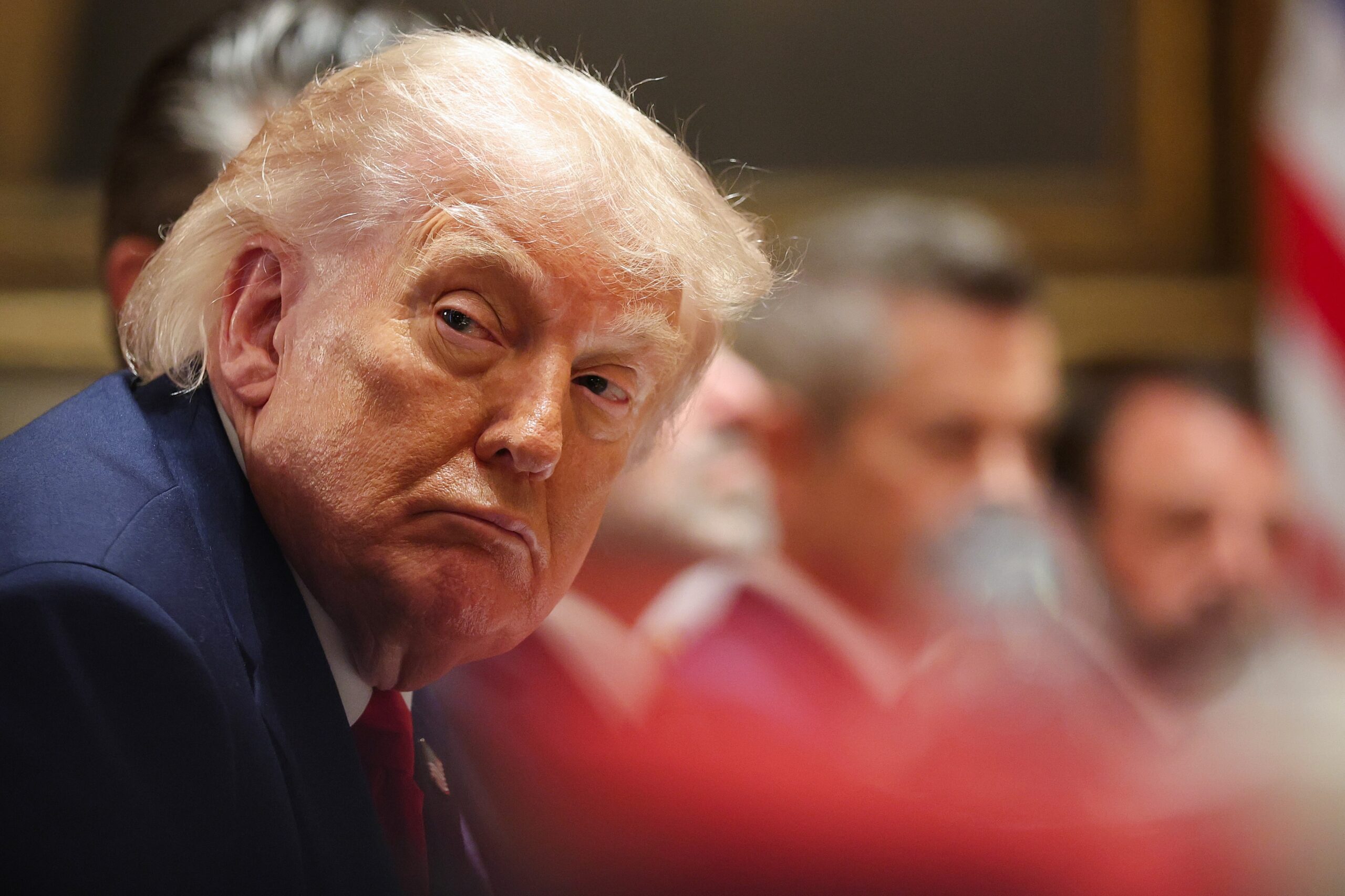
President Donald Trump's $100,000 visa fee for highly skilled workers was struck down Monday, June 8, 2026, by a federal judge. In this photo, Trump looks on during a Cabinet meeting in the Cabinet Room of the White House on May 27, 2026 in Washington, D.C. (Photo by Win McNamee/Getty Images)
WASHINGTON — A federal judge in Massachusetts Monday struck down the Trump administration’s efforts to require a $100,000 visa fee for highly skilled immigrant workers, finding the policy is an unlawful tax.
Judge Leo T. Sorokin found the hefty fee placed on the H-1B visa by President Donald Trump exceeded his authority by creating a tax, something that falls under Congress’ authority.
“The President has no authority to levy a tax unless such a power is delegated by Congress through statute,” Sorokin, who was nominated by former President Barack Obama, wrote. “For these reasons, the Court finds that the Policy imposes a tax on H-1B petitions without the requisite delegation by Congress.”
The H-1B program allows a U.S. employer to hire a noncitizen worker in a specialty occupation for a maximum of six years, ranging from the technology industry to healthcare workers. At a minimum, visa applicants have to hold a bachelor’s degree.
A Department of Homeland Security spokesperson said in a statement to States Newsroom that the agency disagrees “with this blatant judicial activism dismantling President Trump’s historic efforts for immigration reform.”
“The recent changes to the H-1B visa program, including the increased fee, are intended to address concerns about program integrity and the impact on the U.S. workforce,” the spokesperson said. “The policy aims to ensure that employers prioritize hiring U.S. workers, particularly in high-skilled fields. The Trump Administration remains committed to safeguarding opportunities for American workers and maintaining the integrity of employment-based visa programs.”
The suit was brought by 20 states: California, Massachusetts, Arizona, Colorado, Connecticut, Delaware, Hawaii, Illinois, Maryland, Michigan, Minnesota, Nevada, New Jersey, New York, North Carolina, Oregon, Rhode Island, Vermont, Washington state and Wisconsin.
In September the Department of Homeland Security issued a proclamation requiring employers to pay a $100,000 fee for a noncitizen to enter the U.S. under a H-1B visa.
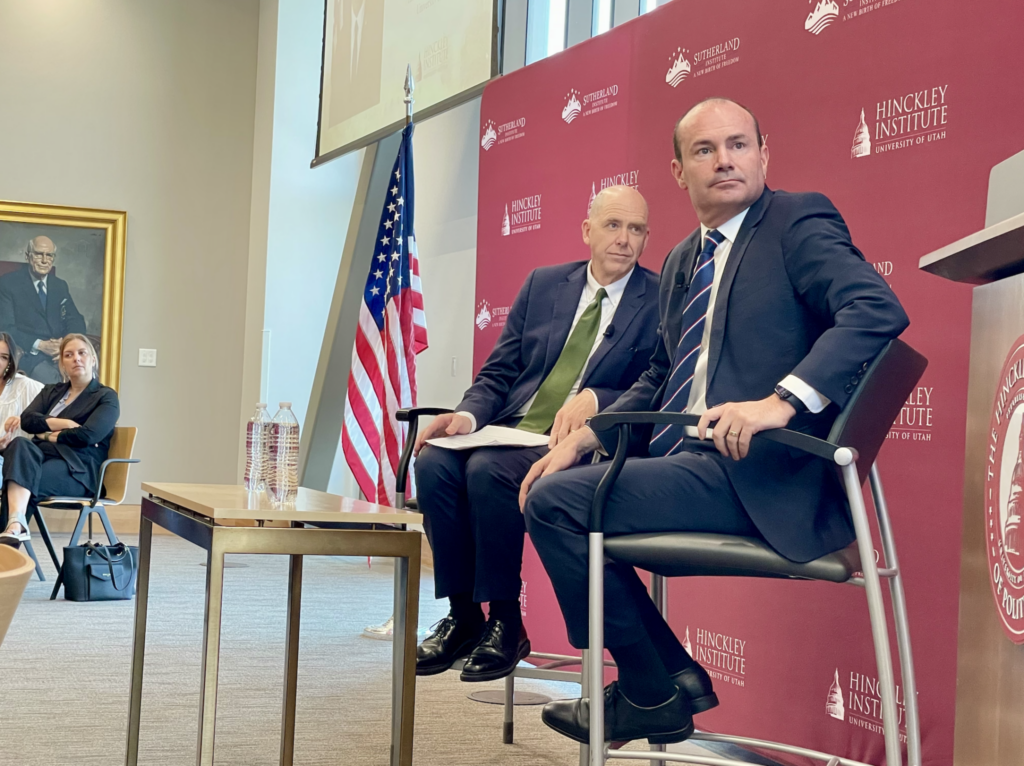
Mike Lee brings back proposal to sell public land in Western states
WASHINGTON — The Pentagon changed course Monday after its removal of dozens of religious denominations from a list of recognized faiths drew intense criticism over the weekend from Utah Republicans incensed by the failure to classify the Church of Jesus Christ of Latter-day Saints as a Christian denomination.
U.S. Sen. Mike Lee, a member of the church widely known as the Mormon church, said the policy for military chaplains announced Friday was “offensive” and demanded the Pentagon reverse course, which the department did Monday afternoon.
“It’s also just repugnant to any sense of decency, any sense of our common heritage and our common belief that the government needs to not weigh in on doctrinal disputes between various religious denominations,” Lee, a Utah Republican, said in a video statement posted to social media Sunday night.
“So I’m respectfully imploring the people at the Pentagon to reconsider this, not just reconsider but undo it,” Lee continued. “Secretary Hegseth: Tear down that wall. This is not cool.”
Hours later, Lee wrote on social media that he personally spoke to President Donald Trump on the phone about the “Pentagon’s ‘Christian list’” and told people to “stay tuned.”
“I won’t speak for him, but I’m thrilled about where this is heading,” Lee wrote. “We’re most fortunate that President Trump (1) loves Latter-day Saints, and (2) is our commander in chief.”
A spokesperson with Lee’s office told States Newsroom Monday the senator received assurances from the administration that the issue will be resolved.
Just after noon Eastern time Monday, the Pentagon pointed States Newsroom to a social media post showing an updated list without the word “Christian” before any of the denominations.
“The Pentagon’s job is not to adjudicate theological debates, but instead to ensure sincerely-held faith is respected and encouraged in our ranks,” according to the post by an account with the handle “DOW Rapid Response,” using the acronym for the administration’s preferred but unofficial name, Department of War.
Sen. John Curtis, a Utah Republican, also spoke out on social media stating the church is “unequivocally Christian.”
“It is unacceptable for a government entity to characterize a faith in a manner that contradicts the religion’s own foundational tenets,” he wrote Saturday.
A concern from lawmakers is that service members who belong to the Latter-day Saints may not receive services from a Christian chaplain.
The issue places the Pentagon in the middle of a longtime theological dispute between Latter-day Saints, who believe in the divinity of Jesus Christ and consider themselves Christian, and some members of other Christian faiths who believe the Salt Lake City-based church should be viewed as outside of Christianity.
Latter-day Saint church leaders declined to comment Monday.
The White House pointed States Newsroom to the department’s Monday afternoon social media announcement.
Shorter list
Citing a two-page letter posted to social media Friday, Parnell said the department was making a “long overdue move” to reduce the military chaplains’ overall list of religious affiliations to 31, down from an “unmanageable” 200.
“This decrease in religious affiliation codes is not designed to make any claims on the legitimacy of any faith or religious belief, nor is it intended to provide a list of ‘officially approved’ religions. Rather, it is designed to allow chaplains to quickly look at the religious composition of their units and determine how they structure resources to best provide for warfighters of all faith groups,” Parnell wrote.
The list includes 21 separate Christian denominations, but lists the Church of Jesus Christ of Latter-day Saints separately.
‘Christian nationalist takeover’
Criticism of the new list reverberated beyond Latter-day Saints.
Rev. Paul Brandeis Raushenbush, a Baptist minister and president and CEO of the Interfaith Alliance advocacy group accused the administration Friday of pushing a “Christian nationalist takeover of the Department of Defense.”
“Religious freedom in the military must mean religious freedom for everyone who serves, not just those this administration finds politically useful,” Raushenbush said in a statement.
“Secretary Hegseth is not ‘streamlining’ anything. He is elevating one narrow religious worldview from the top of the chain of command. That is dangerous, discriminatory and fundamentally un-American. The First Amendment does not allow the government to create a hierarchy of faiths, and it certainly does not allow the Pentagon to decide which beliefs are worthy of recognition.”
Hegseth announced a restructuring of the military’s chaplain corps in March, which he said had been “infected with political correctness and secular humanism.”
Hegseth hosts a monthly Christian worship service at the Pentagon.
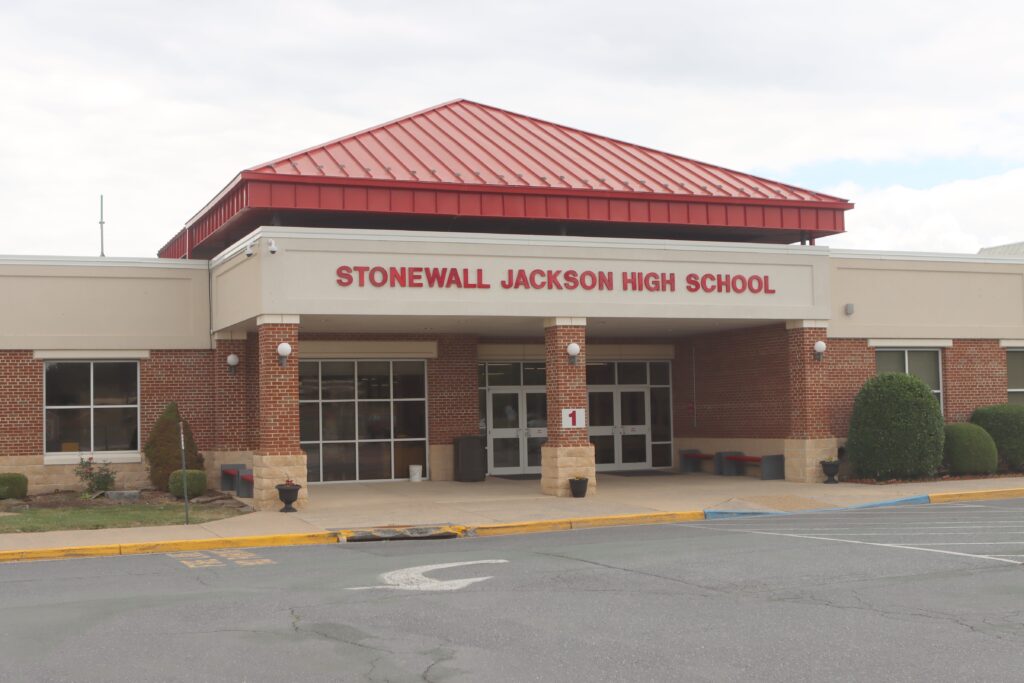
A view from outside Stonewall Jackson High School in Shenandoah County. (Photo by Nathaniel Cline/Virginia Mercury)
Shenandoah County is awaiting a closely watched court decision over whether the names of Confederate figures should remain on several school buildings, a dispute that has reignited debate over history, race and educational equity in Virginia schools.
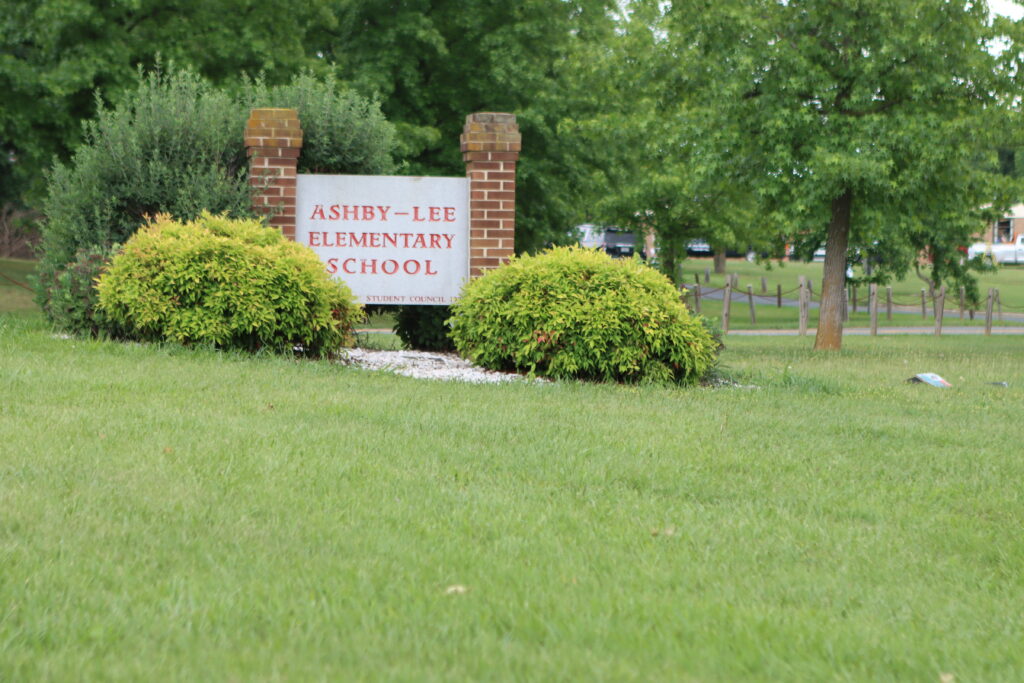
Some residents view honoring Confederate generals, including Turner Ashby, Robert E. Lee, and Thomas “Stonewall” Jackson, as an important part of local heritage and history. Others see them as symbols of slavery and racism that deepen racial tensions.
At the center of the case is whether the Shenandoah County School Board’s decision to restore the Confederate names violates federal law and undermines efforts to provide equal educational opportunities in Virginia.
“I think the central theme that really kind of reverberates through this case is the overall educational equity,” said Marja Plater, senior counsel at the Washington Lawyers Committee for Civil Rights and Urban Affairs, representing the NAACP Virginia State Conference and five students.
“Having students who are subjected to the harmful impacts of having to attend school aimed at Confederate generals, and the entire culture that it establishes, is not what we want students to be subjected to now, and it really hinders achieving educational equity.”
Plater said she believes the U.S. is still working toward fully fully achieving the goals of the Supreme Court case Brown v. Board of Education, which sought to ensure equal education for students regardless of race.
Because of that focus on equal educational opportunity, Plater said the names schools carry a— including those honoring Confederate generals — matter because they can affect fairness and equal treatment in education.
A view from outside Ashby-Lee Elementary School in Shenandoah County. (Nathaniel Cline/Virginia Mercury)
After the Shenandoah County School Board voted in May 2024 to restore the name, the NAACP state conference and several students filed a lawsuit the following month challenging the decision, including the restoration of the name Stonewall Jackson High School.
The lawsuit alleges the board violated students’ First Amendment rights by forcing them to endorse a viewpoint they disagree with through the promotion of Confederate figures.
Last September, U.S. District Court Judge Michael F. Urbanski sided with the students, writing that the board violated students’ First Amendment rights and that Jackson’s name “is expressive as a symbol of racial exclusion in public schools.”
Both sides presented final arguments on March 31, and the court is now considering its ruling.
Asked whether the case should be viewed through the lens of educational equity, Jim Guynn, an attorney representing the school board, said no evidence of inequity was presented during the trial and that the plaintiffs are thriving academically and socially while serving as leaders among their peers.
Looking ahead, Guynn said an adverse ruling could set a precedent for challenges to school names beyond those tied to the Confederacy.
In the board’s view, such challenges could eventually expand to a broad range of historical figures and institutions.
“At some point, we have to stop focusing on the negative and start assessing historical figures in their time and not by our current standards,” Guynn said. “I might add that I hope not to be judged by the standards in place 50 or 100 years from now. We can’t predict what those standards will be.”
Potential consequences
It remains unclear what the remedies the court would impose after finding that the Shenandoah County School Board violated students’ rights, but the consequences could be significant, potentially including federal investigations, loss of federal funding and federal oversight.
The board is also awaiting a decision on whether it illegally discriminated against students based on race through Title VI of the Civil Rights Act of 1964, which bars discrimination in federally funded programs, and the Equal Educational Opportunity Act, which requires equal access to education regardless of race, color, sex or national origin.
Guynn said the board is concerned that an adverse ruling could mean “a school board acting with the overwhelming support of the public could never name a school after a person if some students claim that the name is discriminatory.”
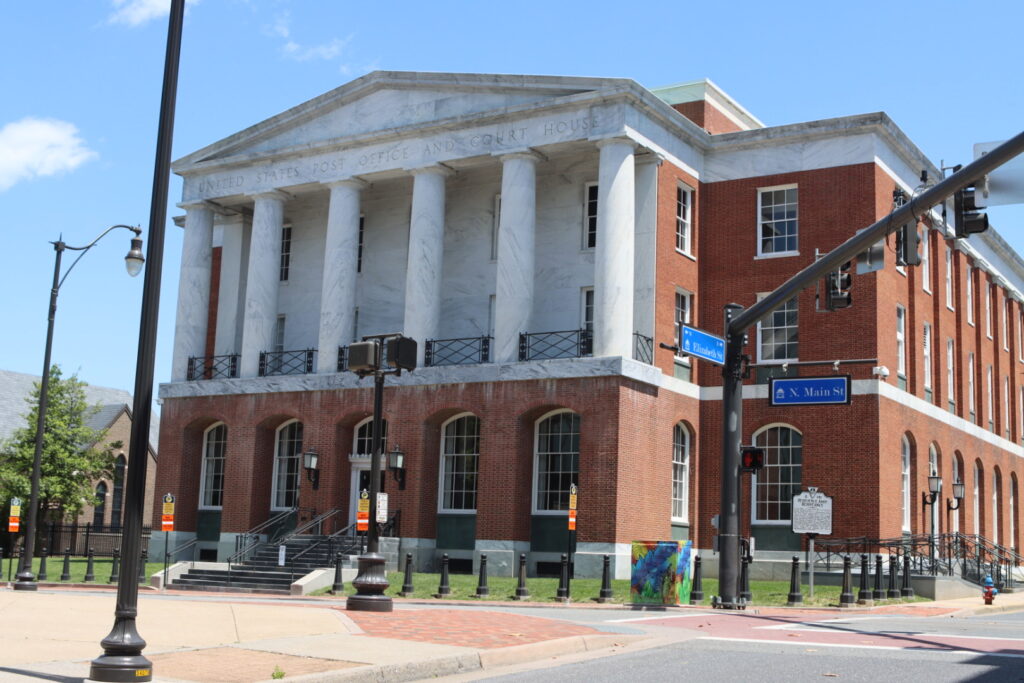
A view outside the U.S. Courthouse in Virginia’s Western District. (Nathaniel Cline/Virginia Mercury)
“Names are not discriminatory, especially when the facts in the case show that there has been no discrimination against any students,” he added.
As the court weighs its decision, Urbanski has not yet ruled on the NAACP’s and students’ request to remove Confederate names, mascots, and other vestiges before the 2026-2027 school year. They also asked the court to bar the school board from using Confederate leaders’ names or references in future naming decisions.
If the court orders the names changed, the ruling would further spotlight the community’s long-running divide over Confederate recognition, symbolizing a deeper conflict between heritage and educational equity.
Public support for restoring the names helped reshape the school board. Only three current members served on the board before the reinstatement vote, and all three voted to restore the names.
“The name of the school is important to county residents because Stonewall Jackson was an important figure in the history of the county and because it is the name of the high school that many residents attended and graduated from, and it has a sentimental place in their hearts,” Guynn said.
Trust at the center of the case
Trust emerged as a central theme for both the students challenging the names and the 2024 school board that restored them.
The 2020 school board, which initially removed the Confederate names, argued its decision was intended to condemn racism and begin a renaming process. The 2024 school board argued restoring the names was necessary to “restore the public’s trust” after the earlier board’s actions.
“This was not an innocent mistake by some inexperienced school board. No, this was carefully choreographed machinations of a school board colluding to ignore the people they represented,” Board member Gloria Carlineo said during a 2024 meeting. “This is what political indoctrination in our schools looks like.”
Other board members described the 2020 name changes as a “slap in the face” to residents near the southern campus, where the three schools are located, saying they felt their heritage was being erased.
On the plaintiffs’ side, one student testified that she no longer knows which adults at the school she can trust because many staff members wear clothing bearing the Stonewall Jackson name.
Other students testified that the Confederate names made their academic experience more difficult and left them feeling “closed off” from classmates after the names were restored, fearing some peers might support segregation or not want them at the school.
Final Ruling
It is unclear when Urbanski will issue a final ruling. Court records show the parties met with the judge shortly after the March 31 hearing concluded.
Urbanski previously announced he would take senior status beginning July 4, 2024, allowing him to remain a federal judge while potentially carrying a reduced caseload. His successor, Jasmine H. Yoon, was nominated and confirmed before the transition.
The outcome of this case will not only affect Shenandoah County and the names of its schools, but also broader debates about history, equity, and trust in public education.
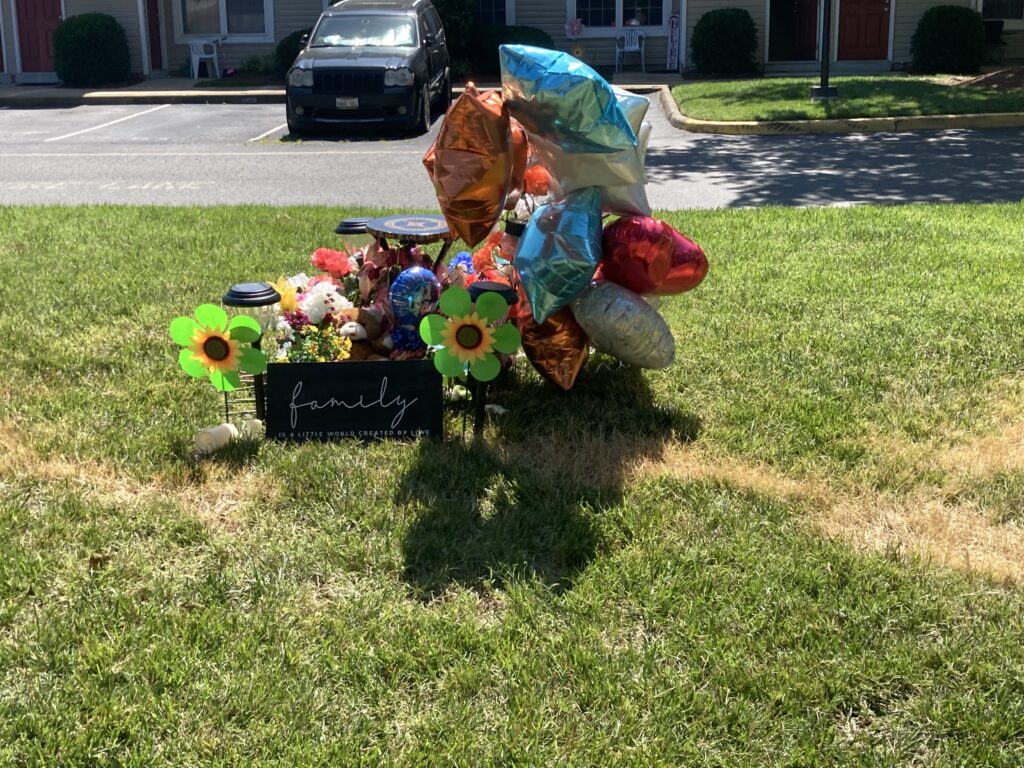
Balloons, fresh and artificial flowers and a sign extolling “Family” dot an apartment complex lawn near where landscaper Guadalupe Rivera was struck by a car on May 29 in Chesapeake. The 60-year-old Suffolk man a father of eight and grandfather and great-grandfather of 33. (Photo by Roger Chesley/Virginia Mercury)
Guadalupe Rivera – landscaping supervisor, family man, helper – suffered a needless, ghastly death because, police said, a speeding car collided with an SUV before striking Rivera on a Chesapeake sidewalk, where the 60-year-old Suffolk man was working.
Police said the male driver of the sedanat the center of the mayhem May 29 was racing so fast that he also dislodged the engine of the SUV he struck first and damaged a nearby utility pole. The speed limit along that stretch is just 35 mph.
Speed has been the key factor cited by authorities in several recent fatalities along Virginia roadways, including the killing of Rivera that is still under investigation. Both drivers in that incident suffered minor injuries. On Thursday, police said they charged Synclair Tyrone Mayes, 19, with involuntary manslaughter.
Guadalupe Rivera. (Photo courtesy of Rivera family)
Excessive speed joins distracted driving and driving under the influence among the causes often cited by authorities for the deaths and injuries that happen too often, here in Virginia and elsewhere.
There’s also a lack of concern for fellow human beings when folks get behind the wheel. So we scoff at posted speed limits. We text,though it’s illegal while driving in Virginia and nearly every other state. We eat. We fiddle with the gadgets on the dashboard.
In other words, we don’t care about anyone but ourselves, our desires, our schedule.
“Reckless driving isn’t new,” Brad Lehmann, assistant professor of criminal justice at Virginia Commonwealth University and a former sergeant with the Henrico County Police Department, told me in an interview. “But we have an interesting kind of storm where a generational change is happening, and our driving behaviors have changed. There’s distraction from devices and electronics in the vehicle.”
Meanwhile, he added, pedestrians and bicyclists can be so focused on their own phones or earplugs that they might not recognize nearby cars and trucks. The 4,000-pound missiles are a threat to their safety.
“It’s a mixture of instant gratification and risky behaviors,” Lehmann noted.
Sadly, the death of Rivera wasn’t the only traffic fatality across Virginia in recent days. Others have been just as gut wrenching:
Four members of a Massachusetts family and another person were killed May 29, when a passenger bus speeding south on Interstate 95 struck a vehicle that had slowed down for a work zone in Stafford County.
The crash caused a chain reaction. Dozens of passengers were injured.Jing S. Dong, 48, the bus driver, faces involuntary manslaughter charges and reckless driving charges.
Later reports said Dong, of Staten Island, New York, had been scheduled to stand trial June 2 in Annapolis, Maryland, for a previous arrest on speeding while driving a coach bus. Virginia court records revealed he’d earlier been cited for speeding, too, in the commonwealth.
A day later,a crash on I-95 in Caroline County killed two people and injured another person. Witnesses told wtvr.com a SUV was speeding down the left shoulder before striking debris and losing control.
The SUV then flew across the median into oncoming traffic headed northbound. What was so important that the driver tried something so illegal and risky by racing along the shoulder?
An 86-year-old male pedestrian in Norfolk died after a hit-and-run crash, Norfolk police said, late the night of June 1. Police said they later located the suspected driver,Malik Alea-Ngongo, 24, of Norfolk, and arrested him near the scene of the accident. Investigators didn’t immediately know whether speed or alcohol were factors.
Yusuke Yamani, an associate professor in the departments of psychology and civil and environmental engineering at Old Dominion University, said traffic fatalities have been declining nationwide and in the commonwealth since a post-COVID spike.
What’s going on nowadays? Bad behavior obviously isn’t new, but it seems to be more lethal on our roads.
“Speeding, impaired driving, red-light running, and road rage are all forms of reckless driving that have existed for decades,” Yamani said, by email. “However, today’s driving environment is different.
“New information technologies (e.g., smartphones and infotainment systems), reduced traffic enforcement in some areas, attitudinal shifts among younger drivers, and behavioral changes following the pandemic have all contributed to a changing landscape of driver behavior.”
The professor cited a AAA Foundation for Traffic Study culture index for more information. He noted the 2024 report found fewer drivers perceived speeding as dangerous, “suggesting that speeding may be becoming increasingly normalized. Notably, speeding tends to draw less social condemnation than many other risky driving behaviors, despite contributing to roughly one-third of all fatal crashes.”
Lehmann, the VCU professor, notedRichmond has suffered a number of pedestrian deaths in recent months, some involving well-known victims. He wondered whether people think it’s OK to fiddle with a device while driving, or to go 25 mph above the speed limit even if they have passengers.
“I don’t know that we are prioritizing the humanity in front of us,” he said.
Rivera’s relatives wish we would. His brother Joe told a newscast that Guadalupe Rivera “would talk to anybody, try to help anybody he could.”
His 33-year-old daughter Andrea Magallan, in her comments to me, called him “our protector, our biggest supporter, and our hero.”
Folks, put the phone down or turn it off when behind the wheel. Pay attention to the road, not the radio. Don’t imbibe and drive.
Voters cast ballots at the Northwest Community Center in Des Moines, Iowa, on Nov. 3, 2020. (Photo by Jim Obradovich for Iowa Capital Dispatch)
Ahead of the November midterm elections, President Donald Trump and his Republican allies have demanded Congress pass sweeping voting restrictions, including showing proof of citizenship to register — all in the name of election security.
At the same time, the only federal agency dedicated solely to helping states and localities run smooth and secure elections operates on a meager budget. It provides grants for election security far smaller than in the past. And U.S. House Republicans have signaled they want sizable further cuts.
The agency, the U.S. Election Assistance Commission, sits at the center of a fight playing out in Congress over how to best ensure secure elections. The debate has thrown into sharp relief a yawning gap between GOP rhetoric over election tampering and actual congressional support for election security efforts.
“If my colleagues truly cared about protecting our elections from foreign interference, they’d put the resources behind it,” Rep. Sanford Bishop, a Georgia Democrat, said at a House Appropriations Committee meeting this spring. “Instead, we get empty rhetoric, zero urgency, while putting the right of citizens to vote at risk.”
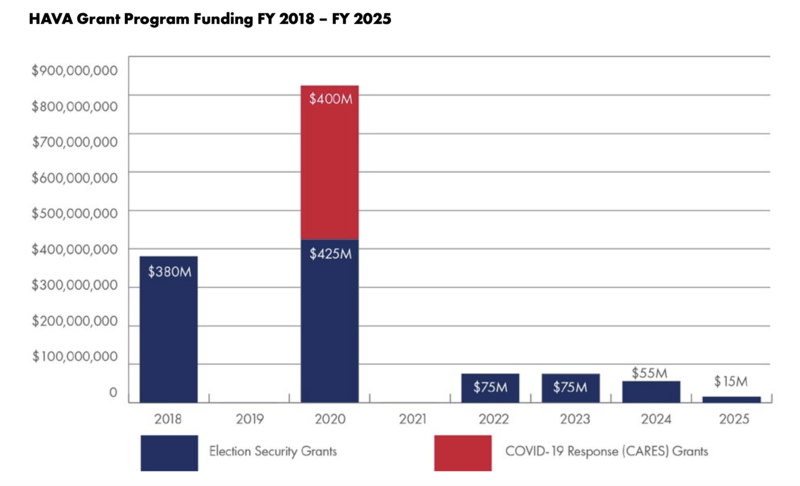
Congressional support of the EAC’s election security grant program has fluctuated over time, but has generally trended downward.
Congress has approved election security grant funding at much lower levels than the program’s early years. (Credit: U.S. Election Assistance Commission 2025 Annual Report)
Lawmakers approved $380 million in 2018 and $425 million in 2020, along with an additional $400 million in election-related pandemic aid that year.
Since then, grant funding has slowed to a trickle. Congress appropriated $75 million in 2022 and again in 2023. That was followed by $55 million in 2024 and $15 million in 2025.
This year’s amount, $45 million, is an increase from the previous year — consistent with enhanced needs in an election year — but substantially lower than other recent years and a far cry from the program’s early years.
Trump and many GOP lawmakers support the SAVE America Act, which would impose new restrictions on voting. It would require voters to show a photo ID at the polls, as well as require them to bring documents proving their citizenship, such as a passport or birth certificate, with them when they register to vote.
The requirements are needed, the bill’s supporters say, to combat noncitizen voting, an extremely rare occurrence.
“The cheating is rampant in our elections,” Trump asserted without evidence in his 2026 State of the Union address. He has called the SAVE America Act “commonsense, country-saving legislation.”
The House passed the bill in February but it has floundered in the Senate amid opposition from Democrats and a handful of Republicans. Trump continues to seek new avenues to advance the measure, including urging lawmakers to attach it to housing legislation.
President Donald Trump delivers his State of the Union address on Feb. 24, 2026. During the address, Trump claimed, without evidence, “cheating is rampant” in U.S. elections. (Photo by Andrew Harnik/Getty Images)
Cuts to election security agency
The Trump-led push for voting restrictions has largely ignored concrete election security needs in favor of chasing the phantom specter of noncitizen voting, Democrats and experts on election administration say. The result, they say, has been the possibility of sharp cuts at the EAC.
The House Appropriations Committee in April approved a bill that would cut the EAC’s salaries and expenses from $23.86 million to $17 million. It would mark the first time in four years the agency’s budget has dropped below $20 million.
The bill would also sharply cut the EAC’s election security grant program from $45 million to $15 million, the same as the last non-election year.
Since 2018, the agency has distributed the grants to election officials for technology upgrades, including cybersecurity, physical security improvements at election sites and efforts to combat voter misinformation. Lawmakers created the election security grants in response to foreign interference in the 2016 election.
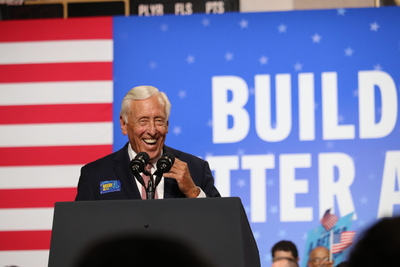
U.S. Rep. Steny Hoyer, a Maryland Democrat, at a Democratic rally in 2022. (Photo by Danielle E. Gaines/Maryland Matters)
“Republicans claim falsely that our elections are plagued by fraud and that more needs to be done to secure the vote,” Rep. Steny Hoyer, a Maryland Democrat, said in a statement to States Newsroom.
“Yet, they have consistently undermined the security of our elections, including by proposing to cut election-security grants by two-thirds and the Election Assistance Commission’s (EAC) overall budget by almost 30% in Fiscal Year 2027,” Hoyer said. “This will leave states without critical resources to secure their voting systems and adopt the latest in voting technology and best practices.”
Hoyer, who helped spearhead the 2002 legislation creating the EAC and is the ranking Democrat on the Appropriations subcommittee that oversees the agency’s budget, said it has been a tremendous benefit to state and local election officials and to the integrity of the vote.
“I will continue to oppose Republican efforts to cut its funding,” he said.
Congressional GOP embraces Trump
The bill represents only one, early step in the appropriations process. The House hasn’t voted on it and the Senate could eliminate or alter the cuts, with any differences eventually worked out in a conference committee.
The House Appropriations Committee, which is not burdened with the Senate’s need for bipartisan approval of most legislation, in past years has also put forward cuts to election security grant funding that have been abandoned later.
Still, the measure this year demonstrates how House Republicans have embraced Trump’s focus on noncitizen voting.
While cutting the EAC and election security funding, the bill includes a provision prohibiting the use of funds to register noncitizens to vote. Noncitizens are already prohibited from voting in federal elections and only a very small number of municipalities allow noncitizens to vote in local contests.
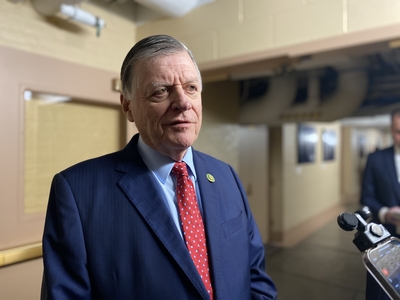
Oklahoma Republican Rep. Tom Cole speaks with reporters at the U.S. Capitol in January 2024. (Photo by Jennifer Shutt/States Newsroom)
“The people demanded a new mandate, we’re carrying it forward. That includes reinforcing President Trump’s work to … ensure that only citizens vote in our elections,” Rep. Tom Cole, an Oklahoma Republican and the Appropriations Committee chairman, said at an April meeting.
A spokesperson for Rep. Dave Joyce, an Ohio Republican who chairs the Appropriations subcommittee that developed the bill, didn’t respond to a request for comment.
Funding ebb
Congress created the EAC in the 2002 Help America Vote Act, passed in the wake of the 2000 presidential election and the Florida recount.
A bipartisan commission leads the agency, which has about 70 employees, according to its 2025 annual report. It focuses on aiding state and local election officials with training and other resources, certifying voting equipment and overseeing grant programs.
Gideon Cohn-Postar, director of federal affairs at the Institute for Responsive Government, said election officials generally want Congress to provide about $400 million a year, a figure that reflects lawmakers’ initial commitment to the grant program in 2018 and would allow states to make significant strides in bolstering their election infrastructure.
Each year’s grants are split between states and territories based on a formula. In practice, most receive the minimum amount. The $45 million grant for 2026 translated into $819,000 for most states, with a mandatory 20% match.
“It’s absolutely insufficient,” Cohn-Postar said.
State spending
A December 2024 report from the Bipartisan Policy Center measuring the impact of the grant program found that cybersecurity constituted the single largest category of grant spending, at over $200 million, followed by nearly $150 million on voting equipment.
Some states save up their grant money over several years to help pay for larger purchases, like voter registration systems, with the money earning interest in the meantime. As of March 2025, states had collectively spent 69% of their grant dollars, according to the latest data available from the EAC.
Two states — Nevada and Ohio — have spent 100% of their funds. Only Louisiana has spent none, ahead of a future elections system overhaul.
In Connecticut, election officials have spent 95% of the $13.8 million it has received in election security grants over the years, according to the EAC data. The funds have helped towns conduct security audits, Connecticut Democratic Secretary of State Stephanie Thomas said in an interview.
As an example, Thomas said when she took office in 2023 not all of the town’s systems were on a government online domain but most have now adopted one.
“Someting like that, it never gets the headlines but hugely important from a security perspective,” Thomas said.
Commission warns against cuts
EAC commissioners have been warning Congress that unstable funding and budget cuts would harm their agency’s work. All three current commissioners and a recent former commissioner testified at a House Administration Committee hearing on election security in May, where they cautioned lawmakers against reduced and unpredictable resources.
Commissioner Benjamin Hovland, a Democratic appointee of Trump, noted that while Congress has provided “significant” funding since the 2002 law, federal dollars have covered less than 5% of the total cost of running elections during that time.
Election officials today face challenges that would have been unimaginable when the law was passed, he said, adding that commissioners heard enthusiasm for the EAC’s work in recent meetings with officials.
“But the agency is nearing a point where funding cuts will impact what we can accomplish, and the support we can provide election officials, especially related to election security,” Hovland said.
States frequently tell the EAC they want federal funding that is “predictable, consistent, and sufficient” to support long-term planning, said Christy McCormick, a Republican commissioner appointed by President Barack Obama.
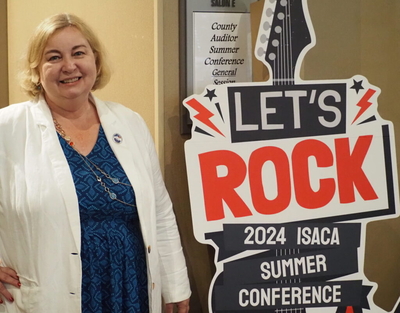
U.S. Election Assistance Commissioner Christy McCormick spoke at the Iowa State Association of County Auditors summer conference in Des Moines in June 2024 about federal resources available to local election officials. (Photo by Robin Opsahl/Iowa Capital Dispatch)
The EAC’s adoption of newer, more rigorous standards for election equipment illustrates the importance of funding for state and local election officials.
In 2021, the EAC adopted the Voluntary Voting System Guidelines 2.0, or VVSG 2.0, replacing the earlier 1.0 guidelines. The technical standards are designed to enhance security, such as requiring air gapped systems, and greater accessibility for voters with disabilities.
While states are not required to use VVSG-certified machines, many states have followed the EAC’s lead and mandated the use of machines that meet these standards. Upgrading is expensive, however.
In the meantime, election technology continues to age. By 2028, the average age of modern voting equipment will rise to 9.3 years old, up from just 4.9 years old in 2020, according to a report from the Bipartisan Policy Center released in late May. The report identified “episodic and unpredictable” federal funding as one obstacle to states purchasing VVSG 2.0 equipment.
“Federal support is absolutely key to making sure that election infrastructure is functioning well at the state and local levels,” Will Adler, a co-author of the report, said in an interview.
‘Don’t give me any more money’
To be sure, some state election officials are skeptical of accepting grant funding. Kansas Republican Secretary of State Scott Schwab told a congressional hearing in April that elections are best run and funded locally.
He said he previously accepted grant dollars but that state lawmakers then didn’t approve the required matching funds, leaving his office in a bind.
“I would rather, because of the strings attached, just don’t give me any more money,” Schwab said. “If we need more money, we can handle it locally.”
But since the House Appropriations Committee advanced cuts to the EAC and the election security grants in April, numerous election officials and voting rights groups have urged lawmakers to reconsider.
On May 12, the Project for Election Infrastructure sent a letter signed by several dozen local election officials asking senators for $400 million in election security grants, with at least two-thirds directed to localities. The true cost of modernizing and fully securing American election systems will run billions of dollars, the letter warned.
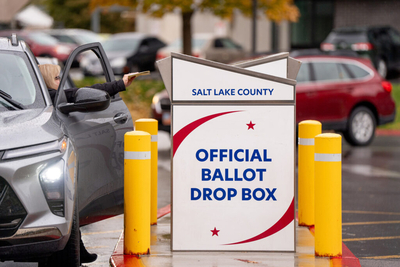
Bollards surround a ballot drop box at the Salt Lake County Government Center in Salt Lake City on Election Day, Tuesday, Nov. 5, 2024. (Photo by Spenser Heaps for Utah News Dispatch)
The National Association of Counties on June 2 asked House and Senate appropriations leaders to not cut funding. The years between presidential elections are when “critical groundwork is laid,” the association’s CEO and executive director, Matt Chase, wrote in a letter.
Chase ticked through typical security expenses that can quickly add up. Bollards to protect remote drop boxes can cost $500 to $4,000 per bollard. Key card access at election facilities can cost $1,500 to $5,000 per door. Video surveillance cameras can run hundreds to thousands of dollars.
“Federal investment scaled only to presidential cycles leaves counties without the resources needed to be ready when turnout surges,” Chase wrote.
Thomas, the Connecticut secretary of state, echoed the sentiment.
“I feel that many people use the term election security almost like a slogan,” Thomas said. “But election security is actually year-round work.”