Author: admin

  • Rising costs of fuel, other goods squeeze already strained abortion funds

    Rising costs of fuel, other goods squeeze already strained abortion funds

    The increasing costs of fuel for cars and airplanes are adding extra strain to abortion funds that help people pay to travel for care in other states, leaders of several funds said this week.

    Abortion funds can help when someone must travel from their home state to a state where care is available. That often includes people living in one of the 13 states with a near-total abortion ban, but it also encompasses those who need to travel because of gestational limits in other states. Funds, which often come exclusively from donations, help pay for the cost of the abortion procedure as well as transportation costs, lodging, meals and other expenses.

    In the four years since the U.S. Supreme Court’s decision in the Dobbs v. Jackson Women’s Health case, abortion fund leaders say the need for assistance has exploded. Poonam Dreyfus-Pai, interim executive director of the National Network of Abortion Funds, said Monday that the funds supported more than 158,000 people in 2025, up from 82,000 in 2022. And the cost per person has doubled from less than $200 to nearly $400 on average nationwide.

    Nearly 1 in 4 people seeking abortions out of state chose Illinois. Here’s why

    Dreyfus-Pai said about one-third of the abortion funds in their network reported that they had to pause their hotline services in 2025 because of funding shortages, staff burnout, legal barriers, security concerns and other issues.

    “We’re seeing that this year is even harder for funds, with many more funds needing to temporarily close their doors to stretch their funding, and some even closing permanently,” Dreyfus-Pai said.

    In Virginia, Blue Ridge Abortion Fund Executive Director April Greene said more than one-quarter of their callers traveled from out of state in the current fiscal year. Greene said the fund has distributed more than $6.1 million in funding since it was founded in 1989, but more than $4 million of that came after the Dobbs decision.

    Melisa Hidalgo-Cuellar, director of Colorado’s Cobalt Abortion Fund, said her organization saw a 1,000% increase in spending for abortion seekers from 2021 to 2025, supporting patients from 32 states and six countries. The fund spent $2.4 million to support abortion seekers in 2025, compared with $206,000 spent in 2021, before Dobbs. Many of the fund’s out-of-state clients are from Texas, which has a near-total ban and other civil enforcement laws related to abortion.

    The spending rose another 26% in the first three months of 2026, at least in part because of rising fuel costs associated with the ongoing conflict in Iran and the closure of the Strait of Hormuz, and recent price increases for food and other services. The total spent in the first quarter of 2025 was about $465,000, while the total in the first quarter of 2026 was nearly $590,000.

    “We saw a 44% increase in how much we spent on flights in March of 2025 to March of 2026,” Hidalgo-Cuellar said. “So it’s a significant increase.”

    The airfare costs can be especially high because when funds receive a help request, the caller usually needs to travel within a few days. Ginnely Carrasco, director of programs and interim executive director of the Florida Access Network, said the quick travel window can increase a ticket’s price by $500 to $700.

    According to a report published Tuesday, the Cobalt Abortion Fund also spent $23,000 in the first quarter of this year to support access to abortion medication by telehealth. Continued access via telehealth to mifepristone, one of two drugs approved by the U.S. Food and Drug Administration to terminate a pregnancy before 10 weeks, is threatened by an ongoing lawsuit filed by the state of Louisiana in 2025.

    The U.S. Supreme Court preserved the rule allowing telehealth prescriptions for now, but the case is ongoing.

    Stateline reporter Kelcie Moseley-Morris can be reached at [email protected].

    This story was originally produced by Stateline, which is part of States Newsroom, a nonprofit news network which includes Virginia Mercury, and is supported by grants and a coalition of donors as a 501c(3) public charity.

  • US Senate blocks Trump’s SAVE America Act, thwarting restrictions on voting

    US Senate blocks Trump’s SAVE America Act, thwarting restrictions on voting

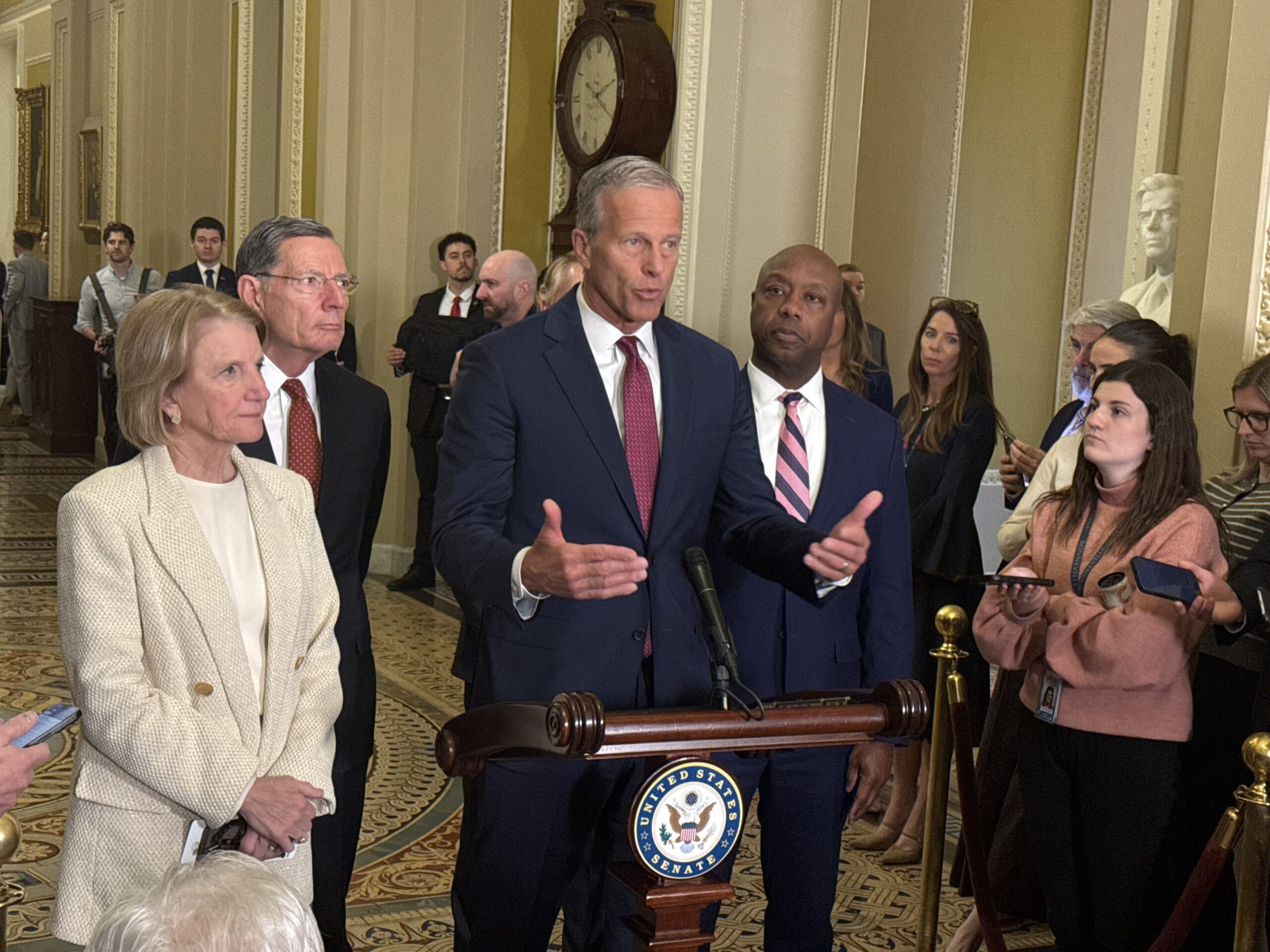
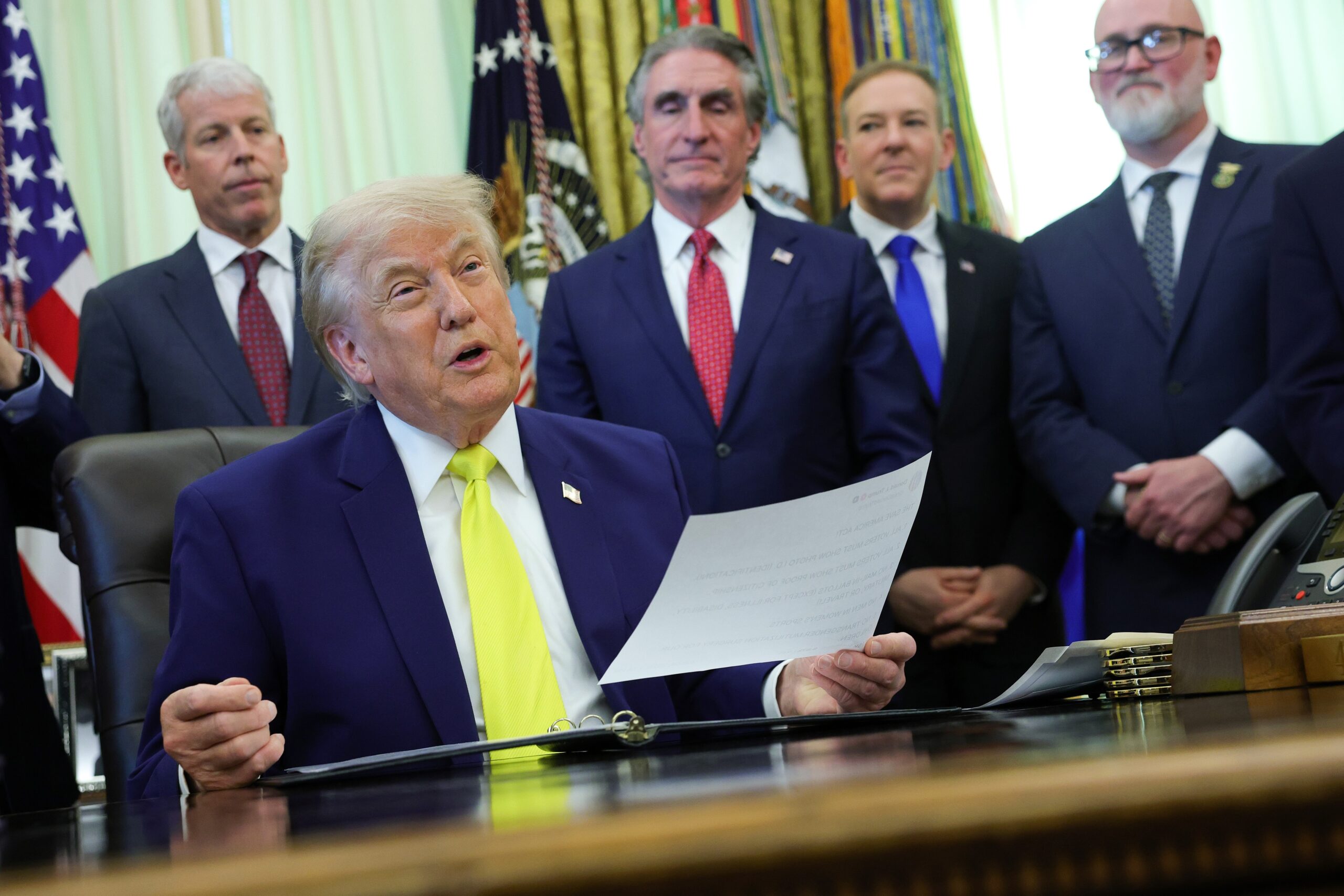
    The U.S. Senate rejected the SAVE America Act on Thursday, dealing a blow to President Donald Trump’s efforts to impose voting restrictions ahead of the November midterm elections.

    Senators voted 48-50 against advancing an amendment that would have incorporated Trump’s top legislative priority into an immigration-focused spending bill. The vote offered the clearest sign yet that despite pressure from the president, a handful of Republican senators continue to resist advancing the bill, which critics say would unleash immense chaos ahead of elections this fall.

    The SAVE America Act would require voters to offer documents, such as a birth certificate or passport, proving their citizenship when registering to vote. It would also mandate voters show photo ID when casting a ballot and restrict where voters can register, effectively eliminating voter registration drives.

    Democrats and voting rights groups have assailed the bill, saying it would disenfranchise voters and upend the midterms because the new rules would take effect immediately. Trump and the bill’s GOP supporters say it’s needed to combat noncitizen voting, an extremely rare phenomenon.

    Since taking office last year, Trump has made a series of attempts to shape how elections are run. An executive order that would limit voting by mail remains in effect for now as opponents challenge it in federal court, and the Department of Justice continues to seek to force states to hand over sensitive voter data, so far unsuccessfully.

    The Senate amendment, offered by Republican Sen. Lindsey Graham of South Carolina, also included restrictions on sports participation by transgender athletes. On social media after the vote, Graham called the SAVE America Act “one of the most consequential” pieces of legislation developed by Trump and his team.

    “All Democrats voted no, and they will eventually pay a price,” Graham wrote.

    Republicans also vote no

    But the proposal fell short among a small group of Republicans, too. Sens. Susan Collins of Maine, Mitch McConnell of Kentucky, Lisa Murkowski of Alaska and Thom Tillis of North Carolina joined Democrats in voting no.

    Collins is seeking reelection in what is one of the most competitive Senate races in the country. McConnell and Tillis have both opted against seeking reelection, while Murkowski has said the bill would set up barriers for voters in her large, rural state.

    Sixty votes would have been needed to advance the amendment — the same threshold to overcome a filibuster.

    The vote came after the Senate spent weeks debating the SAVE America Act earlier this year before moving on to other business without a vote. Trump has urged Republicans to abandon the filibuster to pass the bill, without success.

    “We will squash this blatant attempt at voter suppression,” Sen. Mark Warner, a Virginia Democrat, wrote on social media after the vote.

    The Senate also rejected, 50-49, a separate amendment offered by Sen. Mike Lee, a Utah Republican, that included a different version of the SAVE America Act. According to Lee, the amendment was the version of the bill passed by the House, which didn’t include provisions on transgender athletes.

    Collins voted in favor of the amendment after earlier opposing Graham’s amendment.

    California

    Both amendments failed hours after Trump asserted, without evidence, that Democrats were stealing “the vote” in California. The state held primary elections earlier this week, but vote counting is often slow in the state, meaning vote totals reported on election night don’t always reflect the final outcome of a race.

    Trump linked California’s elections to his push for the SAVE America Act, writing on social media that “I hope Republicans are watching” so they could pass the legislation.

    “They found a lot of mail-in ballots last night, shockingly,” Trump said at an unrelated Oval Office event on Thursday. “So we don’t want that.”

    With the Senate unwilling to advance the SAVE America Act, some GOP lawmakers have begun offering alternative election-related bills.

    Republican Reps. Julie Fedorchak of North Dakota and Laurel Lee of Florida on Thursday introduced the SAVE America Through REAL ID Act, which would create a grant program to help states provide REAL ID-compliant driver’s license and identification cards to residents for free to low-income Americans.

    On Tuesday, Sen. Marsha Blackburn, a Tennessee Republican, and Graham introduced the Election Security Partnership Act, designed to encourage states to submit their voter rolls to a computer program operated by the Department of Homeland Security that can identify possible noncitizens.

    States can already upload voter data to the program, called Systematic Alien Verification for Entitlements or SAVE, but the legislation would provide $20 million in grants for states to offset any costs related to using SAVE.

  • Trump administration processing freeze on asylum seekers violated law, judge rules

    Trump administration processing freeze on asylum seekers violated law, judge rules

    WASHINGTON — A federal judge in Rhode Island Friday struck down several Trump administration policies that halted processing for asylum seekers following a shooting in Washington, D.C., that left one West Virginia National Guard member dead and another seriously injured.

    In a searing opinion, Judge John J. McConnell Jr. said the Trump administration “threw the lives of countless immigrants living in the United States into indeterminate legal limbo” when it directed U.S. Citizenship and Immigration Services to pause asylum applications and green card paperwork for immigrants hailing from 39 African, Asian, Latin American and Middle Eastern countries subject to the president’s travel ban.

    The policy was announced in November after the two National Guard members were shot. Authorities later charged Rahmanullah Lakanwal, an Afghan national who was granted asylum, with the shooting. He has pleaded not guilty in federal court. A status conference is set for June 10 in the U.S. District Court for the District of Columbia.

    McConnell, who was nominated by former President Barack Obama, said the policy “violated the very immigration laws that Congress has charged it with administering.”

    USCIS is an agency within the Department of Homeland Security that oversees processing of legal immigration, ranging from asylum seekers to work authorization forms.

    “USCIS’s hold on adjudications cannot be attributed to anything that these individuals did wrong; rather, it arises solely by the happenstance of their birth,” McConnell wrote.

    He added that “the Court is reminded of a line often repeated in discussions around immigration policy: If people wish to immigrate to the United States, they ought to ‘follow the law’ and ‘do things the right way.’ This case serves as a perfect example of immigrants doing just that.”

    New policy paused processing

    Labor unions and immigration advocacy groups in Rhode Island sued the Trump administration over the policies. They brought the suit on behalf of their members, immigrants who had the processing of their work visas and travel documents paused after the new policy following last year’s shooting in Washington, D.C.

    After the November shooting, on the eve of Thanksgiving, one guard member, U.S. Army Spc. Sarah Beckstrom, 20, died, and U.S. Air Force Staff Sgt. Andrew Wolfe, 24, was critically wounded, but recovered.

    One of the groups that sued, Democracy Forward, praised the decision.

    “This ruling reaffirms a basic principle: the federal government cannot shut down lawful immigration pathways or discriminate against people based on where they come from,” Skye Perryman, president and CEO of Democracy Forward, said in a statement. “These unlawful policies caused enormous harm to families, workers, asylum seekers, and communities across the country who were left in limbo, unable to work, access protections, or move forward with their lives.”

  • US Senate blocks Trump’s SAVE America Act, thwarting restrictions on voting

    US Senate blocks Trump’s SAVE America Act, thwarting restrictions on voting

    The U.S. Senate rejected the SAVE America Act on Thursday, dealing a blow to President Donald Trump’s efforts to impose voting restrictions ahead of the November midterm elections.

    Senators voted 48-50 against advancing an amendment that would have incorporated Trump’s top legislative priority into an immigration-focused spending bill. The vote offered the clearest sign yet that despite pressure from the president, a handful of Republican senators continue to resist advancing the bill, which critics say would unleash immense chaos ahead of elections this fall.

    The SAVE America Act would require voters to offer documents, such as a birth certificate or passport, proving their citizenship when registering to vote. It would also mandate voters show photo ID when casting a ballot and restrict where voters can register, effectively eliminating voter registration drives.

    Democrats and voting rights groups have assailed the bill, saying it would disenfranchise voters and upend the midterms because the new rules would take effect immediately. Trump and the bill’s GOP supporters say it’s needed to combat noncitizen voting, an extremely rare phenomenon.

    Since taking office last year, Trump has made a series of attempts to shape how elections are run. An executive order that would limit voting by mail remains in effect for now as opponents challenge it in federal court, and the Department of Justice continues to seek to force states to hand over sensitive voter data, so far unsuccessfully.

    The Senate amendment, offered by Republican Sen. Lindsey Graham of South Carolina, also included restrictions on sports participation by transgender athletes. On social media after the vote, Graham called the SAVE America Act “one of the most consequential” pieces of legislation developed by Trump and his team.

    “All Democrats voted no, and they will eventually pay a price,” Graham wrote.

    Republicans also vote no

    But the proposal fell short among a small group of Republicans, too. Sens. Susan Collins of Maine, Mitch McConnell of Kentucky, Lisa Murkowski of Alaska and Thom Tillis of North Carolina joined Democrats in voting no.

    Collins is seeking reelection in what is one of the most competitive Senate races in the country. McConnell and Tillis have both opted against seeking reelection, while Murkowski has said the bill would set up barriers for voters in her large, rural state.

    Sixty votes would have been needed to advance the amendment — the same threshold to overcome a filibuster.

    The vote came after the Senate spent weeks debating the SAVE America Act earlier this year before moving on to other business without a vote. Trump has urged Republicans to abandon the filibuster to pass the bill, without success.

    “We will squash this blatant attempt at voter suppression,” Sen. Mark Warner, a Virginia Democrat, wrote on social media after the vote.

    The Senate also rejected, 50-49, a separate amendment offered by Sen. Mike Lee, a Utah Republican, that included a different version of the SAVE America Act. According to Lee, the amendment was the version of the bill passed by the House, which didn’t include provisions on transgender athletes.

    Collins voted in favor of the amendment after earlier opposing Graham’s amendment.

    California

    Both amendments failed hours after Trump asserted, without evidence, that Democrats were stealing “the vote” in California. The state held primary elections earlier this week, but vote counting is often slow in the state, meaning vote totals reported on election night don’t always reflect the final outcome of a race.

    Trump linked California’s elections to his push for the SAVE America Act, writing on social media that “I hope Republicans are watching” so they could pass the legislation.

    “They found a lot of mail-in ballots last night, shockingly,” Trump said at an unrelated Oval Office event on Thursday. “So we don’t want that.”

    With the Senate unwilling to advance the SAVE America Act, some GOP lawmakers have begun offering alternative election-related bills.

    Republican Reps. Julie Fedorchak of North Dakota and Laurel Lee of Florida on Thursday introduced the SAVE America Through REAL ID Act, which would create a grant program to help states provide REAL ID-compliant driver’s license and identification cards to residents for free to low-income Americans.

    On Tuesday, Sen. Marsha Blackburn, a Tennessee Republican, and Graham introduced the Election Security Partnership Act, designed to encourage states to submit their voter rolls to a computer program operated by the Department of Homeland Security that can identify possible noncitizens.

    States can already upload voter data to the program, called Systematic Alien Verification for Entitlements or SAVE, but the legislation would provide $20 million in grants for states to offset any costs related to using SAVE.

  • Republicans push $70B for immigration enforcement through US Senate, with no limits on ICE

    Republicans push $70B for immigration enforcement through US Senate, with no limits on ICE

    WASHINGTON — The U.S. Senate approved a nearly $70 billion package early Friday, moving Republicans one step closer to funding immigration and deportation activities for the next three years without negotiating new constraints on federal agents with Democrats.

    The 52-47 mostly party-line vote sends the measure to the House, where GOP lawmakers could send it to President Donald Trump for his signature as soon as next week.

    Alaska Sen. Lisa Murkowski was the only Republican to vote no. Colorado Democratic Sen. Michael Bennet, who participated in a debate in his bid to become his state’s next governor, did not vote.

    Murkowski said in a statement she opposed the legislation because it bypassed the annual government funding process that forces the two political parties to debate issues and find compromise.

    “By choosing to appropriate funding for three fiscal years instead of one, this measure weakens the normal budgeting process and sets another precedent for avoiding it when we find ourselves in disagreement,” she said. “In doing so, it reduces Congress’ ability to apply reasonable checks on immigration policy for the remainder of this administration and into the next.”

    Murkowski added that she would have voted for the package had it “provided immigration funding for one year, included clear restrictions on what those funds can be used for, and eliminated any potential for taxpayer dollars to be allocated to the administration’s brazen ‘anti-weaponization’ fund.”

    Majority Leader John Thune said during floor debate GOP leaders were forced to draft the package after Democrats “walked away” from negotiations that could have placed restrictions on federal immigration agents.

    “Republicans are going to continue to ensure that these agencies have the funding that they need to fulfill their national security responsibilities,” the South Dakota Republican said.

    Minority Leader Chuck Schumer, D-N.Y., argued the measure shows that Republicans are more focused on funding deportations than lowering the cost of living.

    “Apparently, Republicans think we cannot afford a single penny to help Americans cover the skyrocketing costs of gasoline, of healthcare, of housing, of food, of energy, you name it,” he said. “But somehow we can afford to give another $70 billion to Trump’s rogue agencies.”

    Senate approval followed a marathon amendment voting session that stretched throughout Thursday and overnight as Democrats sought to challenge Republican senators on policy differences just months before the November midterm elections. No amendments were approved.

    Building on “big, beautiful” law

    The bill would provide a second hefty cash infusion to the agencies carrying out the president’s immigration crackdown, building on the $170 billion Republicans included in their “big, beautiful” law.

    This legislation would appropriate:

    • $38.53 billion for Immigration and Customs Enforcement
    • $26.02 billion for Customs and Border Protection
    • $5 billion for the secretary of Homeland Security.

    The money would be available through Sept. 30, 2029, the end of the fiscal year. Republicans decided not to place any new guardrails on immigration agents.

    The measure Republican senators approved was somewhat different from the original version released in early May, which included $1 billion for the Secret Service to make security upgrades associated with the president’s ballroom, dubbed the East Wing Modernization Project.

    Republicans also removed $1.46 billion that would have increased funding for several Justice Department programs.

    Additionally, GOP lawmakers bolstered ICE funding by $350 million compared to the earlier version of the bill.

    Republican leaders are moving the package through the complex budget reconciliation process, avoiding the need to secure Democratic votes in the Senate that would otherwise be required to end debate on the measure.

    GOP leaders opted to use the special legislative maneuver after they were unable to broker agreement with Democrats to place constraints on immigration officers.

    Democratic lawmakers said new guardrails, including body cameras and preventing the use of masks, were necessary after federal agents shot and killed two U.S. citizens in Minneapolis in January.

    The impasse led to a 76-day shutdown at the Department of Homeland Security that didn’t end until late April, when Congress approved the annual spending bill without funding for ICE or the Border Patrol.

    June 1 deadline missed

    The reconciliation process comes with several strict rules that require each section of the legislation to address revenue, spending, or the debt limit. Proposals also cannot be deemed “merely incidental” to the federal budget.

    Trump wanted Congress to approve the funding package ahead of a self-imposed June 1 deadline. But work on the measure ground to a halt after the administration announced plans to establish a $1.776 billion fund to pay people who believe they were wrongly prosecuted by the Justice Department.

    Floor debate on the bill resumed again this week after acting Attorney General Todd Blanche testified before a House subcommittee Tuesday the administration was “not moving forward with the fund, period.”

    Trump, however, muddied the waters a bit Wednesday when asked during an Oval Office event whether the fund was “dead or on hold.”

    “I’d have to ask my lawyers. I don’t know,” he said. “Are you talking about the weaponization fund? The weaponization fund, as far as I’m concerned, was a beautiful thing.”

    Tough amendment votes

    The Justice Department’s “anti-weaponization” account was one of many issues senators sought to address during a marathon voting session that began Thursday morning and lasted until just before sunrise Friday.

    Several Republicans, including those facing tough reelection bids, sided with Democrats on proposals and offered changes of their own, though none were added.

    South Carolina Republican Sen. Lindsey Graham tried unsuccessfully to include language that would have required people registering to vote provide proof of U.S. citizenship and later present a photo ID to cast a ballot.

    Senators voted 48-50 to reject Graham’s attempt to add the SAVE America Act, showing the legislation doesn’t have the votes to clear Congress, despite pressure from the president.

    Republican Sens. Susan Collins of Maine, Mitch McConnell of Kentucky, Murkowski and Thom Tillis of North Carolina voted with Democrats.

    A majority of senators backed an attempt by Delaware’s Chris Coons that would have barred the DOJ from paying anyone convicted of assaulting police on Jan. 6, 2021, when Trump supporters attacked the Capitol.

    The 54-45 vote, however, wasn’t enough to add the provision to the package. It needed the support of at least 60 senators to move past a procedural hurdle since it didn’t address language in the immigration bill. Republican Sens. Bill Cassidy of Louisiana, Collins, Jon Husted of Ohio, Ashley Moody of Florida, Jerry Moran of Kansas, Murkowski, Dan Sullivan of Alaska and Tillis voted with Democrats.

    An amendment from Cassidy to compensate “law enforcement officers who defended the United States Capitol” on Jan. 6 was unable to reach the 60 votes it needed following a 52-47 vote. Cassidy as well as Collins, Husted, Murkowski, Sullivan and Tillis voted along with Democrats.

    Oregon Democratic Sen. Jeff Merkley proposed an amendment that would have required congressional authorization before construction could continue on the White House ballroom, but it wasn’t adopted following a 53-46 vote.

    Cassidy, Collins, Husted, Moran, Murkowski, Sullivan and Tillis voted with Democrats, but it needed at least 60 votes to move past an objection.

    Health insurance

    Georgia Democratic Sen. Jon Ossoff tried to use a maneuver that would have sent the bill back to the Judiciary Committee in order to create “a task force to conduct investigations into health insurance companies that are found to routinely deny and delay patients’ access to medically necessary care.”

    Ossoff told the story of a woman named Ellen from Atlanta who struggled with her insurance company after being diagnosed with a form of blood cancer known as multiple myeloma.

    “As Ellen told me, quote, ‘for a corporation to have a finger on the button of your life is ridiculous. They have their minds on profit margins. I just want to be healthy and alive,’” he said. “Thankfully, Ellen’s cancer is now in remission. But across America, insurance companies continue to deny and delay medically necessary healthcare.”

    Iowa Republican Sen. Chuck Grassley said the issue was “worthy of review” but disagreed with addressing it during debate on the immigration and deportation bill.

    “The Justice Department already performs investigations into healthcare insurance fraud. The Senate also confirmed a new assistant attorney general to fight fraud,” he said. “Further, sending the reconciliation bill back to the Judiciary Committee would essentially kill it.”

    The Senate did not agree with Ossoff’s motion following a 47-50 vote. Collins was the sole Republican to vote with Democrats.

  • What Virginians’ and Americans’ D-Day sacrifices teach us about our country now

    What Virginians’ and Americans’ D-Day sacrifices teach us about our country now

    NORMANDY AMERICAN CEMETERY, COLLEVILLE-SUR-MER, FRANCE- Richard Powhatan Hall’s grave sits nine rows into the vast final resting place of 9,400 U.S. soldiers who lost their lives in the 1944 D-Day invasion. Hall, a man from Virginia’s Albemarle County, was killed in action June 6, 1944 at Omaha Beach, a few hundred yards from where he is buried.

    He died at 26 fighting fascism.

    Hall was among 184 Virginians who gave their lives to spearhead an extended assault that eventually led to Paris, then Berlin, and brought down Adolph Hitler and the Nazis, a regime powered by hate and intolerance.

    The Virginia dead included the Bedford 20, a group of young men from the same small town in the southwest region of the state. They became the best-known Old Dominion D-Day casualties for their community’s collective sacrifice.

    Bedford lost more residents per capita than any other community in the United States on D-Day, as far as is known, according to John Long, education director of the National D-Day Memorial. To the best of historians’ knowledge, the state of Virginia lost more residents per capita in the D-Day mission than any other state in the union, Long said.

    Ruined remains of German gun emplacements still stud the high bluffs above the Atlantic coast. The gun emplacements, considered nearly impenetrable during World War II, have evolved into monuments of the shared pain and desperately hard work it took to overcome fascism.

    U.S. Army rangers who scaled the near vertical rock face of Pont du Hoc used ropes and knives shoved into small cracks to propel themselves upward into enemy fire. Their courage symbolized the difficulty and determination of the entire campaign.

    As Long noted, “They obviously knew they were going into battle. I’ve never talked to a veteran of World War II who would not admit that they were scared.”

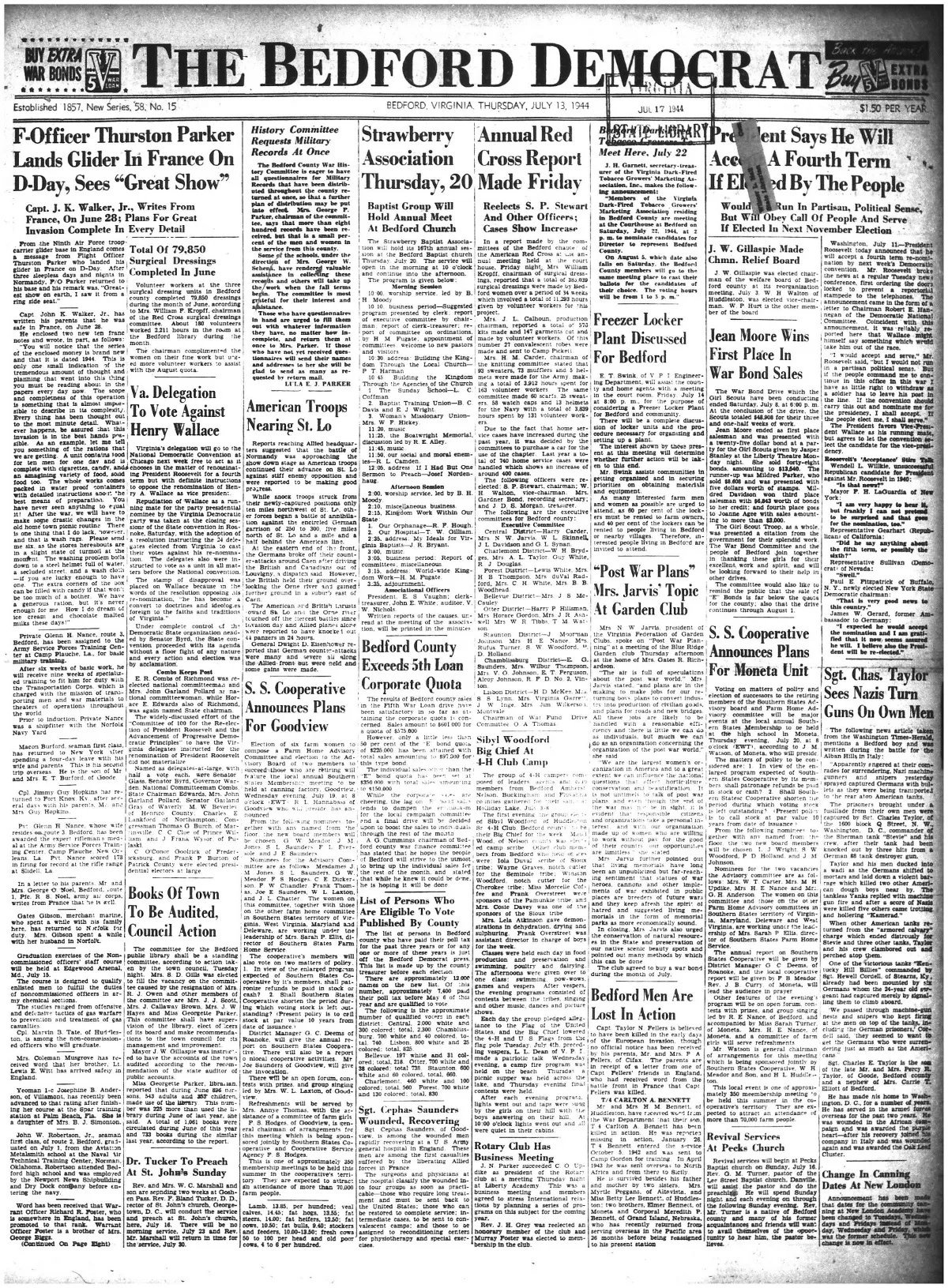
    The July 13, 1944 edition of The Bedford Democrat newspaper details the names of men from the county w ho perished in World War II up to that point. (Photo courtesy Library of Virginia)

    Many of those killed on D-Day were entering combat for the first time, Long said. But they also knew that they were in a crucial battle between good and evil.

    The U.S. worked with its allies, England and Canada, in those days. The leader of the invasion, U.S. Gen. Dwight Eisenhower, ultimately made the decisions. But he led with power that considered other viewpoints. That birthed a spirit of cooperation and adaptation that overcame everything that went wrong on D-Day, a spirit that had to extend to the troops for anything to succeed.

    In his Order of the Day, Eisenhower referred to what was about to happen as a “Great Crusade.”

    This crusade required more than brilliant tacticians or seasoned soldiers. It relied on guys like Hall, who before the war worked for a Charlottesville Ford dealership, according to his obituary.

    Hall, the Bedford 20,most of the rest of the lost Virginians and more than 9,000 other Americans who died in the D-Day invasion were not military professionals. They were mostly average Joes who understood and accepted the obligation of their country’s commitment to freedom from dictators.

    Standing among seemingly endless rows of U.S. grave markers in Normandy inevitably invites a comparison of America’s spirit on D-Day and today.

    On D-Day, the U.S. aligned itself with allies. It did not alienate or publicly lecture them, as our government leaders currently do. The country felt a shared responsibility to the world in a war that was not being fought on American soil. That commitment sprang from ideology instead of property. Freedom from authoritarian rule was the goal, but not just in an abstract sense.

    To fight on D-Day meant facing daunting physical risks to take down the enemy or die trying.

    “By and large, allied leaders made it clear this was a battle of good versus evil that had to be won,” Long said. “They had a sense of what they had to do and why.”

    But there was also a personal sense of the mission reliant on individual survival instincts to succeed. The only path to victory was up the bluffs.

    “Their thinking,” said Long, “was that taking those bluffs was how they got to go home.”

    Thousands didn’t. Still, they trusted in leaders whose integrity made it worth the try.

    In a country whose leaders routinely lie or use their positions to expand personal authority and wealth, such trust cannot exist.

    This is the country we now live in. It is a place where the president punishes institutions that practice traditional values of tolerance, opportunity and compassion.

    It is a place where the president calls the late Sen. John McCain, a hero who suffered years of torture for his service in the Vietnam War, a “loser.”

    We now live in a place where white nationalists and misogynists masquerading as war experts strip promotions from black and female military officers, and the president, a draft dodger who never served, pursues military policies so devoid of tactical rationale and legality that America’s finest officers must resign because they cannot in good conscience follow what they believe to be illegal orders.

    Our highest political leader today believes that undocumented immigrants deserve no constitutional rights and can be separated from their children and thrown into detention facilities for months without court hearings.

    We now live in a country where the same leader encourages government agents to attack protesters. The Trump administration initially refused to cooperate with state investigators seeking facts in the killings of two legal Minnesota residents by Immigration and Customs Enforcement agents. A judge had to order the administration to release evidence.

    ICE officer fatally shoots driver through car window in Minneapolis

    Finally, and perhaps most tragically, instead of fighting fascism, today we live in a country where the leader spreads lies about election fraud when he loses, then encourages an attack on the U.S. Capitol to stop the peaceful transfer of power.

    The attack injured police and led to several deaths. It cost taxpayers tens of millions of dollars. It led to 1,500 criminal convictions. But the leader, shielded from personal criminal prosecution by conservative Supreme Court justices, pardoned the criminals who did his bidding.

    What Americans did in 1944 on the beaches at Normandy showed greatness and selflessness. What Donald Trump has done in his time as president is destroy Americans’ sense of unity and responsibility, which gave us the strength to defeat Hitler.

    On this D-Day anniversary, that begs an ugly question for every American:

    How did the United States go from fighting fascism in 1944 to embracing it in 2026?

  • After Ashland dam removal, freshwater mussel species reintroduced to South Anna River

    After Ashland dam removal, freshwater mussel species reintroduced to South Anna River

    For about 200 years the Ashland Mill Dam, about a half-hour north of Richmond, blocked many fish from moving through the South Anna River. Without fish like herring to attach their larvae to, a freshwater mussel species known as the alewife floater disappeared from the waterway, making them “functionally extinct” in the area, according to Joe Wood with the Chesapeake Bay Foundation.

    The dam was removed two years ago and on Thursday, biologists and volunteers planted over 750 of the shelled critters back in the river to help them migrate upstream.

    Volunteers plant freshwater mussels in the South Anna River in June 2026. (Photo by Shannon Heckt/Virginia Mercury)

    “With the dam gone, we know that there’s unfettered access to these habitats. Any of the fish that are moving up and down this river that are potential mussel hosts are going to help these mussels,” said Alan Weaver, the fish passage coordinator for the Virginia Department of Wildlife Resources.

    For decades, scientists worked to find ways to either build a fishway —a pathway through the dam to allow some fish to move through — or find a way to remove the dam outright. In 2024, a private company purchased the dam to get mitigation credits required by federal law through the Clean Water Act to offset another project in the same watershed that could damage wetlands or other habitats.

    The company, Davey Mitigation, demolished the dam that had been a fixture of the western Hanover landscape for nearly two centuries.

    Since the removal, several targeted species have been able to migrate up the river for the first time in years. The restoration of mussel habitats also coincides with new goals laid out in the recently-renewed Chesapeake Bay Watershed Agreement, which outlines goals for animal habitat growth and pollution reduction.

    “Understanding that life cycle is really important to understanding freshwater mussels, because they’re one of our most endangered classes of organisms in the country,” Wood said.

    Alewife floaters are one of five mussel species found in the area. They can filter up to 15 gallons of water a day, which helps clear pollutants and sediment from streams.

    Freshwater mussel in the South Anna River. June 2026. (Photo by Shannon Heckt/Virginia Mercury)

    The alewife floaters rely on herring to carry their young upstream to grow and spread. Once the dam was removed, scientists began noting species of fish farther up the river than previously recorded.

    “Last year, we got the American shad, the hickory shed, the alewife, the blueback herring,” Weaver said. “Not only the fish are using the river, but they’re also going pretty far inland, and they’re actually using the habitat that we predicted that they would use.”

    The effort to restore the freshwater mussel populations was made possible through a partnership between the Chesapeake Bay Foundation, the Departments of Wildlife Resources, and Conservation and Recreation, and the Pamunkey and Mattaponi Indian Tribes.

    The Bay Foundation received a federal grant of $199,700 through the Chesapeake WILD program to restore wildlife habitat through this alliance, with a matching fund of $44,100 from various sources.

    Even with the dam removal, the return of the alewife floaters has been slow. Wood said it could have taken another hundred years for the mussels to move back upstream to their full potential. The planting efforts will speed up their migration and establish habitats to help them grow.

    South Anna River. June 2026 (Photo by Shannon Heckt/Virginia Mercury)
  • FOIA Friday: Richmond city and schools face scrutiny

    FOIA Friday: Richmond city and schools face scrutiny

    One of the less noticed features of the Virginia Way is the long-running tendency of the commonwealth’s leaders to conduct their decision-making behind closed doors. While the Virginia Freedom of Information Act presumes all government business is by default public and requires officials to justify why exceptions should be made, too many Virginia leaders in practice take the opposite stance, acting as if records are by default private and the public must prove they should be handled otherwise.

    In this feature, we aim to highlight the frequency with which officials around Virginia are resisting public access to records on issues large and small — and note instances when the release of information under FOIA gave the public insight into how government bodies are operating.

    The Mercury’s efforts to track FOIA and other transparency cases in Virginia are indebted to the work of the Virginia Coalition for Open Government, a nonprofit alliance dedicated to expanding access to government records, meetings and other state and local proceedings.

    Richmond fails to uphold transparency plan

    Richmond is facing new transparency questions after the city failed for seven years to follow its own law requiring routine publication of financial transactions, The Richmonder reported in May.

    The outlet found the city followed the law for about four years before it stopped posting new data in 2019. In 2024, it also removed older data because it contained confidential information that had been missed during earlier reviews.

    Mayor Danny Avula’s administration republished most of the information in April after The Richmonder filed a records request for the transactions. The administration took office in January 2025. The Richmonder said the data detailed a range of financial transactions, from a $55 million debt service payment to a $600 paint job for a bathroom in the mayor’s office.

    The administration said concerns over confidential information have prevented the city from ”complying with a law meant to help assure Richmond taxpayers that public funds are spent wisely,” The Richmonder wrote. City officials have said reviewing the records takes significant time as a result.

    The news outlet also reported that Councilmember Kenya Gibson planned to introduce an oversight resolution asking the council to investigate the city’s failure to publish the payment register.

    Courthouse News Service challenges court practices

    A federal judge’s ruling allows a closely watched over access to Virginia to move forward, after court officials argued the case should be thrown out before evidence could be examined.

    The suit, filed by Courthouse News Service, challenges restrictions tied to the Virginia’s Officer of the Court Remote Access system, known as OCRA, which gives attorneys and government workers access to non-confidential court filings that journalists and the public cannot directly access.

    In a May 5 ruling, U.S. District Judge James Jones said the plaintiffs had sufficiently alleged that Virginia’s policies may improperly delay or restrict public access to newly filed civil complaints. Jones wrote that disputes over how the OCRA system functions are issues for the later stages of the case, not grounds for dismissal at the outset.

    Shortly after the ruling, Karl Hade, executive secretary of the Supreme Court of Virginia, appealed the decision on behalf of court officials to the U.S. Court of Appeals for the Fourth Circuit.

    Public allowed to hear complaints against board

    Complaints involving Suffolk County School Board members are now open to the public, the Suffolk News Herald reports.

    The news outlet said in May that the board revised its regulations to allow such matters to be addressed in public rather than in closed session.

    The change also addresses disputes over board norms, member discipline and transparency.

    Some of the issues included court rulings finding FOIA violations, litigation over public access to meetings, and the censure of former board member Sherri Story when the board’s operations and practices became subject of public debate.

    Richmond schools defend redactions in facilities department probe

    Richmond City Public Schools is standing by a personnel exemption after redacting an internal investigation report on its facilities department, which is responsible for maintaining school buildings.

    According to WTVR, which requested the records, the school system’s report revealed little about allegations of mismanagement under former director Bobby Hathaway, who left during the probe.

    Virginia Coalition for Open Government Director Megan Rhyne told the network that “the personnel exemption was never designed and never intended to cover up wrongdoing by public employees, particularly when that wrongdoing has to do with the misappropriation of public funds or taxpayer dollars.”

    She said the exemption should apply to human resources matters or performance reviews, not alleged wrongdoing. She believes RPS applied the exemption too broadly.

    In 2024, a circuit court judge ruled that the district improperly withheld the report on the Huguenot High School graduation shooting investigation, forcing its release. In that case, RPS relied on a different FOIA exemption.

    WTVR requested records tied to the facilities investigation, which revealed operational failures.

    The news outlet reported the investigation uncovered misuse of purchase card accounts, including instances in which non-facilities personnel used the department’s account for purchases at Lowe’s.

    Investigators also found that parts of the work order system were ”completely ignored,” and materials were not properly recorded and stored. The report said a lack of protocols “created an environment susceptible to loss and misuse of assets.”

    Investigators recommended operational reforms and a forensic review of all purchases made by the facilities department to determine the “full scope of financial impact.”

    Much of the remainder of the report was heavily redacted.

    Asked about the redactions, RPS spokesperson Alyssa Schwenk told WTVR that “the division must balance public interest and legal obligations to current and former employees. Our consistent practice is to protect information directly concerning personnel.”

  • Trump to pump $700M into coal power in the states, as he again blasts renewable energy

    Trump to pump $700M into coal power in the states, as he again blasts renewable energy

    The federal government will spend $700 million on building or refurbishing coal power infrastructure across the country in a boost to “clean, beautiful coal,” President Donald Trump said Thursday in the Oval Office.

    Trump said he was invoking the Cold War-era Defense Production Act, which gives the president authority over domestic industry, to save 13 existing power plants and build two new ones. He said the move would save 14,000 coal jobs and lower energy costs, though the spending will not lower the price of gasoline or diesel fuel, which has spiked since Trump launched a war with Iran in February.

    Trump criticized subsidies for wind power championed by Democrats, including his predecessor, Joe Biden, characterizing coal as the most important energy source to cultivate.

    “It’s real power,” Trump said. “In terms of power, there’s really nothing like it. We have so many different alternatives. You talk about some, there’s no real alternative.”

    New coal plants would be built in Alaska and West Virginia, Trump said. A defunct plant in Maryland would also be restarted. Those projects would be funded with $200 million in Department of Energy grants.

    Coal plants receiving a combined $425 million in Defense Production Act funding are in West Virginia, Kentucky, North Carolina, Indiana, Tennessee, Arkansas, Arizona, Oklahoma, North Dakota and Wisconsin, according to the White House.

    Coal mines benefiting from the move are in Pennsylvania, Kentucky, West Virginia, Ohio, Indiana, Illinois, Wyoming, North Dakota and New Mexico, according to the White House.

    The administration would also spend $75 million, authorized by the Defense Production Act, to help open a long-delayed new coal export terminal in Oakland, California, the White House said.

    Administration officials said Thursday’s announcement built on a record of the past 18 months in which the administration has saved dozens of coal production facilities.

    “It is hard to overstate the magnitude of this,” Energy Secretary Chris Wright said. “If you look at our efforts across the whole government, so far 45 coal plants are open today that would not be open.”

    Republican approval

    Trump Cabinet members, congressional Republicans and two governors, Wyoming’s Mark Gordon and West Virginia’s Patrick Morrissey, joined Trump for the Oval Office announcement, with several extolling the importance of the coal industry after Trump spoke.

    Wright, Interior Secretary Doug Burgum and Environmental Protection Agency Administrator Lee Zeldin praised Trump for intervening to help the industry and refocusing federal energy policy away from renewables.

    Wright said Democratic policies were more responsible for high energy costs than the war in Iran, even though Republicans have held unified control of the federal government since January 2025 and the Trump administration has consistently touted its moves to encourage fossil fuel production.

    “We wish they were lower, but gasoline prices in the U.S. are a little over $4. They’re $10 in Europe, they’re higher in Asia, they’re very high in California,” Wright said. The national average price for regular gasoline Thursday was $4.24 per gallon.

    “The bigger threat to energy prices in the United States is Democratic green energy policies,” Wright continued. “They have driven up energy prices far more than a conflict in Iran.”

    Burgum said the president was perhaps the strongest advocate for coal in the country’s history.

    He echoed Trump’s statements that the coal industry needed to be reinvigorated after the Biden administration focused more on renewable energy production.

    “The prior administration, under Biden, had gone so far down the path of pursuing the highly subsidized, intermittent, weather-dependent sources of electricity that our grid was at risk. You understood that and you understood how key coal is,” Burgum told Trump. “It’s the backbone of having affordable, reliable and secure American energy to power our country, our electric grid, power our competitiveness in AI, and power all the manufacturing that’s coming back.”

    Morrissey said the moves would benefit his state.

    “We believe your policies are going to allow America to compete and win,” Morrissey said. “West Virginia is going to supply the coal, the gas, the nuclear to help make that happen. So I’m very excited by everything you’re doing.”

    Greens decry ‘polluter handout’

    Environmental groups blasted the move, saying it propped up a failing industry and would have little long-term impact on energy prices or reliability.

    Jesse Lee, a senior adviser with the advocacy group Climate Power, said the spending on coal projects would not lower utility prices, which he said have climbed 18% during Trump’s second term.

    “He’s gaslighting the American people by claiming that this move will lower electricity prices in the middle of an energy affordability crisis that he created,” Lee said.

    Environmental groups noted the coal industry heavily contributed to Trump’s 2024 campaign.

    Several environmental advocates, including Lena Moffitt, the executive director of the climate group Evergreen Action, suggested that relationship drove Trump to promote coal at the expense of renewable energy sources.

    “Spending $700 million to bail out the coal industry is like throwing a lifeline to a ship that has already sunk,” Moffitt wrote. “Trump is handing out taxpayer money to coal barons and leaving us with nothing but higher energy costs. … There’s no coal revival waiting around the corner—just polluters collecting a handout while their friends run the White House and Americans foot the bill.”

  • US Senate launches marathon session to pass nearly $70B for ICE, Border Patrol

    US Senate launches marathon session to pass nearly $70B for ICE, Border Patrol

    WASHINGTON — U.S. Senate Republicans fended off an attempt Thursday to block the Department of Justice from using an “anti-weaponization” fund to pay people who feel they were wrongly prosecuted, as well as another proposal that sought to require congressional authorization for a new White House ballroom.

    Debate on amendments and motions, by Democrats and Republicans, is a required part of the special process GOP leaders are using to approve nearly $70 billion for immigration enforcement and deportation activities, including Immigration and Customs Enforcement and the Border Patrol, through the end of President Donald Trump’s term.

    Votes were expected to last into the evening and possibly overnight as Democrats look to challenge their Republican counterparts on policy while also making their case for control of Congress ahead of this year’s November midterm elections. The U.S. House adjourned for the week Thursday, meaning the measure will not head to the president’s desk until next week at the earliest.

    Senators voted 49-50 to reject an amendment from Minority Leader Chuck Schumer, D-N.Y., that would have prevented the Department of Justice from carrying out the “anti-weaponization” proposal by Trump to use $1.776 billion to pay people who feel they were wrongly prosecuted.

    Several Republicans facing tough reelection campaigns joined Democrats in voting for the amendment, including Alaska’s Dan Sullivan, Maine’s Susan Collins and Ohio’s Jon Husted.

    Acting Attorney General Todd Blanche testified earlier this week the administration had scrapped plans for the “anti-weaponization” fund, following intense criticism from both Republicans and Democrats, but Trump later said he wasn’t sure and would have to check with his attorneys.

    “Trump won’t give Americans a penny to help offset the skyrocketing costs he brought on our country,” Schumer said. “But he’s more than happy to charge them nearly $2 billion to line the pockets of his families, his billionaire friends, and the criminals who mauled police officers on January 6. If Republicans truly oppose this corruption, then prove it.”

    North Carolina Republican Sen. Thom Tillis then offered an amendment of his own that would have transferred the funding the administration had proposed for its so-called “anti-weaponization” fund to the Justice Department’s fraud division.

    “We heard over the last 48 hours that the acting attorney general said that this fund’s not moving forward,” Tillis said. “All this amendment does is codify what I believe the policy of the DOJ is.”

    South Carolina Republican Sen. Lindsey Graham raised a procedural objection to Tillis’ amendment, arguing it didn’t comply with the strict rules of the process.

    Tillis tried to waive that maneuver, but a 15-84 vote didn’t achieve those goals and the amendment failed.

    White House ballroom construction

    Oregon Sen. Jeff Merkley offered an amendment that would have required congressional authorization to proceed with Trump’s White House ballroom renovations.

    “All of us here have a responsibility to follow the power of the purse responsibility in the Constitution. Let’s all support the idea that it must proceed, if it’s to proceed, with a congressional authorization,” the Democrat said.

    Kentucky GOP Sen. Rand Paul called the amendment a “poison pill” and raised a procedural issue on the grounds that Merkley’s measure is not under the jurisdiction of the Judiciary Committee.

    “There is no money in this bill for a ballroom,” Paul said.

    Merkley tried to waive the procedural objection, but it failed in a 53-46 vote, which required at least 60 to agree in order to move forward.