
Tag: water use

  • Amid statewide drought conditions, data centers face same restrictions as all water customers

    Amid statewide drought conditions, data centers face same restrictions as all water customers

    About one-third of the state of Virginia is under extreme drought conditions, according to the U.S. Drought Monitor, and Gov. Abigail Spanberger is urging citizens to conserve water. So when local water authorities implement restrictions on water use, are there specific carve outs and rules for data centers, which use hundreds of thousands of gallons of water to cool their computer systems?

    No. Across multiple localities, they’re treated the same as all other commercial, industrial and residential customers, state and local officials revealed.

    The Department of Environmental Quality is responsible for permitting the groundwater withdrawal for public water authorities. Once that permit is granted it is up to each authority to manage their water use and limit customers as needed, based on the weather conditions.

    “Any of the permittees that are withdrawing are very cognizant of what they’re pulling out,” Weedon Cloe, manager of the Office of Water Supply at DEQ, said. “They have the limits and those limits are baked in during specific times of the year to ensure that the resource is not depleted.”

    There are provisions in the drought assessment and response plan that allow DEQ’s director to alter those permits in extreme circumstances. Cloe said that the department is reviewing those procedures, since the state is experiencing the worst drought they’ve seen in decades.

    Virginia hasn’t been this dry since 2002, when the extreme conditions triggered new standards.

    “The entire water supply program came (from) that drought. It was severe. It was like a huge swath through the center of the state running north south,” Cloe said.

    There are three main stages of drought that are declared by DEQ, which help localities decide on what water restrictions to implement.

    Under a drought watch, the state agency recommends localities minimize nonessential water use and to get a contingency plan in place.

    In the drought warning category, officials recommend local leaders to start voluntary water restrictions and aggressively identify any leaks or repairs needed.

    Once a drought emergency is declared, mandatory restrictions are put in place and if water customers don’t curb inessential water like irrigation, washing paved surfaces, or filling up pools, they could be fined.

    Some places, like Henrico County, have not needed to venture into the mandatory category for their customers in two decades.

    Bentley Chan, the director of Henrico’s department of public utilities, said that of the eleven data centers in the county, only one makes it into the list of their top ten water users. Apartment complexes and hospitals are the biggest water consumers there, and they don’t have specific usage rules in times of drought.

    “It’s not just on the residential customers (to restrict water use) and you’ll find that a lot of the industrial users have extraneous uses, such as irrigation, additional cleaning, and things of that nature,” Chan said. “And we do ask everybody to be a part of the mandatory restrictions … to preserve the flow in the James River.”

    Similar policies are used in Loudoun and Fairfax counties that house over 200 data centers combined. In Fairfax, the county follows guidance from the Metropolitan Washington Council of Governments that requires all customers to implement reductions under the mandatory orders.

    In Norfolk, there are no data centers online at this time that use water from their utilities, according to a utility representative. The representative went on to state that since they get their water from multiple sources, it is rare to have to implement restrictions.

    If there comes such a time (of data centers), the department would analyze the capacity versus the needs and factor in all conditions to ensure they’re able to adequately provide for all customers,” the representative said in a statement.

    Western Virginia Water Authority provides water to 69,000 customers in the Roanoke area, where there are also no data centers online yet. A representative told the Mercury that they are considering updating their policies once a data center is built – with one from Google expected to begin taking in water in 2028 that will be authorized to use up to 8 million gallons of water per day.

    Some localities have started mandatory restrictions heading into the official start of summer with precipitation totals for the rain year, which begins in October, to be about eight inches short.
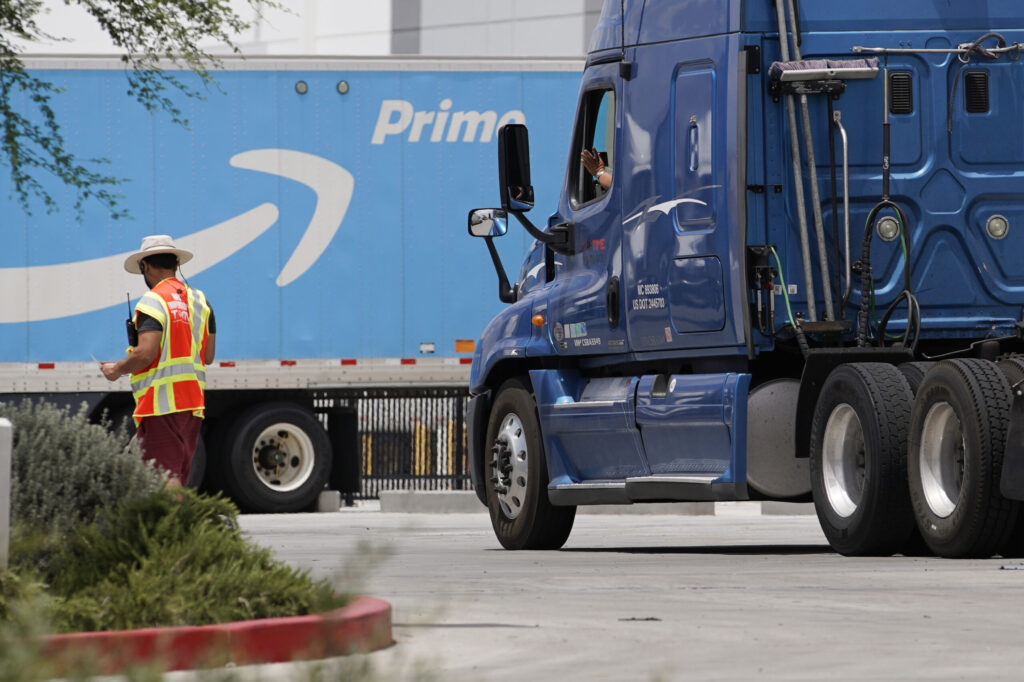
  • Four Va. counties will pump almost 20 million gallons of water a day to Amazon. Cause for concern?

    Four Va. counties will pump almost 20 million gallons of water a day to Amazon. Cause for concern?

    How you look at something – the frame you use and your perspective – often influences what you see.

    This holds true with the issue of data centers and water use. Amazon recently reported that it withdrew a total of 2.5 billion gallons of water for data center cooling operations in 2025. That seems like a lot of water.

    But Amazon also points out that Americans used 3.3 trillion gallons of water that same year to grow their gardens and lawns.

    The company apparently wants to assure you that the water it uses for its data center operations, in comparison to other uses of water across our very large country, is not such a big deal.

    Of course, Amazon doesn’t operate its data centers across the entire nation. It does so in only a few states, and nowhere at higher concentration than in Virginia.

    We wanted to learn for ourselves how much water local communities have promised to Amazon for data center cooling in our part of the state, the region between Northern Virginia and Richmond, including Louisa, Spotsylvania, Caroline and Stafford Counties.

    By scouring available public records and submitting Freedom of Information Act requests, we learned that local governments in the commonwealth have allocated at least 19.6 million gallons a day to Amazon.

    This, we think, is an underestimate. It doesn’t include at least one large water-cooled data center campus in another nearby county that might end up being leased and operated by Amazon, but is currently being constructed by another company. And it doesn’t include other potential Amazon data center campuses that have not yet been approved or are being held up in court.

    Even so, 19.6 million gallons a day seems like a good deal of water. It’s enough to fill 980 backyard swimming pools every day. If the average American uses 82 gallons of water a day, it’s enough to sustain 239,000 people.

    But Amazon tells us not to worry. The company has ambitious goals to become “water positive.” To Amazon, this means “replenishing more water to communities than we use in our direct operations.”

    But being “water positive” depends on your scale of analysis.

    For instance, Louisa County plans to provide seven million gallons a day to two separate Amazon data center campuses. Amazon is paying to construct the new water infrastructure that will make this possible.

    On one hand, this is “new” water to Louisa County that wouldn’t otherwise be available for industrial use without Amazon’s funding. But from the perspective of the larger North Anna reservoir and river system, it still constitutes a withdrawal.

    While Amazon is using raw water for its operations in Louisa County, in other localities the company is investing in extensive “purple pipe” systems that will capture water that would otherwise be sent downstream in order to circulate it to its data center campuses. The company is proud that it “works with utilities to collect treated wastewater, clean it to appropriate standards, and reuse it to save drinking water.”

    Amazon doesn’t mention, however, that it will lose more than half of this water through evaporation as it cools its data center facilities, sending most of it up into the atmosphere. So something that appears to be water positive from the perspective of a community hosting an Amazon data center campus might also be a net water loss to a river system and to downstream users.

    Even so, Amazon claims, it doesn’t use water to cool its operations throughout the whole year, only during the hottest days in Virginia.

    A company spokesperson, for instance, marked up a water service agreement between Stafford County and Amazon we received from a FOIA request, in which the county promised to deliver more than five million gallons a day. The spokesperson wrote to us that, “actual annual use is much lower. Based on 10 years of data, the campus only needs cooling water about 4% of the year during the hottest months.”

    The idea that Amazon is spending tens of millions of dollars to build a water system that it will only use for fifteen days out of the year strains credulity. Even if this is true, those are millions of gallons of water being diverted away from our rivers and streams during the peak of summer, when flows are the lowest and water is most needed.

    It’s especially concerning when most of the state is in a severe drought, as we are now experiencing and may endure again in future years.

    Beyond being Virginia’s leading data center company, Amazon has attained near- monopoly status as an online retailer and delivery service. It spends $19 million a year on lobbying alone, according to the Center for Responsive Politics. It funneled almost $10 million to political campaigns in 2024 in order to influence elections, the same source reports.

    Amazon, needless to say, also has a powerful public relations operation. It uses its economic and political power to avoid paying taxes that other companies and most individuals have to pay.

    And in Virginia, the company and others in the data center industry are exempt from paying sales and use tax, which lawmakers say costs us nearly $2 billion annually. That exemption is the sticking point in ongoing budget negotiations; if legislators don’t finalize the spending plan by June 30, with or without the tax exemption, the state will experience its first government shutdown.

    Amazon encourages us not to worry about all the water local governments are allocating to the company in central Virginia. It assures us that it is a good steward of this resource, and that it cares about sustainability.

    But Amazon, just like any company with vested interests and a profit motive, doesn’t always share the complete picture. It frames the view it wants the public to see.

    Given the massive size of this company and the ways it has abused its power in the past, Virginians would be wise to keep a watchful eye on how Amazon is using water. And as communities consider approving yet more data centers and additional water service agreements, Virginians may want to consider when enough is enough.