Tag: Voting rights

  • Civil rights group files motion to speed up Va.’s reform of voter registration process for ex-felons

    Civil rights group files motion to speed up Va.’s reform of voter registration process for ex-felons

    As thousands of Virginians with certain past felony convictions remain in a voting registration limbo, a civil rights group filed a motion on June 18 seeking an expedited remedy.

    The group accused election officials of violating a voting rights lawsuit previously won earlier this year.

    Some former felons, eligible to vote this summer, are in registration limbo

    The voting access issue stems from a series of 1870 laws called the Readmission Acts, which banned states from constitutionally disenfranchising people other than those convicted of crimes considered common law at the time.

    In Virginia, people with felony convictions lose their right to vote unless they successfully petition a governor for it to be restored or are pardoned — both subjective processes which haven’t always had clear guidelines.

    Virginia’s chapter of the American Civil Liberties Union argued in King v. O’Bannon that Virginians with a variety of felony convictions should have never lost their right to vote in the first place. A judge ruled in their favor earlier this year and ordered the state to comply by May.

    Attorney General Jay Jones then successfully sought an extension to June 1 so that the state could compile guidance for registrars and ascertain which modern-day felonies might bar someone from registering to vote.

    For instance, illegally using tear gas was included on a list of such crimes from Jones’ office, “even though tear gas was not invented in 1870,” ACLU attorney Eden Heilman said in an interview.

    While the legal organization “has serious questions” about how the lists were determined and whether eligible people will be able to vote this year, the group has tried for months to glean a better understanding from Jones’ office.

    Since June, registrars have been instructed to not fully process new voter registrations of people with felony convictions, according to documents obtained by The Mercury that are now exhibited in the new motion.

    In May, ACLU Virginia wrote a letter to Jones and Solicitor General Tillman Breckenridge asking why revisions to registration forms were not feasible for registrars, and for more details on challenges preventing the state from fully complying with the court order.

    The organization also asked for more clarity on conviction types that may require individualized review by Jones’ office.

    Breckenridge responded two days later to confirm receipt of the letter and end the conversation.

    “While we appreciate the information you’ve provided to us to this point, we do not believe further engagement on the topics in your letter would be constructive at this time,” he wrote.

    Heilman said that previous meetings with Jones’ office had not been successful.

    “It became clear that we were not making progress and had different understandings of what the court order was requiring,” she said.

    Jones’ office has not responded to requests for comment on the situation.

    With early voting for congressional primary elections underway, plaintiffs hope that the situation can be resolved before the Aug. 4 election so that eligible voters can participate.

    This fall, Virginia voters will also approve or reject a constitutional amendment that would allow all ex-felons the right to vote, so long as they have served their sentences.


    Outdated forms and web portals another hurdle


    The apparent lack of full compliance with King v. O’Bannon sparked a period of uncertainty for ex-felons in the state, Nolef Turns director Sheba Williams said. The nonprofit shares resources with formerly incarcerated people and advocates for ways to reduce recidivism.

    Voter registration applications question whether or not someone has committed a felony, which Williams said has confused formerly incarcerated people who want to cast a ballot. Many don’t know if they’re eligible or if they should answer the question or not, since it’s a crime to lie on applications.

    Northern Virginia resident Tati King, who’s been a lead plaintiff on the King v. O’Bannon case, claims that his registration was placed in limbo and as of the time of the motion filing on June 18, he was not yet able to vote.

    Fellow plaintiff Toni Heath Johnson, a Southwest Virginia resident, encountered the same “on hold” status.

    While in-person applicants were told their registrations won’t be processed right away, virtual applicants like Southwest Virginia resident Jared Rose relayed via lawyers that he could not proceed in the online process after clicking the felony conviction box.

    Rose is quoted in the filing saying he was “nervous” about additional prosecution if he didn’t indicate his past felony status despite being able to vote.

    “We’re in a pivotal moment where we have been seeing trust in our courts be eroded,” Williams said. “Virignia has an opportunity to restore faith by upholding the ruling of Judge (John) Gibney.”

    Gibney ruled that Virginia can’t take away someone’s voting rights, except for specific common law felonies from 1870. Those are arson, burglary, escape and rescue from a prison or jail, manslaughter, mayhem, murder, rape, robbery, sodomy and suicide.

    As part of their motion to enforce, ACLU suggests forms be amended to ask “only whether the applicant had been convicted of an offense corresponding to one of the 11 common law felonies set forth in the final order.”

    For now, the state has 14 days from the June 18 filing of the motion to respond.
  • Some former felons, eligible to vote this summer, are in registration limbo

    Some former felons, eligible to vote this summer, are in registration limbo

    While a pending constitutional amendment to automatically restore voting rights to people with felony convictions who have served their sentences awaits Virginians’ approval or rejection in a statewide referendum later this year, thousands of people who should never have lost their right to vote in the first place remain in limbo during this summer’s congressional primary elections.

    After a court ruled earlier this year that certain felony convictions should not have resulted in loss of voting rights, Virginia’s Department of Elections had until June 1 to comply with the order to rectify the situation.

    Instead, on June 1, the department sent an advisory to election officials indicating that they should not deny peoples’ applications but to not fully process them either.

    “Please note that records available through the felon search may have been affected by the updates to the Agency Felony Prohibited table. ELECT will provide additional guidance on reviewing felony history soon,” the June 2 advisory obtained by The Mercury read.

    The crux, Nolef Turns director Sheba Williams said, is that some people with felony convictions who should be eligible to vote this summer are nervous to register because it is a crime to lie on applications.

    “When they get to their application, there is a question about whether or not you have been convicted of a felony,” Williams explained.

    For people whose felonies don’t count towards prohibition of voting, they are unsure if they should check the box or not. So, with early voting for the congressional midterms beginning June 18, relevant applicants are stuck waiting as the process plays out.

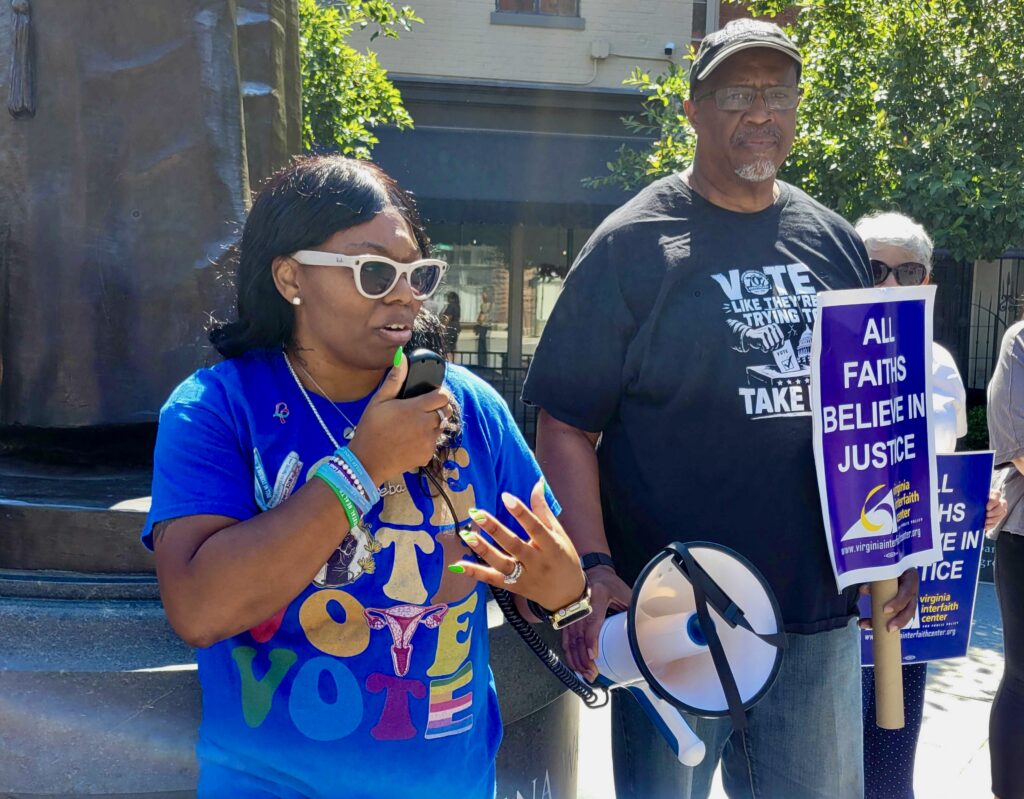
    Williams organized a press conference in Richmond on Wednesday along with the Virginia Interfaith Center For Public Policy and Bridging the Gap Virginia. Each group has advocated for criminal justice reform and voting rights laws and some have helped returning citizens navigate post-incarceration life.

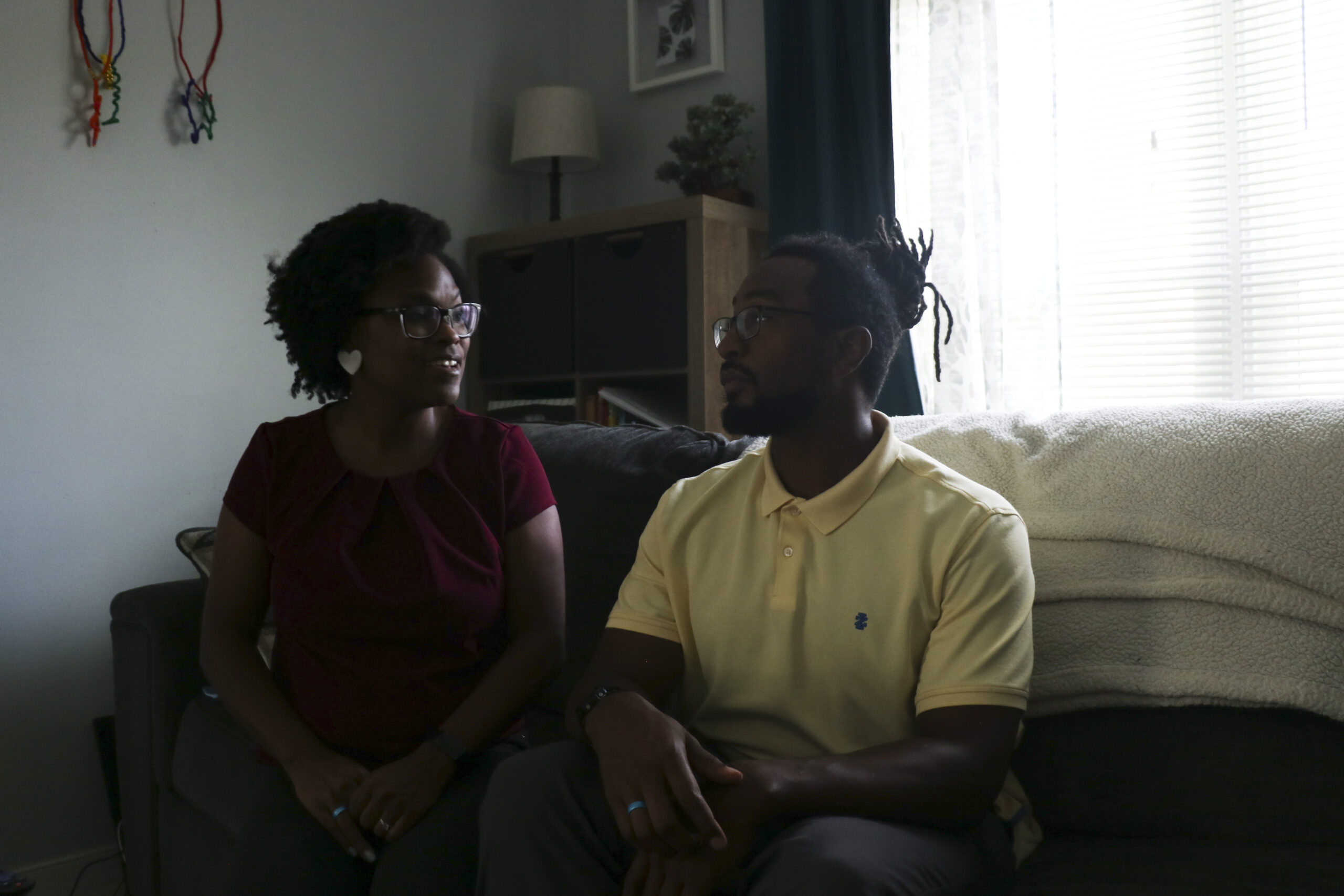
    Quadaire Patterson and his wife Santia Nance attended the event. The couple has ramped up their criminal justice advocacy, starting when Patterson was still incarcerated. Though he’s helped shape laws before and after his 2024 release, he has still been unable to vote.

    Santia Nance (left) sits with husband Quadaire Patterson (right) in their living room in Henrico County in September 2024. (Photo by Charlotte Rene Woods/Virginia Mercury)

    “As I think back to my crime when I was 19 years old, I had no awareness of the political systems that are in play,” Patterson said.

    But now at 38, having spent about half of his life behind bars, Patterson said he understands how important it is to engage in democracy. The importance of the right to vote hits closer to home now that he and his wife have a 14-month-old daughter, Trinity.

    “If we ever want to repair this broken system, if we ever want to repair our broken communities, we have to fully allow returning citizens to participate in the civic processes,” Patterson said.

    The case at the core of the matter stemmed from a series of 1870 laws called the Readmission Acts, which allowed former Confederate states to re-enter U.S. Congress after the Civil War. The laws had barred states from constitutionally disenfranchising people other than those convicted of crimes considered common law at the time.

    “We create crimes every year but we never revisit and say ‘what did we get wrong?’ and I think that is a barrier too,” Williams said.

    Following the suit, Attorney General Jay Jones’ office has been drafting lists of crimes that could be applicable to the ruling.

    Congressional primaries will take place Aug. 4 and the deadline to register to vote in those elections is July 24.

  • Judge approves settlement over rejected Virginia student voter registrations

    Judge approves settlement over rejected Virginia student voter registrations

    A federal judge has approved a consent decree requiring Virginia election officials to accept certain voter registration applications submitted by college students, resolving a lawsuit that alleged students were being improperly denied registration over missing dormitory-related details.

    The agreement, approved last week by the U.S. District Court for the Eastern District of Virginia, bars election officials from rejecting otherwise eligible student voter registration applications solely because they omit information such as dorm room numbers, dorm names or campus mailbox numbers when those details are not necessary to determine voting precincts.

    The lawsuit was filed in October by the NAACP Virginia State Conference and the Advancement Project against Virginia election officials shortly before the November 2025 general election.

    The civil rights groups alleged that election officials in multiple Virginia jurisdictions had rejected or delayed voter registration applications submitted by college students living on campus because the forms lacked dormitory-specific information not required under Virginia law.

    The plaintiffs argued the practice disproportionately affected students attending historically Black colleges and universities, including Norfolk State University and Virginia State University, along with students at schools including George Mason University, James Madison University, Old Dominion University, University of Richmond and Virginia Commonwealth University.

    What the settlement requires

    The lawsuit — titled NAACP Virginia State Conference v. John O’Bannon et al. — alleged that rejecting applications over missing dormitory details violated the Materiality Provision of the Civil Rights Act of 1964 as well as the First and Fourteenth Amendments of the U.S. Constitution.

    Under the consent decree, Virginia election officials must provide guidance and training to local registrars on how to handle student voter registration applications and amend the state voter registration form to clarify what address information is required for people living in dormitories and other group housing.

    The agreement also requires state officials to begin rulemaking efforts to formally incorporate the new standards in the Virginia Administrative Code.

    Andrea Gaines, a spokeswoman for the Virginia Department of Elections, said the State Board of Elections and the department approved the consent decree to promote “uniform processing” of voter registration applications and ensure people living in group housing such as college dormitories provide enough information to be assigned to the correct voting precinct.

    Gaines said additional guidance will be provided to local election officials before Virginia’s Aug. 4 primary election.

    John Powers, legal director for the Advancement Project, said the agreement removes barriers that had prevented some students from successfully registering to vote.

    “This consent decree is a major win for Virginia voters,” Powers said in a statement.

    “For too long, too many Virginia college students have been disenfranchised due to unnecessary and burdensome restrictions. This agreement removes those barriers and mandates important reforms that will allow more students to register successfully and cast ballots that count.”

    Anthony Ashton, senior associate general counsel for the NAACP, said the agreement makes clear that eligible voters cannot be denied registration over technical omissions unrelated to eligibility.

    “College students in Virginia — particularly those at historically Black colleges and universities — have faced unnecessary and unlawful barriers to voter registration,” Ashton said. “This consent decree sends a strong message that those practices will not stand.”

    Case reflects broader fights over student voter access

    The lawsuit was filed amid broader national debates over student voting access and efforts by voting-rights organizations to challenge policies they say place additional hurdles on younger voters.

    An analysis by the Brennan Center for Justice found that college students have long encountered voting obstacles involving residence verification and campus mailing addresses.

    In Indiana, a federal judge last year declined to dismiss a challenge to a law restricting student voter identification, ruling that students had plausibly alleged violations of the First, Fourteenth and Twenty-Sixth Amendments.

    Virginia voting rights advocates had also previously raised concerns that some local registrars were rejecting voter registration applications submitted by students listing university housing addresses without additional proof of residence.

    Supporters of last year’s lawsuit argued that the timing was particularly significant because the complaint was filed shortly before Virginia’s November 2025 statewide elections, which included races for governor, lieutenant governor, attorney general and all 100 seats in the House of Delegates.

    Editor’s note: This story has been updated to include a statement from the Virginia Department of Elections.