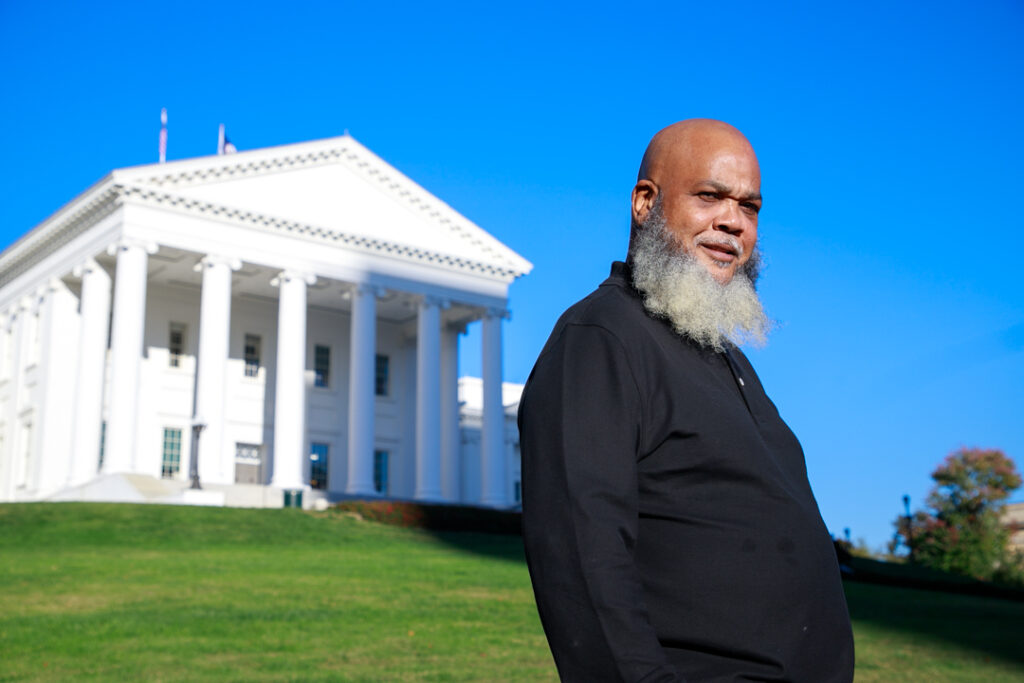
(Photo courtesy of Phuong Tran/ACLU of Virginia)
As thousands of Virginians with certain past felony convictions remain in a voting registration limbo, a civil rights group filed a motion on June 18 seeking an expedited remedy.
The group accused election officials of violating a voting rights lawsuit previously won earlier this year.
Some former felons, eligible to vote this summer, are in registration limbo
The voting access issue stems from a series of 1870 laws called the Readmission Acts, which banned states from constitutionally disenfranchising people other than those convicted of crimes considered common law at the time.
In Virginia, people with felony convictions lose their right to vote unless they successfully petition a governor for it to be restored or are pardoned — both subjective processes which haven’t always had clear guidelines.
Virginia’s chapter of the American Civil Liberties Union argued in King v. O’Bannon that Virginians with a variety of felony convictions should have never lost their right to vote in the first place. A judge ruled in their favor earlier this year and ordered the state to comply by May.
Attorney General Jay Jones then successfully sought an extension to June 1 so that the state could compile guidance for registrars and ascertain which modern-day felonies might bar someone from registering to vote.
For instance, illegally using tear gas was included on a list of such crimes from Jones’ office, “even though tear gas was not invented in 1870,” ACLU attorney Eden Heilman said in an interview.
While the legal organization “has serious questions” about how the lists were determined and whether eligible people will be able to vote this year, the group has tried for months to glean a better understanding from Jones’ office.
Since June, registrars have been instructed to not fully process new voter registrations of people with felony convictions, according to documents obtained by The Mercury that are now exhibited in the new motion.
In May, ACLU Virginia wrote a letter to Jones and Solicitor General Tillman Breckenridge asking why revisions to registration forms were not feasible for registrars, and for more details on challenges preventing the state from fully complying with the court order.
The organization also asked for more clarity on conviction types that may require individualized review by Jones’ office.
Breckenridge responded two days later to confirm receipt of the letter and end the conversation.
“While we appreciate the information you’ve provided to us to this point, we do not believe further engagement on the topics in your letter would be constructive at this time,” he wrote.
Heilman said that previous meetings with Jones’ office had not been successful.
“It became clear that we were not making progress and had different understandings of what the court order was requiring,” she said.
Jones’ office has not responded to requests for comment on the situation.
With early voting for congressional primary elections underway, plaintiffs hope that the situation can be resolved before the Aug. 4 election so that eligible voters can participate.
This fall, Virginia voters will also approve or reject a constitutional amendment that would allow all ex-felons the right to vote, so long as they have served their sentences.
Outdated forms and web portals another hurdle
The apparent lack of full compliance with King v. O’Bannon sparked a period of uncertainty for ex-felons in the state, Nolef Turns director Sheba Williams said. The nonprofit shares resources with formerly incarcerated people and advocates for ways to reduce recidivism.
Voter registration applications question whether or not someone has committed a felony, which Williams said has confused formerly incarcerated people who want to cast a ballot. Many don’t know if they’re eligible or if they should answer the question or not, since it’s a crime to lie on applications.
Northern Virginia resident Tati King, who’s been a lead plaintiff on the King v. O’Bannon case, claims that his registration was placed in limbo and as of the time of the motion filing on June 18, he was not yet able to vote.
Fellow plaintiff Toni Heath Johnson, a Southwest Virginia resident, encountered the same “on hold” status.
While in-person applicants were told their registrations won’t be processed right away, virtual applicants like Southwest Virginia resident Jared Rose relayed via lawyers that he could not proceed in the online process after clicking the felony conviction box.
Rose is quoted in the filing saying he was “nervous” about additional prosecution if he didn’t indicate his past felony status despite being able to vote.
“We’re in a pivotal moment where we have been seeing trust in our courts be eroded,” Williams said. “Virignia has an opportunity to restore faith by upholding the ruling of Judge (John) Gibney.”
Gibney ruled that Virginia can’t take away someone’s voting rights, except for specific common law felonies from 1870. Those are arson, burglary, escape and rescue from a prison or jail, manslaughter, mayhem, murder, rape, robbery, sodomy and suicide.
As part of their motion to enforce, ACLU suggests forms be amended to ask “only whether the applicant had been convicted of an offense corresponding to one of the 11 common law felonies set forth in the final order.”
For now, the state has 14 days from the June 18 filing of the motion to respond.