Tag: Virginia

  • More than abortion: What Va. patients and providers want you to know about reproductive health laws

    More than abortion: What Va. patients and providers want you to know about reproductive health laws

    Editor’s note: This story mentions pregnancy loss.

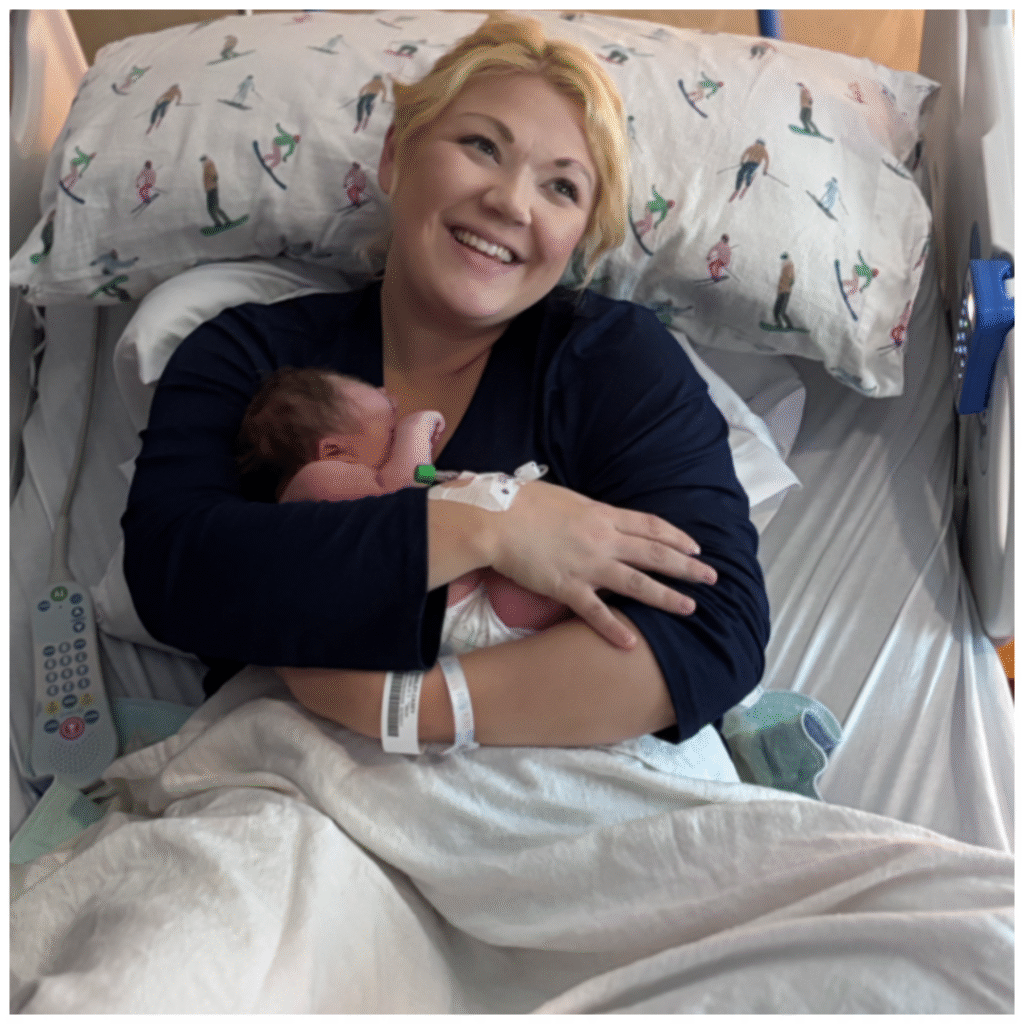
    Miscarriages were common for Albemarle County resident Casey Oakley during her in vitro fertilization process. Some embryo transfers weren’t successful and her body would expel the remnants, a process she had always handled safely at home, until an irregular delay.

    Her bloodwork had indicated her pregnancy hormones were not elevating properly, signaling an imminent miscarriage. But two weeks later nothing had happened.

    “(Doctors) didn’t know where the embryo had implanted in my body, so I was scheduled for an abortion, and I was told before my surgery that if they couldn’t find products of conception in my uterus, that they were going to be taking my tubes,” she said.

    Miscarriage management remains muddled 4 years after Dobbs

    The fallback option was meant to spare her the deadly infections that can arise when miscarriages fail to complete.

    “It wasn’t a question that they asked, it was more of a ‘this is what we have to do to make sure that you live,’” Oakley said.

    Doctors eventually discovered that her body had maintained a gestational sac but no fetal DNA.

    “My body had fought so hard for a pregnancy that would have no baby and then I was going into sepsis,” she said. “The abortion saved my life.”

    Her experience is foundational to her support for a pending constitutional amendment heading to Virginia voters statewide in November.

    If approved, it will permanently embed reproductive rights into Virginia’s constitution.

    The amendment would protect people’s access to contraception, IVF and abortion, four years after the Supreme Court overturned federal protections for abortion and more states have restricted access to the procedure and birth control.

    Virginia remains the least restrictive Southern state for reproductive healthcare in the era after Dobbs v. Jackson Women’s Health Organization, the abortion protection case that justice struck down in 2022.


    State lawmakers weigh in
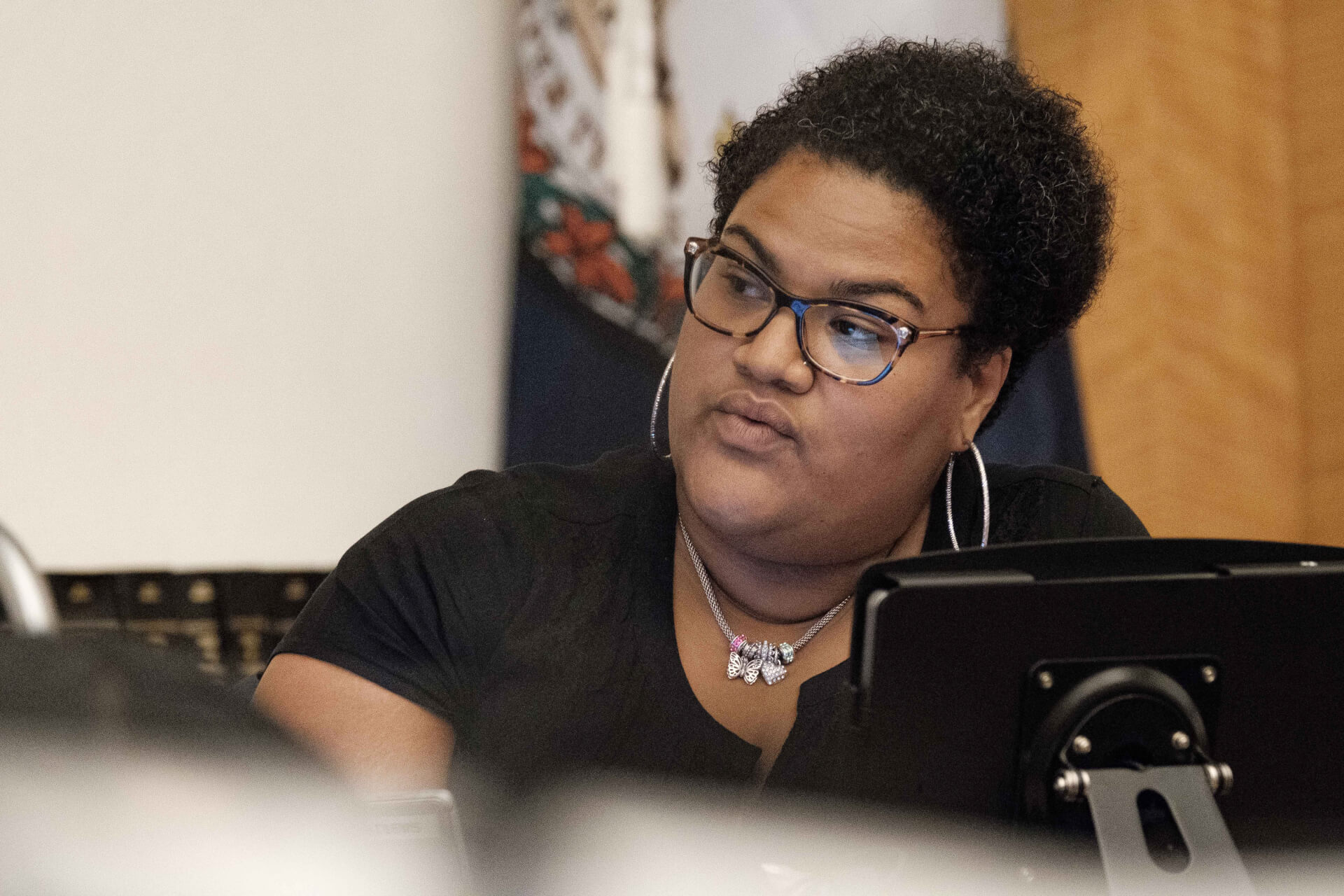
     

    Del. Cia Price, D-Newport News. (Ned Oliver/Virginia Mercury)

    Del. Cia Price, D-Newport News, was diagnosed with polyendocrine metabolic ovarian syndrome at 16 years old. She recalled debilitating cramps that made it hard for her to focus in school and days she could not get out of bed.

    Formerly known as polycystic ovarian syndrome, PMOS is a full body disorder that affects people’s metabolism and reproductive organs. It can also cause infertility. Contraception has long been a standard treatment for the disorder to improve quality of life.

    Though Price doesn’t need contraception for family planning as she is in a same-sex relationship and does not want biological children, the treatment lessens her PMOS symptoms.

    She said her and others’ access to the medication could be at risk.

    After Dobbs, Justice Clarence Thomas suggested the court revisit cases that have protected contraception, as well.

    Gov. Abigail Spanberger signed Price’s Right To Contraception Act into law this summer, after the bill was vetoed multiple times by former Gov. Glenn Youngkin.

    It will protect contraception access in the interim, though the pending reproductive rights amendment would shore matters up longterm.

    Price said she understands some of her constituents’ and legislative colleagues’ reasons for not supporting contraception or abortion — from religious objections to debates over life-at-conception. But she underscored the healthcare utility of each.

    “It’s just really disheartening for your quality of life to be at the intersection of an argument,” she said.

    “This is a difficult topic for a lot of people,” Sen. Emily Jordan, R-Suffolk, said during a floor speech earlier this year amid debate over the amendment.

    Jordan was among the Virginia Republicans who unsuccessfully sought to alter the amendment to reinforce existing state code outlining restrictions for minors and outlining care for infants when they are born.

    The amendment advanced due to Democrats’ majority in the Virginia statehouse. Now, it’s in voters’ hands.

    Price believes her contraception bill and the amendment “takes the conversation out of the political sphere and puts it in the medical sphere and the personal decision sphere.”


    The medical cost


    Dr. Kimi Chernoby, an emergency medicine doctor and lawyer, noted that emergency abortion care can happen at all stages of pregnancy if things go awry with the fetus or parent.

    She added that many first trimester abortions stem from miscarriages or ectopic pregnancies, and that restrictive state laws increase margins for death.

    “These laws are written by lawyers who have no medical training,” she said. “They actually prohibit a lot of care around miscarriages and ectopics, unless they fall within certain exceptions, and so that’s the care that is getting tangled up.”

    As chief operating officer for a nonprofit called FemInEM, Chernoby organizes training around the country for emergency physicians to handle reproductive health emergencies.

    The national patchwork of bans and restrictions with scant exceptions has complicated her and other physicians’ work, she said.

    Legal challenges to mifepristone further muddle matters, as the abortion pill is also critical for managing miscarriages to prevent sepsis. FemInEM has submitted amicus briefs as a key court case that could affect abortions and miscarriage care nationwide unfolds.

    Ahead of the fall referendum and pending court rulings, Oakley reflected on how an abortion allowed her to become a mother, surrogate and foster parent many times over.

    “I was able to further the lives of my children and four other little girls,” she said. “There will be many other children to come into our lives afterwards.”
  • Spanberger unveils reformed practices for Va. prisons and council on corrections

    Spanberger unveils reformed practices for Va. prisons and council on corrections

    A new council convened by Gov. Abigail Spanberger aims to help solve longstanding issues in Virginia’s prisons that residents and correctional officers have expressed concerns about for years.

    The Governor’s Community Partnership Council On Corrections, which Spanberger announced Tuesday, will bring together representatives from advocacy groups, faith-based organizations, healthcare and public safety groups and former prisoners to share their experiences and work towards solutions.

    Two years ago a handful of prisoners at Red Onion State Prison, the most embattled correctional institution in the state, burned themselves in protest of living conditions and in attempts to transfer elsewhere.

    Allegations of racism and retaliation by correctional officers were not ruled out by a state watchdog investigation at the prison and a class action lawsuit on behalf of prisoners who say they were abused will head to trial later this year.

    Federal judge allows Va. inmates rights’ lawsuits to move forward

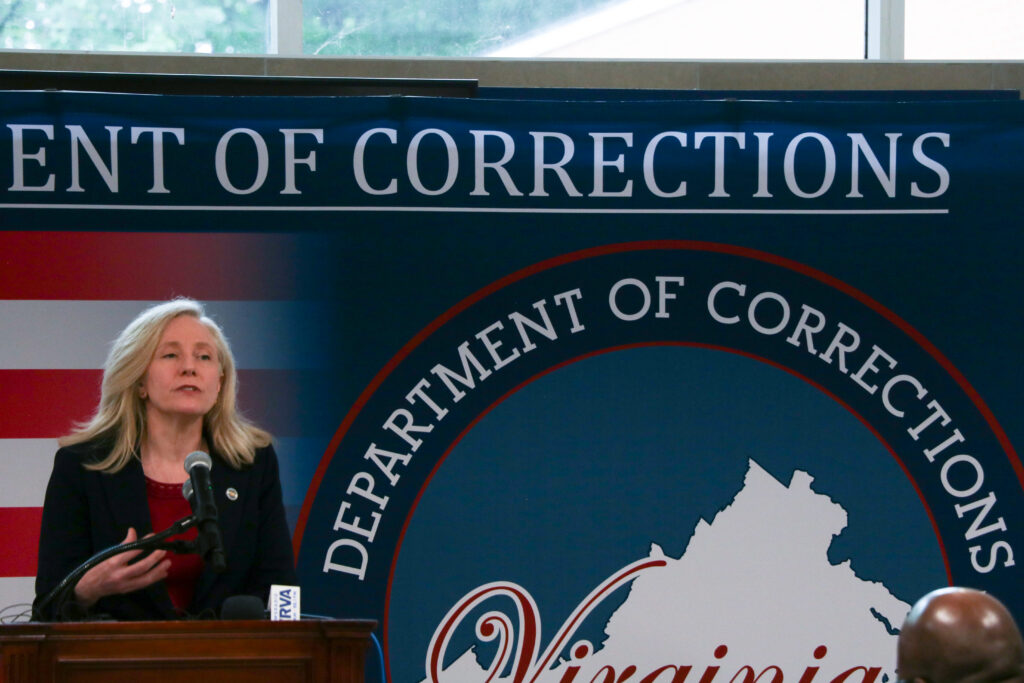
    “The people living in Virginia’s prisons are not forgotten on our watch,” Spanberger said at a press conference announcing the new council held at the Virginia Department of Corrections headquarters in Richmond.

    Virginia Public Safety and Homeland Security Secretary Stanley Meador emphasized that the council will empower participants to propose solutions to problems and help the administration “see things we can’t see.”

    Shawn Weneta, a policy strategist who has helped shape some criminal justice law changes in recent years, commended the creation of the council. He noted that some VADOC changes first began under the previous director but is pleased with the progress that the new administration is building.

    Speaking as a formerly incarcerated person, he emphasized that the council’s mission can best succeed by including “those most directly impacted by the system.”

    Ahead of assembling the official council, Spanberger’s administration has already conducted engagement within prisons and implemented her Executive Order 12, which entailed enhanced training for correctional officers and building partnerships with communities.

    From January to May of this year, Spanberger said use of force across all VADOC facilities has declined by 39%, serious inmate-on-staff assaults dropped 56%, lockdowns decreased by 27%, confirmed overdoses dropped 47%, while suspected overdoses dipped 12%.

    Virginia prisons have stopped using five-point restraints, which can be harmful for people in mental health crises, she said.

    The practice of isolating inmates in restorative housing, a persistent problem, has dropped by 20%.

    Restorative housing is Virginia state code’s euphemism for solitary confinement. It removes inmates from general populations and houses them in solitary cells.

    Restorative housing is used when there’s a threat of gang violence and as a disciplinary measure for inmates who violate prison rules.

    When asked how the reduction in restorative housing was made possible, Spanberger shared that staff training refreshers since she took office have focused on deescalation, which doesn’t exacerbate situations where an inmate may be in crisis or agitated.

    Spanberger also said her administration is considering how to fine tune the state’s Step Down program.

    Step Down is supposed to offer people placed in restorative housing a pathway out by helping address root causes of why they were placed in solitary housing and giving them measures to transition out of it.

    Several current and former inmates have relayed to The Mercury in recent years that restorative housing has been heavily utilized and people sometimes spend weeks or years, rather than days, in it.

    A third-party report to state lawmakers in late 2024 confirmed that at least one facility had placed the majority of its residents under solitary housing.

    Spanberger said her administration wants to be “making sure that every movement is documented on why someone is in restorative housing and their pathways out of it.”

    Under her direction, VADOC has also started to solve visitor access issues.

    After hearing tales of disparate visitation access, Spanberger identified COVID-era restrictions — like less seating and fewer visitor time slots — as a contributing factor.

    In recent months, VADOC has worked to restore past seating capacities in prisons’ visitor centers and expand visitor time slots, the governor said. She also signed a law that creates more guidance and takes into account the needs of long-distance travelers who come to see their loved ones behind bars.

    This “benefits, not just the family, but the person who is incarcerated,” she said.

    With Joseph Walters now serving as director of VADOC, Spanberger’s administration established a new code of ethics for VADOC employees and mandated refreshed training.

    Staffing issues have also plagued Virginia’s prisons. Walters and Meador shared that they’re very proud that their agencies’ work so far has been achieved even with a 21% staffing vacancy.

    This means, they said, that current staffers are working longer hours and pledging deeper commitment to their tasks. But rebuilding employee teams will be critical to halt turnover and alleviate burnout.

    Walters, Meador and Spanberger also hosted in-person engagement sessions with 13 advocacy groups that the governor said had gone unheard by the state’s top leaders for years.

    She called it “stunning” how long some groups had tried to relay concerns to previous administrations and that she hopes her efforts to strengthen communication can “build a foundation for after I am no longer in office.”

    Editor’s note: This story has been updated to correct the spelling of Walters.

  • Civil rights group files motion to speed up Va.’s reform of voter registration process for ex-felons

    Civil rights group files motion to speed up Va.’s reform of voter registration process for ex-felons

    As thousands of Virginians with certain past felony convictions remain in a voting registration limbo, a civil rights group filed a motion on June 18 seeking an expedited remedy.

    The group accused election officials of violating a voting rights lawsuit previously won earlier this year.

    Some former felons, eligible to vote this summer, are in registration limbo

    The voting access issue stems from a series of 1870 laws called the Readmission Acts, which banned states from constitutionally disenfranchising people other than those convicted of crimes considered common law at the time.

    In Virginia, people with felony convictions lose their right to vote unless they successfully petition a governor for it to be restored or are pardoned — both subjective processes which haven’t always had clear guidelines.

    Virginia’s chapter of the American Civil Liberties Union argued in King v. O’Bannon that Virginians with a variety of felony convictions should have never lost their right to vote in the first place. A judge ruled in their favor earlier this year and ordered the state to comply by May.

    Attorney General Jay Jones then successfully sought an extension to June 1 so that the state could compile guidance for registrars and ascertain which modern-day felonies might bar someone from registering to vote.

    For instance, illegally using tear gas was included on a list of such crimes from Jones’ office, “even though tear gas was not invented in 1870,” ACLU attorney Eden Heilman said in an interview.

    While the legal organization “has serious questions” about how the lists were determined and whether eligible people will be able to vote this year, the group has tried for months to glean a better understanding from Jones’ office.

    Since June, registrars have been instructed to not fully process new voter registrations of people with felony convictions, according to documents obtained by The Mercury that are now exhibited in the new motion.

    In May, ACLU Virginia wrote a letter to Jones and Solicitor General Tillman Breckenridge asking why revisions to registration forms were not feasible for registrars, and for more details on challenges preventing the state from fully complying with the court order.

    The organization also asked for more clarity on conviction types that may require individualized review by Jones’ office.

    Breckenridge responded two days later to confirm receipt of the letter and end the conversation.

    “While we appreciate the information you’ve provided to us to this point, we do not believe further engagement on the topics in your letter would be constructive at this time,” he wrote.

    Heilman said that previous meetings with Jones’ office had not been successful.

    “It became clear that we were not making progress and had different understandings of what the court order was requiring,” she said.

    Jones’ office has not responded to requests for comment on the situation.

    With early voting for congressional primary elections underway, plaintiffs hope that the situation can be resolved before the Aug. 4 election so that eligible voters can participate.

    This fall, Virginia voters will also approve or reject a constitutional amendment that would allow all ex-felons the right to vote, so long as they have served their sentences.


    Outdated forms and web portals another hurdle


    The apparent lack of full compliance with King v. O’Bannon sparked a period of uncertainty for ex-felons in the state, Nolef Turns director Sheba Williams said. The nonprofit shares resources with formerly incarcerated people and advocates for ways to reduce recidivism.

    Voter registration applications question whether or not someone has committed a felony, which Williams said has confused formerly incarcerated people who want to cast a ballot. Many don’t know if they’re eligible or if they should answer the question or not, since it’s a crime to lie on applications.

    Northern Virginia resident Tati King, who’s been a lead plaintiff on the King v. O’Bannon case, claims that his registration was placed in limbo and as of the time of the motion filing on June 18, he was not yet able to vote.

    Fellow plaintiff Toni Heath Johnson, a Southwest Virginia resident, encountered the same “on hold” status.

    While in-person applicants were told their registrations won’t be processed right away, virtual applicants like Southwest Virginia resident Jared Rose relayed via lawyers that he could not proceed in the online process after clicking the felony conviction box.

    Rose is quoted in the filing saying he was “nervous” about additional prosecution if he didn’t indicate his past felony status despite being able to vote.

    “We’re in a pivotal moment where we have been seeing trust in our courts be eroded,” Williams said. “Virignia has an opportunity to restore faith by upholding the ruling of Judge (John) Gibney.”

    Gibney ruled that Virginia can’t take away someone’s voting rights, except for specific common law felonies from 1870. Those are arson, burglary, escape and rescue from a prison or jail, manslaughter, mayhem, murder, rape, robbery, sodomy and suicide.

    As part of their motion to enforce, ACLU suggests forms be amended to ask “only whether the applicant had been convicted of an offense corresponding to one of the 11 common law felonies set forth in the final order.”

    For now, the state has 14 days from the June 18 filing of the motion to respond.

  • Some former felons, eligible to vote this summer, are in registration limbo

    Some former felons, eligible to vote this summer, are in registration limbo

    While a pending constitutional amendment to automatically restore voting rights to people with felony convictions who have served their sentences awaits Virginians’ approval or rejection in a statewide referendum later this year, thousands of people who should never have lost their right to vote in the first place remain in limbo during this summer’s congressional primary elections.

    After a court ruled earlier this year that certain felony convictions should not have resulted in loss of voting rights, Virginia’s Department of Elections had until June 1 to comply with the order to rectify the situation.

    Instead, on June 1, the department sent an advisory to election officials indicating that they should not deny peoples’ applications but to not fully process them either.

    “Please note that records available through the felon search may have been affected by the updates to the Agency Felony Prohibited table. ELECT will provide additional guidance on reviewing felony history soon,” the June 2 advisory obtained by The Mercury read.

    The crux, Nolef Turns director Sheba Williams said, is that some people with felony convictions who should be eligible to vote this summer are nervous to register because it is a crime to lie on applications.

    “When they get to their application, there is a question about whether or not you have been convicted of a felony,” Williams explained.

    For people whose felonies don’t count towards prohibition of voting, they are unsure if they should check the box or not. So, with early voting for the congressional midterms beginning June 18, relevant applicants are stuck waiting as the process plays out.

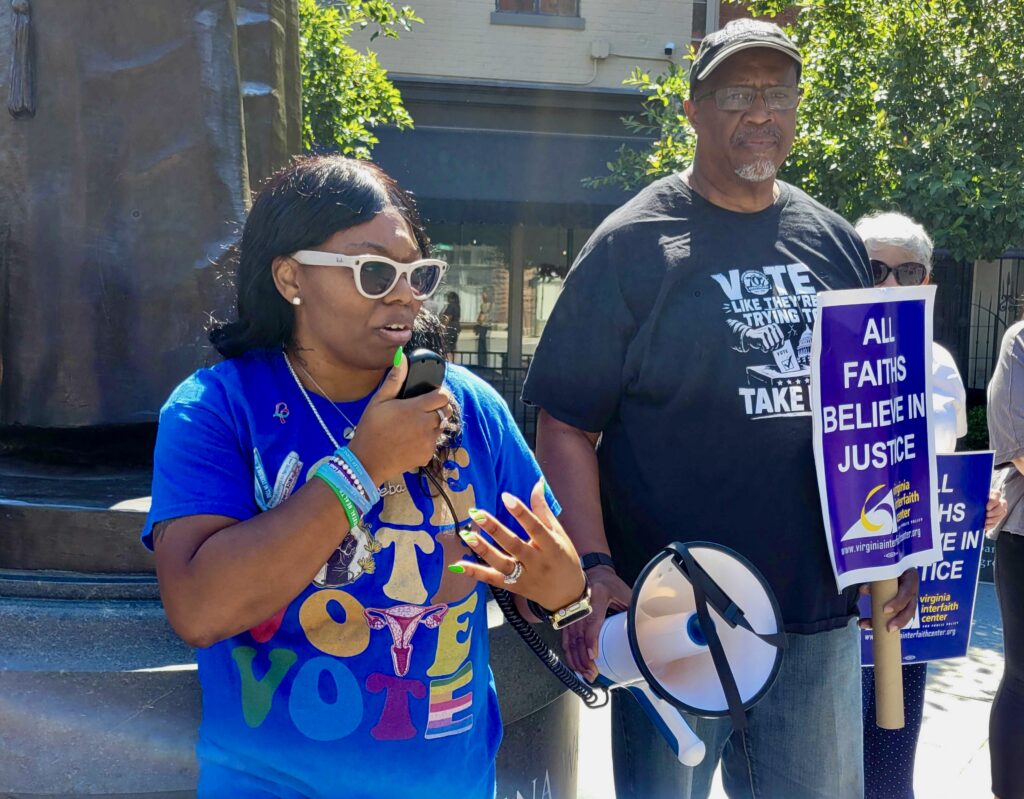
    Williams organized a press conference in Richmond on Wednesday along with the Virginia Interfaith Center For Public Policy and Bridging the Gap Virginia. Each group has advocated for criminal justice reform and voting rights laws and some have helped returning citizens navigate post-incarceration life.

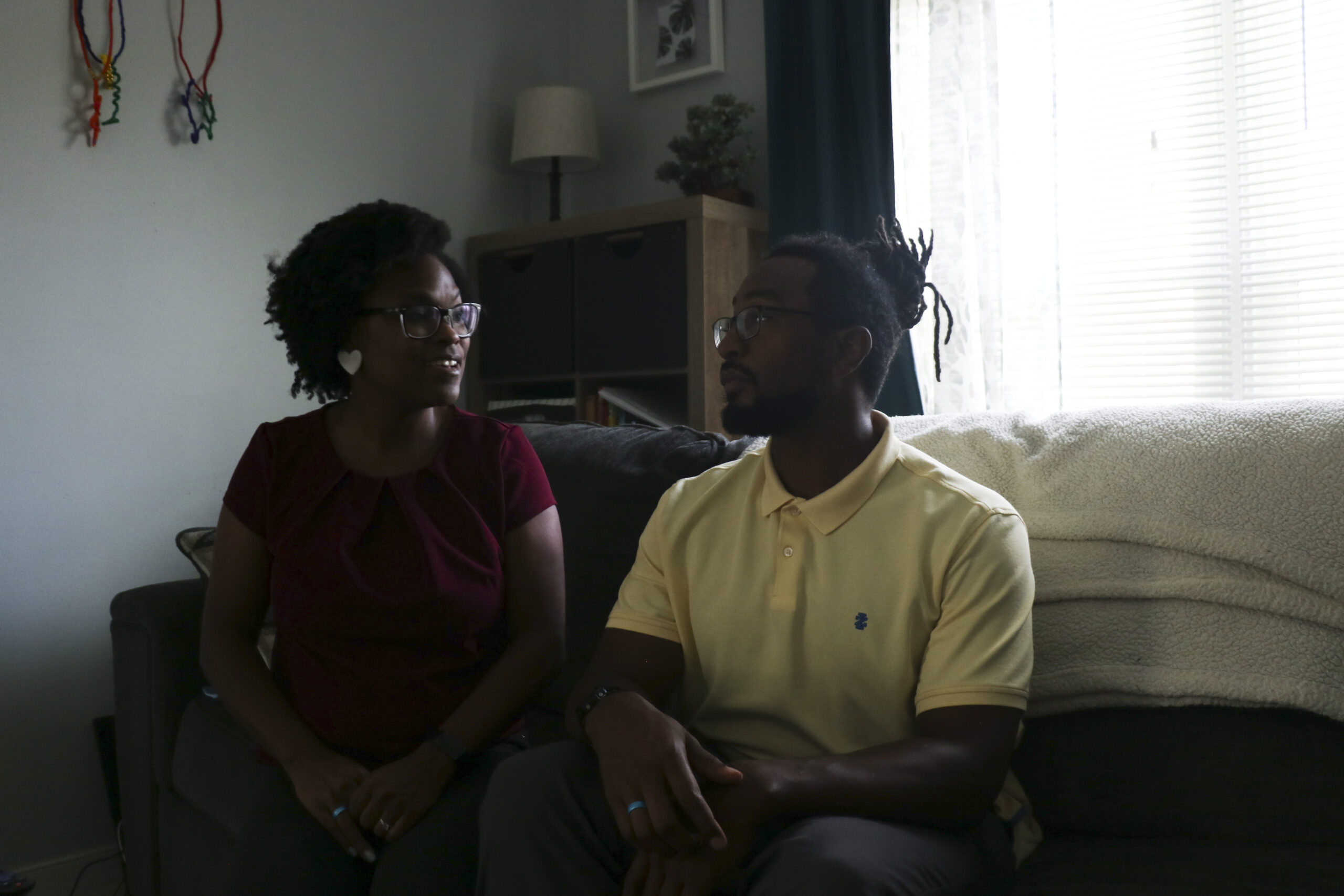
    Quadaire Patterson and his wife Santia Nance attended the event. The couple has ramped up their criminal justice advocacy, starting when Patterson was still incarcerated. Though he’s helped shape laws before and after his 2024 release, he has still been unable to vote.

    Santia Nance (left) sits with husband Quadaire Patterson (right) in their living room in Henrico County in September 2024. (Photo by Charlotte Rene Woods/Virginia Mercury)

    “As I think back to my crime when I was 19 years old, I had no awareness of the political systems that are in play,” Patterson said.

    But now at 38, having spent about half of his life behind bars, Patterson said he understands how important it is to engage in democracy. The importance of the right to vote hits closer to home now that he and his wife have a 14-month-old daughter, Trinity.

    “If we ever want to repair this broken system, if we ever want to repair our broken communities, we have to fully allow returning citizens to participate in the civic processes,” Patterson said.

    The case at the core of the matter stemmed from a series of 1870 laws called the Readmission Acts, which allowed former Confederate states to re-enter U.S. Congress after the Civil War. The laws had barred states from constitutionally disenfranchising people other than those convicted of crimes considered common law at the time.

    “We create crimes every year but we never revisit and say ‘what did we get wrong?’ and I think that is a barrier too,” Williams said.

    Following the suit, Attorney General Jay Jones’ office has been drafting lists of crimes that could be applicable to the ruling.

    Congressional primaries will take place Aug. 4 and the deadline to register to vote in those elections is July 24.

  • Spanberger joins governors in Reproductive Freedom Alliance, signs related Va. bills into law

    Spanberger joins governors in Reproductive Freedom Alliance, signs related Va. bills into law

    From support for legislation and ballot referendums to helping states stockpile abortion and miscarriage management drug mifepristone, a growing cohort of governors are banding together as the Reproductive Freedom Alliance. Virginia Gov. Abigail Spanberger announced Wednesday that she has joined the coalition.

    Members include California Gov. Gavin Newsom, New York Gov. Kathy Hochul, Gov. Wes Moore from Maryland and New Jersey Gov. Mikie Sherrill — who was elected the same night as Spanberger last fall — among 23 others so far.

    As part of the alliance, Spanberger said she will “continue doing everything in my power to preserve the rights of Virginians seeking reproductive care and making sure families across our Commonwealth can continue making their own personal healthcare decisions.”

    Mifepristone has been subject to legal challenges, with opponents pushing for a national ban on mailing the medication. Several of the states are working to preserve access to the medication and have also enacted shield laws to protect patients’ privacy and expand coverage for over-the-counter contraception.

    On the heels of announcing she’d joined the governors’ group, Spanberger signed two new reproductive health bills into law in Lorton Wednesday. Years-long efforts dubbed the Right-To-Contraception Act and Contraception Equity Act will fortify people’s ability to access family planning measures.

    Del. Cia Price, D-Newport News, who carried the legislation, has emphasized that contraception is also used to treat conditions like polycystic ovarian syndrome and endometriosis. Price uses contraception to treat her own PCOS symptoms, she said.

    After signing the law Wednesday, Spanberger called contraception “vital for being able to contend with an ongoing health issue.”

    The coalition announcement and new laws preempt the fourth anniversary of the overturn of federal abortion protections by the U.S. Supreme Court and a ballot referendum in Virginia later this year to enshrine reproductive rights into the state’s constitution.

    How a 19th century law, central to a national telehealth abortion case, could impact Virginia

    With abortion drawing the most scrutiny, several states have enacted deep restrictions or bans on the procedure. Virginia, where abortion is legal to varying degrees in all three trimesters of pregnancy, is the least restrictive Southern state.

    As such, clinics and abortion funds have noted upticks in out-of-state patients in recent years.

    Blue Ridge Abortion Fund director April Greene said that 26% of people seeking assistance from her organization live outside Virginia, a 13% uptick since 2023. More people are relying on abortion funds for financial assistance, as rising fuel prices affect travel.

    “What this tells us is that abortion bans, anywhere, impact access everywhere,” Greene said.

    Spanberger, reproductive rights advocates, state lawmakers and congressional candidates will continue advocating for the constitutional amendment leading up to this fall’s election.

    Rising costs of fuel, other goods squeeze already strained abortion funds

    Despite some Republican-leaning states having already pursued similar measures, the amendment has fallen along partisan lines in Virginia. Every elected Republican in the state legislature has voted against the amendment, which had to clear the legislature two years in a row before it could appear on statewide ballots.

    “Once it becomes enshrined in our constitution it becomes harder to fight,” said Family Foundation president Victoria Cobb at the Virginia March For Life this past spring.

    Her organization, which staunchly opposes the amendment, has filed one of two lawsuits challenging the pending amendment.

  • Luria to face Democratic challengers before a potential rematch with Kiggans in 2nd District

    Luria to face Democratic challengers before a potential rematch with Kiggans in 2nd District

    This summer, four Democratic candidates will face off in a primary for the chance to oust incumbent Republican representative Jen Kiggans in Virginia’s 2nd Congressional District.

    The Virginia Beach-anchored district is politically purple and often oscillates between partisan control, though in past years it had a decidedly Republican lean.

    Its nearly 600,000 residents backed Gov. Abigail Spanberger last year by 53% and analysts consider it flippable — making it a key contest that could help determine partisan control of Congress.

    All four Democratic primary candidates — which include the district’s former representative Elaine Luria, acute care doctor Nila Devanath, former USAID worker Patrick Mosolf and regional government official Bill Fleming — seek to hold Kiggans “accountable” and help congress provide a check and balance to the “corruption” of President Donald Trump.

    Who’s who

    Kiggans, a Navy veteran and nurse practitioner, has represented the district for two terms after ousting Luria, who also represented it for two terms. With no primary challenger, she did not do an interview for this story, but she did respond to questions by email.

    With Navy veteran Luria formerly representing the district, she already has backing from the Democratic Congressional Campaign Committee along with Democratic leadership in Virginia including Gov. Abigail Spanberger and Sen. Louise Lucas, D-Portsmouth.

    During her time in Congress Luria backed the creation of the Affordable Care Act’s Enhanced Premium Tax Credits — which have since expired but helped reach more people struggling to afford healthcare. She also backed the 2022 Inflation Reduction Act, a range of energy efficiency and healthcare affordability measures.

    Devanath,the daughter of Bangladesh immigrants, is an acute care doctor but previously worked as a lawyer at a legal clinic defending domestic violence survivors.

    If elected, she plans to bring her legal and medical insights to Congress. She has already made trips to D.C. to meet with members of finance committees, she said, to prepare for how she can help address economic issues if she earns a seat on Capitol Hill.

    Virginia Beach Soil and Water Conservation District director Bill Fleming hopes to join the U.S. House Committee on Agriculture if elected so that he can help advance environmental laws. He shares many progressive policy priorities with some of his primary opponents but considers himself an “independent democrat.”

    From serving as director of a homeless shelter to time spent working for USAID, Mosolf said his time spent solving problems has helped him prepare to take that work to the nation’s legislative body. He was motivated to run and find new routes to solve problems after losing his job to Trump’s closure of USAID.

    Addressing the cost of living

    The rising cost of living, from groceries to housing to healthcare, is a motivating factor for Kiggans and all four Democratic candidates.

    Each candidate criticized Kiggans’ support for Trump’s tariffs, war with Iran, and a reconciliation bill that entails changes to Medicaid and hospital funding mechanisms. They also pointed out Kiggans’ vote to not renew expired Affordable Care Act subsidies.

    Luria said Kiggans expressed interest in bipartisan collaboration after ousting Luria from the seat in 2022, a stance she said was in contrast with Kiggans’ votes in favor of Trump policies.

    Ahead of the passage of the One Big Beautiful Bill Act last summer, Kiggans joined an open letter in opposition to aspects of the bill she ultimately voted for.

    Kiggans was previously outspoken about the need to renew expiring ACA tax credits, Luria said, even writing a letter in support of extending the credits, but ultimately changed her tune.

    Virginia Congressman Wittman among just 17 Republicans nationally to back ACA credits extension

    “Writing a letter that is in opposition to something you’re voting for — it just doesn’t work that way,” Luria said.

    In an email, Kiggans said her initial support of renewing the credits was conditional on “meaningful reforms” to strengthen protections against “waste fraud and abuse.”

    All Democratic challengers said addressing affordability issues will be a priority for them, if elected.

    “I think it’s going to take a lot of small things. It’s not just pushing a magic button,” Mosolf said.

    All the Democratic contenders said they would work to extend the ACA subsidies and undo the healthcare provisions of the reconciliation bill.

    They are supportive of a massive bipartisan housing bill that is nearing Trump’s desk and could see his signature; if it doesn’t, though, they said they will try again.

    On healthcare, Devanath and Fleming are backing a growing Democratic embrace of universal healthcare. The idea is to replace private insurance companies with government-run insurance available to everyone.

    Because uninsured and underinsured people are more likely to put off primary care, Devanath said she’s increasingly treating people in critical condition or for whom more drastic measures could have been prevented.

    This is why she’ll back the Medicare For All Act, she said.

    “You have to have people who are willing to be bold,” Devanath said. “Instead of following incremental change, let’s go for the gold. Put it out there, stick to it, and see where we land.”

    Devanath and Fleming also support the Working Americans’ Tax Cut Act, which would create a tiered surtax on income over a million dollars.

    “It’s one thing to sit and grumble about something while you’re watching television, but it’s better to try to get a seat at the table, so that you can maybe affect change,” Fleming said.

    Stock trading crackdown, campaign finance reform

    Luria said Congress should hold itself accountable by banning stock trading of elected officials, pointing to what she called a “long list” of ways Trump has capitalized on his presidency to financially benefit his family or allies.

    As a congresswoman, Gov. Abigail Spanberger championed an effort to prevent lawmakers from capitalizing on sensitive information and disproportionately benefitting from their positions of power.

    Luria was not always on board with the proposal, calling it “bullsh-t,” but her stance has evolved into support.

    “Congress can set the example and actually walk the walk,” she said.

    Kiggans is co-sponsor of a similar, more recent effort.

    Wittman seeks to keep 1st District seat, as Democratic challengers face crowded primary

    All of the Democratic contenders want to address how candidates receive donations for their campaigns by reigning in large political action committees’ donations along with “dark money” contributions, large entities’ donations that are not publicly disclosed.

    Luria’s Democratic challengers have taken issue with her updated stance on campaign finance. In 2018, she’d signed a pledge to not take corporate money before accepting $34,000 from corporate PACs in 2020.

    Luria’s donors have included the Democratic Majority for Israel PAC and some of her donors have also contributed to American Israel Public Affairs Committee. After a United Nations committee concluded that Israel is committing genocide in Gaza, Luria’s challengers said it would be unethical for them to take money from groups that support Israel. (Israeli officials have denounced the report as “distorted and false,” according to NPR.)

    While AIPAC has historically supported both parties so long as candidates are “pro-Israel,” the group’s supporthas emerged as a rift among some Democratic candidates in recent election cycles.

    Kiggans, who has also been boosted by AIPAC, has supported U.S. involvement in Israel’s affairs. In 2024 she voted for military aid to Israel in a package of bills she said were “not perfect,” but needed at the time.

    Kiggans defends record, discusses future

    Kiggans recently reaffirmed that she “couldn’t be a stauncher supporter” of Trump and U.S. military actions against Iran.

    The conflict, initiated by America, has contributed to spiking gas prices because Iran is a critical global player in oil trades.

    “When the Iran conflict is over, gas prices will come down and we’ll work to get them even lower with American energy dominance,” Kiggans said.

    While Democrats have lambasted Kiggans for voting for the Big Beautiful Bill, she emphasized that the measure also “cut taxes on social security, tips and overtime” to “put more money in the pockets of Virginians.”

    The two-term congresswoman has bucked Trump’s administration over a new rule that will exclude post-baccalaureate nursing degrees from a “professional degrees” list, joining a bipartisan letter in opposition.

    Kiggans was also critical of the Trump administration’s efforts to stop construction of Dominion Energy’s offshore wind project, which is located in her district.

    Still, her Democratic opponents said she has too often aligned with GOP majorities and the president, including her endorsement of federal workforce trimming despite the 2nd district having among the largest concentration of federal workers in the state.

    “The bottom line is she has put Trump over the people of Hampton Roads,” Luria said. “People will hold her accountable at the ballot box in November.”

    The Democratic hopefuls will face off for the chance to defeat Kiggans in the Democratic state primary election on Aug. 4.

    Editor’s note: This story has been corrected to reflect that Luria has not received donations from AIPAC, as previously stated, but some of her donors have contributed to the organization.

  • Injunction pauses ‘unconstitutional’ USDA conditions for SNAP, WIC funding to Virginia, other states

    Injunction pauses ‘unconstitutional’ USDA conditions for SNAP, WIC funding to Virginia, other states

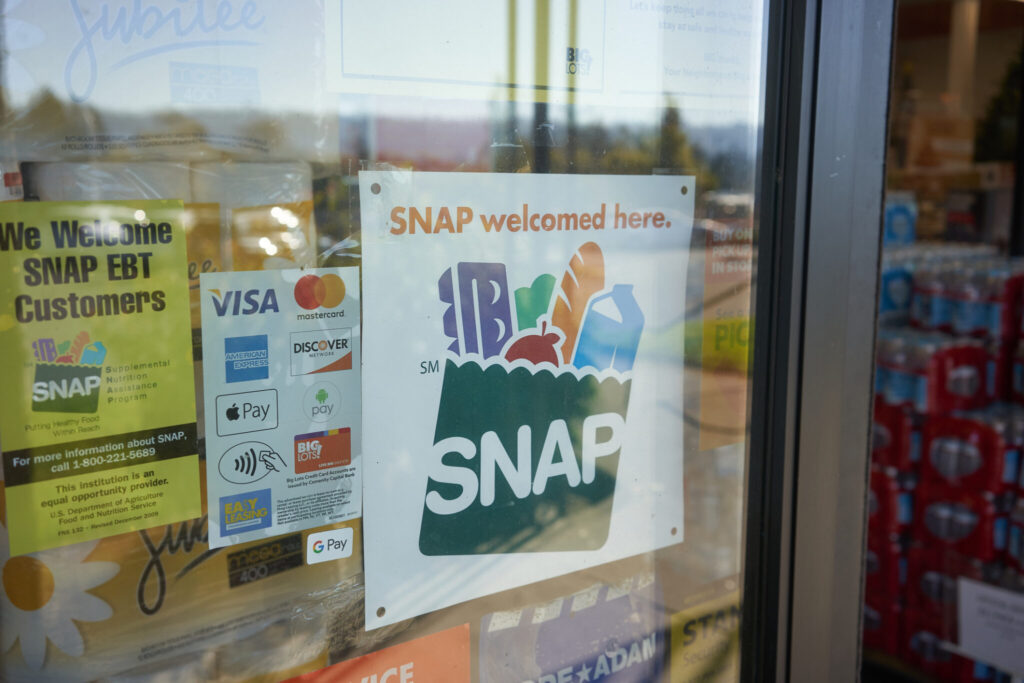
    Virginia Attorney General Jay Jones announced Thursday that a federal judge issued a preliminary injunction on June 5 amid a multi-state lawsuit challenging “vague, extraneous and unreasoned conditions” to how the U.S Department of Agriculture issues funding to states.

    “As Virginians face a growing cost crisis, President Trump is politicizing funding for critical USDA programs that help feed vulnerable children, hardworking families, senior citizens and rural communities,” Jones said in a statement, noting that nearly one million Virginians are facing hunger and rely on programs like SNAP and WIC, which are funded by the USDA.

    As part of its 2026 conditions, states receiving USDA grants must certify that they don’t operate “any programs that advance or promote Diversity, Equity and Inclusion,” do not “promote gender ideology” and that they do not permit funding disbursement to undocumented immigrants.

    Countering this, Virginia, 20 other states and the District of Columbia sued in March, stating they believe the impositions for compliance are unclear and unconstitutional.

    The injunction means that these conditions will not apply as the lawsuit continues to advance.

    Federal lawyers said in court filings that the new requirements would “help promote the sound stewardship of taxpayer dollars, strengthen USDA’s control and oversight of obligated funds, and ensure that grant recipients comply with federal laws, regulations and policies.”

    About 850,000 Virginians (and millions of people nationwide) use SNAP to help them purchase their groceries.

    USDA is also the federal umbrella agency for other social services like the Special Supplemental Nutrition Program for Women, Infants and Children, the Emergency Food Assistance Program, and the Volunteer Fire Capacity Program.

    With one in eight Virginians facing hunger, Jones’ office called the USDA conditions “unconstitutional,” and Jones pledged to “keep fighting for these crucial resources and the people who depend on them.”

  • Some Virginians with past felonies can apply to seal their records, starting next month

    Some Virginians with past felonies can apply to seal their records, starting next month

    After years of fine-tuning and preparation, a 2021 law allowing Virginians with certain past felony convictions to have their criminal records sealed will take effect July 1. Lawmakers and advocates say this will allow former felons without new convictions to expand their housing and employment options.

    Under the “Clean Slate law,” when hiring managers and landlords run background checks on people whose criminal records have been sealed, they won’t be able to see some older convictions. It only applies if former felons don’t have new convictions within seven years of their petition date for certain misdemeanors and 10 years for certain felonies.

    “We know that people age out of crime and nobody should have to live with their record forever,” said Sheba Williams, director of recidivism reduction organization Nolef Turns.

    As someone who navigated hurdles from her past criminal record, Williams founded her organization to help people return to society after incarceration. She has helped craft numerous criminal justice reform laws over the years.

    Sheba Williams is a Richmond native and the founder and executive director of Nolef Turns, which provides direct service and advocates for criminal legal systems reform on behalf of survivors and victims of crime, incarcerated people, and their loved ones. (Provided photo)

    People with Class 1 or 2 felonies – typically violent crimes or charges that carry life sentences — aren’t eligible. And petitioners must not have been convicted of a Class 3 or 4 felony within 20 years.

    Critically, Sen. Scott Surovell, D-Fairfax said, is that the law also effectively eliminates many barrier crimes. Should someone have a cocaine charge and be able to petition, for instance, they would no longer be prohibited from entering medical or security career fields.

    Surovell, along with Del. Charniele Herring, D-Alexandra, had led the legislative charge on the law.

    Over 900,000 Virginians are estimated to be able to seal their misdemeanors under the new provision, while over 100,000 are able to seal their felonies, according to a Virginia State Police presentation to the state Crime Commission.

    Part of the delay in setting up the sealing ability was to give circuit courts time to modernize records and prepare for the additional workload.

    Charlottesville Circuit Court Clerk Llezelle Dugger noted that it has taken a combination of clerks, state police and the office of the executive secretary in the state’s judicial system to properly prepare.

    Nuances had to be sorted out, like how far back the law would permit court records to be sealed and which types of crime would be eligible.

    “I give kudos to the Crime Commission,” Dugger said, for helping lawmakers bring the required parties to the table in recent years.

    With petitions opening July 1, Dugger does still anticipate some hiccups because certain convictions will be eligible for automatic sealing by October of this year.

    For instance, people with past petit larceny, trespassing, shoplifting, disorderly conduct or marijuana distribution misdemeanors would be eligible for automatic sealing so long as they don’t have new convictions within the past seven years.

    “I can see a layperson filing for something that would actually become sealed by October,” she said.

    Surovell said he’s eager for his bill to begin helping people. During a discussion panel last summer on the pending law, he shared that a constituent reached out to him about how a larceny charge from his youth had “followed him around” for decades.

    The new law’s colloquial name is also a nod to a law firm called Clean Slate Virginia and the national movement of the same name. Founder George Townsend, who dedicated his career to helping ex-felons navigate reentry, was also involved in advocacy for Surovell’s and Herring’s bill.

    He’s called the law a “game changer” for many of his clients’ personal and professional lives.

    Beyond employment and stable housing, Williams said people’s records can bar them from certain civic engagement like volunteer work or helping to chaperone their children’s field trips or sporting trips.

    “There’s all these nuanced things that people don’t always think about unless it’s happening to them or their loved one,” she said.

    People with misdemeanors that may have been dismissed but still show up on records can also seek an expungement through local circuit courts. This is a related, but different process where a conviction is not simply sealed, but deleted.

    More details on automatic or petition-based criteria can be found here.

  • State report finds 13 rural hospitals vulnerable to closure

    State report finds 13 rural hospitals vulnerable to closure

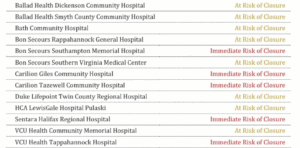
    A new report by Virginia’s Joint Commission on Health Care found 13 of Virginia’s 36 rural hospitals are at distant or immediate risk of closure, as state lawmakers and their constituents work to close healthcare access gaps in the commonwealth’s farthest-flung regions.

    The commission based its analysis on patients’ socioeconomic demographics and insurance types as well as hospitals’ financial information to determine risk levels for closure.

    King William resident Celeste Garrett’s go-to facility, VCU Health Tappahannock Hospital, is on the list. It takes her about 20 minutes to get there and she worries about an emergency if it were to close. That would make VCU’s Richmond location her closest resource, an hour or more away “depending on the traffic.”

    “Minutes matter. Seconds matter,” Franklin County resident Penny Blue said as she joined Garrett on a press call with the state’s health committee chairs Tuesday.

    After a brain aneurysm in 2021, Blue was taken 15 minutes to her nearest hospital and then air-lifted to another one in Roanoke (which otherwise would have been an hour commute).

    With rural hospitals already shoring up access in Southwest and South Side Virginia, the women expressed concern about themselves and their neighbors.

    Some hospitals’ struggles can be traced back years and include demographics and economic regional shifts. But, the current strains are attributed to recent Medicare and Medicaid reimbursement rate cuts, a reconciliation bill Congress passed last summer that makes thousands of Virginians vulnerable to losing health insurance, and Congress’ failure to renew expired Affordable Care Act credits.

    33,000 Virginians have already lost that form of insurance.

    Screenshot from a June 2026 Virginia Joint Commission on Health Care presentation.

    “(Rural hospitals) have always been living on the edge, but with H.R. 1 kicking in our hospitals across Virginia will lose about $2 billion dollars a year,” said Sen. Barbara Favola, D-Arlington, who chairs the Senate’s Education and Health Committee.

    Uninsured people are more likely to delay care until dire situations, so hospital ERs are bracing for surges of patients. Free clinics, long considered public health safety nets, are also preparing for people to rely on them more.

    “We have yet to feel the pain (of the bill) but it’s coming,” King William resident Garrett said on Tuesday’s call.

    After absorbing unpaid or under-paid care from uninsured patients, health systems will eventually negotiate insurance rates with private insurers. This may lead to higher premiums for people with private insurance down the line, health systems have warned.

    Sentara chief administrative operator Aubrey Layne said in a recent phone call that the hospital chain has become “more purposeful lately about getting the public to understand” the challenges.

    That chain has facilities around the state, with its Sentara Halifax Regional Hospital on the new at-risk list.

    Still, Virginia Hospital and Healthcare Association spokesman Julian Walker said hospitals will continue to adapt rather than close overnight or forever.

    “We will see what other measures might have to be taken to continue to sustain hospitals longterm,” he said.

    Those efforts are already playing out in some cases. Citing Congress’ bill as a contributing factor, Valley Health changed staffing contracts and trimmed services this spring. Last winter, Centra closed its labor and delivery unit at a hospital in Farmville. Last fall, Shenandoah Valley’s Augusta Health closed three clinics.

    House Health and Human Services chair Del. Rodney Willett, D-Henrico, emphasized that the federal government placed heavy burdens on state and local governments, calling it a “situation no one wants to be in.”

    The state’s pending budget has proposals to help the state comply with additional requirements for Medicaid and Supplemental Nutrition Assistance Program verifications and could support a state-level ACA subsidy to plug some holes.

    Favola and Willett said the efforts cannot fully heal what federal actions have created but are a reflection of bipartisan assistance.

    As both lawmakers have served on bipartisan health-focused committees and commissions, Willett said Congressional Republicans should be held accountable for pushing through the reconciliation bill but that going forward, both parties will have to work together to create lasting solutions.

    “This report is a nonpartisan report done by the joint commission, we all sit on that — Republicans and Democrats,” Willett said. “The facts are the facts and what’s being done to us by Washington is unconscionable.”

  • Virginia measles cases surge past 70, concentrated in Central Virginia

    Virginia measles cases surge past 70, concentrated in Central Virginia

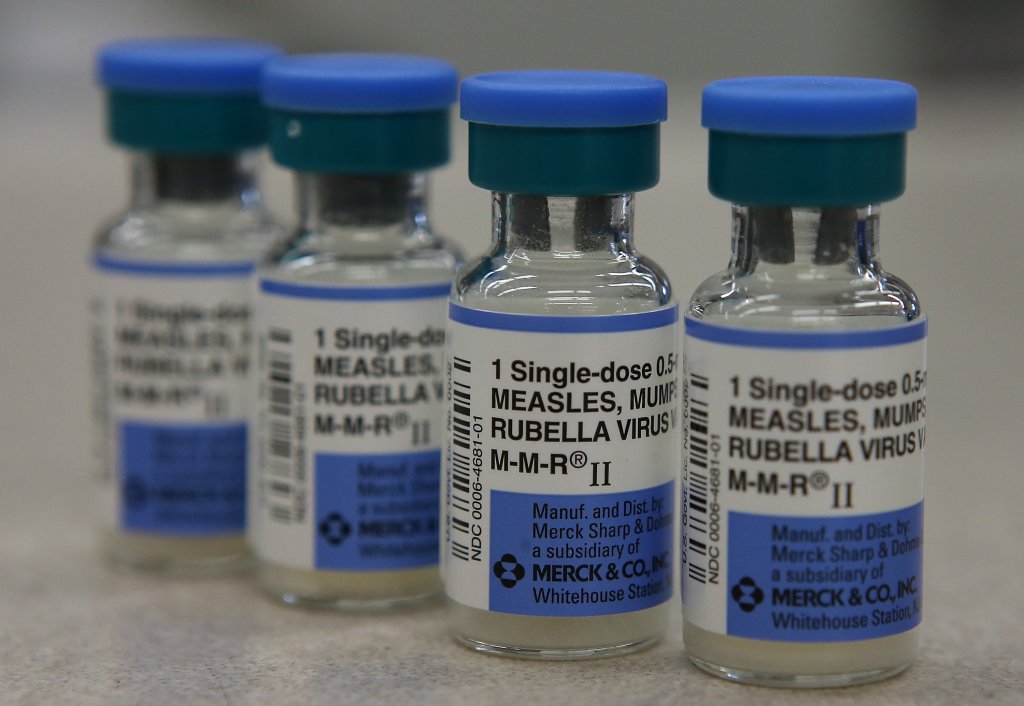
    Virginia’s measles count has jumped by more than 30 cases in recent weeks, with most of the infections centered in Central Virginia around Buckingham County. Data from the Virginia Department of Health shows that there have been 77 cases this year, most involving unvaccinated people.

    The bulk of the cases are babies and children younger than 12, aligning with how some parents were more likely to follow anti-vaccine trends that emerged in the earlier 2000s and have resurfaced more recently.

    During a visit to Virginia Wednesday, U.S. Health and Human Services Secretary Robert F. Kennedy Jr. recommended measles vaccines as a key preventative measure — a relatively recent endorsement following years of national prominence in anti-vaccine movements.

    About two decades ago, measles was considered eliminated in the U.S., but anti-vaccine rhetoric became more mainstream and misinformation about vaccines spread, leading to confusion and hesitancy among some people.

    Kennedy’s comments to Virginia reporters this week follow an acknowledgement he made during Congressional testimony in late April. It marks a relatively new stance after he did not recommend vaccination during a measles outbreak in Texas last year and instead advised Americans to “do your own research.

    Despite the U.S. being among the countries that previously eradicated measles, Kennedy noted this week that new cases are “happening all over the world.”

    “At (the Center for Disease Control and Prevention), we encourage people to get their measles vaccination,” he added. “That’s the best way to prevent yourself from getting measles.”

    Piedmont Health District Director Maria Almond said in an email that local health officials continue recommending vaccinations. Her health district is responding to the region of the state where most measles cases are occurring.

    Virginia Department of Health Commissioner Cameron Webb reiterated that people who remain unsure should speak with their doctors.

    “If you’re still not sure about the MMR vaccine, you should talk to your trusted health care provider immediately,” Webb said. “They can answer all your questions and address any concerns you may have.”

    About a month ago, Virginia’s measles cases were still in the two-dozen range as infections also climbed in other states. The increase prompted the CDC to issue summer travel guidance to encourage vaccinations and other preventive measures.

    Almond said the outbreak in the Piedmont region “has “not yet overburdened the local healthcare systems.”

    Hospitals and clinics are more likely to face strain during epidemics and pandemics.

    In Virginia and across the country, health systems and health departments have also dealt with staff turnover and burnout. Virginia’s health department has spent years addressing internal challenges following the COVID-19 pandemic.

    “According to the CDC, one in five people infected by measles requires hospitalization for complications, including pneumonia and dehydration,” Almond said.

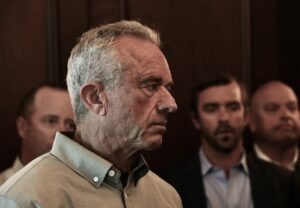
    U.S. Secretary of Health and Human Services Robert F. Kennedy Jr. during a press conference in Doswell Wednesday. (Photo by Charlotte Rene Woods/Virginia Mercury)