Tag: Virginia colleges and universities

  • William & Mary’s Lemon Project helps Black Virginians learn about their lineage, counter narratives

    William & Mary’s Lemon Project helps Black Virginians learn about their lineage, counter narratives

    By Nick McNamara/WHRO

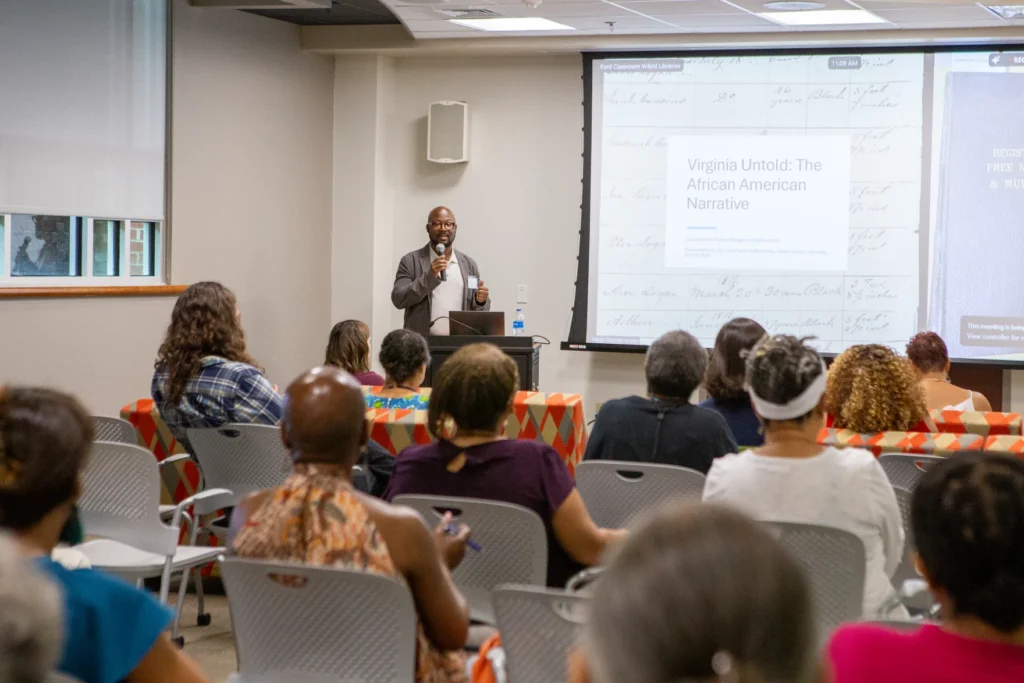
    William & Mary’s Lemon Project helps African Americans in Williamsburg uncover their families’ histories and the role their relatives played in shaping the college, the city and the landscape of the early United States.

    On Thursday morning, the Lemon Project is taking its services to the college’s Juneteenth Celebration in the Sadler Center.

    “It resonates deeply if you have been told for generations that you did not make a substantive contribution to the building of a nation and now you have records that say ‘Yes, I did, I did build this place,’” said Jajuan Johnson, interim director of the Lemon Project. “We think that they’re worth the search, they’re worth the labor.”

    The Lemon Project was created in 2009 to investigate William & Mary’s ties to slavery, starting with its founding in 1693. The college’s historic campus was built by enslaved people, and its founding president, James Blair, was instrumental in the institutionalization of slavery in Colonial Virginia.

    The project was inspired by similar work at Brown University and pushed forward with advocacy by faculty and students such as Tiseme Zegeye, who in 2007 proposed a resolution in the Student Assembly that called on William & Mary to research and publicize the college’s role in slavery and create a memorial to the enslaved. The Board of Visitors agreed in 2009. “Hearth: Memorial to the Enslaved” was dedicated in 2022.

    “We wouldn’t be here without students; they are key to our success,” said Sarah Thomas, associate director of the Lemon Project.

    Johnson helped establish the project’s public genealogical research work about five years ago. Members of the Descendant community, African Americans with roots in Williamsburg’s earliest days, had been asking for it for years.

    A $1 million grant created a foundation to get started during the COVID-19 pandemic.

    “People were wanting to connect,” Johnson said. “They are in place, sheltered and they’re wanting to connect with family.”

    Interest in genealogy predated the pandemic, Johnson said, but as historical records were digitized and made available online, it became easier for Black people to investigate unanswered questions about their lineage.

    For people who descend from enslaved people, however, ancestry work can be difficult. Many records were lost or destroyed during the Civil War. In other cases, records pertaining to the enslaved were sparse or nonexistent, sometimes noting the presence of an enslaved worker but not their name.

    “Slavery was injustice against family lines,” Johnson said. “So much is not recorded because you were considered property.”

    Despite the challenges, many records do exist in William & Mary’s Swem Library special collections. The Lemon Project also makes use of Library of Virginia records and Freedmen’s Bureau records, which Johnson said have been instrumental in their work.

    “Although people are told that they can’t find anything prior to 1865, I would say 80% of the time they do, they find some type of clue,” Johnson said.

    The Lemon Project collaborates on genealogy work with other groups, including the Bray School Lab, the Afro-American Historical and Genealogical Society of Hampton Roads and Black residents, Johnson said. Where institutional records fell short, records from historical church congregations in Williamsburg, such as First Baptist Church, Oak Grove Baptist Church and Bruton Parish, sometimes provide new leads.

    “African American cemeteries and the structures as well are major testimonies of African American life and history and family history in this region,” Johnson said. “These are places that are repositories of information that tell the story of people and the communities they built.”

    The project doesn’t always start in the distant past and move forward. Using a mix of oral history, death certificates and payroll documents from the 1900s at the college, Johnson said, the project was able to follow lineages backward.

    “We see that not only are these people in the early 1900s on this payroll list working at William & Mary, but they have children who are working at the college,” Johnson said. “We can trace back to find that there was this labor lineage at the college.”

    Thomas said the project’s work builds community and connects people.

    “We had a genealogy roundtable and cousins met each other for the first time,” Thomas said. “We didn’t plan it, it just happened; those kinds of stories are priceless.”

    Those moments and demonstrating the Black community’s role in building early Williamsburg and overcoming oppression make the project’s work resonate with people, Johnson said.

    “They built the churches, they cared for their dead, they reproduced, they established businesses, they did everything that people have told them — that institutions have told them — they did not do,” he said. “It’s sustaining when you consistently live in a world that tells you you don’t matter, it reaffirms ‘No, this is my place; this, too, is my nation; this is my institution.’”

  • Virginia Tech rector refuses to resign after Spanberger’s dismissal

    Virginia Tech rector refuses to resign after Spanberger’s dismissal

    Virginia Tech governing board member John Rocovich has refused to resign after Gov. Abigail Spanberger removed him last week after 16 years.

    Rocovich stated in a four-page letter addressed to the Secretary of the Commonwealth that he will not resign before his term ends on June 30, 2027. There was no sign of him at the board’s committee meetings on Monday in Blacksburg.

    Spanberger’s decision is the latest effort by her administration to shake up governing boards at Virginia’s colleges and universities, amid concerns within the higher education community about the politicization of public university governing bodies. She recently appointed four new members to Tech’s governing board.

    Governor fires Virginia Tech Rector Rocovich, appoints Dominion Energy’s Edward Baine as replacement

    Spanberger removed Rocovich, citing “misconduct” in a letter sent last Wednesday, but the letter did not specify the details of Rocovich’s alleged violations, only stating that the findings provided “sufficient cause” for his removal. Rocovich pushed back on that claim.

    “I was appointed to serve a term, I have served that term faithfully, and I intend to fulfill my obligations to the students, faculty, and people of Virginia who depend upon the proper governance of this great university,” Rocovich wrote. “Governor Spanberger’s letter failed to state my specific cause, as the law requires. I am confident she will find no such grounds.”

    Board member William Holtzman, who was appointed by former Gov. Glenn Youngkin and will complete his term next year, said he was “disappointed” with the governor’s decision.

    “I think all of us were disappointed because I think it’s a unanimous feeling of our group that he has done a phenomenal job, and I didn’t understand at all why she removed him, and I don’t think there was any cause for it,” Holzman said.

    Lawmakers have also urged the governor to explicitly state her reasons for the termination.

    Senate Republican Caucus Chair Mark Obenshain, R-Harrisonburg, said Rocovich deserves “fairness,” and emphasized that transparency is “not optional” concerning the governor’s decision to boot Rocovich from the board.

    “What makes this decision especially disappointing is that Governor Spanberger campaigned on a promise to depoliticize higher education governance and to reduce executive involvement in the affairs of Virginia’s universities,” Obenshain said in a statement on Friday. “Removing the sitting rector of Virginia Tech without publicly stating a lawful basis appears inconsistent with those commitments.”

    Edward Baine, executive vice president of utility operations and president of Dominion Energy Virginia, who was appointed to replace Rocovich, attended the first committee meeting on Monday.

    He did not comment on his appointment on Monday morning, but asked Provost Julie Ross about the university’s efforts to address enrollment, which the board expressed interest in growing.

    Rocovich’s dismissal followed the board’s vote to grant an exception allowing him to serve a third one-year term as rector during the search for Virginia Tech’s next president, following Tim Sands’s departure in April, Cardinal News reported last month.

    The board minutes noted that Rocovich was elected rector because no other nominees were available and he was willing to serve.

    A native of Roanoke and a Virginia Tech graduate, Rocovich founded a law firm and specializes in taxation as well as trusts and estates law. He served on the board of visitors from 1997 to 2005, was appointed for a term from 2010 to 2014, and was rector from 2002 to 2004.

    According to the Virginia Public Access Project, Rocovich has donated to several Republican campaigns and candidates, including formerRepublican gubernatorial nominee and Spanberger rival Winsome Earle-Sears.

    In his letter, Rocovich criticized the termination and the governor, expressing his “disappointment” with her use of a “subordinate“ to deliver the message, which he said was the opposite of the respect he showed Spanberger by calling her directly to discuss the board.

    “Virginia Tech deserves better than to be made a political football,” Rocovich wrote. “I have given too much of my life to this institution to stand by silently while its independence is threatened—regardless of which party holds the governor’s office.”

    The governor and attorney general’s offices did not immediately respond for comment on whether they will enforce the termination.

    The board’s committee meetings continued on Monday. The board will have a full meeting on Tuesday. The body will vote on a new rector and vice rector to replace Rocovich and Sandy Davis, who died on March 17.