After a grueling redistricting battle that spanned months and cost millions, the congressional district lines Virginia adopted in 2021 remain in place as Democratic contenders line up to challenge longtime Republican incumbent Robb Wittman in this fall’s race to represent the state’s 1st Congressional District.
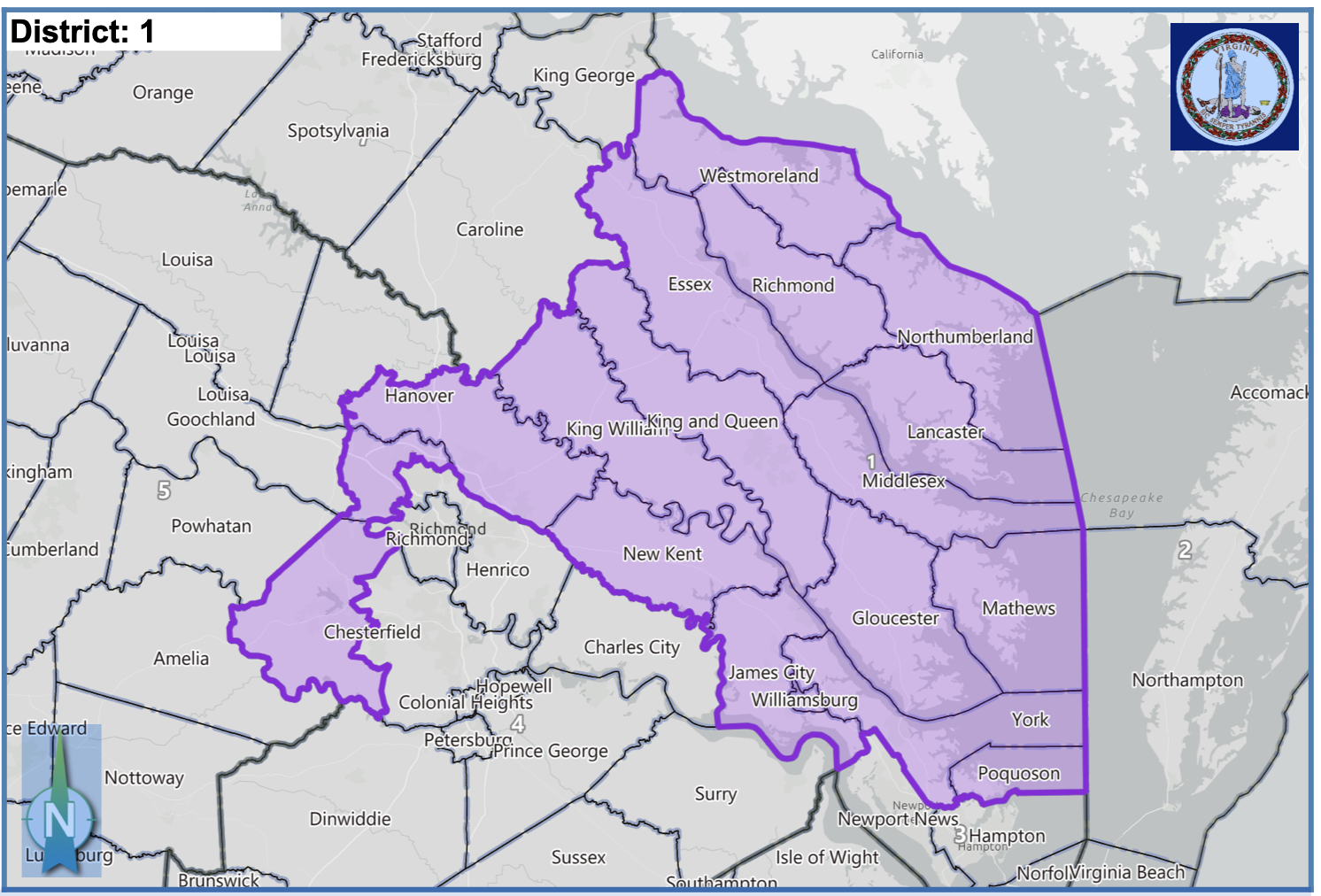
The 1st District stretches from Colonial Beach down the eastern coast of the state to Williamsburg, and hooks over the north side of Henrico County into part of Chesterfield.
Over 615,000 registered voters live in the 1st District, with the largest portions of the population in Henrico, Chesterfield, Hanover, and James City counties. The majority of voters there are white, but U.S. Census Bureau data shows diverse demographics: nearly 13% of voters are Black, almost 7% identify as multiracial and 6% are Asian. About 6% of voters are Hispanic or Latino.
Voters in the area have historically favored Republicans, with 51.6% choosing Donald Trump in the 2024 presidential election and 57.8% voting for Glenn Youngkin in 2021, helping send the GOP newcomer to the governor’s mansion.
That tide shifted in 2025, when Abigail Spanberger was elected governor with a margin of 51% in the district. Spanberger’s victory supercharged scrutiny from up-ballot Democrats, who saw it as a sign the district could be flipped in the 2026 midterm elections.
Wittman to defend seat of nearly two decades
U.S. Rep. Rob Wittman, R-Westmoreland, has represented the 1st District in Congress since 2007. Before taking office, he served in the Virginia Department of Health’s Division of Shellfish Sanitation for 26 years, which has shaped his policies and tenure on the House Natural Resources Committee.
Wittman was one of just a handful of House Republicans nationwide to join Democrats in voting to extend the Enhanced Premium Tax Credits through the Affordable Care Act for three years. The measure ultimately failed.
Wittman has consistently supported H.R. 1, the One Big Beautiful Bill, which excluded the credits when passed last summer, critics have highlighted. The congressman also faced blowback from constituents last year who said he avoided in-person town halls amid sweeping federal budget cuts and layoffs.
Promising to guard against “reckless government spending” on his website, Wittman also supports enhanced border security – including the construction of a wall bordering Mexico to staunch illegal immigration.
Wittman constituents host town hall in his absence to address immigration, federal funding concerns
Wittman did not respond to requests for comment on his campaign and has not completed The Virginia Mercury’s candidate questionnaire, sent to all contenders on June 1.
Seven Democrats vie to take on Wittman
Shannon Taylor, the frontrunner in the race to flip the 1st District to blue, is an experienced prosecutor and has spent the last 13 years as the Henrico Commonwealth’s Attorney. She was the first woman to hold the position and the first Democrat to be elected to the seat in 40 years.
Her courtroom experience undergirds one of her key campaign priorities: managing political corruption. She also advocates for congressional stock trading to be made illegal.
Taylor is also committed to protecting healthcare access in the wake of the sweeping changes from H.B. 1, she said.
“More than 44,000 Virginians have lost their ACA coverage, and rural hospitals like Rappahannock General are at risk of closure,” Taylor said. “I’ll fight to lower health care costs by extending the ACA tax credits, expand Medicare’s ability to negotiate drug prices, and protect Medicaid.”
Shannon Taylor launches bid to represent Virginia’s 1st Congressional District
She previously ran for the office of the Attorney General but lost the primary to Jay Jones, who was elected to the seat last fall. Taylor’s campaign has raised $1,300,040, as of the latest campaign finance reporting.
Political newcomer and lawyer Salaam Bhatti’s priorities center on expanding Medicare access, increasing taxes for the highest earners and reforming political candidates’ campaign finance process.
The former Virginia Poverty Law Center attorney is a child of immigrants who relied on programs like WIC and free school meals while growing up. Bhatti focused his VPLC work on expanding SNAP access and at the Food Research and Action Center, worked against a farm bill addition that would have made major cuts to SNAP.
Wittman has had more than enough time to better address issues of poverty and healthcare access in the district, Bhatti said.
“Rob Wittman has been in office for nearly 20 years and in that time our neighbors have gotten poorer, healthcare has become more expensive, corporate donors have gotten more access, and Rob has become a multimillionaire through stock trades,” he said.
Bhatti has raised $184,834 as of March 31 reporting.
Tim Cywinski, another Democratic challenger, is not new to the political sphere. He spent years as a community advocate and has worked on the political side as an intern for the Obama campaign when he was 17.
Cywinski’s brother was born with a heart defect, and the cost of his care contributed to his family’s skyrocketing medical debt and eventual loss of their home. That experience, Cywinski said, gave him personal experience with the challenges of America’s healthcare system and fuels his interest in addressing it via federal legislation.
Wittman represents what Cywinski characterized as the political establishment, which doesn’t provide solutions for constituents’ healthcare needs, tax burdens and other priorities. His campaign is about finding ways to take big money out of politics, he said.
“My main platform is what I call the fair shot agenda because unless you’re already powerful or unless you’re really wealthy and well connected, no one feels like they have a fair shot in this country and our politics upholds that reality,” Cywinski said.
As of March 31, Cywinski has raised just over $8,113, the smallest campaign coffer of any candidate in the race. He lives in the greater Richmond area.
Jason Knapp has served his country for 21 years as a naval officer and said his military background shapes his policy goals.
A former defense fellow assigned to the Armed Services Committee and deputy director of legislative affairs for the U.S. European Command, Knapp has taken aim at the cost Virginians and Americans are paying for the Iran war, a conflict Wittman has supported.
“Food, fuel, energy, housing, and medical costs are skyrocketing and people are literally choosing between buying food, buying medicine, or paying bills — and the man who represents this district is at worst complicit in these hardships, and at best, apathetic to the real problems people are facing,” Knapp said.
Universal healthcare is another top priority for Knapp, who aims to counter the privatization of the Veterans Administration, which he said creates barriers for servicemembers to access essential care.
Knapp has raised $501,287 as of March 31.
Ericka Kopp, a healthcare attorney and a caregiver to her husband who is a disabled veteran, said Wittman’s support of the congressional bill that stripped funding for Medicaid compelled her to run to replace him.
Kopp earned her law degree from the University of Richmond and clerked for a Virginia circuit court judge. She said she never considered running for office until her frustrations with Wittman bubbled to the surface because he did not attend several town hall meetings in her district in 2025.
“He’s not accessible to the people, let alone accountable to us. In April of last year, I started thinking that anyone could do a better job, even me. And then I thought, ‘Why not me?’” Kopp said.
Her campaign priorities include expanding Medicaid and healthcare access. She has raised $13,867 so far.
Business lawyer and small law firm owner, Mel Tull believes he can help bridge the partisan divide in Congress and said his experience successfully navigating competing interests can earn the trust of other lawmakers and the people they represent.
Like several other Democratic contenders, Tull said Wittman’s 18 years in Congress is too long a time to serve without better addressing issues like healthcare, affordability, and government functionality.
“My job has been to evaluate competing interests, understand risks and consequences, and help people make sound decisions. I’ve spent my career bringing people together to solve difficult problems, not score political points,” Tull said.
Tull served in the Army before branching into business law. His campaign has raised $179,991, to date.
Elizabeth Dempsey Beggs, the final Democratic contender in the contest, was one of the first women to serve as a tank commander in a combat role in the U.S. Army. The veteran now works in the package and manufacturing industry.
She said concerns about affordability and government transparency drove her to enter the race. Her campaign priorities also include protecting the right to vote and reproductive healthcare access.
“As a mother, foster parent, and business leader, I’ve seen firsthand how decisions made in Washington affect families every single day,” Beggs said. “Whether it’s the cost of childcare, access to healthcare, housing affordability, or the lack of accountability in government, people are working harder than ever and feeling like they have less and less to show for it.”
Public office should be a service and not a long-standing career, Beggs added, pointing out Wittman’s tenure in the seat. So far, she has raised $64,494.
Early voting for the primary election for the first congressional district begins on June 18. Election day is Aug. 4.