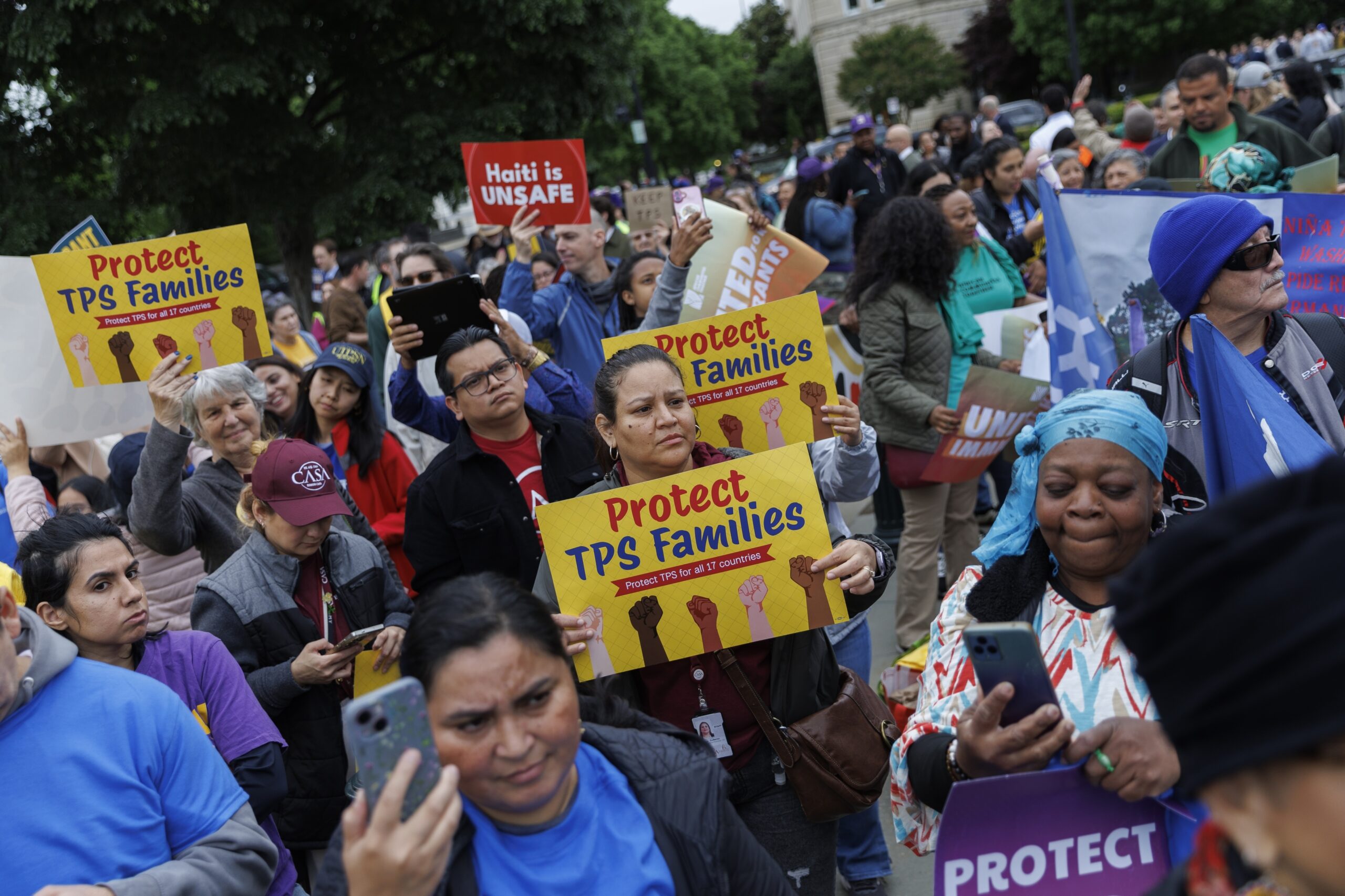
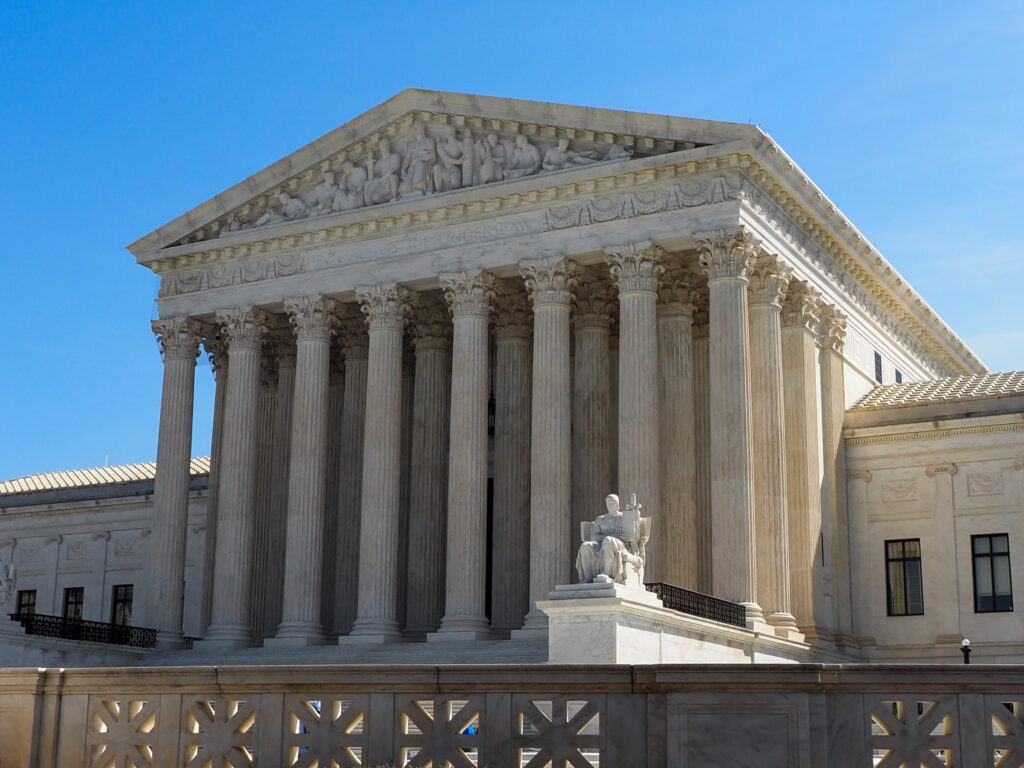
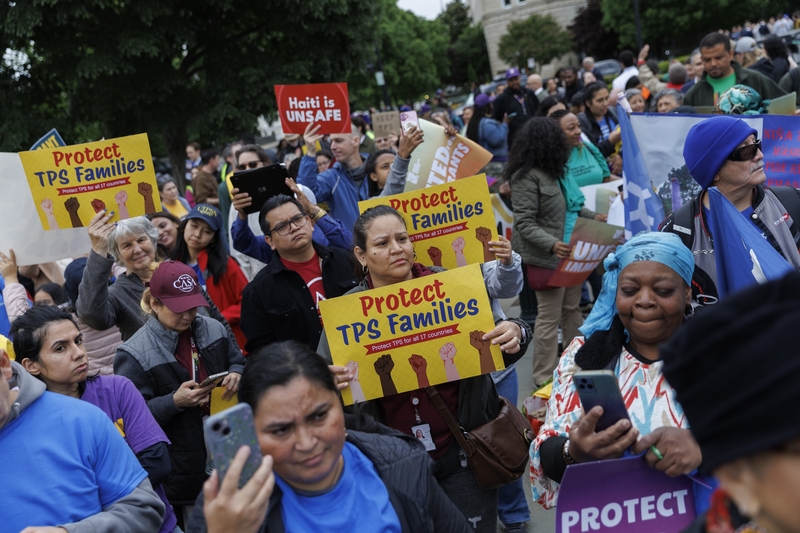
Demonstrators chant and hold signs outside U.S. Supreme Court on April 29, 2026 in Washington, DC. The court heard arguments challenging the government’s termination of Temporary Protected Status for immigrants. (Photo by Tom Brenner/Getty Images)
WASHINGTON — The U.S. Supreme Court Thursday allowed the Trump administration to move forward with its plans to strip temporary legal status from 350,000 Haitians and 6,000 Syrians, a move that opens them up to deportation.
The 6-3 conservative court ruled that the Haitian and Syrian immigrants are not “entitled” to orders postponing an end to their temporary protections while litigation is pending, arguing those are non-constitutional claims. It means their work permits and deportation protections are stripped.
Conservative Justice Samuel Alito, who wrote for the majority, said that the Haitians’ claim — that their equal protection claim that their Temporary Protected Status was terminated on a racial bias — are unlikely to prevail in court.
“None of the cited statements by either the President or the Secretary was overtly racial, and in substance all expressed policy views that could rest on race-neutral justifications,” Alito wrote.
The liberal justices, Sonia Sotomayor, Elena Kagan and Ketanji Brown Jackson, joined in a dissent that argued the president made clear racial comments about Haitians for the purpose of terminating protections.
“Haitians are Black. The references—of filth, disease, and primitiveness—are shot through with racial stereotypes and tropes,” they wrote. “It is hard to imagine the statements being made today of any White community.”
The decision is likely to impact multiple lawsuits across the country in which federal judges have halted President Donald Trump’s efforts to strip legal protections granted to more than 1.3 million immigrants with TPS because they hail from countries the U.S. initially deemed too dangerous for return.
By Jennifer Shutt, Ariana Figueroa, Shauneen Miranda National
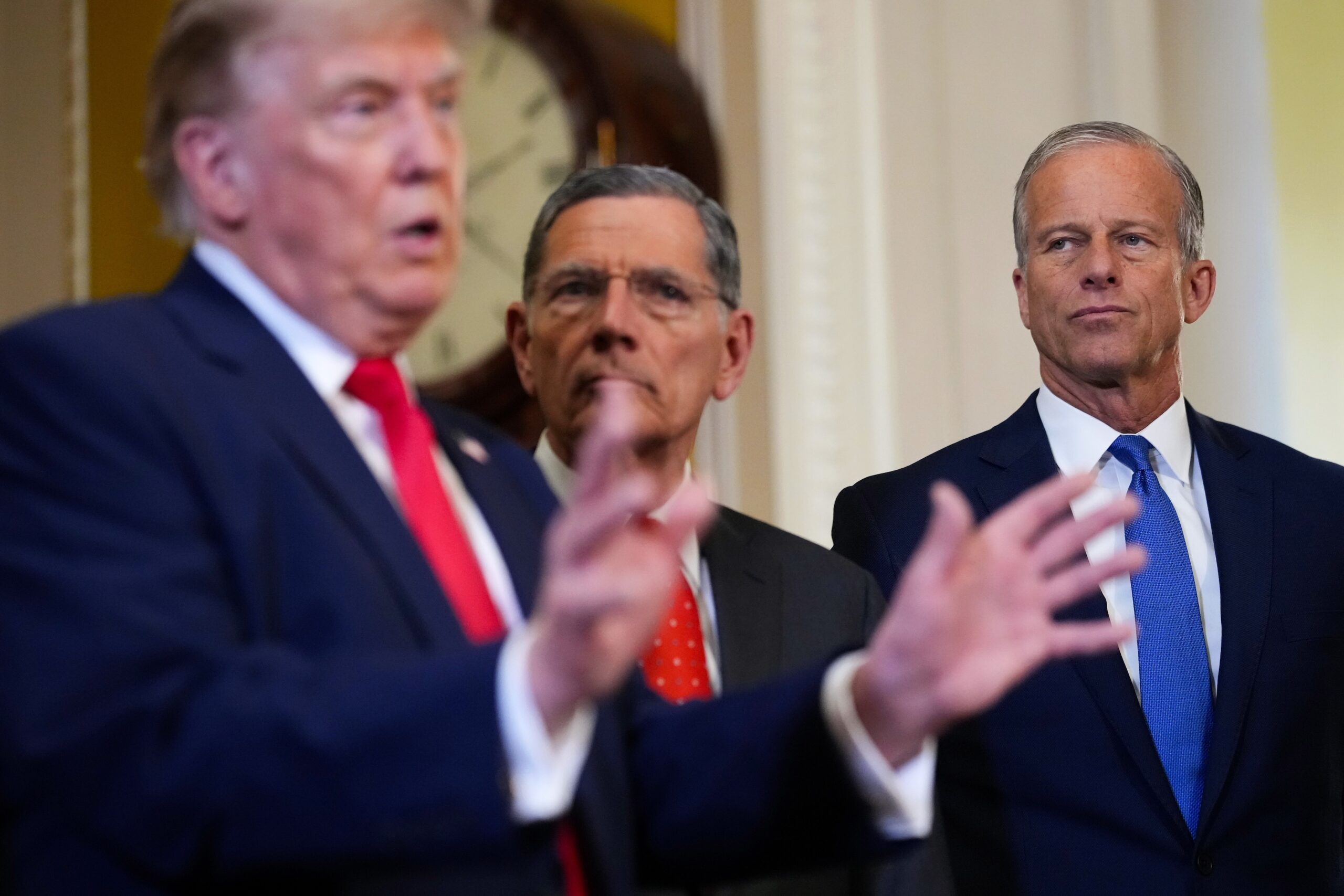
President Donald Trump speaks to the media as U.S. Senate Majority Whip John Barrasso, R-Wyo., and Senate Majority Leader John Thune, R-S.D., look on after a meeting at the U.S. Capitol on June 24, 2026 in Washington, D.C. (Photo by Andrew Harnik/Getty Images)
WASHINGTON — U.S. Senate Republicans walked into a lunch with the president on Wednesday looking for ways to unify, but they left the closed-door meeting on Capitol Hill as fractured as ever about policy goals.
President Donald Trump said after the huddle that he was “very proud of the party” but didn’t offer any concrete steps forward amid deep divisions on a nationwide voter identification law or other issues that don’t yet have enough GOP support to reach his desk.
“For the most part we have a really well-unified party,” Trump said. “And I said it very strongly, we have the hottest country anywhere in the world.”
Republican senators said during hallway interviews after the meeting ended that it wasn’t entirely productive and didn’t create much, if any, goodwill.
Louisiana Sen. Bill Cassidy somewhat jokingly said the meeting went “swimmingly” before detailing a confrontation he had with Trump over the lack of information on the Iran war. Senators have repeatedly asked for a classified briefing from administration officials, but haven’t yet received one.
Cassidy, who lost his May primary after Trump endorsed an opponent, said the exchange began when Trump asked why four Republican senators voted with Democrats to approve a War Powers Resolution earlier this week. Along with Cassidy, they were Lisa Murkowski of Alaska, Rand Paul of Kentucky and Susan Collins of Maine.
“I said, ‘Well, we’ve not been briefed on how it’s going, that the stated objectives don’t appear to be achieved, and it appears as if … it’s not going as well as we’re being told,’” Cassidy recalled. “At which point I think the president said something negative about me. I perceived it as attempting to bully me from asking a question that I think the American people need to know.
“And I’m not going to be bullied when I feel like I’m asking a question the American people need to know. And so at that point it began to escalate. And at some point it de-escalated.”
Trump declined to directly answer a question before the meeting began about whether he believes the voter identification law he advocates, which doesn’t have the votes necessary to advance in the Senate, is more important than a broadly bipartisan housing bill. The housing package would have given Republicans a legislative victory on the campaign trail roughly four months before the midterm elections.
The president was scheduled to sign that housing measure just before he met with Senate Republicans, but he canceled to press for the election bill, called the SAVE America Act.
The bill would overhaul how Americans register to vote and cast ballots in federal elections, such as requiring proof of citizenship to register to vote and requiring a government-issued photo identification at polling locations.
“Every election is important. We’re doing very well,” Trump said.
“They want a lot of communists to come in,” he said, referring to Democrats. “I’m saying it a little bit differently but the people that they’re pushing are communists. And this country is not going to have communists.”
Trump ‘mad as a murder hornet’ about Iran vote
Florida Sen. Rick Scott said he hoped the meeting would help Republicans build consensus, though he acknowledged it led to tension.
“You’ve been around the president, he was pretty forceful about what he cares about,” Scott said, later adding his goal in organizing the meeting was “to try to bring people together.”
Scott said Senate Republicans didn’t talk with Trump about using the complex budget reconciliation process to establish grants for states that implement certain voter identification requirements. House Speaker Mike Johnson put the idea forward earlier in the day as one way to promote elements of the SAVE America Act.
Louisiana Sen. John Kennedy said he appreciated the president’s “candor” during the meeting before saying Trump was “mad as a murder hornet about the war powers vote.”
“And I don’t blame him,” Kennedy said. “Put yourself in his shoes, he’s right in the middle of delicate negotiations and the Senate votes to get out of Iran. And it upset him.”
Kennedy said the president also pressed for the SAVE America Act, though he somewhat dismissed Johnson’s proposal to provide grants to states instead of enacting the entire bill.
“I don’t think that’s going to satisfy the president,” Kennedy said.
‘Like a hospital board meeting,’ with yelling
West Virginia Sen. Jim Justice said both Trump and Cassidy “expressed their feelings and didn’t hold back, but at the same time, it ended up respectful.”
“It was, I wouldn’t say super combative, but very passionate — very passionate,” he said.
Justice noted that “very, very few questions” were asked at the lunch.
Kansas Sen. Roger Marshall described Trump and Cassidy’s exchange as “very much like a hospital board meeting when a bunch of doctors are yelling at each other. But at the end of the day, we’ll figure out a way to get along.”
Trump, he said, was “very disappointed” by the four GOP senators voting this week to try to limit any additional military action against Iran.
“They’re trying to negotiate that and they feel like that vote from Republicans chopped their legs out from under them,” Marshall said. “And they’re making such incredible progress on this deal. So it’s hard for them to negotiate it when there’s two messages coming out of Washington.”
Pressed on the confrontation between Cassidy and Trump, Sen. Tommy Tuberville said the two “just had some differences of opinion about Iran.”
The Alabama Republican said “it was very cordial — it wasn’t over the top.”
Not many questions
North Carolina Sen. Thom Tillis acknowledged there was some contention in the meeting over the voter identification bill.
“I know there’s frustration over the SAVE America Act passage, but we simply don’t have the votes because we’re not gonna nuke the filibuster, so it’s more a matter of how do we move forward,” he said. “Not all of the meeting was contentious, but there’s a general consensus that we on Capitol Hill have to start getting in lockstep.”
When it comes to the bipartisan housing bill, Tillis said it being signed into law is “up to the president, we’ve done our work.”
South Dakota’s Mike Rounds declined to give details about the meeting but said that Republicans “had a good talking to,” and that senators did not ask the president many questions.
Rounds said while Trump pushed for the SAVE America Act, there was little acknowledgment that the Senate lacks the votes to pass the bill.
Texas Sen. John Cornyn said there “wasn’t really a lot of opportunity” to ask questions during the meeting. He said Trump spoke for one hour and 15 minutes.
Missouri Sen. Josh Hawley said the president repeated some of the comments he posted on social media earlier in the day when he said he would refuse to sign the housing affordability package until Congress approves the election bill.
“He’s here to talk about whatever it is he wants to talk about,” Hawley said. “And without speaking for him, I think it’s safe to say that what he posted this morning is what he talked about.”
Ahead of the May 2024 primary, a drop box for mail-in ballots sits outside the Shelby County Courthouse Annex in Shelbyville, Kentucky. (Photo by McKenna Horsley/Kentucky Lantern)
The U.S. Postal Service won’t deliver mail ballots in states that refuse to turn over lists of voters under a proposed rule, the agency’s chief executive said Wednesday, angering Democrats who warn the decision will disenfranchise voters.
Postmaster General David Steiner defended the rule at a Senate hearing and dismissed accusations that the Postal Service was acting politically after President Donald Trump signed an executive order in March restricting voting by mail.
“If a state refuses to turn their absentee voter list over to the federal government, will the Postal Service still mail their ballots under this proposed rule?” Sen. Gary Peters, a Michigan Democrat, asked Steiner.
Steiner’s testimony, before the Senate Homeland Security & Governmental Affairs Committee, marked the clearest acknowledgment yet by a federal official that the rule threatens to upend voting by mail across the country.
If the rule takes effect and Democratic-led states refuse to comply, the requirements would effectively limit mail voting to Republican-led states during November midterm elections to decide control of Congress.
The Postal Service put forward the rule after Trump ordered Steiner to require states to submit lists of anticipated mail voters to the agency as a condition of having ballots delivered.
Trump cancels signing ceremony
The executive order is one of several steps the Trump administration has taken this year to influence how elections are administered, along with the Department of Justice suing states to obtain sensitive voter data.
Underscoring the depth of Trump’s interest, as Steiner was speaking Wednesday morning the president abruptly called off a U.S. Capitol ceremony to sign a bipartisan housing bill because of the Senate’s refusal to pass the SAVE America Act. The legislation would require voters to show documents, such as a birth certificate or passport, proving their citizenship.
“Now we have this new rule you’ve put out saying that states have to turn over their voting rolls and you, the U.S. Postal Service, will decide who’s approved to send their ballot through the mail,” Sen. Elissa Slotkin, a Michigan Democrat, said. “It’s just another backdoor way of trying to influence this election.“
Slotkin said Trump’s decision to cancel the housing bill signing demonstrated the “level of obsession this president has” over elections.
Turning over names
Every state would have to provide the names of residents expected to vote by mail. Additionally, eight states and Washington, D.C., conduct elections by mailing all voters a ballot, meaning election officials would have to provide information on every voter. Those states include California, Colorado, Hawaii, Nevada, Oregon, Utah, Vermont and Washington.
Trump and his aides argue the restrictions are needed to combat noncitizen voting, which occurs very rarely. Democrats and voting rights groups have sued over the order, arguing it’s an unconstitutional assertion of presidential authority over state-run elections. No judge has yet halted it.
Steiner sought to place himself outside the controversy and said, in response to a question, that the Postal Service would adhere to a court order blocking the rule if one were issued. Asked about the legal authority underlying the rule, he said he would “have to defer that to the courts to understand the authority.”
Steiner, who became the postmaster general in July 2025, cast the rule as primarily focused on best practices for election mail, a description that understates the scope of the proposal, which postal experts call unprecedented.
“I’m not a political person and the Postal Service is not a political organization,” Steiner said.
Dems urge Steiner to withdraw rule
Democrats expressed sharp disagreement with Steiner and accused him of folding to Trump’s efforts to exercise more control over elections. Steiner answers to the USPS Board of Governors, not the president, and his critics say he is endangering the agency’s independence by complying with the executive order.
Every Senate Democrat, as well as two independents who caucus with the party, on Tuesday signed a letter to Steiner urging him to withdraw the rule. The letter warns that aside from the rule’s legal and constitutional problems, it’s not feasible for state and local election officials to meet its requirements.
“The proposed regulation demands that the Postal Service set up an entirely new system and database to process and transmit millions of absentee ballots that is secure and accessible to every American election official, just months prior to a general election,” the letter says.
At Wednesday’s hearing, GOP senators mostly steered clear of the mail ballot rule, instead focusing on the official topic, the Postal Service’s finances. But Sen. Bernie Moreno, an Ohio Republican, accused Democrats of hypocrisy over their past support of the “For the People Act.”
The sweeping bill, offered when Democrats last controlled Congress, would have required states to offer same-day voter registration and expand mail voting. Opponents said it amounted to nationalized elections.
“Three years later all of them are testifying, ‘It’s outrageous, President Trump is trying to nationalize elections.’ No, he’s not, he’s trying to get rid of voter fraud,” Moreno said, adding that Democrats had now “dug up from their bottom desk drawer” the Constitution.
“Should we get back to post office stuff now?” Moreno said.
An observer is detained by ICE agents after they arrested two people from a residence on Jan. 13, 2026 in Minneapolis, Minnesota. (Photo by Stephen Maturen/Getty Images)
WASHINGTON — An appeals court Tuesday cleared the way for the Trump administration to use fast-track deportations within the interior of the country and not just at the Southern border, a key pillar in the president’s mass deportation campaign.
The 2-1 decision from the U.S. Court of Appeals for the District of Columbia means the Department of Homeland Security can continue with an expanded use of expedited removal after lower courts blocked the policy over concerns that immigrants were not receiving due process.
Last year, the Trump administration expanded the use of expedited removal to apply to immigrants in the interior of the United States who cannot prove they have remained in the country for more than two years, greatly expanding the numbers of migrants affected. Previously the policy applied only to migrants at the Southern border, rather than those in the interior of the country.
Tuesday’s ruling, by Judge Justin R. Walker, argued that Congress allowed the executive branch to decide when to apply an expedited removal policy to immigrants. President Donald Trump appointed Walker, along with Judge Neomi Rao, who also ruled in favor of the government.
They found in addition that the Trump administration’s policy did not violate the due rights of immigrants. The judges vacated lower court decisions that blocked the Trump policy.
No immigration judge
The expanded policy allows the removal of some immigrants – sometimes within hours – without an appearance before an immigration judge, which is key to the Trump administration’s mass deportation campaign.
Judge Robert L. Wilkins disagreed and said he would have kept the lower court’s decision in place that blocked the policy. Former President Barack Obama nominated Wilkins.
In a statement, James Percival, the Department of Homeland Security’s general counsel, praised the appeals court ruling.
“For years, DHS has arbitrarily limited expedited removal to 14 days even though it applies to illegal aliens who entered the country illegally within the last two years,” Percival said. “Today, the DC Circuit vindicated our decision to apply the law as written.”
Due process questions
In December, the Department of Justice argued that due process is not guaranteed for immigrants in a fast-track deportation.
The immigrants’ rights group that sued the Trump administration, Make the Road New York, contended that the expanded policy did not give adequate notice to immigrants and that immigration officials did not provide proper information to an immigrant who may or may not fall under the policy.
Walker wrote that a notice of removal was satisfactory and that an immigration official notifying a migrant if they fall under the policy would be akin to providing them with legal counsel.
“Make the Road’s contrary reasoning would require immigration officers to provide what amounts to legal advice,” Walker wrote. “If due process requires the government to inform individuals of the two-year continuous-presence rule, it presumably also requires informing them of every other basis for contesting expedited removal.”
Wilkins, in his dissent, argued that immigration officials should inquire about how long an immigrant has been in the country before making a decision if expedited removal should be applied.
“A procedure that can result in persons being deported pursuant to the expedited removal statute without even being asked how long they have been in the country might satisfy due process for persons encountered at the border, but it is woefully inadequate for persons encountered in the interior of the country,” Wilkins wrote.
Make the Road New York did not immediately respond to States Newsroom’s request for comment.
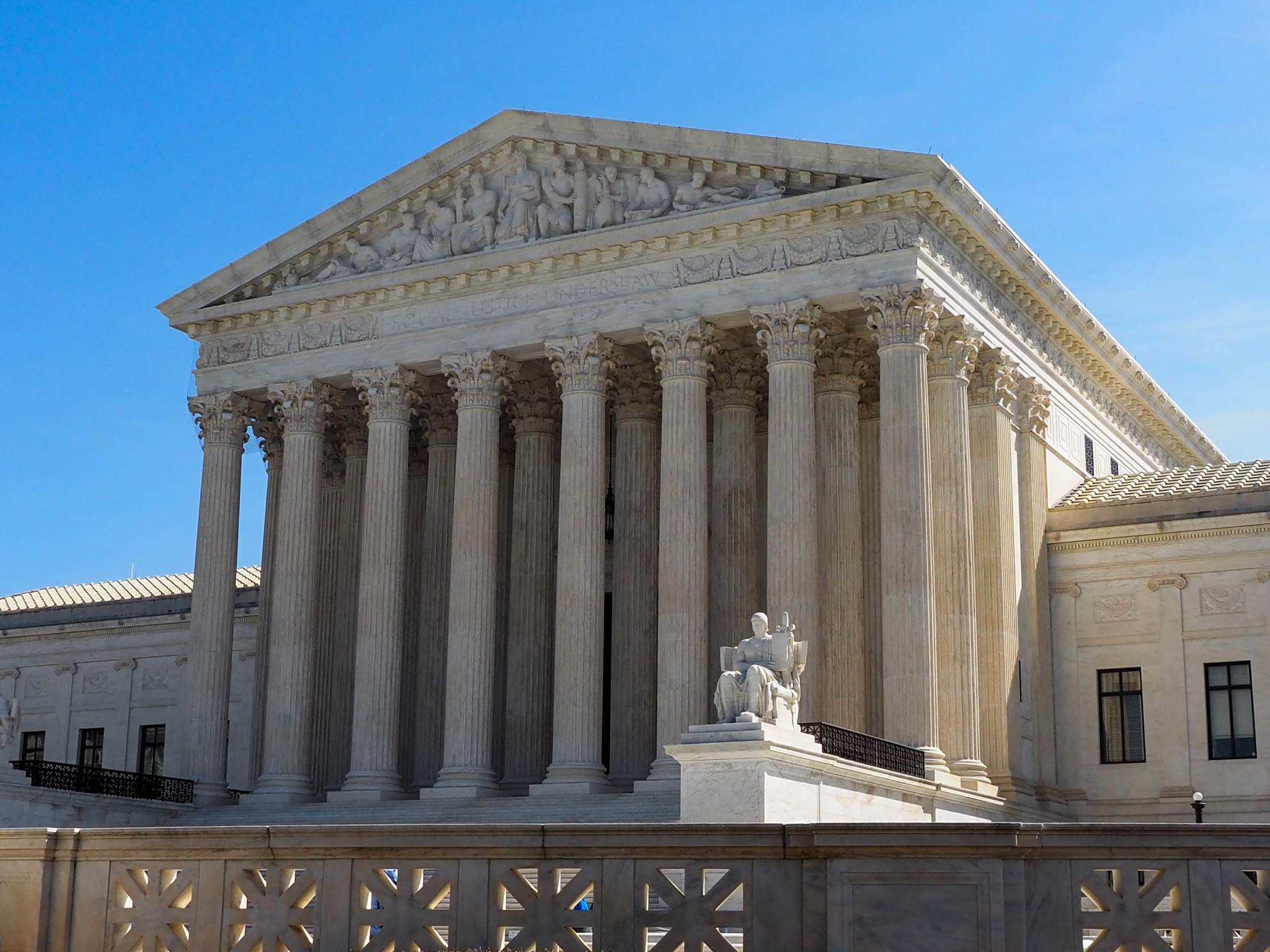
The U.S. Supreme Court, on April 9, 2026. (Photo by Ashley Murray/States Newsroom)
By Kaitlin Bender-Thomas/Medill News Service
WASHINGTON — Even with a valid driver’s license, Maryse Balthazar knows she lacks protection from what she dreads most: deportation back to Haiti.
Balthazar, a nursing assistant, often hesitates to leave her home in South Florida, worried that something as simple as a broken taillight could upend the life she’s spent 16 years building in the United States.
“If you get stopped for a traffic violation, what’s going to happen to you?” Balthazar said. “It’s a fear that lives with me every day.”
Maryse Balthazar, a Haitian certified nursing assistant living in the United States with Temporary Protected Status. (Photo courtesy Maryse Balthazar)
Balthazar is one of nearly 350,000 Haitians living in the U.S. with Temporary Protected Status, or TPS. The program allows people from countries facing armed conflict, natural disasters or other extraordinary crises to live and work in the U.S. temporarily.
Her fear comes as the Supreme Court weighs whether the Trump administration can end TPS for Haitians, as well as Syrians. Although protections remain in place while the case is pending, a Haitian TPS holder in Florida was recently detained during a routine traffic stop and deported, before being allowed to return to the U.S.
What is TPS?
Balthazar came to the U.S. under TPS in 2010, when Haiti was first designated for the program following a devastating earthquake that killed more than 200,000 people and destroyed more than 100,000 homes, including her own.
Congress and President George H. W. Bush created TPS in 1990 to protect immigrants from being deported to unsafe countries. The designation grants temporary legal status and work authorization for up to 18 months and can be renewed if conditions do not improve. It does not provide a pathway to citizenship.
Since 2010, the Department of Homeland Security has repeatedly extended Haiti’s TPS designation due to ongoing instability, including natural disasters, widespread gang violence and the 2021 assassination of President Jovenel Moïse.
The government had set Haitian TPS to end on Feb. 3, but on Feb. 2, U.S. District Judge Ana Reyes blocked the termination, finding it was unlawful and likely motivated in part by “racial animus.”
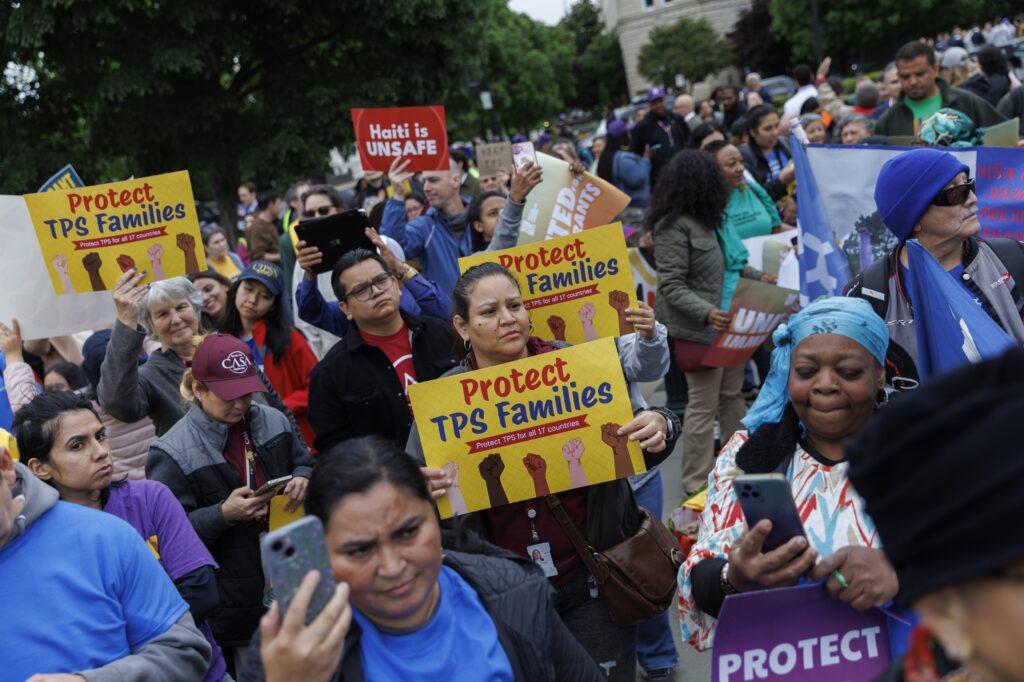
Demonstrators chant and hold signs outside U.S. Supreme Court on April 29, 2026 in Washington, DC. The court heard arguments challenging DHS’s termination of Temporary Protected Status for asylum seekers. (Photo by Tom Brenner/Getty Images)
The Trump administration has argued that TPS has become a “de facto asylum program” and that conditions in Haiti have improved enough to end the designation. It appealed the ruling to the Supreme Court in March, and the justices heard oral arguments on an emergency basis.
The court is expected to issue a ruling by the end of the term in late June or early July. The decision will determine whether the administration acted lawfully in its attempt to revoke TPS, including whether it consulted with the State Department when reviewing the country’s conditions.
An uncertain future
Immigration attorneys and advocates say the uncertainty surrounding TPS and immigration enforcement has heightened fears within the Haitian community.
“Everyone is scared across the board,” said Tremaine Hemans, founder and managing attorney of an immigration law firm in Fort Lauderdale, Florida. “But specifically our Haitian clients.”
Balthazar said she no longer feels entirely safe here, either.
She said she used to fly to Massachusetts for months at a time to care for a patient. Now, she would refuse any nursing assistant job that required air travel, even if it paid $50 an hour, because she fears encountering Immigration and Customs Enforcement agents at the airport.
“They handicap you, make you uncomfortable to live here, to be here,” Balthazar said.
Violence and humanitarian instability continue to worsen throughout Haiti, said Brian Concannon, a human rights attorney and executive director of the Institute for Justice and Democracy in Haiti, a nonprofit focused on advancing human rights and justice in Haiti.
By U.N. estimates, armed gangs control approximately 90% of the capital, Port-au-Prince, and hunger and displacement have risen sharply in recent years.
“There’s literally no metric by which you can say that conditions in Haiti are improving or are in any way safe,” Concannon said.
In Ohio, troubling phone calls
For Rose-Thamar Joseph, a Haitian TPS holder and community advocate in Springfield, Ohio, that reality hits close to home.
Joseph came to the U.S. under TPS in 2021 after former President Joe Biden redesignated the program for Haiti. She said she speaks with her family back home almost every day, including her 12-year-old son. Calls rarely end without her hearing gunfire in the background.
She recalled her family sending photos of bullets that landed in their yard.
One night, Joseph said she stayed on the phone with them until the morning, unable to sleep because she was worried about their safety.
“It was a real, real challenging and stressful situation for me,” Joseph said.
Sometimes the violence becomes so severe that her son cannot go to school. What worries her even more, she said, is when the country’s poor network service prevents her from reaching her family at all.
Although Joseph has asylum status to fall back on if TPS ends, which would allow her to continue living and working in the U.S, she said many Haitian TPS holders don’t have that option.
“It is so heartbreaking for me to see or to know that a lot of people will be out of work, will be laid off… because of TPS,” Joseph said.
Consequences in the US for families, employers
Concannon at the Institute for Justice and Democracy in Haiti said the Supreme Court’s decision could have immediate consequences for TPS holders and their families.
Of the 350,000 Haitian TPS holders in the U.S., about 200,000 of them are already in the U.S. workforce, according to FWD.us, an immigration and criminal justice advocacy organization.
Many send money home to support relatives in Haiti because ongoing violence and economic instability have left many families struggling to get by.
“It’s literally thousands of families that are being kept afloat by remittances from TPS holders,” Concannon said.
But the impact would also be felt by employers across the country.
Many Haitian immigrants work in critical industries throughout the United States. FWD.us estimates that about 15,000 work in agriculture, 13,000 serve as nursing assistants, and another 8,000 work as caregivers.
Todd Andrews, chief operating officer for Asbury Communities, a continuing care retirement community with campuses in Maryland, Pennsylvania, and Delaware, said immigrant workers play a critical role in caring for elderly adults.
Asbury employs about 2,000 workers and serves more than 4,000 residents across its senior living communities. At the organization’s Gaithersburg, Maryland, campus alone, Andrews said employees represent more than 90 nationalities.
“These jobs are very important, they’re very difficult, and they’re very, very integral in the care management of the residents,” Andrews said.
He added that providers already face staffing shortages and warned that losing TPS workers could create disruptions similar to those experienced during the COVID-19 pandemic.
“Employees that are employed today won’t be there tomorrow,” Andrews said. “So we’ll have to figure out a way to provide that care.”
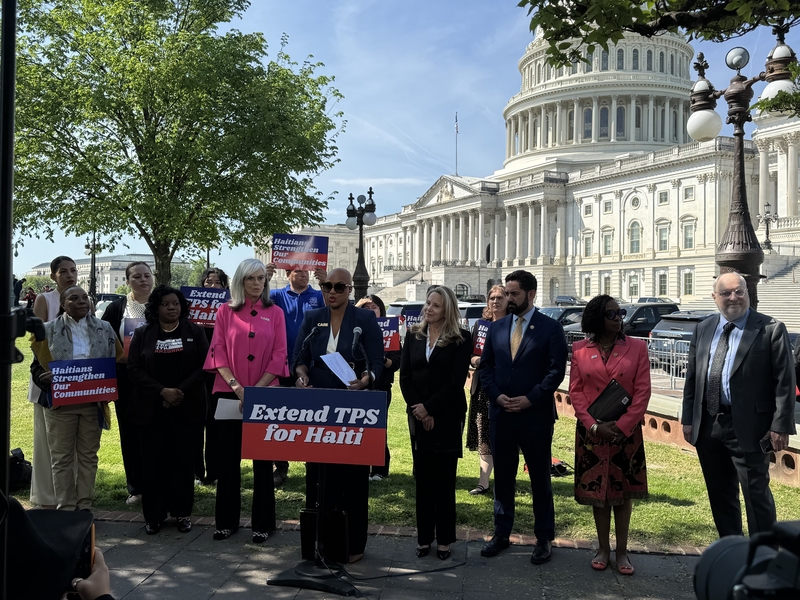
Massachusetts Democratic U.S. Rep. Ayanna Pressley speaks at a press conference April 15, 2026, outside the U.S. Capitol in Washington, D.C., advocating for the extension of Temporary Protected Status for Haiti. The lawmakers alongside her include, from left, House Minority Whip Katherine Clark of Massachusetts, as well as New York’s Democratic Rep. Laura Gillen, GOP Rep. Mike Lawler and Congressional Black Caucus Chair Yvette Clarke. (Photo by Shauneen Miranda/States Newsroom)
Lawmakers remain divided over the program’s future.
Sen. Rick Scott, R-Fla., declined to explicitly say during an interview at the Capitol whether he believes TPS for Haitians should continue. Instead, he noted that Florida is home to “a lot of wonderful Haitians” and said the broader immigration system needs reform.
“TPS was never a permanent program,” Scott said. “What I’d rather do is focus on, okay, so how do we fix the program where people can come here that are fully vetted that want to add to our economy.”
Sen. Raphael Warnock, D-Ga., said immigrant communities make significant contributions to the U.S. economy and criticized the Trump administration’s efforts to end TPS for Haiti.
“How can you deny Haitians who are here Temporary Protected Status, while at the same time put Haiti under the travel ban?” Warnock said. “It doesn’t make any sense.”
Painful conversations
While lawmakers remain divided over the future of TPS, Balthazar said the uncertainty has forced painful conversations with her daughter, a U.S. citizen and college student, about what might happen if she is deported.
“That will affect her a lot,” Balthazar said. “She will be more at ease, more relaxed, if mama is around because she knows that she can rely on me…but if I’m not around, she will have to take care of herself.”
For now, Balthazar said she is focused on living in the present. She spends her time caring for elderly patients, running her small online hair care business, and being with her family.
Like many Haitians living under TPS, she said she still hopes for the day her country is stable enough to return.
“As Haitians, we all dream, we all are dreaming to go back because we love our country. We just don’t have a system like here.”
Medill News Service articles are reported and written by graduate student journalists in the Washington program of the Medill School at Northwestern University.
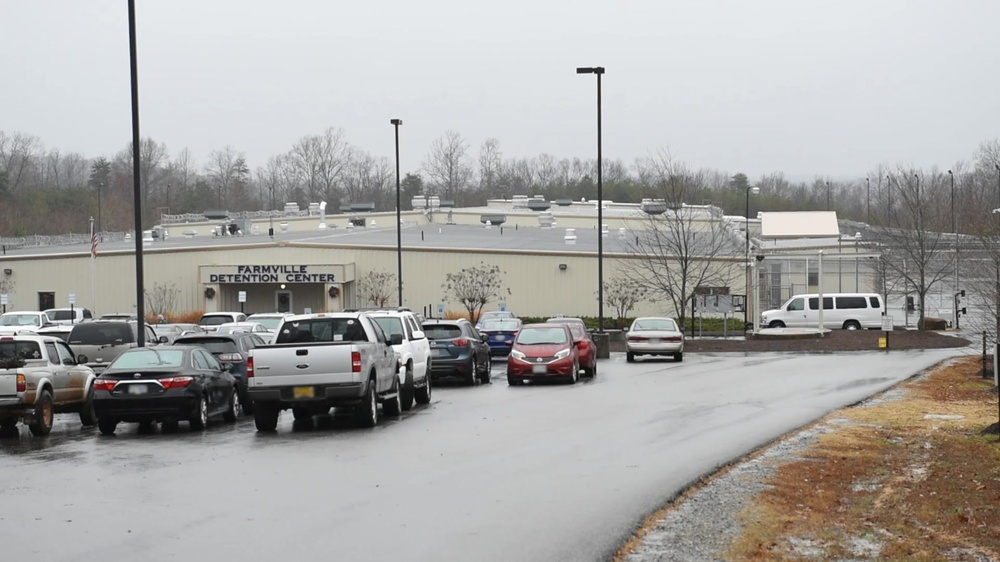
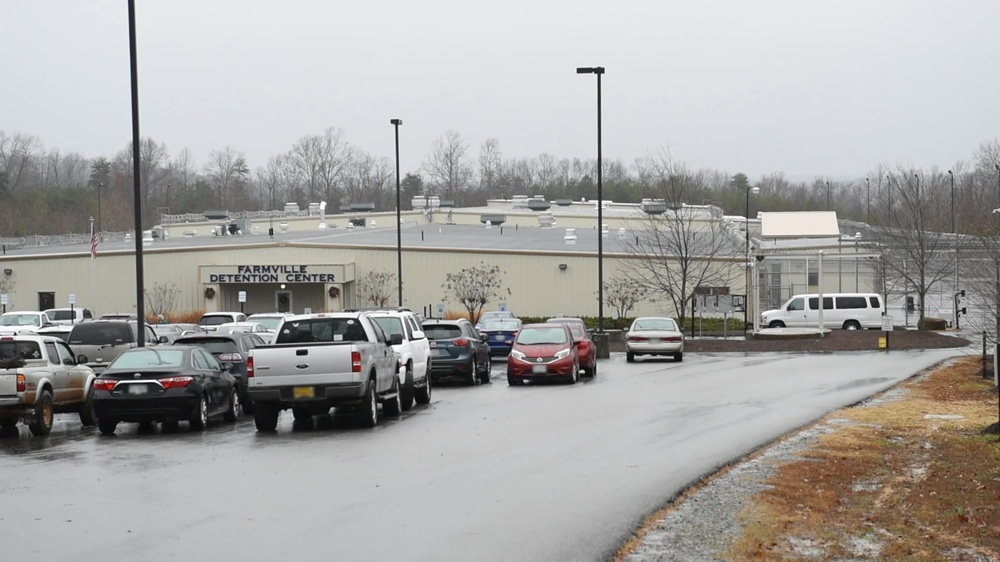
The U.S. Immigration and Customs Enforcement’s Farmville Detention Center in Virginia, pictured in December 2019. (Photo: Screenshot of ICE courtesy video)
WASHINGTON — When the overhead lights turn off at the Farmville Detention Center in Virginia, it not only means that night has arrived for Aliaksei Scharbachenia, but that panic attacks will soon follow.
The attacks, which started after his detention began last August, he said, have only grown worse, stemming from the fear that he will be returned to his country of Belarus and face persecution due to his opposition to the authoritarian government.
“With the panic attacks, I was able to take care of myself before,” he said in Russian. “But now it’s kind of getting worse, so I really need some medication, which will help me.”
States Newsroom interviewed Scharbachenia by video with the help of an interpreter.
As the Trump administration increases the scale of its immigrant detention program, now up to 68,000 immigrants in custody, reports have surfaced of inhumane conditions and inadequate medical care at U.S. Immigration and Customs Enforcement detention facilities like the one housing Scharbachenia. Congress recently boosted funding for immigration enforcement by $70 billion over three years, through the end of President Donald Trump’s term.
ICE acknowledged receiving, but did not respond to, a detailed list of questions from States Newsroom regarding Scharbachenia’s treatment at Farmville.
Ailments ignored
The front entrance to the ICE Farmville Detention Center in 2010. (Photo by Paul Caffrey/ICE)
The nightly panic attacks, and the lack of medication to treat them, are not the only health issues that 37-year-old Scharbachenia said he has brought to medical staff at the Virginia facility.
He’s lost feeling in his right pinky and ring fingers, which he attributes to an-egg sized mass that developed on the back of his biceps during his 11-month detention. The few items that he purchased at the center – earplugs and a small blanket – were confiscated after he spent two weeks in solitary confinement after sharing know-your-rights information to newly arrived immigrants, he said.
“I totally understand that’s another way of punishment to beat me, you know, so I will be quiet,” Scharbachenia said of his two weeks in solitary confinement.
Scharbachenia told States Newsroom that on May 20, ICE agents tried to deport him to Belarus, despite his active legal petition challenging his detention. He said he was eventually placed on a deportation flight back to the United States from Turkey, his hands and feet bound for the nine-hour journey, and returned to the Farmville detention.
States Newsroom could not independently verify the May 20 deportation attempt, and ICE did not respond to questions about it.
Poor conditions at multiple facilities
Scharbachenia’s complaints fit a pattern of reports from independent government inspectors that have found unsafe conditions and inadequate medical care provided to immigrants detained in facilities in Texas and Louisiana.
A recent report from the Department of Homeland Security’s internal watchdog found a detention center in Louisiana failed to ensure sanitary conditions, properly store perishable food, report use-of-force incidents and maintain medical records of detainees.
Congress this month passed the three-year, $70 billion immigration enforcement package that contains no restraints on ICE activities. The tens of billions in funding is on top of roughly $170 billion provided to DHS last year for detention and deportations.
Democratic lawmakers conducting oversight visits at some facilities have raised concerns about poor conditions and lack of medical care provided.
U.S. Rep. Adriano Espaillat, a New York Democrat who chairs the Congressional Hispanic Caucus, said during a recent press conference that the additional $70 billion in funding will only continue a “detention and deportation industry that profits from human suffering.”
New Jersey facility
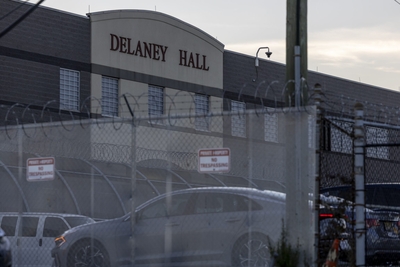
Delaney Hall in New Jersey. (Photo by Anne-Marie Caruso/New Jersey Monitor)
Civil rights groups have filed two major lawsuits charging poor and inadequate conditions at detention centers in Texas and New Jersey run by ICE and private contractors.
In New Jersey, Sen. Andy Kim called for the Delaney Hall facility to be shut down after detained immigrants went on a hunger strike to protest their conditions. While Kim and dozens of advocates demonstrated at the facility, he was hit with pepper smoke deployed by immigration officers.
“At Delaney Hall, we learned of unsanitary living conditions, lack of adequate medical care and unhealthy food,” House Minority Leader Hakeem Jeffries, D-N.Y., said after conducting oversight at the facility. “The situation is unacceptable. Delaney Hall must be shut down immediately.”
In response to the criticism of poor conditions at Delaney Hall, Homeland Security Secretary Markwayne Mullin argued before lawmakers that the detention centers have higher standards than jails and prisons. He described the complaints about food as detainees wanting “ethnic food.”
With House Democrats in the minority, the authority to make unannounced oversight visits at any federal facility that houses immigrants is one of the few tools they have. The power is codified in a 2019 appropriations law, but the Trump administration has not adhered to that policy.
Democrats have sued to regain access in a case now before the U.S. Court of Appeals for the District of Columbia Circuit.
Outbreaks at Farmville
Prior to Trump’s current deportation push, lawmakers had raised concerns about issues at the detention center where Scharbachenia is held. In 2019, a mumps outbreak started at the facility, and in 2020, 93% of the detained population contracted the coronavirus.
Roughly now three-quarters of the immigrants detained at Farmville, nearly 500, have no criminal record, according to the most recent government data. On the campaign trail, the president vowed to focus enforcement on immigrants with criminal records, but those in detention are there on a civil charge of violating U.S. immigration law.
Virginia Democrats have continued to conduct oversight of the facility.
U.S. Sen. Mark Warner went last August to visit Kilmar Abrego Garcia, who was transferred to Farmville after the Trump administration brought him back to the U.S. after erroneously deporting him to a brutal mega-prison in El Salvador.
Warner also raised concerns about the facility during the coronavirus outbreak in 2020.
During his August visit, Warner’s office said he “secured a commitment from the facility’s private operator to work with legislators to address concerns regarding food quality and access to health care.”
Virginia Sen. Tim Kaine also visited the facility in March and his office said he “continues to track conditions there closely.”
He has a final order of removal from an immigration judge, but said if he is removed back to Belarus, the country’s special police force will be waiting for him, “along with electric shock torture and death.”
WASHINGTON — When the overhead lights turn off at the Farmville Detention Center in Virginia, it not only means that night has arrived for Aliaksei Scharbachenia, but that panic attacks will soon follow.
The attacks, which started after his detention began last August, he said, have only grown worse, stemming from the fear that he will be returned to his country of Belarus and face persecution due to his opposition to the authoritarian government.
“With the panic attacks, I was able to take care of myself before,” he said in Russian. “But now it’s kind of getting worse, so I really need some medication, which will help me.”
States Newsroom interviewed Scharbachenia by video with the help of an interpreter.
As the Trump administration increases the scale of its immigrant detention program, now up to 68,000 immigrants in custody, reports have surfaced of inhumane conditions and inadequate medical care at U.S. Immigration and Customs Enforcement detention facilities like the one housing Scharbachenia. Congress recently boosted funding for immigration enforcement by $70 billion over three years, through the end of President Donald Trump’s term.
ICE acknowledged receiving, but did not respond to, a detailed list of questions from States Newsroom regarding Scharbachenia’s treatment at Farmville.
Ailments ignored
The front entrance to the ICE Farmville Detention Center in 2010. (Photo by Paul Caffrey/ICE)
The nightly panic attacks, and the lack of medication to treat them, are not the only health issues that 37-year-old Scharbachenia said he has brought to medical staff at the Virginia facility.
He’s lost feeling in his right pinky and ring fingers, which he attributes to an-egg sized mass that developed on the back of his biceps during his 11-month detention. The few items that he purchased at the center – earplugs and a small blanket – were confiscated after he spent two weeks in solitary confinement after sharing know-your-rights information to newly arrived immigrants, he said.
“I totally understand that’s another way of punishment to beat me, you know, so I will be quiet,” Scharbachenia said of his two weeks in solitary confinement.
Scharbachenia told States Newsroom that on May 20, ICE agents tried to deport him to Belarus, despite his active legal petition challenging his detention. He said he was eventually placed on a deportation flight back to the United States from Turkey, his hands and feet bound for the nine-hour journey, and returned to the Farmville detention.
States Newsroom could not independently verify the May 20 deportation attempt, and ICE did not respond to questions about it.
Poor conditions at multiple facilities
Scharbachenia’s complaints fit a pattern of reports from independent government inspectors that have found unsafe conditions and inadequate medical care provided to immigrants detained in facilities in Texas and Louisiana.
A recent report from the Department of Homeland Security’s internal watchdog found a detention center in Louisiana failed to ensure sanitary conditions, properly store perishable food, report use-of-force incidents and maintain medical records of detainees.
Congress this month passed the three-year, $70 billion immigration enforcement package that contains no restraints on ICE activities. The tens of billions in funding is on top of roughly $170 billion provided to DHS last year for detention and deportations.
Democratic lawmakers conducting oversight visits at some facilities have raised concerns about poor conditions and lack of medical care provided.
U.S. Rep. Adriano Espaillat, a New York Democrat who chairs the Congressional Hispanic Caucus, said during a recent press conference that the additional $70 billion in funding will only continue a “detention and deportation industry that profits from human suffering.”
New Jersey facility
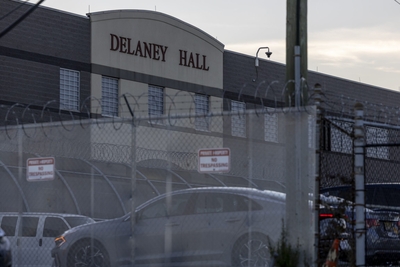
Delaney Hall in New Jersey. (Photo by Anne-Marie Caruso/New Jersey Monitor)
Civil rights groups have filed two major lawsuits charging poor and inadequate conditions at detention centers in Texas and New Jersey run by ICE and private contractors.
In New Jersey, Sen. Andy Kim called for the Delaney Hall facility to be shut down after detained immigrants went on a hunger strike to protest their conditions. While Kim and dozens of advocates demonstrated at the facility, he was hit with pepper smoke deployed by immigration officers.
“At Delaney Hall, we learned of unsanitary living conditions, lack of adequate medical care and unhealthy food,” House Minority Leader Hakeem Jeffries, D-N.Y., said after conducting oversight at the facility. “The situation is unacceptable. Delaney Hall must be shut down immediately.”
In response to the criticism of poor conditions at Delaney Hall, Homeland Security Secretary Markwayne Mullin argued before lawmakers that the detention centers have higher standards than jails and prisons. He described the complaints about food as detainees wanting “ethnic food.”
With House Democrats in the minority, the authority to make unannounced oversight visits at any federal facility that houses immigrants is one of the few tools they have. The power is codified in a 2019 appropriations law, but the Trump administration has not adhered to that policy.
Democrats have sued to regain access in a case now before the U.S. Court of Appeals for the District of Columbia Circuit.
Outbreaks at Farmville
Prior to Trump’s current deportation push, lawmakers had raised concerns about issues at the detention center where Scharbachenia is held. In 2019, a mumps outbreak started at the facility, and in 2020, 93% of the detained population contracted the coronavirus.
Roughly now three-quarters of the immigrants detained at Farmville, nearly 500, have no criminal record, according to the most recent government data. On the campaign trail, the president vowed to focus enforcement on immigrants with criminal records, but those in detention are there on a civil charge of violating U.S. immigration law.
Virginia Democrats have continued to conduct oversight of the facility.
U.S. Sen. Mark Warner went last August to visit Kilmar Abrego Garcia, who was transferred to Farmville after the Trump administration brought him back to the U.S. after erroneously deporting him to a brutal mega-prison in El Salvador.
Warner also raised concerns about the facility during the coronavirus outbreak in 2020.
During his August visit, Warner’s office said he “secured a commitment from the facility’s private operator to work with legislators to address concerns regarding food quality and access to health care.”
Virginia Sen. Tim Kaine also visited the facility in March and his office said he “continues to track conditions there closely.”
He has a final order of removal from an immigration judge, but said if he is removed back to Belarus, the country’s special police force will be waiting for him, “along with electric shock torture and death.”
On June 10, 2026, President Donald Trump signed into law a bill providing $70 billion for immigration enforcement and detention activites over the next three years. In this photo, a U.S. Immigration and Customs Enforcement agent watches a crowd of protesters at Delaney Hall in Newark, N.J., on May 25, 2026. (Photo by Ben Ackman/New Jersey Monitor)
WASHINGTON — President Donald Trump significantly bolstered funding for immigration enforcement Wednesday when he signed into law a nearly $70 billion package that will keep key federal agencies operating without any new restrictions.
Democrats pressed for guardrails after immigration officers shot and killed two U.S. citizens in Minneapolis in January. But when talks broke down, Republican lawmakers drafted their own bill without any additional constraints.
“The bill provides crucial funding for domestic law enforcement investigations and combating child exploitation, continuing our work to restore law and order across our nation, and to protect America’s youth,” Trump said during an Oval Office event.
The measure moved through Congress this month with nearly every Republican voting to approve the additional spending, which will last through September 2029.
Democratic lawmakers argued immigration officers should adhere to the standards other federal law enforcement agencies follow, like wearing body cameras, getting a warrant from a judge before entering someone’s home and identifying themselves by removing masks.
Republican leaders said during talks they were open to instituting limitations on how immigration officers behave, but opted not to include any curbs in their party-line bill.
ICE, CBP funded
The law will provide Immigration and Customs Enforcement with another $38.53 billion. Customs and Border Protection will receive an additional $26.02 billion and the secretary of Homeland Security will be given $5 billion more in funding.
The money is in addition to the $170 billion Republicans included in their “big, beautiful” law, as well as the funding approved in the annual DHS appropriations package.
Nearly every Republican in the House voted to approve the measure, though New Jersey Rep. Thomas H. Kean, Jr., who has been absent due to an undisclosed illness, and South Carolina Reps. Nancy Mace and Ralph Norman, who were competing in their state’s gubernatorial primary, missed the vote.
Alaska Sen. Lisa Murkowski was the sole Republican to vote against approving the legislation in that chamber, writing in a statement negotiators should have worked out a bipartisan solution in the annual funding bill instead of using the complex budget reconciliation process to get around procedural votes that would otherwise have required the support of 60 senators.
“By choosing to appropriate funding for three fiscal years instead of one, this measure weakens the normal budgeting process and sets another precedent for avoiding it when we find ourselves in disagreement,” she wrote. “In doing so, it reduces Congress’ ability to apply reasonable checks on immigration policy for the remainder of this administration and into the next.”
Murkowski added that she would have voted for the package had it “provided immigration funding for one year, included clear restrictions on what those funds can be used for, and eliminated any potential for taxpayer dollars to be allocated to the administration’s brazen ‘anti-weaponization’ fund.”
That $1.776 billion account would have paid restitution to people who believe they were wrongly prosecuted by the Justice Department. Acting Attorney General Todd Blanche testified before Congress the administration wasn’t planning to proceed with that proposal after Republicans on Capitol Hill voiced opposition.
Trump, however, hasn’t completely retracted his support for the fund, saying in an NBC News interview this weekend that he and other Republicans believe it “is a great idea.”
“You have to get it approved,” he said. “If they get it approved, that’s great. If they don’t get it approved, I’d be disappointed.”
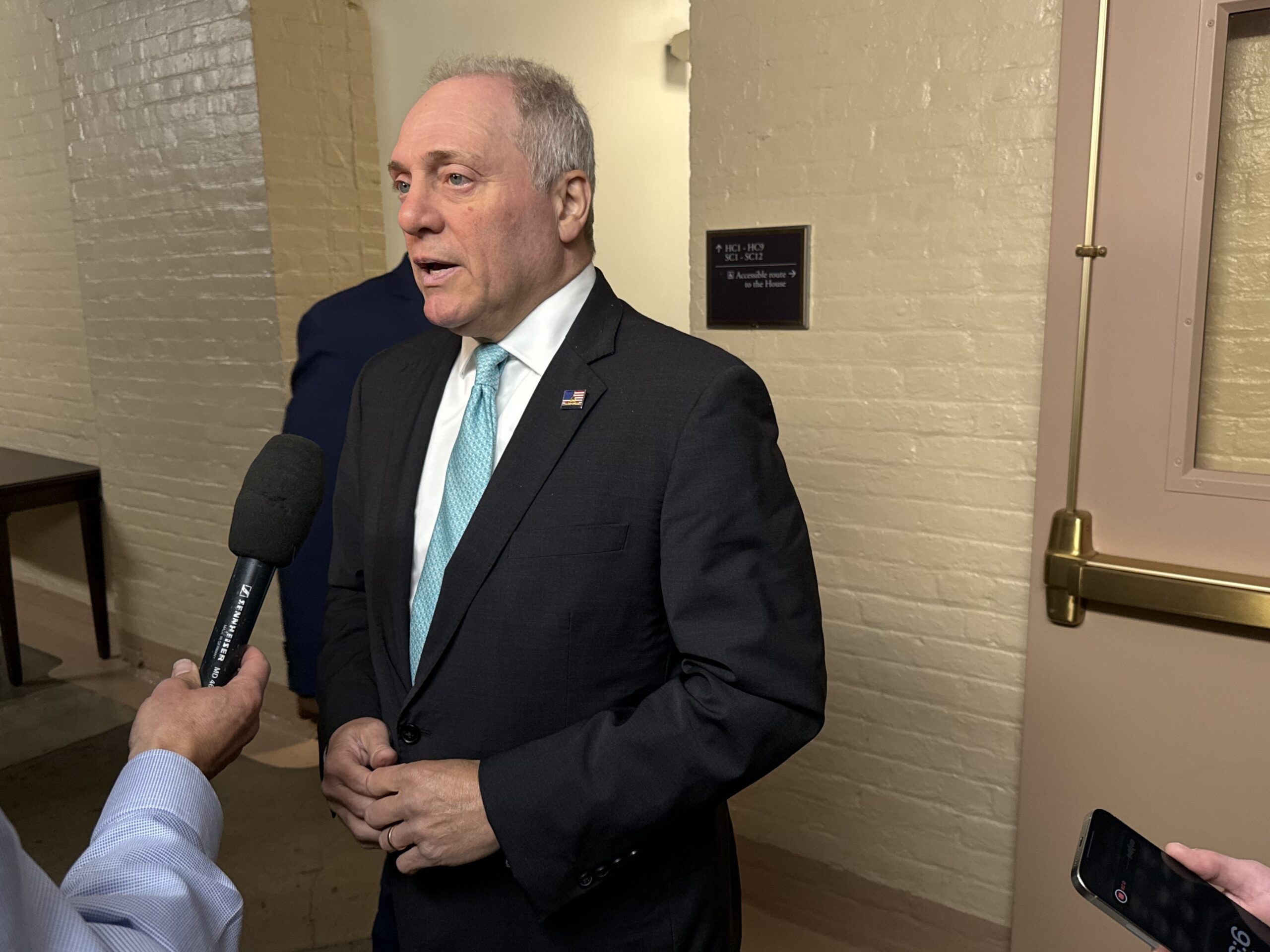
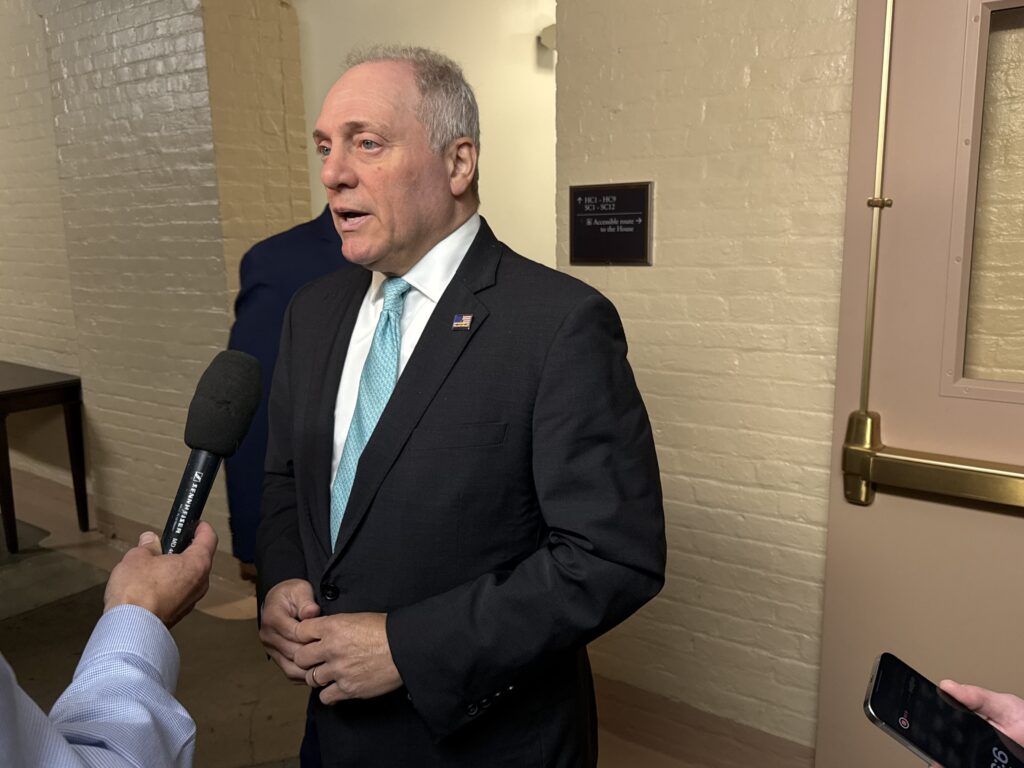
U.S. House Majority Leader Steve Scalise, R-La., speaks to reporters in the basement of the Capitol building in Washington, D.C., on Tuesday, June 9, 2026. (Photo by Jennifer Shutt/States Newsroom)
WASHINGTON — U.S. House Republicans on Tuesday approved three years of funding for immigration enforcement without any new guardrails on how federal agents operate.
The 214-212 vote sent the nearly $70 billion package to President Donald Trump, who is expected to sign the measure. Republican senators approved the bill earlier this month, with Alaska Sen. Lisa Murkowski the only member of the GOP in opposition.
California independent Rep. Kevin Kiley, who conferences with Republicans, voted no, along with Democrats.
Majority Leader Steve Scalise, R-La., argued Immigration and Customs Enforcement and the Border Patrol need the additional funding so they can deport anyone in the country without proper authorization.
“They want you to think that it’s just everybody coming in to seek the American dream,” he said. “We have a legal method for that to happen.”
Scalise then read a list of Americans killed by people who were present in the United States without legal status.
“It’s not some hypothetical, it’s happened over and over and over again,” he said.
Minority Leader Hakeem Jeffries, D-N.Y., said he opposed Republicans’ plans to “give a blank check to ICE without any guardrails, any oversight, or any accountability.”
“Donald Trump promised America that he would target violent felons who are here illegally, but instead taxpayer dollars are being used by ICE and his violent mass deportation machine to target and brutalize American citizens, in some cases killing them,” he said.
Jeffries contended that “immigration enforcement should be fair, just and humane” and that ICE “needs to conduct itself” according to the same standards other law enforcement agencies follow.
Funds will stretch over 3 years
The legislation will provide $38.53 billion for Immigration and Customs Enforcement, $26.02 billion for Customs and Border Protection and $5 billion for the secretary of Homeland Security.
The funding, which lasts through September 2029, is in addition to the $170 billion Republicans provided in their “big, beautiful” law. About $100 billion of that remains unspent, according to Democrats.
Republicans opted not to place any new constraints on how federal immigration agents operate or provide additional funding for oversight, despite officers killing two U.S. citizens in Minneapolis in January.
Those shootings led Democrats in Congress to demand new restrictions on officers, which led to weeks of bipartisan negotiations amid a 76-day shutdown for the Department of Homeland Security.
That stalemate ended in April after lawmakers approved DHS’ annual appropriations bill without funding for ICE or the Border Patrol. Republicans had to remove those provisions in order to move the legislation through procedural votes in the Senate that require the support of at least 60 lawmakers.
A new path
Republican leaders then turned to the complex budget reconciliation process to provide three years of funding for ICE, CBP and the secretary of DHS without requiring any changes to how they operate.
The special legislative pathway allows bills to move through the Senate with simple majority votes as long as they adhere to certain rules.
Senate Republicans originally included, but later removed, $1.46 billion for several Department of Justice Programs and $1 billion for the Secret Service to make security upgrades linked to the new White House ballroom, also called the East Wing Modernization Project.
The funding for ICE, CBP and the DHS secretary clears the way for the Trump administration to continue its immigration crackdown until just a few months before his second term is scheduled to end.
An aerial view of Camp East Montana, an immigrant detention center in El Paso, Texas. (Photo courtesy of Government Accountability Office)
WASHINGTON — A hastily constructed immigrant detention facility on a military base in Texas wasted millions in federal funding and failed to meet basic standards, according to a report released Tuesday by a nonpartisan government watchdog.
The report by the Government Accountability Office documenting problems at Camp East Montana is one of the first independent investigations into a facility quickly constructed from the $170 billion in immigration enforcement and detention funding provided by Republicans’ “big beautiful” law enacted in July 2025 as part of the president’s mass deportation campaign. The camp is considered the largest immigrant detention center in the United States.
The Department of Defense and U.S. Immigration and Customs Enforcement in August 2025 set up the soft-sided detention site of Camp East Montana at Fort Bliss in El Paso, Texas. It was intended to hold as many as 5,000 immigrants and is still currently operating under a private contractor as well as ICE.
The facility was plagued with several tuberculosis cases and at least four detainee deaths, with one ruled a homicide by the local coroner. The American Civil Liberties Union filed a suit against the government over inhumane conditions.
“The facility also did not meet key detention standards, risking the safety and security of detained noncitizens and staff,” GAO said.
The report came as the U.S. House this week prepares to take final steps to pass a $70 billion package to fund immigration enforcement until the end of fiscal year 2029. President Donald Trump is expected to sign the legislation into law.
Congressional Democrats requested that GAO do a report on Camp East Montana, including Sens. Dick Durbin of Illinois, Jack Reed of Rhode Island and Gary Peters of Michigan and Rep. Bennie Thomspon of Mississippi.
Reed, the top Democrat on the Senate Armed Services Committee, said in a statement that he was concerned the U.S. military was responsible for the quick construction of the detention camp.
“Preventable deaths, inhumane conditions, and millions of dollars in waste are the direct result of the Pentagon cutting corners and handing a billion-dollar contract to an inexperienced vendor that wrote its own performance standards,” Reed said.
$1.3 billion contract
GAO investigators found that the Department of Defense’s contracting vehicle used to handle the $1.3 billion contract for Camp East Montana provided no flexibility and resulted in paying for meals and employee services during times when no immigrants were detained at the facility, resulting in millions of dollars wasted.
For example, the Army paid the full cost for guards, medical services, transportation, meals and other services from Aug. 1, 2025 to Aug. 15, 2025, when there were no detainees at the facility, wasting up to $11.5 million, GAO said.
“Further, because the Army set a fixed price for meals based on the capacity of the facility, it paid about an additional $423,000 for meals it did not need when the facility was operating below its designated capacity from August 16, 2025, through September 30, 2025,” according to the GAO report.
Same failures could repeat, GAO says
GAO investigators also noted that the same mistakes could be made with the Department of Homeland Security’s ongoing move to spend $38 billion to convert warehouses for the purpose of detaining thousands of immigrants.
“GAO points out that ICE’s planned facility expansion—a $38 billion program to convert warehouses into detention facilities using the same contracting vehicle—risks repeating every one of these failures at a dramatically larger scale,” according to the report.
Investigators made four recommendations, including that ICE consider tiered pricing for food to account for fluctuations in populations of detained immigrants and that ICE ensure that new facilities meet detention standards before housing immigrants.
The report notes that DHS and DOD agreed with the recommendations. DOD deferred comment to DHS, which did not immediately respond to States Newsroom’s request for comment.
Homicide investigated
Investigators also raised use-of-force concerns, including one in January in which an autopsy found the death of a detainee to be due to asphyxia and ruled it a homicide.
“However, the contractor did not provide use of force and death reports to ICE, as required,” according to the report. “In addition, evidence associated with the incident was missing or destroyed.”
Durbin, who is the top Democrat on the Senate Judiciary Committee, called the GAO report “damning.”
“We now know even more details of how dangerous and irresponsible the Trump Administration’s mass deportation campaign truly is,” he said in a statement. “Excessive use of force, lacking medical and mental health care, and wasted taxpayer dollars are emblematic of this mass deportation scheme. The American people have rightfully expressed outrage at these policies, and it’s time to hold ICE and their private contractors responsible.”
GAO investigators noted several health issues. They pointed out that none of the detainees with HIV or diabetes had treatment plans in place.
Also, facility employees did not follow proper procedure for tuberculosis screening. One contractor used a questionnaire rather than administering the required skin tests for tuberculosis.
Investigators found that as a result in November, a detained immigrant with tuberculosis was housed with the general immigrant population.