Tag: History

  • Juneteenth reminds us of Black Americans’ long struggle for education following end of slavery

    Juneteenth reminds us of Black Americans’ long struggle for education following end of slavery

    This piece originally appeared in The Conversation.

    The abolitionist and writer Frederick Douglass is known for many things, but perhaps among the most significant is his views on education’s relationship to slavery. Douglass himself was born into slavery in Maryland in 1818.

    Douglass described in his 1845 autobiography how one of his enslavers, Mrs. Auld, began teaching him to read when he was a child. Mrs. Auld’s husband ordered her to stop giving Douglass lessons.

    “Just at this point of my progress, Mr. Auld found out what was going on, and at once forbade Mrs. Auld to instruct me further, telling her, among other things, that it was unlawful, as well as unsafe, to teach a slave to read,” Douglass writes. “To use his own words, further, he said, ‘If you give a nigger an inch, he will take an ell. A nigger should know nothing but to obey his master.’”

    Congress enacted the 13th Amendment on Jan. 31, 1865, abolishing slavery. It was not until June 19, 1865, that word of the amendment reached enslaved people in Galveston, Texas, marking the origin of the Juneteenth holiday.

    The Biden administration declared Juneteenth a federal holiday in 2021. Today, Juneteenth commemorates the end of slavery in the U.S. But the story for formerly enslaved people continued to unfold in complex ways well after Juneteenth, including when it came to their educational journeys.

    Juneteenth made clear that freedom was not just confined to someone’s physical enslavement, but mental enslavement as well, bound in the laws that barred enslaved people from receiving an education in Southern states.

    A drawing of a National Freedmen’s Bureau school in Richmond, Va., in 1866. (Photo by Universal History Archive/Universal Images Group via Getty Images)

    Making learning illegal

    In 1739, the Stono slave rebellion took place in South Carolina. Fearing that educated slaves would go on to plot future rebellions, South Carolina passed an anti-literacy law in 1740, banning slaves from being taught how to read.

    Most Southern states soon followed with anti-literacy laws of their own between 1740 and 1834, in the hopes of preventing any further slave rebellions. These laws applied to both enslaved and free Black people.

    Despite these laws, thousands of enslaved people still learned to read and write in the antebellum South. Literacy was a means of freedom.

    Meanwhile, the first African Free School for Black children was established in New York City in 1787. The one-room schoolhouse began with 40 students, the majority of whom had parents who were formerly enslaved. Six additional, similar schools were created with public funding by 1824.

    Juneteenth and the path to freedom

    Juneteenth is a complicated story of formerly enslaved people’s faith and resilience, as well as white supremacists’ hate and resistance to formerly enslaved people experiencing liberation.

    It also offers an important reminder that true freedom must also include the right to an education.

    Formerly enslaved individuals had various responses to their newfound freedom in 1865, ranging from gratitude and joy to despair and loss.

    Many formerly enslaved people decided to leave plantations and Southern states to reunite with family members and communities separated by slavery.

    Others opted to remain where they had been enslaved, seeking to experience freedom in familiar surroundings. In fact, the vast majority of freed people remained in the South.

    Regardless of their choices, the approximately 4 million formerly enslaved people challenged the U.S. to acknowledge their liberation and welcome them as equals.

    Relentlessly, they endeavored to establish themselves as free citizens within the nation. One of these newly freed people’s primary goals was to receive an education.

    Learning to read, write and more

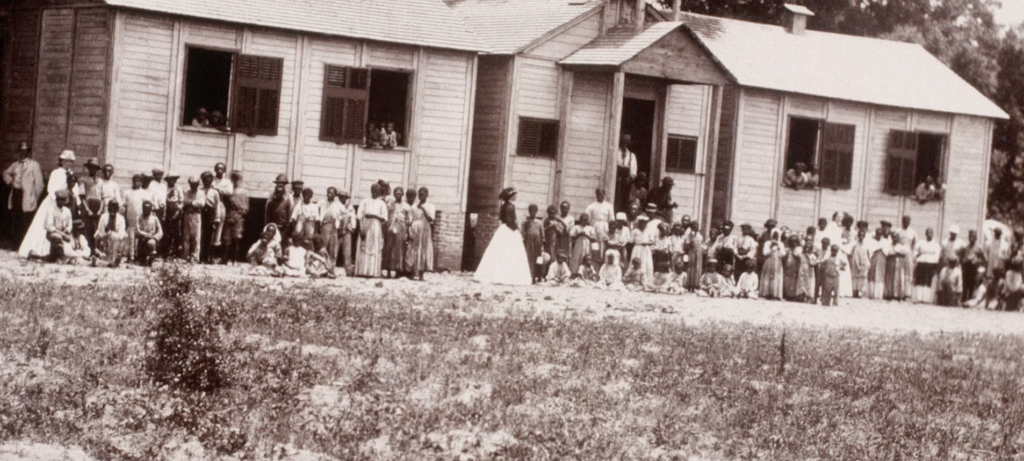
    After the Civil War, newly freed people gathered in churches, homes, cellars, sheds, meetinghouses and even under shade trees in the fields where they worked the crops to learn how to read and write. They also learned basic job skills, such as the ability to read and understand labor contracts.

    Many of the teachers had no formal training, and some of them were local Black people who were self-taught.

    Other educators included white teachers from the South and the North, sent by churches and aid societies.

    White aid societies and religious organizations from the North, including the American Missionary Association and the National Freedman’s Relief Association, sometimes funded these free schools for formerly enslaved Black people.

    However, most of the money to fund these schools came from the newly freed Americans, who privately paid for their schools.

    While about 90% of the Black population in Southern states were illiterate in 1865, this percentage dropped to 70% by 1880.

    A journey into higher education

    Newly freed Black people also began to have more options for higher education.

    The first historically Black college and university, Cheyney University, was established in Pennsylvania in 1837, well before the Civil War. A total of four HBCUs were established by the end of the Civil War in 1865.

    At this point, true liberation began, as a growing number of HBCUs offered academic freedom to Black Americans, who otherwise would have been prohibited from attending most colleges and universities.

    In the 15 years following the Civil War, a total of 59 HBCUs had opened their doors to Black students.

    In 1867, by act of Congress, Howard University was established in Washington, D.C. It provided not only basic college courses but also programs in law, medicine, education and pharmaceuticals.

    A history class at the Tuskegee Institute, a coeducational elementary and secondary school for Black Americans founded in 1881 in Georgia. (Photo by Corbis/Getty Images)

    A promise that requires education

    A whole new set of challenges and opportunities greeted the formerly enslaved Black Americans who sought freedom in the North. Most arrived in cities such as Chicago and New York, where they found some humanitarian support but also racial discrimination and poverty.

    Their lives were constantly filled with both legal and racial hostility.

    Education ranked high among the free people as a priority, as they looked to gain new skills and advance in life. They learned not only the basics in reading and math, but also job skills, citizenship and advanced learning in professional careers, such as law, medicine, pharmacy and teaching.

    Ultimately, Juneteenth offered a promise of freedom – but education was necessary to make it happen.
  • William & Mary’s Lemon Project helps Black Virginians learn about their lineage, counter narratives

    William & Mary’s Lemon Project helps Black Virginians learn about their lineage, counter narratives

    By Nick McNamara/WHRO

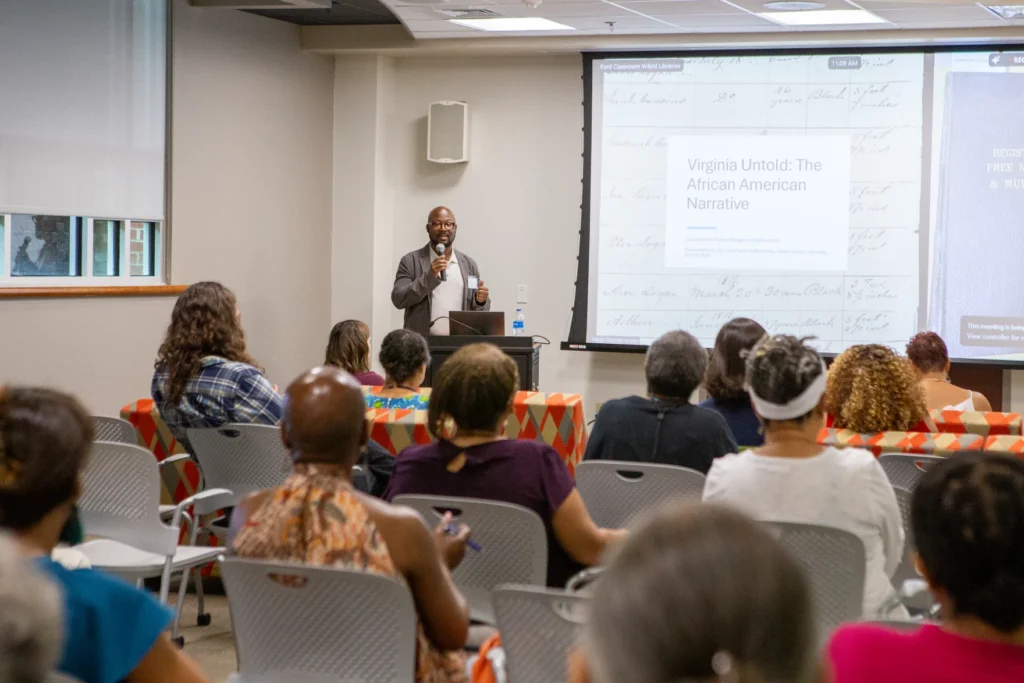
    William & Mary’s Lemon Project helps African Americans in Williamsburg uncover their families’ histories and the role their relatives played in shaping the college, the city and the landscape of the early United States.

    On Thursday morning, the Lemon Project is taking its services to the college’s Juneteenth Celebration in the Sadler Center.

    “It resonates deeply if you have been told for generations that you did not make a substantive contribution to the building of a nation and now you have records that say ‘Yes, I did, I did build this place,’” said Jajuan Johnson, interim director of the Lemon Project. “We think that they’re worth the search, they’re worth the labor.”

    The Lemon Project was created in 2009 to investigate William & Mary’s ties to slavery, starting with its founding in 1693. The college’s historic campus was built by enslaved people, and its founding president, James Blair, was instrumental in the institutionalization of slavery in Colonial Virginia.

    The project was inspired by similar work at Brown University and pushed forward with advocacy by faculty and students such as Tiseme Zegeye, who in 2007 proposed a resolution in the Student Assembly that called on William & Mary to research and publicize the college’s role in slavery and create a memorial to the enslaved. The Board of Visitors agreed in 2009. “Hearth: Memorial to the Enslaved” was dedicated in 2022.

    “We wouldn’t be here without students; they are key to our success,” said Sarah Thomas, associate director of the Lemon Project.

    Johnson helped establish the project’s public genealogical research work about five years ago. Members of the Descendant community, African Americans with roots in Williamsburg’s earliest days, had been asking for it for years.

    A $1 million grant created a foundation to get started during the COVID-19 pandemic.

    “People were wanting to connect,” Johnson said. “They are in place, sheltered and they’re wanting to connect with family.”

    Interest in genealogy predated the pandemic, Johnson said, but as historical records were digitized and made available online, it became easier for Black people to investigate unanswered questions about their lineage.

    For people who descend from enslaved people, however, ancestry work can be difficult. Many records were lost or destroyed during the Civil War. In other cases, records pertaining to the enslaved were sparse or nonexistent, sometimes noting the presence of an enslaved worker but not their name.

    “Slavery was injustice against family lines,” Johnson said. “So much is not recorded because you were considered property.”

    Despite the challenges, many records do exist in William & Mary’s Swem Library special collections. The Lemon Project also makes use of Library of Virginia records and Freedmen’s Bureau records, which Johnson said have been instrumental in their work.

    “Although people are told that they can’t find anything prior to 1865, I would say 80% of the time they do, they find some type of clue,” Johnson said.

    The Lemon Project collaborates on genealogy work with other groups, including the Bray School Lab, the Afro-American Historical and Genealogical Society of Hampton Roads and Black residents, Johnson said. Where institutional records fell short, records from historical church congregations in Williamsburg, such as First Baptist Church, Oak Grove Baptist Church and Bruton Parish, sometimes provide new leads.

    “African American cemeteries and the structures as well are major testimonies of African American life and history and family history in this region,” Johnson said. “These are places that are repositories of information that tell the story of people and the communities they built.”

    The project doesn’t always start in the distant past and move forward. Using a mix of oral history, death certificates and payroll documents from the 1900s at the college, Johnson said, the project was able to follow lineages backward.

    “We see that not only are these people in the early 1900s on this payroll list working at William & Mary, but they have children who are working at the college,” Johnson said. “We can trace back to find that there was this labor lineage at the college.”

    Thomas said the project’s work builds community and connects people.

    “We had a genealogy roundtable and cousins met each other for the first time,” Thomas said. “We didn’t plan it, it just happened; those kinds of stories are priceless.”

    Those moments and demonstrating the Black community’s role in building early Williamsburg and overcoming oppression make the project’s work resonate with people, Johnson said.

    “They built the churches, they cared for their dead, they reproduced, they established businesses, they did everything that people have told them — that institutions have told them — they did not do,” he said. “It’s sustaining when you consistently live in a world that tells you you don’t matter, it reaffirms ‘No, this is my place; this, too, is my nation; this is my institution.’”

  • What Virginians’ and Americans’ D-Day sacrifices teach us about our country now

    What Virginians’ and Americans’ D-Day sacrifices teach us about our country now

    NORMANDY AMERICAN CEMETERY, COLLEVILLE-SUR-MER, FRANCE- Richard Powhatan Hall’s grave sits nine rows into the vast final resting place of 9,400 U.S. soldiers who lost their lives in the 1944 D-Day invasion. Hall, a man from Virginia’s Albemarle County, was killed in action June 6, 1944 at Omaha Beach, a few hundred yards from where he is buried.

    He died at 26 fighting fascism.

    Hall was among 184 Virginians who gave their lives to spearhead an extended assault that eventually led to Paris, then Berlin, and brought down Adolph Hitler and the Nazis, a regime powered by hate and intolerance.

    The Virginia dead included the Bedford 20, a group of young men from the same small town in the southwest region of the state. They became the best-known Old Dominion D-Day casualties for their community’s collective sacrifice.

    Bedford lost more residents per capita than any other community in the United States on D-Day, as far as is known, according to John Long, education director of the National D-Day Memorial. To the best of historians’ knowledge, the state of Virginia lost more residents per capita in the D-Day mission than any other state in the union, Long said.

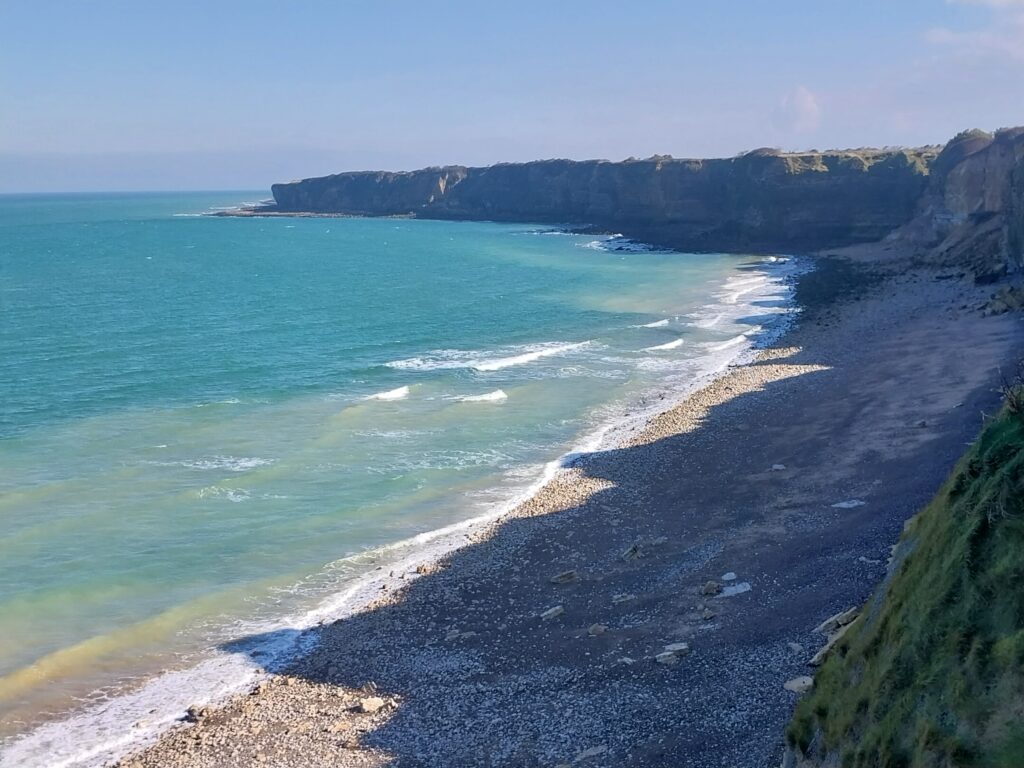
    Ruined remains of German gun emplacements still stud the high bluffs above the Atlantic coast. The gun emplacements, considered nearly impenetrable during World War II, have evolved into monuments of the shared pain and desperately hard work it took to overcome fascism.

    U.S. Army rangers who scaled the near vertical rock face of Pont du Hoc used ropes and knives shoved into small cracks to propel themselves upward into enemy fire. Their courage symbolized the difficulty and determination of the entire campaign.

    As Long noted, “They obviously knew they were going into battle. I’ve never talked to a veteran of World War II who would not admit that they were scared.”

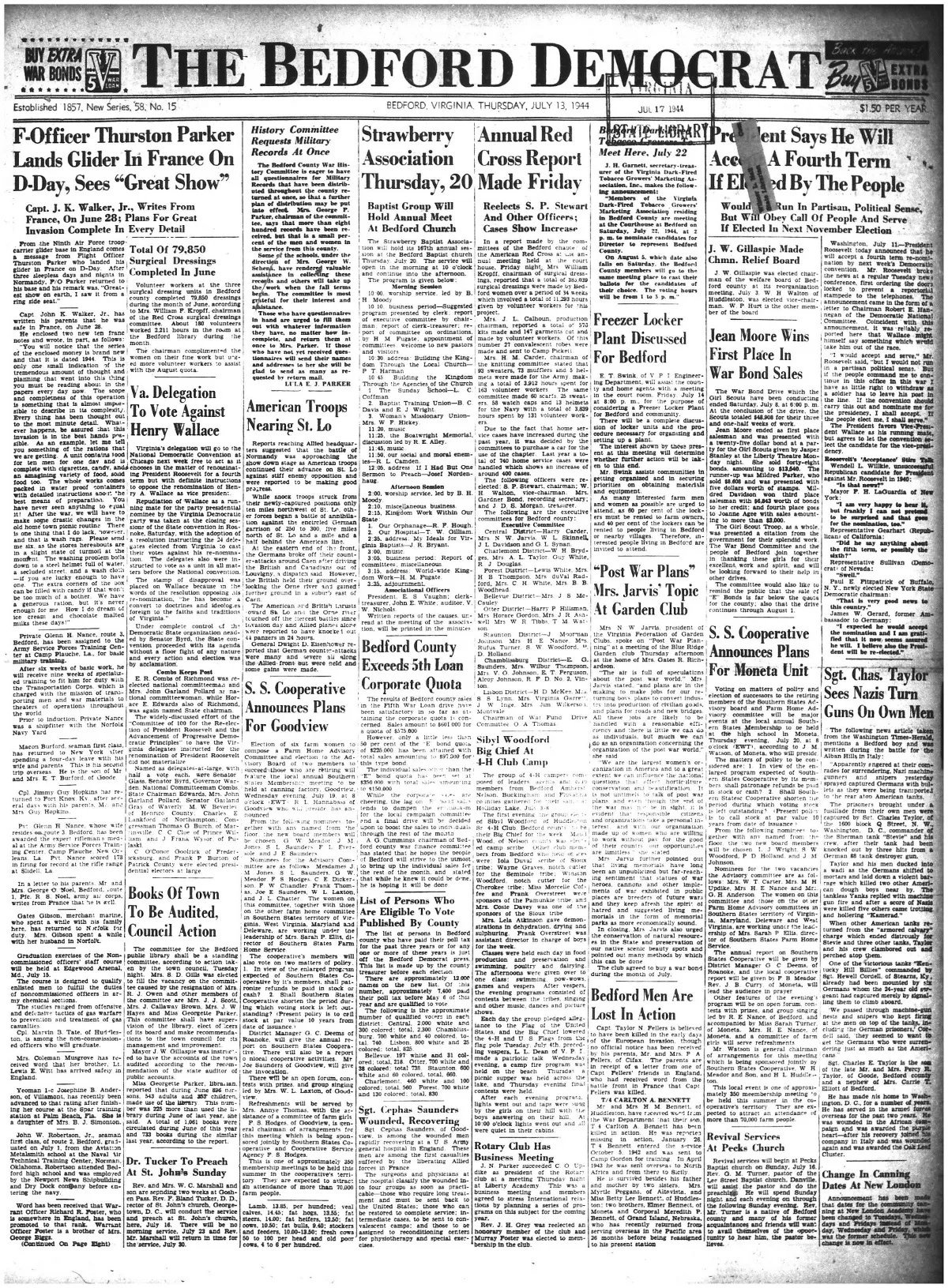
    The July 13, 1944 edition of The Bedford Democrat newspaper details the names of men from the county w ho perished in World War II up to that point. (Photo courtesy Library of Virginia)

    Many of those killed on D-Day were entering combat for the first time, Long said. But they also knew that they were in a crucial battle between good and evil.

    The U.S. worked with its allies, England and Canada, in those days. The leader of the invasion, U.S. Gen. Dwight Eisenhower, ultimately made the decisions. But he led with power that considered other viewpoints. That birthed a spirit of cooperation and adaptation that overcame everything that went wrong on D-Day, a spirit that had to extend to the troops for anything to succeed.

    In his Order of the Day, Eisenhower referred to what was about to happen as a “Great Crusade.”

    This crusade required more than brilliant tacticians or seasoned soldiers. It relied on guys like Hall, who before the war worked for a Charlottesville Ford dealership, according to his obituary.

    Hall, the Bedford 20,most of the rest of the lost Virginians and more than 9,000 other Americans who died in the D-Day invasion were not military professionals. They were mostly average Joes who understood and accepted the obligation of their country’s commitment to freedom from dictators.

    Standing among seemingly endless rows of U.S. grave markers in Normandy inevitably invites a comparison of America’s spirit on D-Day and today.

    On D-Day, the U.S. aligned itself with allies. It did not alienate or publicly lecture them, as our government leaders currently do. The country felt a shared responsibility to the world in a war that was not being fought on American soil. That commitment sprang from ideology instead of property. Freedom from authoritarian rule was the goal, but not just in an abstract sense.

    To fight on D-Day meant facing daunting physical risks to take down the enemy or die trying.

    “By and large, allied leaders made it clear this was a battle of good versus evil that had to be won,” Long said. “They had a sense of what they had to do and why.”

    But there was also a personal sense of the mission reliant on individual survival instincts to succeed. The only path to victory was up the bluffs.

    “Their thinking,” said Long, “was that taking those bluffs was how they got to go home.”

    Thousands didn’t. Still, they trusted in leaders whose integrity made it worth the try.

    In a country whose leaders routinely lie or use their positions to expand personal authority and wealth, such trust cannot exist.

    This is the country we now live in. It is a place where the president punishes institutions that practice traditional values of tolerance, opportunity and compassion.

    It is a place where the president calls the late Sen. John McCain, a hero who suffered years of torture for his service in the Vietnam War, a “loser.”

    We now live in a place where white nationalists and misogynists masquerading as war experts strip promotions from black and female military officers, and the president, a draft dodger who never served, pursues military policies so devoid of tactical rationale and legality that America’s finest officers must resign because they cannot in good conscience follow what they believe to be illegal orders.

    Our highest political leader today believes that undocumented immigrants deserve no constitutional rights and can be separated from their children and thrown into detention facilities for months without court hearings.

    We now live in a country where the same leader encourages government agents to attack protesters. The Trump administration initially refused to cooperate with state investigators seeking facts in the killings of two legal Minnesota residents by Immigration and Customs Enforcement agents. A judge had to order the administration to release evidence.

    ICE officer fatally shoots driver through car window in Minneapolis

    Finally, and perhaps most tragically, instead of fighting fascism, today we live in a country where the leader spreads lies about election fraud when he loses, then encourages an attack on the U.S. Capitol to stop the peaceful transfer of power.

    The attack injured police and led to several deaths. It cost taxpayers tens of millions of dollars. It led to 1,500 criminal convictions. But the leader, shielded from personal criminal prosecution by conservative Supreme Court justices, pardoned the criminals who did his bidding.

    What Americans did in 1944 on the beaches at Normandy showed greatness and selflessness. What Donald Trump has done in his time as president is destroy Americans’ sense of unity and responsibility, which gave us the strength to defeat Hitler.

    On this D-Day anniversary, that begs an ugly question for every American:

    How did the United States go from fighting fascism in 1944 to embracing it in 2026?