
Tag: higher education

  • Virginia joins initiative to create three-year bachelor’s degree model

    Virginia joins initiative to create three-year bachelor’s degree model

    Higher education leaders in Virginia and Ohio announced Thursday that they will join forces to create a model for three-year bachelor’s degrees, cutting the traditional timeframe of obtaining the credential by one year.

    The move reflects Virginia’s strategic plan to better align higher education with student and employer needs and increase affordability.

    Currently, the laws in Virginia and Ohio require at least 120 semester credit hours to earn a bachelor’s degree. By spring 2028, participating institutions are expected to propose two 90-credit degree programs.

    If successful, the 90-credit undergraduate degree would likely require legislative action, depending on how programs are structured.

    “Virginia’s higher education institutions continue to lead the way in innovation, demonstrating a statewide commitment to ensuring higher education delivers on its value proposition to students and families,” said Scott Fleming, the State Council on Higher Education for Virginia’s executive director, in a statement on Thursday.

    “Colleges and universities throughout the country are already offering three-year degrees, but there is no national model. This effort will create new pathways for students to pursue their life and career goals while ensuring a rigorous education experience,” he added.

    The effort emanates from a joint venture with Jobs for the Future, Arnold Ventures, Strada Education Foundation, the American Association of Colleges and Universities, and Ithaka S+R on the “Scaling College in 3” initiative.

    The three-year degree initiative builds on the work of higher-education researchers Robert Zemsky, Lori Carrell, and colleagues through the National Center for Inquiry & Improvement. The group argued in 2023 that college takes longer and costs more than it needs to, and many students are paying for credits that aren’t essential for a degree or a career.

    Higher education representatives from Virginia and Ohio will meet with national experts over the next year to discuss the program’s design.

    Potential legislative changes may be required in some states that have statutory or regulatory minimum credit-hour requirements.

    In Virginia, however, state officials indicate that the code does not prescribe credit-hour requirements for public institutions or exempt nonprofit private institutions, so any impact would likely depend on accreditation standards and institutional policies rather than state law.

    The General Assembly has already supported goals to improve affordability and encourage expedited degree completion.

  • Va. centralizes state internship programs to benefit students, workforce

    Va. centralizes state internship programs to benefit students, workforce

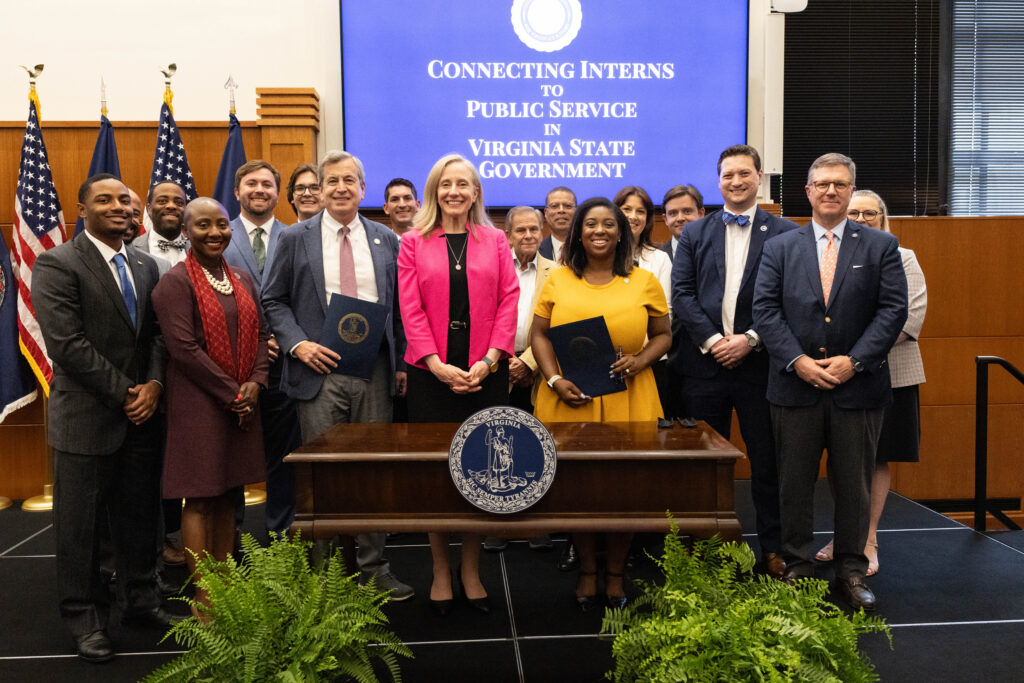
    Virginia Gov. Abigail Spanberger recently signed a law creating a Virginia State Internship coordinator position, designed to improve how students and recent graduates gain workforce experience through state agencies.

    In 2019, Virginia established the Innovative Internship Fund and Program to expand paid and credit-bearing internships statewide, reinforcing the commonwealth’s commitment to workforce development. The new role builds on that foundation, as does the Virginia Talent + Opportunity Partnership, which helps connect students and government agencies with these opportunities.

    Then in 2023, the Department of Human Resource Management, in partnership with the State Council of Higher Education in Virginia and V-TOP, created the COVA Internship Connection Pilot, which uses the V-TOP system to help agencies recruit interns.

    The COVA Internship Connection Pilot was designed to be a temporary, multi-agency initiative during and after the COVID pandemic, so students studying remotely could still find meaningful paid or unpaid, work-based learning through the state government.

    When Spanberger signed legislation carried by Sen. Lashrecse Aird, D-Henrico, and Del. Rip Sullivan, D-Fairfax, the pilot was transformed into a permanent, centrally managed program.

    “This is a great example of what the commonwealth can do to provide real-world opportunities for young, talented people entering the workforce,” Spanberger said in a statement on Friday. “Virginia is the top state for talent in America, and one of the most powerful tools we have is making sure talented students stay and grow right here in Virginia.”

    The legislation aims to centralize internship outreach, streamline application processes and provide agency support, making internships more visible and accessible to all students, including those from under-resourced schools and students with disabilities.

    The legislation strengthens data collection and program tracking to measure internship results and enhance Virginia’s long-term workforce development.

    “Internships are an essential opportunity to provide young people on-the-job experience and employers access to the workforce of the future,” Sullivan said in a statement. “As one of the largest employers in Virginia, it is imperative that the Virginia state government lead by example by expanding quality internships and attracting talent to support its vital mission.”

    As someone who started her public service with a state government internship, Aird said she knows firsthand how transformative such opportunities can be for young people. She cited Virginia’s aging public workforce as a driver of the new law that will help develop the next generation of public servants.

    “By strengthening and coordinating internship opportunities across state government, we can build a workforce that better reflects the communities it serves and ensure Virginia remains prepared to meet the challenges of tomorrow,” Aird said.

    Max Berckmueller, who graduated early from the College of William & Mary in 2023, credits his internships at multiple state agencies with helping him reach his goal of gaining real experience and making a tangible difference in his fellow Virginians’ lives.

    Now working as a data analyst with the Department of the Treasury, Berckmueller helps review monetary and budgetary matters for the state.

    “Conducting a budget or fiscal analysis, and seeing how the Department of Planning and Budget is taking that into account and changing their decisions based on the analysis that I did…that’s pretty cool,” Berckmueller said.

    “You might not get those kinds of opportunities at the federal government, but the state always needs a lot of help, and there’s always a lot to do,” he added.

    Spanberger also launched InternshipsVA, a statewide initiative to connect students with paid internships and strengthen Virginia’s workforce, as one of her first major economic development announcements at the start of her term. Recently, the program won a national Business Facilities 2026 Economic Development Organization (EDO) award.

    Funding for the new position is included in the House and Senate’s budget proposals, which lawmakers are working to reconcile and finalize ahead of a June 30 deadline. The position is estimated to cost annually $172,224.

  • Virginia Tech rector refuses to resign after Spanberger’s dismissal

    Virginia Tech rector refuses to resign after Spanberger’s dismissal

    Virginia Tech governing board member John Rocovich has refused to resign after Gov. Abigail Spanberger removed him last week after 16 years.

    Rocovich stated in a four-page letter addressed to the Secretary of the Commonwealth that he will not resign before his term ends on June 30, 2027. There was no sign of him at the board’s committee meetings on Monday in Blacksburg.

    Spanberger’s decision is the latest effort by her administration to shake up governing boards at Virginia’s colleges and universities, amid concerns within the higher education community about the politicization of public university governing bodies. She recently appointed four new members to Tech’s governing board.

    Governor fires Virginia Tech Rector Rocovich, appoints Dominion Energy’s Edward Baine as replacement

    Spanberger removed Rocovich, citing “misconduct” in a letter sent last Wednesday, but the letter did not specify the details of Rocovich’s alleged violations, only stating that the findings provided “sufficient cause” for his removal. Rocovich pushed back on that claim.

    “I was appointed to serve a term, I have served that term faithfully, and I intend to fulfill my obligations to the students, faculty, and people of Virginia who depend upon the proper governance of this great university,” Rocovich wrote. “Governor Spanberger’s letter failed to state my specific cause, as the law requires. I am confident she will find no such grounds.”

    Board member William Holtzman, who was appointed by former Gov. Glenn Youngkin and will complete his term next year, said he was “disappointed” with the governor’s decision.

    “I think all of us were disappointed because I think it’s a unanimous feeling of our group that he has done a phenomenal job, and I didn’t understand at all why she removed him, and I don’t think there was any cause for it,” Holzman said.

    Lawmakers have also urged the governor to explicitly state her reasons for the termination.

    Senate Republican Caucus Chair Mark Obenshain, R-Harrisonburg, said Rocovich deserves “fairness,” and emphasized that transparency is “not optional” concerning the governor’s decision to boot Rocovich from the board.

    “What makes this decision especially disappointing is that Governor Spanberger campaigned on a promise to depoliticize higher education governance and to reduce executive involvement in the affairs of Virginia’s universities,” Obenshain said in a statement on Friday. “Removing the sitting rector of Virginia Tech without publicly stating a lawful basis appears inconsistent with those commitments.”

    Edward Baine, executive vice president of utility operations and president of Dominion Energy Virginia, who was appointed to replace Rocovich, attended the first committee meeting on Monday.

    He did not comment on his appointment on Monday morning, but asked Provost Julie Ross about the university’s efforts to address enrollment, which the board expressed interest in growing.

    Rocovich’s dismissal followed the board’s vote to grant an exception allowing him to serve a third one-year term as rector during the search for Virginia Tech’s next president, following Tim Sands’s departure in April, Cardinal News reported last month.

    The board minutes noted that Rocovich was elected rector because no other nominees were available and he was willing to serve.

    A native of Roanoke and a Virginia Tech graduate, Rocovich founded a law firm and specializes in taxation as well as trusts and estates law. He served on the board of visitors from 1997 to 2005, was appointed for a term from 2010 to 2014, and was rector from 2002 to 2004.

    According to the Virginia Public Access Project, Rocovich has donated to several Republican campaigns and candidates, including formerRepublican gubernatorial nominee and Spanberger rival Winsome Earle-Sears.

    In his letter, Rocovich criticized the termination and the governor, expressing his “disappointment” with her use of a “subordinate“ to deliver the message, which he said was the opposite of the respect he showed Spanberger by calling her directly to discuss the board.

    “Virginia Tech deserves better than to be made a political football,” Rocovich wrote. “I have given too much of my life to this institution to stand by silently while its independence is threatened—regardless of which party holds the governor’s office.”

    The governor and attorney general’s offices did not immediately respond for comment on whether they will enforce the termination.

    The board’s committee meetings continued on Monday. The board will have a full meeting on Tuesday. The body will vote on a new rector and vice rector to replace Rocovich and Sandy Davis, who died on March 17.