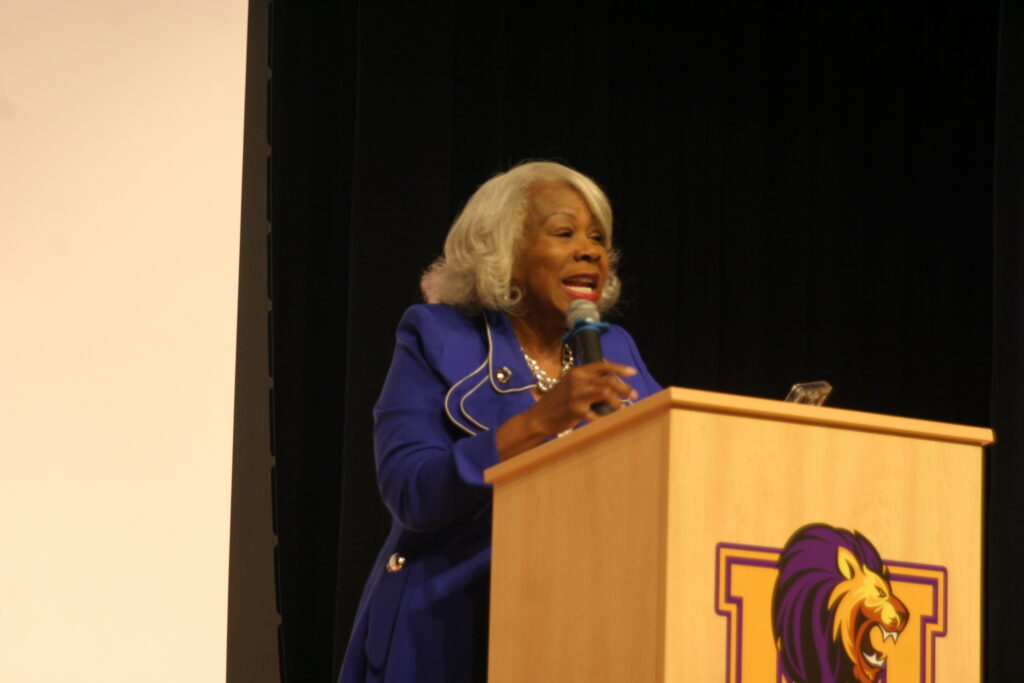
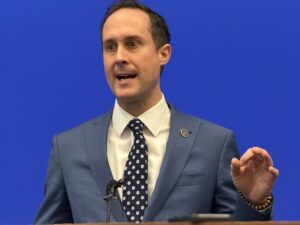
Sen. L. Louise Lucas, D-Portsmouth, speaks during a Chesterfield stop on her statewide listening tour about data centers. (Photo by Shannon Heckt/Virginia Mercury)
On Tuesday, the Virginia Senate released its latest budget proposal that preserves a sales and use tax exemption for the data center industry, the major hangup that has gummed up negotiations between both legislative chambers.
The revamped proposal also adds a tiered tax for the industry that targets diesel generators and would generate $1.8 billion for the state, Senate leaders said.
Sen. Louise Lucas, D-Portsmouth, has advocated to axe the exemption for months but amid stalled negotiations that risk a government shutdown if a budget isn’t finalized by June 30, the new proposal from her chamber signals willingness to compromise, with a sustained goal of regaining money the state misses out on due to the exemption.
“We know technology is not bad. You know, we all can benefit from technology, but we, as a government, have not done a good job in managing the regulations and the impact on our communities and that’s what we’ve got to rein in,” Lucas said Tuesday night at a middle school in Chesterfield at a stop on her data center listening tour.
The new Senate spending plan would levy a tiered impact tax on the types of backup generators that data centers use. The diesel generators have been a point of contention for residents who live near data centers due to heightened concerns over the air pollution released from the generators.
The older, Tier 1 and 2 model backup generators release the most pollution. A new state law requires all new data centers that apply for an air permit to use Tier 4 models, which, along with tier 3 models, are cleaner.
The Senate’s proposed data center tax would be distributed this way:
– $45.00 per permitted kilowatt electrical (kWe) on any Tier 1 and Tier 2 generator;
– $37.00 per permitted kWe on any Tier 2 backup generator retrofitted to be a Tier 4-
equivalent backup generator, Tier 3 generators, and any generator powered by natural gas
– $35.00 per permitted kWe on any Tier 4 generator or any other generator.
Each quarter, data centers would remit the fees to the Department of Taxation and deposited to the general fund.
The key term is “permitted.” Data centers rarely run their backup generators unless there is an emergency power outage or for short periods for monthly testing. But they are permitted for vastly larger amounts than their actual use – which would mean more tax revenue under this plan.
According to Senate finance committee officials, the new generator tax would bring in an estimated $1.8 billion over the biennium. This would be about half of what the state could make in tax revenue if the sales and use tax exemption for the industry was revoked.
The Senate plan, similar to the House, would create a workgroup to generate policy recommendations on how to phase out the sales tax exemption for the industry and present a report to the General Assembly in the fall.
When asked how this group’s report would differ from past reports, such as the 2024 JLARC study on data centers, Lucas said it won’t reveal more than what the state already knows about the impact of data centers across the commonwealth.
“I don’t expect that there’s going to be anything new coming out of it. I actually think it’s a waste of time. But since they want to do it, we will accommodate them,” Lucas said Tuesday.
Lucas said that the House and Senate conferees planned to meet late into the night on Tuesday to work out a deal.
House Speaker Don Scott, D-Portsmouth, cancelled the chamber’s special session on the budget that had been scheduled for Thursday in Richmond, since a deal with the Senate has not been finalized.
Lucas said that the goal for budget conferees of both bodies is to have a deal in place before the Senate is slated to return to the Capitol on Monday.
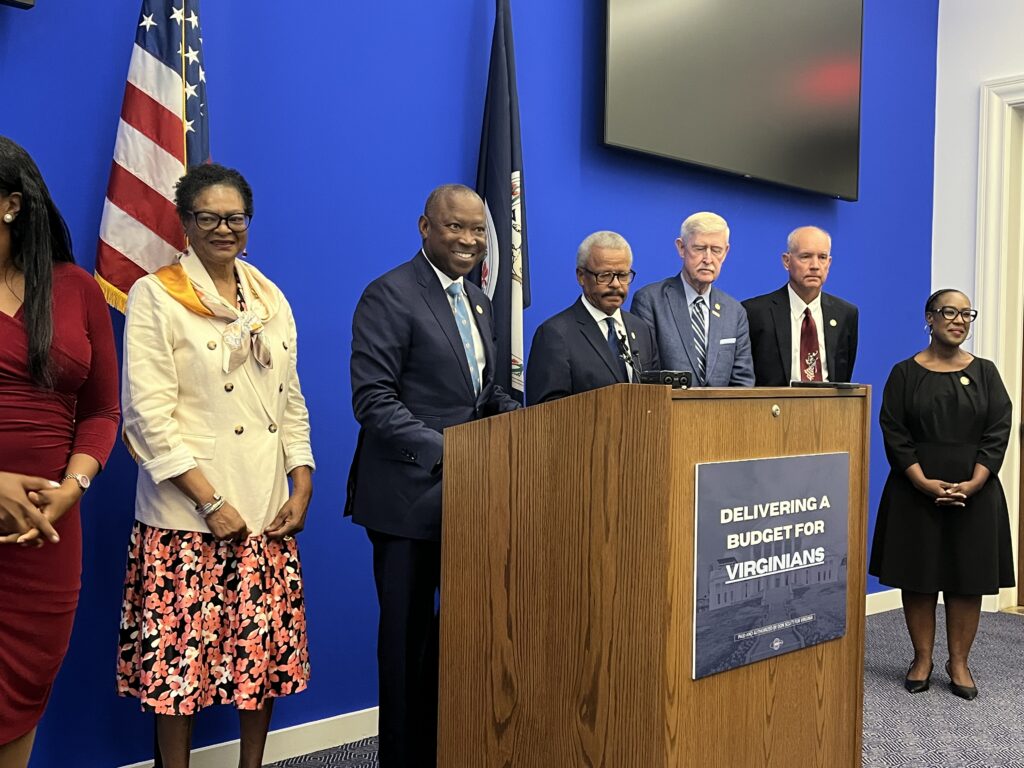
Speaker of the House Don Scott, D-Portsmouth, presents the chamber's latest budget proposal on June 12, 2026 in downtown Richmond. (Photo by Shannon Heckt/Virginia Mercury)
Speaker of the House of Delegates Don Scott, flanked by Appropriations Chair Del. Luke Torian, D-Prince William, and other bipartisan house members, unveiled the chamber’s latest budget proposal in Richmond on Friday, which they framed as a “compromise package” that they urged the state Senate to accept.
The updated spending plan no longer includes environmental standards data centers would need to meet in order to be exempted from the state’s sales and use tax, an issue that has stalled budget negotiations for weeks and sparked speculation about a government shutdown if the parties can’t finalize the budget by June 30.
“This budget comes through for Virginians in a real and meaningful way without introducing a single new tax,” Torian said in a statement. “It anticipates future federal funding cuts by establishing a reserve – so when Washington turns its back again on Virginians we are prepared to step in.”
The dueling House and Senate budget proposals differ over whether data centers should continue to be exempt from the state’s 5.3% sales and use tax. State data shows the industry saves about $1.6 billion annually through the exemption, money Senate lawmakers say the state should recoup by ending the tax break.
Data centers have to routinely upgrade and replace pricey computer equipment, which is the bulk of where they save with the exemption.
The new House proposal removes the previous measures that would have mandated developers limit data centers from co-locating with power facilities that emit carbon emissions.
The previous proposal also outlined energy efficiency requirements for the digital warehouses, including using newer backup generator models that emit less carbon.
The new House budget instead proposes creating a commission of stakeholders and lawmakers to study the impacts and benefits of the data center industry in Virginia.
The commission would be required to report to the General Assembly by Nov. 1 on ways to ensure energy demands don’t put extra costs onto residential utility customers. The commission would also scrutinize local tax revenue impacts and “other ways to generate revenue from the industry”.
“(It will be a) full investigation into energy costs, financial impacts, air quality, water conservation, renewable energy, and community impacts,” Scott said, “So the 2027 General Assembly can pass real national reform. Or if the governor would like, we could come back right after that report … for a special session.”
Scott has staunchly supported preserving data centers’ exemption, he said, because of the local tax revenue the centers generate and the union jobs that come with the construction of the facilities.
Gov. Abigail Spanberger has also publicly supported keeping the exemption, saying the state should “honor its commitments” to businesses that have located in the commonwealth. She praised the updated House budget on Friday.
“This proposal creates a clear roadmap for evaluating the impact of the data center industry in Virginia and for reassessing the state’s incentives into the future, with a focus on fairness to ratepayers and the needs of local communities,” Spanberger said in a statement.
Senate members’ response to the updated House budget was unclear Friday afternoon, with no comment from Finance Chairwoman Sen. Louise Lucas, D-Portsmouth.
Lucas has been adamant about ending the tax exemption for data centers since the Senate spending plan was introduced earlier this year.
“I want (the money) to go towards hard working families. We’ve got people who are struggling to put food on the table, to put a roof over their heads, pay for their car payment, their kids school. I want that money to go back to them,” Lucas said then.
The House is slated to return to Richmond to debate this proposal on June 18, while the Senate, who has not yet released an updated budget proposal, will return on June 22. If a budget is not passed by the end of the month, state services and employee pay will be interrupted.
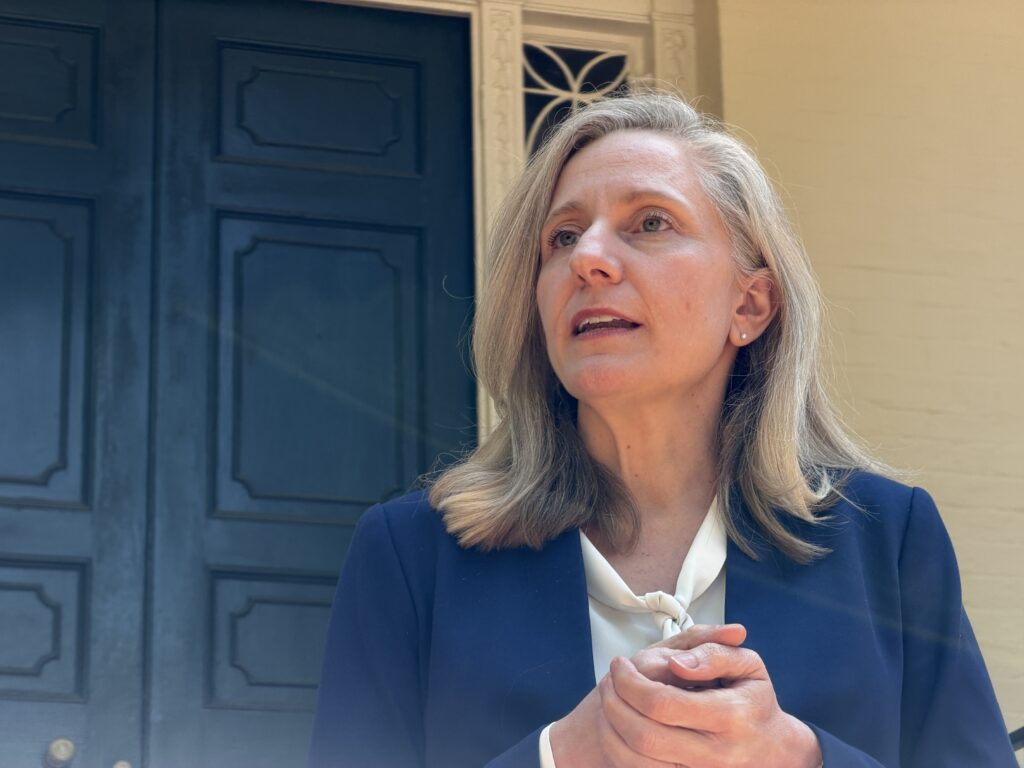
Virginia Gov. Abigail Spanberger stands outside the Executive Mansion in Richmond as her administration faces growing tensions with some fellow Democrats over a series of high-profile vetoes and amendments to major legislation. (Photo by Markus Schmidt/Virginia Mercury)
Virginia Democrats spent years waiting for unified control of state government after an unprecedented string of bruising vetoes under Republican Gov. Glenn Youngkin.
But nearly six months into Gov. Abigail Spanberger’s four-year term, some Democratic lawmakers and progressive allies say the former congresswoman is governing less like the leader of a blue-state trifecta and more like the cautious centrist Virginians elected to Congress eight years ago.
The pushback has exposed ideological and procedural tensions inside Virginia’s Democratic Party at a moment when lawmakers had hoped to capitalize on full control of Richmond after years of divided government.
Spanberger, however, rejects the idea that her vetoes reflect dysfunction or political drift.
“As I view it, I’m doing my job,” Spanberger said during a lengthy interview with The Mercury at her office at the Patrick Henry Building in Richmond Thursday. “The General Assembly passes bills, the governor has the responsibility to amend, sign, or veto.”
The governor argued that Democrats entered the 2026 legislative session with what she described as “some sort of pent-up interest” after four years of Youngkin, noting that she has signed more than 100 bills previously vetoed by her Republican predecessor.
“My focus is on implementation,” Spanberger said. “Especially some of the larger bills that need to be implemented and people will feel or see if they are not implemented well. That is on my administration.”
Tensions emerge inside Democratic trifecta
The friction has become increasingly public in recent weeks.
Labor groups blasted Spanberger after she vetoed collective bargaining legislation backed heavily by unions. Progressive lawmakers privately complained that the governor’s office failed to engage during the legislative session, only to unveil sweeping substitute proposals after bills had already reached her desk.
Sen. Louise Lucas, D-Portsmouth, the Senate’s president pro tempore, continues to air her frustration with the governor on social media.
And Senate Majority Leader Scott Surovell, one of the chamber’s most vocal lawmakers, said Spanberger’s approach differs significantly from the four prior governors he has worked with since he was first elected to public office.
“In the 17 years I’ve served, governors just tend to leave the details of a bill to the legislature,” Surovell said in a recent phone interview. “And if they have issues with details, they’re usually raised during session.”
But this year, he said, lawmakers were often presented with late-stage substitute proposals that fundamentally rewrote legislation without time for enough public debate or negotiation.
“It’s hard to work with a governor’s office that has opinions when they don’t share them before they act, or they don’t share them during the legislative process,” Surovell said. “Governor Spanberger’s proposals were serious policy proposals, but they were made about two months too late.”
The criticism reflects a growing complaint among some Democrats that Spanberger, who served three terms in Congress before winning the governorship last year, brought a more executive-driven style to Richmond that clashes with the relationship-heavy culture of the Virginia legislature.
In a strongly-worded resolution, the Virginia AFL-CIO accused Spanberger of abandoning campaign commitments after she vetoed the collective bargaining proposal for public employees.
The labor federation said Spanberger campaigned on ending what it called a “historic injustice” and noted that unions had agreed to changes requested by her administration during negotiations over the bill.
The resolution said the governor later offered a substitute measure containing “poison-pill terms” before ultimately rejecting it, which they framed as Spanberger choosing “to betray her commitment and vetoing the legislation.”
Spanberger, who said she supported the core idea of the proposal, dismissed suggestions that the criticism reflects a wider collapse in Democratic support.
“Here’s a place where I will say, there’s a backlash among some organized groups and advocates, and then there’s the opinions of people and communities,” she said in the interview.
Spanberger said local governments raised concerns about the cost and complexity of implementing collective bargaining systems, particularly in smaller jurisdictions.
“Those concerns were significant,” she said. “People can react to their anger or their disappointment in me as they choose, but I’m going to do what I think is right.”
Virginia Senate Majority Leader Scott Surovell, D-Fairfax, has emerged as one of the most vocal Democratic critics of Gov. Abigail Spanberger’s approach to vetoes and late-stage amendments during her first months in office. (Photo by Nathaniel Cline/Virginia Mercury)
Governor defends cannabis veto
Spanberger’s veto of legislation establishing a legal cannabis retail market by early next year became another major source of tension.
Virginia legalized adult possession of marijuana in 2021 but never created a legal framework for commercial sales, leaving the state in what many lawmakers have described as a legal gray area.
Spanberger said she supports eventually creating a regulated market and called the current system “not optimal.” But she argued the legislation moved too quickly and did not give regulators enough time to build enforcement systems.
“There’s not enough time to stand up the CCA,” she said, referring to the Virginia Cannabis Control Authority. “There’s not enough time to train law enforcement under the CCA. There’s not enough time to get their regulations for the licenses in place.”
She also defended her decision to veto the bill and revisit changes at a later time. Conversations between her administrations and lawmakers to wrap a revised measure into the state budget are currently underway.
“I did have people say, why not just sign it and we’ll fix it later?” Spanberger said. “To which I said, I sent back a list of all the things I wanted to fix, but you didn’t vote them up or down.”
Surovell said lawmakers were alarmed by portions of the governor’s substitute proposal, including felony penalties tied to marijuana transportation offenses.
Spanberger’s proposed substitute, he said, had a Class 2 felony for carrying 50 pounds of marijuana over the state line.
“I don’t think I’ve ever voted for a Class 2 felony in 17 years,” he said.
Spanberger also vetoed or amended several immigration-related measures tied to federal Immigration and Customs Enforcement, drawing criticism from several top Democrats and immigrant-rights advocates.
The intra-party clashes have revived an old debate inside Virginia Democratic politics about how progressive statewide Democrats can afford to be.
“Virginia Democrats are continuing to struggle with a question of identity,” Steven Farnsworth, a political scientist at the University of Mary Washington, said. “How conservative or how moderate do you have to be to win a statewide election is a question that has bedeviled Virginia lawmakers since the days of (former Governor) Chuck Robb.”
Farnsworth noted that Spanberger campaigned and served in Congress as a centrist Democrat.
“If Virginia liberal Democrats were unhappy with that record, then why was the governor unopposed in the Democratic primary last year?” he said.
The governor’s approval ratings have also slipped since her election victory last November. A Washington Post-Schar School poll released in April found 47% of Virginia voters approved of her performance while 46% disapproved.
While she eventually backed the effort, some Democratic activists criticized what they viewed as a lukewarm embrace of a proposal designed to help Democrats pick up U.S. House seats in the 2026 midterms.
Farnsworth said Spanberger appears to be caught between different audiences.
“The governor’s current battle is really to persuade Virginians to support her over the Democratic majority of the Senate,” he said.
Still, Farnsworth said tensions between governors and legislatures are hardly unique.
“The first year for every new governor tends to be a rough one,” he said. “Even if members of the same party hold all the key positions of power, there are still significant differences of opinion between what the governor wants and what the legislature wants.”
Sen. Schuyler VanValkenburg, D-Henrico, one of the state Senate’s more liberal members, said lawmakers still accomplished major priorities this year despite disagreements with the governor.
“I think we had an incredibly productive session, the most productive session we’ve had in four years,” VanValkenburg said in a recent interview.
He acknowledged frustration over some vetoes but argued the broader picture remains positive.
“Every time a governor comes in, there’s growing pains, people have to feel each other out,” he said. “We’re going to get those other things done. Maybe it’s not all going to be this year, but this happens every four years.”
Virginia state Sen. Schuyler VanValkenburg, D-Henrico, said disagreements between Gov. Abigail Spanberger and Democratic lawmakers are part of the adjustment period that often comes with a new administration and legislature. (Photo by Markus Schmidt/Virginia Mercury)
Budget battle is governor’s, legislature’s next test
Spanberger and lawmakers are facing another looming challenge: a budget stalemate tied largely to disagreements over when Virginia should scale back tax incentives for data centers.
Democratic lawmakers are expected to return to Richmond in the coming weeks and pass a new biennial spending plan before the June 30 deadline to avoid a government shutdown.
Farnsworth said the budget fight may ultimately force both sides toward compromise.
“The idea of an impasse lasting past June 30 would be very unappealing for all Democrats,” he said.
For now, Spanberger insists her ties with her party remain intact despite the public criticism.
“I don’t think it’s in a difficult place, I think it’s in a strong place,” she said of her relationship with legislative Democrats.
“But a legislator who might think that I was going to come in and do everything they wanted me to do is probably not happy with the fact that I’m an executive who takes my role very seriously.”
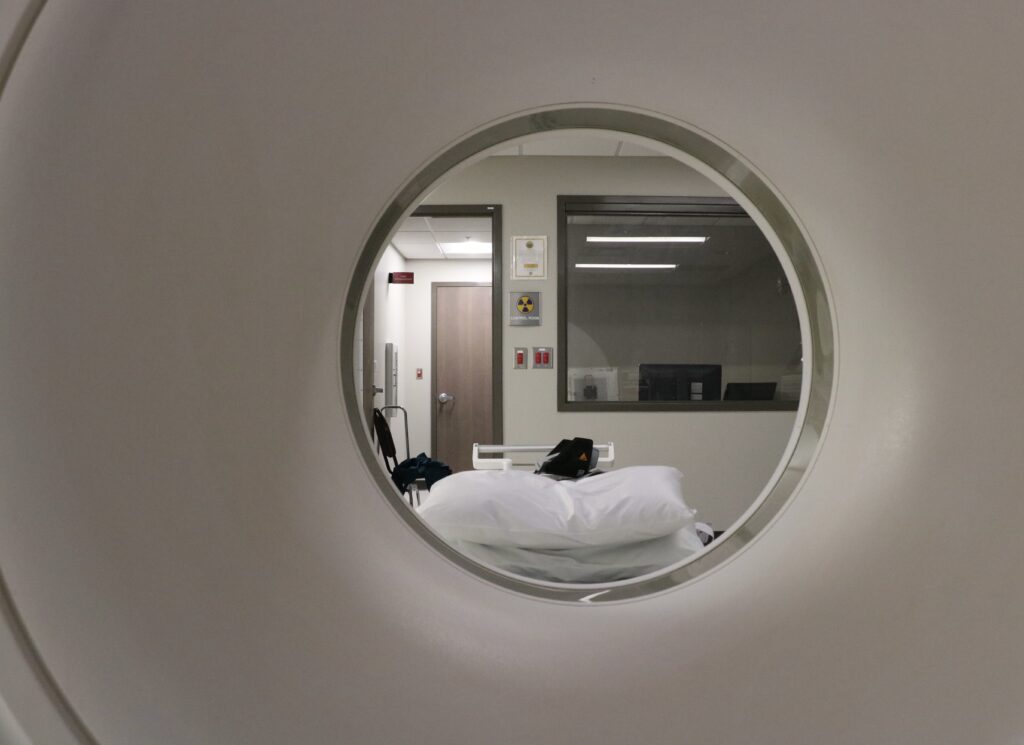
An MRI machine in Lee County Community Hospital in Southwest Virginia, a once-shuttered facility that Ballad Health reopened in 2021. (Photo by Charlotte Rene Woods/Virginia Mercury)
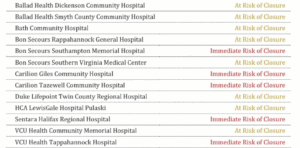
A new report by Virginia’s Joint Commission on Health Care found 13 of Virginia’s 36 rural hospitals are at distant or immediate risk of closure, as state lawmakers and their constituents work to close healthcare access gaps in the commonwealth’s farthest-flung regions.
The commission based its analysis on patients’ socioeconomic demographics and insurance types as well as hospitals’ financial information to determine risk levels for closure.
King William resident Celeste Garrett’s go-to facility, VCU Health Tappahannock Hospital, is on the list. It takes her about 20 minutes to get there and she worries about an emergency if it were to close. That would make VCU’s Richmond location her closest resource, an hour or more away “depending on the traffic.”
“Minutes matter. Seconds matter,” Franklin County resident Penny Blue said as she joined Garrett on a press call with the state’s health committee chairs Tuesday.
After a brain aneurysm in 2021, Blue was taken 15 minutes to her nearest hospital and then air-lifted to another one in Roanoke (which otherwise would have been an hour commute).
With rural hospitals already shoring up access in Southwest and South Side Virginia, the women expressed concern about themselves and their neighbors.
Some hospitals’ struggles can be traced back years and include demographics and economic regional shifts. But, the current strains are attributed to recent Medicare and Medicaid reimbursement rate cuts, a reconciliation bill Congress passed last summer that makes thousands of Virginians vulnerable to losing health insurance, and Congress’ failure to renew expired Affordable Care Act credits.
Screenshot from a June 2026 Virginia Joint Commission on Health Care presentation.
“(Rural hospitals) have always been living on the edge, but with H.R. 1 kicking in our hospitals across Virginia will lose about $2 billion dollars a year,” said Sen. Barbara Favola, D-Arlington, who chairs the Senate’s Education and Health Committee.
Uninsured people are more likely to delay care until dire situations, so hospital ERs are bracing for surges of patients. Free clinics, long considered public health safety nets, are also preparing for people to rely on them more.
“We have yet to feel the pain (of the bill) but it’s coming,” King William resident Garrett said on Tuesday’s call.
After absorbing unpaid or under-paid care from uninsured patients, health systems will eventually negotiate insurance rates with private insurers. This may lead to higher premiums for people with private insurance down the line, health systems have warned.
Sentara chief administrative operator Aubrey Layne said in a recent phone call that the hospital chain has become “more purposeful lately about getting the public to understand” the challenges.
That chain has facilities around the state, with its Sentara Halifax Regional Hospital on the new at-risk list.
Still, Virginia Hospital and Healthcare Association spokesman Julian Walker said hospitals will continue to adapt rather than close overnight or forever.
“We will see what other measures might have to be taken to continue to sustain hospitals longterm,” he said.
Those efforts are already playing out in some cases. Citing Congress’ bill as a contributing factor, Valley Health changed staffing contracts and trimmed services this spring. Last winter, Centra closed its labor and delivery unit at a hospital in Farmville. Last fall, Shenandoah Valley’s Augusta Health closed three clinics.
House Health and Human Services chair Del. Rodney Willett, D-Henrico, emphasized that the federal government placed heavy burdens on state and local governments, calling it a “situation no one wants to be in.”
The state’s pending budget has proposals to help the state comply with additional requirements for Medicaid and Supplemental Nutrition Assistance Program verifications and could support a state-level ACA subsidy to plug some holes.
Favola and Willett said the efforts cannot fully heal what federal actions have created but are a reflection of bipartisan assistance.
As both lawmakers have served on bipartisan health-focused committees and commissions, Willett said Congressional Republicans should be held accountable for pushing through the reconciliation bill but that going forward, both parties will have to work together to create lasting solutions.
“This report is a nonpartisan report done by the joint commission, we all sit on that — Republicans and Democrats,” Willett said. “The facts are the facts and what’s being done to us by Washington is unconscionable.”
The Virginia General Assembly Building stands in Capitol Square in Richmond. Virginia lawmakers are expected to return later this month to continue negotiations on the state budget ahead of the June 30 fiscal deadline. (Photo by Markus Schmidt/Virginia Mercury)
Virginia’s revenue outlook has improved by $1.5 billion over the next three fiscal years, giving lawmakers more breathing room as negotiations over a stalled state budget are set to continue in Richmond later this month.
Gov. Abigail Spanberger on Monday afternoon released the updated revenue forecast she ordered last month, telling top legislative budget writers that Virginia is projected to collect substantially more General Fund revenue through fiscal year 2028 than previously expected.
The revised forecast projects revenues for fiscal year 2026 will exceed the official estimate by $585.5 million. Another $922.6 million in General Fund revenue is projected for fiscal years 2027 and 2028, including $582.4 million in 2027 and $340.2 million in 2028.
The new projections arrive while lawmakers remain stuck in negotiations over Virginia’s next two-year budget, with disagreements over data center tax incentives and spending priorities continuing to hold up a final deal.
In a letter to Sen. Louise Lucas, D-Portsmouth, and Del. Luke Torian, D-Prince William — the chairs of the legislature’s money committees — Spanberger said lawmakers need updated economic information as they work toward a budget deal.
“As General Assembly leadership and budget conferees continue their important work, it is critical they have the most current and accurate information available,” Spanberger said in a statement.
“While forecasted General Fund revenues have increased, I remain concerned by rising national economic instability, the ongoing conflict in Iran, and the continued impacts of federal workforce cuts. We must account for these evolving economic conditions as we plan for the long-term strength of our commonwealth.”
The updated forecast arrives as lawmakers prepare to return to Richmond later this month for another attempt to break the budget impasse before the start of the new fiscal year.
The House is scheduled to reconvene its special session June 18, followed by the Senate on June 22, as budget conferees continue working toward a compromise spending plan that can pass both chambers and reach Spanberger’s desk before the June 30 deadline.
The revised forecast reflects strong tax collections even as parts of Virginia’s economy show signs of slowing.
General Fund revenues have grown 7.3% on a fiscal year-to-date basis and are running 3.3% ahead of forecast. Virginia is currently $851 million ahead of expectations, though nearly 70% of that amount — about $578 million — comes from nonwithheld income tax payments and individual refunds, two of the state’s most volatile revenue categories.
Virginia Secretary of Finance Mark Sickles said the revised forecast attempts to balance the state’s recent revenue growth against growing uncertainty in the national economy.
“The updated forecast confirms that the commonwealth’s revenue performance remains solid but also factors in the deteriorating economic conditions and increased uncertainty in the national outlook,” Sickles said in a statement.
“The additional $1.5 billion in updated projected revenues should provide the General Assembly with enough resources to craft a structurally balanced budget that mitigates any potential risks related to national market volatility.”
The updated forecast follows warnings from state finance officials last month that Virginia’s economy is facing slower job growth, persistent inflation and weakening consumer confidence even as tax revenues continue to exceed expectations.
During a May presentation of the Senate Finance & Appropriations Committee, Sickles said Virginia had lost 41,900 jobs since the beginning of fiscal year 2026 while General Fund revenues remained more than $850 million ahead of forecast.
At the time, Sickles suggested the surplus could help lawmakers move past the budget stalemate.
“It would not be unprecedented for us to use some of this money to get past this impasse, if we needed to,” Sickles told the committee.
Spanberger ordered the updated forecast May 19 while budget negotiations remained unsolved. The revised projections extend through fiscal year 2031 and are intended to give lawmakers updated economic data before final spending decisions are made.
The prolonged budget standoff has raised concerns about whether lawmakers will finish work on a revised spending plan before the new fiscal year begins July 1.
Lawmakers adjourned a special session in April without an agreement. Disputes over data center tax incentives, transportation funding and competing priorities between the Democratic-controlled House and Senate have remained major obstacles.
The stronger revenue forecast could give negotiators additional flexibility on spending priorities including education, transportation, healthcare and state employee compensation. But administration officials cautioned that economic risks remain.
Federal workforce reductions continue weighing heavily on Northern Virginia and Hampton Roads, both of which have large concentrations of federal employees and contractors. State officials have also pointed to instability in financial markets and international tensions as possible threats to future economic growth.
Even with revenues ahead of forecast, Virginia officials have repeatedly noted that much of the current surplus comes from revenue streams that can fluctuate significantly from year to year.
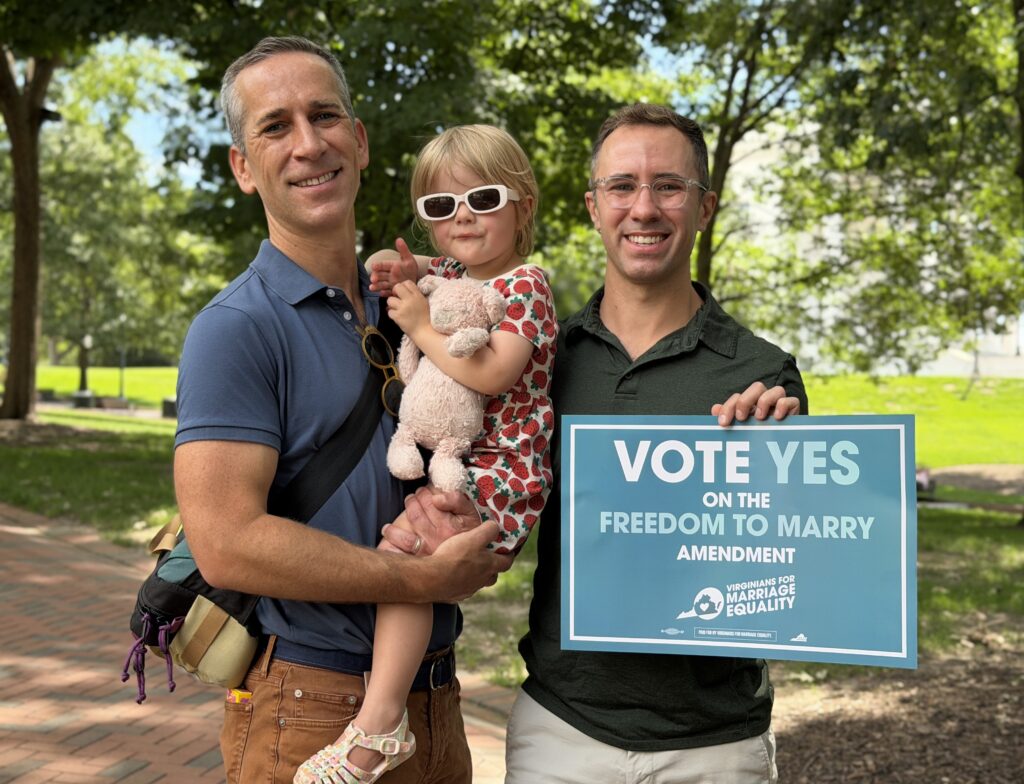
Blake McDonald (left) and Chad Stewart pose with their daughter, Flora, during the launch of the Virginians for Marriage Equality campaign near the Bell Tower in Richmond’s Capitol Square on Monday, the start of LGBTQ Pride Month. The campaign supports a constitutional amendment referendum that would permanently protect same-sex marriage in Virginia’s constitution. (Photo by Markus Schmidt/Virginia Mercury)
Chad Stewart and Blake McDonald met in college in 2007 and began dating two years later, eventually building a life together in Richmond after settling in Virginia more than a decade ago.
By 2015, the couple married — just one week before the U.S. Supreme Court’s landmark Obergefell v. Hodges decision legalized same-sex marriage nationwide.
“We didn’t want to have to think about politics or court cases,” McDonald said Monday outside the Bell Tower in Richmond’s Capitol Square. “We just wanted to dream about the future we’re going to build together.”
The couple spoke as Virginians for Marriage Equality formally launched its statewide campaign to pass a constitutional amendment referendum in November that would permanently protect same-sex marriage in the Virginia Constitution.
The coalition gathered at the start of LGBTQ Pride Month to rally support for the amendment, which would repeal Virginia’s dormant constitutional ban on same-sex marriage and replace it with language requiring the commonwealth to recognize all marriages, regardless of sex, gender or race.
Advocates say the amendment is needed in case federal protections for same-sex marriage are ever overturned.
Concerns intensified after the U.S. Supreme Court overturned Dobbs vs. Jackson Women’s Health Organization in 2022 and Justice Clarence Thomas later suggested the court should reconsider other rulings involving privacy and due process rights, including same-sex marriage protections.
Over time, Stewart said, the future he and McDonald imagined together in Virginia expanded beyond the two of them. During the pandemic, they began the adoption process. In 2023, they received a call, giving them just 16 hours notice before bringing home their daughter, Flora.
“And so now our life is daycare drop offs, bedtime routines, holidays together, play dates with neighbors, and our daughter proudly calling the people down the street family, too,” Stewart said.
From Marshall-Newman to Obergefell
Virginia’s fight over marriage equality has spanned two decades, from one of the country’s strictest constitutional bans to this year’s referendum effort to permanently protect those marriages in state law.
Voters approved the Marshall-Newman amendment in 2006 after legislation introduced by then-Del. Bob Marshall, R-Manassass, and then-Sen. Steve Newman, R-Bedford County.
The amendment defined marriage exclusively as a union between “one man and one woman” and barred the state from recognizing same-sex relationships or similar legal arrangements.
Roughly 57% of voters backed the amendment at the time.
A federal judge struck down Virginia’s ban in 2014, and the 4th U.S. Circuit Court of Appeals later upheld the ruling. When the U.S. Supreme Court declined to hear Virginia’s appeal later that year, same-sex marriages began statewide.
The following year, the high court’s Obergefell ruling established a nationwide constitutional right to same-sex marriage under the 14th Amendment’s guarantees of due process and equal protection. Although the decision invalidated Virginia’s constitutional ban, the language itself remained in the state constitution.
The amendment before voters in the 2026 midterm elections passed the General Assembly in 2025 and again during the 2026 legislative session, satisfying the constitutional requirement that amendments pass in two separately elected legislatures before reaching the ballot.
If approved by voters this fall, the amendment would repeal the Marshall-Newman language and replace it with protections requiring Virginia to recognize marriages regardless of sex, gender or race.
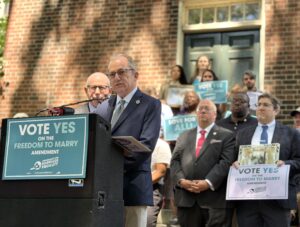
Former state senator Adam Ebbin speaks during the launch of the Virginians for Marriage Equality campaign in Richmond Monday. (Photo by Markus Schmidt/Virginia Mercury)
‘Dignity, respect, and equal treatment under the law’
In Richmond Monday, several speakers described the referendum as the culmination of decades of legislative efforts and legal battles.
Former state senator Adam Ebbin, a Democrat from Alexandria and the first openly gay legislator elected to Virginia’s General Assembly in 2003, recalled watching lawmakers approve the constitutional ban more than 20 years ago.
“For Mark and me, today is deeply personal,” Ebbin said, referring to Virginia Secretary of Finance Mark Sickles, another openly gay former lawmaker standing next to him.
“Twenty years ago, we stood in the General Assembly and watched Virginia write discrimination into its constitution. We argued against it, we voted against it, and for 20 years, we worked to undo that mistake.”
Ebbin said same-sex couples across Virginia have spent more than a decade building families while the constitutional ban remained written into state law.
“Back in 2006, Virginians were told that marriage equality would somehow threaten our community,” Ebbin said. “But today, for more than a decade, same-sex couples have been building marriages, raising children, buying homes, and growing all together across the commonwealth.”
Sickles said public attitudes shifted over time as LGBTQ Virginians became more visible in communities and families across the state.
“People keep organizing,” Sickles said. “Families kept showing up. Virginia has changed because people got to know their neighbors, their coworkers, their friends, their siblings, their children more fully.”
Narissa Rahaman, executive director of Equality Virginia and a committee member of Virginians for Marriage Equality, described the campaign as centered on dignity, family and personal freedom.
“This November, Virginians have the opportunity to protect the Freedom to marry and affirm what so many of us already know,” Rahaman said. “Every Virginia family deserves dignity, respect, and equal treatment under the law.”
Rahaman referred to her marriage to her wife, Brianna, as “a million little decisions and a million little moments” built around love, commitment and stability.
“No family in Virginia should have to wonder whether their rights will be protected tomorrow,” she said.
Marshall, the sponsor of Virginia’s 2006 same-sex marriage ban, declined to comment when reached by phone Monday.
But the political landscape around the issue has since shifted dramatically. In 2024, then-Gov. Glenn Youngkin, a Republican, signed legislation sponsored by Democratic lawmakers aimed at ensuring same-sex marriage would remain legal in Virginia regardless of future federal court decisions.
Still, Youngkin’s office at the time emphasized provisions protecting religious liberties, including language allowing clergy members and religious organizations to decline to perform same-sex weddings.
Campaign heads into election season
Organizers said they plan to spend the coming months traveling across Virginia to build support ahead of the November elections.
Alexandria Democrat Del. Kirk McPike, who is also campaign co-chair, said marriage equality advocates will engage voters in communities statewide in the coming months.
“My own husband, Jason, and I have built a life together here in Virginia, just like thousands of other couples and families across the commonwealth,” McPike said. “Every Virginian has a place in this campaign and a place in this commonwealth.”
Mary Bauer, executive director of the American Civil Liberties Union of Virginia, tied the amendment effort to Virginia’s broader civil rights history, including the 1967 U.S. Supreme Court decision in Loving v. Virginia, which struck down interracial marriage bans.
“This amendment is about making clear that the government has no business deciding which marriages or which families are worthy of recognition,” Bauer said.
For Stewart and McDonald, the constitutional debate ultimately comes back to protecting and honoring their union.
“When you build a family like that, legal recognition stops feeling abstract very quickly,” Stewart said. “Marriage equality is what allows families like ours to navigate healthcare, school enrollment, parenting, and all the ordinary parts of life that come with making a home together.”
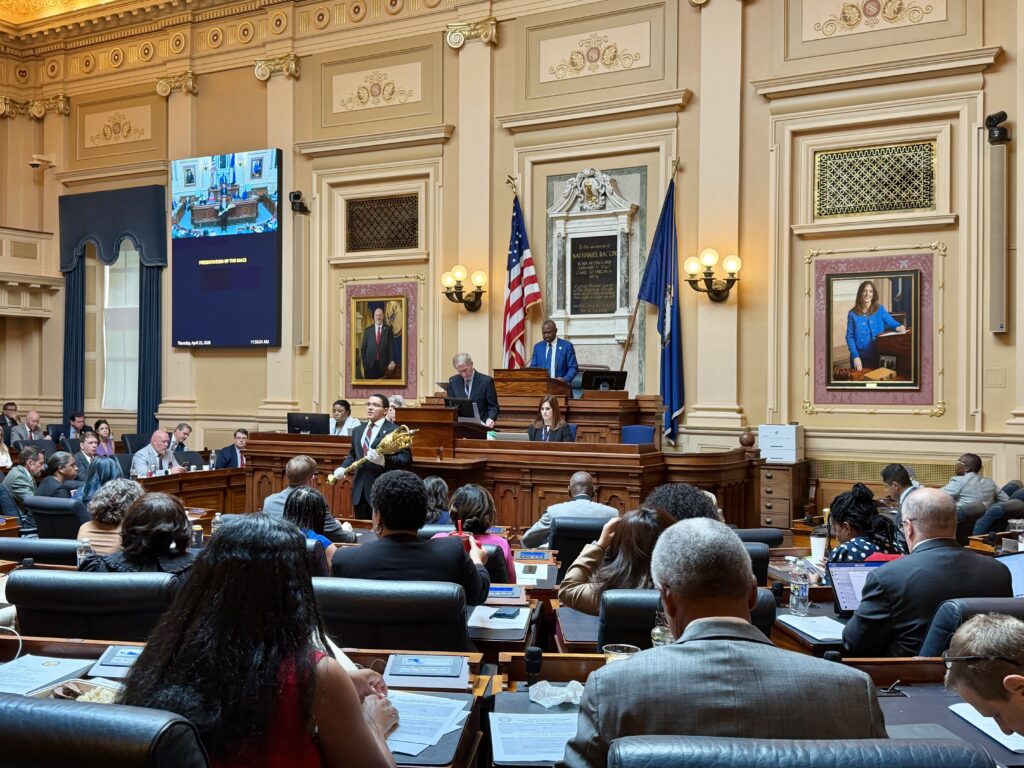
The Virginia House chamber during a special session at the Capitol in Richmond last month. Lawmakers adjourned without reaching agreement on the state's biennial budget, leaving negotiations unresolved ahead of a planned June return to Richmond. (Photo by Markus Schmidt/Virginia Mercury)
Virginia lawmakers are set to return to Richmond this month for another attempt to reach a budget deal, with just days until the start of the new fiscal year and no agreement yet on the state’s next two-year spending plan.
The House of Delegates is scheduled to reconvene its special session June 18 at 10 a.m., followed by the Senate on June 22 at noon, as negotiators continue working toward a compromise budget that can pass both chambers and reach Gov. Abigail Spanberger’s desk before the June 30 deadline.
Failure to enact a budget before the new fiscal year begins would result in a government shutdown, creating fiscal uncertainty for state agencies, local governments and school divisions that depend on state funding. Spanberger has repeatedly warned against allowing negotiations to extend beyond the deadline.
“It’s absolutely unacceptable if the General Assembly would allow for the state to go past July 1,” she told Cardinal News last month.
Lawmakers have remained at an impasse since the regular 2026 General Assembly session ended without a budget, despite Democrats controlling both chambers of the legislature. A special session in April also ended without a deal.
The biggest sticking point is a Senate-backed proposal to begin phasing out the state’s sales and use tax exemption for data centers before it expires nine years from now.
Senate Finance and Appropriations Committee Chair Louise Lucas, D-Portsmouth, has argued the fast-growing industry places increasing demands on Virginia’s electrical grid and water resources while producing relatively few long-term jobs.
Spanberger and House Democrats have opposed ending the incentive prematurely, arguing it could damage Virginia’s reputation with businesses and discourage future investment.
The tax exemption was approved in 2008 and is authorized through 2035. Lawmakers originally estimated it would reduce state revenue by about $1.5 million annually. Today, its value is estimated at nearly $2 billion a year, as Virginia has become the world’s largest data center market.
Spanberger said she is open to discussions about what happens after 2035.
“There are efforts afoot in the General Assembly, as it relates to the budget, to ensure that data centers are paying their fair share, as I think everyone broadly agrees is necessary,” Spanberger said in mid-April. ”And so that will continue to play out in those negotiations.”
But the governor said she opposes changing the policy before the exemption lapses.
“If Virginia were to take an adversarial stance towards any particular industry, it sends the wrong signal broadly, and we’re already seeing it with the decision to move away from the tax abatement,” she told Cardinal News in an interview published last week.
“It is the absolute prerogative of the General Assembly to look towards the future and to have conversations about incentives they do or do not want to give into the future.”
She also warned that ending the incentive early could invite legal challenges.
“As governor, I’m not going to break a contract that the state has signed — one, because who’s going to fund those lawsuits when we have to defend ourselves from broken contracts?” Spanberger said.
The dispute has put the governor at odds with Lucas, one of the Senate’s most powerful members.
In a series of posts Wednesday on X, formerly Twitter, Lucas blamed the administration and House Democrats for the continued stalemate.
“The Governor and the House are the ones that are gambling with our future by allowing the data centers to expand without concern for power, water, or paying their fair share of taxes,” Lucas wrote.
“The Governor should be honest and tell the public what she won’t do — she won’t tax billion dollar corporations to provide long term revenue to help pay for K12 and public safety and to backfill the federal cuts from Trump.”
“That’s the budget hold up!! Once again, the Governor is wrong on the policy and knows Virginians will cook her if there is a government shutdown.”
Lucas has repeatedly defended the Senate proposal during budget discussions.
At a Senate Finance Committee meeting in May, she argued the state should not continue providing the incentive without additional policy changes.
“Data centers will employ very few permanent jobs for a sizable tax giveaway,” Lucas said.
“This is imperative to encourage responsible growth in the commonwealth to protect our electric grid and natural resources, while also ensuring hard working Virginians are not asked to pick up higher utility costs to fund a higher share of our existing core services,” she added.
Despite the disagreement, Lucas said at the time that she expects lawmakers to reach a deal before the new fiscal year begins.
“Virginia will have a budget by June 30,” she said. “We will have to get this right for Virginians.”
Meanwhile, state officials are preparing updated financial projections to aid negotiations.
Earlier this month, Spanberger directed state finance officials to roll out a revised revenue forecast that will include projections through fiscal year 2031. The administration said the updated forecast is intended to give budget conferees a clearer picture of the state’s fiscal outlook.
“When making long-term budget commitments, it is important that policymakers have the most current and accurate information available,” Spanberger said in a statement. “This updated forecast will help provide budget conferees and the public with greater confidence as negotiations continue on the commonwealth’s next two-year budget.”
The request came as Virginia Secretary of Finance Mark Sickles warned that parts of the state’s economy are showing signs of weakness.
During last month’s meeting of the Senate’s money committee, Sickles pointed to slower job growth, persistent inflation and declining consumer confidence, even as state revenues continue to exceed expectations.
Those stronger revenues have given negotiators additional room as they work toward a budget agreement before July 1.