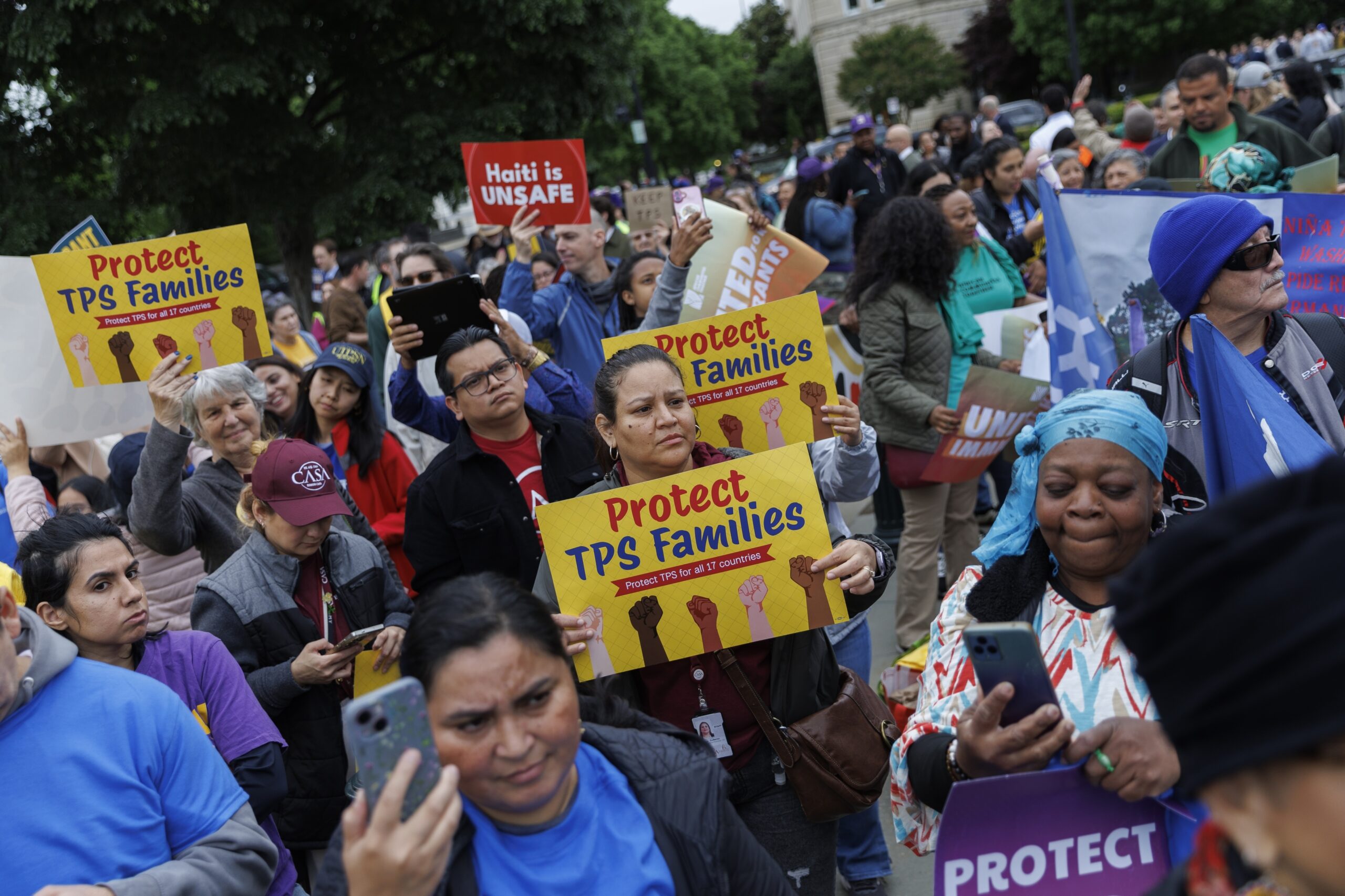
Demonstrators chant and hold signs outside U.S. Supreme Court on April 29, 2026 in Washington, DC. The court heard arguments challenging the government’s termination of Temporary Protected Status for immigrants. (Photo by Tom Brenner/Getty Images)
WASHINGTON — The U.S. Supreme Court Thursday allowed the Trump administration to move forward with its plans to strip temporary legal status from 350,000 Haitians and 6,000 Syrians, a move that opens them up to deportation.
The 6-3 conservative court ruled that the Haitian and Syrian immigrants are not “entitled” to orders postponing an end to their temporary protections while litigation is pending, arguing those are non-constitutional claims. It means their work permits and deportation protections are stripped.
Conservative Justice Samuel Alito, who wrote for the majority, said that the Haitians’ claim — that their equal protection claim that their Temporary Protected Status was terminated on a racial bias — are unlikely to prevail in court.
“None of the cited statements by either the President or the Secretary was overtly racial, and in substance all expressed policy views that could rest on race-neutral justifications,” Alito wrote.
The liberal justices, Sonia Sotomayor, Elena Kagan and Ketanji Brown Jackson, joined in a dissent that argued the president made clear racial comments about Haitians for the purpose of terminating protections.
“Haitians are Black. The references—of filth, disease, and primitiveness—are shot through with racial stereotypes and tropes,” they wrote. “It is hard to imagine the statements being made today of any White community.”
The decision is likely to impact multiple lawsuits across the country in which federal judges have halted President Donald Trump’s efforts to strip legal protections granted to more than 1.3 million immigrants with TPS because they hail from countries the U.S. initially deemed too dangerous for return.
Appeals court says Trump administration must open borders to asylum-seekers
WASHINGTON — The U.S. Supreme Court sided Thursday with the Trump administration’s request to turn away asylum-seekers who present themselves at ports of entry at the U.S.-Mexico border.
The question the justices considered was whether migrants have to fully cross into the United States in order to have the right to apply for asylum and be processed, or if they can apply for asylum when they appear at a port of entry while on Mexico’s side of the border.
In a 6-3 decision, the conservative justices agreed with the Trump administration that a noncitizen who is standing in Mexico doesn’t arrive in the U.S. “by attempting, and failing, to set foot in this country.”
The justices held that a noncitizen only arrives in the U.S. “when he crosses the border,” and that the Immigration Nationality Act does not entitle that noncitizen who is standing on Mexico’s side of the border who wants to apply for asylum to be inspected by an immigration officer.
Justice Samuel Alito, who wrote for the majority, said the case before the justices presented a “straightforward question.”
“The phrase ‘arrives in the United States’ … carries its ordinary meaning: A person arrives in a geographic location only when he enters it,” he wrote. “A person arrives in a destination when he enters within its area—not before—and that conclusion does not change because someone or something blocks entry. Everyday examples of how people ordinarily use the phrase ‘arrives in’ confirm this understanding.”
The policy requiring a full crossing, known as metering, is defunct, but Vivek Suri, assistant to the U.S. solicitor general, argued before the high court that it was a policy the federal government should be allowed to have in its toolbox for future uses at the southern border.
Liberal Justice Sonia Sotomayor wrote a scathing dissent saying the ruling will allow the Trump administration to turn away asylum seekers, a policy she said violates Congress’ refugee law.
“Because the Court today blesses the Executive Branch’s decision to slam the door shut on all who are fleeing persecution, despite the detailed inspection and asylum system that Congress enacted and commands, I respectfully dissent,” she wrote.
During oral arguments in March, the justices seemed ideologically split, with the six conservative justices agreeing with the Trump administration. The three liberals of the Supreme Court — Sotomayor and Justices Elena Kagan and Ketanji Brown Jackson — questioned whether the policy violated federal law protecting refugees.
This is a breaking news story and will be updated.
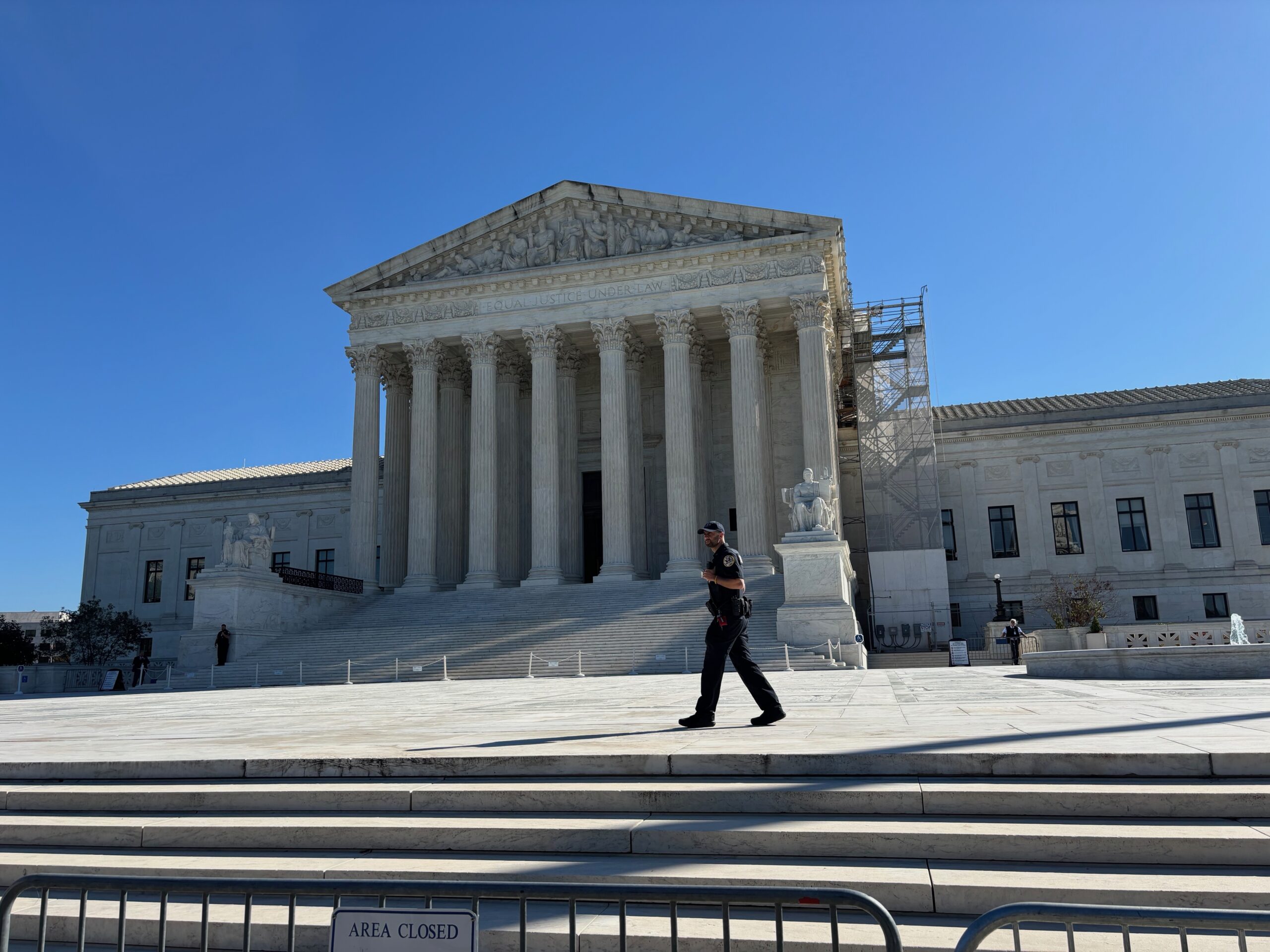
The U.S. Supreme Court on Oct. 29, 2024. (Photo by Jane Norman/States Newsroom)
State courts cannot find liability for labeling shortcomings in pesticides and related products because such products are covered by federal law, the U.S. Supreme Court said Thursday in a decision backing agricultural giant Monsanto.
The justices, in a 7-2 decision, threw out a $1.25 million verdict a Missouri court awarded to a man who said long-term use of the weedkiller Roundup caused him to develop non-Hodgkin lymphoma, a type of blood cancer.
The herbicide, produced by Monsanto, does not include any warning of carcinogenic material and Monsanto and parent company Bayer deny there is any link.
The decision created an unusual split for the conservative-dominated court, with Justice Brett Kavanaugh writing the majority opinion and his fellow conservative Justice Neil Gorsuch joining a dissent written by liberal Justice Ketanji Brown Jackson.
The majority ruled that the Federal Insecticide, Fungicide, and Rodenticide Act, or FIFRA, which governs herbicide use, preempts state claims like the one awarded to John Durnell of St. Louis.
Roundup’s label complied with U.S. Environmental Protection Agency regulations, to which states cannot add requirements, Kavanaugh wrote.
“In sum, federal law requires Monsanto to sell Roundup with the label that EPA approved at the initial registration and that EPA has subsequently re-approved on multiple occasions—that is, the label without a cancer warning,” he wrote.
“Durnell’s state tort claim, by contrast, would require Monsanto to add a cancer warning to its labels. That Missouri-law requirement is ‘in addition to’ and ‘different from’ Monsanto’s federal-law labeling obligations.”
In her dissent, Jackson wrote that the majority’s decision improperly prioritized national uniformity over consumer protection.
“In accepting Monsanto’s argument and holding that Durnell’s failure-to-warn claim is preempted, the Court misunderstands FIFRA’s requirements, misinterprets the scope of FIFRA’s preemption, and ultimately leaves Durnell without a remedy for the significant harms he has suffered,” she wrote.
Durnell sued Monsanto and parent company Bayer in 2019, claiming that exposure to Roundup over two decades led to his cancer diagnosis. A Missouri trial court awarded him $1.25 million, and a state appeals courts affirmed the ruling.
The Supreme Court was the first federal court to hear the case.
Federal law typically trumps state law, which Monsanto and the Justice Department emphasized during April oral arguments. Industry groups across the economy tend to support federal supremacy because it saves companies from complying with 50 separate regulatory schemes across states.
The EPA, which regulates labeling requirements for herbicides, does not require the kind of warning the Missouri jury said was appropriate.
This is a breaking news story and will be updated.
Casey Oakley, who needed an abortion after an unsuccessful IVF embryo transfer. She and her husband have two biological children and she has been a surrogate mom for two families. The couple has also foster parented four girls. (Photo courtesy Casey Oakey)
Editor’s note: This story mentions pregnancy loss.
Miscarriages were common for Albemarle County resident Casey Oakley during her in vitro fertilization process. Some embryo transfers weren’t successful and her body would expel the remnants, a process she had always handled safely at home, until an irregular delay.
Her bloodwork had indicated her pregnancy hormones were not elevating properly, signaling an imminent miscarriage. But two weeks later nothing had happened.
“(Doctors) didn’t know where the embryo had implanted in my body, so I was scheduled for an abortion, and I was told before my surgery that if they couldn’t find products of conception in my uterus, that they were going to be taking my tubes,” she said.
The fallback option was meant to spare her the deadly infections that can arise when miscarriages fail to complete.
“It wasn’t a question that they asked, it was more of a ‘this is what we have to do to make sure that you live,’” Oakley said.
Doctors eventually discovered that her body had maintained a gestational sac but no fetal DNA.
“My body had fought so hard for a pregnancy that would have no baby and then I was going into sepsis,” she said. “The abortion saved my life.”
Her experience is foundational to her support for a pending constitutional amendment heading to Virginia voters statewide in November.
If approved, it will permanently embed reproductive rights into Virginia’s constitution.
The amendment would protect people’s access to contraception, IVF and abortion, four years after the Supreme Court overturned federal protections for abortion and more states have restricted access to the procedure and birth control.
Virginia remains the least restrictive Southern state for reproductive healthcare in the era after Dobbs v. Jackson Women’s Health Organization, the abortion protection case that justice struck down in 2022.
State lawmakers weigh in
Del. Cia Price, D-Newport News. (Ned Oliver/Virginia Mercury)
Del. Cia Price, D-Newport News, was diagnosed with polyendocrine metabolic ovarian syndrome at 16 years old. She recalled debilitating cramps that made it hard for her to focus in school and days she could not get out of bed.
Formerly known as polycystic ovarian syndrome, PMOS is a full body disorder that affects people’s metabolism and reproductive organs. It can also cause infertility. Contraception has long been a standard treatment for the disorder to improve quality of life.
Though Price doesn’t need contraception for family planning as she is in a same-sex relationship and does not want biological children, the treatment lessens her PMOS symptoms.
She said her and others’ access to the medication could be at risk.
After Dobbs, Justice Clarence Thomas suggested the court revisit cases that have protected contraception, as well.
Gov. Abigail Spanberger signed Price’s Right To Contraception Act into law this summer, after the bill was vetoed multiple times by former Gov. Glenn Youngkin.
It will protect contraception access in the interim, though the pending reproductive rights amendment would shore matters up longterm.
Price said she understands some of her constituents’ and legislative colleagues’ reasons for not supporting contraception or abortion — from religious objections to debates over life-at-conception. But she underscored the healthcare utility of each.
“It’s just really disheartening for your quality of life to be at the intersection of an argument,” she said.
“This is a difficult topic for a lot of people,” Sen. Emily Jordan, R-Suffolk, said during a floor speech earlier this year amid debate over the amendment.
Jordan was among the Virginia Republicans who unsuccessfully sought to alter the amendment to reinforce existing state code outlining restrictions for minors and outlining care for infants when they are born.
The amendment advanced due to Democrats’ majority in the Virginia statehouse. Now, it’s in voters’ hands.
Price believes her contraception bill and the amendment “takes the conversation out of the political sphere and puts it in the medical sphere and the personal decision sphere.”
The medical cost
Dr. Kimi Chernoby, an emergency medicine doctor and lawyer, noted that emergency abortion care can happen at all stages of pregnancy if things go awry with the fetus or parent.
She added that many first trimester abortions stem from miscarriages or ectopic pregnancies, and that restrictive state laws increase margins for death.
“These laws are written by lawyers who have no medical training,” she said. “They actually prohibit a lot of care around miscarriages and ectopics, unless they fall within certain exceptions, and so that’s the care that is getting tangled up.”
As chief operating officer for a nonprofit called FemInEM, Chernoby organizes training around the country for emergency physicians to handle reproductive health emergencies.
The national patchwork of bans and restrictions with scant exceptions has complicated her and other physicians’ work, she said.
Legal challenges to mifepristone further muddle matters, as the abortion pill is also critical for managing miscarriages to prevent sepsis. FemInEM has submitted amicus briefs as a key court case that could affect abortions and miscarriage care nationwide unfolds.
Ahead of the fall referendum and pending court rulings, Oakley reflected on how an abortion allowed her to become a mother, surrogate and foster parent many times over.
“I was able to further the lives of my children and four other little girls,” she said. “There will be many other children to come into our lives afterwards.”
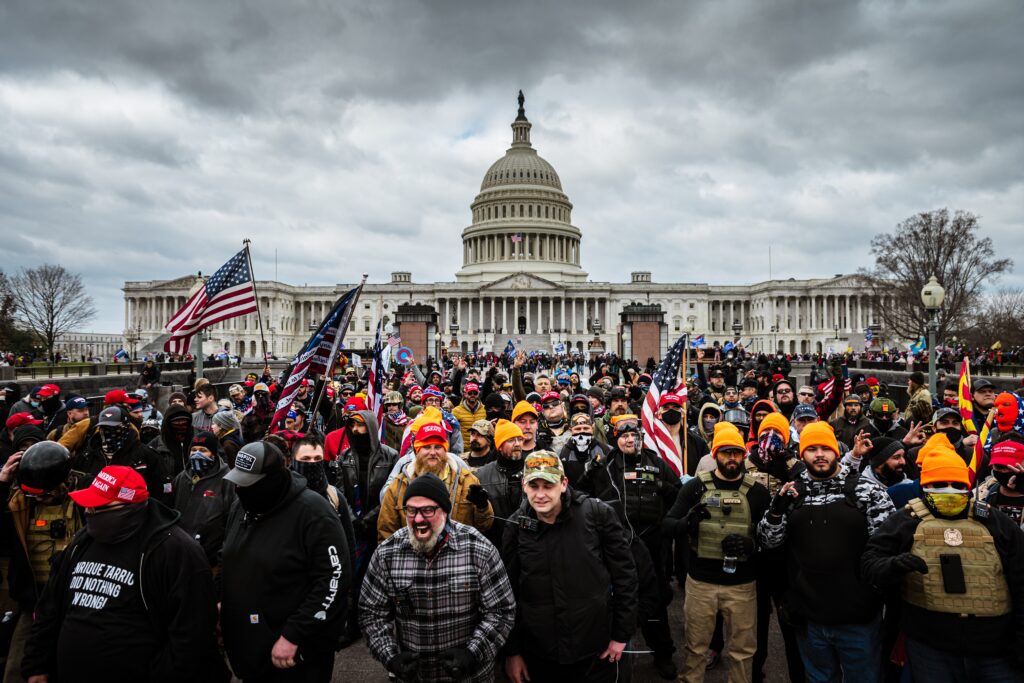
Supporters of President Donald Trump gather outside the U.S. Capitol on Jan. 6, 2021, in Washington, before a mob breached the building during the certification of the 2020 presidential election results. Critics of a proposed settlement tied to Trump’s lawsuit against the IRS have raised concerns that a planned “Anti-Weaponization” fund could ultimately benefit Jan. 6 defendants. (Photo by Jon Cherry/Getty Images)
Virginia Attorney Jay Jones joined a coalition of 22 Democratic attorneys general Wednesday urging a federal judge in Florida to closely examine a controversial settlement tied to President Donald Trump’s lawsuit against the Internal Revenue Service, arguing the agreement raises serious constitutional and ethics concerns.
The filing, submitted to the U.S. District Court for the Southern District of Florida, asks the court to scrutinize what the coalition describes as a potentially “collusive” settlement between Trump and the U.S. Department of Justice in the case known as Trump v. IRS.
The attorneys general argue the agreement would grant broad protections to Trump, his family and business interests while creating a proposed $1.776 billion “Anti-Weaponization” fund that the president’s critics say could steer taxpayer money toward Trump allies and others claiming they were unfairly targeted by the government.
The multi-state effort is led by California Attorney General Rob Bonta.
“This proposed ‘settlement’ is yet another appalling example of Donald Trump’s belief that he is above the law, and that his presidency allows him to evade accountability for his illegal actions,” Jones said in a statement.
“The people of the commonwealth are fed up with his schemes, and they are fed up with elected leaders who believe they are above the people they serve. This office will use every resource available to speak up for and act on behalf of Virginians, who deserve better than a president who only serves himself.”
The filing comes as legal scholars, former federal judges and watchdog groups nationwide continue questioning both the settlement itself and the unusual circumstances surrounding the case.
Trump, his sons Donald Trump Jr. and Eric Trump and the Trump Organization filed the lawsuit in January against the U.S. Treasury Department and IRS over the disclosure of Trump tax return information by a government contractor. The lawsuit sought billions in damages tied to the release of tax records later published by several news organizations.
The suit drew immediate attention because Trump, as president, oversees the federal agencies he sued.
U.S. District Court Judge Kathleen Williams had previously questioned whether the parties were genuinely adversarial and ordered a briefing on whether the court even had jurisdiction over the dispute. According to Wednesday’s filing, Trump voluntarily dismissed the lawsuit and entered into a settlement agreement with the U.S. Justice Department shortly before those issues were set to be argued.
The coalition said that timing raises additional concerns.
According to the attorneys general, the agreement appears to be “an attempted end-run around constitutional limits on Executive Branch authority.” The brief argues the settlement bears little connection to the legal merits of the original lawsuit and may exceed the Justice Department’s authority.
The filing also argues the arrangement risks undermining public confidence in the courts by allowing a president to negotiate favorable legal protections with agencies under his own control.
The dispute has sparked growing political and legal backlash since details of the settlement became public last month, with Democrats and some Republicans questioning whether taxpayer money could eventually benefit Jan. 6 defendants or political allies of the president.
Former federal judges also urged the court to reopen the case, accusing the parties of potentially misleading the judiciary.
The controversy escalated further after reports that the settlement included provisions shielding Trump, members of his family and related businesses from certain future tax investigations or audits.
The Justice Department initially defended the proposal, describing the fund as a mechanism to address alleged government “weaponization.”
“The machinery of government should never be weaponized against any American, and it is this Department’s intention to make right the wrongs that were previously done while ensuring this never happens again,” Acting U.S. Attorney General Todd Blanche said in a statement last month.
But the Trump administration has since faced growing political and legal pressure over the arrangement and has begun backing away from the proposed fund.
Legal fights connected to the settlement, however, are continuing in federal court. A federal judge in Virginia last month blocked the proposed fund from moving forward.
The Florida court is now considering whether to reopen Trump v. IRS under Rule 60 of the Federal Rules of Civil Procedure, which allows courts to revisit judgments in cases involving alleged fraud, misconduct or deception.
In this week’s filing, the coalition argued that state attorneys general have a particular interest in preserving public confidence in the legal system and guarding against abuses of executive authority.
“The self-dealing and corrupt nature of this settlement agreement is antithetical to the responsibilities of attorneys general and the rule of law,” the coalition wrote.
The Florida court has not yet ruled on whether the case will be reopened.
Tom Dunlap, a Riverkeeper with the James River Association, looks over Swift Creek where toxic leachate from the Shoosmith Landfill is leaking in June 2026. (Photo by Shannon Heckt/Virginia Mercury)
The Virginia General Assembly allocated $10.6 million in the two-year budget lawmakers passed this week for the Department of Environmental Quality to help contain toxic leachate spilling from the bankrupt Shoosmith Landfill in Chesterfield County.
The emergency funds will be used “to prevent it from becoming a catastrophe”, according the Sen. Glen Sturtevant, R-Chesterfield.
It represents a fraction of the $173 million needed to fully close down the landfill located off of Route 10 in Chester. The landfill, which has not taken in new trash since 2022 and whose owners filed for bankruptcy in 2025, reportedly generates about 50,000 gallons of leachate a day, a toxic wastewater made up of runoff from the garbage in the landfill.
View of Shoosmith Landfill through trees surrounding a nearby neighborhood along Swift Creek. June 2026. (Photo by Shannon Heckt/Virginia Mercury)
The creek flows into the Appomattox River and eventually into the James River at Hopewell – where drinking water is collected. Tom Dunlap, a riverkeeper with the James River Association, emphasized that if the leachate continues flowing into the environment it could lead to a major disaster, impacting clean drinking water and healthy streams for wildlife.
“You have to treat that discharged waste fluid to protect the environment,” Dunlap said. “It can be laden with all sorts of things from heavy metals to PFAS chemicals, and on and on. To have that leachate wind up directly in the environment is one of the worst case scenarios that we could be experiencing.”
The leachate is part of normal operations when managing a landfill, but must be treated before being discharged into wastewater treatment systems. In 2018, the county board of supervisors denied a request to expand the landfill by including a lined disposal cell in a nearby rock quarry.
Supervisors said the disposal of the wastewater below the water table could pose serious health and safety risks for residents.
The landfill has a history of improperly managing the leachate from the facility.
Chesterfield County reported that between 2019 and 2023, elevated levels of ammonia were found in the wastewater treatment plant that were traced back to Shoosmith. The landfill wasn’t properly treating the leachate it was discharging into the municipal system, an investigation found, which is a violation of its permit and the Clean Water Act.
This led the county to suspend Shoosmith’s permit to discharge the leachate into the county system; the liquid had to then be hauled offsite to be disposed of.
When filing for bankruptcy, DEQ approved the surety bonds from the facility’s owners to the tune of $19 million. This money was earmarked for the bankruptcy trustee to oversee the continued clean up of the leachate. In a May 26 letter to DEQ, the senator asked what could be done to make sure taxpayers are not left holding the bag to close this private facility.
Local residents in the surrounding neighborhoods have warned for years that the leachate has been getting into streams and odors have been permeating from the landfill.
A group called Chesterfield Citizens for Responsible Government said that the $10.6 million in state funding is not enough to cover the environmental and infrastructure needs laid out in the bankruptcy filings and engineers budget report for the closure of the landfill.
“These are not theoretical concerns. They are documented operational deficiencies at a landfill located adjacent to critical waterways. Immediate action is needed to protect public health, groundwater, and the environment,” the group said in a statement.
The James River Association estimates that about $50 million is needed over the next two years to establish an on-site leachate and treatment facility to slow the spread into the local environment.
“That engineering report cited elevated temperatures and all the knock-on effects of that which includes potential gases that are coming out of it, concerns with the stability of the landfill overall, identifying some of the more rapid-than-expected subsidence and collapses in the landfill,” among other concerns, Dunlap said.
Sturtevant said that the $10 million is just the first step and that the state – alongside the EPA and local officials – are evaluating other revenue streams to help shut down the landfill and manage the leachate before it gets too dangerous.
“This allows the federal, state and local folks the time to develop a plan to stop the leachate to prevent it from becoming a catastrophe, which is where it was headed, because they told us we’re gonna run out of money as soon as August,” Sturtevant said.
The bipartisan delegation of lawmakers that represent the Chesterfield area have been engaging with DEQ and Secretary of Natural and Historic Resources David Bulova on how to protect residents in the interim.
They are also considering how to claw back more funds from the company that abandoned the landfill when bankruptcy was filed.
“It would appear that there were a lot of things that failed along the way, and we have these governmental rules and regulations and agencies in place for the purpose of not allowing that to happen,” Sturtevant said. “So it’s going to require some legislative changes to make sure that there’s not an opportunity for this kind of thing to happen again.”
The Virginia Board of Education may delay the full implementation of the state’s plan to raise academic benchmarks for reading and math by two years, rather than gradually increasing them over a four-year period starting this year as scheduled.
The department briefed board members on the proposed delay at their work session on Wednesday at J. Sergeant Reynolds Community College in Henrico County, following a state study’s finding that the new K-12 accountability system, which includes the cut scores, could be refined.
Virginia will raise cut scores for its Standards of Learning assessments to boost student proficiency, a process that was slated to begin this school year. This initiative, led by former Gov. Glenn Youngkin, followed findings of declining reading and math scores among students in grades 3 through 8, a trend that began during the pandemic.
But critics are urging a slower rollout, saying a quicker shift could increase teacher burnout, lower graduation rates, and worsen inequitable access to education. Several members of the board said at Wednesday’s meeting that they wanted to keep to the original timeline.
Board member Amber Northern, an appointee of former Gov. Glenn Youngkin, said Virginia has received national praise for moving toward higher standards and accountability. She is concerned the proposal jeopardizes the board’s earlier work.
“Regardless of whether it’s a Republican or a Democrat in office … Virginia’s is for high standards and they’re going to work together with colleagues that are on the right, the left, the center .. to continue to do the right thing by kids on an aggressive, yet doable timeline,” said Northern.
Ida McPherson and Bill Hansen, both Youngkin appointees to the board, opposed delaying implementation of the accountability system that includes the cut scores, citing concerns that staving off implementation would negatively impact student outcomes.
Superintendent of Public Instruction Jenna Conway emphasized that higher proficiency cut scores would be in effect one year faster than the original plan.
She also added that staff would meet the request of some members for a side-by-side comparison of the proposal to the board’s original plan, which some — including Fairfax County Public Schools, representing the largest groups of students in the commonwealth — took issue with.
“These changes will have a significant and potentially detrimental impact on schools and students,” Fairfax said in a statement last fall about the original plan. “FCPS supports rigorous standards, but will continue to advocate for this work to be done in meaningful and measured ways.
Arlington Parents for Education, a group advocating for high academic expectations, said in a statement it opposes this proposed delay.
“This last-minute proposal to lower expectations would mislead parents and allow schools to keep delaying the improvements Virginia’s kids desperately need,” the group said in a statement. “Major changes to academic standards should be made through a transparent process focused on student outcomes – not rushed through at the eleventh hour.”
According to a study conducted by the Joint Legislative Audit and Review Commission, if the plan passes, schools’ overall scores will drop by about 8.5 points, while proficiency scores will fall by about 21 points in reading and 17 points in math.
The study stemmed from lawmakers directing the commission to examine the state’s K-12 accountability system, which was split into two parts: accreditation, which determines whether schools meet legal and regulatory requirements; and the School Performance and Support Framework (SPSF), which provides clear data on student and school performance.
The board praised the report that included recommendations to refine the accountability system. Overall, the recommendations urge the board and lawmakers to continue developing a more transparent and fair system that better reflects student growth and ensures stronger support for struggling schools.
The department is asking the board to consider the proposal to adjust the timeline for rolling out new cut scores to avoid “confusion” and to ensure divisions can fully prepare without having to manage multiple major changes each year.
If approved, the plan starts this upcoming school year. The Department of Education will provide divisions with a preview of results under the higher standards. Schools’ academic progress labels will also change, from “off track” to “approaching expectations,” and from “on track” to “meets expectations.”
Under the proposal, if a student recently moved to the U.S. and is still learning English, they are exempt from the reading assessment in their first year (2026-2027).
High school ratings will use current achievement data instead of longer-term cohort results. Elementary and middle schools won’t be penalized for having too few English Learner students to get a fair evaluation.
For the 2027-2028 school year, the department plans to preview updated School Performance and Support Framework results for divisions without consequences.
Implementation will start in 2028-2029 with a single increase in cut scores and the adoption of the new SPSF version.
Test data from the 2028-2029 school year will be released in the summer of 2029, and accountability data will be published in the fall of 2029, reflecting the new cut scores.
One area that wasn’t mentioned in the proposal was whether the board’s interest in having Virginia’s cut scores meet the “proficient” standard set by the National Assessment of Educational Progress would change.
This standard is defined as a student demonstrating a deeper understanding of complex topics and the ability to apply them in real-world situations.
Gov. Abigail Spanberger appointed four new members to the nine-member board, which remains controlled by Youngkin’s appointees, most of whom supported a gradual four-year increase last November that would have been completed during the 2029-2030 school year.
The proposal would wrap up during the 2028-2029 school year.
Hansen, the board’s vice president, will finish his term June 30 and his replacement will be appointed by Spanberger’s administration.
The board is not expected to take any action on the proposal on Thursday, their next scheduled meeting.
At left, Patti Gordon, 71, of Atlanta, Georgia, walks with her friend from Texas at the Freedom 250 kick-off event in Washington, D.C., on Wednesday, June 24, 2026. (Photo by Ashley Murray/States Newsroom)
WASHINGTON — President Donald Trump kicked off his administration’s celebration of America’s 250th anniversary Wednesday night with a rally speech nearly mirroring his days on the 2024 presidential campaign trail to a crowd of loyal supporters waving American flag placards.
The president delivered remarks for roughly 25 minutes on the National Mall against the backdrop of the Washington Monument and exalted the Founding Fathers and valuable contributions to the world by American inventors.
But Trump also spent significant time on his familiar refrains, declaring “America is back,” and that he rescued it from “total disaster,” he said, by closing the “most wide open, insecure” border along the U.S. southwest, “sending education back to the states where it belongs,” issuing an executive order requiring only two genders on federal documents, signing a bill that made tips non-taxable income for four years, among other policies.
“We’re not a joke anymore, we’re the most powerful country in the world,” Trump said. “But just like those patriots of 1776, over the past 17 months, we have taken power back from the far-off political class. They’re trying to gain it back, but it’s not going to happen.”
Trump also praised what he described as a military boom. The event featured music by the U.S. Marine Corps Band and five separate military flyovers of fighter jets and a B-2 stealth bomber.
A B-2 stealth bomber and four fighter jets perform a flyover at the Freedom 250 kickoff on the National Mall on June 24, 2026. (Photo by Sam Gauntt/States Newsroom)
Military recruitment, he said, is “setting records,” well above the numbers under former President Joe Biden.
“Then the thing happened on Nov. 5, it’s called a great election victory, and from that moment on, now you can’t even get into the military, we have waiting lists to get into the military,” he said.
Trump also credited the war he launched in Iran for bringing peace to the Middle East “for the first time in 3,000 years,” and said the administration’s peace negotiations sent the stock market “skyrocketing upward.”
The S&P 500 has actually dropped slightly since close on June 18, the day before the administration announced a peace deal with Iran.
“How good is our military? How good? In one week, Iran was essentially finished in one hour, Venezuela was finished, and I guess we have other things in store, but we don’t want to get carried away,” he said.
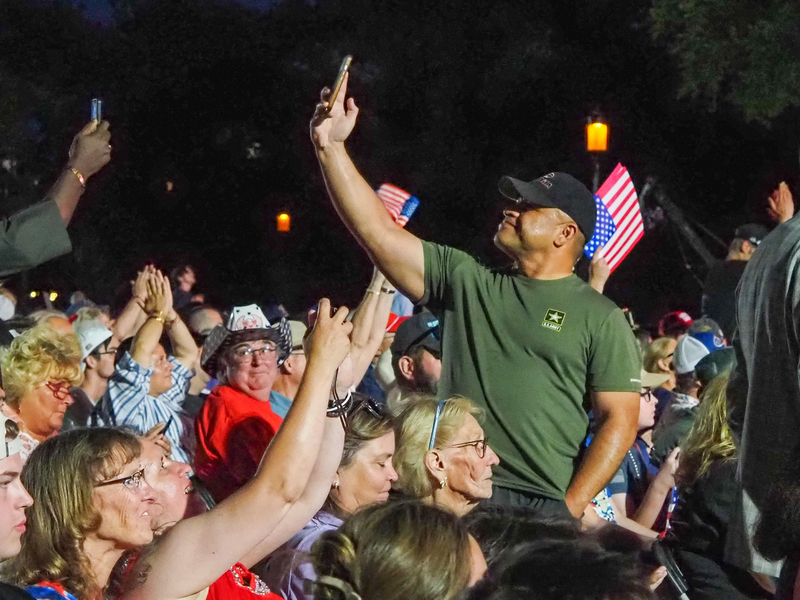
A man in the crowd wearing a U.S. Army shirt takes a selfie as President Donald Trump spoke Wednesday, June 24, 2026, for the administration’s Freedom 250 kickoff event. (Photo by Ashley Murray/States Newsroom)
Washington revamp
He also touted his efforts to beautify Washington, D.C., highlighting projects including the restored Christopher Columbus statue outside Union Station, his planned ballroom that will replace the White House’s East Wing and the renovations to the Lincoln Memorial Reflecting Pool.
After the pool was drained to paint the basin “American flag blue,” it has faced consistent problems with algae blooms and peeling paint, which Trump has said is the fault of vandals.
Trump concluded his remarks by invoking imagery of early American settlers and revolutionary heroes. He described the American spirit as taking up the call to freedom, exploring the “most dangerous frontiers,” and fighting and winning the “most vicious battles.”
Now, Trump said, America is expanding that “glory of American freedom into a horizon that’s never been seen before.”
“We’ve never reached so high as we’re reaching right now,” he said. “This is our heritage, this is our history, and this is the destiny of America to be the greatest, most incredible country ever to grace the earth.”
After Trump finished his speech, the band played the Village People’s YMCA, a staple at his rallies and events, and he danced off the stage.
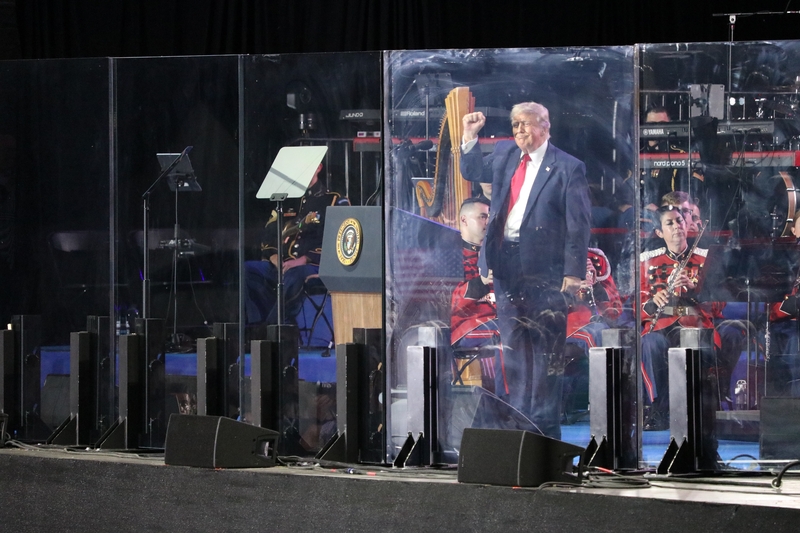
President Donald Trump pumps his fist to the crowd after his remarks during the Freedom 250 kickoff celebration on June 24, 2026. (Photo by Sam Gauntt/States Newsroom)
Supporters arrive early
Attendees — wearing plenty of splashy outfits and historical costumes among a sea of red, white and blue and MAGA red — began to trickle through U.S. Secret Service security hours before Trump was set to give remarks initially scheduled for 7 p.m. Eastern.
Excited guests shaded themselves from the sun with American flag placards until the U.S. Marine Corps band began to play a patriotic melody. Chairs in the front row at the stage’s edge were reserved for “Front Row Joes,” a nickname Trump gave to regulars at his 2024 presidential campaign rallies.
The grounds weren’t quite ready for primetime. Construction continued on the National Mall where Freedom 250’s Great American State Fair was scheduled to begin Thursday.
Workers hang up a menu, with drawn-on prices, in a concessions area along the National Mall ahead of the Freedom 250 kickoff celebration in Washington, D.C. on June 24, 2026. (Photo by Sam Gauntt/States Newsroom)
And food vendors hurried to hang menu signs as guests looked to see if food was ready for sale. Among the menu items were a $23 turkey leg, pretzel bites and plenty of Phorm, the energy drink owned by Dana White, the president of the Ultimate Fighting Championship and close ally of Trump.
Bill Anderson, 64, of Plankinton, South Dakota, said he traveled to “just to take it in.”
“I don’t know what Trump’s speech is going to be, but it’s always going to be uplifting, and maybe tell us some things (that) are going to happen in the future,” Anderson said, adding the semiquincentennial makes him feel hopeful for what’s ahead in the United States, which he predicted will be a stronger focus on Christianity.
Anderson attended the Christian heritage “Rededicate 250” event on the National Mall in May, which featured appearances by several Cabinet members and Republican lawmakers, including U.S. House Speaker Mike Johnson.
People in the crowd shaded themselves with American flag placards as they waited for President Donald Trump’s speech at the Freedom 250 kickoff rally in Washington, D.C., on Wednesday, June 24, 2026. (Photo by Ashley Murray/States Newsroom)
‘Beautiful turning point’
Patti Gordon, 71, of Atlanta, wore matching red, white and blue sequined jackets with her friend from Texas. Each featured an eagle and stars and stripes on the back with the message, “America 250th Anniversary.”
Gordon, a vice chair of the Fulton County, Georgia, Republican Party, sat in the third row and said the semiquincentennial is a “beautiful turning point for this country.”
“I’m really hoping people become a little bit more patriotic and realize this country is worth saving,” she said. “I think a lot of people are trying to destroy this country and erase our history and say that we have a horrible history. We do not. We know we are the most generous country in the world, and we have helped people to freedom.”
Fulton County is a focus of Trump’s unfounded claims that he won the 2020 presidential election. In January, the Trump administration deployed federal agents to the county to seize ballots from the 2020 election.
Laura Strohmeyer, 37, a new resident of Washington, said she came out to the kickoff to see a B-2 stealth bomber fly by.
“I think it’s pretty awesome,” the former Virginia resident said of the kickoff. “I think it’s cool to celebrate our country, our history — something to be very proud of.”
Strohmeyer added that she hoped celebrating the country’s 250th would bring people together, rather than further separate them.
Alex, who declined to give his last name, dressed as “Honest Abe” takes photos with attendees at the Freedom 250 kickoff rally on the National Mall on June 24, 2026. (Photo by Sam Gauntt/States Newsroom)
Honest Abe
Many attendees came in customized outfits featuring sequins, American flag print or political slogans.
One, dressed as Abraham Lincoln, called himself Honest Abe and said his real first name was Alex, but declined to provide States Newsroom his last name. He is a frequent presence at Trump’s rallies, and said he has twice been recognized by the president for his historical garb. The back of his jacket featured an image of the late conservative activist Charlie Kirk with the words “Martyr for Truth and Freedom.”
As people milled about the kickoff celebration, many stopped to take their picture with the Lincoln impersonator who wore a “special guest” credential issued by Freedom 250. He gave several interviews.
“We’ll be happy to see him again, and to celebrate America 250 years, to be here with the patriots,” he said of Trump.
The impersonator said that, after George Washington and, of course, Lincoln, Trump ranks as the third-best president “in the Holy Story of America.”
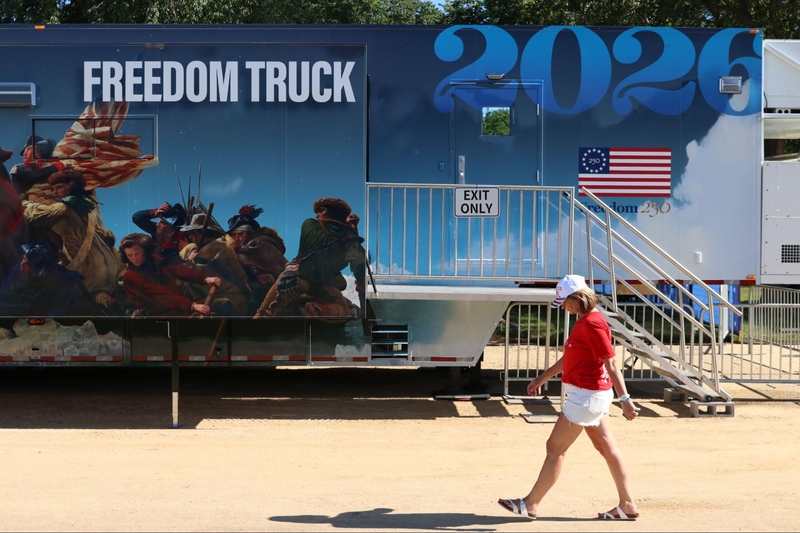
An attendee of the Freedom 250 kickoff rally walks by a trailer on the National Mall. (Photo by Sam Gauntt/States Newsroom)
Summer of celebration
Freedom 250, the Trump administration’s iteration of semiquincentennial celebrations, will stretch through the summer, with the Great American State Fair on the National Mall until July 10 followed by a high school athletic competition and an INDYCAR race around the National Mall in August.
The White House worked with the Las Vegas-based Ultimate Fighting Championship to promote a series of primetime mixed martial arts fights on Flag Day, and Trump’s 80th birthday, as a kickoff to the semiquincentennial.
The administration’s Freedom 250 events are not part of the America250 commission created by Congress a decade ago that is hosting events and initiatives around the country on Independence Day and throughout 2026.
President Donald Trump opened his administration’s days-long Freedom 250 event on the National Mall with a speech Wednesday, June 24, 2026. (Video by Ashley Murray/States Newsroom)
President Donald Trump looks on during a Cabinet meeting in the Cabinet Room of the White House on May 27, 2026 in Washington, D.C. (Photo by Win McNamee/Getty Images)
WASHINGTON — The Trump administration sent Congress a request Wednesday for $87.6 billion in emergency funding to cover the cost of the war in Iran and other expenses.
White House budget director Russ Vought wrote in a letter that in addition to addressing “urgent needs” for the Defense Department, the funding would help the U.S. government assist with the Ebola outbreak and provide aid to American farmers.
Funding for the Energy Department, he wrote, would “support nuclear and other energy security requirements, primarily for the National Nuclear Security Administration.”
The supplemental spending request asks Congress to provide money for “restoration and construction projects in and around Washington, D.C.,” as well as the project that would modernize Penn Station in New York City.
The proposal asks lawmakers to add a few policy changes, including the year-round sale of E-15 gasoline, to any supplemental spending bill they may approve in the weeks and months ahead. Sen. Charles Grassley, R-Iowa, praised the move on social media. “Pres Trump’s admin is exactly right 2say yr-round nationwide E15 is ‘urgent’ & ‘needed’ Congress MUST pass yr-round nationwide E15 by end of fiscal yr Im very glad 2 see it incl in Defense Dept’s supplemental request,” said Grassley.
The proposals didn’t appear to have broad consensus among Democrats, who would likely be needed for any emergency funding to become law.
Senate Appropriations Committee ranking member Patty Murray, D-Wash., wrote in a statement the administration’s request “is not merely meant to pay for the president’s disastrous war, but an attempt to secure tens of billions of additional dollars for unrelated Pentagon priorities that should rightly be considered through the annual appropriations process.”
“I will closely review this request in its entirety and ensure we take care of our servicemembers, but I will not rubberstamp tens of billions more for this disastrous war of choice,” Murray added.
Senate Appropriations Chairwoman Susan Collins, R-Maine, wrote in a statement she will “evaluate the Administration’s supplemental budget request.”
“I plan to convene an Appropriations Committee hearing so that Senators can hear directly from the relevant Administration officials,” she said.
The supplemental spending requests ask lawmakers to provide:
$67.15 billion for the Defense Department
$11.1 billion for the Agriculture Department to provide aid to farmers
$3.36 billion for the State Department for diplomatic, security and global health programs
$2.03 billion for the U.S. Coast Guard
$1 billion for the Transportation Department to “to assist in the final design and construction of a modernized Penn Station in New York City”
$1 billion for the Labor Department to “increase the benefit levels for participants of certain pension plans that were sponsored by Delphi Corporation and terminated as a result of General Motors’ bankruptcy in 2009″
$767.5 million for the Energy Department
$600 million for the General Services Administration’s federal buildings fund
$500 million for the National Park Service to upgrade a seawall and improve the World War II Memorial
$40.26 million for the FBI for its role in the Iran war and “other classified needs”
$36.18 million for the Treasury Department’s office of terrorism and financial intelligence
$13.1 million for the Homeland Security Department’s operations and support account that was part of a “classified request.”
By Jennifer Shutt, Ariana Figueroa, Shauneen Miranda National
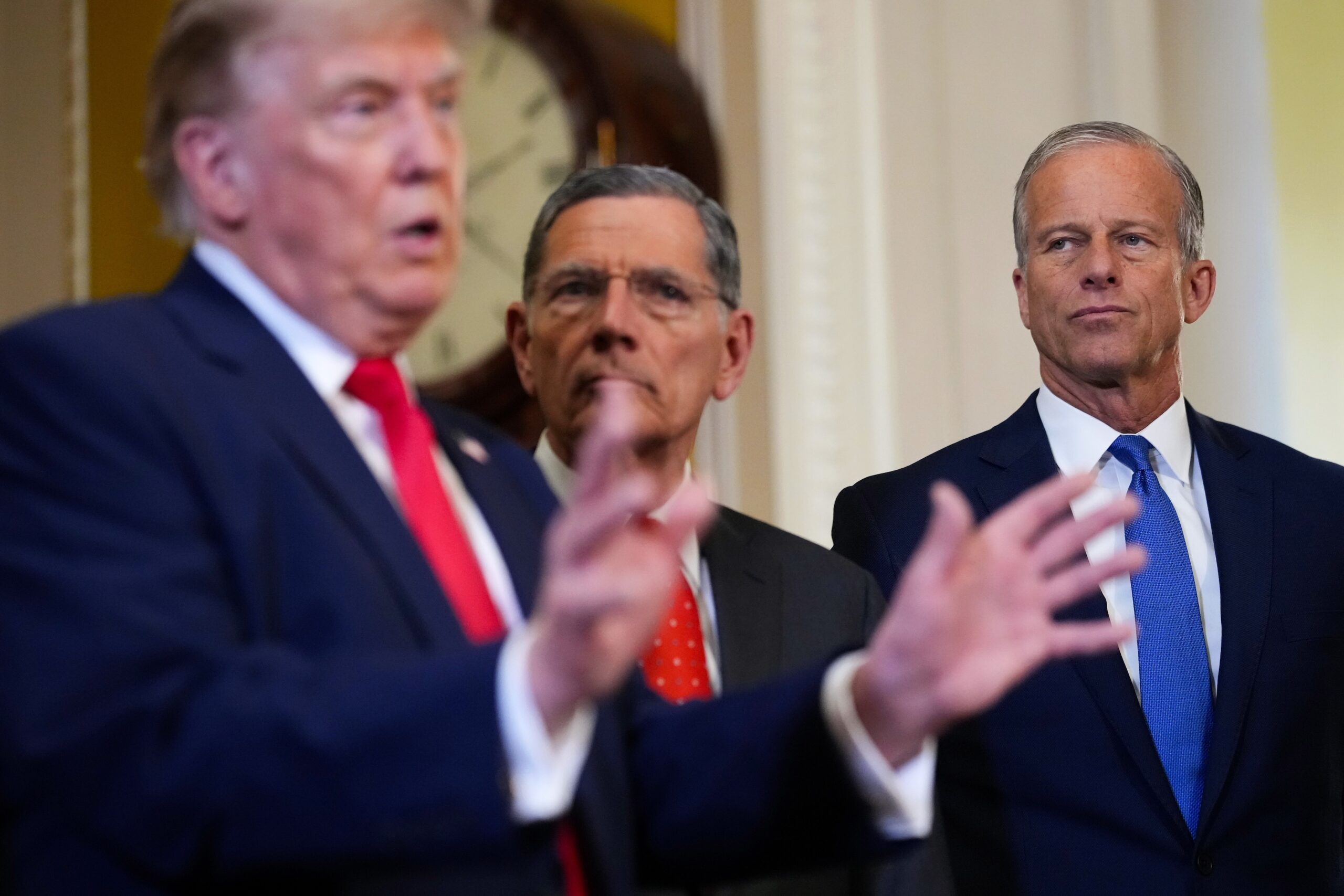
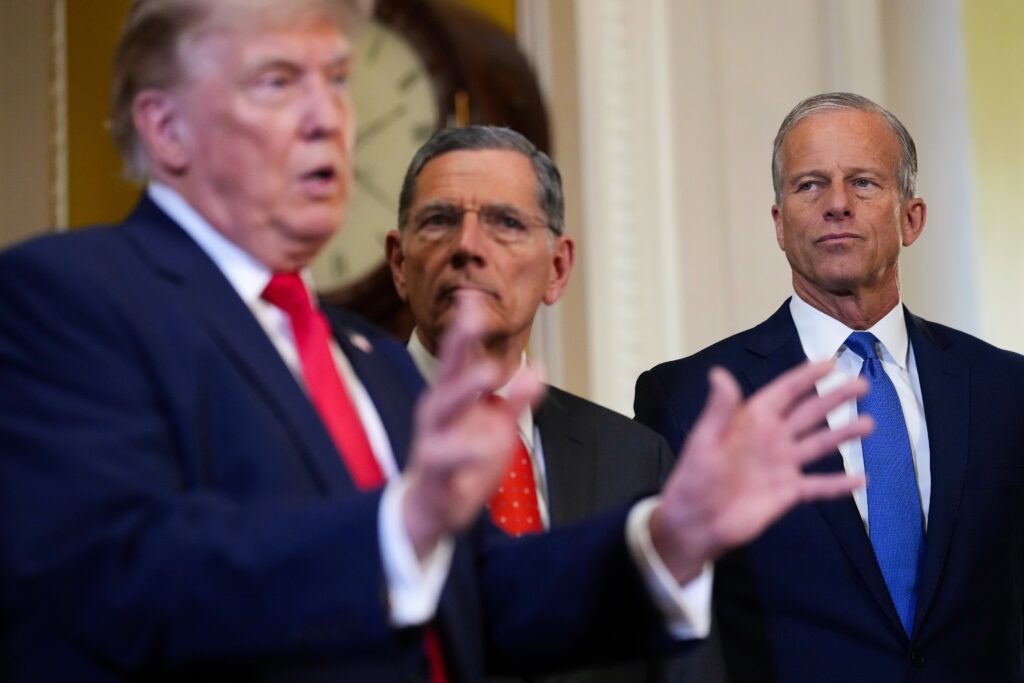
President Donald Trump speaks to the media as U.S. Senate Majority Whip John Barrasso, R-Wyo., and Senate Majority Leader John Thune, R-S.D., look on after a meeting at the U.S. Capitol on June 24, 2026 in Washington, D.C. (Photo by Andrew Harnik/Getty Images)
WASHINGTON — U.S. Senate Republicans walked into a lunch with the president on Wednesday looking for ways to unify, but they left the closed-door meeting on Capitol Hill as fractured as ever about policy goals.
President Donald Trump said after the huddle that he was “very proud of the party” but didn’t offer any concrete steps forward amid deep divisions on a nationwide voter identification law or other issues that don’t yet have enough GOP support to reach his desk.
“For the most part we have a really well-unified party,” Trump said. “And I said it very strongly, we have the hottest country anywhere in the world.”
Republican senators said during hallway interviews after the meeting ended that it wasn’t entirely productive and didn’t create much, if any, goodwill.
Louisiana Sen. Bill Cassidy somewhat jokingly said the meeting went “swimmingly” before detailing a confrontation he had with Trump over the lack of information on the Iran war. Senators have repeatedly asked for a classified briefing from administration officials, but haven’t yet received one.
Cassidy, who lost his May primary after Trump endorsed an opponent, said the exchange began when Trump asked why four Republican senators voted with Democrats to approve a War Powers Resolution earlier this week. Along with Cassidy, they were Lisa Murkowski of Alaska, Rand Paul of Kentucky and Susan Collins of Maine.
“I said, ‘Well, we’ve not been briefed on how it’s going, that the stated objectives don’t appear to be achieved, and it appears as if … it’s not going as well as we’re being told,’” Cassidy recalled. “At which point I think the president said something negative about me. I perceived it as attempting to bully me from asking a question that I think the American people need to know.
“And I’m not going to be bullied when I feel like I’m asking a question the American people need to know. And so at that point it began to escalate. And at some point it de-escalated.”
Trump declined to directly answer a question before the meeting began about whether he believes the voter identification law he advocates, which doesn’t have the votes necessary to advance in the Senate, is more important than a broadly bipartisan housing bill. The housing package would have given Republicans a legislative victory on the campaign trail roughly four months before the midterm elections.
The president was scheduled to sign that housing measure just before he met with Senate Republicans, but he canceled to press for the election bill, called the SAVE America Act.
The bill would overhaul how Americans register to vote and cast ballots in federal elections, such as requiring proof of citizenship to register to vote and requiring a government-issued photo identification at polling locations.
“Every election is important. We’re doing very well,” Trump said.
“They want a lot of communists to come in,” he said, referring to Democrats. “I’m saying it a little bit differently but the people that they’re pushing are communists. And this country is not going to have communists.”
Trump ‘mad as a murder hornet’ about Iran vote
Florida Sen. Rick Scott said he hoped the meeting would help Republicans build consensus, though he acknowledged it led to tension.
“You’ve been around the president, he was pretty forceful about what he cares about,” Scott said, later adding his goal in organizing the meeting was “to try to bring people together.”
Scott said Senate Republicans didn’t talk with Trump about using the complex budget reconciliation process to establish grants for states that implement certain voter identification requirements. House Speaker Mike Johnson put the idea forward earlier in the day as one way to promote elements of the SAVE America Act.
Louisiana Sen. John Kennedy said he appreciated the president’s “candor” during the meeting before saying Trump was “mad as a murder hornet about the war powers vote.”
“And I don’t blame him,” Kennedy said. “Put yourself in his shoes, he’s right in the middle of delicate negotiations and the Senate votes to get out of Iran. And it upset him.”
Kennedy said the president also pressed for the SAVE America Act, though he somewhat dismissed Johnson’s proposal to provide grants to states instead of enacting the entire bill.
“I don’t think that’s going to satisfy the president,” Kennedy said.
‘Like a hospital board meeting,’ with yelling
West Virginia Sen. Jim Justice said both Trump and Cassidy “expressed their feelings and didn’t hold back, but at the same time, it ended up respectful.”
“It was, I wouldn’t say super combative, but very passionate — very passionate,” he said.
Justice noted that “very, very few questions” were asked at the lunch.
Kansas Sen. Roger Marshall described Trump and Cassidy’s exchange as “very much like a hospital board meeting when a bunch of doctors are yelling at each other. But at the end of the day, we’ll figure out a way to get along.”
Trump, he said, was “very disappointed” by the four GOP senators voting this week to try to limit any additional military action against Iran.
“They’re trying to negotiate that and they feel like that vote from Republicans chopped their legs out from under them,” Marshall said. “And they’re making such incredible progress on this deal. So it’s hard for them to negotiate it when there’s two messages coming out of Washington.”
Pressed on the confrontation between Cassidy and Trump, Sen. Tommy Tuberville said the two “just had some differences of opinion about Iran.”
The Alabama Republican said “it was very cordial — it wasn’t over the top.”
Not many questions
North Carolina Sen. Thom Tillis acknowledged there was some contention in the meeting over the voter identification bill.
“I know there’s frustration over the SAVE America Act passage, but we simply don’t have the votes because we’re not gonna nuke the filibuster, so it’s more a matter of how do we move forward,” he said. “Not all of the meeting was contentious, but there’s a general consensus that we on Capitol Hill have to start getting in lockstep.”
When it comes to the bipartisan housing bill, Tillis said it being signed into law is “up to the president, we’ve done our work.”
South Dakota’s Mike Rounds declined to give details about the meeting but said that Republicans “had a good talking to,” and that senators did not ask the president many questions.
Rounds said while Trump pushed for the SAVE America Act, there was little acknowledgment that the Senate lacks the votes to pass the bill.
Texas Sen. John Cornyn said there “wasn’t really a lot of opportunity” to ask questions during the meeting. He said Trump spoke for one hour and 15 minutes.
Missouri Sen. Josh Hawley said the president repeated some of the comments he posted on social media earlier in the day when he said he would refuse to sign the housing affordability package until Congress approves the election bill.
“He’s here to talk about whatever it is he wants to talk about,” Hawley said. “And without speaking for him, I think it’s safe to say that what he posted this morning is what he talked about.”