Tag: DEQ

  • Va. legislature grants emergency funds to help close leaking, bankrupt landfill in Chesterfield

    Va. legislature grants emergency funds to help close leaking, bankrupt landfill in Chesterfield

    The Virginia General Assembly allocated $10.6 million in the two-year budget lawmakers passed this week for the Department of Environmental Quality to help contain toxic leachate spilling from the bankrupt Shoosmith Landfill in Chesterfield County.

    The emergency funds will be used “to prevent it from becoming a catastrophe”, according the Sen. Glen Sturtevant, R-Chesterfield.

    It represents a fraction of the $173 million needed to fully close down the landfill located off of Route 10 in Chester. The landfill, which has not taken in new trash since 2022 and whose owners filed for bankruptcy in 2025, reportedly generates about 50,000 gallons of leachate a day, a toxic wastewater made up of runoff from the garbage in the landfill.

    View of Shoosmith Landfill through trees surrounding a nearby neighborhood along Swift Creek. June 2026. (Photo by Shannon Heckt/Virginia Mercury)

    That toxic liquid has been spilling into stormwater collections and directly into Swift Creek in some cases, according to the James River Association.

    The creek flows into the Appomattox River and eventually into the James River at Hopewell – where drinking water is collected. Tom Dunlap, a riverkeeper with the James River Association, emphasized that if the leachate continues flowing into the environment it could lead to a major disaster, impacting clean drinking water and healthy streams for wildlife.

    “You have to treat that discharged waste fluid to protect the environment,” Dunlap said. “It can be laden with all sorts of things from heavy metals to PFAS chemicals, and on and on. To have that leachate wind up directly in the environment is one of the worst case scenarios that we could be experiencing.”

    The leachate is part of normal operations when managing a landfill, but must be treated before being discharged into wastewater treatment systems. In 2018, the county board of supervisors denied a request to expand the landfill by including a lined disposal cell in a nearby rock quarry.

    Supervisors said the disposal of the wastewater below the water table could pose serious health and safety risks for residents.

    The landfill has a history of improperly managing the leachate from the facility.

    Chesterfield County reported that between 2019 and 2023, elevated levels of ammonia were found in the wastewater treatment plant that were traced back to Shoosmith. The landfill wasn’t properly treating the leachate it was discharging into the municipal system, an investigation found, which is a violation of its permit and the Clean Water Act.

    This led the county to suspend Shoosmith’s permit to discharge the leachate into the county system; the liquid had to then be hauled offsite to be disposed of.

    When filing for bankruptcy, DEQ approved the surety bonds from the facility’s owners to the tune of $19 million. This money was earmarked for the bankruptcy trustee to oversee the continued clean up of the leachate. In a May 26 letter to DEQ, the senator asked what could be done to make sure taxpayers are not left holding the bag to close this private facility.

    Local residents in the surrounding neighborhoods have warned for years that the leachate has been getting into streams and odors have been permeating from the landfill.

    A group called Chesterfield Citizens for Responsible Government said that the $10.6 million in state funding is not enough to cover the environmental and infrastructure needs laid out in the bankruptcy filings and engineers budget report for the closure of the landfill.

    “These are not theoretical concerns. They are documented operational deficiencies at a landfill located adjacent to critical waterways. Immediate action is needed to protect public health, groundwater, and the environment,” the group said in a statement.

    The James River Association estimates that about $50 million is needed over the next two years to establish an on-site leachate and treatment facility to slow the spread into the local environment.

    “That engineering report cited elevated temperatures and all the knock-on effects of that which includes potential gases that are coming out of it, concerns with the stability of the landfill overall, identifying some of the more rapid-than-expected subsidence and collapses in the landfill,” among other concerns, Dunlap said.

    Sturtevant said that the $10 million is just the first step and that the state – alongside the EPA and local officials – are evaluating other revenue streams to help shut down the landfill and manage the leachate before it gets too dangerous.

    “This allows the federal, state and local folks the time to develop a plan to stop the leachate to prevent it from becoming a catastrophe, which is where it was headed, because they told us we’re gonna run out of money as soon as August,” Sturtevant said.

    The bipartisan delegation of lawmakers that represent the Chesterfield area have been engaging with DEQ and Secretary of Natural and Historic Resources David Bulova on how to protect residents in the interim.

    They are also considering how to claw back more funds from the company that abandoned the landfill when bankruptcy was filed.

    “It would appear that there were a lot of things that failed along the way, and we have these governmental rules and regulations and agencies in place for the purpose of not allowing that to happen,” Sturtevant said. “So it’s going to require some legislative changes to make sure that there’s not an opportunity for this kind of thing to happen again.”
  • May rains help ease Virginia drought, but dry conditions persist

    May rains help ease Virginia drought, but dry conditions persist

    Many parts of Virginia ended May with soaking rains after reports showed 80% of the state was experiencing “severe drought” conditions. While the rain that moved through much of the state helped ease some of the dryness, the drought remains.

    “We realized about 2-5 inches of rain throughout the commonwealth,” said Weedon Cloe, who manages the Department of Environmental Quality’s Office of Water Supply. “And that went a long way to making some short term improvements in stream flow, and precipitation.”

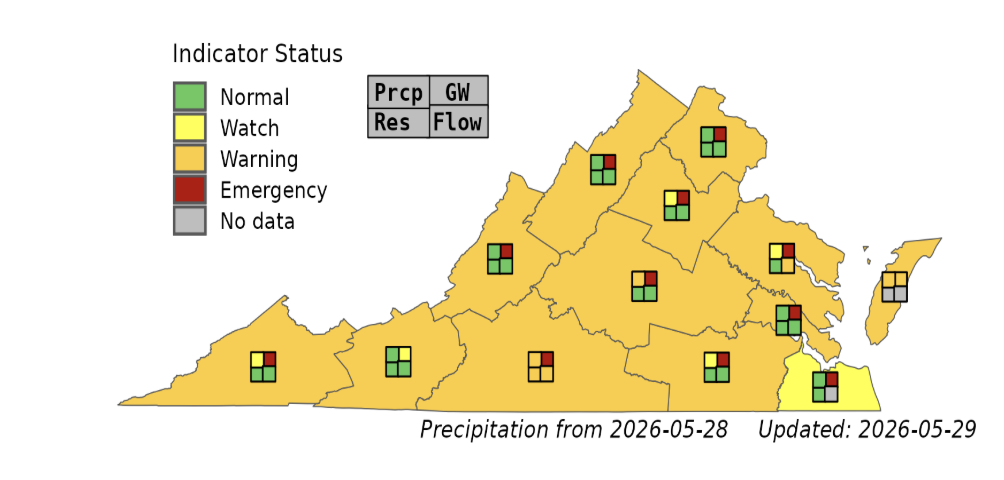
    The state is mostly classified under a “drought warning” by DEQ, but many regions spanning from Southside Virginia into the central part of the state remain in critical groundwater conditions.

    This time of year, much of the rain gets caught up in the tree canopy and is absorbed by vegetation before it can reach the water table and replenish groundwater supplies. Cloe said officials did see areas where the water table had bottomed out and received some water recharge from recent rains.

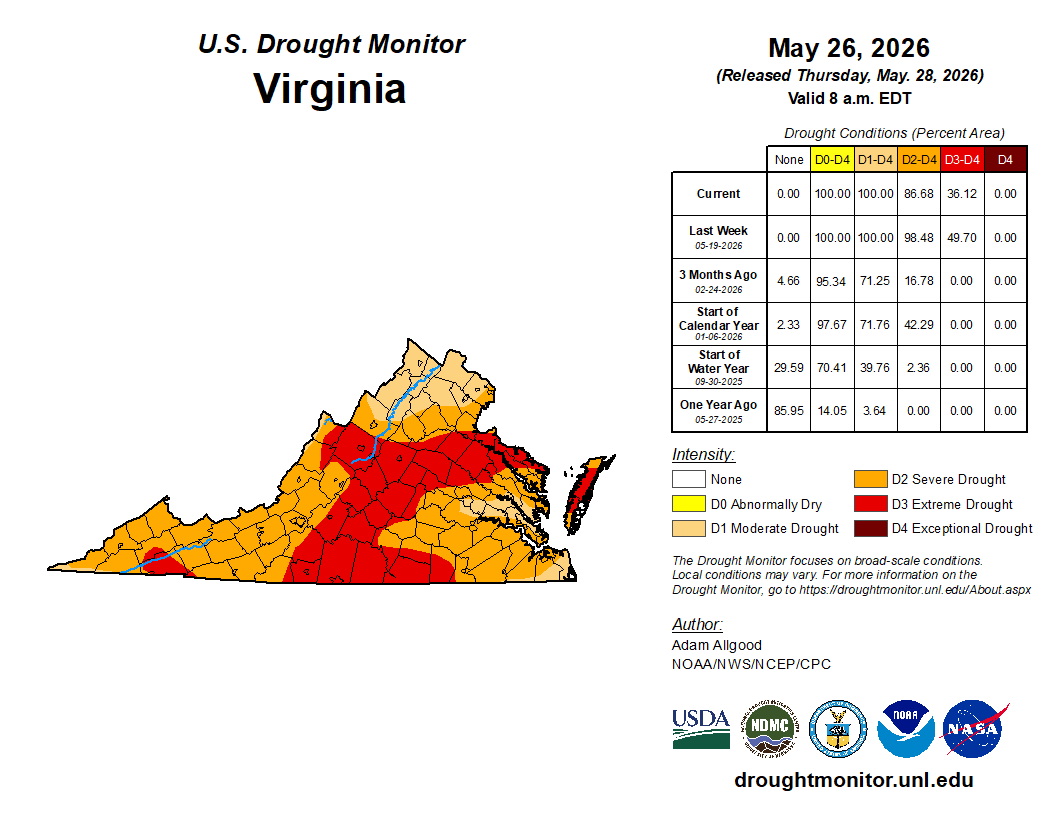
    U.S. Drought monitor shows conditions across Virginia at the end of May 2026. (U.S. Drought Monitor)

    The state experienced an overall dry winter, which left water tables lower than usual, and the dry spring hasn’t helped. DEQ reports that of the 24 groundwater monitoring wells, groundwater levels in 20 are still below the 10th percentile for this time of the year. The state is also about 7.5 inches short on precipitation for the water year that began in October, DEQ states.

    “We are limping along,” Cloe said, describing conditions leading into the final weeks of spring before summer heat intensifies.

    “I would still say it’s probably one of the driest springs, if not one of in recent history,” Cloe said. “There’s still (a) large swath of D3 (extreme) in the U.S. drought monitor punching up from the southside, up through the middle of the state.”

    Drought Indicators and key to Drought Map for the end of May 2026. (Virginia Department of Environmental Quality)

    Despite the persistent dry conditions, drinking water reservoirs remain in good condition, Cloe said. If rainfall tapers off, as forecast in the short term, and temperatures rise significantly, agencies have procedures in place to restrict water use if necessary.

    It will take more sustained rainfall to fully replenish the water table and make up for the long-term dry conditions the state has experienced.

    For a drought warning, DEQ recommends minimizing nonessential water use and beginning voluntary water conservation efforts. The agency also encourages local governments to publicly share water conservation information, continue leak detection and repair programs, and impose mandatory water use restrictions when local water supply conditions warrant.

  • What’s in the water? What we know and don’t know about data center water discharge in Virginia

    What’s in the water? What we know and don’t know about data center water discharge in Virginia

    Data centers require a massive amount of water to cool their systems, which heat up as they process digital information through numerous computers and network servers. Systems that aren’t “closed loop” have to cycle out water that doesn’t evaporate.

    Most data centers in Virginia are permitted to discharge water into municipal wastewater systems, the same place household water goes to be treated and recycled for consumption. But there’s limited data tracking of potential chemicals in data centers’ discharge water.

    At least one data center is permitted to discharge directly into a natural water source in the state: Northeast Creek in Louisa County. Another is applying for a similar permit to discharge into nearby Sedges Creek which feeds into Lake Anna.

    That water is pretreated before being released into the creek and has limits to certain metals and temperature set by the Department of Environmental Quality. But the knowledge gaps about the chemical makeup of data centers’ water discharge poses major questions over whether “forever chemicals” could be contaminating water from the facilities, posing risks to human and environmental health.

    Cooling the waters

    Amazon’s Lake Anna Tech Park project will include an evaporative water cooling system, which is what they use in the Northeast Creek location. The H2O will come from well water until industrial systems are hooked up. At that point, the water will be run through a “membrane” that cools the air and fans will blow it onto the data halls containing the computers.

    Amazon – which operates dozens of data centers in the state – explained that at the two Louisa sites they are only using the evaporation method a small portion of the year; the rest of the time they pull in air from outside for cooling. Water sent through an evaporative cooling system is considered non-contact, meaning it does not directly touch the computer equipment.

    “In Louisa County, we rely on outside natural air-cooling for about 96% of the year and only use water-based cooling during the hottest periods, which is about 4% of annual operations,” Amazon said in a statement.

    After a few cycles the water has to be released. The system dechlorinates the water and manages pH balance before sending it into the creek.

    “As part of this process, cooling water needs to be periodically discharged; this cooling water is called ‘non-contact cooling water.’ It never touches IT equipment, and it’s treated before release in alignment with state environmental standards,” an Amazon representative said.

    Larger, newer data centers are more frequently designed with “closed loop” systems, meaning they don’t take in as much water on a daily basis. Initially, hundreds of gallons of water are pumped into this type of system, much of which evaporates, and then it’s topped off as needed.

    But they take more energy to operate.

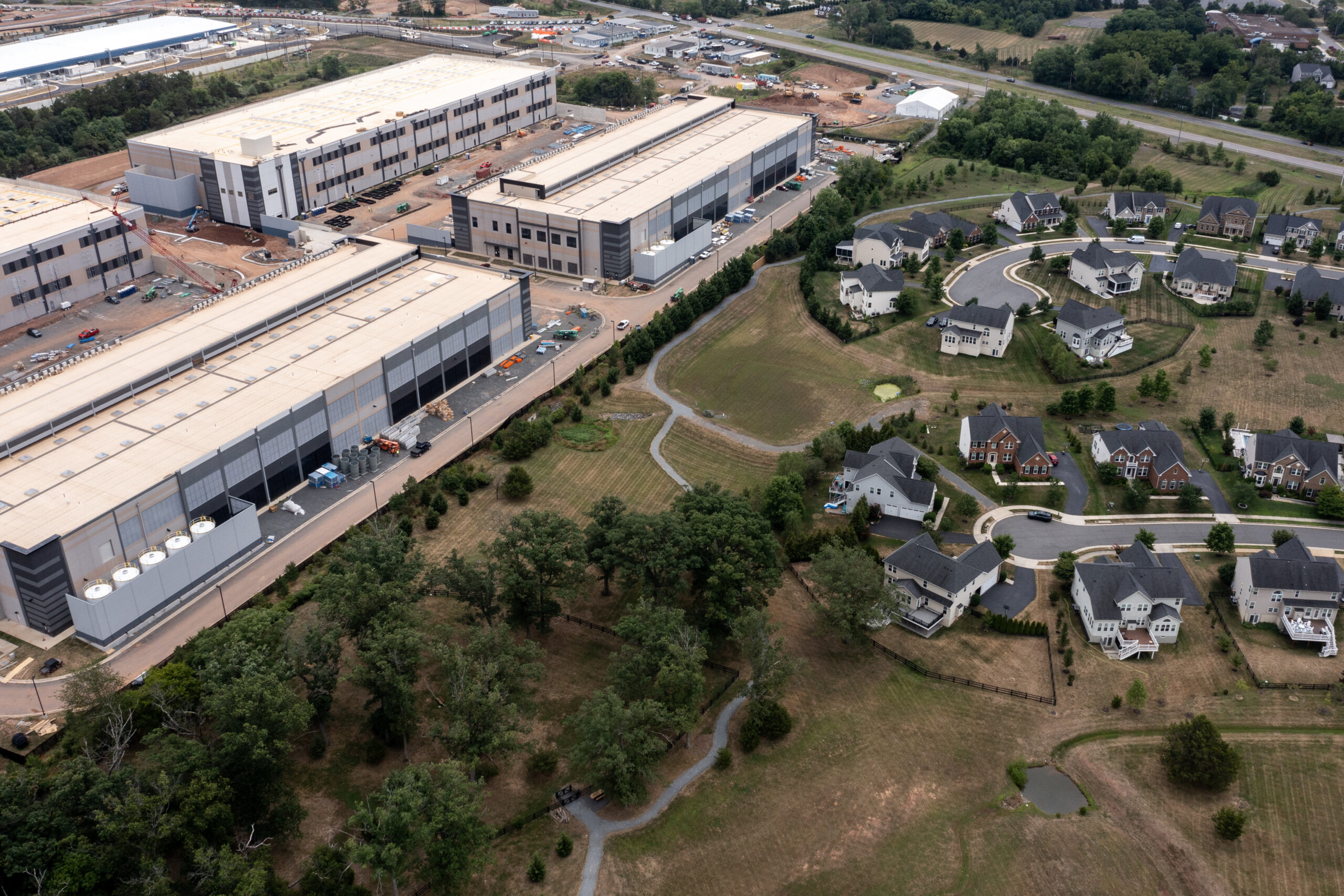
    In an aerial view, an Amazon Web Services data center is shown situated near single-family homes on July 17, 2024 in Stone Ridge, Virginia. (Photo by Nathan Howard/Getty Images)

    Closed loop systems will often use what is described as mechanical cooling or liquid cooling, where the water is recycled through the system, cooled, and placed directly on chips to bring the temperature down. The heat from those systems still has to be expelled through an HVAC system.

    The water is pretreated before being released into the creek and has limits for certain metals and temperature set by DEQ. But with recent reports showing the ubiquitous nature of per- and polyfluoroalkyl substances (PFAS) in everything from water to soil to household products, community members are increasingly worried about whether the data center’s discharge water contains them, too.

    Residents have also cited concerns over PFAS being present in the equipment inside of data centers that is used to cool the heated systems and routinely replaced every few years.

    These chemicals can have serious health impacts when people are exposed to even small amounts, such as decreased fertility, higher risk of some cancers, and weakening of the immune system.

    Virginia currently does not have requirements for the testing of the discharge water of data centers for PFAS, nor does the federal Environmental Protection Agency.

    Because the water being discharged from data centers either into wastewater systems or into the creek are not explicitly required to be tested for PFAS, it is unclear whether they are present or not.

    “We know that they may be using, not only PFAS, but other toxic chemicals. We know that they released massive amounts of water, at least to treatment works, and some of them to surface waters,” said Jonathan Kalmuss-Katz with EarthJustice, a nonprofit that litigates environmental issues. ”And beyond that, it’s just a void. There’s really a dangerous lack of information.”

    The Environmental and Energy Study Institute reports that PFAS can be present in the cooling systems that are liquid based – which is not what the Louisa Amazon data centers use. Data on how much of those chemicals are released from centers and cause pollution is minimal.

    Documents DEQ provided in response to community concerns about potential chemicals in the treated water for the Sedges Creek permit application provide some answers.

    “25% sodium hydroxide, 93% sulfuric acid, 40% sodium bisulfite, polyaluminum chloride, polymer, sulfide‐functional polymer, and 32% calcium chloride,” the agency wrote. “These chemicals are removed during the treatment process; however, Total Residual Chlorine (TRC), chlorides and pH are monitored to ensure they have been removed and that the treatment process is operating properly.”

    What Virginia allows

    Data centers that discharge their pretreated water into wastewater infrastructure have to comply with local treatment requirements and regulations. The amount of water they may unload varies by project and is determined by local leaders.

    Industry representatives emphasize that they follow local and state regulations, which do not include the PFAS testing in the water discharge.

    “Those that do produce wastewater handle it in a variety of ways in compliance with the law. Some may send their wastewater back to a municipal treatment plant, while others may treat it on site,” Nicole Riley with the Data Center Coalition said in an interview. “Some data centers are actually discharging cleaner water than they take in. In all cases, the industry takes seriously its responsibility to comply with applicable laws and regulations.”

    The permit for the Amazon data center in the Northeast Tech Campus in Louisa is allowed to discharge up to 460,000 gallons of water a day into Northeast Creek that feeds into Lake Anna.

    Under the pollutant discharge elimination system permit for that data center, operators must test monthly, and in some cases daily, for residual chlorine used in the treatment phase, as well as aluminum, cadmium, copper, zinc, hardness and pH. The water temperature must be maintained below 90 degrees Fahrenheit.

    In general, data collected over most data centers’ five-year permits must be evaluated by state regulators before the permit may be re-issued. Depending on the results, data center operators may have to make adjustments.

    “In the case of a data center, the source water, type of cooling system, and any additives used with the cooling system are key and need to be evaluated to determine the reasonable potential for a pollutant to be in the discharge,” a DEQ representative said.

    PFAS, which pose harm to human and environmental health, also find their way into drinking water and human bodies. (Photo by CasarsaGuru via Getty Images)

    The draft permit for the additional Amazon data center in the Lake Anna Tech campus that would discharge into Sedges Creek allows up to 280,000 gallons a day. It will abide by the same standards for metals, pH, and temperature regulation.

    Amazon anticipates not needing to use the cooling system all year round. DEQ states they plan to use it “mainly in April through October of each year,” which would presumably lead to less water use than the permitted gallons. The company claims it will be even less, with only 4% of the year needing the water cooling system rather than using air from outside the facility.

    The draft permit also allows for it to be altered to potentially include PFAS testing in the future, if that is something regulators desire.

    “The permit may be reopened to incorporate changes to any applicable standard or requirement, including those related to per- and polyfluoroalkyl substances” DEQ said. It’s a step that advocates want to see the state take.

    “They can test their wastewater before they discharge it to the publicly owned treatment works (POTW) and they should be doing that. POTWs need to know what the sources of PFAS that they’re dealing with are,” Kalmuss-Katz said.

    New PFAS regulations in the works

    The General Assembly this year advanced legislation towards testing for PFAS in wastewater and trying to locate the largest polluters of forever chemicals.

    Senate Bill 138 requires public wastewater treatment facilities, industrial companies that use PFAS, airports and firefighting facilities to test their discharge for PFAS. Data centers do not currently fall under this legislation’s self reporting requirements.

    Additionally, other bills were signed into law that require biosolids — sewage sludge from wastewater treatment facilities that is converted into fertilizer for farms — to be tested for the presence of PFAS. This pairs with past legislation to track down the largest sources of PFAS that are ending up in wastewater treatment facilities.

    The Trump Administration has been adamant about expanding AI infrastructure, which includes data centers, by signing executive orders to beef up the expansion of the industry and the necessary transmission lines and power generation needed to support it.

    Subsequently, the EPA announced the fast-track review of new chemicals that are intended to be used by the data center industry for their equipment and the manufacturing of their components.

    What comes next

    For the draft permit for the Amazon data center discharge into Sedges Creek, the next public hearing will be at Louisa County Middle School on June 9, 2026 at 7 to 9 p.m. From there, DEQ will make final decisions on if they will approve the permit for the facility.

    It remains to be seen whether state or local officials will begin requiring data center discharge water be tested for PFAS and what that process might entail.