Tag: D.C. Bureau

  • Lunch with ‘mad as a murder hornet’ Trump and US Senate GOP fails to heal divisions

    Lunch with ‘mad as a murder hornet’ Trump and US Senate GOP fails to heal divisions

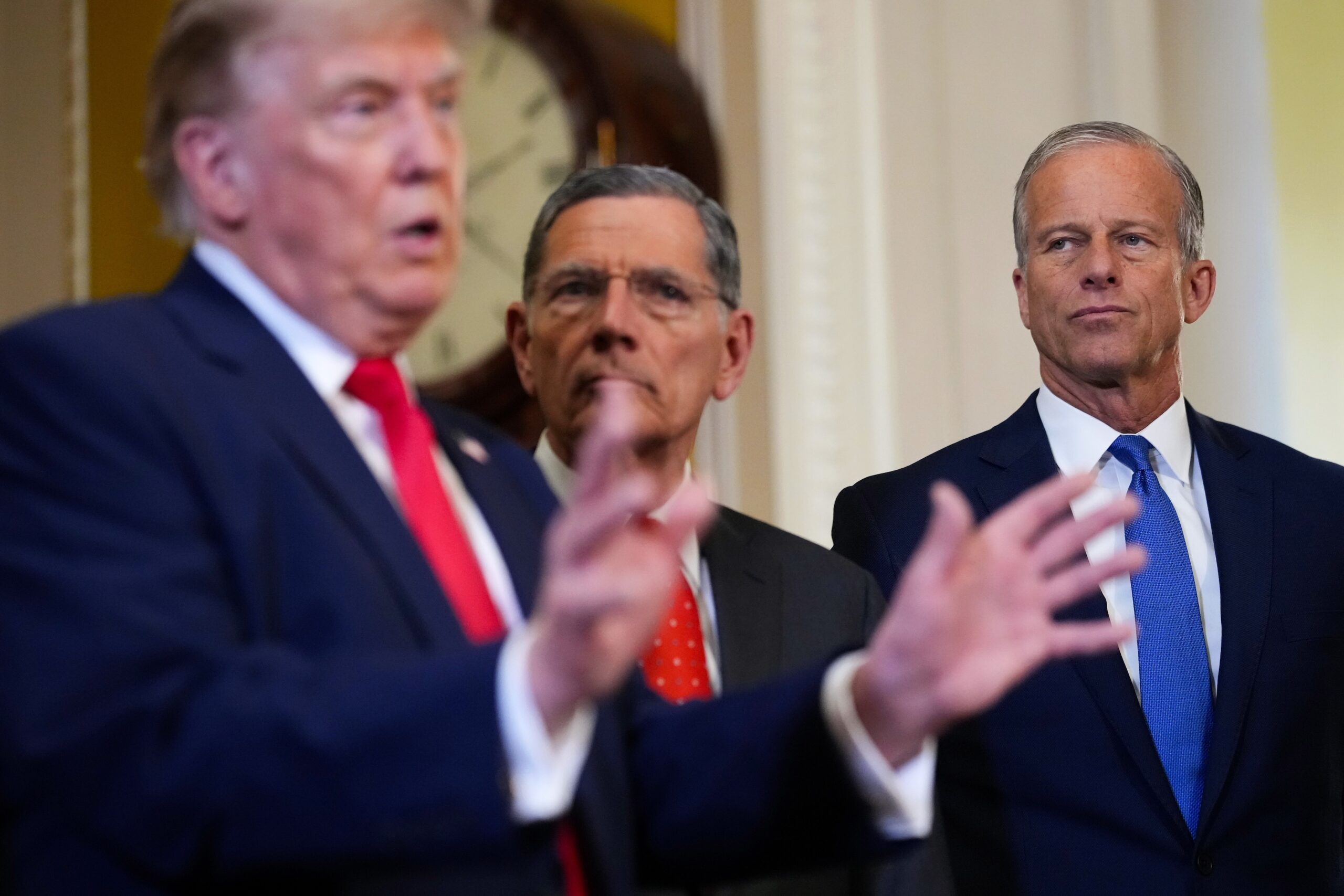
    WASHINGTON — U.S. Senate Republicans walked into a lunch with the president on Wednesday looking for ways to unify, but they left the closed-door meeting on Capitol Hill as fractured as ever about policy goals.

    President Donald Trump said after the huddle that he was “very proud of the party” but didn’t offer any concrete steps forward amid deep divisions on a nationwide voter identification law or other issues that don’t yet have enough GOP support to reach his desk.

    “For the most part we have a really well-unified party,” Trump said. “And I said it very strongly, we have the hottest country anywhere in the world.”

    Republican senators said during hallway interviews after the meeting ended that it wasn’t entirely productive and didn’t create much, if any, goodwill.

    Louisiana Sen. Bill Cassidy somewhat jokingly said the meeting went “swimmingly” before detailing a confrontation he had with Trump over the lack of information on the Iran war. Senators have repeatedly asked for a classified briefing from administration officials, but haven’t yet received one.

    Cassidy, who lost his May primary after Trump endorsed an opponent, said the exchange began when Trump asked why four Republican senators voted with Democrats to approve a War Powers Resolution earlier this week. Along with Cassidy, they were Lisa Murkowski of Alaska, Rand Paul of Kentucky and Susan Collins of Maine.

    “I said, ‘Well, we’ve not been briefed on how it’s going, that the stated objectives don’t appear to be achieved, and it appears as if … it’s not going as well as we’re being told,’” Cassidy recalled. “At which point I think the president said something negative about me. I perceived it as attempting to bully me from asking a question that I think the American people need to know.

    “And I’m not going to be bullied when I feel like I’m asking a question the American people need to know. And so at that point it began to escalate. And at some point it de-escalated.”

    Trump declined to directly answer a question before the meeting began about whether he believes the voter identification law he advocates, which doesn’t have the votes necessary to advance in the Senate, is more important than a broadly bipartisan housing bill. The housing package would have given Republicans a legislative victory on the campaign trail roughly four months before the midterm elections.

    The president was scheduled to sign that housing measure just before he met with Senate Republicans, but he canceled to press for the election bill, called the SAVE America Act.

    The bill would overhaul how Americans register to vote and cast ballots in federal elections, such as requiring proof of citizenship to register to vote and requiring a government-issued photo identification at polling locations.

    “Every election is important. We’re doing very well,” Trump said.

    “They want a lot of communists to come in,” he said, referring to Democrats. “I’m saying it a little bit differently but the people that they’re pushing are communists. And this country is not going to have communists.”

    Trump ‘mad as a murder hornet’ about Iran vote

    Florida Sen. Rick Scott said he hoped the meeting would help Republicans build consensus, though he acknowledged it led to tension.

    “You’ve been around the president, he was pretty forceful about what he cares about,” Scott said, later adding his goal in organizing the meeting was “to try to bring people together.”

    Scott said Senate Republicans didn’t talk with Trump about using the complex budget reconciliation process to establish grants for states that implement certain voter identification requirements. House Speaker Mike Johnson put the idea forward earlier in the day as one way to promote elements of the SAVE America Act.

    Louisiana Sen. John Kennedy said he appreciated the president’s “candor” during the meeting before saying Trump was “mad as a murder hornet about the war powers vote.”

    “And I don’t blame him,” Kennedy said. “Put yourself in his shoes, he’s right in the middle of delicate negotiations and the Senate votes to get out of Iran. And it upset him.”

    Kennedy said the president also pressed for the SAVE America Act, though he somewhat dismissed Johnson’s proposal to provide grants to states instead of enacting the entire bill.

    “I don’t think that’s going to satisfy the president,” Kennedy said.

    ‘Like a hospital board meeting,’ with yelling

    West Virginia Sen. Jim Justice said both Trump and Cassidy “expressed their feelings and didn’t hold back, but at the same time, it ended up respectful.”

    “It was, I wouldn’t say super combative, but very passionate — very passionate,” he said.

    Justice noted that “very, very few questions” were asked at the lunch.

    Kansas Sen. Roger Marshall described Trump and Cassidy’s exchange as “very much like a hospital board meeting when a bunch of doctors are yelling at each other. But at the end of the day, we’ll figure out a way to get along.”

    Trump, he said, was “very disappointed” by the four GOP senators voting this week to try to limit any additional military action against Iran.

    “They’re trying to negotiate that and they feel like that vote from Republicans chopped their legs out from under them,” Marshall said. “And they’re making such incredible progress on this deal. So it’s hard for them to negotiate it when there’s two messages coming out of Washington.”

    Pressed on the confrontation between Cassidy and Trump, Sen. Tommy Tuberville said the two “just had some differences of opinion about Iran.”

    The Alabama Republican said “it was very cordial — it wasn’t over the top.”

    Not many questions

    North Carolina Sen. Thom Tillis acknowledged there was some contention in the meeting over the voter identification bill.

    “I know there’s frustration over the SAVE America Act passage, but we simply don’t have the votes because we’re not gonna nuke the filibuster, so it’s more a matter of how do we move forward,” he said. “Not all of the meeting was contentious, but there’s a general consensus that we on Capitol Hill have to start getting in lockstep.”

    When it comes to the bipartisan housing bill, Tillis said it being signed into law is “up to the president, we’ve done our work.”

    South Dakota’s Mike Rounds declined to give details about the meeting but said that Republicans “had a good talking to,” and that senators did not ask the president many questions.

    Rounds said while Trump pushed for the SAVE America Act, there was little acknowledgment that the Senate lacks the votes to pass the bill.

    Texas Sen. John Cornyn said there “wasn’t really a lot of opportunity” to ask questions during the meeting. He said Trump spoke for one hour and 15 minutes.

    Missouri Sen. Josh Hawley said the president repeated some of the comments he posted on social media earlier in the day when he said he would refuse to sign the housing affordability package until Congress approves the election bill.

    “He’s here to talk about whatever it is he wants to talk about,” Hawley said. “And without speaking for him, I think it’s safe to say that what he posted this morning is what he talked about.”

  • Families, lawmakers, advocates pay tribute to victims of social media harms at US Capitol memorial

    Content notice: This story includes discussion of suicide. If you are struggling or in crisis, help is available. You can call or text 988 in the U.S. and Canada, or contact the National Suicide Prevention Lifeline. There is also an online chat at 988lifeline.org.

    WASHINGTON — Placards featuring 272 names, each with a photo and the age of a child or young adult who lost their life due to what their families call social media-related causes, lined the lawn of the U.S. Capitol’s Upper Senate Park Tuesday evening.

    Scattered among the signs stood dozens of bereaved families, friends, lawmakers and advocates from across the country and both sides of the political aisle, joining together to honor those who had died — and call for legislation aiming to make social media safer for children.

    Founded in 2023 by two mothers whose sons died the same morning, Social Media Victims Remembrance Day commemorates young victims of online threats such as cyberbullying, blackmail, drug dealing, viral challenges and addictive algorithms.

    Tuesday’s public memorial — the largest ever held in commemoration of kids impacted by social media, organizers said — featured speeches from Democratic and Republican U.S. senators working to pass legislation that would, among other things, seek to hold tech companies more accountable for a series of harms caused by their platforms.

    Just as they took the stage, the rain that had been showering Washington all day trickled to an end and sunlight broke through clouds, shining down on the crowd and the placards that swayed gently in the breeze around them, which Sen. Amy Klobuchar used as a metaphor for the issue.

    “I think part of what we need is more sunshine on what’s happening here, and more transparency, and people understanding how truly bad this is,” the Minnesota Democrat told the families seated before her.

    Sens. Richard Blumenthal, a Connecticut Democrat, and Josh Hawley, a Republican from Missouri, also spoke at Tuesday’s memorial.

    Social Media Victims Remembrance Day

    Klobuchar

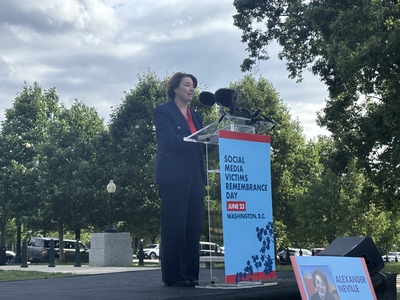
    U.S. Sen. Amy Klobuchar, a Minnesota Democrat, speaks at a Social Media Victims Remembrance Day event outside the U.S. Capitol on June 23, 2026. (Photo by Amelia Twyman/States Newsroom)

    Mothers Kristin Bride and Amy Neville created Social Media Victims Remembrance Day to honor their late sons Carson Bride and Alexander Neville, who died in social media-related incidents on June 23, 2020.

    Carson Bride, of Oregon, was 16 when he died by suicide after being cyberbullied through anonymous integrated apps on Snapchat. Fourteen-year-old Alexander Neville, of Arizona, lost his life the same morning from a fake prescription pill laced with fentanyl, which he had purchased through a drug dealer, also on Snapchat.

    For Neville, founding Social Media Victims Remembrance Day was a way for her to put her “feelings out there at scale.”

    The day now also gives her the chance to connect with other parents who have gone through similar tragedies.

    “It’s a weird feeling being out in the world among people who don’t know what you’ve experienced,” she said in a joint interview with Bride on Tuesday. “Being together like this with folks who know, folks who have similar experiences, we feel normal. It is special to be together like this.”

    Bride saw Social Media Victims Remembrance Day as an opportunity to “make a difference,” she said.

    “I really feel like the way we can come at social media companies is education and awareness, which this event does,” she added. “Carson always wanted to make the world a better place. And I feel like we could be grieving alone on this day, or we could be together with so many other families.”

    Big Tech or families?

    Bride and Neville held the first Social Media Victims Remembrance Day event in 2023 in front of the Orange County Crime Victims Monument, a memorial outside the district attorney’s office.

    Then, after taking a year off, they decided to bring the observance to the nation’s capital last year because they wanted to increase lawmakers’ awareness of the dangers surrounding youth social media use.

    “We want them to make the decision: Is it Big Tech, or is it American families?” Bride said. “Because unfortunately, this memorial continues to grow.”

    Over the past year, efforts to protect children online and hold Big Tech companies accountable for social media harms have continued to grow, with U.S. lawmakers in both the House and Senate pushing regulatory legislation and parents taking a legal stand.

    Tuesday’s event three months after a California jury found Meta and Youtube liable in a breakthrough social media addiction trial, one of the first in a long line of suits blaming tech companies for personal injury and recklessness. A New Mexico jury had just days before found that Meta violated its state law in a separate child sexual exploitation case.

    Social media platforms have rejected the framing that their products are responsible for harms to young users.

    In a statement responding to the California verdict, Meta said the issue was much more complicated than the jury recognized.

    “Teen mental health is profoundly complex and cannot be linked to a single app,” a company spokesman wrote on X.

    Hawley Rememberance Day

    U.S. Sen. Josh Hawley, a Missouri Republican, speaks at a Social Media Victims Remembrance Day event outside the U.S. Capitol on June 23, 2026. (Photo by Amelia Twyman/States Newsroom)

    Congressional action

    On Monday, Republican and Democratic leaders on the House Committee on Energy and Commerce announced that they had reached a bipartisan agreement on a bill aimed at making social media environments safer for children and holding parent companies accountable.

    “If you make a defective toaster and it blows up in someone’s home, they are liable,” Blumenthal said Tuesday. “When Big Tech makes products that addict and kill young people, they should be liable under a duty of care that is clear and effective.”

    Blumenthal was one of the senators who introduced the measure in February 2022. The bill eventually passed in the Senate, 91-3, but did not receive a vote in the House as social media platforms opposed it.

    House Energy and Commerce Committee Chair Brett Guthrie of Kentucky, a Republican, and ranking Democrat Frank Pallone of New Jersey reached a deal this year to include the bill as part of a broader legislative package titled the Kids Internet and Digital Safety, or KIDS, Act.

    “Through empowering parents, establishing safety as a default, strengthening privacy for children and teens, increasing transparency around data brokers, and holding Big Tech accountable, the KIDS Act delivers the 21st century protections parents have demanded and our kids deserve,” Guthrie and Pallone said in a news release.

    Politico reported last week that Meta has dropped its opposition to the safety measures because the package also includes provisions on artificial intelligence that the company supports.

    Hawley on Tuesday accused the companies of putting profits above children’s wellness.

    “We’re here today to say that there is no amount of profit that justifies the exploitation of our children,” Hawley said. “But that’s exactly what these companies are doing, and they know just what they’re doing.”

  • Judges block Trump push for Michigan voter info, setting up possible Supreme Court fight

    Judges block Trump push for Michigan voter info, setting up possible Supreme Court fight

    A federal appeals court on Wednesday ruled the Department of Justice isn’t entitled to access the sensitive personal data of Michigan voters, a setback in President Donald Trump’s push to assert power over state-run elections.

    The decision moves the country closer to a potential fight at the U.S. Supreme Court over state voter rolls ahead of the November midterm elections, with Michigan at the center.

    The Trump administration has sued 30 states for copies of their voter information. Federal officials want to run the data through a Department of Homeland Security computer program to identify possible noncitizen voters.

    In a 2-1 decision, a three-judge panel of the 6th Circuit Court of Appeals found that Michigan Democratic Secretary of State Jocelyn Benson isn’t required to turn over sensitive voter data, including dates of birth, driver’s license and Social Security numbers of voters. The 6th Circuit is the first appellate court to weigh in on the voter roll lawsuits after a series of district court rulings against the DOJ.

    The Justice Department had demanded Michigan’s voter roll under the 1960 Civil Rights Act, which grants the U.S. attorney general broad access to documents and records that “come into the possession” of election officials. Congress passed the law to empower investigations into voting discrimination against Black citizens.

    Lower court affirmed

    Wednesday’s opinion affirmed a February decision by U.S District Court Judge Hala Jarbou, a Trump appointee in the Western District of Michigan, who ruled that the Justice Department isn’t entitled to voters’ data. Michigan’s voter registration database is a record created by state officials, not a document that comes into their possession, she reasoned.

    The appellate judges agreed, writing that making the state’s full voter roll subject to the Civil Rights Act would place Michigan officials on a “collision course” with the National Voter Registration Act and the Help America Vote Act, two federal laws that require states to maintain and update voter registration lists.

    The Civil Rights Act “tells election officials to retain and preserve certain records and papers that come into their possession, and the NVRA and HAVA tell election officials to remove ineligible voters from statewide voter registration lists,” Judge Andre B. Mathis, a President Joe Biden appointee, wrote in the majority opinion.

    “We should not adopt a reading that would place election officials in violation of one federal law for trying to comply with others,” Mathis added.

    One member of the appellate panel, Judge John B. Nalbandian, a Trump appointee, wrote in a dissent that Michigan’s voter roll is a record that the Justice Department can demand under the Civil Rights Act. He argued that requiring Michigan to turn over the data wouldn’t conflict with the NVRA and HAVA.

    DOJ sees ‘carveout’

    During oral arguments in May, the Justice Department suggested that upholding the district court decision would weaken its ability to investigate racial discrimination in voting. DOJ attorney David Goldman told the panel that the district court judge had created a “carveout” in the Civil Rights Act not rooted in the law.

    But Michigan Assistant Attorney General Heather Meingast, representing Benson, told the judges that the Justice Department’s demand is unprecedented and unsupported by federal law.

    “It doesn’t seem to meet the test of what the (Civil Rights Act) was talking about in the ‘60s,” Meingast said. “And the purpose was voters turning in their documents, their applications, their poll taxes.”

    The Justice Department has been pursuing state voter rolls for more than a year. While some Republican-led states voluntarily provided the data, most states have resisted, leading to a wave of lawsuits. So far, no court has ruled in the DOJ’s favor.

    Lawyers for the Justice Department have said the voter information would be shared with Homeland Security’s Systematic Alien Verification for Entitlements, or SAVE, system — a computer program that originally checked the eligibility of individual immigrants for government benefits that the Trump administration overhauled into a tool to verify citizenship.

    On Monday, a federal judge in Washington, D.C., ruled that the changes to SAVE had been made illegally and that the Trump administration had violated the privacy of millions of Americans. The judge also noted that problems had been found with SAVE, including falsely flagging citizens.

    The Justice Department didn’t immediately respond to a request for comment. DOJ lawyers can ask the full 6th Circuit or Supreme Court to hear the case.

    “The law cannot be any clearer– states run elections, the federal government is not entitled to Michigan voters’ personal data, and the president cannot change election law with the stroke of a pen,” Benson said in a statement.

  • States that won’t obey Trump order will have their mail ballots halted, postmaster says

    States that won’t obey Trump order will have their mail ballots halted, postmaster says

    The U.S. Postal Service won’t deliver mail ballots in states that refuse to turn over lists of voters under a proposed rule, the agency’s chief executive said Wednesday, angering Democrats who warn the decision will disenfranchise voters.

    Postmaster General David Steiner defended the rule at a Senate hearing and dismissed accusations that the Postal Service was acting politically after President Donald Trump signed an executive order in March restricting voting by mail.

    “If a state refuses to turn their absentee voter list over to the federal government, will the Postal Service still mail their ballots under this proposed rule?” Sen. Gary Peters, a Michigan Democrat, asked Steiner.

    “Under our proposed regulation, no,” Steiner replied.

    Steiner’s testimony, before the Senate Homeland Security & Governmental Affairs Committee, marked the clearest acknowledgment yet by a federal official that the rule threatens to upend voting by mail across the country.

    If the rule takes effect and Democratic-led states refuse to comply, the requirements would effectively limit mail voting to Republican-led states during November midterm elections to decide control of Congress.

    The Postal Service put forward the rule after Trump ordered Steiner to require states to submit lists of anticipated mail voters to the agency as a condition of having ballots delivered.

    Trump cancels signing ceremony

    The executive order is one of several steps the Trump administration has taken this year to influence how elections are administered, along with the Department of Justice suing states to obtain sensitive voter data.

    Underscoring the depth of Trump’s interest, as Steiner was speaking Wednesday morning the president abruptly called off a U.S. Capitol ceremony to sign a bipartisan housing bill because of the Senate’s refusal to pass the SAVE America Act. The legislation would require voters to show documents, such as a birth certificate or passport, proving their citizenship.

    “Now we have this new rule you’ve put out saying that states have to turn over their voting rolls and you, the U.S. Postal Service, will decide who’s approved to send their ballot through the mail,” Sen. Elissa Slotkin, a Michigan Democrat, said. “It’s just another backdoor way of trying to influence this election.“

    Slotkin said Trump’s decision to cancel the housing bill signing demonstrated the “level of obsession this president has” over elections.

    Turning over names

    Every state would have to provide the names of residents expected to vote by mail. Additionally, eight states and Washington, D.C., conduct elections by mailing all voters a ballot, meaning election officials would have to provide information on every voter. Those states include California, Colorado, Hawaii, Nevada, Oregon, Utah, Vermont and Washington.

    Trump and his aides argue the restrictions are needed to combat noncitizen voting, which occurs very rarely. Democrats and voting rights groups have sued over the order, arguing it’s an unconstitutional assertion of presidential authority over state-run elections. No judge has yet halted it.

    Steiner sought to place himself outside the controversy and said, in response to a question, that the Postal Service would adhere to a court order blocking the rule if one were issued. Asked about the legal authority underlying the rule, he said he would “have to defer that to the courts to understand the authority.”

    Steiner, who became the postmaster general in July 2025, cast the rule as primarily focused on best practices for election mail, a description that understates the scope of the proposal, which postal experts call unprecedented.

    “I’m not a political person and the Postal Service is not a political organization,” Steiner said.

    Dems urge Steiner to withdraw rule

    Democrats expressed sharp disagreement with Steiner and accused him of folding to Trump’s efforts to exercise more control over elections. Steiner answers to the USPS Board of Governors, not the president, and his critics say he is endangering the agency’s independence by complying with the executive order.

    Every Senate Democrat, as well as two independents who caucus with the party, on Tuesday signed a letter to Steiner urging him to withdraw the rule. The letter warns that aside from the rule’s legal and constitutional problems, it’s not feasible for state and local election officials to meet its requirements.

    “The proposed regulation demands that the Postal Service set up an entirely new system and database to process and transmit millions of absentee ballots that is secure and accessible to every American election official, just months prior to a general election,” the letter says.

    At Wednesday’s hearing, GOP senators mostly steered clear of the mail ballot rule, instead focusing on the official topic, the Postal Service’s finances. But Sen. Bernie Moreno, an Ohio Republican, accused Democrats of hypocrisy over their past support of the “For the People Act.”

    The sweeping bill, offered when Democrats last controlled Congress, would have required states to offer same-day voter registration and expand mail voting. Opponents said it amounted to nationalized elections.

    “Three years later all of them are testifying, ‘It’s outrageous, President Trump is trying to nationalize elections.’ No, he’s not, he’s trying to get rid of voter fraud,” Moreno said, adding that Democrats had now “dug up from their bottom desk drawer” the Constitution.

    “Should we get back to post office stuff now?” Moreno said.

    “Absolutely,” Steiner replied.

  • Trump spikes housing bill at last minute, refusing to sign until SAVE America Act passes

    Trump spikes housing bill at last minute, refusing to sign until SAVE America Act passes

    President Donald Trump derailed a housing overhaul that he was set to sign into law Wednesday, canceling a signing ceremony for the broadly popular bipartisan bill until Congress passes an election security measure.

    Trump had been scheduled to sign the bill, which passed the Senate Monday and House Tuesday with wide margins, during a Capitol ceremony.

    But in a pair of social media posts prior to the event, he derided the overhaul aimed at lowering housing costs as “minor” before refusing to sign it entirely.

    “Today’s Housing News Conference and Signing is hereby cancelled until such time as we pass the desperately needed SAVE AMERICA ACT, which I consider to be a National Emergency,” Trump wrote on his social media platform, Truth Social.

    The controversial SAVE America Act, a top priority for Trump, addresses the extremely rare phenomenon of noncitizen voting. Republican senators have told Trump there are not enough votes in the chamber for it to pass.

    The housing bill’s Senate sponsors, Banking Committee Chairman Tim Scott and ranking Democrat Elizabeth Warren of Massachusetts, sought to lower the costs of housing construction by removing regulatory barriers, expanding the uses of federal housing grants and banning institutional investors from buying single-family homes.

    Scott, a South Carolina Republican, lauded the bill Tuesday as not only bipartisan, but nonpartisan, addressing universal needs.

    Republican leaders framed the measure as addressing affordability, which is expected to be a key issue in November’s midterm elections amid stubborn inflation.

    The measure, which combined elements of proposals in each chamber, appeared on a fast track to becoming law after the Senate approved it 85-5 Monday and the House voted 358-32 Tuesday. The White House had said Trump supported the bill.

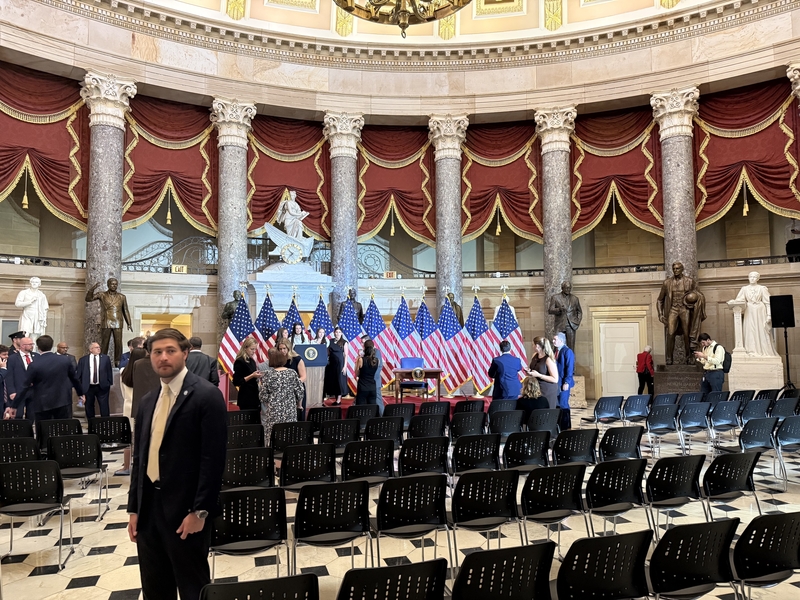
    Statuary Hall in the U.S. Capitol on June 24, 2026, after President Donald Trump called off a scheduled bill-signing ceremony. (Photo by Jennifer Shutt/States Newsrooom)

    Statuary Hall in the U.S. Capitol on June 24, 2026, after President Donald Trump called off a scheduled bill-signing ceremony. (Photo by Jennifer Shutt/States Newsroom)

    The House opponents were virtually all from a group of conservatives, led by Florida’s Anna Paulina Luna, who said she would oppose all legislation from the Senate, and even some House rules resolutions, until the Senate passed Trump’s elections security measure.

    Speaker Mike Johnson, R-La., said during a Wednesday morning press conference that he spoke with the president earlier in the day and that he is going to delay signing the housing bill until Congress approves a grant program for elections through the complex budget reconciliation process. That’s the same procedure the GOP used to enact its “big, beautiful” law and $70 billion for immigration enforcement.

    “You have to put it on a reconciliation bill,” he said. “We believe that if you create a grant program that ties it to reconciling the budget and you allow blue states, if they come to their senses and they want to avail themselves of election integrity proposals and ideas and policies, they can draw down from a federal fund and use those funds. We’re willing to invest heavily in that.”

    Johnson said he told Trump that Republicans in Congress can enact that policy if they “stand together.”

    “As you know he has a window of time before he has to sign a bill and he’s going to use a bit more of that window of time,” Johnson said. “And we’re going to go through this together.”

    Johnson said he expects Trump to sign the housing bill within the 10-day window.

  • Get ready for the semiquincentennial: Americans celebrate a 250th anniversary

    Get ready for the semiquincentennial: Americans celebrate a 250th anniversary

    WASHINGTON — Parties, protests, displays of historic documents, odes to the Founding Fathers — and a massive political rally by the president — will mark a deeply polarized nation’s 250th anniversary on this Fourth of July.

    Pomp and circumstance will abound for the semiquincentennial as the similarly named America250 and Freedom 250 offer different slates of programming on Independence Day and beyond.

    A countdown and ball drop will ring in the holiday in the eight time zones across the United States and its territories. The milestone birthday bash will close with an “unprecedented pyrotechnic spectacle” in the skies above the National Mall, livestreamed.

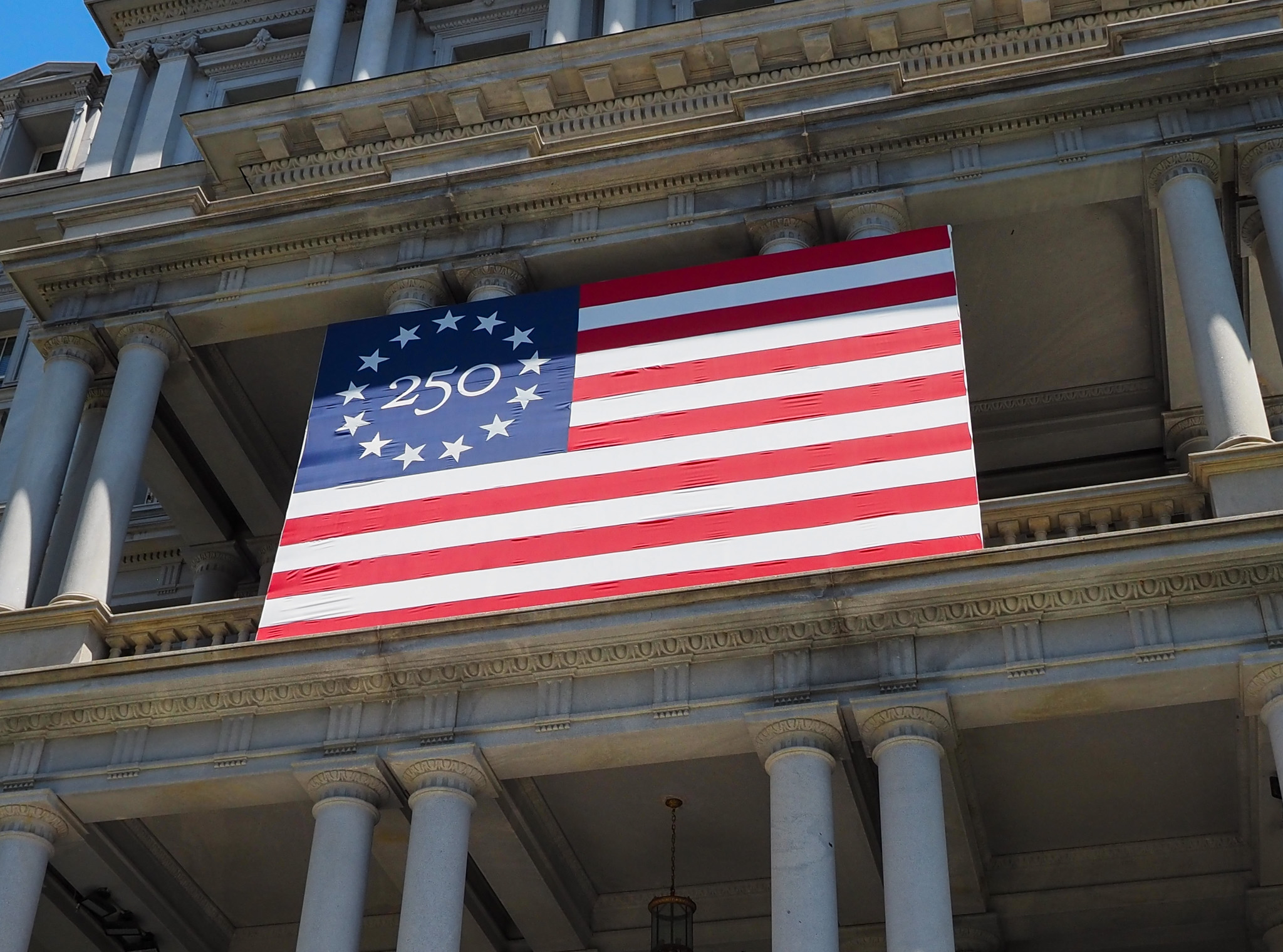
    Tourists walk along the barricades surrounding the Freedom 250 construction site on 7th Street NW on Monday, June 22, 2026. A banner in the distance promoting Freedom 250 hangs on the Federal Aviation Administration headquarters. (Photo by Ashley Murray/States Newsroom)

    Tourists walk along the barricades surrounding the Freedom 250 construction site on 7th Street NW on June 22, 2026. A banner in the distance promoting Freedom 250 hangs on the Federal Aviation Administration headquarters. (Photo by Ashley Murray/States Newsroom)

    In Philadelphia, a time capsule, to be opened in 2276, will be buried beneath Independence National Historic Park. The capsule contains contributions from each state and territory; sports memorabilia, including an Olympic gold medal; a 1GB digital archive from the Library of Congress; and a pocket Constitution signed by each Supreme Court justice, among hundreds of other items.

    Visitors to the nation’s capital can watch and anyone across the country, and the world, can tune in to a live dramatic reading of the Declaration of Independence at 10 a.m. Eastern at the National Archives.

    The public will also be invited to seldom-accessible spaces. The Federal Circuit Center for Innovation & Law will open its doors July 3. Guests, who must register ahead, will get the rare opportunity to don a judge’s robe and take part in a mock trial inside the U.S. Court of Appeals for the Federal Circuit’s courtrooms.

    Federal judges will be on hand to answer questions, and Chief Judge Kimberly A. Moore hopes the experience will “show how courts, public service, discovery and history continue to shape the American story,” she told States Newsroom in a statement.

    Former first lady Dolley Madison's parlor at her former residence on H Street NW in Washington, D.C., as seen on Monday, June 22, 2026. (Photo by Ashley Murray/States Newsroom)

    Former first lady Dolley Madison’s parlor at her former residence on H Street NW in Washington, D.C., on June 22, 2026. (Photo by Ashley Murray/States Newsroom)

    The court complex, which is connected to the residence of first lady Dolley Madison, the wife of President James Madison, will also showcase various highlights of American history. Visitors can see Dolley’s parlor, but also learn that NASA was headquartered there from 1958 to 1961. Space suits and a 3.9-billion-year-old moon rock will be on display.

    America250 vs. Freedom 250

    Two separate celebrations of America’s big year are similarly named but feature vastly differing programs that stretch beyond Independence Day.

    America250, a 24-member bipartisan commission created by Congress a decade ago, has spearheaded nationwide initiatives for school students, corporate employees and young entrepreneurs.

    The commission has organized plenty of July Fourth happenings, including the ball drops, time capsule burial and simultaneous block parties in Charleston, South Carolina; Fort Campbell, Kentucky; and Milwaukee.

    America250 will also host a benefit concert at the Los Angeles Memorial Coliseum, which will feature Chris Stapleton and the Smashing Pumpkins. Tickets are $17.76, and all proceeds go to nonprofit organizations to kick-off “Giving 4th,” a nationwide initiative to promote mid-year donations.

    It is all separate from President Donald Trump’s plans for 2026. Days after beginning his second term, Trump issued an executive order creating Task Force 250, resulting in White House-led programming known as Freedom 250.

    Fencing along the Freedom 250 construction site on the National Mall near Madison Drive and 7th Street NW on Monday, June 22, 2026. (Photo by Ashley Murray/States Newsroom)

    Fencing along the Freedom 250 construction site on the National Mall near Madison Drive and 7th Street NW on June 22, 2026. (Photo by Ashley Murray/States Newsroom)

    America250 Chair Rosie Rios said the parallel initiatives are a collaboration to balance events in the nation’s capital and beyond.

    “You see a lot of activities that the administration is planning in D.C. It was our agreement that we would focus on ‘sea to shining sea,’ and still obviously have opportunities for all Americans to participate across the board,” said Rios, who served as U.S. treasurer under the Obama administration.

    State fair, car races, Trump rally

    The White House initiative will take over the National Mall.

    The president will kick off the Great American State Fair with a speech on Wednesday night. The fair, featuring 150 exhibits from all states and territories, a Ferris wheel and a model of Trump’s controversial proposed “triumphal arch,” will last until July 10.

    The Washington Monument can be seen from a Freedom 250 ferris wheel at 7th Street and Madison Drive NW on Monday, June 22, 2026. (Photo by Ashley Murray/States Newsroom)

    The Washington Monument can be seen from a Freedom 250 ferris wheel at 7th Street and Madison Drive NW on June 22, 2026. (Photo by Ashley Murray/States Newsroom)

    Winners of the Freedom 250 “American Heroes” student art contest will also be honored at the fair.

    As part of the Freedom 250 lineup, Trump will visit North Dakota on July 1 ahead of the Theodore Roosevelt Presidential Library opening set for July 3.

    A Freedom 250 firework display at Mount Rushmore in South Dakota is also scheduled for the eve of Independence Day.

    Trump promised the “most spectacular TRUMP RALLY of them all” on July Fourth, featuring military bands and orchestras, military flyovers and keynote remarks from the president himself.

    The night will culminate with the “LARGEST FIREWORKS SHOW IN HISTORY,” he wrote on his Truth Social platform on June 15.

    A National Guard member stands along the National Mall on Independence Avenue and 12th Street SW on Monday, June 22, 2026, (Photo by Ashley Murray/States Newsroom)

    A National Guard member stands along the National Mall on Independence Avenue and 12th Street SW on June 22, 2026. (Photo by Ashley Murray/States Newsroom)

    Attendees can also expect to see an increased National Guard presence as part of the administration’s “summer surge.”

    Trump’s Freedom 250 festivities will extend into August with a national high school athletic competition for 14-to-17 year olds, dubbed “The Patriot Games.” The games are scheduled in Washington, D.C., for Aug. 9-11 and will stream on the ESPN app.

    A one-hour primetime finale special will air on ABC the evening of Aug. 13. One female and one male athlete each will win a $250,000 scholarship.

    A banner promoting the Freedom 250 Grand Prix scheduled for August hangs on the Department of Transportation's Orville Wright Federal Building at 800 Independence Ave. SW on Monday, June 22, 2026. (Photo by Ashley Murray/States Newsroom)

    A banner promoting the Freedom 250 Grand Prix scheduled for August hangs on the Department of Transportation’s Orville Wright Federal Building at 800 Independence Ave. SW on June 22, 2026. (Photo by Ashley Murray/States Newsroom)

    On Aug. 22-23, motorsports will come to the capital for the Freedom 250 Grand Prix where an NTT INDYCAR SERIES race will follow a 1.7 mile circuit “through the National Mall and surrounding city streets,” according to the event’s website. The event will be broadcast live on FOX.

    ‘After the fireworks’

    Rios said America250 also has an “after-the-fireworks strategy.”

    Winners of essay, art and poetry contests at schools across the U.S. can choose an all-expenses-paid “America’s Field Trip” to one of several locations.

    They include a private guided tour of the Kennedy Space Center in Cape Canaveral, Florida; Mount Rushmore National Memorial in South Dakota; or Yellowstone National Park in Montana and Wyoming, among other choices.

    A national contest and expo for young entrepreneurs in San Francisco — and another in Washington, D.C., this coming November — awarded $25,000 in seed grants under the “America Innovates” and startup initiative.

    A 3.9 billion-year-old Moon rock on display at the Federal Circuit Center for Innovation & Law, which is connected to NASA's former headquarters on Madison Place NW on Monday, June 22, 2026. (Photo by Ashley Murray/States Newsroom)

    A 3.9 billion-year-old Moon rock on display at the Federal Circuit Center for Innovation & Law, which is connected to NASA’s former headquarters on Madison Place NW on June 22, 2026. (Photo by Ashley Murray/States Newsroom)

    The commission is also aiming to make 2026 the “largest year of volunteer hours ever recorded by our country,” Rios said. A counter on the commission’s website displays the number of “America Gives” hours tracked, and Rios will announce a grand total on New Year’s Eve in Times Square.

    “We’ve had great stakeholders who’ve already made their pledges, so Coca-Cola, for example, made a pledge for 250,000 volunteer hours. Not to be outdone, Rob Manfred from Major League Baseball says, ‘Well, we’re going to do 250,000 volunteer hours,’” Rios said, referring to the baseball commissioner.

    ‘Declaration of Interdependence’

    Not all are feeling celebratory.

    A coalition of organizers led by those who spearheaded the 2017 Women’s March will host a nationwide mobilization event June 27 demanding change for America’s next 250 years.

    “We know the oxygen is going to be consumed by the official Trump-led commemoration on the Fourth. Kicking this off, in a proactive way, if we can talk about what we want this country to look like and what it actually does look like ahead of that, it’s important that we go first,” said Angelo Greco, a D.C.-based strategist handling messaging for the event.

    Progressive groups including the 50501 movement, All of U.S. 250, Next 250 and Get Free are expecting up to 5,000 people at a flagship march near the White House and thousands more at teach-ins, faith events, art installations, marches and cultural events at 80 locations throughout the U.S.

    Organizers are collecting signatures on a “Declaration of Interdependence” outlining four principles for a nation where: “All people are treated with dignity and respect; Everybody feels safe in every community; Access to clean, green spaces is abundant; and Every person who works earns a living wages and benefits that allow families a work-life balance.”

    “We’re taking away the spotlight from those in power that want to whitewash our history, and instead setting the terms of the debate about what the story of America has been, who we are, and who we should become,” said Anthony Vidal Torres, communications director at Get Free.

    Activists said they are ready to incorporate any relevant news events into their messaging, not least of which could include a forthcoming Supreme Court decision on birthright citizenship.

    The future of a polarized nation

    Thought leaders, lawmakers and former administration officials from both parties are marking the nation’s semiquincentennial by sounding the alarm about the effects of polarization.

    Citing recent statistics, including that only 4 in 10 Gen Zers are more likely to describe the Founding Fathers as “villains” rather than “heroes,” an advisory board convened by the center-left Progressive Policy Institute launched the American Identity Project meant to guide policymakers and educators on the future of civics education.

    Rep. Ritchie Torres, D-N.Y., an adviser on the project, said he worries the liberal patriotism modeled by figures like Martin Luther King Jr. and former President Barack Obama is “vanishingly rare.”

    “The central emotion of our time is not patriotic hope about America, but rage against America across the political spectrum,” Torres said at the think tank’s June 11 event to unveil the board’s Identity Project “manifesto.”

    Linda Chavez, a former Reagan administration official and chair of the conservative Center for Equal Opportunity, said she sees the problem on “both the left and right.”

    “I see kids on the left who find our whole system of government, including democracy, as not important, and you know they seek to transform the country, they want to throw everything out,” Chavez said at the June event.

    “And on the right I see young people who are falling under the sway of people like Tucker Carlson and Nick Fuentes and Candace Owens, who want to divide Americans, and basically they’re going to get to decide what an American is and who gets to count as an American.”

    Other current and former lawmakers who advised include Rep. Don Beyer, D-Va., and former Sens. Bill Bradley, D-N.J., and Doug Jones, D-Ala., who is Alabama’s current Democratic gubernatorial candidate.

  • Bipartisan affordable housing bill heads to Trump’s desk

    Bipartisan affordable housing bill heads to Trump’s desk

    The U.S. House cleared a bipartisan housing policy overhaul Tuesday, aiming to lower the cost of homeownership as members of both parties attempt to focus on affordability issues ahead of November’s midterm elections.

    The House passed the bill, 358-32, sending it to President Donald Trump’s desk a day after the Senate’s 85-5 vote. The White House has said the administration supports the measure and Trump’s aides would advise he sign it.

    The bill would reduce some regulatory hurdles, including environmental reviews, to home construction and expand the possible uses of federal housing funds. It includes a high-profile provision to ban private equity firms from buying single-family homes.

    The bill would allow money from the Department of Housing and Urban Development’s Community Development Block Grant program to be used for construction of new affordable housing. It would also tie the amount some cities and states receive from the $3.3 billion grant program to their rates of affordable housing construction.

    Increasing worries over cost of living

    The action from Congress this week reflects a bipartisan focus on affordability, as both parties have sought to address voters’ increasing concerns with the cost of living that has been consistently rising since the start of the decade.

    Margaret Spellings, the president and CEO of the Bipartisan Policy Center, said at a housing policy conference hosted by the Washington, D.C., think tank that the rising cost of housing was due to a lack of supply.

    “During the past two decades, the U.S. has simply not built enough housing to meet demand,” she said. “This supply-demand imbalance has led to soaring prices and rents in communities across the nation, with millions of households struggling to make their payments and unable to achieve the American dream of home ownership.”

    She added that the issue had animated policymakers at the national, state and local levels.

    “Housing is now a top-tier issue here in Washington and in state capitols and city halls all across our country,” she said.

    Broad consensus

    The measure includes provisions from earlier proposals in both chambers, reflecting a consensus not only between the two major parties but between the two chambers of Congress that often cannot agree on how to approach even broadly supported legislation.

    Sen. Tim Scott, a South Carolina Republican who chairs the Senate Banking, Housing and Urban Affairs Committee, lauded the measure’s broad appeal in a pre-recorded message to the BPC conference.

    The bill was nonpartisan, reflecting “advocacy on behalf of common sense,” he said.

    “But it does take a bipartisan coalition who puts America first,” he said. “Your work encouraging all of us to put the country first, to put first-time homebuyers first, has resulted in legislation passed through the Senate yet again, and this time is on a path straight to the president’s desk.”

    The committee’s ranking Democrat, Elizabeth Warren of Massachusetts, called it a “BIG WIN to build more housing” in a post to social media Tuesday.

    “I’ve worked on this bill for over a year,” she wrote. “It’s still possible to find bipartisan, common ground on legislation that actually helps the American people.”

    Conservatives revolt

    Despite the bill’s broad appeal, a bloc of House conservatives frustrated with the Senate’s inability to pass a Trump-supported bill to require photo ID at polling places and other measures they say are important to secure elections, mounted a last-minute objection to the housing bill.

    Florida Republican Rep. Anna Paulina Luna was the most vocal member of the opposition Tuesday, pledging to vote against other bills and House rules resolutions until the Senate passed the elections security measure, titled the SAVE America Act, whose proponents have noted would restrict noncitizen voting, which is already illegal and extremely rare.

    “I will be voting no and oppose other bills AND rules until we fight for SAVE America Act,” Luna wrote on social media Tuesday afternoon, well after the bill had been scheduled for a floor vote. “That means if House GOP leadership chooses today to move the SENATE HOUSING BILL under suspension (getting rid of our house rules) I will vote to shut the floor down. I AM NOT THE ONLY ONE.”

  • US Senate joins House in rebuke of Trump over his war in Iran

    US Senate joins House in rebuke of Trump over his war in Iran

    WASHINGTON — The Republican-led U.S. Senate served up a rare public check on President Donald Trump’s agenda Tuesday when it voted to approve a House-passed War Powers Resolution to end hostilities in Iran.

    Senate approval marked the first time both chambers have agreed in a rebuke of Trump over his war in Iran.

    The concurrent resolution, which passed 50-48, does not require the president’s signature and its enforceability has been a perennial topic of debate.

    The Senate’s approval occurred against the backdrop of the administration’s peace deal negotiations with Iran, which have been criticized from both sides of the aisle.

    Four Republicans joined Democrats in voting for the measure: Lisa Murkowski of Alaska; Rand Paul of Kentucky; Louisiana’s Bill Cassidy, who recently lost his primary race after Trump endorsed an opponent; and Susan Collins, who’s fighting a tough reelection campaign in Maine.

    Democrat John Fetterman of Pennsylvania voted no. Paul and Fetterman have broken ranks with their parties on several previous Iran War Powers Resolution votes.

    Republican Sens. Mitch McConnell of Kentucky, who was recently hospitalized, and Dave McCormick of Pennsylvania did not vote. McCormick was with Trump on a trip to Pennsylvania.

    Debate over impact

    Trump administration officials, including Secretary of State Marco Rubio, argue that War Powers Resolutions are not constitutional.

    The U.S. Supreme Court in 1983 ruled against the validity of congressional measures that do not require a president’s signature.

    Senate Minority Leader Chuck Schumer, D-N.Y., said Congress “stood up to Donald Trump and voted to end his costly, unnecessary, and devastating war with Iran.”

    “Let me be clear: for the first time, this resolution has passed both chambers of Congress and does not require the President’s signature. The message from the only branch of government with the power to declare war is unmistakable: the Trump administration must withdraw U.S. forces from hostilities in Iran. The pressure on Republicans mounts,” Schumer said in a statement following the vote.

    Rep. Gregory Meeks, D-N.Y., who sponsored the original resolution that passed the House on June 3, said the measure is binding and the president “must cease all hostilities against Iran.”

    “Regardless of what President Trump says, this measure is binding under the War Powers Resolution, and I will explore all legal avenues to ensure the Executive complies with the will of Congress. Congress never authorized this failed war, and the president certainly has no authority to continue it indefinitely without our consent as the Constitution demands,” Meeks, the top Democrat on the House Committee on Foreign Affairs, said in a statement.

    The White House declined to comment on the vote.

    Negotiations continue

    Administration officials, who maintain hostilities ended in early April, are on a 60-day clock to hammer out a final agreement with Iran.

    As part of a temporary memorandum of understanding in effect during talks, the administration lifted its naval blockade of Iranian ports and economic sanctions on Iranian oil, allowing the Islamic Republic to now sell on the global market.

    The interim deal also charges Iran with demining the Strait of Hormuz and allowing tankers and cargo ships to travel unimpeded while Iran and Oman create a scheme for passage through the narrow shipping route where one-fifth of the world’s petroleum traveled prior to the war.

    Trump issued social media threats to Iran over the weekend as Iran’s new Persian Gulf Strait Authority continued to impose certain requirements for ships to pass.

    Thirteen American service members died in the war launched by the U.S. and Israel on Feb. 28, and over 400 have been injured, according to the Pentagon. Thousands of civilians across Iran and the Gulf region were killed during the fighting.

  • Trump administration in court win allowed to conduct nationwide fast-track deportations

    Trump administration in court win allowed to conduct nationwide fast-track deportations

    WASHINGTON — An appeals court Tuesday cleared the way for the Trump administration to use fast-track deportations within the interior of the country and not just at the Southern border, a key pillar in the president’s mass deportation campaign.

    The 2-1 decision from the U.S. Court of Appeals for the District of Columbia means the Department of Homeland Security can continue with an expanded use of expedited removal after lower courts blocked the policy over concerns that immigrants were not receiving due process.

    Last year, the Trump administration expanded the use of expedited removal to apply to immigrants in the interior of the United States who cannot prove they have remained in the country for more than two years, greatly expanding the numbers of migrants affected. Previously the policy applied only to migrants at the Southern border, rather than those in the interior of the country.

    Tuesday’s ruling, by Judge Justin R. Walker, argued that Congress allowed the executive branch to decide when to apply an expedited removal policy to immigrants. President Donald Trump appointed Walker, along with Judge Neomi Rao, who also ruled in favor of the government.

    They found in addition that the Trump administration’s policy did not violate the due rights of immigrants. The judges vacated lower court decisions that blocked the Trump policy.

    No immigration judge

    The expanded policy allows the removal of some immigrants – sometimes within hours – without an appearance before an immigration judge, which is key to the Trump administration’s mass deportation campaign.

    Judge Robert L. Wilkins disagreed and said he would have kept the lower court’s decision in place that blocked the policy. Former President Barack Obama nominated Wilkins.

    In a statement, James Percival, the Department of Homeland Security’s general counsel, praised the appeals court ruling.

    “For years, DHS has arbitrarily limited expedited removal to 14 days even though it applies to illegal aliens who entered the country illegally within the last two years,” Percival said. “Today, the DC Circuit vindicated our decision to apply the law as written.”

    Due process questions

    In December, the Department of Justice argued that due process is not guaranteed for immigrants in a fast-track deportation.

    The immigrants’ rights group that sued the Trump administration, Make the Road New York, contended that the expanded policy did not give adequate notice to immigrants and that immigration officials did not provide proper information to an immigrant who may or may not fall under the policy.

    Walker wrote that a notice of removal was satisfactory and that an immigration official notifying a migrant if they fall under the policy would be akin to providing them with legal counsel.

    “Make the Road’s contrary reasoning would require immigration officers to provide what amounts to legal advice,” Walker wrote. “If due process requires the government to inform individuals of the two-year continuous-presence rule, it presumably also requires informing them of every other basis for contesting expedited removal.”

    Wilkins, in his dissent, argued that immigration officials should inquire about how long an immigrant has been in the country before making a decision if expedited removal should be applied.

    “A procedure that can result in persons being deported pursuant to the expedited removal statute without even being asked how long they have been in the country might satisfy due process for persons encountered at the border, but it is woefully inadequate for persons encountered in the interior of the country,” Wilkins wrote.

    Make the Road New York did not immediately respond to States Newsroom’s request for comment.

  • Legal protections for nearly 350,000 Haitians at risk as US Supreme Court nears ruling

    Legal protections for nearly 350,000 Haitians at risk as US Supreme Court nears ruling

    By Kaitlin Bender-Thomas/Medill News Service

    WASHINGTON — Even with a valid driver’s license, Maryse Balthazar knows she lacks protection from what she dreads most: deportation back to Haiti.

    Balthazar, a nursing assistant, often hesitates to leave her home in South Florida, worried that something as simple as a broken taillight could upend the life she’s spent 16 years building in the United States.

    “If you get stopped for a traffic violation, what’s going to happen to you?” Balthazar said. “It’s a fear that lives with me every day.”

    Maryse Balthazar, a certified nursing assistant and one of 350,000 Haitians living in the United States with Temporary Protected Status. (Photo courtesy Maryse Balthazar)

    Maryse Balthazar, a Haitian certified nursing assistant living in the United States with Temporary Protected Status. (Photo courtesy Maryse Balthazar)

    Balthazar is one of nearly 350,000 Haitians living in the U.S. with Temporary Protected Status, or TPS. The program allows people from countries facing armed conflict, natural disasters or other extraordinary crises to live and work in the U.S. temporarily.

    Her fear comes as the Supreme Court weighs whether the Trump administration can end TPS for Haitians, as well as Syrians. Although protections remain in place while the case is pending, a Haitian TPS holder in Florida was recently detained during a routine traffic stop and deported, before being allowed to return to the U.S.

    What is TPS?

    Balthazar came to the U.S. under TPS in 2010, when Haiti was first designated for the program following a devastating earthquake that killed more than 200,000 people and destroyed more than 100,000 homes, including her own.

    Congress and President George H. W. Bush created TPS in 1990 to protect immigrants from being deported to unsafe countries. The designation grants temporary legal status and work authorization for up to 18 months and can be renewed if conditions do not improve. It does not provide a pathway to citizenship.

    Since 2010, the Department of Homeland Security has repeatedly extended Haiti’s TPS designation due to ongoing instability, including natural disasters, widespread gang violence and the 2021 assassination of President Jovenel Moïse.

    The government had set Haitian TPS to end on Feb. 3, but on Feb. 2, U.S. District Judge Ana Reyes blocked the termination, finding it was unlawful and likely motivated in part by “racial animus.”

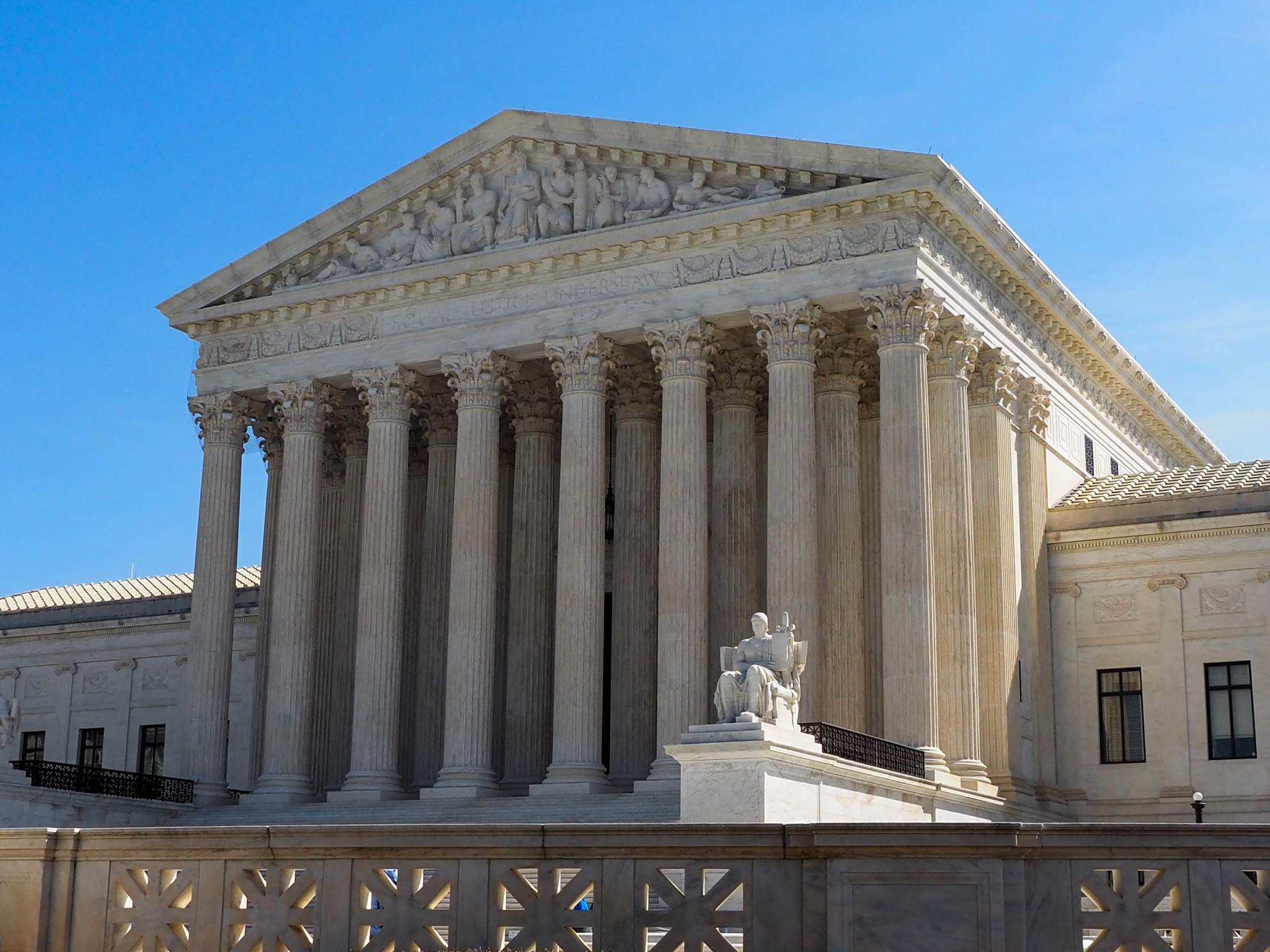
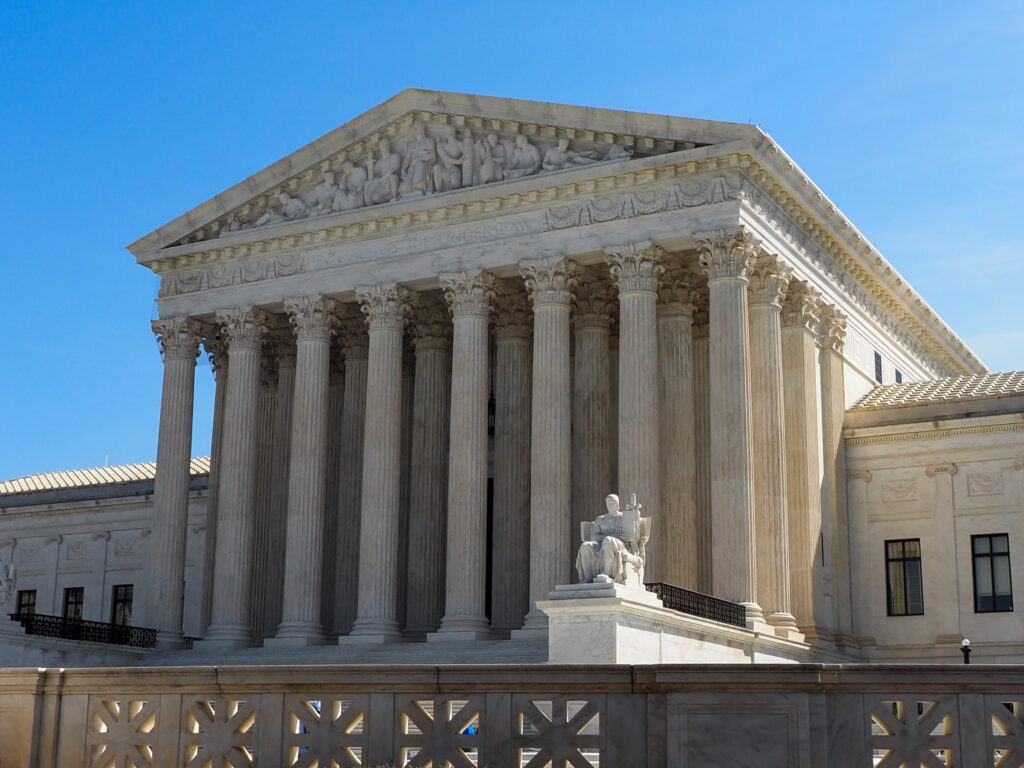
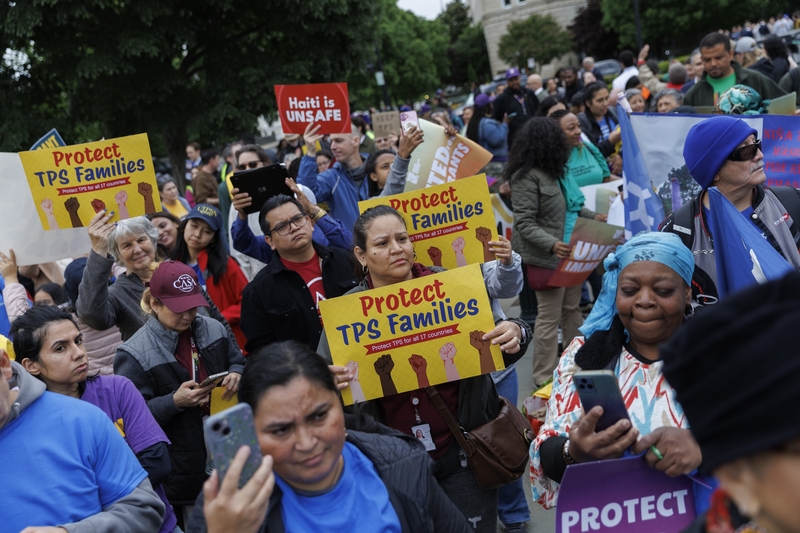
    Demonstrators chant and hold signs outside U.S. Supreme Court on April 29, 2026 in Washington, DC. The court heard arguments challenging DHS's termination of Temporary Protected Status for asylum seekers. (Photo by Tom Brenner/Getty Images)

    Demonstrators chant and hold signs outside U.S. Supreme Court on April 29, 2026 in Washington, DC. The court heard arguments challenging DHS’s termination of Temporary Protected Status for asylum seekers. (Photo by Tom Brenner/Getty Images)

    The Trump administration has argued that TPS has become a “de facto asylum program” and that conditions in Haiti have improved enough to end the designation. It appealed the ruling to the Supreme Court in March, and the justices heard oral arguments on an emergency basis.

    The court is expected to issue a ruling by the end of the term in late June or early July. The decision will determine whether the administration acted lawfully in its attempt to revoke TPS, including whether it consulted with the State Department when reviewing the country’s conditions.

    An uncertain future

    Immigration attorneys and advocates say the uncertainty surrounding TPS and immigration enforcement has heightened fears within the Haitian community.

    “Everyone is scared across the board,” said Tremaine Hemans, founder and managing attorney of an immigration law firm in Fort Lauderdale, Florida. “But specifically our Haitian clients.”

    Balthazar said she no longer feels entirely safe here, either.

    She said she used to fly to Massachusetts for months at a time to care for a patient. Now, she would refuse any nursing assistant job that required air travel, even if it paid $50 an hour, because she fears encountering Immigration and Customs Enforcement agents at the airport.

    “They handicap you, make you uncomfortable to live here, to be here,” Balthazar said.

    Violence and humanitarian instability continue to worsen throughout Haiti, said Brian Concannon, a human rights attorney and executive director of the Institute for Justice and Democracy in Haiti, a nonprofit focused on advancing human rights and justice in Haiti.

    By U.N. estimates, armed gangs control approximately 90% of the capital, Port-au-Prince, and hunger and displacement have risen sharply in recent years.

    “There’s literally no metric by which you can say that conditions in Haiti are improving or are in any way safe,” Concannon said.

    In Ohio, troubling phone calls

    For Rose-Thamar Joseph, a Haitian TPS holder and community advocate in Springfield, Ohio, that reality hits close to home.

    Joseph came to the U.S. under TPS in 2021 after former President Joe Biden redesignated the program for Haiti. She said she speaks with her family back home almost every day, including her 12-year-old son. Calls rarely end without her hearing gunfire in the background.

    She recalled her family sending photos of bullets that landed in their yard.

    One night, Joseph said she stayed on the phone with them until the morning, unable to sleep because she was worried about their safety.

    “It was a real, real challenging and stressful situation for me,” Joseph said.

    Sometimes the violence becomes so severe that her son cannot go to school. What worries her even more, she said, is when the country’s poor network service prevents her from reaching her family at all.

    Although Joseph has asylum status to fall back on if TPS ends, which would allow her to continue living and working in the U.S, she said many Haitian TPS holders don’t have that option.

    “It is so heartbreaking for me to see or to know that a lot of people will be out of work, will be laid off… because of TPS,” Joseph said.

    Consequences in the US for families, employers

    Concannon at the Institute for Justice and Democracy in Haiti said the Supreme Court’s decision could have immediate consequences for TPS holders and their families.

    Of the 350,000 Haitian TPS holders in the U.S., about 200,000 of them are already in the U.S. workforce, according to FWD.us, an immigration and criminal justice advocacy organization.

    Many send money home to support relatives in Haiti because ongoing violence and economic instability have left many families struggling to get by.

    “It’s literally thousands of families that are being kept afloat by remittances from TPS holders,” Concannon said.

    But the impact would also be felt by employers across the country.

    Many Haitian immigrants work in critical industries throughout the United States. FWD.us estimates that about 15,000 work in agriculture, 13,000 serve as nursing assistants, and another 8,000 work as caregivers.

    Todd Andrews, chief operating officer for Asbury Communities, a continuing care retirement community with campuses in Maryland, Pennsylvania, and Delaware, said immigrant workers play a critical role in caring for elderly adults.

    Asbury employs about 2,000 workers and serves more than 4,000 residents across its senior living communities. At the organization’s Gaithersburg, Maryland, campus alone, Andrews said employees represent more than 90 nationalities.

    “These jobs are very important, they’re very difficult, and they’re very, very integral in the care management of the residents,” Andrews said.

    He added that providers already face staffing shortages and warned that losing TPS workers could create disruptions similar to those experienced during the COVID-19 pandemic.

    “Employees that are employed today won’t be there tomorrow,” Andrews said. “So we’ll have to figure out a way to provide that care.”

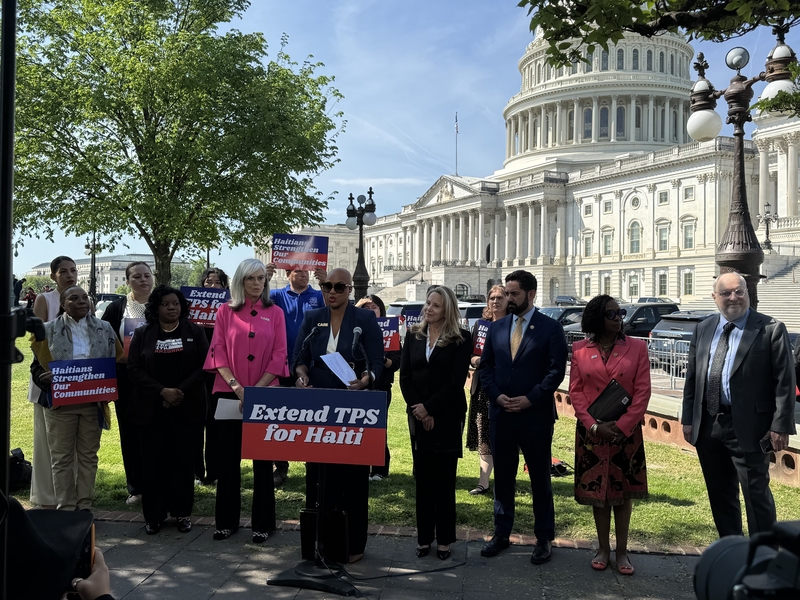
    Massachusetts Democratic U.S. Rep. Ayanna Pressley speaks at a press conference April 15, 2026, outside the U.S. Capitol in Washington, D.C., advocating for the extension of Temporary Protected Status for Haiti. The lawmakers alongside her include, from left, House Minority Whip Katherine Clark of Massachusetts, as well as New York's Democratic Rep. Laura Gillen, GOP Rep. Mike Lawler and Congressional Black Caucus Chair Yvette Clarke. (Photo by Shauneen Miranda/States Newsroom)

    Massachusetts Democratic U.S. Rep. Ayanna Pressley speaks at a press conference April 15, 2026, outside the U.S. Capitol in Washington, D.C., advocating for the extension of Temporary Protected Status for Haiti. The lawmakers alongside her include, from left, House Minority Whip Katherine Clark of Massachusetts, as well as New York’s Democratic Rep. Laura Gillen, GOP Rep. Mike Lawler and Congressional Black Caucus Chair Yvette Clarke. (Photo by Shauneen Miranda/States Newsroom)

    Lawmakers remain divided over the program’s future.

    Sen. Rick Scott, R-Fla., declined to explicitly say during an interview at the Capitol whether he believes TPS for Haitians should continue. Instead, he noted that Florida is home to “a lot of wonderful Haitians” and said the broader immigration system needs reform.

    “TPS was never a permanent program,” Scott said. “What I’d rather do is focus on, okay, so how do we fix the program where people can come here that are fully vetted that want to add to our economy.”

    Sen. Raphael Warnock, D-Ga., said immigrant communities make significant contributions to the U.S. economy and criticized the Trump administration’s efforts to end TPS for Haiti.

    “How can you deny Haitians who are here Temporary Protected Status, while at the same time put Haiti under the travel ban?” Warnock said. “It doesn’t make any sense.”

    Painful conversations

    While lawmakers remain divided over the future of TPS, Balthazar said the uncertainty has forced painful conversations with her daughter, a U.S. citizen and college student, about what might happen if she is deported.

    “That will affect her a lot,” Balthazar said. “She will be more at ease, more relaxed, if mama is around because she knows that she can rely on me…but if I’m not around, she will have to take care of herself.”

    For now, Balthazar said she is focused on living in the present. She spends her time caring for elderly patients, running her small online hair care business, and being with her family.

    Like many Haitians living under TPS, she said she still hopes for the day her country is stable enough to return.

    “As Haitians, we all dream, we all are dreaming to go back because we love our country. We just don’t have a system like here.”

    Medill News Service articles are reported and written by graduate student journalists in the Washington program of the Medill School at Northwestern University.