Tag: Commentary

  • Trump’s policies won’t bring back coal, but they are driving up Virginians’ energy costs

    Trump’s policies won’t bring back coal, but they are driving up Virginians’ energy costs

    If virtue signaling has a Trump-era corollary, we might call it vice signaling. That’s what President Donald Trump’s most recent package of subsidies for the coal industry looks like: it infuriates the environmentalists he despises and thereby delivers a little dopamine hit to the president’s base, while accomplishing nothing meaningful for the industry or the nation’s energy supply.

    On the other hand, the administration’s policy moves on energy are definitely hurting the clean technologies that Virginia needs to reach its zero-carbon electricity goals and lower rates for residents.

    Browbeating Republicans in Congress to terminate wind and solar tax credits caused many renewable energy projects to get canceled across the U.S., wiping out $16 billion of clean energy investments; other projects have been blocked or lost grant funding.

    Unable to stop offshore wind by any other means, the administration has even resorted to paying developers to abandon leases, with payments totaling more than $2.5 billion.

    This mischief is hurting American consumers, and nowhere is that clearer than in Virginia. Our need for massively more power to feed the data center industry makes us especially vulnerable to the effects of Trump’s monkeying around with the energy markets. With less low-cost wind and solar available to buy, our utilities have to burn more high-cost coal. Our rates go up, and so does pollution.

    The irony is that even Virginia Republicans don’t champion coal anymore, having thrown it over for cheaper and cleaner-burning fracked gas. Four years ago, then-Gov. Glenn Youngkin’s energy plan touted what he called an all-of-the-above strategy that was mainly focused on fossil gas. About the only time the plan mentioned coal was to note that it had fallen to only 4% of Virginia’s electricity generation.

    Republicans here still rise to the defense of one coal plant, Dominion Energy’s Virginia City Hybrid Energy Center (VCHEC) in Wise County. But that’s in spite of the cost, not because of it.

    Last time we looked, VCHEC was losing millions of dollars annually – money that comes out of customer pockets. Legislators defend it only because the jobs it provides and the local taxes it pays keep Wise County afloat.

    This importance to Southwest Virginia earned VCHEC special treatment in the 2020 Virginia Clean Economy Act (VCEA), which aimed to slash both carbon and costs quickly by forcing the closure of Dominion’s other coal and oil-fired generation. Legally, VCHEC is allowed to stick around until 2045, though few people expected it would survive market realities that long.

    In spite of its poor economics, however, coal use has surged in Virginia and nationwide as demand from data centers makes utilities scramble to produce every possible electron. If you don’t have enough cheap renewable energy, you have to use whatever you’ve got, never mind the cost.

    Five years ago, Dominion expected to run VCHEC only 15.5% of the time in 2024, less than 11% of the time in 2025, and only a little more than 6% by 2030. Instead, the plant is generating more this year than it has at any time this decade.

    The only other large-scale coal plant still operational in Virginia, the Clover coal plant co-owned by Dominion and Old Dominion Electric Cooperative, puts out well under half the electricity it did ten years ago, generating mainly during summer heatwaves and winter cold spells. But it too runs more often now than it did in the first few years of this decade.

    Dominion also operates the Mount Storm coal plant in West Virginia. It serves Virginia customers, but its location outside Virginia means the VCEA didn’t require its closure.

    Appalachian Power operates coal plants in West Virginia, too, producing power for its residents in that state as well as Southwest Virginia.

    The lousy economics of coal mean all these plants generate significantly less power than they used to – but, again, more than they did just three or four years ago, thanks to the demand pressure of data centers. (Well, that and a Trump-style insistence by West Virginia regulators that utilities run their coal plants most of the time, no matter how much it hurts consumers).

    A similar dynamic is playing out across the country. Coal use jumped in 2025 nationwide as data centers demanded more energy, adding to air pollution and killing more people.

    The Trump administration is determined to make matters even worse.

    Since resuming office last year, Trump has ordered the Department of Defense to buy power from coal plants for its military installations. His Department of Energy has ordered units to keep operating at five coal plants that were about to close because they lose money. His Environmental Protection Agency is loosening pollution standards for coal plants to save them money.

    In February the Energy Department announced it would spend $175 million on six projects to extend the life of coal plants in West Virginia, Ohio, North Carolina and Kentucky. The federally-owned Tennessee Valley Authority announced it would keep coal units open at two power plants that were previously slated for closure.

    Then, in June, the Energy Department announced another $500 million in coal spending, including $425 million for a bunch more plant upgrades and a $75 million subsidy for a coal export terminal.

    Most recently, the department issued plans to throw $350 million at four more coal projects, including restarting a closed plant in Maryland and subsidizing construction of two new plants, one at Mt. Storm.

    Some of this spending will keep old plants limping along; some of it smells of grift. One of the proposed new coal plants getting an $18 million contribution from federal taxpayers is the project of a MAGA activist with no energy industry experience.

    Indeed, the idea of propping up last century’s technology to build an inefficient industrial plant that won’t ever make money has a distinctly retro vibe, reminiscent of the Soviet Union in its heyday. The problem with Trump‘s vision is that since these money-losing plants couldn’t be completed before his term expires, no self-respecting capitalist will build them.

    Trump’s vice signaling is having its intended effect in one respect, though: environmentalists hate it. So, for that matter, do economists and grid experts.

    One grid expert I spoke with, Mike Jacobs, a senior manager at the Union of Concerned Scientists, noted that “if the goal was to mine more coal and send more of it up a smokestack, it would make more sense to subsidize coal purchases directly.” Building a coal plant, he said, is “a vanity project.”

    What Trump isn’t accomplishing for coal, however, Big Tech is.

    Data centers’ demand for power, coupled with Trump’s stifling of the renewable energy sector, keeps coal plants belching along and drives up electricity costs for everyone. That these companies have a long history of virtue signaling with sustainability promises they haven’t met is just its own kind of irony.

  • Four Va. counties will pump almost 20 million gallons of water a day to Amazon. Cause for concern?

    Four Va. counties will pump almost 20 million gallons of water a day to Amazon. Cause for concern?

    How you look at something – the frame you use and your perspective – often influences what you see.

    This holds true with the issue of data centers and water use. Amazon recently reported that it withdrew a total of 2.5 billion gallons of water for data center cooling operations in 2025. That seems like a lot of water.

    But Amazon also points out that Americans used 3.3 trillion gallons of water that same year to grow their gardens and lawns.

    The company apparently wants to assure you that the water it uses for its data center operations, in comparison to other uses of water across our very large country, is not such a big deal.

    Of course, Amazon doesn’t operate its data centers across the entire nation. It does so in only a few states, and nowhere at higher concentration than in Virginia.

    We wanted to learn for ourselves how much water local communities have promised to Amazon for data center cooling in our part of the state, the region between Northern Virginia and Richmond, including Louisa, Spotsylvania, Caroline and Stafford Counties.

    By scouring available public records and submitting Freedom of Information Act requests, we learned that local governments in the commonwealth have allocated at least 19.6 million gallons a day to Amazon.

    This, we think, is an underestimate. It doesn’t include at least one large water-cooled data center campus in another nearby county that might end up being leased and operated by Amazon, but is currently being constructed by another company. And it doesn’t include other potential Amazon data center campuses that have not yet been approved or are being held up in court.

    Even so, 19.6 million gallons a day seems like a good deal of water. It’s enough to fill 980 backyard swimming pools every day. If the average American uses 82 gallons of water a day, it’s enough to sustain 239,000 people.

    But Amazon tells us not to worry. The company has ambitious goals to become “water positive.” To Amazon, this means “replenishing more water to communities than we use in our direct operations.”

    But being “water positive” depends on your scale of analysis.

    For instance, Louisa County plans to provide seven million gallons a day to two separate Amazon data center campuses. Amazon is paying to construct the new water infrastructure that will make this possible.

    On one hand, this is “new” water to Louisa County that wouldn’t otherwise be available for industrial use without Amazon’s funding. But from the perspective of the larger North Anna reservoir and river system, it still constitutes a withdrawal.

    While Amazon is using raw water for its operations in Louisa County, in other localities the company is investing in extensive “purple pipe” systems that will capture water that would otherwise be sent downstream in order to circulate it to its data center campuses. The company is proud that it “works with utilities to collect treated wastewater, clean it to appropriate standards, and reuse it to save drinking water.”

    Amazon doesn’t mention, however, that it will lose more than half of this water through evaporation as it cools its data center facilities, sending most of it up into the atmosphere. So something that appears to be water positive from the perspective of a community hosting an Amazon data center campus might also be a net water loss to a river system and to downstream users.

    Even so, Amazon claims, it doesn’t use water to cool its operations throughout the whole year, only during the hottest days in Virginia.

    A company spokesperson, for instance, marked up a water service agreement between Stafford County and Amazon we received from a FOIA request, in which the county promised to deliver more than five million gallons a day. The spokesperson wrote to us that, “actual annual use is much lower. Based on 10 years of data, the campus only needs cooling water about 4% of the year during the hottest months.”

    The idea that Amazon is spending tens of millions of dollars to build a water system that it will only use for fifteen days out of the year strains credulity. Even if this is true, those are millions of gallons of water being diverted away from our rivers and streams during the peak of summer, when flows are the lowest and water is most needed.

    It’s especially concerning when most of the state is in a severe drought, as we are now experiencing and may endure again in future years.

    Beyond being Virginia’s leading data center company, Amazon has attained near- monopoly status as an online retailer and delivery service. It spends $19 million a year on lobbying alone, according to the Center for Responsive Politics. It funneled almost $10 million to political campaigns in 2024 in order to influence elections, the same source reports.

    Amazon, needless to say, also has a powerful public relations operation. It uses its economic and political power to avoid paying taxes that other companies and most individuals have to pay.

    And in Virginia, the company and others in the data center industry are exempt from paying sales and use tax, which lawmakers say costs us nearly $2 billion annually. That exemption is the sticking point in ongoing budget negotiations; if legislators don’t finalize the spending plan by June 30, with or without the tax exemption, the state will experience its first government shutdown.

    Amazon encourages us not to worry about all the water local governments are allocating to the company in central Virginia. It assures us that it is a good steward of this resource, and that it cares about sustainability.

    But Amazon, just like any company with vested interests and a profit motive, doesn’t always share the complete picture. It frames the view it wants the public to see.

    Given the massive size of this company and the ways it has abused its power in the past, Virginians would be wise to keep a watchful eye on how Amazon is using water. And as communities consider approving yet more data centers and additional water service agreements, Virginians may want to consider when enough is enough.

  • Amid budget battle, legislators pass the buck on concrete data center reforms. Again.

    Amid budget battle, legislators pass the buck on concrete data center reforms. Again.

    Oh yay, another commission.

    Leaders in the House of Delegates are continuing to tweak their version of a state budget, but they aren’t backing down from their fight with the Senate over data centers. What they are backing down from is their former insistence that data centers use clean energy. Instead, they propose to punt this and every other data center issue over to a commission.

    Is that supposed to resolve the budget impasse? Because if that’s the idea, it sure seems like an odd way to go about it.

    New House budget strips environmental standards for data centers, creates commission instead

    Recall that Senate Finance Chair Louise Lucas, D-Portsmouth, wants to terminate the sales tax exemption that data centers have exploited to the tune of $1.6 billion lost from state coffers. (The total subsidy rises to $1.9 if you include the exemption from local taxes, but what’s a few hundred million bucks among friends?)

    The tax isn’t something specific to data centers. It’s the same one all the rest of us pay. The argument that there are better ways to spend the money than to give it away to the world’s richest corporations has reaffirmed Lucas as a bonafide social media star at age 82, and she is enjoying it very much.

    In response to the new House budget proposal, Lucas tweeted out a tweak of her own: She now proposes to subject data centers to a nearly-equivalent fee that would generate $1.7 billion in revenue. Lucas and allies have launched a “listening tour” to build support for her approach.

    But the House budget does not eliminate the exemption, leaving the two sides at an impasse.

    The House is set to reconvene on June 18, and the Senate on June 22. The chambers will attempt to resolve their differences and adopt a budget before July 1 to avoid a government shutdown.

    House leaders argue that data center operators relied on this tax exemption when they chose to locate in Virginia. They signed memorandums of understanding agreeing to a few minor conditions, and in return they were promised they wouldn’t have to pay sales tax on computer chips and other equipment until 2035. (In the case of Amazon and any other corporation that sinks $50 billion into data centers in Virginia, the date has been extended out to 2045.)

    But the House budget proposal originally incorporated provisions drawn from legislation introduced by Del. Rip Sullivan, D-Fairfax, requiring data centers that take advantage of the tax exemption to buy increasing percentages of renewable energy, refrain from using onsite fossil fuels as their primary energy source, and begin phasing out the backup diesel generators that threaten air quality. The bill passed the House but died in the Senate around the same time Lucas decided there shouldn’t be a tax exemption at all.

    The disagreement left Virginia without a budget for the new year. Now suddenly the House has issued a new proposal that has the support of Gov. Abigail Spanberger. Instead of resolving the impasse, though, it actually goes backwards on regulating data centers.

    It still leaves the tax exemption intact, but now “includes explicit direction for the establishment of a Commission to thoroughly evaluate the direct and indirect costs and benefits of the data center industry.” The commission is to issue a report and recommendations for legislative and budgetary changes, which the General Assembly will then consider next year.

    Are you feeling a little prickle of déjà vu? That’s because we have seen this before, and not very long ago. In December 2023, the General Assembly headed off action for all of 2024 by directing the Joint Legislative Audit and Review Commission (JLARC) to assess the impact of the industry on energy demand, state revenue, natural resources – essentially, the same things this year’s commission is supposed to look at all over again.

    You remember the JLARC report. It sounded a dire warning against the consequences of “unconstrained” data center demand. The report made a stir in December of 2024 when it was issued. Statements were released, proposals were floated.

    And thus warned, the General Assembly went into the 2025 session and did . . . nothing.

    Doing nothing pretty much described 2026 legislative action on data centers, as well. Among the few reforms House and Senate Democrats seemed to agree on were that data centers needed to buy renewable energy and storage to limit the increase in Virginia’s carbon emissions and to decrease the pollution from diesel generators. The House did this by way of Sullivan’s bill; the Senate supported a different approach. Each chamber killed the other’s bill.

    That left the House budget as the only vehicle for progress this year on one of the central problems of the data center buildout. By backtracking now, House leaders and the governor show they are willing to capitulate entirely to the data center industry and its labor allies.

    Workers, Speaker Scott criticize plan to axe data center tax exemption as budgets advance

    To be sure, a budget amendment this year that puts conditions on tax exemptions in future years would need to be followed with new legislation to lock in the requirements. And for that purpose, House and Senate members should definitely work together this summer to align their proposals, ensuring both chambers agree on the terms of the legislation before it is introduced.

    A commission with that task could be useful. After all, the Commission on Electric Utility Regulation, now rebranded as the Energy Commission of Virginia, succeeded in bringing together House and Senate members around a striking number of good energy bills this year.

    But a commission that is thrown together suddenly and instructed to retrace the steps of a report issued barely 18 months ago seems suspiciously like a substitute for action.

    This is all too familiar. When it comes to data centers, inaction seems to be the point.

  • The exemption Virginia can’t price and won’t stop

    The exemption Virginia can’t price and won’t stop

    Virginia gave data centers a $928 million tax break in a single fiscal year, 2023, and the General Assembly cannot pass a budget because it can no longer agree on whether to keep doing it. That is the fight underneath the standoff in Richmond, with state spending set to expire June 30 and the conferees who should be writing a deal gone home without one.

    The state’s own auditors laid out the stakes more than a year ago. The Joint Legislative Audit and Review Commission studied the exemption in 2024 and found it provided $928 million in tax savings in fiscal 2023. About 90% of the state’s data center industry was using it. The exemption has been on the books since 2010 and is scheduled to expire in 2035.

    Local governments race to attract data centers, often in spite of concerns from their constituents

    The significance of JLARC’s findings about the return on that money has eluded the budget debate so far.

    The benefit is real but front-loaded. JLARC estimated the industry contributes 74,000 jobs, $5.5 billion in labor income, and $9.1 billion in GDP to the state economy, then added the qualifier that matters: most of it comes from construction, not from running the centers once built.

    A typical data center employs about 50 full-time workers, half of them contractors, JLARC’s report found. At the height of building one, roughly 1,500 workers are on site. The jobs that justify the break are mostly the jobs that end when the concrete cures.

    Then there is the cost that lands on people who will never own a server.

    JLARC commissioned an independent study of utility rates and found current rates correctly assign costs to the customers who cause them, data centers included. But the industry’s appetite for power changes the math going forward. Meeting it requires building generation and transmission that would not otherwise be built, and those fixed costs get spread across every ratepayer.

    JLARC put a number on it: a typical Dominion residential customer could see generation and transmission costs rise by $14 to $37 a month in today’s dollars by 2040. That is the quiet transfer inside this debate. An industry that buys its equipment tax-free helps drive a power buildout that shows up on household bills.

    This is where the Senate and the governor parted ways. Senate Finance Chair Louise Lucas has pushed to wind the exemption down rather than let it run untouched to 2035, and walked out of the meeting when that went nowhere.

    Gov. Abigail Spanberger and House Appropriations Chair Luke Torian have resisted early repeal, arguing the state must honor the agreements it signed. A single tax preference has been able to hold the whole budget hostage.

    Spanberger’s data center position is the test of her affordability message

    The contract argument deserves a closer look than it usually gets. Companies claiming the exemption sign a memorandum of understanding with the state, and Virginia law spells out what that document must contain: the company’s investment target, its job target, the timeline, and what it owes back if it falls short.

    The binding promises run from the company to the commonwealth, enforced by clawback. Nothing in that framework commits the state to keep the exemption alive for any set term. The life of the break is fixed by statute, and a statute can be amended by the body that wrote it.

    That points to an option neither side is championing, though JLARC named it plainly: The Assembly could apply a partial exemption after 2035, or end the full break early, drawing the line to protect existing commitments while changing the terms for what comes next.

    JLARC noted the Assembly could even narrow an expiration to one region, while warning a Northern Virginia-only approach would do little to slow statewide growth, since the industry is now spreading down the I-95 corridor into central Virginia. A prospective change avoids the contract objection entirely, because no facility can claim it relied on a benefit it was never offered.

    The reason the clean version isn’t on the table is the same reason the budget is stuck. Prospective-only changes raise little money now, and the money is the point.

    Lucas wants revenue this biennium for services that federal cuts are squeezing. Phasing the break out for the existing base delivers that; protecting the base does not. So the legally cautious path is the fiscally weak one, and the fiscally strong path invites the fight over the agreements. Both sides understand the tradeoff. Neither states it out loud.

    A skinny budget may keep the lights on past June 30. It will not resolve what the standoff revealed.

    Virginia built an incentive its own auditors say returns less to the state than it costs, watched it grow into a near-billion-dollar annual line, and has not decided whether it has the will to change course. Localities adopting their own budgets this month, waiting on state numbers that may not come, will feel that indecision first.

  • In light of horrific Virginia deaths, consider others when behind the wheel

    In light of horrific Virginia deaths, consider others when behind the wheel

    Guadalupe Rivera – landscaping supervisor, family man, helper – suffered a needless, ghastly death because, police said, a speeding car collided with an SUV before striking Rivera on a Chesapeake sidewalk, where the 60-year-old Suffolk man was working.

    Police said the male driver of the sedan at the center of the mayhem May 29 was racing so fast that he also dislodged the engine of the SUV he struck first and damaged a nearby utility pole. The speed limit along that stretch is just 35 mph.

    “This is the most devastating news we’ve ever heard,” Andrea Magallan, one of Rivera’s eight children, told me by email. A news report said he had 33 grandchildren and great-grandchildren.

    Speed has been the key factor cited by authorities in several recent fatalities along Virginia roadways, including the killing of Rivera that is still under investigation. Both drivers in that incident suffered minor injuries. On Thursday, police said they charged Synclair Tyrone Mayes, 19, with involuntary manslaughter.

    Guadalupe Rivera. (Photo courtesy of Rivera family)

    Excessive speed joins distracted driving and driving under the influence among the causes often cited by authorities for the deaths and injuries that happen too often, here in Virginia and elsewhere.

    There’s also a lack of concern for fellow human beings when folks get behind the wheel. So we scoff at posted speed limits. We text, though it’s illegal while driving in Virginia and nearly every other state. We eat. We fiddle with the gadgets on the dashboard.

    In other words, we don’t care about anyone but ourselves, our desires, our schedule.

    “Reckless driving isn’t new,” Brad Lehmann, assistant professor of criminal justice at Virginia Commonwealth University and a former sergeant with the Henrico County Police Department, told me in an interview. “But we have an interesting kind of storm where a generational change is happening, and our driving behaviors have changed. There’s distraction from devices and electronics in the vehicle.”

    Meanwhile, he added, pedestrians and bicyclists can be so focused on their own phones or earplugs that they might not recognize nearby cars and trucks. The 4,000-pound missiles are a threat to their safety.

    “It’s a mixture of instant gratification and risky behaviors,” Lehmann noted.

    Sadly, the death of Rivera wasn’t the only traffic fatality across Virginia in recent days. Others have been just as gut wrenching:

    Four members of a Massachusetts family and another person were killed May 29, when a passenger bus speeding south on Interstate 95 struck a vehicle that had slowed down for a work zone in Stafford County.

    The crash caused a chain reaction. Dozens of passengers were injured. Jing S. Dong, 48, the bus driver, faces involuntary manslaughter charges and reckless driving charges.

    Later reports said Dong, of Staten Island, New York, had been scheduled to stand trial June 2 in Annapolis, Maryland, for a previous arrest on speeding while driving a coach bus. Virginia court records revealed he’d earlier been cited for speeding, too, in the commonwealth.

    A day later, a crash on I-95 in Caroline County killed two people and injured another person. Witnesses told wtvr.com a SUV was speeding down the left shoulder before striking debris and losing control.

    The SUV then flew across the median into oncoming traffic headed northbound. What was so important that the driver tried something so illegal and risky by racing along the shoulder?

    An 86-year-old male pedestrian in Norfolk died after a hit-and-run crash, Norfolk police said, late the night of June 1. Police said they later located the suspected driver, Malik Alea-Ngongo, 24, of Norfolk, and arrested him near the scene of the accident. Investigators didn’t immediately know whether speed or alcohol were factors.

    Yusuke Yamani, an associate professor in the departments of psychology and civil and environmental engineering at Old Dominion University, said traffic fatalities have been declining nationwide and in the commonwealth since a post-COVID spike.

    They remain higher, however, compared to a decade ago. In Virginia, the total number of fatalities was 700 in 2014. That figure leapt to 918 in 2024.

    What’s going on nowadays? Bad behavior obviously isn’t new, but it seems to be more lethal on our roads.

    “Speeding, impaired driving, red-light running, and road rage are all forms of reckless driving that have existed for decades,” Yamani said, by email. “However, today’s driving environment is different.

    “New information technologies (e.g., smartphones and infotainment systems), reduced traffic enforcement in some areas, attitudinal shifts among younger drivers, and behavioral changes following the pandemic have all contributed to a changing landscape of driver behavior.”

    The professor cited a AAA Foundation for Traffic Study culture index for more information. He noted the 2024 report found fewer drivers perceived speeding as dangerous, “suggesting that speeding may be becoming increasingly normalized. Notably, speeding tends to draw less social condemnation than many other risky driving behaviors, despite contributing to roughly one-third of all fatal crashes.”

    Lehmann, the VCU professor, noted Richmond has suffered a number of pedestrian deaths in recent months, some involving well-known victims. He wondered whether people think it’s OK to fiddle with a device while driving, or to go 25 mph above the speed limit even if they have passengers.

    “I don’t know that we are prioritizing the humanity in front of us,” he said.

    Rivera’s relatives wish we would. His brother Joe told a newscast that Guadalupe Rivera “would talk to anybody, try to help anybody he could.”

    His 33-year-old daughter Andrea Magallan, in her comments to me, called him “our protector, our biggest supporter, and our hero.”

    Folks, put the phone down or turn it off when behind the wheel. Pay attention to the road, not the radio. Don’t imbibe and drive.

    And please, please ease up on the gas.

  • What Virginians’ and Americans’ D-Day sacrifices teach us about our country now

    What Virginians’ and Americans’ D-Day sacrifices teach us about our country now

    NORMANDY AMERICAN CEMETERY, COLLEVILLE-SUR-MER, FRANCE- Richard Powhatan Hall’s grave sits nine rows into the vast final resting place of 9,400 U.S. soldiers who lost their lives in the 1944 D-Day invasion. Hall, a man from Virginia’s Albemarle County, was killed in action June 6, 1944 at Omaha Beach, a few hundred yards from where he is buried.

    He died at 26 fighting fascism.

    Hall was among 184 Virginians who gave their lives to spearhead an extended assault that eventually led to Paris, then Berlin, and brought down Adolph Hitler and the Nazis, a regime powered by hate and intolerance.

    The Virginia dead included the Bedford 20, a group of young men from the same small town in the southwest region of the state. They became the best-known Old Dominion D-Day casualties for their community’s collective sacrifice.

    Bedford lost more residents per capita than any other community in the United States on D-Day, as far as is known, according to John Long, education director of the National D-Day Memorial. To the best of historians’ knowledge, the state of Virginia lost more residents per capita in the D-Day mission than any other state in the union, Long said.

    Ruined remains of German gun emplacements still stud the high bluffs above the Atlantic coast. The gun emplacements, considered nearly impenetrable during World War II, have evolved into monuments of the shared pain and desperately hard work it took to overcome fascism.

    U.S. Army rangers who scaled the near vertical rock face of Pont du Hoc used ropes and knives shoved into small cracks to propel themselves upward into enemy fire. Their courage symbolized the difficulty and determination of the entire campaign.

    As Long noted, “They obviously knew they were going into battle. I’ve never talked to a veteran of World War II who would not admit that they were scared.”

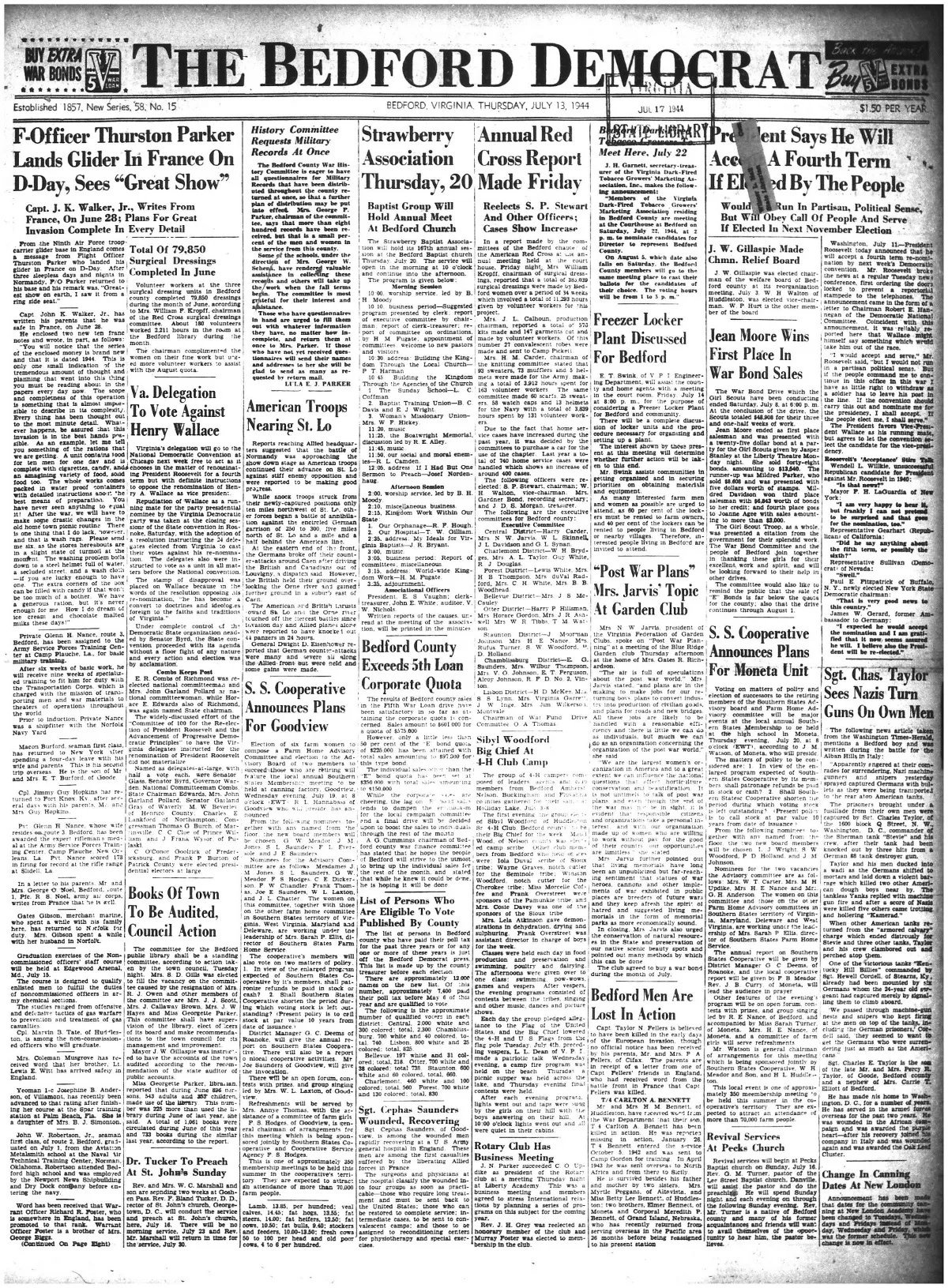
    The July 13, 1944 edition of The Bedford Democrat newspaper details the names of men from the county w ho perished in World War II up to that point. (Photo courtesy Library of Virginia)

    Many of those killed on D-Day were entering combat for the first time, Long said. But they also knew that they were in a crucial battle between good and evil.

    The U.S. worked with its allies, England and Canada, in those days. The leader of the invasion, U.S. Gen. Dwight Eisenhower, ultimately made the decisions. But he led with power that considered other viewpoints. That birthed a spirit of cooperation and adaptation that overcame everything that went wrong on D-Day, a spirit that had to extend to the troops for anything to succeed.

    In his Order of the Day, Eisenhower referred to what was about to happen as a “Great Crusade.”

    This crusade required more than brilliant tacticians or seasoned soldiers. It relied on guys like Hall, who before the war worked for a Charlottesville Ford dealership, according to his obituary.

    Hall, the Bedford 20,most of the rest of the lost Virginians and more than 9,000 other Americans who died in the D-Day invasion were not military professionals. They were mostly average Joes who understood and accepted the obligation of their country’s commitment to freedom from dictators.

    Standing among seemingly endless rows of U.S. grave markers in Normandy inevitably invites a comparison of America’s spirit on D-Day and today.

    On D-Day, the U.S. aligned itself with allies. It did not alienate or publicly lecture them, as our government leaders currently do. The country felt a shared responsibility to the world in a war that was not being fought on American soil. That commitment sprang from ideology instead of property. Freedom from authoritarian rule was the goal, but not just in an abstract sense.

    To fight on D-Day meant facing daunting physical risks to take down the enemy or die trying.

    “By and large, allied leaders made it clear this was a battle of good versus evil that had to be won,” Long said. “They had a sense of what they had to do and why.”

    But there was also a personal sense of the mission reliant on individual survival instincts to succeed. The only path to victory was up the bluffs.

    “Their thinking,” said Long, “was that taking those bluffs was how they got to go home.”

    Thousands didn’t. Still, they trusted in leaders whose integrity made it worth the try.

    In a country whose leaders routinely lie or use their positions to expand personal authority and wealth, such trust cannot exist.

    This is the country we now live in. It is a place where the president punishes institutions that practice traditional values of tolerance, opportunity and compassion.

    It is a place where the president calls the late Sen. John McCain, a hero who suffered years of torture for his service in the Vietnam War, a “loser.”

    We now live in a place where white nationalists and misogynists masquerading as war experts strip promotions from black and female military officers, and the president, a draft dodger who never served, pursues military policies so devoid of tactical rationale and legality that America’s finest officers must resign because they cannot in good conscience follow what they believe to be illegal orders.

    Our highest political leader today believes that undocumented immigrants deserve no constitutional rights and can be separated from their children and thrown into detention facilities for months without court hearings.

    We now live in a country where the same leader encourages government agents to attack protesters. The Trump administration initially refused to cooperate with state investigators seeking facts in the killings of two legal Minnesota residents by Immigration and Customs Enforcement agents. A judge had to order the administration to release evidence.

    ICE officer fatally shoots driver through car window in Minneapolis

    Finally, and perhaps most tragically, instead of fighting fascism, today we live in a country where the leader spreads lies about election fraud when he loses, then encourages an attack on the U.S. Capitol to stop the peaceful transfer of power.

    The attack injured police and led to several deaths. It cost taxpayers tens of millions of dollars. It led to 1,500 criminal convictions. But the leader, shielded from personal criminal prosecution by conservative Supreme Court justices, pardoned the criminals who did his bidding.

    What Americans did in 1944 on the beaches at Normandy showed greatness and selflessness. What Donald Trump has done in his time as president is destroy Americans’ sense of unity and responsibility, which gave us the strength to defeat Hitler.

    On this D-Day anniversary, that begs an ugly question for every American:

    How did the United States go from fighting fascism in 1944 to embracing it in 2026?

  • Virginians suffer as callous, major cuts to food stamps become entrenched

    Virginians suffer as callous, major cuts to food stamps become entrenched

    President Donald Trump’s Darwinian food stamp modifications – abetted last year by supine Republican congresspeople whose constituents are now suffering – is working out just as critics had predicted. Low-income and disabled residents in Virginia and elsewhere are forced to choose between food, shelter, and healthcare.

    ‘Trying to do the best we can’: Va. lawmakers, beneficiaries brace for SNAP changes

    Roughly 867,000 Virginians received Supplemental Nutrition Assistance Program benefits in March 2025. The figure a year later is down to almost 754,000, a spokesman with the Virginia Department of Social Services said Friday. That’s a nearly 14% drop.

    Some $187 billion will be cut from the federal food stamps program over a decade because of the changes. It’s as if Inspector Javert is running the program.

    Don’t just take my word for the calamity these heartless cuts have caused – all to mostly benefit wealthy Americans. Listen to the people on the front lines in the commonwealth who assist the poor, unemployed and others who are overwhelmed by decreasing federal aid, a stagnant economy and higher gas prices because of the poorly planned war against Iran:

    Patrice Smallwood, chair of the board of Virginia Organizing, said Trump’s H.R. 1 bill was supposed to take money from scammers and those committing fraud to redirect money to the truly needy. “That’s not what I’m seeing,” she continued. “That was deception.

    “The biggest thing really is the propaganda … about how Virginians and people all across the country were going to be helped,” Smallwood said.

    Though some decline in enrollment occurred before H.R. 1 passed (I refuse to call it by Trump’s risible slogan), the demand on area food pantries has rocketed in recent years, said Eddie Oliver, executive director of the Federation of Virginia Food Banks. The group is a collaboration among seven regional food banks and hundreds of agency partners around the state.

    “We’ve seen a pretty steady rise in food pantry usage since 2023,” Oliver said. Some food banks are seeing all-time record demand now, he added, which was supercharged by the government shutdown late last year.

    Social worker Erika Nunez, of the Feed More food bank in Richmond, visits the St. Thomas Episcopal Church Food and Wellness Pantry in Richmond twice a month to assist people applying for SNAP benefits. Here she is working with volunteer Quentin Atkins. (Photo courtesy of the St. Thomas Food and Wellness Pantry)

    The federation notes that eight of the 10 localities with the highest rates of food insecurity are rural and concentrated in Southwest Virginia. Those areas typically select Republicans in Congress – and GOP congresspersons almost unanimously supported cuts to SNAP and Medicaid last year.

    All five Virginia Republicans in the U.S. House of Representatives – Ben Cline, Morgan Griffith, Jennifer Kiggans, John McGuire and Rob Wittman – voted to slash the social safety net. All of them are up for re-election this fall.

    Many Virginians who remain eligible for food stamps are exasperated because of stricter application and work requirements, noted Hannah Wyatt, a staff attorney who specializes in food security and public benefits with the Virginia Poverty Law Center.

    “Some are kind of just giving up,” Wyatt said.

    Able-bodied adults without dependents, for example, already faced a three-month time limit on SNAP participation if they weren’t working at least 80 hours per month. But the legislation increased the age that adults must adhere to those work requirements and time limits, from 54 years old before to 64 now.

    So older adults will be forced back into the workforce to remain eligible, even if it’s a chore because of age and general creakiness to get up, get out and get to a job.

    This is just one of the regulations in the legislation that tilt away from compassion for average Americans. The law also made eligibility stricter for non-citizens and reduced exemptions for certain requirements.

    Other states face the same problems. For example, NBC News recently reported on the upheaval in Arizona, where applicants must fight to prove their eligibility. Some were even quizzed about monetary birthday gifts sent by Zelle, and whether they were one time or recurring.

    The article told of recipients who had to turn over even more documents to prove they’re eligible – forcing people off the rolls who should get food aid. Folks needed to visit food pantries more often. The number of Arizonans getting food stamps in March was about half the total from the same time last year; 200,000 children have lost benefits, state data showed.

    The claims by toadies for the Trump administration that the new regs are ending “fraud, waste and abuse” have been illusory – especially since those receiving aid are jumping through more hurdles to receive what they deserve.

    Plus, the Center on Budget and Policy Priorities, a nonpartisan research and policy institute, previously reported that “cases of intentional fraud by participants or SNAP authorized retailers are relatively rare.”

    VDSS has published a webpage with a dedicated list of resources for SNAP participants that covers employment and volunteer opportunities, medical resources and more information.

    “The primary impact of this law on the Commonwealth is that now more families are going hungry when nobody should have to go hungry,” the spokesman said.

    Contrast the amount of documentation that SNAP recipients must provide to the lack of oversight involving repairs to the Lincoln Memorial Reflecting Pool in D.C. Trump put a proverbial thumb on the scale to help a contractor that he knew. (Trump later claimed he didn’t know the firm. But we’ve seen this story before.)

    Atlantic Industrial Coatings, a Virginia firm, received a no-bid contract, bypassing a requirement to seek competing offers – reportedly because a delay would cause “serious injury” to the government. The president wants the repairs done before the nation’s 250th birthday on July 4.

    The New York Times has reported that Trump promised the repairs would cost nearly $2 million; the total is now more than $13 million. The company also has an inflated profit margin of 20%, a government analysis found.

    Trump said he chose the company because it had worked on swimming pools at his golf club in Sterling, Virginia. He doesn’t even try to disguise his obvious conflict of interest.

    It’s too bad that millions of Americans, desperate for food, don’t have such a chummy relationship with the president. They’re just trying to survive.

    The callousness is a disgrace. Trump’s cuts are heartless and have endangered lives and livelihoods.

    The government’s contempt for the poor is a blight on our nation.