Tom Dunlap, a Riverkeeper with the James River Association, looks over Swift Creek where toxic leachate from the Shoosmith Landfill is leaking in June 2026. (Photo by Shannon Heckt/Virginia Mercury)
The Virginia General Assembly allocated $10.6 million in the two-year budget lawmakers passed this week for the Department of Environmental Quality to help contain toxic leachate spilling from the bankrupt Shoosmith Landfill in Chesterfield County.
The emergency funds will be used “to prevent it from becoming a catastrophe”, according the Sen. Glen Sturtevant, R-Chesterfield.
It represents a fraction of the $173 million needed to fully close down the landfill located off of Route 10 in Chester. The landfill, which has not taken in new trash since 2022 and whose owners filed for bankruptcy in 2025, reportedly generates about 50,000 gallons of leachate a day, a toxic wastewater made up of runoff from the garbage in the landfill.
View of Shoosmith Landfill through trees surrounding a nearby neighborhood along Swift Creek. June 2026. (Photo by Shannon Heckt/Virginia Mercury)
The creek flows into the Appomattox River and eventually into the James River at Hopewell – where drinking water is collected. Tom Dunlap, a riverkeeper with the James River Association, emphasized that if the leachate continues flowing into the environment it could lead to a major disaster, impacting clean drinking water and healthy streams for wildlife.
“You have to treat that discharged waste fluid to protect the environment,” Dunlap said. “It can be laden with all sorts of things from heavy metals to PFAS chemicals, and on and on. To have that leachate wind up directly in the environment is one of the worst case scenarios that we could be experiencing.”
The leachate is part of normal operations when managing a landfill, but must be treated before being discharged into wastewater treatment systems. In 2018, the county board of supervisors denied a request to expand the landfill by including a lined disposal cell in a nearby rock quarry.
Supervisors said the disposal of the wastewater below the water table could pose serious health and safety risks for residents.
The landfill has a history of improperly managing the leachate from the facility.
Chesterfield County reported that between 2019 and 2023, elevated levels of ammonia were found in the wastewater treatment plant that were traced back to Shoosmith. The landfill wasn’t properly treating the leachate it was discharging into the municipal system, an investigation found, which is a violation of its permit and the Clean Water Act.
This led the county to suspend Shoosmith’s permit to discharge the leachate into the county system; the liquid had to then be hauled offsite to be disposed of.
When filing for bankruptcy, DEQ approved the surety bonds from the facility’s owners to the tune of $19 million. This money was earmarked for the bankruptcy trustee to oversee the continued clean up of the leachate. In a May 26 letter to DEQ, the senator asked what could be done to make sure taxpayers are not left holding the bag to close this private facility.
Local residents in the surrounding neighborhoods have warned for years that the leachate has been getting into streams and odors have been permeating from the landfill.
A group called Chesterfield Citizens for Responsible Government said that the $10.6 million in state funding is not enough to cover the environmental and infrastructure needs laid out in the bankruptcy filings and engineers budget report for the closure of the landfill.
“These are not theoretical concerns. They are documented operational deficiencies at a landfill located adjacent to critical waterways. Immediate action is needed to protect public health, groundwater, and the environment,” the group said in a statement.
The James River Association estimates that about $50 million is needed over the next two years to establish an on-site leachate and treatment facility to slow the spread into the local environment.
“That engineering report cited elevated temperatures and all the knock-on effects of that which includes potential gases that are coming out of it, concerns with the stability of the landfill overall, identifying some of the more rapid-than-expected subsidence and collapses in the landfill,” among other concerns, Dunlap said.
Sturtevant said that the $10 million is just the first step and that the state – alongside the EPA and local officials – are evaluating other revenue streams to help shut down the landfill and manage the leachate before it gets too dangerous.
“This allows the federal, state and local folks the time to develop a plan to stop the leachate to prevent it from becoming a catastrophe, which is where it was headed, because they told us we’re gonna run out of money as soon as August,” Sturtevant said.
The bipartisan delegation of lawmakers that represent the Chesterfield area have been engaging with DEQ and Secretary of Natural and Historic Resources David Bulova on how to protect residents in the interim.
They are also considering how to claw back more funds from the company that abandoned the landfill when bankruptcy was filed.
“It would appear that there were a lot of things that failed along the way, and we have these governmental rules and regulations and agencies in place for the purpose of not allowing that to happen,” Sturtevant said. “So it’s going to require some legislative changes to make sure that there’s not an opportunity for this kind of thing to happen again.”
Map of potential lease site locations for offshore mineral mining. (Image by the Bureau of Ocean Energy Management)
The Bureau of Ocean Energy Management has pitched the possibility of leasing areas of the outer continental shelf off Virginia’s shores for mineral mining. Over the next month, the agency will seek comments from seabed mining industries interested in leasing portions of the coast.
The move is part of President Donald Trump’s effort to increase domestic production of minerals, which are needed for the production of electronics and defense materials.
“Virginia’s offshore mineral resources present a pathway to lessen foreign dependence and reinforce America’s strategic position by establishing secure domestic supply chains,” BOEM Acting Director Matt Diacona said in a statement.
The area that is under consideration for the lease sale is a massive swath next to the Eastern Shore that the Southern Environmental Law Center noted is larger than the state of Delaware.
The entire zone under consideration would not be leased, but if the mining industry shows interest in extracting minerals off the coast, BOEM would then identify areas that could be available for a lease. From there, environmental tests and potential impacts would be analyzed before a lease is granted.
The SELC and Environment Virginia quickly condemned the idea of allowing private companies to conduct industrial dredging to remove large amounts of sediment from the ocean floor with heavy machinery. Both groups cited the major environmental risks it could pose.
“From dolphins breaching the waves to seabirds soaring above our heads, a visit to Virginia’s coast is a reminder of the vibrant ecosystems we are lucky enough to have right over the horizon. Ripping up vast swaths of the seafloor puts this ocean heritage at risk,” said Elly Wilson, the state director of Environment Virginia.
Virginia has not conducted offshore mineral mining before. The SELC is gearing up to fight the potential lease and likened it to proposals for offshore drilling.
Following 2015 and 2018 proposals by BOEM to offer offshore leases for oil and gas production, the Virginia General Assembly passed a law in 2020 banning the permitting and leasing of seabeds within 50 miles of the commonwealth’s shores for oil and gas production. But that law still allows for mineral mining.
“This beloved public resource belongs to the people, not private, extractive industry. Opening Virginia’s federal waters to seabed mining would put countless essential resources at risk, and that’s not a risk we can or should take,” said Megan Huynh with SELC’s wetlands and coasts program.
Environment Virginia suggested that mining companies would be interested in heavy mineral sands in the deep water locations and phosphorites in the shallower waters.
The United States Geological Survey states that “titanium, zirconium, and rare earth elements, needed to manufacture, for example, modern electronics for consumer and defense applications” are commonly found in those heavy mineral sands.
The nation relies on imports of these minerals from foreign countries across the globe, which the Trump administration wants to end..
A public comment period on the potential interest in this mining effort will be open on the Federal Register website until July 23.
By Eric Bonds, Braderick Hatch Jr., Fiona Steffens Virginia Mercury
By scouring available public records and submitting Freedom of Information Act requests, we learned that local governments in the commonwealth have allocated at least 19.6 million gallons a day to Amazon, guest columnists Eric Bonds, Braderick Hatch and Fiona Steffens write. (Photo by George Frey/Getty Images)
How you look at something – the frame you use and your perspective – often influences what you see.
This holds true with the issue of data centers and water use. Amazon recently reported that it withdrew a total of 2.5 billion gallons of water for data center cooling operations in 2025. That seems like a lot of water.
But Amazon also points out that Americans used 3.3 trillion gallons of water that same year to grow their gardens and lawns.
The company apparently wants to assure you that the water it uses for its data center operations, in comparison to other uses of water across our very large country, is not such a big deal.
Of course, Amazon doesn’t operate its data centers across the entire nation. It does so in only a few states, and nowhere at higher concentration than in Virginia.
We wanted to learn for ourselves how much water local communities have promised to Amazon for data center cooling in our part of the state, the region between Northern Virginia and Richmond, including Louisa, Spotsylvania, Caroline and Stafford Counties.
By scouring available public records and submitting Freedom of Information Act requests, we learned that local governments in the commonwealth have allocated at least 19.6 million gallons a day to Amazon.
This, we think, is an underestimate. It doesn’t include at least one large water-cooled data center campus in another nearby county that might end up being leased and operated by Amazon, but is currently being constructed by another company. And it doesn’t include other potential Amazon data center campuses that have not yet been approved or are being held up in court.
Even so, 19.6 million gallons a day seems like a good deal of water. It’s enough to fill 980 backyard swimming pools every day. If the average American uses 82 gallons of water a day, it’s enough to sustain 239,000 people.
But Amazon tells us not to worry. The company has ambitious goals to become “water positive.” To Amazon, this means “replenishing more water to communities than we use in our direct operations.”
But being “water positive” depends on your scale of analysis.
For instance, Louisa County plans to provide seven million gallons a day to two separate Amazon data center campuses. Amazon is paying to construct the new water infrastructure that will make this possible.
On one hand, this is “new” water to Louisa County that wouldn’t otherwise be available for industrial use without Amazon’s funding. But from the perspective of the larger North Anna reservoir and river system, it still constitutes a withdrawal.
While Amazon is using raw water for its operations in Louisa County, in other localities the company is investing in extensive “purple pipe” systems that will capture water that would otherwise be sent downstream in order to circulate it to its data center campuses. The company is proud that it “works with utilities to collect treated wastewater, clean it to appropriate standards, and reuse it to save drinking water.”
Amazon doesn’t mention, however, that it will lose more than half of this water through evaporation as it cools its data center facilities, sending most of it up into the atmosphere. So something that appears to be water positive from the perspective of a community hosting an Amazon data center campus might also be a net water loss to a river system and to downstream users.
Even so, Amazon claims, it doesn’t use water to cool its operations throughout the whole year, only during the hottest days in Virginia.
A company spokesperson, for instance, marked up a water service agreement between Stafford County and Amazon we received from a FOIA request, in which the county promised to deliver more than five million gallons a day. The spokesperson wrote to us that, “actual annual use is much lower. Based on 10 years of data, the campus only needs cooling water about 4% of the year during the hottest months.”
The idea that Amazon is spending tens of millions of dollars to build a water system that it will only use for fifteen days out of the year strains credulity. Even if this is true, those are millions of gallons of water being diverted away from our rivers and streams during the peak of summer, when flows are the lowest and water is most needed.
It’s especially concerning when most of the state is in a severe drought, as we are now experiencing and may endure again in future years.
Beyond being Virginia’s leading data center company, Amazon has attained near- monopoly status as an online retailer and delivery service. It spends $19 million a year on lobbying alone, according to the Center for Responsive Politics. It funneled almost $10 million to political campaigns in 2024 in order to influence elections, the same source reports.
Amazon, needless to say, also has a powerful public relations operation. It uses its economic and political power to avoid paying taxes that other companies and most individuals have to pay.
And in Virginia, the company and others in the data center industry are exempt from paying sales and use tax, which lawmakers say costs us nearly $2 billion annually. That exemption is the sticking point in ongoing budget negotiations; if legislators don’t finalize the spending plan by June 30, with or without the tax exemption, the state will experience its first government shutdown.
Amazon encourages us not to worry about all the water local governments are allocating to the company in central Virginia. It assures us that it is a good steward of this resource, and that it cares about sustainability.
But Amazon, just like any company with vested interests and a profit motive, doesn’t always share the complete picture. It frames the view it wants the public to see.
Given the massive size of this company and the ways it has abused its power in the past, Virginians would be wise to keep a watchful eye on how Amazon is using water. And as communities consider approving yet more data centers and additional water service agreements, Virginians may want to consider when enough is enough.
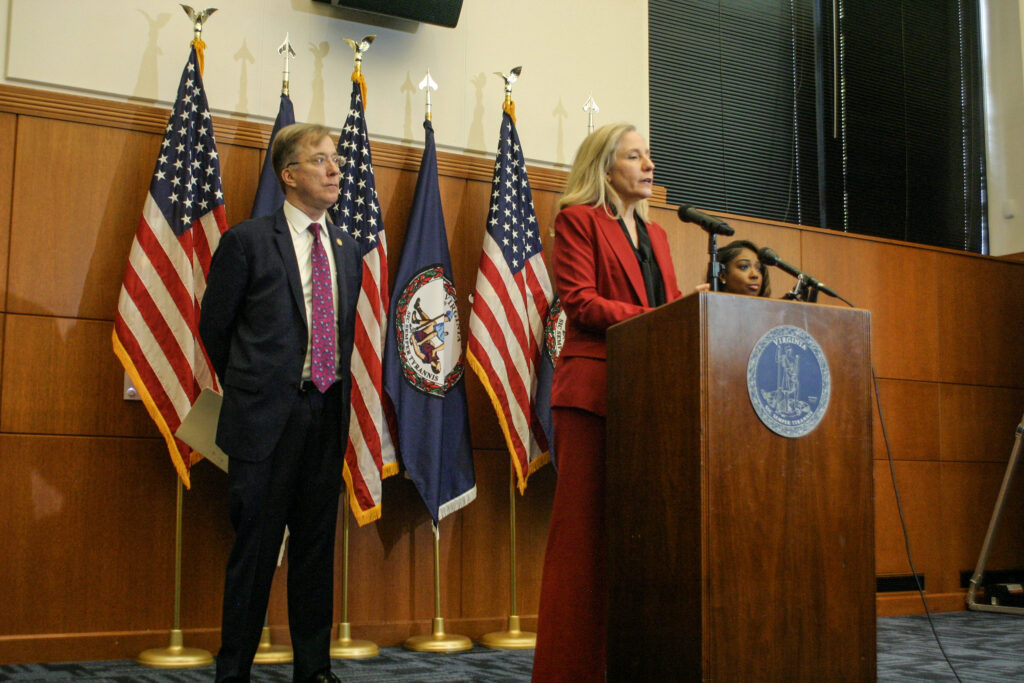
From left: Del. Paul Krizek, D-Fairfax, Gov. Abigail Spanberger and Sen. Lashrecse Aird, D-Henrico present a revamped plan for the state's retail cannabis marketplace, which includes compromise provisions incorporating many of lawmakers' priorities in the original bill and the governor's tweaks. Cannabis sales are set to begin July 1, 2027, they said. (Photo by Shannon Heckt/Virginia Mercury)
Tuesday morning, Gov. Abigail Spanberger and the legislative architects of a long-awaited retail weed framework presented a revamped plan for the recreational marketplace that they said is set to launch next summer, pending finalization of the state budget.
The announcement marked a major shift, after Spanberger vetoed the cannabis marketplace plan approved by lawmakers in this year’s General Assembly session, five years after the state made adult simple possession legal.
“I am excited to stand alongside Sen. Lashrecse Aird and Del. Paul Krizek to announce that we have agreed to a proposal that will create a safe, legal, and well-regulated cannabis market here in the commonwealth of Virginia, with recreational sales beginning on July 1, 2027,” Spanberger said at the press conference in Richmond.
“Virginians have been waiting a long time for policymakers and a governor who wanted to do this and get it right. And today we are taking an important step forward,” Spanberger added.
Aird, a Democrat from Henrico, said the state tax on cannabis sales will be 6% at launch and will increase to 8% in 2029. Localities also have the option to add an additional tax of 1 to 3.5%.
“If our goal is to move consumers away from the illicit market, then the legal market has to be able to compete, and keeping the tax rate low at the start is not just an economic decision, it is a public safety strategy,” Aird said.
The plan will also limit the total number of retail locations to 350 statewide, which Aird said wouldn’t all debut at once and will be geographically balanced.
In a compromise between the original legislation and Spanberger’s tweaks that lawmakers rejected before her veto, the new framework includes a $250 public consumption civil penalty that will not take effect until 2027.
“We had serious concerns about creating extreme new penalties that would not have meaningfully reduced the illicit market,” Aird said, “but we believe this final framework strikes the right balance for enforcement mechanisms, but also in accountability, but also not harming those who just choose to participate in the market.”
Krizek, a Fairfax Democrat, announced several measures designed to make the marketplace more equitable and accessible to small businesses, including one that will direct 75% of license fee deposits in the first year of operation into the Cannabis Equity Business Loan Fund.
“This is important because access to capital is one of the biggest barriers for small businesses entering a highly regulated marketplace,” Kirzek said.
The Virginia Cannabis Control Authority will be allowed to issue up to 100 microbusiness licenses by May 1, 2027, Krizek added, which will “help prevent the market from being dominated solely by the largest and best capitalized ventures.”
Microbusinesses will also be authorized to operate up to two locations under their license structure, which had been a key concern for small and rural entrepreneurs.
Regulatory structures of the original plan like seed-to-sale tracking, a product testing framework, licensing administration, and reporting requirements related to ownership, equity, participation, and disciplinary actions are present in the updated framework, with Krizek framing them as tools to “create transparency and accountability as the market develops.”
In contrast to the recent tensions between leading Democrats and Spanberger after she vetoed 31 bills that represented priority issues for the party, the governor, Aird and Krizek repeatedly emphasized the collaboration and compromise undergirding the new plan.
“We have always had this same end goal, an end goal that has been years in the making, so I am proud to stand alongside these dedicated legislators and to be working alongside them to deliver a marketplace built to last,” Spanberger said.
The retail cannabis plan — released as the Senate money committee met nearby to unveil its reworked state spending proposal — hinges on finalization of the state budget, which has been stalled for weeks as lawmakers debate whether data centers’ sales tax exemption should continue.
“I believe that the Senate is very much interested in also getting us a budget, and that we have shared goals on how to get there,” Aird said.
The House revealed its new budget proposal on Friday; the chambers must work together to finalize the budget by June 30 to prevent a state government shutdown.
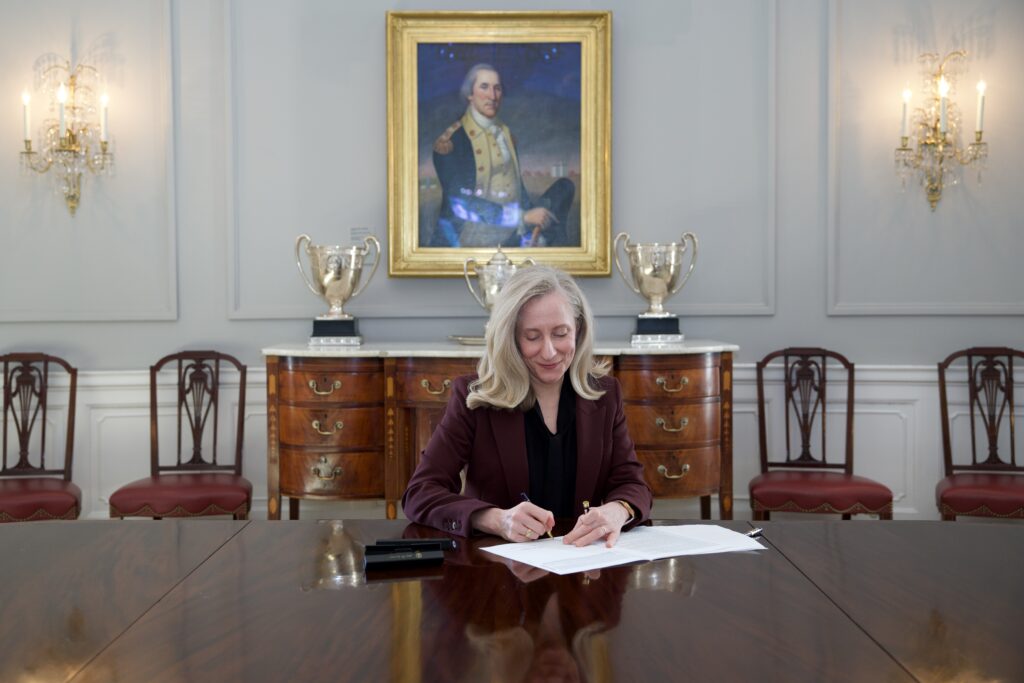
Gov. Abigail Spanberger signs legislation in Richmond in April. Spanberger’s first six months in office have been marked by clashes over vetoes, affordability policies and ongoing budget negotiations tied to data center tax incentives. (Photo courtesy of the Virginia Governor’s Office)
Back in January, Gov. Abigail Spanberger arrived in office promising pragmatism, affordability and a less combative style of politics.
Fast forward a few months, and Virginia’s first woman governor finds herself navigating one of the rockiest starts to a Democratic administration in years, with budget negotiations intensifying weeks before a shutdown deadline, frustration simmering inside her own party over a wave of vetoes and lawmakers openly questioning her governing style.
“I think it’s outrageous that we are where we are, and I hear from many legislators that they are displeased with the process,” Spanberger said during an interview with The Mercury at her office in Richmond Thursday, referring to the state’s still unfinished biennial spending plan.
“And I know that they are making that known to their individual bodies. And we will get there, because we have to.”
The impasse has overshadowed much of Spanberger’s opening months in office. Democratic leaders remain divided over whether to scale back Virginia’s lucrative data center tax incentives and how aggressively to regulate the fast-growing industry.
Lawmakers face a June 30 deadline to approve a spending plan before the new fiscal year begins July 1. Without a deal, Virginia could enter an unprecedented government shutdown.
The fight has also exposed tensions between Spanberger and some top Democrats in the legislature who expected a smoother relationship with a governor from their own party after four years of divided government under Republican Gov. Glenn Youngkin.
Political analyst Bob Holsworth said the administration’s first few months have been shakier than many Democrats anticipated.
“By and large, I think it’s been a wobbly term for sure,” Holsworth said. “We’ve never seen the kind of vetoes that we had before, and the Democrats are in a position that’s almost embarrassing in terms of the budget.”
Still, Spanberger rejects the idea that her administration so far has been defined mainly by conflict.
“I’ve signed more than 100 bills that Governor Youngkin had vetoed,” she said.
Richmond versus the rest of Virginia
Spanberger said one of the biggest surprises on the job has been the disconnect she sees between debates dominating Capitol Square and the concerns she hears while traveling the commonwealth.
“How different things are here in Richmond, or even Capitol Square, versus everywhere else in Virginia,” she said, recalling recent visits to Abingdon, Washington County, Blacksburg and Surry County during Virginia Agriculture Week.
“The things people are talking about at times are very, very different from the things that people are talking about in Richmond,” she said.
Spanberger said that disconnect has influenced how she approaches many of the biggest issues coming out of the General Assembly.
While progressive lawmakers pushed for sweeping changes on labor, environmental and criminal justice issues, Spanberger said she often evaluates legislation differently now as governor, focusing more heavily on implementation, agency capacity and long-term economic effects.
“It’s important to me that not only are we getting it right, but when there’s clear places and areas for improvement in terms of how we can set up state agencies or entities for that implementation, we need to make those changes,” she said.
Spanberger pointed to paid family and medical leave as an example of a policy she supports but also requires careful implementation.
“Virginia is the 14th state in the country to adopt a policy like this. It’s a policy that I think people are going to feel in a positive way, but it is a major shift, and we have to get it right,” she said.
But Holsworth said many lawmakers expected clearer guidance from the governor earlier in the legislative process, especially relating to the state budget.
“She could have been involved earlier there,” he said. “Typically governors really try to do a more determined job of setting the parameters of the budget early on.”
Holsworth also argued the tensions reflect ideological shifts within the Democratic Party of Virginia.
“Virginia’s always had these pro-business governors, Democratic or Republicans,” he said. “But the legislative branch of the Democratic Party has moved a little further to the left.”
The data center divide
Sen. Louise Lucas on the Senate floor at the Virginia State Capitol in Richmond during this year’s legislative session. Lucas has emerged as one of the leading voices pushing to scale back Virginia’s data center tax incentives amid ongoing state budget negotiations. (Photo by Shannon Heckt/Virginia Mercury)
Much of the budget dispute comes down to disagreements over Virginia’s sales and use tax exemption for data center equipment, an incentive credited with helping the commonwealth become the world’s largest data center hub.
Sen. Louise Lucas, D-Portsmouth, the chair of the powerful Senate Finance and Appropriations Committee, wants to eliminate the incentive, arguing the state is subsidizing highly profitable corporations while residents face rising utility costs and environmental concerns.
Last week, Lucas announced that she would take the data center debate directly to the voters, launching a statewide listening tour focused on the industry’s impact on communities statewide.
Stops are planned across Virginia, including Hampton Roads on Sunday, Richmond and Northern Virginia as lawmakers continue weighing whether the state should scale back billions of dollars in tax incentives for the rapidly expanding sector.
Spanberger, however, has taken a more cautious approach.
“What is less part of the discussion is the end goal,” she said, warning that abruptly dismantling the tax break could trigger lawsuits, damage Virginia’s business reputation and destabilize local governments heavily dependent on data center revenue.
“Look at Mecklenburg, where they’ve built multiple public schools fully with data center funding,” Spanberger said. “When you have localities with nearly half their local revenues coming in from data centers, there’s some localities that are saying, wait, why are you going to pull up the ladder behind you?”
At the same time, she said the industry should face stricter standards on energy consumption, water usage and environmental impacts.
“If energy generation and energy consumption is a problem — and I’ve been very clear that data centers need to pay their fair share as relates to energy consumption — well, how do we get there?” she said.
Spanberger argued Virginia still holds leverage because companies want to locate in the commonwealth.
“We have a pretty significant stance to be able to say we have these very high standards, and we want you all to meet them,” she said.
On Friday, the House released a new budget proposal that would preserve the existing sales and use tax exemption for data centers while creating a commission to study the industry’s long-term impact on Virginia’s power grid, water resources and economy.
The revised plan also eliminated earlier Senate-backed environmental requirements opposed by industry groups and some business advocates. Spanberger, who has repeatedly argued the state should “honor its commitments” to companies that invested in Virginia under the current incentive structure, praised the House approach Friday.
“This proposal creates a clear roadmap for evaluating the impact of the data center industry in Virginia and for reassessing the state’s incentives into the future, with a focus on fairness to ratepayers and the needs of local communities,” Spanberger said in a statement.
Meanwhile, Senate Minority Leader Ryan McDougle, R-Hanover, blamed Democrats broadly — and Spanberger specifically — for the ongoing impasse.
“She’s the governor and it’s her party,” McDougle said in an interview Friday. “She should take the blame.”
McDougle also criticized what he described as a lack of policy engagement from the administration during the session.
“My conversations with the governor during the legislative process were always polite and courteous, but nothing substantive about policy. I would expect such conversations would have a significant policy component, and I did not see that from my perspective. And we did not see representatives of the administration at many of the committee hearings and debates,” McDougle said.
Holsworth said the budget stalemate has exposed deeper tensions over Virginia’s economic identity.
“You have one group of Democrats, with Spanberger leading it, saying that if we do this, our ranking, as the best state for business, is really going to take a hit,” he said.
“On the other hand, you have Senator Louise Lucas and other people in the Senate, some Republicans included, saying, ‘Why in the world are we paying a couple of billion dollars a year to the richest people in the world as a tax exemption? We should get rid of it, or at least tone it down in some fashion.’”
Senate Minority leader Ryan McDougle, R-Hanover, speaks with reporters outside the Virginia State Capitol in Richmond last month as lawmakers continued negotiations over the state budget and data center tax incentives. (Photo by Shannon Heckt/Virginia Mercury)
Affordability and political pressure
Spanberger campaigned heavily on affordability last year, but acknowledged many Virginians still don’t feel economic relief.
“The measure of success keeps changing because all of the pressures that require us to work on issues of affordability and lowering costs keep getting worse,” she said.
She highlighted insulin cost reforms, healthcare changes involving insurance pre-authorization and housing measures she said will help residents more directly.
However, Spanberger acknowledged those gains collided with inflation and rising fuel prices.
“The progress we’re making is muted by the fact that there’s still pressures and bad policies that are negatively impacting people,” she said.
Republicans have repeatedly argued that Democratic policies are contributing to higher household costs.
McDougle said the governor’s policies contradict her campaign messaging on affordability and bipartisanship.
“She talked a lot about being for people and bipartisanness and affordability on the campaign trail. And then her initial policies, right out of the gate, were to raise everybody’s power bill through RGGI,” he said, referring to Democrats’ move to rejoin the Regional Greenhouse Gas Initiative.
The Spanberger administration pointed out that 75% of the governor’s “Affordable Virginia Agenda” passed with bipartisan support.
But Holsworth said Republicans moved quickly after Spanberger took office to define her politically before she could fully establish her governing identity.
“They went after her early, and I think they caught that team a little unaware,” Holsworth said. He added that many of Spanberger’s affordability initiatives may ultimately prove popular but are not tangible to many voters.
“The average person in the street knows that their electric bills and insurance bills are going up,” he said.
What comes after the budget
Even with the budget fight and criticism from some Democrats, Spanberger said she remains focused on longer-term priorities, particularly housing, childcare and administrative reforms.
“There’s more to do to continue to really push on the supply side challenge,” she said, referring to housing and childcare.
The governor is also closely watching Dominion Energy’s proposed merger with NextEra Energy, which would create one of the nation’s largest utility companies.
Spanberger said she sees possible benefits if the merger expands renewable energy production and lowers costs for ratepayers, but she also expressed concerns about long-term impacts on Virginia jobs and consumers.
“There also has to be some clear financial benefit for the fact that these two gigantic companies are endeavoring to merge to become even more enormous,” she said.
Spanberger also acknowledged that, as Virginia’s first woman governor, some reactions to her leadership may be shaped by expectations that previous governors did not face.
“I think that things are scrutinized differently, assumptions are made differently,” she said. “I might not be exactly in the model that people are used to.”
Still, she suggested that some of the criticism surrounding her first few months in office reflects discomfort with a governing style that does not fit traditional expectations of Virginia governors.
“The way that people will level critiques against me just objectively, they wouldn’t do it (to others),” Spanberger said. “They haven’t.”
Marvell data center is one of eight newly approved data center campuses in Culpeper County. (Photo by Evan Visconti/Virginia Mercury).
Virginia gave data centers a $928 million tax break in a single fiscal year, 2023, and the General Assembly cannot pass a budget because it can no longer agree on whether to keep doing it. That is the fight underneath the standoff in Richmond, with state spending set to expire June 30 and the conferees who should be writing a deal gone home without one.
The state’s own auditors laid out the stakes more than a year ago. The Joint Legislative Audit and Review Commission studied the exemption in 2024 and found it provided $928 million in tax savings in fiscal 2023. About 90% of the state’s data center industry was using it. The exemption has been on the books since 2010 and is scheduled to expire in 2035.
The significance of JLARC’s findings about the return on that money has eluded the budget debate so far.
The benefit is real but front-loaded. JLARC estimated the industry contributes 74,000 jobs, $5.5 billion in labor income, and $9.1 billion in GDP to the state economy, then added the qualifier that matters: most of it comes from construction, not from running the centers once built.
A typical data center employs about 50 full-time workers, half of them contractors, JLARC’s report found. At the height of building one, roughly 1,500 workers are on site. The jobs that justify the break are mostly the jobs that end when the concrete cures.
Then there is the cost that lands on people who will never own a server.
JLARC commissioned an independent study of utility rates and found current rates correctly assign costs to the customers who cause them, data centers included. But the industry’s appetite for power changes the math going forward. Meeting it requires building generation and transmission that would not otherwise be built, and those fixed costs get spread across every ratepayer.
JLARC put a number on it: a typical Dominion residential customer could see generation and transmission costs rise by $14 to $37 a month in today’s dollars by 2040. That is the quiet transfer inside this debate. An industry that buys its equipment tax-free helps drive a power buildout that shows up on household bills.
This is where the Senate and the governor parted ways. Senate Finance Chair Louise Lucas has pushed to wind the exemption down rather than let it run untouched to 2035, and walked out of the meeting when that went nowhere.
Gov. Abigail Spanberger and House Appropriations Chair Luke Torian have resisted early repeal, arguing the state must honor the agreements it signed. A single tax preference has been able to hold the whole budget hostage.
The contract argument deserves a closer look than it usually gets. Companies claiming the exemption sign a memorandum of understanding with the state, and Virginia law spells out what that document must contain: the company’s investment target, its job target, the timeline, and what it owes back if it falls short.
The binding promises run from the company to the commonwealth, enforced by clawback. Nothing in that framework commits the state to keep the exemption alive for any set term. The life of the break is fixed by statute, and a statute can be amended by the body that wrote it.
That points to an option neither side is championing, though JLARC named it plainly: The Assembly could apply a partial exemption after 2035, or end the full break early, drawing the line to protect existing commitments while changing the terms for what comes next.
JLARC noted the Assembly could even narrow an expiration to one region, while warning a Northern Virginia-only approach would do little to slow statewide growth, since the industry is now spreading down the I-95 corridor into central Virginia. A prospective change avoids the contract objection entirely, because no facility can claim it relied on a benefit it was never offered.
The reason the clean version isn’t on the table is the same reason the budget is stuck. Prospective-only changes raise little money now, and the money is the point.
Lucas wants revenue this biennium for services that federal cuts are squeezing. Phasing the break out for the existing base delivers that; protecting the base does not. So the legally cautious path is the fiscally weak one, and the fiscally strong path invites the fight over the agreements. Both sides understand the tradeoff. Neither states it out loud.
A skinny budget may keep the lights on past June 30. It will not resolve what the standoff revealed.
Virginia built an incentive its own auditors say returns less to the state than it costs, watched it grow into a near-billion-dollar annual line, and has not decided whether it has the will to change course. Localities adopting their own budgets this month, waiting on state numbers that may not come, will feel that indecision first.
Construction in Richmond, Virginia on May 15, 2026. (Photo by Charlotte Rene Woods/Virginia Mercury)
Last summer, U.S. Sen. Mark Warner, D-Va., criticized Congress for often “kicking the can” on federal housing policy. One year later, federal lawmakers are close to sending a large bipartisan housing bill to President Donald Trump’s desk.
Dubbed the 21st Century ROAD To Housing Act, the effort is led by Sens. Tom Scott, R-S.C., and Elizabeth Warren, D-Mass. along with U.S. Reps. French Hill, R-Ark., and Maxine Waters, D-Calif.
A key provision of the bill aligns with one of Trump’s goals to restrict large investment firms from buying up too many single-family homes. The practice has stifled first-time homebuyers, and state lawmakers from both parties in Virginia have previously introduced similar restrictions.
Other provisions in the bill encourage housing development in underused or vacant commercial properties like strip malls.
“They can be converted to housing because they’ve already got power, parking and utilities around,” said Warner, who spearheaded that portion of the bill.
The concept, along with incentives to build manufactured homes, drew inspiration from legislation also introduced in Virginia.
A “housing near jobs” bill by Sen. Schuyler VanValkenburg, D-Henrico, and Del. Dan Helmer, D-Fairfax, did not become law, but its similarity to Warner’s proposal could give supporters hope to try again, VanValkenburg said. The bill would encourage multifamily and mixed-use development by right in certain commercial corridors so more people can live closer to where they work and reduce suburban sprawl.
VanValkenburg’s manufactured homes bill, which was recently signed into law by Gov. Abigail Spanberger, can help bring those types of homes onto the market in areas that need or want them. Likewise, Congress’ pending bill would treat the factory-built style of home the same as a site-built home when it comes to zoning and financing.
“Housing is tricky because a lot of it is local, but of course state and federal governments play a role too,” VanValkenburg said.
To guide local governments, which typically control land use decisions like housing, the federal bill would also direct the U.S. Department of Housing and Urban Development to publish model zoning guidelines for states and localities to explore in their communities.
“We also have to be honest that zoning is a local prerogative — too often, it’s a local prerogative to say ‘no,’” Housing Opportunities Made Equal Director Thomas Okuda Fitzpatrick said. “That’s why we need strong state actions and policy solutions in parallel with the 21st Century Road to Housing Act.”
All of Virginia’s congressional representatives from both parties voted to advance the bill. But with differences between the House and Senate versions still unresolved, lawmakers cautioned that final passage — and Trump’s signature — are not guaranteed yet.
‘Devil’s in the details’
U.S. Sen. Mark Warner, D-Va., speaks on the patio of Legend Brewing Co. in Richmond on April 9, 2026. (Photo by Charlotte Rene Woods/Virginia Mercury)
One major sticking point involves a provision the House stripped from its version of the bill that would have required developers of build-to-rent housing to sell properties within seven years of construction completion.
Build-to-rent developments allow tenants to rent single-family homes instead of apartments and can serve people who are not ready to buy or cannot yet afford home ownership but need more space. Supporters of the original provision argued it could help create a path to homeownership for renters, while developers warned the time limit could discourage investment in that type of housing altogether.
The National Association of Home Builders praised the House changes and said it hopes the Senate accepts them.
In a statement, Chairman Bill Owens said that keeping the original provision would have “reduced supply.”
The House version of the bill also includes provisions to streamline examinations for smaller banks, which Owens called “meaningful relief to community banks.”
“We urge the Senate to move quickly to send a once-in-a-generation housing bill to President Trump to expand housing supply and address America’s housing affordability challenges,” Owens wrote.
Warner said he is cautiously optimistic the Senate can get the legislation across the finish line.
“Never underestimate the ability of Congress to screw up a sure thing,” Warner said in a recent phone call.
He added that the compromise feels “fairly reasonable, so I think we’ll get it done, but there are some strong personalities involved.”
Fitzpatrick said corporate ownership has long concerned his organization, particularly when investors target low-income neighborhoods to “change the ownership landscape there.” But he described build-to-rent housing as “more nuanced” because “they provide a housing option.”
“As with so many things, the devil’s in the details,” he said.
Still, Fitzpatrick said his organization is pleased to see federal lawmakers exploring solutions to the country’s housing shortage. He also praised provisions aimed at boosting federal funding streams local governments and housing groups rely on, even as some of those programs face proposed cuts from Trump.
Community Development Block Grants, for example, have long provided funding for local governments to build affordable housing, revitalize neighborhoods and support economic development projects in low-and-moderate-income communities.
Warner’s fellow Democratic Virginia senator, Tim Kaine, said Congress has repeatedly blocked Trump’s attempts to eliminate the grants because lawmakers hear how “enormously popular” they are with local governments across the country. Kaine, a former Richmond mayor, said he saw their impact firsthand.
Overall, Kaine said he does not view the differences between the House and Senate bills as insurmountable and is prepared to help colleagues “get this done.”
With congressional midterm elections later this year expected to intensify partisan fights, lawmakers may soon return to attacking one another over policy differences.
But VanValkenburg said the housing bill shows bipartisan cooperation is still possible.
“In a day and age where we all have, rightfully, a lot of cynicism about Congress and its ability to act, this seems like a bipartisan action on an issue that needs action,” VanValkenburg said.
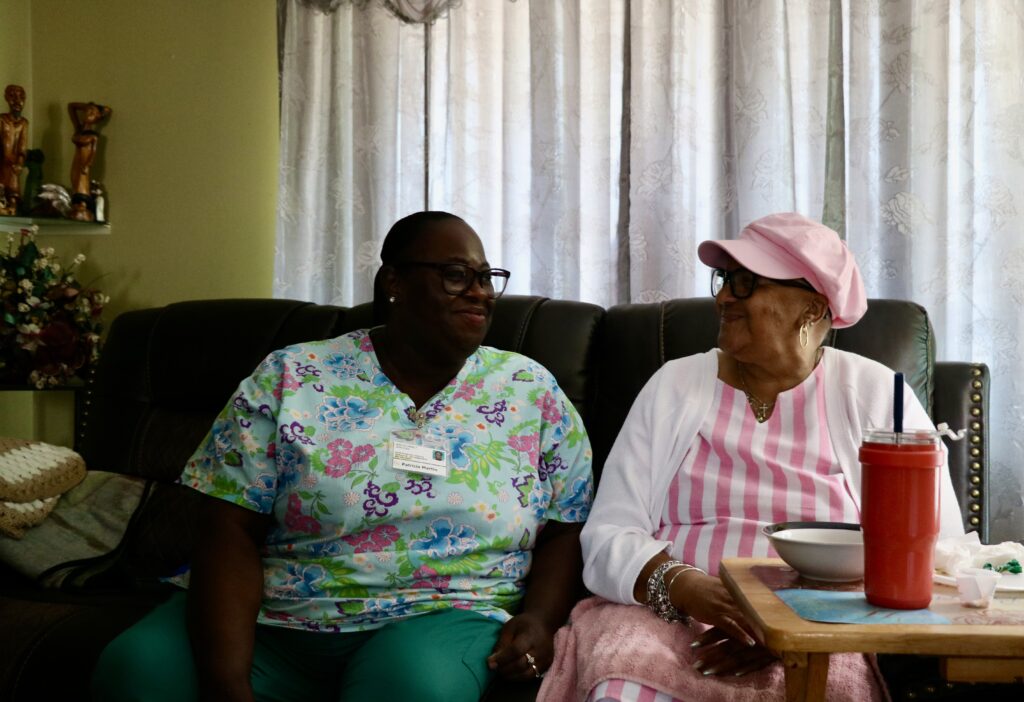
Pat Martin (left) and Clara Hatcher (right) smile at each other in Hatcher's living room. (Photo by Charlotte Rene Woods/Virginia Mercury)
Decked out in a matching pink shirt and hat with layers of bracelets and necklaces, Clara Hatcher’s dialysis appointment doubles as a fashion event.
She spends three and a half hours, three mornings a week, receiving the treatment, so the 77-year-old likes to dress up for the occasion. Having been a dialysis patient for 12 years, she also shares her expertise with newer patients about how to handle the procedure.
“I like to warn people how tired it can make you feel and what to expect,” Hatcher said.
While she likes helping others prepare for it, she receives help of her own through her caregiver Pat Martin and nurse Belinda Hensley.
The trio reflected on how healthcare “takes a village” as they helped her slowly walk back into her ranch-style Henrico County home after an appointment.
Hatcher’s home health workers help her age in place in the house she bought to do just that.
Much of Martin’s work involves making sure Hatcher sticks to her medication schedule, handling light housekeeping, ensuring she gets to medical appointments and assisting with tasks like dressing or cooking.
“She likes to cook but her hands have tremors and I need to make sure she doesn’t fall,” Martin said.
Hensley makes occasional visits to check in, as nurse supervision is required by Medicaid.
As a nurse and a caregiver, Hensley and Martin are part of an evolving home healthcare landscape. As more people choose to age in place longer or avoid nursing homes altogether, demand for services is growing.
Staffing organizations are innovating to hire and retain workers while coping with low Medicaid reimbursement rates at a time where the state-federal program is bracing for funding losses. That’s why two Richmond-area nonprofits hope that a grant-funded pilot program they participated in could become a model for other parts of the state.
Supported staff, supported clients
With $700,000 in funding from the Richmond Memorial Health Foundation and the Bob and Anna Lou Schaberg Foundation, Family Lifeline and Jewish Family Services were able to grow their staff numbers by 69% and 43%, respectively. They also raised caregivers’ starting wages to $15 an hour, predating the benchmark that state legislators passed this year.
“This is a workforce where the wages have historically been very low,” Family Lifeline CEO Jennifer Case said.
Raising pay was important for both attracting and retaining staff. The funding also helped the organizations modernize technology to make paperwork easier for nurses and caregivers, improve professional development training and assist workers facing transportation issues.
Case emphasized that many caregivers do not have cars and rely on public transportation to get to work.
If a client lives along a bus route, that may not be a problem, she said. But when clients live deeper into Henrico or Chesterfield counties, transportation can become a challenge.
Even within Richmond city limits, Southside resident Regina Carter said what would normally be a short drive to the East End can sometimes take her more than an hour because she relies on the bus.
“Sometimes the bus will not even come, so I have to wait for a whole other one,” she said. “And that’s almost like I don’t want to say an hour, but it’s an hour.”
In recent years, the city and surrounding counties have expanded bus routes, but building that infrastructure takes time.
For caregivers whose clients live farther out, the pilot program helped offset some Lyft and Uber costs for workers who needed it.
Wendy Kreuter, CEO of Jewish Family Services, said both organizations continue supporting workers with transportation needs and plan to advocate on the issue with state and local governments while exploring public-private partnerships.
Transportation barriers have long been an issue in healthcare, particularly in rural communities. State lawmakers have backed a pilot program providing Medicaid coverage for non-emergency transportation to help rural patients reach appointments. But challenges getting workers into patients’ homes have not yet been addressed.
“This is something we should explore,” said Del. Rodney Willett, D-Henrico, who chairs the House Health and Human Services Committee, where healthcare legislation is reviewed each year.
Medicaid issues
Another longstanding issue has been Medicaid reimbursement rates. For Family Lifeline and Jewish Family Services, that means both organizations have had to rely on other funding sources to support staff.
Generally, reimbursement rates range from $20 to $23 per hour. But Kreuter and Case said the “village” includes more than direct care workers. Administrative staff are also needed to coordinate scheduling and transportation for clients.
“I think it’s just going to get harder,” Hensley said of a reconciliation bill Congress passed last summer that puts thousands of Virginians at risk of losing Medicaid coverage.
A KFF survey released earlier this year found that 41 states have reported home health agency closures, though Virginia was not among them.
Case and Kreuter said their organizations seek private philanthropy of all sizes to continue supporting workers and clients.
Though the reconciliation bill could affect Medicaid coverage and services across Virginia, federal lawmakers also negotiated the Rural Health Transformation Fund as an opportunity to address longstanding challenges.
Outgoing Gov. Glenn Youngkin secured $189 million from the fund, which Gov. Abigail Spanberger’s administration is now responsible for administering.
LeadingAge Virginia, which represents organizations like Kreuter’s and Case’s, has applied for the funding.
Betsy Archer, director of the association’s PositiveAge branch, said the charitable pilot offers a strong blueprint.
“We definitely see it as a replication or a replicable pilot that we think can be strengthened,” she said.
Medical cannabis plants are inspected during cultivation. Abigail Spanberger’s veto of a retail cannabis bill leaves businesses waiting and regulators limited in how much they can prepare for a future adult-use market. (Photo courtesy Shutterstock)
Throughout her bid for governor, Gov. Abigail Spanberger said she would support a bill to set up a legal, adult-use cannabis market — which is why her veto on May 19 caught many rooting for such a market by surprise.
“I thought it was a joke, honestly,” said Julian Redcross, a Hampton-based hemp grower. “When I saw it going around on fire on social media, I was like, ‘Oh, this is not real. This is AI.’”
Spanberger said her decision was based on the need for stronger tools to enforce the law and regulate a legal cannabis market.
“Virginians deserve a system that replaces the illicit cannabis market with one that prioritizes our children’s health and safety, public safety, product integrity, and accountability,” she wrote in her veto statement.
The veto left Virginia cannabis businesses facing another year in limbo after many spent years preparing for a legal market following the 2021 legalization of personal possession. Now, some hemp growers are having to make tough calls about the future of their businesses.
It also left the state’s safety questions unresolved: Regulators say they cannot finalize licensing, monitoring or inspection rules without a law in place, while health experts warn consumers are likely to keep buying products that are hard to test, label and trace.
The bill Virginia lawmakers sent to the governor’s desk this year would have allowed adults 21 and older to buy marijuana starting in January 2027. The legislation proposed capping the number of licenses to a few hundred to limit the number of retail cannabis stores. It included policies for labeling and testing, said Jason Blanchette, president of the Virginia Cannabis Association and a hemp grower in Hampton Roads.
Spanberger sent back changes that pushed the starting sale date to July 2027, capped the number of stores at 200, reduced the personal possession limit to two ounces and recommended new criminal penalties, VPM reported.
The new penalties, especially, gave lawmakers and lobbyists pause.
“The way that she wrote those back in, we are now recriminalizing a product that we have already made legal in the state of Virginia, so to a lot of those groups it appears that we are moving backwards when it comes to justice,” Blanchette said.
A sliver of hope remains that a compromise could still be reached when lawmakers meet later this month to talk about the state budget, Blanchette said, but it’s a long-shot.
“We’ll be lucky to be up and running by 2028,” he said.
That will be too late for some businesses.
‘Up in smoke’
Brad Wynne started growing hemp in Virginia Beach in 2023 for his company Veg Out Organics, which sells topical CBD products.
He stopped growing hemp in 2024, biding his time for the state to get the ball rolling on a retail cannabis market. But he said he can’t afford to wait any longer.
“I’m shutting down end of June,” Wynne said.
He said his operation was as small as they come, but he spent years building it.
“If you were to start from scratch with no land, no building, no nothing, each business, whether it’s retail, growing or dispensing, is about $500,000 to $1 million,” he said.
The high startup cost makes sure the business can stay afloat while the plant is growing, which takes roughly six months.
“This is a living plant, so this is not something you just buy from out of state, throw onto a shelf of a dispensary overnight, and you’re open the next morning,” Blanchette said.
Wynne said he wished Spanberger sent her changes as line items lawmakers could have addressed individually, rather than as a substitute that had to be accepted or rejected as a whole.
Blanchette said he disagreed with Spanberger’s assessment that the legislation was rushed.
“I’ve been personally working on this for five years, so I know that we’ve put plenty of time and effort into this, and it has not been rushed,” he said.
Julian Redcross said he was angry at Spanberger’s decision at first. But the anger soon gave way to acceptance and hope that a better bill will be proposed in the future.
He and his twin brother Jonathan Redcross co-own Yoagie Enterprises and started growing hemp in 2019, while keeping their day jobs. They stopped growing operations this year when new hemp regulations strained their business. Julian said they plan to keep waiting.
“We just have an empty space right now that’s costing money, but we didn’t jump over the edge just yet,” he said.
Julian and Jonathan said they hope when the state eventually sets up a retail market, it gives small businesses like theirs a fighting chance. As for Spanberger, Julian said doesn’t take this year’s veto as her backtracking on her support of the legal market — yet.
“She said she would pass it,” he said. “She didn’t say when.”
A regulatory dilemma
One of Spanberberger’s reasons for vetoing the bill was the need for stronger regulations.
“That includes clear enforcement authority and sufficient resources for compliance, testing, and inspections, and robust tools to crack down on bad actors who continue to profit from the illicit market,” she wrote in her veto statement.
But the illicit market will continue to reign supreme with no competition from a legal market, said Wynne, the Virginia Beach grower.
Some businesses and public health experts say the commonwealth needs stronger safety rules before opening a retail cannabis market, but in practice, regulators are limited in how much they can prepare before lawmakers pass a final bill.
Barbara Biddle, a hemp business owner from Northern Virginia and the founder of the Cannabis Small Business Association, said she supports legalization, but did not think the vetoed bill was the right vehicle to create the market.
“It was a necessary action that needed to happen,” Biddle said. “But we don’t think that this was the right vehicle for it.”
Biddle said Virginia needs clearer rules for testing, labeling and industry compliance, as well as more training for police and first responders before retail sales begin.
Jamie Patten, chief administrative officer at the Virginia Cannabis Control Authority, has previously told WHRO that the authority is ready to implement additional regulation and resources if lawmakers approve a retail market.
Those measures will include specific rules for licensing, monitoring and data collection in an adult-use retail market.
But without finalized legislation, she said, the agency can’t settle the details of how that market would be monitored.
In the interim, Patten said the authority has been focused on public education, including warnings about impaired driving, after a survey found nearly a third of Virginia drivers believe cannabis makes them safer behind the wheel.
Michelle Peace, a forensic science professor at Virginia Commonwealth University who specializes in cannabis testing, said without a regulated retail market, consumers have fewer ways to know whether cannabis products are accurately labeled, properly tested or made under consistent safety standards.
She’s repeatedly found products with THC levels that did not match their labels.
“My laboratory has demonstrated over and over again that products are either more concentrated than what’s on the label or significantly less concentrated than what’s on the label,” Peace said.
The risk will also be hard to track because consumers may not know where to report adverse reactions from unregulated products, Peace said.
The Virginia General Assembly Building stands in Capitol Square in Richmond. Virginia lawmakers are expected to return later this month to continue negotiations on the state budget ahead of the June 30 fiscal deadline. (Photo by Markus Schmidt/Virginia Mercury)
Virginia’s revenue outlook has improved by $1.5 billion over the next three fiscal years, giving lawmakers more breathing room as negotiations over a stalled state budget are set to continue in Richmond later this month.
Gov. Abigail Spanberger on Monday afternoon released the updated revenue forecast she ordered last month, telling top legislative budget writers that Virginia is projected to collect substantially more General Fund revenue through fiscal year 2028 than previously expected.
The revised forecast projects revenues for fiscal year 2026 will exceed the official estimate by $585.5 million. Another $922.6 million in General Fund revenue is projected for fiscal years 2027 and 2028, including $582.4 million in 2027 and $340.2 million in 2028.
The new projections arrive while lawmakers remain stuck in negotiations over Virginia’s next two-year budget, with disagreements over data center tax incentives and spending priorities continuing to hold up a final deal.
In a letter to Sen. Louise Lucas, D-Portsmouth, and Del. Luke Torian, D-Prince William — the chairs of the legislature’s money committees — Spanberger said lawmakers need updated economic information as they work toward a budget deal.
“As General Assembly leadership and budget conferees continue their important work, it is critical they have the most current and accurate information available,” Spanberger said in a statement.
“While forecasted General Fund revenues have increased, I remain concerned by rising national economic instability, the ongoing conflict in Iran, and the continued impacts of federal workforce cuts. We must account for these evolving economic conditions as we plan for the long-term strength of our commonwealth.”
The updated forecast arrives as lawmakers prepare to return to Richmond later this month for another attempt to break the budget impasse before the start of the new fiscal year.
The House is scheduled to reconvene its special session June 18, followed by the Senate on June 22, as budget conferees continue working toward a compromise spending plan that can pass both chambers and reach Spanberger’s desk before the June 30 deadline.
The revised forecast reflects strong tax collections even as parts of Virginia’s economy show signs of slowing.
General Fund revenues have grown 7.3% on a fiscal year-to-date basis and are running 3.3% ahead of forecast. Virginia is currently $851 million ahead of expectations, though nearly 70% of that amount — about $578 million — comes from nonwithheld income tax payments and individual refunds, two of the state’s most volatile revenue categories.
Virginia Secretary of Finance Mark Sickles said the revised forecast attempts to balance the state’s recent revenue growth against growing uncertainty in the national economy.
“The updated forecast confirms that the commonwealth’s revenue performance remains solid but also factors in the deteriorating economic conditions and increased uncertainty in the national outlook,” Sickles said in a statement.
“The additional $1.5 billion in updated projected revenues should provide the General Assembly with enough resources to craft a structurally balanced budget that mitigates any potential risks related to national market volatility.”
The updated forecast follows warnings from state finance officials last month that Virginia’s economy is facing slower job growth, persistent inflation and weakening consumer confidence even as tax revenues continue to exceed expectations.
During a May presentation of the Senate Finance & Appropriations Committee, Sickles said Virginia had lost 41,900 jobs since the beginning of fiscal year 2026 while General Fund revenues remained more than $850 million ahead of forecast.
At the time, Sickles suggested the surplus could help lawmakers move past the budget stalemate.
“It would not be unprecedented for us to use some of this money to get past this impasse, if we needed to,” Sickles told the committee.
Spanberger ordered the updated forecast May 19 while budget negotiations remained unsolved. The revised projections extend through fiscal year 2031 and are intended to give lawmakers updated economic data before final spending decisions are made.
The prolonged budget standoff has raised concerns about whether lawmakers will finish work on a revised spending plan before the new fiscal year begins July 1.
Lawmakers adjourned a special session in April without an agreement. Disputes over data center tax incentives, transportation funding and competing priorities between the Democratic-controlled House and Senate have remained major obstacles.
The stronger revenue forecast could give negotiators additional flexibility on spending priorities including education, transportation, healthcare and state employee compensation. But administration officials cautioned that economic risks remain.
Federal workforce reductions continue weighing heavily on Northern Virginia and Hampton Roads, both of which have large concentrations of federal employees and contractors. State officials have also pointed to instability in financial markets and international tensions as possible threats to future economic growth.
Even with revenues ahead of forecast, Virginia officials have repeatedly noted that much of the current surplus comes from revenue streams that can fluctuate significantly from year to year.