Tag: Amazon

  • Four Va. counties will pump almost 20 million gallons of water a day to Amazon. Cause for concern?

    Four Va. counties will pump almost 20 million gallons of water a day to Amazon. Cause for concern?

    How you look at something – the frame you use and your perspective – often influences what you see.

    This holds true with the issue of data centers and water use. Amazon recently reported that it withdrew a total of 2.5 billion gallons of water for data center cooling operations in 2025. That seems like a lot of water.

    But Amazon also points out that Americans used 3.3 trillion gallons of water that same year to grow their gardens and lawns.

    The company apparently wants to assure you that the water it uses for its data center operations, in comparison to other uses of water across our very large country, is not such a big deal.

    Of course, Amazon doesn’t operate its data centers across the entire nation. It does so in only a few states, and nowhere at higher concentration than in Virginia.

    We wanted to learn for ourselves how much water local communities have promised to Amazon for data center cooling in our part of the state, the region between Northern Virginia and Richmond, including Louisa, Spotsylvania, Caroline and Stafford Counties.

    By scouring available public records and submitting Freedom of Information Act requests, we learned that local governments in the commonwealth have allocated at least 19.6 million gallons a day to Amazon.

    This, we think, is an underestimate. It doesn’t include at least one large water-cooled data center campus in another nearby county that might end up being leased and operated by Amazon, but is currently being constructed by another company. And it doesn’t include other potential Amazon data center campuses that have not yet been approved or are being held up in court.

    Even so, 19.6 million gallons a day seems like a good deal of water. It’s enough to fill 980 backyard swimming pools every day. If the average American uses 82 gallons of water a day, it’s enough to sustain 239,000 people.

    But Amazon tells us not to worry. The company has ambitious goals to become “water positive.” To Amazon, this means “replenishing more water to communities than we use in our direct operations.”

    But being “water positive” depends on your scale of analysis.

    For instance, Louisa County plans to provide seven million gallons a day to two separate Amazon data center campuses. Amazon is paying to construct the new water infrastructure that will make this possible.

    On one hand, this is “new” water to Louisa County that wouldn’t otherwise be available for industrial use without Amazon’s funding. But from the perspective of the larger North Anna reservoir and river system, it still constitutes a withdrawal.

    While Amazon is using raw water for its operations in Louisa County, in other localities the company is investing in extensive “purple pipe” systems that will capture water that would otherwise be sent downstream in order to circulate it to its data center campuses. The company is proud that it “works with utilities to collect treated wastewater, clean it to appropriate standards, and reuse it to save drinking water.”

    Amazon doesn’t mention, however, that it will lose more than half of this water through evaporation as it cools its data center facilities, sending most of it up into the atmosphere. So something that appears to be water positive from the perspective of a community hosting an Amazon data center campus might also be a net water loss to a river system and to downstream users.

    Even so, Amazon claims, it doesn’t use water to cool its operations throughout the whole year, only during the hottest days in Virginia.

    A company spokesperson, for instance, marked up a water service agreement between Stafford County and Amazon we received from a FOIA request, in which the county promised to deliver more than five million gallons a day. The spokesperson wrote to us that, “actual annual use is much lower. Based on 10 years of data, the campus only needs cooling water about 4% of the year during the hottest months.”

    The idea that Amazon is spending tens of millions of dollars to build a water system that it will only use for fifteen days out of the year strains credulity. Even if this is true, those are millions of gallons of water being diverted away from our rivers and streams during the peak of summer, when flows are the lowest and water is most needed.

    It’s especially concerning when most of the state is in a severe drought, as we are now experiencing and may endure again in future years.

    Beyond being Virginia’s leading data center company, Amazon has attained near- monopoly status as an online retailer and delivery service. It spends $19 million a year on lobbying alone, according to the Center for Responsive Politics. It funneled almost $10 million to political campaigns in 2024 in order to influence elections, the same source reports.

    Amazon, needless to say, also has a powerful public relations operation. It uses its economic and political power to avoid paying taxes that other companies and most individuals have to pay.

    And in Virginia, the company and others in the data center industry are exempt from paying sales and use tax, which lawmakers say costs us nearly $2 billion annually. That exemption is the sticking point in ongoing budget negotiations; if legislators don’t finalize the spending plan by June 30, with or without the tax exemption, the state will experience its first government shutdown.

    Amazon encourages us not to worry about all the water local governments are allocating to the company in central Virginia. It assures us that it is a good steward of this resource, and that it cares about sustainability.

    But Amazon, just like any company with vested interests and a profit motive, doesn’t always share the complete picture. It frames the view it wants the public to see.

    Given the massive size of this company and the ways it has abused its power in the past, Virginians would be wise to keep a watchful eye on how Amazon is using water. And as communities consider approving yet more data centers and additional water service agreements, Virginians may want to consider when enough is enough.
  • What’s in the water? What we know and don’t know about data center water discharge in Virginia

    What’s in the water? What we know and don’t know about data center water discharge in Virginia

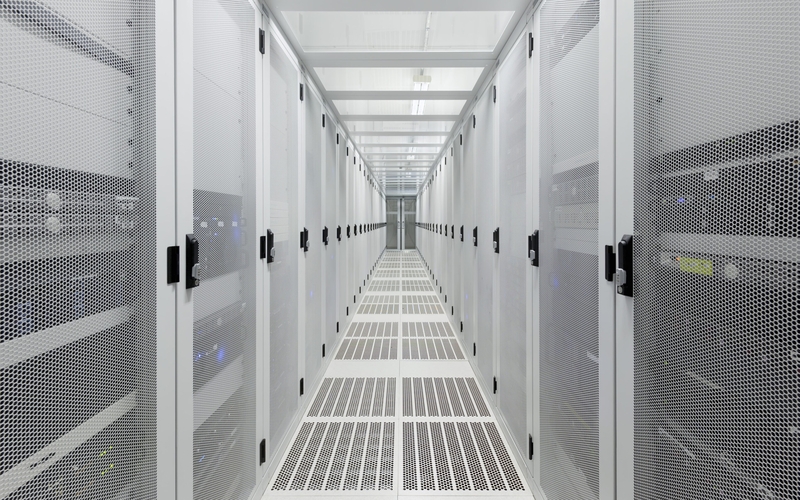
    Data centers require a massive amount of water to cool their systems, which heat up as they process digital information through numerous computers and network servers. Systems that aren’t “closed loop” have to cycle out water that doesn’t evaporate.

    Most data centers in Virginia are permitted to discharge water into municipal wastewater systems, the same place household water goes to be treated and recycled for consumption. But there’s limited data tracking of potential chemicals in data centers’ discharge water.

    At least one data center is permitted to discharge directly into a natural water source in the state: Northeast Creek in Louisa County. Another is applying for a similar permit to discharge into nearby Sedges Creek which feeds into Lake Anna.

    That water is pretreated before being released into the creek and has limits to certain metals and temperature set by the Department of Environmental Quality. But the knowledge gaps about the chemical makeup of data centers’ water discharge poses major questions over whether “forever chemicals” could be contaminating water from the facilities, posing risks to human and environmental health.

    Cooling the waters

    Amazon’s Lake Anna Tech Park project will include an evaporative water cooling system, which is what they use in the Northeast Creek location. The H2O will come from well water until industrial systems are hooked up. At that point, the water will be run through a “membrane” that cools the air and fans will blow it onto the data halls containing the computers.

    Amazon – which operates dozens of data centers in the state – explained that at the two Louisa sites they are only using the evaporation method a small portion of the year; the rest of the time they pull in air from outside for cooling. Water sent through an evaporative cooling system is considered non-contact, meaning it does not directly touch the computer equipment.

    “In Louisa County, we rely on outside natural air-cooling for about 96% of the year and only use water-based cooling during the hottest periods, which is about 4% of annual operations,” Amazon said in a statement.

    After a few cycles the water has to be released. The system dechlorinates the water and manages pH balance before sending it into the creek.

    “As part of this process, cooling water needs to be periodically discharged; this cooling water is called ‘non-contact cooling water.’ It never touches IT equipment, and it’s treated before release in alignment with state environmental standards,” an Amazon representative said.

    Larger, newer data centers are more frequently designed with “closed loop” systems, meaning they don’t take in as much water on a daily basis. Initially, hundreds of gallons of water are pumped into this type of system, much of which evaporates, and then it’s topped off as needed.

    But they take more energy to operate.

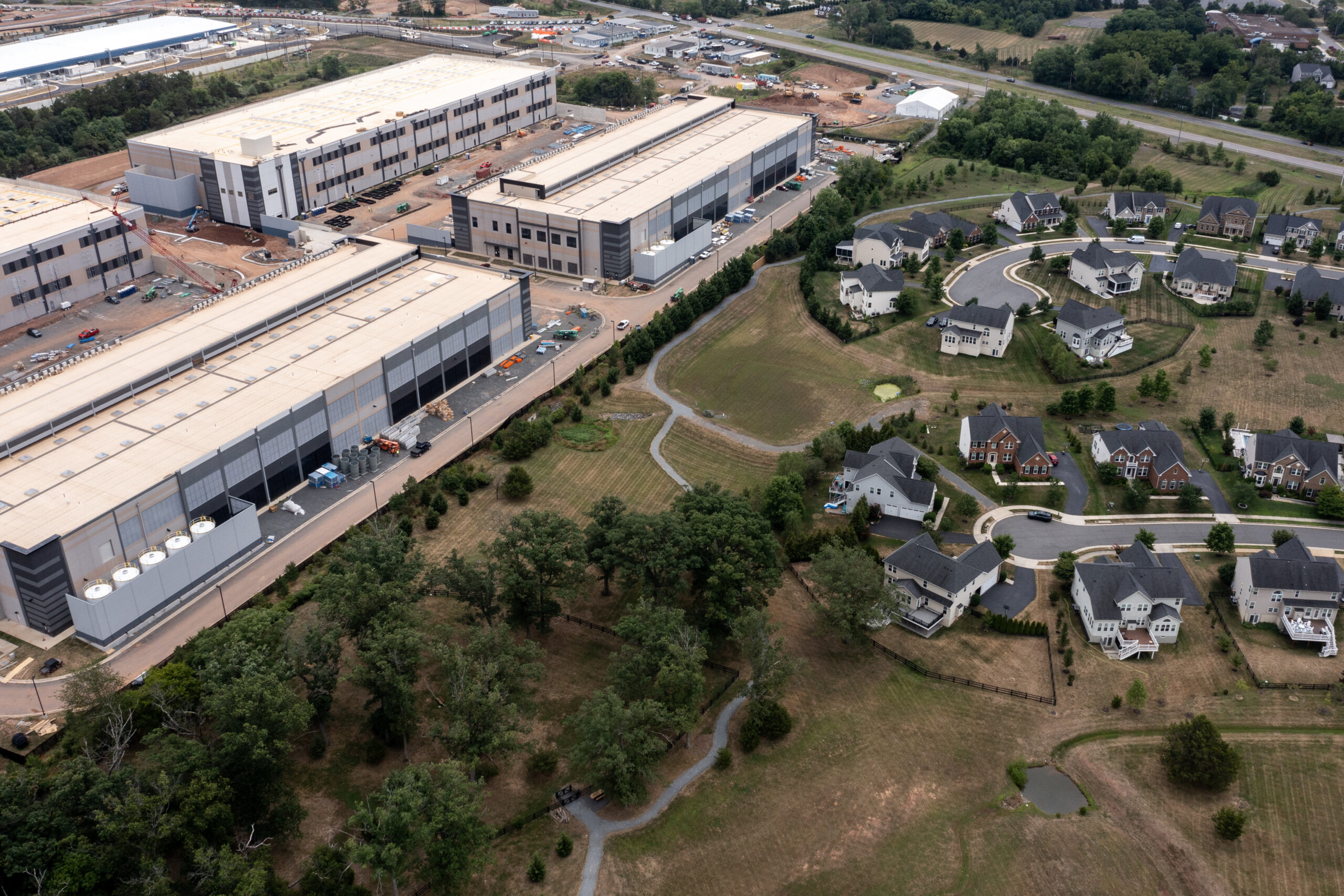
    In an aerial view, an Amazon Web Services data center is shown situated near single-family homes on July 17, 2024 in Stone Ridge, Virginia. (Photo by Nathan Howard/Getty Images)

    Closed loop systems will often use what is described as mechanical cooling or liquid cooling, where the water is recycled through the system, cooled, and placed directly on chips to bring the temperature down. The heat from those systems still has to be expelled through an HVAC system.

    The water is pretreated before being released into the creek and has limits for certain metals and temperature set by DEQ. But with recent reports showing the ubiquitous nature of per- and polyfluoroalkyl substances (PFAS) in everything from water to soil to household products, community members are increasingly worried about whether the data center’s discharge water contains them, too.

    Residents have also cited concerns over PFAS being present in the equipment inside of data centers that is used to cool the heated systems and routinely replaced every few years.

    These chemicals can have serious health impacts when people are exposed to even small amounts, such as decreased fertility, higher risk of some cancers, and weakening of the immune system.

    Virginia currently does not have requirements for the testing of the discharge water of data centers for PFAS, nor does the federal Environmental Protection Agency.

    Because the water being discharged from data centers either into wastewater systems or into the creek are not explicitly required to be tested for PFAS, it is unclear whether they are present or not.

    “We know that they may be using, not only PFAS, but other toxic chemicals. We know that they released massive amounts of water, at least to treatment works, and some of them to surface waters,” said Jonathan Kalmuss-Katz with EarthJustice, a nonprofit that litigates environmental issues. ”And beyond that, it’s just a void. There’s really a dangerous lack of information.”

    The Environmental and Energy Study Institute reports that PFAS can be present in the cooling systems that are liquid based – which is not what the Louisa Amazon data centers use. Data on how much of those chemicals are released from centers and cause pollution is minimal.

    Documents DEQ provided in response to community concerns about potential chemicals in the treated water for the Sedges Creek permit application provide some answers.

    “25% sodium hydroxide, 93% sulfuric acid, 40% sodium bisulfite, polyaluminum chloride, polymer, sulfide‐functional polymer, and 32% calcium chloride,” the agency wrote. “These chemicals are removed during the treatment process; however, Total Residual Chlorine (TRC), chlorides and pH are monitored to ensure they have been removed and that the treatment process is operating properly.”

    What Virginia allows

    Data centers that discharge their pretreated water into wastewater infrastructure have to comply with local treatment requirements and regulations. The amount of water they may unload varies by project and is determined by local leaders.

    Industry representatives emphasize that they follow local and state regulations, which do not include the PFAS testing in the water discharge.

    “Those that do produce wastewater handle it in a variety of ways in compliance with the law. Some may send their wastewater back to a municipal treatment plant, while others may treat it on site,” Nicole Riley with the Data Center Coalition said in an interview. “Some data centers are actually discharging cleaner water than they take in. In all cases, the industry takes seriously its responsibility to comply with applicable laws and regulations.”

    The permit for the Amazon data center in the Northeast Tech Campus in Louisa is allowed to discharge up to 460,000 gallons of water a day into Northeast Creek that feeds into Lake Anna.

    Under the pollutant discharge elimination system permit for that data center, operators must test monthly, and in some cases daily, for residual chlorine used in the treatment phase, as well as aluminum, cadmium, copper, zinc, hardness and pH. The water temperature must be maintained below 90 degrees Fahrenheit.

    In general, data collected over most data centers’ five-year permits must be evaluated by state regulators before the permit may be re-issued. Depending on the results, data center operators may have to make adjustments.

    “In the case of a data center, the source water, type of cooling system, and any additives used with the cooling system are key and need to be evaluated to determine the reasonable potential for a pollutant to be in the discharge,” a DEQ representative said.

    PFAS, which pose harm to human and environmental health, also find their way into drinking water and human bodies. (Photo by CasarsaGuru via Getty Images)

    The draft permit for the additional Amazon data center in the Lake Anna Tech campus that would discharge into Sedges Creek allows up to 280,000 gallons a day. It will abide by the same standards for metals, pH, and temperature regulation.

    Amazon anticipates not needing to use the cooling system all year round. DEQ states they plan to use it “mainly in April through October of each year,” which would presumably lead to less water use than the permitted gallons. The company claims it will be even less, with only 4% of the year needing the water cooling system rather than using air from outside the facility.

    The draft permit also allows for it to be altered to potentially include PFAS testing in the future, if that is something regulators desire.

    “The permit may be reopened to incorporate changes to any applicable standard or requirement, including those related to per- and polyfluoroalkyl substances” DEQ said. It’s a step that advocates want to see the state take.

    “They can test their wastewater before they discharge it to the publicly owned treatment works (POTW) and they should be doing that. POTWs need to know what the sources of PFAS that they’re dealing with are,” Kalmuss-Katz said.

    New PFAS regulations in the works

    The General Assembly this year advanced legislation towards testing for PFAS in wastewater and trying to locate the largest polluters of forever chemicals.

    Senate Bill 138 requires public wastewater treatment facilities, industrial companies that use PFAS, airports and firefighting facilities to test their discharge for PFAS. Data centers do not currently fall under this legislation’s self reporting requirements.

    Additionally, other bills were signed into law that require biosolids — sewage sludge from wastewater treatment facilities that is converted into fertilizer for farms — to be tested for the presence of PFAS. This pairs with past legislation to track down the largest sources of PFAS that are ending up in wastewater treatment facilities.

    The Trump Administration has been adamant about expanding AI infrastructure, which includes data centers, by signing executive orders to beef up the expansion of the industry and the necessary transmission lines and power generation needed to support it.

    Subsequently, the EPA announced the fast-track review of new chemicals that are intended to be used by the data center industry for their equipment and the manufacturing of their components.

    What comes next

    For the draft permit for the Amazon data center discharge into Sedges Creek, the next public hearing will be at Louisa County Middle School on June 9, 2026 at 7 to 9 p.m. From there, DEQ will make final decisions on if they will approve the permit for the facility.

    It remains to be seen whether state or local officials will begin requiring data center discharge water be tested for PFAS and what that process might entail.